1
Discussing the principle, the advantages and
disadvantages of Single Molecule Real Time by Pacific
Biosciences (SMRT PacBio).
BY: NAKAKAWA LILIAN and MUUNDA MUDENDA, MSc Molecular Biology and
Biotechnology
Email: muundamudenda@gmail.com
INTRODUCTION
Single Molecule Real Time (SMRT) is a technology developed by Pacific Biosciences and was
officially launched in the year 2011. SMRT is a third generation long-read sequencing (LRS)
technology that is based on sequencing-by-synthesis principle (Roberts et al., 2013). This
means that SMRT sequencing technology leverages the work of DNA polymerase to determine
the sequence of sample DNA while synthesis of complementary strands occurs. The synthesis
of complementary strands happens in SMRT Cells which have Nano-photonic visualization
chambers called the Zero-Mode Waveguides (ZMW) (Pavlovic, 2020). The Zero-Mode
Waveguides (ZMW) is able to detect light for a single fluorescently labeled nucleotide being
added by DNA polymerase. The light pulses are detected in real-time by cameras and recorded
for analysis by a computer system (Logsdon et al., 2020).
Typically, in a SMRT sequencing procedure, a circular DNA template called SMRTbell is used
(Ardui et al., 2018). This is composed of a set of synthesized hairpin loops called adapters with
universal primer binding sites. These adapters are ligated to either ends of the DNA sample to
form a piece of circular DNA during the DNA library preparation before the actual sequencing
process. This circular DNA is then feed to a polymerase enzyme that is immobilized at the
bottom of the SMRT cell in a Zero-Mode Waveguide Chamber. The sequence of the DNA
insert is determined by the addition of complementary fluorescent dNTPs whose reaction light
is detected and recorded. According to Pavlovic (2020), SMRT uses DNA polymerase 29
because; it is a stable, has high speed, has high efficacy and has a good life expectancy of over
70,000 bases.
2
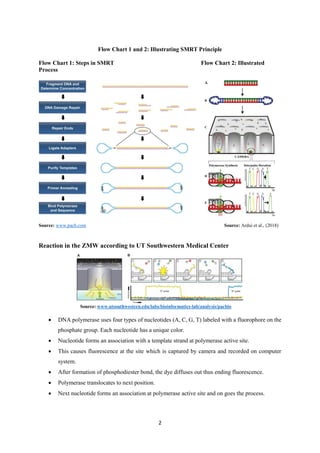
Flow Chart 1 and 2: Illustrating SMRT Principle
Flow Chart 1: Steps in SMRT Flow Chart 2: Illustrated
Process
Source: www.pacb.com Source: Ardui et al., (2018)
Reaction in the ZMW according to UT Southwestern Medical Center
Source: www.utsouthwestern.edu/labs/bioinformatics-lab/analysis/pacbio
 DNA polymerase uses four types of nucleotides (A, C, G, T) labeled with a fluorophore on the
phosphate group. Each nucleotide has a unique color.
 Nucleotide forms an association with a template strand at polymerase active site.
 This causes fluorescence at the site which is captured by camera and recorded on computer
system.
 After formation of phosphodiester bond, the dye diffuses out thus ending fluorescence.
 Polymerase translocates to next position.
 Next nucleotide forms an association at polymerase active site and on goes the process.
3
Applications of SMRT include the following;
 Whole genome sequencing: for humans, plants, animals and microbes.
 RNA Sequencing: Analysis of cDNA sequences across entire transcriptomes or targeted genes.
 Population studies: Understanding variants among bacterial, viral and cancer cells in complex
populations.
 Targeted sequencing: of relevant genome targets in regions of interest.
 Epigenetics: To detect DNA modifications in samples through epigenetic studies.
Advantages of SMRT
 Long Reads: SMRT is called a long-read sequencing technology because it can make
continuous long read (CLR) for DNA inserts ranging between 1Kb to 100Kb depending on the
PacBio platform being used and the data type (Logsdon et al., 2020).
 Uniform coverage in sequencing: GC rich and GC poor regions are sequenced without bias in
continuous long read. This is unlike in short-read sequencing technologies where GC rich
regions result in fragmentation (Roberts et al., 2013).
 High Accuracy: Due to repeated sequencing of same regions, the data produced is more than
99% accurate (Pacific Biosciences, 2021).
 Single Molecule Resolution: Sequencing of native DNA or RNA is nucleotide by nucleotide
hence enabling highly accurate long read with over 99.9% single molecule accuracy
(Biosciences, 2021).
 Detection of Epigenetic Modifications: DNA and RNA modifications can be detected by
observing change in timing when fluoresce occurs. The change in timing is due to change in
DNA polymerase of RNA transcriptase kinetics resulting from methylation (Roberts et al.,
2013).
 Real-Time acquisition of signal: In SMRT, there is no lag between detection of each nucleotide
addition due to the high sensitivity of the machine that can easily detect the color changes
(Pacific Biosciences, 2021).
 De Novo Genome Assembly: Unlike in short read sequencing technologies where there are a
lot of gaps during reconstruction of random fragments, SMRT produces superior genome
assemblies from DNA fragments due to its continuous long read ability. According to Logsdon
et al., (2020), De novo genome assembly is the process by which randomly sampled sequence
fragments are reconstructed to determine the order of every base in a genome.
4
Disadvantages of SMRT
 Size and Cost of machine: The machine is relatively large and still very expensive for average
laboratories hence it is not widely used as compared to other sequencing technologies that are
relatively cheaper (Pavlovic, 2020).
 Sequencing Error Rate: Concerns of high sequencing error rate on platforms of SMRT such as
RS II, Sequel and Sequel II put the error rate at 8%-15% which is high compared to other
sequencing technologies like Illumina which has an error rate of 0.01% across its platforms
(Logsdon et al., 2020).
 Low throughput: While SMRT has long reads, not all the reaction wells will carry out
sequencing reaction because some wells may not have the DNA template. This is unlike
technologies like Illumina that has short reads but has a high throughput (Pavlovic, 2020).
 Time: Because of the high error rates on SMRT platforms, the technology is mitigating this
error rate by increasing the number of passes on each SMRTbell template. While this increases
the accuracy, the time taken to complete the process is increased (Logsdon et al., 2020).
REFERENCES
Ardui, S., Ameur, A., Vermeesch, J. R., & Hestand, M. S. (2018). Single molecule real-time ( SMRT )
sequencing comes of age : applications and utilities for medical diagnostics. 46(5), 2159–2168.
https://doi.org/10.1093/nar/gky066
Biosciences, P. (2021). SEQUENCE WITH CONFIDENCE SMRT Sequencing — Delivering Highly
Accurate Long Reads to Drive Discovery in Life Science Our Core Technology.
https://www.pacb.com
Logsdon, G. A., Vollger, M. R., & Eichler, E. E. (2020). Long-read human genome sequencing and
its applications. Nature Reviews Genetics, 21(October). https://doi.org/10.1038/s41576-020-
0236-x
Pavlovic, S. B. Z. (2020). Next-Generation Sequencing: The Enabler and the Way Ahead.
Microbiomics.
Roberts, R. J., Carneiro, M. O., & Schatz, M. C. (2013). The advantages of SMRT sequencing. 2–5.

PacBio SMRT - THIRD GENERATION SEQUENCING TECHNIQUE

  • 1.
    1 Discussing the principle,the advantages and disadvantages of Single Molecule Real Time by Pacific Biosciences (SMRT PacBio). BY: NAKAKAWA LILIAN and MUUNDA MUDENDA, MSc Molecular Biology and Biotechnology Email: muundamudenda@gmail.com INTRODUCTION Single Molecule Real Time (SMRT) is a technology developed by Pacific Biosciences and was officially launched in the year 2011. SMRT is a third generation long-read sequencing (LRS) technology that is based on sequencing-by-synthesis principle (Roberts et al., 2013). This means that SMRT sequencing technology leverages the work of DNA polymerase to determine the sequence of sample DNA while synthesis of complementary strands occurs. The synthesis of complementary strands happens in SMRT Cells which have Nano-photonic visualization chambers called the Zero-Mode Waveguides (ZMW) (Pavlovic, 2020). The Zero-Mode Waveguides (ZMW) is able to detect light for a single fluorescently labeled nucleotide being added by DNA polymerase. The light pulses are detected in real-time by cameras and recorded for analysis by a computer system (Logsdon et al., 2020). Typically, in a SMRT sequencing procedure, a circular DNA template called SMRTbell is used (Ardui et al., 2018). This is composed of a set of synthesized hairpin loops called adapters with universal primer binding sites. These adapters are ligated to either ends of the DNA sample to form a piece of circular DNA during the DNA library preparation before the actual sequencing process. This circular DNA is then feed to a polymerase enzyme that is immobilized at the bottom of the SMRT cell in a Zero-Mode Waveguide Chamber. The sequence of the DNA insert is determined by the addition of complementary fluorescent dNTPs whose reaction light is detected and recorded. According to Pavlovic (2020), SMRT uses DNA polymerase 29 because; it is a stable, has high speed, has high efficacy and has a good life expectancy of over 70,000 bases.
  • 2.
    2 Flow Chart 1and 2: Illustrating SMRT Principle Flow Chart 1: Steps in SMRT Flow Chart 2: Illustrated Process Source: www.pacb.com Source: Ardui et al., (2018) Reaction in the ZMW according to UT Southwestern Medical Center Source: www.utsouthwestern.edu/labs/bioinformatics-lab/analysis/pacbio  DNA polymerase uses four types of nucleotides (A, C, G, T) labeled with a fluorophore on the phosphate group. Each nucleotide has a unique color.  Nucleotide forms an association with a template strand at polymerase active site.  This causes fluorescence at the site which is captured by camera and recorded on computer system.  After formation of phosphodiester bond, the dye diffuses out thus ending fluorescence.  Polymerase translocates to next position.  Next nucleotide forms an association at polymerase active site and on goes the process.
  • 3.
    3 Applications of SMRTinclude the following;  Whole genome sequencing: for humans, plants, animals and microbes.  RNA Sequencing: Analysis of cDNA sequences across entire transcriptomes or targeted genes.  Population studies: Understanding variants among bacterial, viral and cancer cells in complex populations.  Targeted sequencing: of relevant genome targets in regions of interest.  Epigenetics: To detect DNA modifications in samples through epigenetic studies. Advantages of SMRT  Long Reads: SMRT is called a long-read sequencing technology because it can make continuous long read (CLR) for DNA inserts ranging between 1Kb to 100Kb depending on the PacBio platform being used and the data type (Logsdon et al., 2020).  Uniform coverage in sequencing: GC rich and GC poor regions are sequenced without bias in continuous long read. This is unlike in short-read sequencing technologies where GC rich regions result in fragmentation (Roberts et al., 2013).  High Accuracy: Due to repeated sequencing of same regions, the data produced is more than 99% accurate (Pacific Biosciences, 2021).  Single Molecule Resolution: Sequencing of native DNA or RNA is nucleotide by nucleotide hence enabling highly accurate long read with over 99.9% single molecule accuracy (Biosciences, 2021).  Detection of Epigenetic Modifications: DNA and RNA modifications can be detected by observing change in timing when fluoresce occurs. The change in timing is due to change in DNA polymerase of RNA transcriptase kinetics resulting from methylation (Roberts et al., 2013).  Real-Time acquisition of signal: In SMRT, there is no lag between detection of each nucleotide addition due to the high sensitivity of the machine that can easily detect the color changes (Pacific Biosciences, 2021).  De Novo Genome Assembly: Unlike in short read sequencing technologies where there are a lot of gaps during reconstruction of random fragments, SMRT produces superior genome assemblies from DNA fragments due to its continuous long read ability. According to Logsdon et al., (2020), De novo genome assembly is the process by which randomly sampled sequence fragments are reconstructed to determine the order of every base in a genome.
  • 4.
    4 Disadvantages of SMRT Size and Cost of machine: The machine is relatively large and still very expensive for average laboratories hence it is not widely used as compared to other sequencing technologies that are relatively cheaper (Pavlovic, 2020).  Sequencing Error Rate: Concerns of high sequencing error rate on platforms of SMRT such as RS II, Sequel and Sequel II put the error rate at 8%-15% which is high compared to other sequencing technologies like Illumina which has an error rate of 0.01% across its platforms (Logsdon et al., 2020).  Low throughput: While SMRT has long reads, not all the reaction wells will carry out sequencing reaction because some wells may not have the DNA template. This is unlike technologies like Illumina that has short reads but has a high throughput (Pavlovic, 2020).  Time: Because of the high error rates on SMRT platforms, the technology is mitigating this error rate by increasing the number of passes on each SMRTbell template. While this increases the accuracy, the time taken to complete the process is increased (Logsdon et al., 2020). REFERENCES Ardui, S., Ameur, A., Vermeesch, J. R., & Hestand, M. S. (2018). Single molecule real-time ( SMRT ) sequencing comes of age : applications and utilities for medical diagnostics. 46(5), 2159–2168. https://doi.org/10.1093/nar/gky066 Biosciences, P. (2021). SEQUENCE WITH CONFIDENCE SMRT Sequencing — Delivering Highly Accurate Long Reads to Drive Discovery in Life Science Our Core Technology. https://www.pacb.com Logsdon, G. A., Vollger, M. R., & Eichler, E. E. (2020). Long-read human genome sequencing and its applications. Nature Reviews Genetics, 21(October). https://doi.org/10.1038/s41576-020- 0236-x Pavlovic, S. B. Z. (2020). Next-Generation Sequencing: The Enabler and the Way Ahead. Microbiomics. Roberts, R. J., Carneiro, M. O., & Schatz, M. C. (2013). The advantages of SMRT sequencing. 2–5.