



G-PROTEIN COUPLED
RECEPTOR
PRAVEENA PRASAD.R
1ST M.SC-BIOTECH
Outline:
Where you can find ?
How it looks ?
How it works ?
How it stops?
Introduction:
•Largest known receptor family –
Constitutes > 1% of the human genome.
•Comprises receptors for a diverse array of molecules:
neurotransmitters, odorants, lipids, neuropeptides, large
glycoprotein hormones.
•Odorant receptor family alone contains hundreds of genes.
•Behavioural and mood regulation: Receptors in the mammalian
brain bind several different neurotransmitters,
including serotonin, dopamine, GABA, and glutamate.
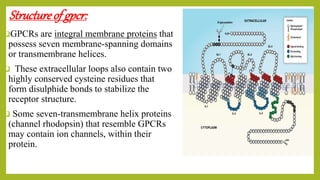
Structureof gpcr:
GPCRs are integral membrane proteins that
possess seven membrane-spanning domains
or transmembrane helices.
 These extracellular loops also contain two
highly conserved cysteine residues that
form disulphide bonds to stabilize the
receptor structure.
 Some seven-transmembrane helix proteins
(channel rhodopsin) that resemble GPCRs
may contain ion channels, within their
protein.
mechanism
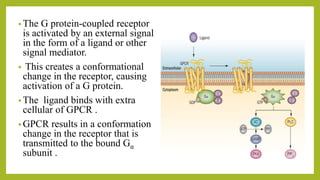
• The G protein-coupled receptor
is activated by an external signal
in the form of a ligand or other
signal mediator.
• This creates a conformational
change in the receptor, causing
activation of a G protein.
• The ligand binds with extra
cellular of GPCR .
• GPCR results in a conformation
change in the receptor that is
transmitted to the bound Gα
subunit .
• There are two principal signal transduction pathways involving the G
protein–coupled receptors:
•the cAMP signal pathway and
•the phosphatidylinositol signal pathway
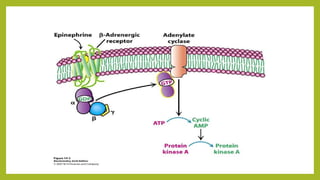
• The cAMP signal transduction contains:
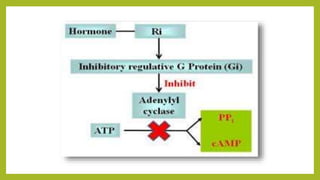
• Stimulative hormone receptor (Rs) is a receptor that can bind with
stimulative signal molecules, while inhibitory hormone receptor (Ri)
is a receptor that can bind with inhibitory signal molecules.
• Adenylyl cyclase is a 12-transmembrane glycoprotein that catalyzes
ATP to form cAMP with the help of cofactor Mg2+ or Mn2+.
• The cAMP produced is a second messenger in cellular metabolism
and is an allosteric activator of protein kinase A
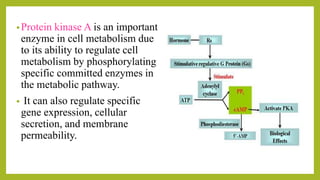
•Protein kinase A is an important
enzyme in cell metabolism due
to its ability to regulate cell
metabolism by phosphorylating
specific committed enzymes in
the metabolic pathway.
• It can also regulate specific
gene expression, cellular
secretion, and membrane
permeability.
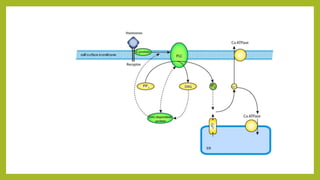
• In the phosphatidylinositol signal pathway, the extracellular signal
molecule binds with the G-protein receptor (Gq) on the cell surface
and activates phospholipase C, which is located on the plasma
membrane.
• IP3 binds to IP3 receptor in the membrane of the smooth ER and
mitochondria to open Ca2+ channels.
• DAG helps activate protein kinase C (PKC), which phosphorylates
many other proteins, changing their catalytic activities, leading to
cellular responses.
GPCR functions :
a) generation of second messengers including cGMP and IP3, which
stimulate phosphorylation reactions, causing release of second-
messenger calcium ions from storage in ER.
b) generation of cAMP and activation of the transcription factor,
cAMP response element binding protein (CREB) to stimulate gene
transcription.
c) regulation of gene transcription
d) chemotaxis
e) ion channel opening (conformational change) in response to
neurotransmitters
Regulationof gpcr:
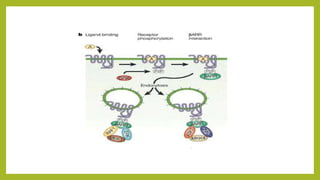
•Members of arrestin/beta-arrestin protein family are thought
to participate in agonist-mediated desensitization of G
protein-coupled receptors and cause specific dampening of
cellular responses to stimuli such as hormones,
neurotransmitters, or sensory signals.
•Arrestin beta 1 is a cytosolic protein and acts as a cofactor in
the beta-adrenergic receptor kinase (BARK) mediated
desensitization of beta-adrenergic receptors
•The Gs alpha subunit slowly catalyses the hydrolysis of GTP to
GDP, which in turn deactivates the Gs protein, shutting off the
cAMP pathway.
•The pathway may also be deactivated downstream by directly
inhibiting adenylyl cyclase or dephosphorylating the proteins
phosphorylated by PKA.
Molecules that inhibit the cAMP pathway include:
•cAMP phosphodiesterase dephosphorylates cAMP into AMP,
reducing the cAMP levels
G protein coupled receptor

G protein coupled receptor

  • 1.
  • 2.
    Outline: Where you canfind ? How it looks ? How it works ? How it stops?
  • 3.
    Introduction: •Largest known receptorfamily – Constitutes > 1% of the human genome. •Comprises receptors for a diverse array of molecules: neurotransmitters, odorants, lipids, neuropeptides, large glycoprotein hormones. •Odorant receptor family alone contains hundreds of genes. •Behavioural and mood regulation: Receptors in the mammalian brain bind several different neurotransmitters, including serotonin, dopamine, GABA, and glutamate.
  • 4.
    Structureof gpcr: GPCRs areintegral membrane proteins that possess seven membrane-spanning domains or transmembrane helices.  These extracellular loops also contain two highly conserved cysteine residues that form disulphide bonds to stabilize the receptor structure.  Some seven-transmembrane helix proteins (channel rhodopsin) that resemble GPCRs may contain ion channels, within their protein.
  • 5.
  • 6.
    • The Gprotein-coupled receptor is activated by an external signal in the form of a ligand or other signal mediator. • This creates a conformational change in the receptor, causing activation of a G protein. • The ligand binds with extra cellular of GPCR . • GPCR results in a conformation change in the receptor that is transmitted to the bound Gα subunit .
  • 8.
    • There aretwo principal signal transduction pathways involving the G protein–coupled receptors: •the cAMP signal pathway and •the phosphatidylinositol signal pathway
  • 9.
    • The cAMPsignal transduction contains: • Stimulative hormone receptor (Rs) is a receptor that can bind with stimulative signal molecules, while inhibitory hormone receptor (Ri) is a receptor that can bind with inhibitory signal molecules. • Adenylyl cyclase is a 12-transmembrane glycoprotein that catalyzes ATP to form cAMP with the help of cofactor Mg2+ or Mn2+. • The cAMP produced is a second messenger in cellular metabolism and is an allosteric activator of protein kinase A
  • 10.
    •Protein kinase Ais an important enzyme in cell metabolism due to its ability to regulate cell metabolism by phosphorylating specific committed enzymes in the metabolic pathway. • It can also regulate specific gene expression, cellular secretion, and membrane permeability.
  • 11.
    • In thephosphatidylinositol signal pathway, the extracellular signal molecule binds with the G-protein receptor (Gq) on the cell surface and activates phospholipase C, which is located on the plasma membrane. • IP3 binds to IP3 receptor in the membrane of the smooth ER and mitochondria to open Ca2+ channels. • DAG helps activate protein kinase C (PKC), which phosphorylates many other proteins, changing their catalytic activities, leading to cellular responses.
  • 13.
    GPCR functions : a)generation of second messengers including cGMP and IP3, which stimulate phosphorylation reactions, causing release of second- messenger calcium ions from storage in ER. b) generation of cAMP and activation of the transcription factor, cAMP response element binding protein (CREB) to stimulate gene transcription. c) regulation of gene transcription d) chemotaxis e) ion channel opening (conformational change) in response to neurotransmitters
  • 14.
    Regulationof gpcr: •Members ofarrestin/beta-arrestin protein family are thought to participate in agonist-mediated desensitization of G protein-coupled receptors and cause specific dampening of cellular responses to stimuli such as hormones, neurotransmitters, or sensory signals. •Arrestin beta 1 is a cytosolic protein and acts as a cofactor in the beta-adrenergic receptor kinase (BARK) mediated desensitization of beta-adrenergic receptors
  • 16.
    •The Gs alphasubunit slowly catalyses the hydrolysis of GTP to GDP, which in turn deactivates the Gs protein, shutting off the cAMP pathway. •The pathway may also be deactivated downstream by directly inhibiting adenylyl cyclase or dephosphorylating the proteins phosphorylated by PKA. Molecules that inhibit the cAMP pathway include: •cAMP phosphodiesterase dephosphorylates cAMP into AMP, reducing the cAMP levels