

HETEROTRIMERIC
G-PROTEINS
          GULPREET KAUR
                   Jan 24, 2012
   Molecular Biology Signalling
                   Spring 2012
CONTENTS


                          Structure
           The Story of               Mechanism    G-proteins
Overview   G-proteins
                             and
                                       of Action   and disease
                          Function
OVERVIEW
                          Structure
           The Story of               Mechanism    G-proteins
                             and
           G-proteins                  of Action   and disease
                          function
What are Heterotrimeric G-Proteins?

    • G-Proteins: Guanine nucleotide binding
      proteins
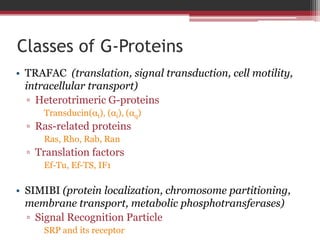
Classes of G-Proteins
• TRAFAC (translation, signal transduction, cell motility,
  intracellular transport)
   ▫ Heterotrimeric G-proteins
     Transducin(αt), (αi), (αq)
  ▫ Ras-related proteins
     Ras, Rho, Rab, Ran
  ▫ Translation factors
     Ef-Tu, Ef-TS, IF1

• SIMIBI (protein localization, chromosome partitioning,
  membrane transport, metabolic phosphotransferases)
  ▫ Signal Recognition Particle
     SRP and its receptor
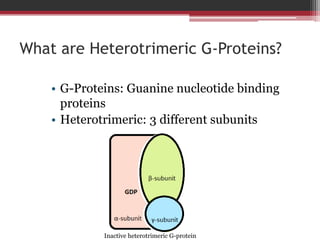
What are Heterotrimeric G-Proteins?

    • G-Proteins: Guanine nucleotide binding
      proteins
    • Heterotrimeric: 3 different subunits


             Inactive heterotrimeric G-protein
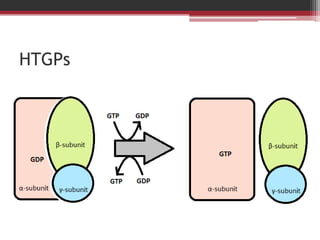
HTGPs
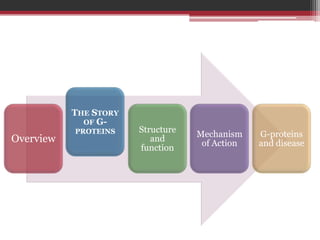
THE STORY
             OF G-
           PROTEINS    Structure
                                   Mechanism    G-proteins
Overview                  and
                                    of Action   and disease
                       function
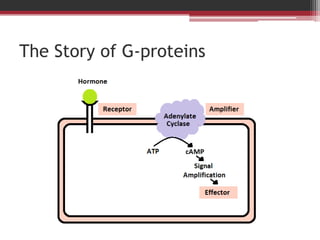
The Story of G-proteins
Nobel Prize in Physiology or Medicine, 1994


         ALFRED G. GILMAN                MARTIN RODBELL

  "for their discovery of G-proteins and the role of these proteins in
                     signal transduction in cells"
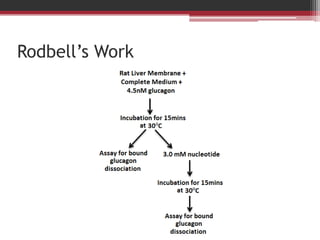
Rodbell’s Work
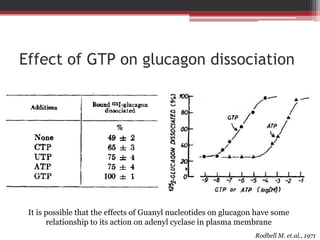
Effect of GTP on glucagon dissociation


 It is possible that the effects of Guanyl nucleotides on glucagon have some
       relationship to its action on adenyl cyclase in plasma membrane
                                                                  Rodbell M. et.al., 1971
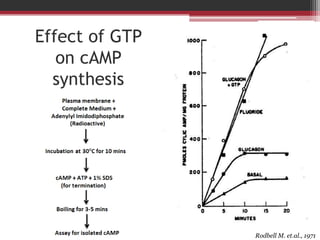
Effect of GTP
   on cAMP
  synthesis


                Rodbell M. et.al., 1971
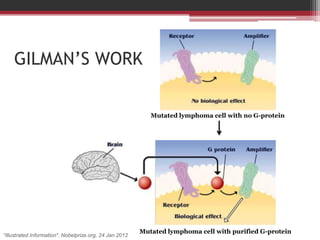
GILMAN’S WORK

                                                            Mutated lymphoma cell with no G-protein


                                                         Mutated lymphoma cell with purified G-protein
“Illustrated Information". Nobelprize.org. 24 Jan 2012
STRUCTURE
                            AND
           The Story of   FUNCTION    Mechanism    G-proteins
Overview
            G-proteins                 of Action   and disease
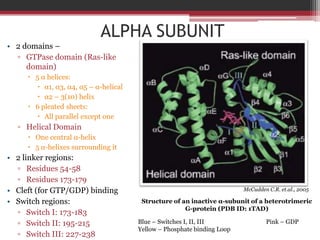
ALPHA SUBUNIT
• 2 domains –
  ▫ GTPase domain (Ras-like
     domain)
      5 α helices:
         α1, α3, α4, α5 – α-helical
         α2 – 3(10) helix
      6 pleated sheets:
         All parallel except one
  ▫ Helical Domain
      One central α-helix
      5 α-helixes surrounding it
• 2 linker regions:
  ▫ Residues 54-58
  ▫ Residues 173-179
• Cleft (for GTP/GDP) binding                                            McCudden C.R. et.al., 2005

• Switch regions:                       Structure of an inactive α-subunit of a heterotrimeric
                                                      G-protein (PDB ID: 1TAD)
  ▫ Switch I: 173-183
  ▫ Switch II: 195-215                 Blue – Switches I, II, III                Pink – GDP
                                       Yellow – Phosphate binding Loop
  ▫ Switch III: 227-238
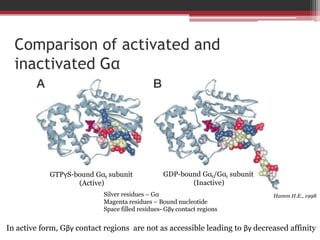
Comparison of activated and
  inactivated Gα


            GTPγS-bound Gαt subunit               GDP-bound Gαt/Gαi subunit
                   (Active)                              (Inactive)
                            Silver residues – Gα                              Hamm H.E., 1998
                            Magenta residues – Bound nucleotide
                            Space filled residues- Gβγ contact regions


In active form, Gβγ contact regions are not as accessible leading to βγ decreased affinity
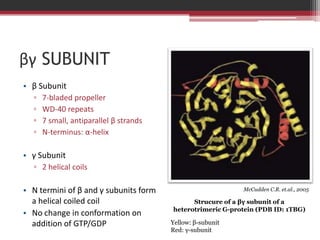
βγ SUBUNIT
• β Subunit
  ▫   7-bladed propeller
  ▫   WD-40 repeats
  ▫   7 small, antiparallel β strands
  ▫   N-terminus: α-helix

• γ Subunit
  ▫ 2 helical coils

• N termini of β and γ subunits form                        McCudden C.R. et.al., 2005

  a helical coiled coil                       Strucure of a βγ subunit of a
                                        heterotrimeric G-protein (PDB ID: 1TBG)
• No change in conformation on
  addition of GTP/GDP                   Yellow: β-subunit
                                        Red: γ-subunit
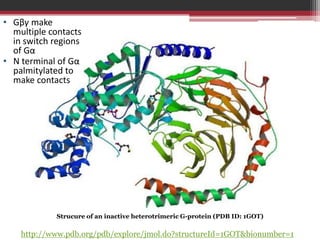
• Gβγ make
  multiple contacts
  in switch regions
  of Gα
• N terminal of Gα
  palmitylated to
  make contacts


            Strucure of an inactive heterotrimeric G-protein (PDB ID: 1GOT)

    http://www.pdb.org/pdb/explore/jmol.do?structureId=1GOT&bionumber=1
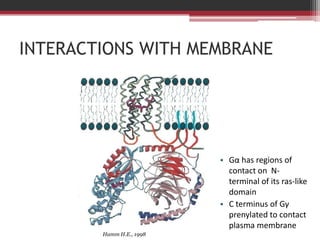
INTERACTIONS WITH MEMBRANE


                          • Gα has regions of
                            contact on N-
                            terminal of its ras-like
                            domain
                          • C terminus of Gγ
                            prenylated to contact
                            plasma membrane
        Hamm H.E., 1998
HTGP DIVERSITY

• G α - 16 genes
• G β – 5 genes
• G γ – 12 genes
HTGP DIVERSITY
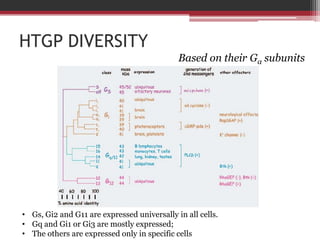
                                             Based on their Gα subunits


• Gs, Gi2 and G11 are expressed universally in all cells.
• Gq and Gi1 or Gi3 are mostly expressed;
• The others are expressed only in specific cells
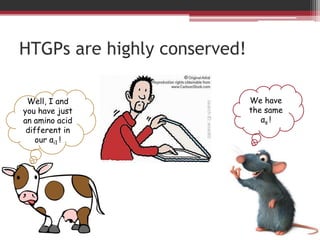
HTGPs are highly conserved!

 Well, I and                  We have
you have just                 the same
an amino acid                    αs !
 different in
    our αi1 !
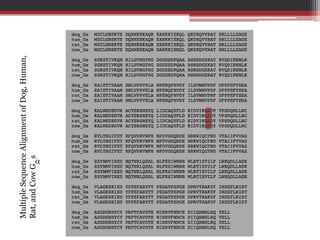
Multiple Sequence Alignment of Dog, Human,
Rat, and Cow G s
FUNCTIONS OF βγ
  • Stabilizes Gα
  • Open K+ channels
  • Activate Phospholipase A2
MECHANISM
                                         OF ACTION
           The Story of    Structure                 G-proteins
Overview
           G-proteins     and function               and disease
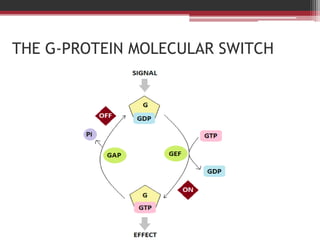
THE G-PROTEIN MOLECULAR SWITCH
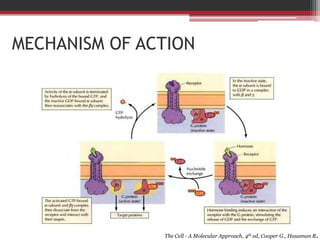
MECHANISM OF ACTION


               The Cell - A Molecular Approach, 4th ed, Cooper G., Hausman R.
KINETICS
• Initial rate of GDP dissociation
  ▫ G-Protein Activation

• Rate of GTP hydrolysis
  ▫ G-Protein Inactivation
ACTIVATION
• Depends on Gα subunit
• Receptor interacts 20A⁰ away from
  GDP binding site
• Signal travels through Gα as
  conformational changes
• Gβγ may provide exit route –
  required
AGS – Receptor independent
activation of G Protein Signalling
            AGS 3
       Binds to Gα and
           prevents
      reassociation with
             Gβγ


Activation of G-
                                  AGS 1
proteins that are             Promotes GTPγS
not near                          binding
membrane
  e.g.: Golgi
  membrane
INACTIVATION
•   Intrinsic GTPase activity of Gα subunit
•   Conserved Arg residue
•   Depends on Gα subunit
•   GAPs-
    ▫ Effectors of Gα
       PLCβ, Pγ of phosphodiesterase
       Feedback inhibition
    ▫ RGS proteins
RGS
• RGS box- 125 aa domain
• GAPs
• Bind to Switch regions on Gα
 ▫ Stabilizes Gα transition state to GTP hydrolysis

• Pγ may enhance RGS9
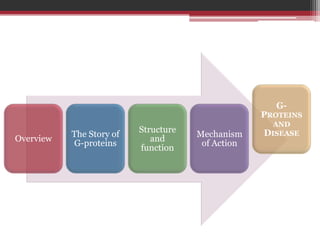
G-
                                                   PROTEINS
                                                     AND
                          Structure                DISEASE
           The Story of               Mechanism
Overview                     and
           G-proteins                  of Action
                          function
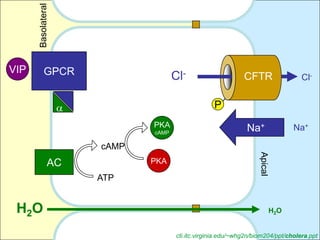
G-PROTEIN IN CHOLERA
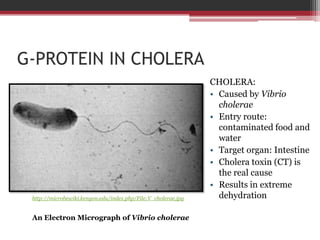
                                                               CHOLERA:
                                                               • Caused by Vibrio
                                                                 cholerae
                                                               • Entry route:
                                                                 contaminated food and
                                                                 water
                                                               • Target organ: Intestine
                                                               • Cholera toxin (CT) is
                                                                 the real cause
                                                               • Results in extreme
 http://microbewiki.kenyon.edu/index.php/File:V_cholerae.jpg     dehydration

 An Electron Micrograph of Vibrio cholerae
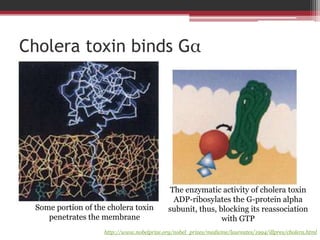
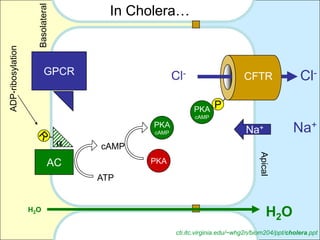
Cholera toxin binds Gα


                                             The enzymatic activity of cholera toxin
                                              ADP-ribosylates the G-protein alpha
 Some portion of the cholera toxin          subunit, thus, blocking its reassociation
    penetrates the membrane                                 with GTP
                    http://www.nobelprize.org/nobel_prizes/medicine/laureates/1994/illpres/cholera.html
Basolateral


VIP        GPCR                   Cl-                     CFTR                  Cl-


                                               P
                           PKA                             Na+                 Na+
                           cAMP

                    cAMP


                                                                Apical
               AC          PKA

                    ATP


 H 2O                                                                    H2O


                                  cti.itc.virginia.edu/~whg2n/biom204/ppt/cholera.ppt
In Cholera…

                     Basolateral
ADP-ribosylation


                          GPCR                    Cl-                     CFTR                Cl-

                                                        PKA    P
                                                        cAMP
                                           PKA
                                           cAMP                            Na+              Na+
                                   cAMP


                                                                                Apical
                              AC          PKA

                                   ATP


                   H2O
                                                                                    H 2O
                                                  cti.itc.virginia.edu/~whg2n/biom204/ppt/cholera.ppt
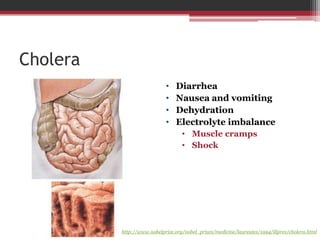
Cholera
                            •    Diarrhea
                            •    Nausea and vomiting
                            •    Dehydration
                            •    Electrolyte imbalance
                                   • Muscle cramps
                                   • Shock


          http://www.nobelprize.org/nobel_prizes/medicine/laureates/1994/illpres/cholera.html
QUESTIONS?
BIBLIOGRAPHY
• Rodbell M. et.al. 1971. The Journal of Biological Chemistry. 268(6): 1872-1876
• Rodbell M. et.al. 1971. The Journal of Biological Chemistry. 268(6): 1877-1882
• Liepe D.D. et.al. 2002. J. Mol. Biol. 317: 41-72
• McCudden C.R. et.al. 2005. Cell. Mol. Life Sci. 62:551–577
• Hamm H.E. 2003. Endocrine Reviews. 24(6):765–781
• Hamm H.E. 1998. The Journal of Biological Chemistry.273(2): 669–672
• “Physiology or Medicine 1994 - Press Release”. Nobelprize.org. 24 Jan 2012
• Cooper G., Hausman R. 2007. The Cell - A Molecular Approach, 4th ed. Sinauer
  Associates
• Gomperts B.D., Kramer I.M., Tatham P.E.R. 2009. Signal Transduction. 2nd ed.
  Elsevier Academic Press
• http://www.mayoclinic.com/health/cholera/DS00579/DSECTION=symptoms
THANK YOU!

Heterotrimeric G-proteins

  • 1.
    HETEROTRIMERIC G-PROTEINS GULPREET KAUR Jan 24, 2012 Molecular Biology Signalling Spring 2012
  • 2.
    CONTENTS Structure The Story of Mechanism G-proteins Overview G-proteins and of Action and disease Function
  • 3.
    OVERVIEW Structure The Story of Mechanism G-proteins and G-proteins of Action and disease function
  • 4.
    What are HeterotrimericG-Proteins? • G-Proteins: Guanine nucleotide binding proteins
  • 5.
    Classes of G-Proteins •TRAFAC (translation, signal transduction, cell motility, intracellular transport) ▫ Heterotrimeric G-proteins Transducin(αt), (αi), (αq) ▫ Ras-related proteins Ras, Rho, Rab, Ran ▫ Translation factors Ef-Tu, Ef-TS, IF1 • SIMIBI (protein localization, chromosome partitioning, membrane transport, metabolic phosphotransferases) ▫ Signal Recognition Particle SRP and its receptor
  • 6.
    What are HeterotrimericG-Proteins? • G-Proteins: Guanine nucleotide binding proteins • Heterotrimeric: 3 different subunits Inactive heterotrimeric G-protein
  • 7.
  • 8.
    THE STORY OF G- PROTEINS Structure Mechanism G-proteins Overview and of Action and disease function
  • 9.
    The Story ofG-proteins
  • 10.
    Nobel Prize inPhysiology or Medicine, 1994 ALFRED G. GILMAN MARTIN RODBELL "for their discovery of G-proteins and the role of these proteins in signal transduction in cells"
  • 11.
  • 12.
    Effect of GTPon glucagon dissociation It is possible that the effects of Guanyl nucleotides on glucagon have some relationship to its action on adenyl cyclase in plasma membrane Rodbell M. et.al., 1971
  • 13.
    Effect of GTP on cAMP synthesis Rodbell M. et.al., 1971
  • 14.
    GILMAN’S WORK Mutated lymphoma cell with no G-protein Mutated lymphoma cell with purified G-protein “Illustrated Information". Nobelprize.org. 24 Jan 2012
  • 15.
    STRUCTURE AND The Story of FUNCTION Mechanism G-proteins Overview G-proteins of Action and disease
  • 16.
    ALPHA SUBUNIT • 2domains – ▫ GTPase domain (Ras-like domain)  5 α helices:  α1, α3, α4, α5 – α-helical  α2 – 3(10) helix  6 pleated sheets:  All parallel except one ▫ Helical Domain  One central α-helix  5 α-helixes surrounding it • 2 linker regions: ▫ Residues 54-58 ▫ Residues 173-179 • Cleft (for GTP/GDP) binding McCudden C.R. et.al., 2005 • Switch regions: Structure of an inactive α-subunit of a heterotrimeric G-protein (PDB ID: 1TAD) ▫ Switch I: 173-183 ▫ Switch II: 195-215 Blue – Switches I, II, III Pink – GDP Yellow – Phosphate binding Loop ▫ Switch III: 227-238
  • 17.
    Comparison of activatedand inactivated Gα GTPγS-bound Gαt subunit GDP-bound Gαt/Gαi subunit (Active) (Inactive) Silver residues – Gα Hamm H.E., 1998 Magenta residues – Bound nucleotide Space filled residues- Gβγ contact regions In active form, Gβγ contact regions are not as accessible leading to βγ decreased affinity
  • 18.
    βγ SUBUNIT • βSubunit ▫ 7-bladed propeller ▫ WD-40 repeats ▫ 7 small, antiparallel β strands ▫ N-terminus: α-helix • γ Subunit ▫ 2 helical coils • N termini of β and γ subunits form McCudden C.R. et.al., 2005 a helical coiled coil Strucure of a βγ subunit of a heterotrimeric G-protein (PDB ID: 1TBG) • No change in conformation on addition of GTP/GDP Yellow: β-subunit Red: γ-subunit
  • 19.
    • Gβγ make multiple contacts in switch regions of Gα • N terminal of Gα palmitylated to make contacts Strucure of an inactive heterotrimeric G-protein (PDB ID: 1GOT) http://www.pdb.org/pdb/explore/jmol.do?structureId=1GOT&bionumber=1
  • 20.
    INTERACTIONS WITH MEMBRANE • Gα has regions of contact on N- terminal of its ras-like domain • C terminus of Gγ prenylated to contact plasma membrane Hamm H.E., 1998
  • 21.
    HTGP DIVERSITY • Gα - 16 genes • G β – 5 genes • G γ – 12 genes
  • 22.
    HTGP DIVERSITY Based on their Gα subunits • Gs, Gi2 and G11 are expressed universally in all cells. • Gq and Gi1 or Gi3 are mostly expressed; • The others are expressed only in specific cells
  • 23.
    HTGPs are highlyconserved! Well, I and We have you have just the same an amino acid αs ! different in our αi1 !
  • 24.
    Multiple Sequence Alignmentof Dog, Human, Rat, and Cow G s
  • 25.
    FUNCTIONS OF βγ • Stabilizes Gα • Open K+ channels • Activate Phospholipase A2
  • 26.
    MECHANISM OF ACTION The Story of Structure G-proteins Overview G-proteins and function and disease
  • 27.
  • 28.
    MECHANISM OF ACTION The Cell - A Molecular Approach, 4th ed, Cooper G., Hausman R.
  • 29.
    KINETICS • Initial rateof GDP dissociation ▫ G-Protein Activation • Rate of GTP hydrolysis ▫ G-Protein Inactivation
  • 30.
    ACTIVATION • Depends onGα subunit • Receptor interacts 20A⁰ away from GDP binding site • Signal travels through Gα as conformational changes • Gβγ may provide exit route – required
  • 31.
    AGS – Receptorindependent activation of G Protein Signalling AGS 3 Binds to Gα and prevents reassociation with Gβγ Activation of G- AGS 1 proteins that are Promotes GTPγS not near binding membrane e.g.: Golgi membrane
  • 32.
    INACTIVATION • Intrinsic GTPase activity of Gα subunit • Conserved Arg residue • Depends on Gα subunit • GAPs- ▫ Effectors of Gα  PLCβ, Pγ of phosphodiesterase  Feedback inhibition ▫ RGS proteins
  • 33.
    RGS • RGS box-125 aa domain • GAPs • Bind to Switch regions on Gα ▫ Stabilizes Gα transition state to GTP hydrolysis • Pγ may enhance RGS9
  • 34.
    G- PROTEINS AND Structure DISEASE The Story of Mechanism Overview and G-proteins of Action function
  • 35.
    G-PROTEIN IN CHOLERA CHOLERA: • Caused by Vibrio cholerae • Entry route: contaminated food and water • Target organ: Intestine • Cholera toxin (CT) is the real cause • Results in extreme http://microbewiki.kenyon.edu/index.php/File:V_cholerae.jpg dehydration An Electron Micrograph of Vibrio cholerae
  • 36.
    Cholera toxin bindsGα The enzymatic activity of cholera toxin ADP-ribosylates the G-protein alpha Some portion of the cholera toxin subunit, thus, blocking its reassociation penetrates the membrane with GTP http://www.nobelprize.org/nobel_prizes/medicine/laureates/1994/illpres/cholera.html
  • 37.
    Basolateral VIP GPCR Cl- CFTR Cl- P PKA Na+ Na+ cAMP cAMP Apical AC PKA ATP H 2O H2O cti.itc.virginia.edu/~whg2n/biom204/ppt/cholera.ppt
  • 38.
    In Cholera… Basolateral ADP-ribosylation GPCR Cl- CFTR Cl- PKA P cAMP PKA cAMP Na+ Na+ cAMP Apical AC PKA ATP H2O H 2O cti.itc.virginia.edu/~whg2n/biom204/ppt/cholera.ppt
  • 39.
    Cholera • Diarrhea • Nausea and vomiting • Dehydration • Electrolyte imbalance • Muscle cramps • Shock http://www.nobelprize.org/nobel_prizes/medicine/laureates/1994/illpres/cholera.html
  • 40.
  • 41.
    BIBLIOGRAPHY • Rodbell M.et.al. 1971. The Journal of Biological Chemistry. 268(6): 1872-1876 • Rodbell M. et.al. 1971. The Journal of Biological Chemistry. 268(6): 1877-1882 • Liepe D.D. et.al. 2002. J. Mol. Biol. 317: 41-72 • McCudden C.R. et.al. 2005. Cell. Mol. Life Sci. 62:551–577 • Hamm H.E. 2003. Endocrine Reviews. 24(6):765–781 • Hamm H.E. 1998. The Journal of Biological Chemistry.273(2): 669–672 • “Physiology or Medicine 1994 - Press Release”. Nobelprize.org. 24 Jan 2012 • Cooper G., Hausman R. 2007. The Cell - A Molecular Approach, 4th ed. Sinauer Associates • Gomperts B.D., Kramer I.M., Tatham P.E.R. 2009. Signal Transduction. 2nd ed. Elsevier Academic Press • http://www.mayoclinic.com/health/cholera/DS00579/DSECTION=symptoms
  • 42.

Editor's Notes

  • #5 First, let’s understand what are Heterotrimeric G-protein? Let’s break it up - what is a G-protein? A protein that binds to guanine nucleotides is a G-protein. What are guanine nucleotides? GTP, GMP, GDP are guanine nucleotides. Any protein that likes to bind to these is called a G-protein.
  • #6 However, G-proteins are a huge class of proteins, that include molecules with varied functions. Some relevant families are shown here. There are 2 main classes – TRAFAC and SIMIBI. TRAFAC are the G-proteins involved in translation, signal transduction, cell motility, intracellular transport. These include- And then we have SIMIBI Class which includes the G-proteins involved in protein localization, chromosome partitioning, membrane transport, metabolic phosphotransferases. There are over 60 families of G-proteins and with this slide, I wanted to emphasize that we are studying a very small portion of an entire class of G-proteins, so please do not ever say just ‘G-protein’ for a heterotrimeric G-protein. There is a lot of difference.
  • #7 Now, let’s get back to heterotrimeric G-proteins. We already know that they are G-proteins. And let’s also understand that they are heterotrimeric, which implies that they are 3 different subunits, as we can see here.
  • #10 For years, scientists had known that hormones and neurotransmitters bind to receptors on the cell surface and this leads to the amplification of a signal, leading to the desired effect. However, the link between the receptor and amplifier was unknown.
  • #11 Rodbell found that there is a transducer molecule that transfers the signal from the receptor to the amplifier. And Gilman found the first G-protein and named it transducin.For this achievement, they received the nobel prize in 1994.
  • #12 Rodbell has done a lot of work on the hormone glucagon, its effector, adenylyl cyclase on rat liver plasma membranes. I’m going to present a small portion of his work. This is a flowchart showing how he checked the effect of GTP on the dissociation of glucagon from plasma membranes.In vivo conditions, Glucagon binds to a receptor which is present in the plasma membrane. It produces it’s effects and is then, expected to dissociate. However, in an invitro system, the glucagon would not dissociate from the plasma membrane. So, Rodbell worked on this aspect. He incubated rat liver membranes in a complete medium for 10 mins with glucagon. So glucagon would bind to the receptors.Then, he checked for any dissociation.In another set, he also added different nucleotides and incubated the mixture again. Again, he checked for glucagon dissociation.
  • #13 And this is what he found… presence of GTP increased the rate of dissociation of glucagon (As depicted in the table and the graph). Well, the graph also showed that there was increase in dissociation due to addition of ATP, but that was probably just because ATP is required for various cellular processes in low concentrations. Also, the effect of other nucleotides could be due to contamination with GTP.With this study, Rodbell suggested that these effects of GTP on flucagon could be related to its action on adenylcyclase in plasma membrane.
  • #14 This is another experiment that shows proves his earlier concept. In this case, plasma membranes are fed with a radioactive mix of AMP-PNP, which is a non-hydrolysable analog of ATP. So, we check the rate of formation of cAMP from this analog in the presence of GTP, and as you can see, it is pretty high compared to the basal rates. This was some significant research in terms of the discovery of G-proteins.
  • #15 Gilman followed up on Rodbell’s work from a different perspective. He found the G-protein and characterized it, determined it’s properties and worked on its mechanism. Here’s how he found the protein.In a lymphoma cell line, he found a cell line which did not show any adenylatecyclase activity. Though, this mutant had adenylatecyclase, there was no activity. He hypothesized that this must be due to the absence of the transducer funtion, the G-protein. So, he tried a large number of proteins and finally found a protein which compensated for this activity. This was the G-protein. His further research is spent on characterizing various aspects of this protein.
  • #19 All Gb subunits contain seven WD-40 repeats, a tryptophan-aspartic acid sequence that repeats about every 40 amino acids and forms small antiparallel b strands
  • #23 This slide shows a classification of G-proteins on the basis of the G-alpha subunits. As you can see, there are 4 classes of HTGPs. Here, you can see their effector functions. These are important because the classification if based on these funcitons. So, Gs stimulates adenylcyclase. Remember the ‘S’. Simlarly, Gi inhibits ad. Cyclase. Whereas Gq/11 stimulate PLC-beta. And the last category, 12 and 13 modulate the activity of proteins in signal transduction pathways. 12 and 13 have opposing effects on rhoGEF. I’d also like to divert your attention to this part, that states the amino acid identity. As you can see, even the most unrelated HTGP has a sequence similarity of atleast 40%.
  • #24 Well, that means that HTGPs are highly conserved. And here’s a fun fact. Cows and Humans have the same alpha-s subunit. And rats have only an amino acid difference in alpha i1! So that’s kinda cool
  • #26 Ok besides those effector functions of alpha, beta gamma also has some important functions, such as these.
  • #28 Now, we are going to di
  • #33 Arg-174 in Gαt
  • #34 Pγ may enhance RGS9- suggests that RGS may be regulated through pathways of signal transduction