Fused-ring heterocyclic chemistry
Heterocyclic ring systems common in
drug structures
Rings contain in addition to carbon, other atoms like
nitrogen, oxygen, sulfur
Benzo-fused heterocycles:
Indole
Indole is an important heterocyclic
system because it is built into proteins in
the form of the amino acid tryptophan. It
is the basis of important drugs such as
indomethacin, and because it provides
the skeleton of the indole alkaloids—
biologically active compounds from
plants including strychnine and LSD
Indole : Such bicyclic heterocyclic structures which has a benzene ring and a pyrrole ring
sharing one double bond.
Medicinal compounds contain indole
Serotonin is a monoamine neurotransmitter (derived
from Trp) synthesized in serotonergic neurons in the
central nervous system (CNS) and enterochromaffin
cells in the gastrointestinal (GIT)tract of animals
including humans. Serotonin is also found in many
mushrooms and plants, including fruits and
vegetables.
Serotonin antagonists
Antiemetic: treatment of vomiting
Medicinal compounds contain indole
LSD stands for LySergic acid Diethylamide. It is the hallucinogenic drug ‘acid’. When people walk
off a building claiming that they can fly, they are probably on LSD. It contains an indole ring
made up of a benzene ring and a pyrrole ring fused together.
Isoindole is more basic than indole
According to lewis definition
Acid  e
Base  e
The lone pair of sp3 N in indole are
delocalized into the aromatic ring,
thus less available to give.
While in isoindole it is not delocalized
into the aromatic ring, thus available
to give.
Indole is more stable than isoindole.
Six-membered
ring corresponds
to benzene
Six-membered
ring does not have
same pattern of
bonds as benzene
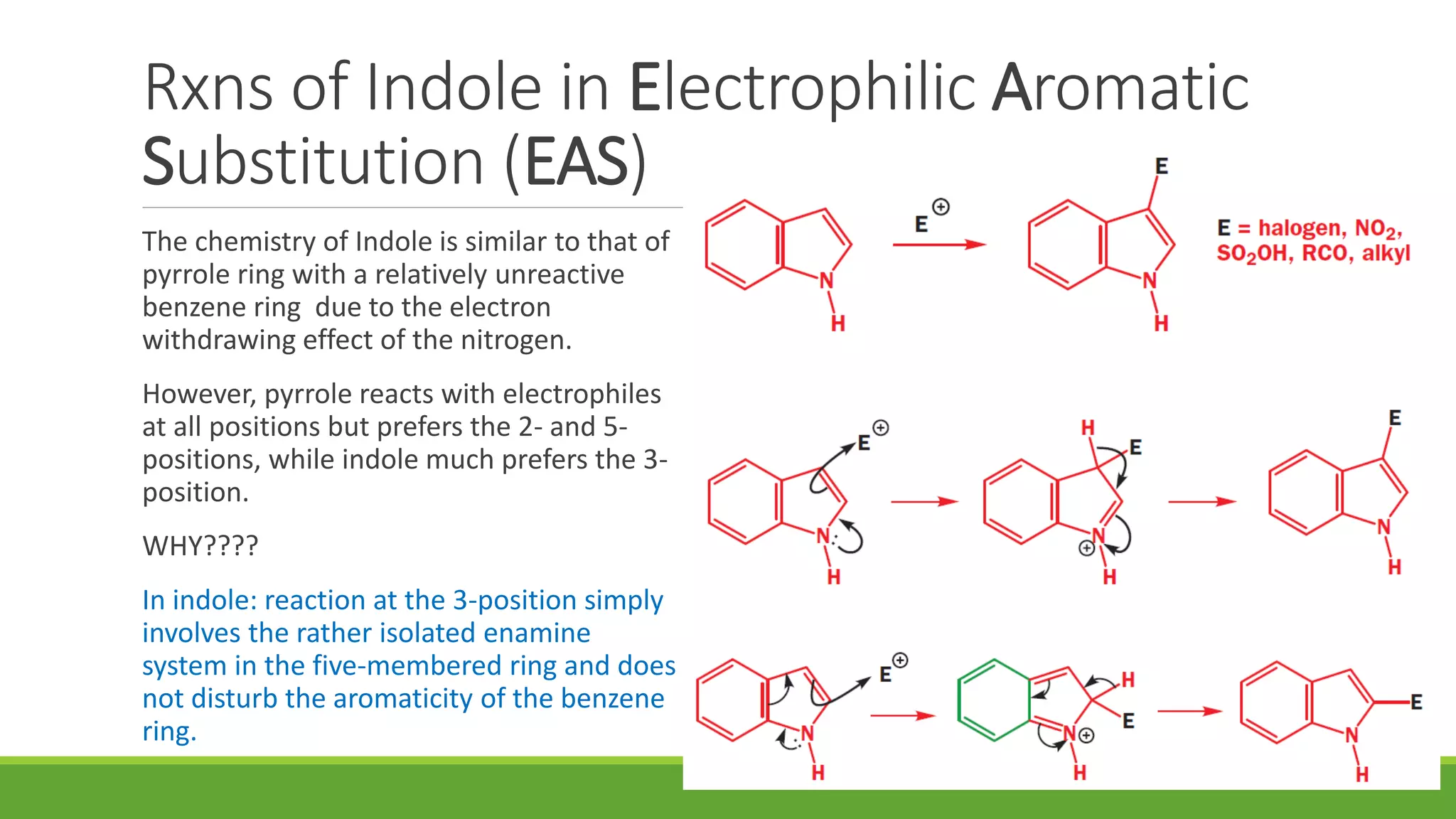
Rxns of Indole in Electrophilic Aromatic
Substitution (EAS)
The chemistry of Indole is similar to that of
pyrrole ring with a relatively unreactive
benzene ring due to the electron
withdrawing effect of the nitrogen.
However, pyrrole reacts with electrophiles
at all positions but prefers the 2- and 5-
positions, while indole much prefers the 3-
position.
WHY????
In indole: reaction at the 3-position simply
involves the rather isolated enamine
system in the five-membered ring and does
not disturb the aromaticity of the benzene
ring.
Nitration
Sulphonation
Halogenation
Fischer indole synthesis
The Fischer indole synthesis, which was first discovered in 1883, is still considered as the most popular,
general and efficient approach.
The aryl hydrazones are easily obtained by condensation of a ketone with an aryl hydrazine
The acid-catalyzed cyclization of aryl hydrazones generate indole with loss of ammonia.
The method can be used to generate substituted endols at 2-position (R2 in figure below) which is difficult
to obtain by EAS
R1
R1
R2
R1
R2
R1
R2
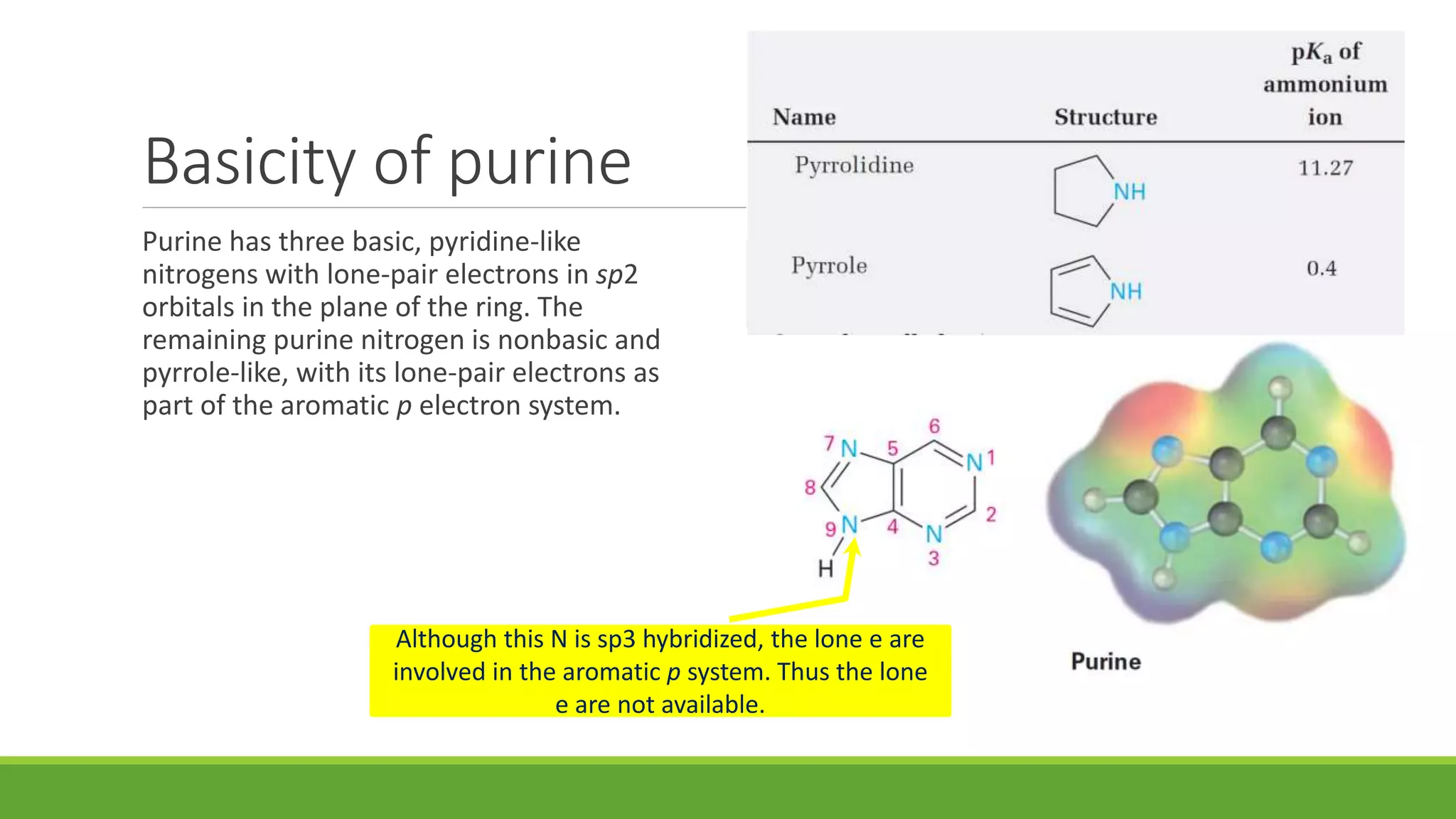
Basicity of purine
Purine has three basic, pyridine-like
nitrogens with lone-pair electrons in sp2
orbitals in the plane of the ring. The
remaining purine nitrogen is nonbasic and
pyrrole-like, with its lone-pair electrons as
part of the aromatic p electron system.
Although this N is sp3 hybridized, the lone e are
involved in the aromatic p system. Thus the lone
e are not available.
Basicity of sp3 N in Indole and purine
The indole sp3 N is more
basic than that of purine.
Since purine has three
aromatic sp2 N withdrawing
the electrons, the sp3 N has
less electron to give (less
basic)
13
Purine Two purine bases of nucleic acids:
(pyrimidinoimidazole)
N
N
N
N
H
NH2
adenine
6-aminopurine
N
N
N
N
H
OH
H2N
guanine
2-amino-6-hydroxypurine
xanthine
2,6-dihydroxypurine
hypoxanthine
6-hydroxypurine
N
N
N
N
H
OH
N
N
N
N
H
HO
OH
uric acid (2,6,8-trihydroxypurine)
N
N
N
N
H
–OH
HO
OH
N
N
N
N
H
O– NH4
+
HO
OH
ammonium hydrogen urate lactim form lactam form of uric acid
N
N
N
N
H
–OH
HO
OH
N
N
N
N
H
N
N
N
N
H
–OH
HOHO
OHOH
N
N
N
N
H
1
2
3
4
6
7
8
9
5
atypical numbering!
Lactam is cyclic amide
(NH-C=O) which
undergo tautomerism
to lactim (N=C-OH)
DNA base pairing
15
OH
allopurinol
N
N
N
N
H
mercaptopurine
N
N
N
N
H
SH
caffeine
1,3,7-trimethyxanthine
theophylline
1,3-dimethylxanthine
theobromine
1,7-dimethylxanthine
Methylxanthines are N-methyl derivatives of xanthines, known
alkaloids in coffee, tea, and cocoa.
Allopurinol is an isomer of hypoxanthine, which is used in treatment of hyperuricacidaemia and
gout. It inhibits xanthine oxidase – the enzyme that transforms hypoxanthine and xanthine to
urate.
Mercaptopurine (6-sulfanylpurine) inhibits the biosynthesis of purine bases and is used in
chemotherapy of cancer.
Purine synthesis
4,5-diaminopyrimidine 8-methyl-9H-purine
3-methyl-5-aminoimidazole-4-carbonitrile
Traube synthesis:
Reacting 4,5-diaminopyrimidine
with formic acid to give purine, or
acetic anhydride to give methyl
substituted purine at imidazole ring.
Or
Reacting substituted imidazole with
formamide to give substituted
purine at pyrimidine ring
Quinoline and Isoquinoline
A benzene ring can be fused on to the pyridine ring in two
ways giving the important heterocycles quinoline, with the
nitrogen atom next to the benzene ring, and isoquinoline,
with the nitrogen atom in the other possible position
Quinoline forms part of quinine (anti-
malarial alkaloid) and isoquinoline forms
the central skeleton of the papaverine
(antispasmodic opium alkaloid).
Numbering
The presence of nitrogen in this
structure produces an irregular
distribution of the electron density in
both heterocyclic and carbocyclic
rings, a situation that alters the
physicochemical properties and
reactivity.
Napthalene Quinoline
Basicity of quinolone and isoquinoline
Both N are sp2
The lone-pair electrons of N
are close to benzene ring and
thus get involved with the p
electrons of benzene
(play with neighbor kids)
The lone-pair electrons of N
are far from benzene ring and
thus get not involved with the
p electrons of benzene
(no neighbor kids to play with)
Basicity depends on the ability of N to give electrons for
Reactivtiy of quinolines
The chemistry quinolines = pyridine
Quinoline and isoquinoline both have
1. Have basic, pyridine-like nitrogen atoms, which undergo electrophilic substitutions.
2. Are less reactive toward electrophilic substitution than benzene because of the
electronegative nitrogen atom that withdraws electrons from the ring.
3. Electrophilic substitution occurs on the benzene ring rather than on the nitrogen-containing
pyridine ring, and a mixture of substitution products is obtained.
In quinolone and isoquinoline the N withdraw electrons in
pyridine ring thus few are available for EAS, therefore Br
prefers to go to benzene
Note: EAS reactivity for the fused benzene ring in both of
quinolone and isoquinoline is much lower than that for non-
fused benzene (Because of the deactivating effect of N)
While pyrrole ring of indole is most reactive
to EAS
This N is sp3 hybridized, thus
electrons are swimming away
from their mother (nucleus) ,
thus wolf can attack
This N is sp2 hybridized, thus
electrons are swimming close
to their mother (nucleus),
thus wolf can not attack
This is a hateful
electron greedy wolf
Here we pull e by
protonation, to destroy any
hope for NO2 to come to
pyridine ring
Rxns of quinolone
Electrophilic substitution
Quinoline chemistry is a mixture of that of benzene and pyridine. Electrophilic substitution
favours the benzene ring and nucleophilic substitution favours the pyridine ring.
So nitration of quinoline gives two products—the 5- nitroquinolines and the 8-nitroquinolines—
in about equal quantities (though you will realize that the reaction really occurs on protonated
quinolone).
Rxns of quinolone
Electrophilic substitution
Acridine, with two benzene rings, which gives four nitration products, all on the benzene rings.
IF you want electrophils to come to pyridine ring, then give the ring some electrons, e.g. by
formation of N-oxide.
The acridine-N-oxide gives just one product in good yield—nitration takes place at the only
remaining position on the pyridine ring.
Here we fuel N with e
to enable EAS at
pyridine
Rxns of isoquinoline
Electrophilic substitution
The nitration of isoquinoline is rather better behaved, giving 72% of one isomer (5-
nitroisoquinoline) at 0 °C.
Synthesis of quinolines
Anilines Plus 1,3-Dielectrophiles:
Condensation of a 1,3-dielectrophile, in the simplest case a 1, 3-dicarbonyl derivative, with an
aniline furnishes a β-aminoenone, which can evolve to an aromatic derivative by treatment with
concentrated acid.
Cβ
Cα
o-Acylanilines Plus Carbonyl Compounds
o-Acylanilines condense with enolizable
carbonyl (keto group with adjacent H) to
give quinolines.
The outcome of the condensation was
found to be dependent on the type of
catalyst (acid or base)
Synthesis of quinolines
This Zigzag bond
indicate unknown
isomer
Here we have
tautomerizatoin also
Synthesis of quinoline
Skraup reaction
conjugate addition of the amine. Under acid catalysis the ketone now cyclizes to give a
dihydroquinoline after dehydration. Oxidation to the aromatic quinoline is an easy step
accomplished by many possible oxidants.
Unsaturated
keton
Aniline
Synthesis of quinoline
Simple example of Skraup reaction
Traditionally, the Skraup reaction was carried out by mixing everything together and letting it rip.
A typical mixture to make a quinoline without substituents on the pyridine ring would be the
aromatic amine, concentrated sulfuric acid, glycerol, and nitrobenzene all heated up in a large
flask at over 100 °C with a wide condenser.
The glycerol was to provide acrolein (CH2=CH·CHO) by dehydration, which provide the necessary 3C to close the ring
The nitrobenzene was to act as oxidant
Synthesis of isoquinoline
Alkylation of phenylethylamine by acyl halide, then electrophile is made from an amide and
POCl3 to close the ring and generate dihydroisoquinoline, which is then reduced to isoquinoline

Fused ring heterocyclic chemistry 3ed

  • 1.
  • 2.
    Heterocyclic ring systemscommon in drug structures Rings contain in addition to carbon, other atoms like nitrogen, oxygen, sulfur
  • 3.
    Benzo-fused heterocycles: Indole Indole isan important heterocyclic system because it is built into proteins in the form of the amino acid tryptophan. It is the basis of important drugs such as indomethacin, and because it provides the skeleton of the indole alkaloids— biologically active compounds from plants including strychnine and LSD Indole : Such bicyclic heterocyclic structures which has a benzene ring and a pyrrole ring sharing one double bond.
  • 4.
    Medicinal compounds containindole Serotonin is a monoamine neurotransmitter (derived from Trp) synthesized in serotonergic neurons in the central nervous system (CNS) and enterochromaffin cells in the gastrointestinal (GIT)tract of animals including humans. Serotonin is also found in many mushrooms and plants, including fruits and vegetables. Serotonin antagonists Antiemetic: treatment of vomiting
  • 5.
    Medicinal compounds containindole LSD stands for LySergic acid Diethylamide. It is the hallucinogenic drug ‘acid’. When people walk off a building claiming that they can fly, they are probably on LSD. It contains an indole ring made up of a benzene ring and a pyrrole ring fused together.
  • 6.
    Isoindole is morebasic than indole According to lewis definition Acid  e Base  e The lone pair of sp3 N in indole are delocalized into the aromatic ring, thus less available to give. While in isoindole it is not delocalized into the aromatic ring, thus available to give. Indole is more stable than isoindole. Six-membered ring corresponds to benzene Six-membered ring does not have same pattern of bonds as benzene
  • 7.
    Rxns of Indolein Electrophilic Aromatic Substitution (EAS) The chemistry of Indole is similar to that of pyrrole ring with a relatively unreactive benzene ring due to the electron withdrawing effect of the nitrogen. However, pyrrole reacts with electrophiles at all positions but prefers the 2- and 5- positions, while indole much prefers the 3- position. WHY???? In indole: reaction at the 3-position simply involves the rather isolated enamine system in the five-membered ring and does not disturb the aromaticity of the benzene ring.
  • 8.
  • 9.
  • 10.
    Fischer indole synthesis TheFischer indole synthesis, which was first discovered in 1883, is still considered as the most popular, general and efficient approach. The aryl hydrazones are easily obtained by condensation of a ketone with an aryl hydrazine The acid-catalyzed cyclization of aryl hydrazones generate indole with loss of ammonia. The method can be used to generate substituted endols at 2-position (R2 in figure below) which is difficult to obtain by EAS R1 R1 R2 R1 R2 R1 R2
  • 11.
    Basicity of purine Purinehas three basic, pyridine-like nitrogens with lone-pair electrons in sp2 orbitals in the plane of the ring. The remaining purine nitrogen is nonbasic and pyrrole-like, with its lone-pair electrons as part of the aromatic p electron system. Although this N is sp3 hybridized, the lone e are involved in the aromatic p system. Thus the lone e are not available.
  • 12.
    Basicity of sp3N in Indole and purine The indole sp3 N is more basic than that of purine. Since purine has three aromatic sp2 N withdrawing the electrons, the sp3 N has less electron to give (less basic)
  • 13.
    13 Purine Two purinebases of nucleic acids: (pyrimidinoimidazole) N N N N H NH2 adenine 6-aminopurine N N N N H OH H2N guanine 2-amino-6-hydroxypurine xanthine 2,6-dihydroxypurine hypoxanthine 6-hydroxypurine N N N N H OH N N N N H HO OH uric acid (2,6,8-trihydroxypurine) N N N N H –OH HO OH N N N N H O– NH4 + HO OH ammonium hydrogen urate lactim form lactam form of uric acid N N N N H –OH HO OH N N N N H N N N N H –OH HOHO OHOH N N N N H 1 2 3 4 6 7 8 9 5 atypical numbering! Lactam is cyclic amide (NH-C=O) which undergo tautomerism to lactim (N=C-OH)
  • 14.
  • 15.
    15 OH allopurinol N N N N H mercaptopurine N N N N H SH caffeine 1,3,7-trimethyxanthine theophylline 1,3-dimethylxanthine theobromine 1,7-dimethylxanthine Methylxanthines are N-methylderivatives of xanthines, known alkaloids in coffee, tea, and cocoa. Allopurinol is an isomer of hypoxanthine, which is used in treatment of hyperuricacidaemia and gout. It inhibits xanthine oxidase – the enzyme that transforms hypoxanthine and xanthine to urate. Mercaptopurine (6-sulfanylpurine) inhibits the biosynthesis of purine bases and is used in chemotherapy of cancer.
  • 17.
    Purine synthesis 4,5-diaminopyrimidine 8-methyl-9H-purine 3-methyl-5-aminoimidazole-4-carbonitrile Traubesynthesis: Reacting 4,5-diaminopyrimidine with formic acid to give purine, or acetic anhydride to give methyl substituted purine at imidazole ring. Or Reacting substituted imidazole with formamide to give substituted purine at pyrimidine ring
  • 18.
    Quinoline and Isoquinoline Abenzene ring can be fused on to the pyridine ring in two ways giving the important heterocycles quinoline, with the nitrogen atom next to the benzene ring, and isoquinoline, with the nitrogen atom in the other possible position Quinoline forms part of quinine (anti- malarial alkaloid) and isoquinoline forms the central skeleton of the papaverine (antispasmodic opium alkaloid).
  • 19.
  • 20.
    The presence ofnitrogen in this structure produces an irregular distribution of the electron density in both heterocyclic and carbocyclic rings, a situation that alters the physicochemical properties and reactivity. Napthalene Quinoline
  • 21.
    Basicity of quinoloneand isoquinoline Both N are sp2 The lone-pair electrons of N are close to benzene ring and thus get involved with the p electrons of benzene (play with neighbor kids) The lone-pair electrons of N are far from benzene ring and thus get not involved with the p electrons of benzene (no neighbor kids to play with) Basicity depends on the ability of N to give electrons for
  • 22.
    Reactivtiy of quinolines Thechemistry quinolines = pyridine Quinoline and isoquinoline both have 1. Have basic, pyridine-like nitrogen atoms, which undergo electrophilic substitutions. 2. Are less reactive toward electrophilic substitution than benzene because of the electronegative nitrogen atom that withdraws electrons from the ring. 3. Electrophilic substitution occurs on the benzene ring rather than on the nitrogen-containing pyridine ring, and a mixture of substitution products is obtained.
  • 23.
    In quinolone andisoquinoline the N withdraw electrons in pyridine ring thus few are available for EAS, therefore Br prefers to go to benzene Note: EAS reactivity for the fused benzene ring in both of quinolone and isoquinoline is much lower than that for non- fused benzene (Because of the deactivating effect of N) While pyrrole ring of indole is most reactive to EAS This N is sp3 hybridized, thus electrons are swimming away from their mother (nucleus) , thus wolf can attack This N is sp2 hybridized, thus electrons are swimming close to their mother (nucleus), thus wolf can not attack This is a hateful electron greedy wolf
  • 24.
    Here we pulle by protonation, to destroy any hope for NO2 to come to pyridine ring Rxns of quinolone Electrophilic substitution Quinoline chemistry is a mixture of that of benzene and pyridine. Electrophilic substitution favours the benzene ring and nucleophilic substitution favours the pyridine ring. So nitration of quinoline gives two products—the 5- nitroquinolines and the 8-nitroquinolines— in about equal quantities (though you will realize that the reaction really occurs on protonated quinolone).
  • 25.
    Rxns of quinolone Electrophilicsubstitution Acridine, with two benzene rings, which gives four nitration products, all on the benzene rings. IF you want electrophils to come to pyridine ring, then give the ring some electrons, e.g. by formation of N-oxide. The acridine-N-oxide gives just one product in good yield—nitration takes place at the only remaining position on the pyridine ring. Here we fuel N with e to enable EAS at pyridine
  • 26.
    Rxns of isoquinoline Electrophilicsubstitution The nitration of isoquinoline is rather better behaved, giving 72% of one isomer (5- nitroisoquinoline) at 0 °C.
  • 27.
    Synthesis of quinolines AnilinesPlus 1,3-Dielectrophiles: Condensation of a 1,3-dielectrophile, in the simplest case a 1, 3-dicarbonyl derivative, with an aniline furnishes a β-aminoenone, which can evolve to an aromatic derivative by treatment with concentrated acid. Cβ Cα
  • 28.
    o-Acylanilines Plus CarbonylCompounds o-Acylanilines condense with enolizable carbonyl (keto group with adjacent H) to give quinolines. The outcome of the condensation was found to be dependent on the type of catalyst (acid or base) Synthesis of quinolines This Zigzag bond indicate unknown isomer Here we have tautomerizatoin also
  • 29.
    Synthesis of quinoline Skraupreaction conjugate addition of the amine. Under acid catalysis the ketone now cyclizes to give a dihydroquinoline after dehydration. Oxidation to the aromatic quinoline is an easy step accomplished by many possible oxidants. Unsaturated keton Aniline
  • 30.
    Synthesis of quinoline Simpleexample of Skraup reaction Traditionally, the Skraup reaction was carried out by mixing everything together and letting it rip. A typical mixture to make a quinoline without substituents on the pyridine ring would be the aromatic amine, concentrated sulfuric acid, glycerol, and nitrobenzene all heated up in a large flask at over 100 °C with a wide condenser. The glycerol was to provide acrolein (CH2=CH·CHO) by dehydration, which provide the necessary 3C to close the ring The nitrobenzene was to act as oxidant
  • 31.
    Synthesis of isoquinoline Alkylationof phenylethylamine by acyl halide, then electrophile is made from an amide and POCl3 to close the ring and generate dihydroisoquinoline, which is then reduced to isoquinoline

Editor's Notes

  • #30 DDQ= dichloro dicyano quinone