HETEROCYCLIC
COMPOUND
in
By ,
K.Murugaboopathy
Roll No:146504
II M.Sc (SPL)
DIAZINE
GROUP
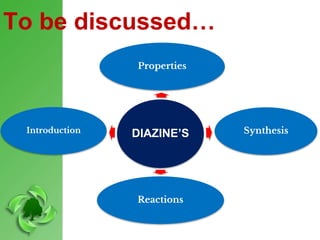
To be discussed…
DIAZINE’S
Properties
Synthesis
Reactions
Introduction
INTRODUCTION
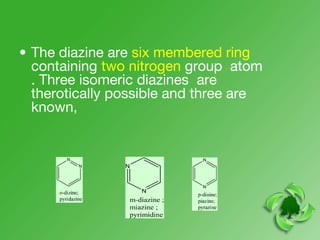
• The diazine are six membered ring
containing two nitrogen group atom
. Three isomeric diazines are
therotically possible and three are
known,
PROPERTIES
OF DIAZINE
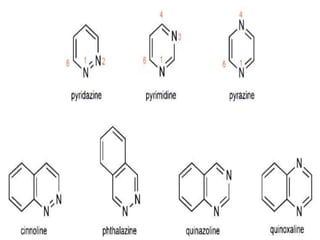
• The three diazines, pyridazine, pyrimidine, and pyrazine are
stable, colourless compounds that are soluble in water. The
three parent heterocycles, unlike pyridine, are expensive and
not readily available and so are seldom used as starting
materials for the synthesis of their derivatives.
• One striking aspect of the physical properties of the diazine trio
is the high boiling point of pyridazine (207 ° C), 80 – 90 ° C
higher than that of pyrimidine (123 ° C), pyrazine (118 ° C), or
indeed other azines, including 1,3,5 - triazine, all of which also
boil in the range 114 – 124 ° C. The high boiling point of
pyridazine is attributed to the polarisability of the N – N unit,
which results in extensive dipolar association in the liquid.
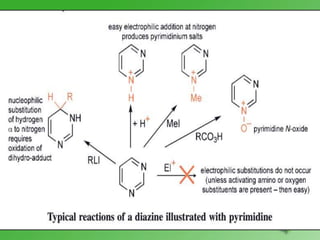
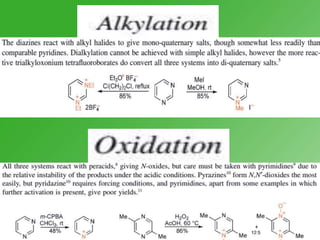
• Pyridazine,Boiling point 208o C, is a weak base
and forms the pyridazinium mono-cation with
acids. Pyridazine undergoes electrophilic
substitution with great difficulty , but conversion
into the 1-oxide offers a mean of preparing
various pydazine substitution products.
Nucleophilic Substitution with
Displacement of Good Leaving Groups
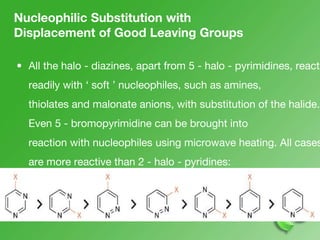
• All the halo - diazines, apart from 5 - halo - pyrimidines, react
readily with ‘ soft ’ nucleophiles, such as amines,
thiolates and malonate anions, with substitution of the halide.
Even 5 - bromopyrimidine can be brought into
reaction with nucleophiles using microwave heating. All cases
are more reactive than 2 - halo - pyridines:
the relative reactivities can be summarised:
PYRIDAZINES
1. From a 1,4 - Dicarbonyl Compound
and a Hydrazine
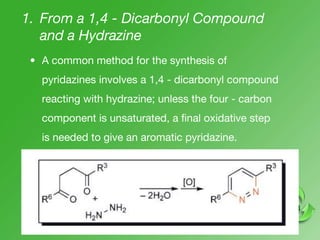
• A common method for the synthesis of
pyridazines involves a 1,4 - dicarbonyl compound
reacting with hydrazine; unless the four - carbon
component is unsaturated, a final oxidative step
is needed to give an aromatic pyridazine.
2. By Cycloaddition of a 1,2,4,5 -
Tetrazine with an Alkyne
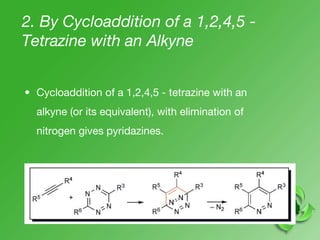
• Cycloaddition of a 1,2,4,5 - tetrazine with an
alkyne (or its equivalent), with elimination of
nitrogen gives pyridazines.
PYRIMIDINES
1. From a 1,3 - Dicarbonyl
Compound and an N – C – N
Fragment
• The most general pyrimidine ring synthesis
involves the combination of a 1,3 - dicarbonyl
component with an N – C – N fragment such as a
urea, an amidine or a guanidine.
2. From 3 - Ethoxyacryloyl
Isocyanate and Primary Amines
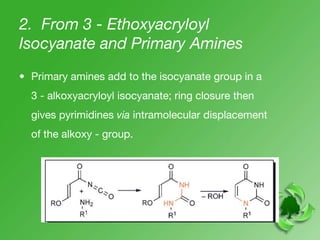
• Primary amines add to the isocyanate group in a
3 - alkoxyacryloyl isocyanate; ring closure then
gives pyrimidines via intramolecular displacement
of the alkoxy - group.
3. From Ketones
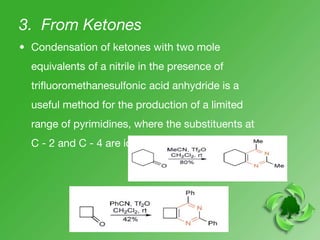
• Condensation of ketones with two mole
equivalents of a nitrile in the presence of
trifluoromethanesulfonic acid anhydride is a
useful method for the production of a limited
range of pyrimidines, where the substituents at
C - 2 and C - 4 are identical.
PYRAZINES
1. From the Self - Condensation of a
2 - Amino - Ketone
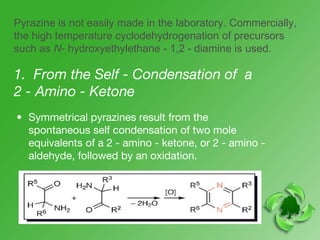
• Symmetrical pyrazines result from the
spontaneous self condensation of two mole
equivalents of a 2 - amino - ketone, or 2 - amino -
aldehyde, followed by an oxidation.
Pyrazine is not easily made in the laboratory. Commercially,
the high temperature cyclodehydrogenation of precursors
such as N- hydroxyethylethane - 1,2 - diamine is used.
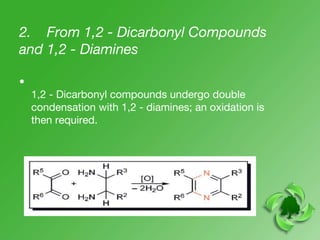
2. From 1,2 - Dicarbonyl Compounds
and 1,2 - Diamines
•
1,2 - Dicarbonyl compounds undergo double
condensation with 1,2 - diamines; an oxidation is
then required.
3. From 1,2 - Diketone Mono - Oximes
• Alkyl - pyrazines can be produced by an ingenious sequence
involving an electrocyclic ring closure of a 1 - hydroxy - 1,4 -
diazatriene, aromatisation being completed by loss of the
oxygen from the original oxime hydroxyl group.
NOTABLE SYNTHESES
OF
DIAZINES AND USES
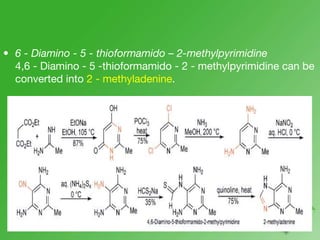
• 6 - Diamino - 5 - thioformamido – 2-methylpyrimidine
4,6 - Diamino - 5 -thioformamido - 2 - methylpyrimidine can be
converted into 2 - methyladenine.
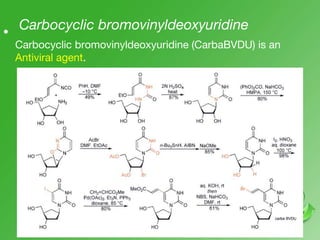
Carbocyclic bromovinyldeoxyuridine•
Carbocyclic bromovinyldeoxyuridine (CarbaBVDU) is an
Antiviral agent.
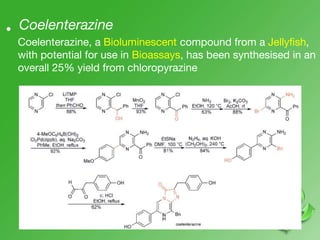
Coelenterazine•
Coelenterazine, a Bioluminescent compound from a Jellyfish,
with potential for use in Bioassays, has been synthesised in an
overall 25% yield from chloropyrazine
REACTIONS
OF DIAZINES
Reactions with Oxidising Agents
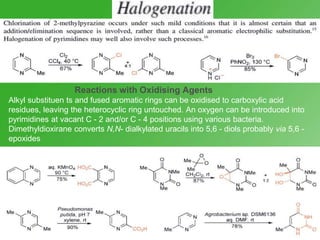
Alkyl substituen ts and fused aromatic rings can be oxidised to carboxylic acid
residues, leaving the heterocyclic ring untouched. An oxygen can be introduced into
pyrimidines at vacant C - 2 and/or C - 4 positions using various bacteria.
Dimethyldioxirane converts N,N- dialkylated uracils into 5,6 - diols probably via 5,6 -
epoxides
Reactions with Nucleophilic
Reagents•
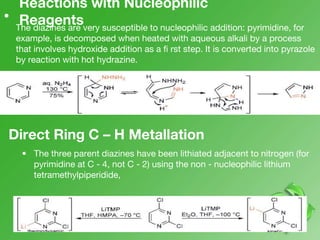
The diazines are very susceptible to nucleophilic addition: pyrimidine, for
example, is decomposed when heated with aqueous alkali by a process
that involves hydroxide addition as a fi rst step. It is converted into pyrazole
by reaction with hot hydrazine.
Direct Ring C – H Metallation
• The three parent diazines have been lithiated adjacent to nitrogen (for
pyrimidine at C - 4, not C - 2) using the non - nucleophilic lithium
tetramethylpiperidide,
Reactions with Radicals
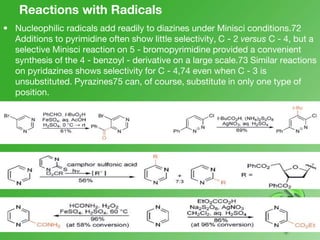
• Nucleophilic radicals add readily to diazines under Minisci conditions.72
Additions to pyrimidine often show little selectivity, C - 2 versus C - 4, but a
selective Minisci reaction on 5 - bromopyrimidine provided a convenient
synthesis of the 4 - benzoyl - derivative on a large scale.73 Similar reactions
on pyridazines shows selectivity for C - 4,74 even when C - 3 is
unsubstituted. Pyrazines75 can, of course, substitute in only one type of
position.
TIME FOR QUERIES
?
THANK YOU
.!.

Diazine group

  • 1.
  • 2.
  • 3.
  • 4.
    • The diazineare six membered ring containing two nitrogen group atom . Three isomeric diazines are therotically possible and three are known,
  • 6.
  • 7.
    • The threediazines, pyridazine, pyrimidine, and pyrazine are stable, colourless compounds that are soluble in water. The three parent heterocycles, unlike pyridine, are expensive and not readily available and so are seldom used as starting materials for the synthesis of their derivatives. • One striking aspect of the physical properties of the diazine trio is the high boiling point of pyridazine (207 ° C), 80 – 90 ° C higher than that of pyrimidine (123 ° C), pyrazine (118 ° C), or indeed other azines, including 1,3,5 - triazine, all of which also boil in the range 114 – 124 ° C. The high boiling point of pyridazine is attributed to the polarisability of the N – N unit, which results in extensive dipolar association in the liquid.
  • 8.
    • Pyridazine,Boiling point208o C, is a weak base and forms the pyridazinium mono-cation with acids. Pyridazine undergoes electrophilic substitution with great difficulty , but conversion into the 1-oxide offers a mean of preparing various pydazine substitution products.
  • 9.
    Nucleophilic Substitution with Displacementof Good Leaving Groups • All the halo - diazines, apart from 5 - halo - pyrimidines, react readily with ‘ soft ’ nucleophiles, such as amines, thiolates and malonate anions, with substitution of the halide. Even 5 - bromopyrimidine can be brought into reaction with nucleophiles using microwave heating. All cases are more reactive than 2 - halo - pyridines: the relative reactivities can be summarised:
  • 10.
  • 11.
    1. From a1,4 - Dicarbonyl Compound and a Hydrazine • A common method for the synthesis of pyridazines involves a 1,4 - dicarbonyl compound reacting with hydrazine; unless the four - carbon component is unsaturated, a final oxidative step is needed to give an aromatic pyridazine.
  • 12.
    2. By Cycloadditionof a 1,2,4,5 - Tetrazine with an Alkyne • Cycloaddition of a 1,2,4,5 - tetrazine with an alkyne (or its equivalent), with elimination of nitrogen gives pyridazines.
  • 13.
  • 14.
    1. From a1,3 - Dicarbonyl Compound and an N – C – N Fragment • The most general pyrimidine ring synthesis involves the combination of a 1,3 - dicarbonyl component with an N – C – N fragment such as a urea, an amidine or a guanidine.
  • 15.
    2. From 3- Ethoxyacryloyl Isocyanate and Primary Amines • Primary amines add to the isocyanate group in a 3 - alkoxyacryloyl isocyanate; ring closure then gives pyrimidines via intramolecular displacement of the alkoxy - group.
  • 16.
    3. From Ketones •Condensation of ketones with two mole equivalents of a nitrile in the presence of trifluoromethanesulfonic acid anhydride is a useful method for the production of a limited range of pyrimidines, where the substituents at C - 2 and C - 4 are identical.
  • 17.
  • 18.
    1. From theSelf - Condensation of a 2 - Amino - Ketone • Symmetrical pyrazines result from the spontaneous self condensation of two mole equivalents of a 2 - amino - ketone, or 2 - amino - aldehyde, followed by an oxidation. Pyrazine is not easily made in the laboratory. Commercially, the high temperature cyclodehydrogenation of precursors such as N- hydroxyethylethane - 1,2 - diamine is used.
  • 19.
    2. From 1,2- Dicarbonyl Compounds and 1,2 - Diamines • 1,2 - Dicarbonyl compounds undergo double condensation with 1,2 - diamines; an oxidation is then required.
  • 20.
    3. From 1,2- Diketone Mono - Oximes • Alkyl - pyrazines can be produced by an ingenious sequence involving an electrocyclic ring closure of a 1 - hydroxy - 1,4 - diazatriene, aromatisation being completed by loss of the oxygen from the original oxime hydroxyl group.
  • 21.
  • 22.
    • 6 -Diamino - 5 - thioformamido – 2-methylpyrimidine 4,6 - Diamino - 5 -thioformamido - 2 - methylpyrimidine can be converted into 2 - methyladenine.
  • 23.
  • 24.
    Coelenterazine• Coelenterazine, a Bioluminescentcompound from a Jellyfish, with potential for use in Bioassays, has been synthesised in an overall 25% yield from chloropyrazine
  • 25.
  • 28.
    Reactions with OxidisingAgents Alkyl substituen ts and fused aromatic rings can be oxidised to carboxylic acid residues, leaving the heterocyclic ring untouched. An oxygen can be introduced into pyrimidines at vacant C - 2 and/or C - 4 positions using various bacteria. Dimethyldioxirane converts N,N- dialkylated uracils into 5,6 - diols probably via 5,6 - epoxides
  • 29.
    Reactions with Nucleophilic Reagents• Thediazines are very susceptible to nucleophilic addition: pyrimidine, for example, is decomposed when heated with aqueous alkali by a process that involves hydroxide addition as a fi rst step. It is converted into pyrazole by reaction with hot hydrazine. Direct Ring C – H Metallation • The three parent diazines have been lithiated adjacent to nitrogen (for pyrimidine at C - 4, not C - 2) using the non - nucleophilic lithium tetramethylpiperidide,
  • 30.
    Reactions with Radicals •Nucleophilic radicals add readily to diazines under Minisci conditions.72 Additions to pyrimidine often show little selectivity, C - 2 versus C - 4, but a selective Minisci reaction on 5 - bromopyrimidine provided a convenient synthesis of the 4 - benzoyl - derivative on a large scale.73 Similar reactions on pyridazines shows selectivity for C - 4,74 even when C - 3 is unsubstituted. Pyrazines75 can, of course, substitute in only one type of position.
  • 31.
  • 32.