1
Heterocyclic Chemistry
N
O
S
Nomenclature of
Heterocyclic compounds
Heterocyclic Chemistry
2
• Three systems for naming heterocylic compounds:
1) The common nomenclature: no structural information but
it still widely used.
2) The replacement method
3) The Hantzsch-Widman (IUPAC or Systematic) method
which is designed so that one may deduce from it the
structure of the compound.
Nomenclature of heterocyclic compounds
3
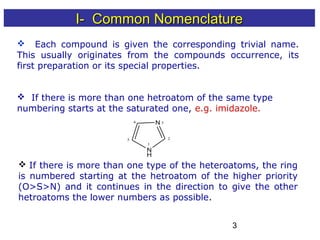
 Each compound is given the corresponding trivial name.
This usually originates from the compounds occurrence, its
first preparation or its special properties.
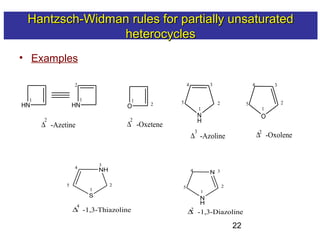
 If there is more than one hetroatom of the same type
numbering starts at the saturated one, e.g. imidazole.
 If there is more than one type of the heteroatoms, the ring
is numbered starting at the hetroatom of the higher priority
(O>S>N) and it continues in the direction to give the other
hetroatoms the lower numbers as possible.
N
H
N
1
2
34
5
I- Common NomenclatureI- Common Nomenclature
4
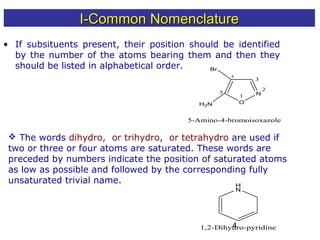
• If subsituents present, their position should be identified
by the number of the atoms bearing them and then they
should be listed in alphabetical order.
O
N1
2
3
4
5
Br
H2N
5-Amino-4-bromoisoxazole
 The words dihydro, or trihydro, or tetrahydro are used if
two or three or four atoms are saturated. These words are
preceded by numbers indicate the position of saturated atoms
as low as possible and followed by the corresponding fully
unsaturated trivial name. H
N
1,2-Dihydro-pyridine
I-Common NomenclatureI-Common Nomenclature
5
1) 5-membered heterocycles with one or two heteroatoms
2) 6-membered heterocycles with one or two heteroatoms
O O N N
N
N
N
N
N
These are tautomers
Both are not aromatic
DNA/RNA bases
Common azines-six-membered aromatic nitorgrn heterocycles
2H-Pyran 4H-Pyran Pyridine Pyridazine Pyrimidine Pyrazine
Trivial namesTrivial names
6
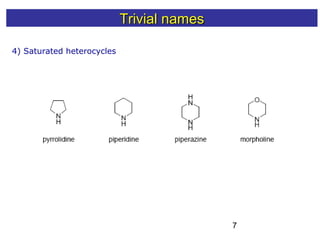
3) Fused heterocycles
N N
N
NH
O
NH2
Guanine
Trivial namesTrivial names
7
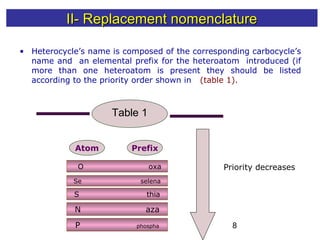
4) Saturated heterocycles
Trivial namesTrivial names
8
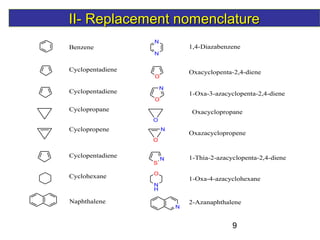
• Heterocycle’s name is composed of the corresponding carbocycle’s
name and an elemental prefix for the heteroatom introduced (if
more than one heteroatom is present they should be listed
according to the priority order shown in (table 1).
Table 1
Priority decreases
PrefixAtom
O oxa
Se selena
S thia
N aza
P phospha
II- Replacement nomenclatureII- Replacement nomenclature
9
O
N
O
N
S
N
O
N
N
O
N
H
Benzene
Cyclopentadiene
Cyclopentadiene
Cyclopropene
Cyclopentadiene
Cyclohexane
1,4-Diazabenzene
Oxacyclopenta-2,4-diene
1-Oxa-3-azacyclopenta-2,4-diene
Oxazacyclopropene
1-Thia-2-azacyclopenta-2,4-diene
1-Oxa-4-azacyclohexane
N
Naphthalene
O
Cyclopropane Oxacyclopropane
2-Azanaphthalene
II- Replacement nomenclatureII- Replacement nomenclature
10
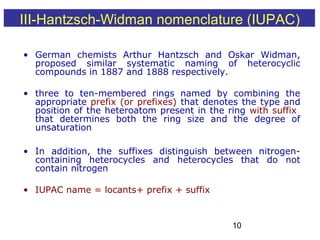
• German chemists Arthur Hantzsch and Oskar Widman,
proposed similar systematic naming of heterocyclic
compounds in 1887 and 1888 respectively.
• three to ten-membered rings named by combining the
appropriate prefix (or prefixes) that denotes the type and
position of the heteroatom present in the ring with suffix
that determines both the ring size and the degree of
unsaturation
• In addition, the suffixes distinguish between nitrogen-
containing heterocycles and heterocycles that do not
contain nitrogen
• IUPAC name = locants+ prefix + suffix
III-Hantzsch-Widman nomenclature (IUPAC)
11
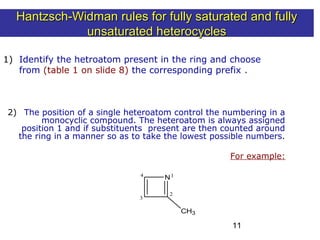
1) Identify the hetroatom present in the ring and choose
from (table 1 on slide 8) the corresponding prefix .
2) The position of a single heteroatom control the numbering in a
monocyclic compound. The heteroatom is always assigned
position 1 and if substituents present are then counted around
the ring in a manner so as to take the lowest possible numbers.
For example:
N
CH3
1
2
3
4
Hantzsch-Widman rules for fully saturated and fullyHantzsch-Widman rules for fully saturated and fully
unsaturated heterocyclesunsaturated heterocycles
12
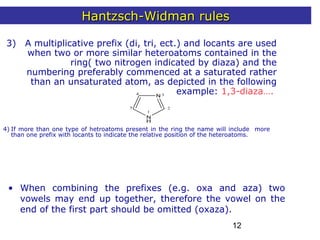
3) A multiplicative prefix (di, tri, ect.) and locants are used
when two or more similar heteroatoms contained in the
ring( two nitrogen indicated by diaza) and the
numbering preferably commenced at a saturated rather
than an unsaturated atom, as depicted in the following
example: 1,3-diaza….
1
2
34
N
N
H
5
4) If more than one type of hetroatoms present in the ring the name will include more
than one prefix with locants to indicate the relative position of the heteroatoms.
• When combining the prefixes (e.g. oxa and aza) two
vowels may end up together, therefore the vowel on the
end of the first part should be omitted (oxaza).
Hantzsch-Widman rulesHantzsch-Widman rules
13
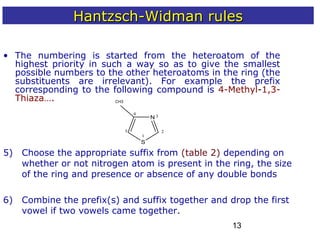
• The numbering is started from the heteroatom of the
highest priority in such a way so as to give the smallest
possible numbers to the other heteroatoms in the ring (the
substituents are irrelevant). For example the prefix
corresponding to the following compound is 4-Methyl-1,3-
Thiaza….
1
2
3
4
N
S
5
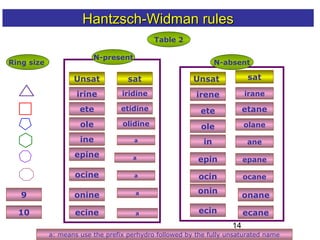
5) Choose the appropriate suffix from (table 2) depending on
whether or not nitrogen atom is present in the ring, the size
of the ring and presence or absence of any double bonds
6) Combine the prefix(s) and suffix together and drop the first
vowel if two vowels came together.
Hantzsch-Widman rulesHantzsch-Widman rules
CH3
14
irine
Table 2
Ring size
9
10
Unsat sat
N-present
iridine
ete etidine
ole olidine
ine a
ocine
aepine
a
onine a
ecine a
Unsat sat
N-absent
irene irane
ete etane
ole olane
in ane
epin
ocaneocin
epane
onin
ecin
onane
ecane
a: means use the prefix perhydro followed by the fully unsaturated name
Hantzsch-Widman rulesHantzsch-Widman rules
15
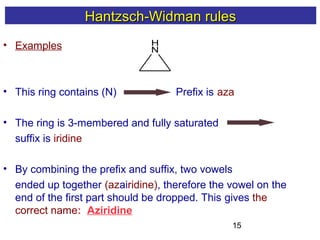
• Examples
• This ring contains (N) Prefix is aza
• The ring is 3-membered and fully saturated
suffix is iridine
• By combining the prefix and suffix, two vowels
ended up together (azairidine), therefore the vowel on the
end of the first part should be dropped. This gives the
correct name: Aziridine
H
N
Hantzsch-Widman rulesHantzsch-Widman rules
16
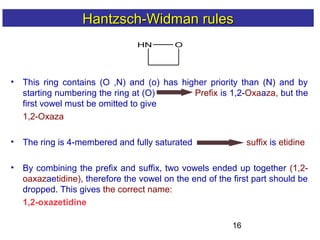
HN O
• This ring contains (O ,N) and (o) has higher priority than (N) and by
starting numbering the ring at (O) Prefix is 1,2-Oxaaza, but the
first vowel must be omitted to give
1,2-Oxaza
• The ring is 4-membered and fully saturated suffix is etidine
• By combining the prefix and suffix, two vowels ended up together (1,2-
oaxazaetidine), therefore the vowel on the end of the first part should be
dropped. This gives the correct name:
1,2-oxazetidine
Hantzsch-Widman rulesHantzsch-Widman rules
17
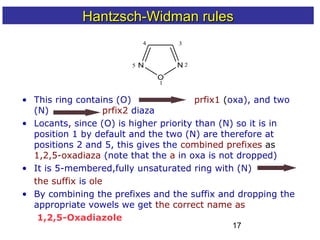
• This ring contains (O) prfix1 (oxa), and two
(N) prfix2 diaza
• Locants, since (O) is higher priority than (N) so it is in
position 1 by default and the two (N) are therefore at
positions 2 and 5, this gives the combined prefixes as
1,2,5-oxadiaza (note that the a in oxa is not dropped)
• It is 5-membered,fully unsaturated ring with (N)
the suffix is ole
• By combining the prefixes and the suffix and dropping the
appropriate vowels we get the correct name as
1,2,5-Oxadiazole
N
O
N
1
2
34
5
Hantzsch-Widman rulesHantzsch-Widman rules
18
Hantzsch-Widman rulesHantzsch-Widman rules
N
H
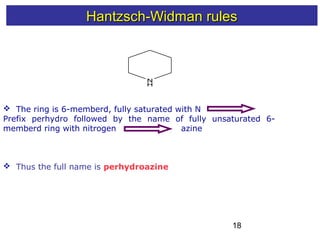
 The ring is 6-memberd, fully saturated with N
Prefix perhydro followed by the name of fully unsaturated 6-
memberd ring with nitrogen azine
 Thus the full name is perhydroazine
19
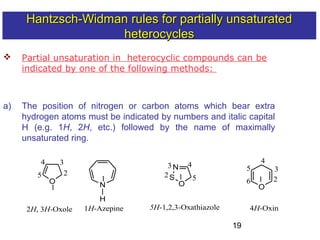
 Partial unsaturation in heterocyclic compounds can be
indicated by one of the following methods:
a) The position of nitrogen or carbon atoms which bear extra
hydrogen atoms must be indicated by numbers and italic capital
H (e.g. 1H, 2H, etc.) followed by the name of maximally
unsaturated ring.
6 1
1
2
3
O
2H, 3H-Oxole
4
5
N
1H-Azepine
12
3N
S
O
4
5
5H-1,2,3-Oxathiazole
1
O
2
3
4
5
4H-Oxin
H
Hantzsch-Widman rules for partially unsaturatedHantzsch-Widman rules for partially unsaturated
heterocyclesheterocycles
20
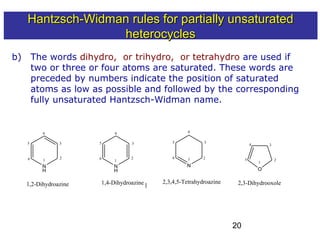
b) The words dihydro, or trihydro, or tetrahydro are used if
two or three or four atoms are saturated. These words are
preceded by numbers indicate the position of saturated
atoms as low as possible and followed by the corresponding
fully unsaturated Hantzsch-Widman name.
1
2
3
N
H
1,2-Dihydroazine
N
H
1,4-Dihydroazine
Isomers have the same M.F.
but differ in the position of
the double bond
N
2,3,4,5-Tetrahydroazine
111
222
333
444
555
666
O
2,3-Dihydrooxole
4
5
Hantzsch-Widman rules for partially unsaturatedHantzsch-Widman rules for partially unsaturated
heterocyclesheterocycles
21
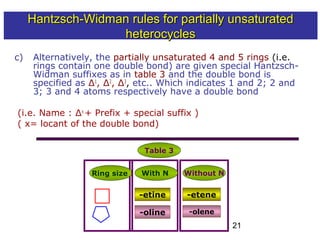
c) Alternatively, the partially unsaturated 4 and 5 rings (i.e.
rings contain one double bond) are given special Hantzsch-
Widman suffixes as in table 3 and the double bond is
specified as ∆1
, ∆2
, ∆3
, etc.. Which indicates 1 and 2; 2 and
3; 3 and 4 atoms respectively have a double bond
(i.e. Name : ∆x
+ Prefix + special suffix )
( x= locant of the double bond)
-etine -etene
With N Without N
-oline -olene
Table 3
Ring size
Hantzsch-Widman rules for partially unsaturatedHantzsch-Widman rules for partially unsaturated
heterocyclesheterocycles
22
• Examples
S
NH
1
2
3
5
∆
4
-1,3-Thiazoline
4
N
H
N
2
34
5
1
∆2
-1,3-Diazoline
HN HN
∆
2
-Azetine
1 1
2
O
1
2
∆
2
-Oxetene
N
H
O
∆
3
-Azoline ∆2
-Oxolene
1
2 2
3 34 4
5 5
1
Hantzsch-Widman rules for partially unsaturatedHantzsch-Widman rules for partially unsaturated
heterocyclesheterocycles
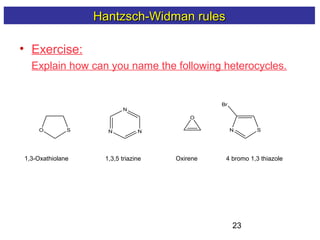
23
• Exercise:
Explain how can you name the following heterocycles.
O S N N
N
O
N S
Br
Hantzsch-Widman rulesHantzsch-Widman rules
1,3,5 triazine Oxirene 4 bromo 1,3 thiazole1,3-Oxathiolane

Heterocycles 2

  • 1.
  • 2.
    2 • Three systemsfor naming heterocylic compounds: 1) The common nomenclature: no structural information but it still widely used. 2) The replacement method 3) The Hantzsch-Widman (IUPAC or Systematic) method which is designed so that one may deduce from it the structure of the compound. Nomenclature of heterocyclic compounds
  • 3.
    3  Each compoundis given the corresponding trivial name. This usually originates from the compounds occurrence, its first preparation or its special properties.  If there is more than one hetroatom of the same type numbering starts at the saturated one, e.g. imidazole.  If there is more than one type of the heteroatoms, the ring is numbered starting at the hetroatom of the higher priority (O>S>N) and it continues in the direction to give the other hetroatoms the lower numbers as possible. N H N 1 2 34 5 I- Common NomenclatureI- Common Nomenclature
  • 4.
    4 • If subsituentspresent, their position should be identified by the number of the atoms bearing them and then they should be listed in alphabetical order. O N1 2 3 4 5 Br H2N 5-Amino-4-bromoisoxazole  The words dihydro, or trihydro, or tetrahydro are used if two or three or four atoms are saturated. These words are preceded by numbers indicate the position of saturated atoms as low as possible and followed by the corresponding fully unsaturated trivial name. H N 1,2-Dihydro-pyridine I-Common NomenclatureI-Common Nomenclature
  • 5.
    5 1) 5-membered heterocycleswith one or two heteroatoms 2) 6-membered heterocycles with one or two heteroatoms O O N N N N N N N These are tautomers Both are not aromatic DNA/RNA bases Common azines-six-membered aromatic nitorgrn heterocycles 2H-Pyran 4H-Pyran Pyridine Pyridazine Pyrimidine Pyrazine Trivial namesTrivial names
  • 6.
    6 3) Fused heterocycles NN N NH O NH2 Guanine Trivial namesTrivial names
  • 7.
  • 8.
    8 • Heterocycle’s nameis composed of the corresponding carbocycle’s name and an elemental prefix for the heteroatom introduced (if more than one heteroatom is present they should be listed according to the priority order shown in (table 1). Table 1 Priority decreases PrefixAtom O oxa Se selena S thia N aza P phospha II- Replacement nomenclatureII- Replacement nomenclature
  • 9.
  • 10.
    10 • German chemistsArthur Hantzsch and Oskar Widman, proposed similar systematic naming of heterocyclic compounds in 1887 and 1888 respectively. • three to ten-membered rings named by combining the appropriate prefix (or prefixes) that denotes the type and position of the heteroatom present in the ring with suffix that determines both the ring size and the degree of unsaturation • In addition, the suffixes distinguish between nitrogen- containing heterocycles and heterocycles that do not contain nitrogen • IUPAC name = locants+ prefix + suffix III-Hantzsch-Widman nomenclature (IUPAC)
  • 11.
    11 1) Identify thehetroatom present in the ring and choose from (table 1 on slide 8) the corresponding prefix . 2) The position of a single heteroatom control the numbering in a monocyclic compound. The heteroatom is always assigned position 1 and if substituents present are then counted around the ring in a manner so as to take the lowest possible numbers. For example: N CH3 1 2 3 4 Hantzsch-Widman rules for fully saturated and fullyHantzsch-Widman rules for fully saturated and fully unsaturated heterocyclesunsaturated heterocycles
  • 12.
    12 3) A multiplicativeprefix (di, tri, ect.) and locants are used when two or more similar heteroatoms contained in the ring( two nitrogen indicated by diaza) and the numbering preferably commenced at a saturated rather than an unsaturated atom, as depicted in the following example: 1,3-diaza…. 1 2 34 N N H 5 4) If more than one type of hetroatoms present in the ring the name will include more than one prefix with locants to indicate the relative position of the heteroatoms. • When combining the prefixes (e.g. oxa and aza) two vowels may end up together, therefore the vowel on the end of the first part should be omitted (oxaza). Hantzsch-Widman rulesHantzsch-Widman rules
  • 13.
    13 • The numberingis started from the heteroatom of the highest priority in such a way so as to give the smallest possible numbers to the other heteroatoms in the ring (the substituents are irrelevant). For example the prefix corresponding to the following compound is 4-Methyl-1,3- Thiaza…. 1 2 3 4 N S 5 5) Choose the appropriate suffix from (table 2) depending on whether or not nitrogen atom is present in the ring, the size of the ring and presence or absence of any double bonds 6) Combine the prefix(s) and suffix together and drop the first vowel if two vowels came together. Hantzsch-Widman rulesHantzsch-Widman rules CH3
  • 14.
    14 irine Table 2 Ring size 9 10 Unsatsat N-present iridine ete etidine ole olidine ine a ocine aepine a onine a ecine a Unsat sat N-absent irene irane ete etane ole olane in ane epin ocaneocin epane onin ecin onane ecane a: means use the prefix perhydro followed by the fully unsaturated name Hantzsch-Widman rulesHantzsch-Widman rules
  • 15.
    15 • Examples • Thisring contains (N) Prefix is aza • The ring is 3-membered and fully saturated suffix is iridine • By combining the prefix and suffix, two vowels ended up together (azairidine), therefore the vowel on the end of the first part should be dropped. This gives the correct name: Aziridine H N Hantzsch-Widman rulesHantzsch-Widman rules
  • 16.
    16 HN O • Thisring contains (O ,N) and (o) has higher priority than (N) and by starting numbering the ring at (O) Prefix is 1,2-Oxaaza, but the first vowel must be omitted to give 1,2-Oxaza • The ring is 4-membered and fully saturated suffix is etidine • By combining the prefix and suffix, two vowels ended up together (1,2- oaxazaetidine), therefore the vowel on the end of the first part should be dropped. This gives the correct name: 1,2-oxazetidine Hantzsch-Widman rulesHantzsch-Widman rules
  • 17.
    17 • This ringcontains (O) prfix1 (oxa), and two (N) prfix2 diaza • Locants, since (O) is higher priority than (N) so it is in position 1 by default and the two (N) are therefore at positions 2 and 5, this gives the combined prefixes as 1,2,5-oxadiaza (note that the a in oxa is not dropped) • It is 5-membered,fully unsaturated ring with (N) the suffix is ole • By combining the prefixes and the suffix and dropping the appropriate vowels we get the correct name as 1,2,5-Oxadiazole N O N 1 2 34 5 Hantzsch-Widman rulesHantzsch-Widman rules
  • 18.
    18 Hantzsch-Widman rulesHantzsch-Widman rules N H The ring is 6-memberd, fully saturated with N Prefix perhydro followed by the name of fully unsaturated 6- memberd ring with nitrogen azine  Thus the full name is perhydroazine
  • 19.
    19  Partial unsaturationin heterocyclic compounds can be indicated by one of the following methods: a) The position of nitrogen or carbon atoms which bear extra hydrogen atoms must be indicated by numbers and italic capital H (e.g. 1H, 2H, etc.) followed by the name of maximally unsaturated ring. 6 1 1 2 3 O 2H, 3H-Oxole 4 5 N 1H-Azepine 12 3N S O 4 5 5H-1,2,3-Oxathiazole 1 O 2 3 4 5 4H-Oxin H Hantzsch-Widman rules for partially unsaturatedHantzsch-Widman rules for partially unsaturated heterocyclesheterocycles
  • 20.
    20 b) The wordsdihydro, or trihydro, or tetrahydro are used if two or three or four atoms are saturated. These words are preceded by numbers indicate the position of saturated atoms as low as possible and followed by the corresponding fully unsaturated Hantzsch-Widman name. 1 2 3 N H 1,2-Dihydroazine N H 1,4-Dihydroazine Isomers have the same M.F. but differ in the position of the double bond N 2,3,4,5-Tetrahydroazine 111 222 333 444 555 666 O 2,3-Dihydrooxole 4 5 Hantzsch-Widman rules for partially unsaturatedHantzsch-Widman rules for partially unsaturated heterocyclesheterocycles
  • 21.
    21 c) Alternatively, thepartially unsaturated 4 and 5 rings (i.e. rings contain one double bond) are given special Hantzsch- Widman suffixes as in table 3 and the double bond is specified as ∆1 , ∆2 , ∆3 , etc.. Which indicates 1 and 2; 2 and 3; 3 and 4 atoms respectively have a double bond (i.e. Name : ∆x + Prefix + special suffix ) ( x= locant of the double bond) -etine -etene With N Without N -oline -olene Table 3 Ring size Hantzsch-Widman rules for partially unsaturatedHantzsch-Widman rules for partially unsaturated heterocyclesheterocycles
  • 22.
    22 • Examples S NH 1 2 3 5 ∆ 4 -1,3-Thiazoline 4 N H N 2 34 5 1 ∆2 -1,3-Diazoline HN HN ∆ 2 -Azetine 11 2 O 1 2 ∆ 2 -Oxetene N H O ∆ 3 -Azoline ∆2 -Oxolene 1 2 2 3 34 4 5 5 1 Hantzsch-Widman rules for partially unsaturatedHantzsch-Widman rules for partially unsaturated heterocyclesheterocycles
  • 23.
    23 • Exercise: Explain howcan you name the following heterocycles. O S N N N O N S Br Hantzsch-Widman rulesHantzsch-Widman rules 1,3,5 triazine Oxirene 4 bromo 1,3 thiazole1,3-Oxathiolane