Chapter 6:
User-Defined Functions
Objectives
In this chapter, you will:
– Learn about standard (predefined) functions
– Learn about user-defined functions
– Examine value-returning functions
– Explore how to construct and use a value-returning,
user-defined function
– Learn about function prototypes
– Learn how to construct and use void functions
C++ Programming: From Problem Analysis to Program Design, Seventh Edition 2
Objectives (cont’d.)
– Discover the difference between value and reference
parameters
– Explore reference parameters and value-returning
functions
– Learn about the scope of an identifier
– Examine the difference between local and global
identifiers
– Discover static variables
C++ Programming: From Problem Analysis to Program Design, Seventh Edition 3
Objectives (cont’d.)
– Learn how to debug programs using drivers and stubs
– Learn function overloading
– Explore functions with default parameters
C++ Programming: From Problem Analysis to Program Design, Seventh Edition 4
Introduction
• Functions are often called modules
• They are like miniature programs that can be
combined to form larger programs
• They allow complicated programs to be divided
into manageable pieces
C++ Programming: From Problem Analysis to Program Design, Seventh Edition 5
Predefined Functions
• In C++, a function is similar to that of a
function in algebra
– It has a name
– It does some computation
• Some of the predefined mathematical
functions are:
sqrt(x)
pow(x, y)
floor(x)
C++ Programming: From Problem Analysis to Program Design, Seventh Edition 6
Predefined Functions (cont'd.)
• Predefined functions are organized into
separate libraries
– I/O functions are in iostream header
– Math functions are in cmath header
• To use predefined functions, you must include
the header file using an include statement
• See Table 6-1 in the text for some common
predefined functions
C++ Programming: From Problem Analysis to Program Design, Seventh Edition 7
User-Defined Functions
• Value-returning functions: have a return type
– Return a value of a specific data type using the
return statement
• Void functions: do not have a return type
– Do not use a return statement to return a value
C++ Programming: From Problem Analysis to Program Design, Seventh Edition 8
Value-Returning Functions
• To use these functions, you must:
– Include the appropriate header file in your
program using the include statement
– Know the following items:
• Name of the function
• Number of parameters, if any
• Data type of each parameter
• Data type of the value returned: called the type of the
function
C++ Programming: From Problem Analysis to Program Design, Seventh Edition 9
Value-Returning Functions (cont’d.)
• Can use the value returned by a value-
returning function by:
– Saving it for further calculation
– Using it in some calculation
– Printing it
• A value-returning function is used in an
assignment or in an output statement
C++ Programming: From Problem Analysis to Program Design, Seventh Edition 10
Value-Returning Functions (cont’d.)
• Heading (or function header): first line of the
function
– Example: int abs(int number)
• Formal parameter: variable declared in the
heading
– Example: number
• Actual parameter: variable or expression
listed in a call to a function
– Example: x = pow(u, v)
C++ Programming: From Problem Analysis to Program Design, Seventh Edition 11
Syntax: Value-Returning Function
• Syntax:
• functionType is also called the data type
or return type
C++ Programming: From Problem Analysis to Program Design, Seventh Edition 12
Syntax: Formal Parameter List
C++ Programming: From Problem Analysis to Program Design, Seventh Edition 13
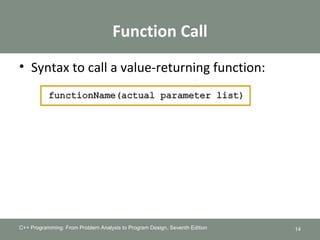
Function Call
C++ Programming: From Problem Analysis to Program Design, Seventh Edition
• Syntax to call a value-returning function:
14
Syntax: Actual Parameter List
• Syntax of the actual parameter list:
• Formal parameter list can be empty:
• A call to a value-returning function with an
empty formal parameter list is:
C++ Programming: From Problem Analysis to Program Design, Seventh Edition 15
return Statement
• Function returns its value via the return
statement
– It passes this value outside the function
C++ Programming: From Problem Analysis to Program Design, Seventh Edition 16
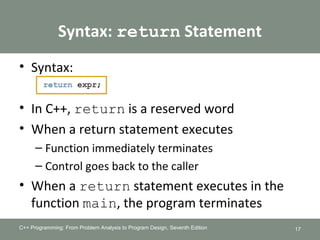
Syntax: return Statement
• Syntax:
• In C++, return is a reserved word
• When a return statement executes
– Function immediately terminates
– Control goes back to the caller
• When a return statement executes in the
function main, the program terminates
C++ Programming: From Problem Analysis to Program Design, Seventh Edition 17
Syntax: return Statement (cont’d.)
C++ Programming: From Problem Analysis to Program Design, Seventh Edition 18
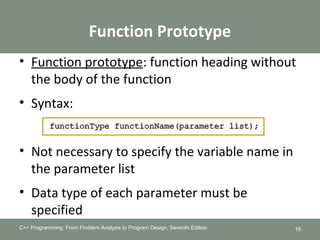
Function Prototype
• Function prototype: function heading without
the body of the function
• Syntax:
• Not necessary to specify the variable name in
the parameter list
• Data type of each parameter must be
specified
C++ Programming: From Problem Analysis to Program Design, Seventh Edition 19
Value-Returning Functions: Some
Peculiarities
C++ Programming: From Problem Analysis to Program Design, Seventh Edition 20
Value-Returning Functions: Some
Peculiarities (cont’d.)
C++ Programming: From Problem Analysis to Program Design, Seventh Edition 21
Flow of Compilation and Execution
• Execution always begins at the first statement
in the function main
• Other functions are executed only when called
• Function prototypes appear before any
function definition
– Compiler translates these first
• Compiler can then correctly translate a
function call
C++ Programming: From Problem Analysis to Program Design, Seventh Edition 22
Flow of Compilation and Execution
(cont’d.)
• Function call transfers control to the first
statement in the body of the called function
• When the end of a called function is executed,
control is passed back to the point immediately
following the function call
– Function’s returned value replaces the function
call statement
C++ Programming: From Problem Analysis to Program Design, Seventh Edition 23
Void Functions
• User-defined void functions can be placed
either before or after the function main
• If user-defined void functions are placed after
the function main
– The function prototype must be placed before the
function main
• Void function does not have a return type
– return statement without any value is typically
used to exit the function early
C++ Programming: From Problem Analysis to Program Design, Seventh Edition 24
Void Functions (cont’d.)
• Formal parameters are optional
• A call to a void function is a stand-alone
statement
• Void function definition syntax:
C++ Programming: From Problem Analysis to Program Design, Seventh Edition 25
Void Functions (cont’d.)
• Formal parameter list syntax:
• Function call syntax:
• Actual parameter list syntax:
C++ Programming: From Problem Analysis to Program Design, Seventh Edition 26
Void Functions (cont’d.)
• Value parameter: a formal parameter that
receives a copy of the content of
corresponding actual parameter
• Reference parameter: a formal parameter
that receives the location (memory address)
of the corresponding actual parameter
C++ Programming: From Problem Analysis to Program Design, Seventh Edition 27
Value Parameters
• If a formal parameter is a value parameter:
– The value of the corresponding actual parameter
is copied into it
– Formal parameter has its own copy of the data
• During program execution
– Formal parameter manipulates the data stored in
its own memory space
C++ Programming: From Problem Analysis to Program Design, Seventh Edition 28
Reference Variables as Parameters
• If a formal parameter is a reference
parameter
– It receives the memory address of the
corresponding actual parameter
• During program execution to manipulate data
– Changes to formal parameter will change the
corresponding actual parameter
C++ Programming: From Problem Analysis to Program Design, Seventh Edition 29
Reference Variables as Parameters
(cont’d.)
• Reference parameters are useful in three
situations:
– Returning more than one value
– Changing the actual parameter
– When passing the address would save memory
space and time
C++ Programming: From Problem Analysis to Program Design, Seventh Edition 30
Value and Reference Parameters and
Memory Allocation
• When a function is called
– Memory for its formal parameters and its local
variables is allocated in the function data area
• For a value parameter, the actual parameter’s
value is copied into the formal parameter’s
memory cell
– Changes to the formal parameter do not affect
the actual parameter’s value
C++ Programming: From Problem Analysis to Program Design, Seventh Edition 31
Value and Reference Parameters and
Memory Allocation (cont’d.)
• For a reference parameter, the actual
parameter’s address passes to the formal
parameter
• Both formal and actual parameters refer to the
same memory location
• During execution, changes made to the formal
parameter’s value permanently change the actual
parameter’s value
C++ Programming: From Problem Analysis to Program Design, Seventh Edition 32
Reference Parameters and Value-
Returning Functions
• Can also use reference parameters in a value-
returning function
– Not recommended
• By definition, a value-returning function
returns a single value via return statement
• If a function needs to return more than one
value, change it to a void function and use
reference parameters to return the values
C++ Programming: From Problem Analysis to Program Design, Seventh Edition 33
Scope of an Identifier
• Scope of an identifier: where in the program
the identifier is accessible
• Local identifier: identifiers declared within a
function (or block)
• Global identifier: identifiers declared outside
of every function definition
• C++ does not allow nested functions
– Definition of one function cannot be included in
the body of another function
C++ Programming: From Problem Analysis to Program Design, Seventh Edition 34
Scope of an Identifier (cont’d.)
• Rules when an identifier is accessed:
– Global identifiers are accessible by a function or
block if:
• Declared before function definition
• Function name different from identifier
• Parameters to the function have different names
• All local identifiers have different names
C++ Programming: From Problem Analysis to Program Design, Seventh Edition 35
Scope of an Identifier (cont’d.)
• Rules when an identifier is accessed (cont’d.):
– Nested block
• Identifier accessible from declaration to end of block in
which it is declared
• Within nested blocks if no identifier with same name
exists
– Scope of function name similar to scope of
identifier declared outside any block
• i.e., function name scope = global variable scope
C++ Programming: From Problem Analysis to Program Design, Seventh Edition 36
Scope of an Identifier (cont’d.)
• Some compilers initialize global variables to
default values
• Scope resolution operator in C++ is ::
• By using the scope resolution operator
– A global variable declared before the definition of
a function (or block) can be accessed by the
function (or block)
– Even if the function (or block) has an identifier
with the same name as the global variable
C++ Programming: From Problem Analysis to Program Design, Seventh Edition 37
Scope of an Identifier (cont’d.)
• To access a global variable declared after the
definition of a function, the function must not
contain any identifier with the same name
– Reserved word extern indicates that a global
variable has been declared elsewhere
C++ Programming: From Problem Analysis to Program Design, Seventh Edition 38
Global Variables, Named Constants,
and Side Effects
• Using global variables causes side effects
• A function that uses global variables is not
independent
• If more than one function uses the same
global variable:
– Can be difficult to debug problems with it
– Problems caused in one area of the program may
appear to be from another area
• Global named constants have no side effects
C++ Programming: From Problem Analysis to Program Design, Seventh Edition 39
Static and Automatic Variables
• Automatic variable: memory is allocated at
block entry and deallocated at block exit
– By default, variables declared within a block are
automatic variables
• Static variable: memory remains allocated as
long as the program executes
– Global variables declared outside of any block are
static variables
C++ Programming: From Problem Analysis to Program Design, Seventh Edition 40
Static and Automatic Variables
(cont’d.)
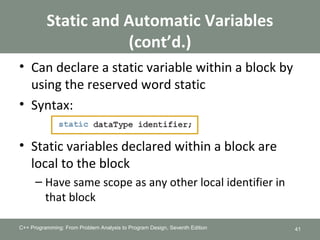
• Can declare a static variable within a block by
using the reserved word static
• Syntax:
• Static variables declared within a block are
local to the block
– Have same scope as any other local identifier in
that block
C++ Programming: From Problem Analysis to Program Design, Seventh Edition 41
Debugging:
Using Drivers and Stubs
• Driver program: separate program used to
test a function
• When results calculated by one function are
needed in another function, use a function
stub
• Function stub: a function that is not fully
coded
C++ Programming: From Problem Analysis to Program Design, Seventh Edition 42
Function Overloading:
An Introduction
• In a C++ program, several functions can have
the same name
• Function overloading: creating several
functions with the same name
• Function signature: the name and formal
parameter list of the function
– Does not include the return type of the function
C++ Programming: From Problem Analysis to Program Design, Seventh Edition 43
Function Overloading (cont’d.)
• Two functions are said to have different
formal parameter lists if both functions have
either:
– A different number of formal parameters
– If the number of formal parameters is the same,
but the data type of the formal parameters differs
in at least one position
• Overloaded functions must have different
function signatures
C++ Programming: From Problem Analysis to Program Design, Seventh Edition 44
Function Overloading (cont’d.)
• The parameter list supplied in a call to an
overloaded function determines which
function is executed
C++ Programming: From Problem Analysis to Program Design, Seventh Edition 45
Functions with Default Parameters
• In a function call, the number of actual and
formal parameters must be the same
– C++ relaxes this condition for functions with
default parameters
• Can specify the value of a default parameter
in the function prototype
• If you do not specify the value for a default
parameter when calling the function, the
default value is used
C++ Programming: From Problem Analysis to Program Design, Seventh Edition 46
Functions with Default Parameters
(cont’d.)
• All default parameters must be the rightmost
parameters of the function
• If a default parameter value is not specified:
– You must omit all of the arguments to its right
• Default values can be constants, global
variables, or function calls
• Cannot assign a constant value as a default
value to a reference parameter
C++ Programming: From Problem Analysis to Program Design, Seventh Edition 47
Summary
• Functions (modules) divide a program into
manageable tasks
• C++ provides standard, predefined functions
• Two types of user-defined functions: value-
returning functions and void functions
• Variables defined in a function heading are called
formal parameters
• Expressions, variables, or constant values in a
function call are called actual parameters
C++ Programming: From Problem Analysis to Program Design, Seventh Edition 48
Summary (cont’d.)
• Function heading and the body of the function
are called the definition of the function
• A value-returning function returns its value via
the return statement
• A prototype is the function heading without the
body of the function
• User-defined functions execute only when they
are called
• Void functions do not have a data type
C++ Programming: From Problem Analysis to Program Design, Seventh Edition 49
Summary (cont’d.)
• Two types of formal parameters:
– A value parameter receives a copy of its
corresponding actual parameter
– A reference parameter receives the memory
address of its corresponding actual parameter
• Variables declared within a function (or block)
are called local variables
• Variables declared outside of every function
definition (and block) are global variables
C++ Programming: From Problem Analysis to Program Design, Seventh Edition 50
Summary (cont’d.)
• Automatic variable: variable for which
memory is allocated on function/block entry
and deallocated on function/block exit
• Static variable: memory remains allocated
throughout the execution of the program
• C++ functions can have default parameters
C++ Programming: From Problem Analysis to Program Design, Seventh Edition 51

Functions ppt ch06

  • 1.
  • 2.
    Objectives In this chapter,you will: – Learn about standard (predefined) functions – Learn about user-defined functions – Examine value-returning functions – Explore how to construct and use a value-returning, user-defined function – Learn about function prototypes – Learn how to construct and use void functions C++ Programming: From Problem Analysis to Program Design, Seventh Edition 2
  • 3.
    Objectives (cont’d.) – Discoverthe difference between value and reference parameters – Explore reference parameters and value-returning functions – Learn about the scope of an identifier – Examine the difference between local and global identifiers – Discover static variables C++ Programming: From Problem Analysis to Program Design, Seventh Edition 3
  • 4.
    Objectives (cont’d.) – Learnhow to debug programs using drivers and stubs – Learn function overloading – Explore functions with default parameters C++ Programming: From Problem Analysis to Program Design, Seventh Edition 4
  • 5.
    Introduction • Functions areoften called modules • They are like miniature programs that can be combined to form larger programs • They allow complicated programs to be divided into manageable pieces C++ Programming: From Problem Analysis to Program Design, Seventh Edition 5
  • 6.
    Predefined Functions • InC++, a function is similar to that of a function in algebra – It has a name – It does some computation • Some of the predefined mathematical functions are: sqrt(x) pow(x, y) floor(x) C++ Programming: From Problem Analysis to Program Design, Seventh Edition 6
  • 7.
    Predefined Functions (cont'd.) •Predefined functions are organized into separate libraries – I/O functions are in iostream header – Math functions are in cmath header • To use predefined functions, you must include the header file using an include statement • See Table 6-1 in the text for some common predefined functions C++ Programming: From Problem Analysis to Program Design, Seventh Edition 7
  • 8.
    User-Defined Functions • Value-returningfunctions: have a return type – Return a value of a specific data type using the return statement • Void functions: do not have a return type – Do not use a return statement to return a value C++ Programming: From Problem Analysis to Program Design, Seventh Edition 8
  • 9.
    Value-Returning Functions • Touse these functions, you must: – Include the appropriate header file in your program using the include statement – Know the following items: • Name of the function • Number of parameters, if any • Data type of each parameter • Data type of the value returned: called the type of the function C++ Programming: From Problem Analysis to Program Design, Seventh Edition 9
  • 10.
    Value-Returning Functions (cont’d.) •Can use the value returned by a value- returning function by: – Saving it for further calculation – Using it in some calculation – Printing it • A value-returning function is used in an assignment or in an output statement C++ Programming: From Problem Analysis to Program Design, Seventh Edition 10
  • 11.
    Value-Returning Functions (cont’d.) •Heading (or function header): first line of the function – Example: int abs(int number) • Formal parameter: variable declared in the heading – Example: number • Actual parameter: variable or expression listed in a call to a function – Example: x = pow(u, v) C++ Programming: From Problem Analysis to Program Design, Seventh Edition 11
  • 12.
    Syntax: Value-Returning Function •Syntax: • functionType is also called the data type or return type C++ Programming: From Problem Analysis to Program Design, Seventh Edition 12
  • 13.
    Syntax: Formal ParameterList C++ Programming: From Problem Analysis to Program Design, Seventh Edition 13
  • 14.
    Function Call C++ Programming:From Problem Analysis to Program Design, Seventh Edition • Syntax to call a value-returning function: 14
  • 15.
    Syntax: Actual ParameterList • Syntax of the actual parameter list: • Formal parameter list can be empty: • A call to a value-returning function with an empty formal parameter list is: C++ Programming: From Problem Analysis to Program Design, Seventh Edition 15
  • 16.
    return Statement • Functionreturns its value via the return statement – It passes this value outside the function C++ Programming: From Problem Analysis to Program Design, Seventh Edition 16
  • 17.
    Syntax: return Statement •Syntax: • In C++, return is a reserved word • When a return statement executes – Function immediately terminates – Control goes back to the caller • When a return statement executes in the function main, the program terminates C++ Programming: From Problem Analysis to Program Design, Seventh Edition 17
  • 18.
    Syntax: return Statement(cont’d.) C++ Programming: From Problem Analysis to Program Design, Seventh Edition 18
  • 19.
    Function Prototype • Functionprototype: function heading without the body of the function • Syntax: • Not necessary to specify the variable name in the parameter list • Data type of each parameter must be specified C++ Programming: From Problem Analysis to Program Design, Seventh Edition 19
  • 20.
    Value-Returning Functions: Some Peculiarities C++Programming: From Problem Analysis to Program Design, Seventh Edition 20
  • 21.
    Value-Returning Functions: Some Peculiarities(cont’d.) C++ Programming: From Problem Analysis to Program Design, Seventh Edition 21
  • 22.
    Flow of Compilationand Execution • Execution always begins at the first statement in the function main • Other functions are executed only when called • Function prototypes appear before any function definition – Compiler translates these first • Compiler can then correctly translate a function call C++ Programming: From Problem Analysis to Program Design, Seventh Edition 22
  • 23.
    Flow of Compilationand Execution (cont’d.) • Function call transfers control to the first statement in the body of the called function • When the end of a called function is executed, control is passed back to the point immediately following the function call – Function’s returned value replaces the function call statement C++ Programming: From Problem Analysis to Program Design, Seventh Edition 23
  • 24.
    Void Functions • User-definedvoid functions can be placed either before or after the function main • If user-defined void functions are placed after the function main – The function prototype must be placed before the function main • Void function does not have a return type – return statement without any value is typically used to exit the function early C++ Programming: From Problem Analysis to Program Design, Seventh Edition 24
  • 25.
    Void Functions (cont’d.) •Formal parameters are optional • A call to a void function is a stand-alone statement • Void function definition syntax: C++ Programming: From Problem Analysis to Program Design, Seventh Edition 25
  • 26.
    Void Functions (cont’d.) •Formal parameter list syntax: • Function call syntax: • Actual parameter list syntax: C++ Programming: From Problem Analysis to Program Design, Seventh Edition 26
  • 27.
    Void Functions (cont’d.) •Value parameter: a formal parameter that receives a copy of the content of corresponding actual parameter • Reference parameter: a formal parameter that receives the location (memory address) of the corresponding actual parameter C++ Programming: From Problem Analysis to Program Design, Seventh Edition 27
  • 28.
    Value Parameters • Ifa formal parameter is a value parameter: – The value of the corresponding actual parameter is copied into it – Formal parameter has its own copy of the data • During program execution – Formal parameter manipulates the data stored in its own memory space C++ Programming: From Problem Analysis to Program Design, Seventh Edition 28
  • 29.
    Reference Variables asParameters • If a formal parameter is a reference parameter – It receives the memory address of the corresponding actual parameter • During program execution to manipulate data – Changes to formal parameter will change the corresponding actual parameter C++ Programming: From Problem Analysis to Program Design, Seventh Edition 29
  • 30.
    Reference Variables asParameters (cont’d.) • Reference parameters are useful in three situations: – Returning more than one value – Changing the actual parameter – When passing the address would save memory space and time C++ Programming: From Problem Analysis to Program Design, Seventh Edition 30
  • 31.
    Value and ReferenceParameters and Memory Allocation • When a function is called – Memory for its formal parameters and its local variables is allocated in the function data area • For a value parameter, the actual parameter’s value is copied into the formal parameter’s memory cell – Changes to the formal parameter do not affect the actual parameter’s value C++ Programming: From Problem Analysis to Program Design, Seventh Edition 31
  • 32.
    Value and ReferenceParameters and Memory Allocation (cont’d.) • For a reference parameter, the actual parameter’s address passes to the formal parameter • Both formal and actual parameters refer to the same memory location • During execution, changes made to the formal parameter’s value permanently change the actual parameter’s value C++ Programming: From Problem Analysis to Program Design, Seventh Edition 32
  • 33.
    Reference Parameters andValue- Returning Functions • Can also use reference parameters in a value- returning function – Not recommended • By definition, a value-returning function returns a single value via return statement • If a function needs to return more than one value, change it to a void function and use reference parameters to return the values C++ Programming: From Problem Analysis to Program Design, Seventh Edition 33
  • 34.
    Scope of anIdentifier • Scope of an identifier: where in the program the identifier is accessible • Local identifier: identifiers declared within a function (or block) • Global identifier: identifiers declared outside of every function definition • C++ does not allow nested functions – Definition of one function cannot be included in the body of another function C++ Programming: From Problem Analysis to Program Design, Seventh Edition 34
  • 35.
    Scope of anIdentifier (cont’d.) • Rules when an identifier is accessed: – Global identifiers are accessible by a function or block if: • Declared before function definition • Function name different from identifier • Parameters to the function have different names • All local identifiers have different names C++ Programming: From Problem Analysis to Program Design, Seventh Edition 35
  • 36.
    Scope of anIdentifier (cont’d.) • Rules when an identifier is accessed (cont’d.): – Nested block • Identifier accessible from declaration to end of block in which it is declared • Within nested blocks if no identifier with same name exists – Scope of function name similar to scope of identifier declared outside any block • i.e., function name scope = global variable scope C++ Programming: From Problem Analysis to Program Design, Seventh Edition 36
  • 37.
    Scope of anIdentifier (cont’d.) • Some compilers initialize global variables to default values • Scope resolution operator in C++ is :: • By using the scope resolution operator – A global variable declared before the definition of a function (or block) can be accessed by the function (or block) – Even if the function (or block) has an identifier with the same name as the global variable C++ Programming: From Problem Analysis to Program Design, Seventh Edition 37
  • 38.
    Scope of anIdentifier (cont’d.) • To access a global variable declared after the definition of a function, the function must not contain any identifier with the same name – Reserved word extern indicates that a global variable has been declared elsewhere C++ Programming: From Problem Analysis to Program Design, Seventh Edition 38
  • 39.
    Global Variables, NamedConstants, and Side Effects • Using global variables causes side effects • A function that uses global variables is not independent • If more than one function uses the same global variable: – Can be difficult to debug problems with it – Problems caused in one area of the program may appear to be from another area • Global named constants have no side effects C++ Programming: From Problem Analysis to Program Design, Seventh Edition 39
  • 40.
    Static and AutomaticVariables • Automatic variable: memory is allocated at block entry and deallocated at block exit – By default, variables declared within a block are automatic variables • Static variable: memory remains allocated as long as the program executes – Global variables declared outside of any block are static variables C++ Programming: From Problem Analysis to Program Design, Seventh Edition 40
  • 41.
    Static and AutomaticVariables (cont’d.) • Can declare a static variable within a block by using the reserved word static • Syntax: • Static variables declared within a block are local to the block – Have same scope as any other local identifier in that block C++ Programming: From Problem Analysis to Program Design, Seventh Edition 41
  • 42.
    Debugging: Using Drivers andStubs • Driver program: separate program used to test a function • When results calculated by one function are needed in another function, use a function stub • Function stub: a function that is not fully coded C++ Programming: From Problem Analysis to Program Design, Seventh Edition 42
  • 43.
    Function Overloading: An Introduction •In a C++ program, several functions can have the same name • Function overloading: creating several functions with the same name • Function signature: the name and formal parameter list of the function – Does not include the return type of the function C++ Programming: From Problem Analysis to Program Design, Seventh Edition 43
  • 44.
    Function Overloading (cont’d.) •Two functions are said to have different formal parameter lists if both functions have either: – A different number of formal parameters – If the number of formal parameters is the same, but the data type of the formal parameters differs in at least one position • Overloaded functions must have different function signatures C++ Programming: From Problem Analysis to Program Design, Seventh Edition 44
  • 45.
    Function Overloading (cont’d.) •The parameter list supplied in a call to an overloaded function determines which function is executed C++ Programming: From Problem Analysis to Program Design, Seventh Edition 45
  • 46.
    Functions with DefaultParameters • In a function call, the number of actual and formal parameters must be the same – C++ relaxes this condition for functions with default parameters • Can specify the value of a default parameter in the function prototype • If you do not specify the value for a default parameter when calling the function, the default value is used C++ Programming: From Problem Analysis to Program Design, Seventh Edition 46
  • 47.
    Functions with DefaultParameters (cont’d.) • All default parameters must be the rightmost parameters of the function • If a default parameter value is not specified: – You must omit all of the arguments to its right • Default values can be constants, global variables, or function calls • Cannot assign a constant value as a default value to a reference parameter C++ Programming: From Problem Analysis to Program Design, Seventh Edition 47
  • 48.
    Summary • Functions (modules)divide a program into manageable tasks • C++ provides standard, predefined functions • Two types of user-defined functions: value- returning functions and void functions • Variables defined in a function heading are called formal parameters • Expressions, variables, or constant values in a function call are called actual parameters C++ Programming: From Problem Analysis to Program Design, Seventh Edition 48
  • 49.
    Summary (cont’d.) • Functionheading and the body of the function are called the definition of the function • A value-returning function returns its value via the return statement • A prototype is the function heading without the body of the function • User-defined functions execute only when they are called • Void functions do not have a data type C++ Programming: From Problem Analysis to Program Design, Seventh Edition 49
  • 50.
    Summary (cont’d.) • Twotypes of formal parameters: – A value parameter receives a copy of its corresponding actual parameter – A reference parameter receives the memory address of its corresponding actual parameter • Variables declared within a function (or block) are called local variables • Variables declared outside of every function definition (and block) are global variables C++ Programming: From Problem Analysis to Program Design, Seventh Edition 50
  • 51.
    Summary (cont’d.) • Automaticvariable: variable for which memory is allocated on function/block entry and deallocated on function/block exit • Static variable: memory remains allocated throughout the execution of the program • C++ functions can have default parameters C++ Programming: From Problem Analysis to Program Design, Seventh Edition 51