JavaScript, Sixth Edition
Chapter 2
Working with Functions, Data Types,
and Operators
JavaScript, Sixth Edition 2
Objectives
When you complete this chapter, you will be able to:
• Use functions to organize your JavaScript code
• Use expressions and operators
• Identify the order of operator precedence in an
expression
JavaScript, Sixth Edition 3
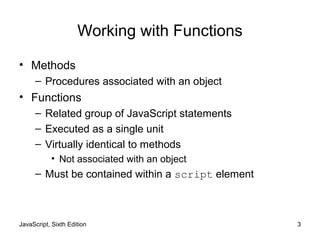
Working with Functions
• Methods
– Procedures associated with an object
• Functions
– Related group of JavaScript statements
– Executed as a single unit
– Virtually identical to methods
• Not associated with an object
– Must be contained within a script element
JavaScript, Sixth Edition 4
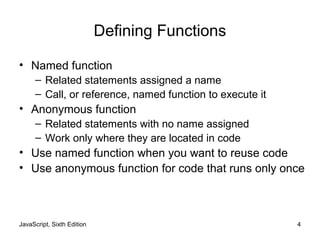
Defining Functions
• Named function
– Related statements assigned a name
– Call, or reference, named function to execute it
• Anonymous function
– Related statements with no name assigned
– Work only where they are located in code
• Use named function when you want to reuse code
• Use anonymous function for code that runs only once
JavaScript, Sixth Edition 5
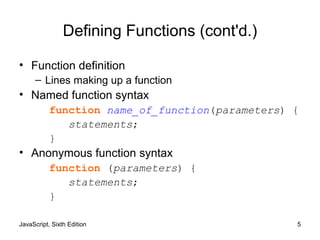
Defining Functions (cont'd.)
• Function definition
– Lines making up a function
• Named function syntax
function name_of_function(parameters) {
statements;
}
• Anonymous function syntax
function (parameters) {
statements;
}
JavaScript, Sixth Edition 6
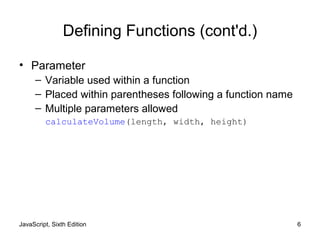
Defining Functions (cont'd.)
• Parameter
– Variable used within a function
– Placed within parentheses following a function name
– Multiple parameters allowed
calculateVolume(length, width, height)
JavaScript, Sixth Edition 7
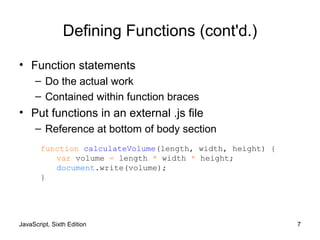
Defining Functions (cont'd.)
• Function statements
– Do the actual work
– Contained within function braces
• Put functions in an external .js file
– Reference at bottom of body section
function calculateVolume(length, width, height) {
var volume = length * width * height;
document.write(volume);
}
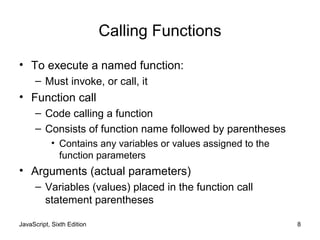
Calling Functions
• To execute a named function:
– Must invoke, or call, it
• Function call
– Code calling a function
– Consists of function name followed by parentheses
• Contains any variables or values assigned to the
function parameters
• Arguments (actual parameters)
– Variables (values) placed in the function call
statement parentheses
JavaScript, Sixth Edition 8
JavaScript, Sixth Edition 9
Calling Functions (cont'd.)
• Passing arguments
– Sending arguments to parameters of a called function
• Argument value assigned to the corresponding
parameter value in the function definition
JavaScript, Sixth Edition 10
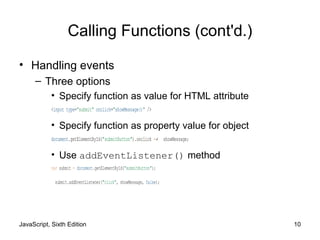
Calling Functions (cont'd.)
• Handling events
– Three options
• Specify function as value for HTML attribute
<input type="submit" onclick="showMessage()" />
• Specify function as property value for object
document.getElementById("submitButton").onclick =↵ showMessage;
• Use addEventListener() method
var submit = document.getElementById("submitButton");
submit.addEventListener("click", showMessage, false);
JavaScript, Sixth Edition 11
Calling Functions (cont'd.)
• Adding an event listener is most flexible
– Separates HTML and JavaScript code
– Can specify several event handlers for a single event
• IE8 requires use of the attachEvent() method
instead of addEventListener() (see Chapter 3)
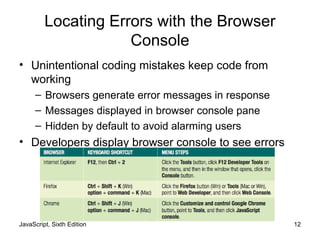
JavaScript, Sixth Edition 12
Locating Errors with the Browser
Console
• Unintentional coding mistakes keep code from
working
– Browsers generate error messages in response
– Messages displayed in browser console pane
– Hidden by default to avoid alarming users
• Developers display browser console to see errors
JavaScript, Sixth Edition 13
Locating Errors with the Browser
Console (cont'd.)
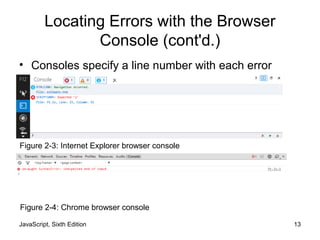
• Consoles specify a line number with each error
Figure 2-3: Internet Explorer browser console
Figure 2-4: Chrome browser console
JavaScript, Sixth Edition 14
Using Return Statements
• Can return function value to a calling statement
• Return statement
– Returns a value to the statement calling the function
– Use the return keyword with the variable or value to
send to the calling statement
• Example:
function averageNumbers(a, b, c) {
var sum_of_numbers = a + b + c;
var result = sum_of_numbers / 3;
return result;
}
JavaScript, Sixth Edition 15
Understanding Variable Scope
• Variable scope
– Where in code a declared variable can be used
• Global variable
– Declared outside a function
• Available to all parts of code
• Local variable
– Declared inside a function
• Only available within the function in which it is declared
– Cease to exist when the function ends
– Keyword var required
JavaScript, Sixth Edition 16
Understanding Variable Scope (cont’d.)
• Good programming technique
– Always use the var keyword when declaring
variables
• Clarifies where and when variable used
• Poor programming technique
– Declaring a global variable inside of a function by not
using the var keyword
• Harder to identify global variables in your scripts
Understanding Variable Scope (cont’d.)
• If variable declared within a function and does not
include the var keyword
– Variable automatically becomes a global variable
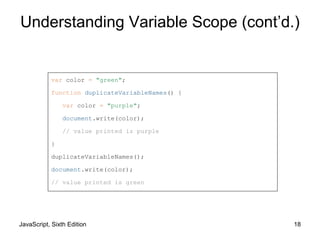
• Program may contain global and local variables with
the same name
– Local variable takes precedence
– Value assigned to local variable of the same name
• Not assigned to global variable of the same name
JavaScript, Sixth Edition 17
JavaScript, Sixth Edition 18
var color = "green";
function duplicateVariableNames() {
var color = "purple";
document.write(color);
// value printed is purple
}
duplicateVariableNames();
document.write(color);
// value printed is green
Understanding Variable Scope (cont’d.)
JavaScript, Sixth Edition 19
Using Built-in JavaScript Functions
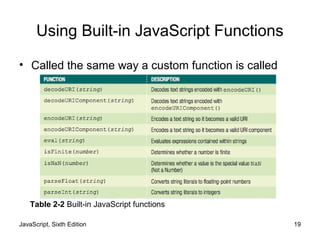
• Called the same way a custom function is called
Table 2-2 Built-in JavaScript functions
JavaScript, Sixth Edition 20
Working with Data Types
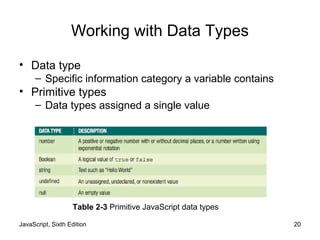
• Data type
– Specific information category a variable contains
• Primitive types
– Data types assigned a single value
Table 2-3 Primitive JavaScript data types
JavaScript, Sixth Edition 21
Working with Data Types (cont’d.)
• The null value: data type and a value
– Can be assigned to a variable
– Indicates no usable value
– Use: ensure a variable does not contain any data
• Undefined variable
– Never had a value assigned to it, has not been
declared, or does not exist
– Indicates variable never assigned a value: not even
null
– Use: determine if a value being used by another part
of a script
JavaScript, Sixth Edition 22
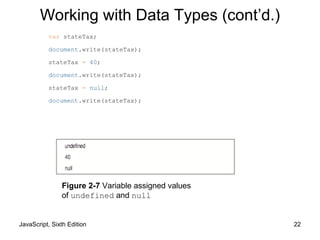
Figure 2-7 Variable assigned values
of undefined and null
var stateTax;
document.write(stateTax);
stateTax = 40;
document.write(stateTax);
stateTax = null;
document.write(stateTax);
Working with Data Types (cont’d.)
JavaScript, Sixth Edition 23
Working with Data Types (cont’d.)
• Strongly typed programming languages
– Require declaration of the data types of variables
– Strong typing also known as static typing
• Data types do not change after declared
• Loosely typed programming languages
– Do not require declaration of the data types of
variables
– Loose typing also known as dynamic typing
• Data types can change after declared
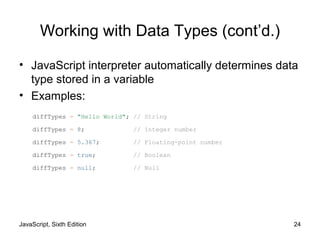
JavaScript, Sixth Edition 24
Working with Data Types (cont’d.)
• JavaScript interpreter automatically determines data
type stored in a variable
• Examples:
diffTypes = "Hello World"; // String
diffTypes = 8; // Integer number
diffTypes = 5.367; // Floating-point number
diffTypes = true; // Boolean
diffTypes = null; // Null
Understanding Numeric Data Types
• JavaScript supports two numeric data types
– Integers and floating-point numbers
• Integer
– Positive or negative number with no decimal places
• Floating-point number
– Number containing decimal places or written in
exponential notation
– Exponential notation (scientific notation)
• Shortened format for writing very large numbers or
numbers with many decimal places
JavaScript, Sixth Edition 25
Using Boolean Values
• Logical value of true or false
– Used for decision making
• Which parts of a program should execute
– Used for comparing data
• JavaScript programming Boolean values
– The words true and false
• JavaScript converts true and false values to the
integers 1 and 0 when necessary
JavaScript, Sixth Edition 26
JavaScript, Sixth Edition 27
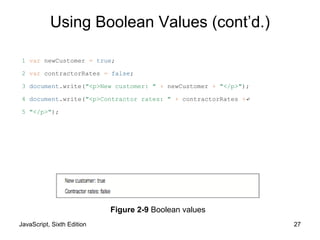
Figure 2-9 Boolean values
1 var newCustomer = true;
2 var contractorRates = false;
3 document.write("<p>New customer: " + newCustomer + "</p>");
4 document.write("<p>Contractor rates: " + contractorRates +↵
5 "</p>");
Using Boolean Values (cont’d.)
JavaScript, Sixth Edition 28
Working with Strings
• Text string
– Contains zero or more characters
• Surrounded by double or single quotation marks
– Can be used as literal values or assigned to a
variable
• Empty string
– Zero-length string value
– Valid for literal strings
• Not considered to be null or undefined
Working with Strings (cont’d.)
• To include a quoted string within a literal string
surrounded by double quotation marks
– Surround the quoted string with single quotation
marks
• To include a quoted string within a literal string
surrounded by single quotation marks
– Surround the quoted string with double quotation
marks
• String must begin and end with the same type of
quotation marks
JavaScript, Sixth Edition 29
JavaScript, Sixth Edition 30
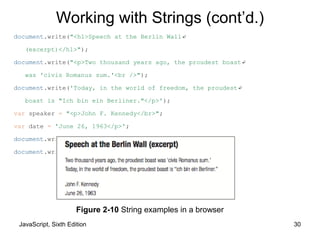
Figure 2-10 String examples in a browser
Working with Strings (cont’d.)
document.write("<h1>Speech at the Berlin Wall↵
(excerpt)</h1>");
document.write("<p>Two thousand years ago, the proudest boast↵
was 'civis Romanus sum.'<br />");
document.write('Today, in the world of freedom, the proudest↵
boast is "Ich bin ein Berliner."</p>');
var speaker = "<p>John F. Kennedy</br>";
var date = 'June 26, 1963</p>';
document.write(speaker);
document.write(date);
JavaScript, Sixth Edition 31
Working with Strings (cont’d.)
• String operators
– Concatenation operator (+): combines two strings
var destination = "Honolulu";
var location = "Hawaii";
destination = destination + " is in " + location;
• Compound assignment operator (+=): combines two
strings
var destination = "Honolulu";
destination += " is in Hawaii";
• Plus sign
– Concatenation operator and addition operator
Working with Strings (cont’d.)
• Escape characters and sequences
– Escape character
• Tells the compiler or interpreter that the character that
follows has a special purpose
• In JavaScript, escape character is backslash ()
– Escape sequence
• Escape character combined with other characters
• Most escape sequences carry out special functions
JavaScript, Sixth Edition 32
JavaScript, Sixth Edition 33
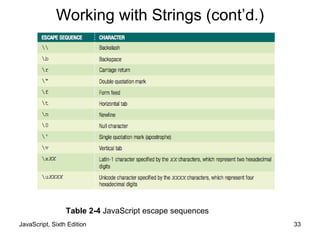
Table 2-4 JavaScript escape sequences
Working with Strings (cont’d.)
JavaScript, Sixth Edition 34
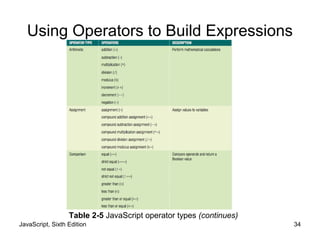
Using Operators to Build Expressions
Table 2-5 JavaScript operator types (continues)
JavaScript, Sixth Edition 35
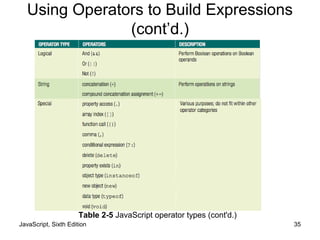
Table 2-5 JavaScript operator types (cont'd.)
Using Operators to Build Expressions
(cont’d.)
JavaScript, Sixth Edition 36
Using Operators to Build Expressions
(cont’d.)
• Binary operator
– Requires an operand before and after the operator
• Unary operator
– Requires a single operand either before or after the
operator
JavaScript, Sixth Edition 37
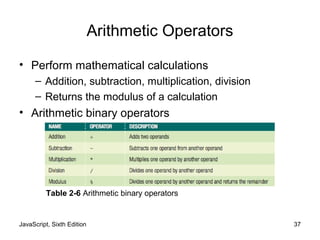
Arithmetic Operators
• Perform mathematical calculations
– Addition, subtraction, multiplication, division
– Returns the modulus of a calculation
• Arithmetic binary operators
Table 2-6 Arithmetic binary operators
JavaScript, Sixth Edition 38
Arithmetic Operators (cont’d.)
• Arithmetic binary operators (cont’d.)
– Value of operation on right side of the assignment
operator assigned to variable on the left side
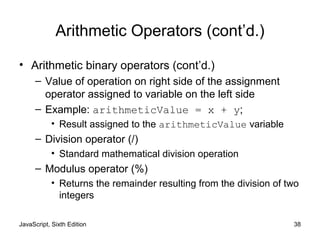
– Example: arithmeticValue = x + y;
• Result assigned to the arithmeticValue variable
– Division operator (/)
• Standard mathematical division operation
– Modulus operator (%)
• Returns the remainder resulting from the division of two
integers
JavaScript, Sixth Edition 39
Figure 2-13 Division and modulus expressions
Arithmetic Operators (cont’d.)
var divisionResult = 15 / 6;
var modulusResult = 15 % 6;
document.write("<p>15 divided by 6 is "↵
+ divisionResult + ".</p>"); // prints '2.5'
document.write("<p>The whole number 6 goes into 15 twice,↵
with a remainder of "+ modulusResult + ".</p>");↵ // prints '3'
JavaScript, Sixth Edition 40
Arithmetic Operators (cont’d.)
• Arithmetic binary operators (cont’d.)
– Assignment statement
• Can include combination of variables and literal values
on the right side
• Cannot include a literal value as the left operand
– JavaScript interpreter
• Attempts to convert the string values to numbers
• Does not convert strings to numbers when using the
addition operator
JavaScript, Sixth Edition 41
Arithmetic Operators (cont’d.)
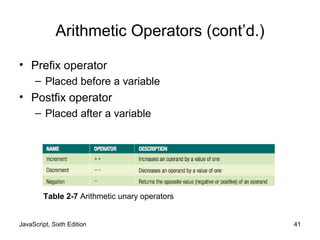
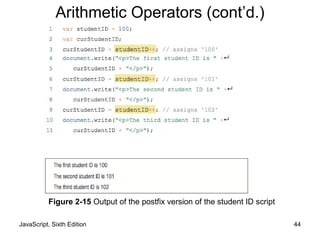
• Prefix operator
– Placed before a variable
• Postfix operator
– Placed after a variable
Table 2-7 Arithmetic unary operators
JavaScript, Sixth Edition 42
Arithmetic Operators (cont’d.)
• Arithmetic unary operators
– Performed on a single variable using unary operators
– Increment (++) unary operator: used as prefix
operators
• Prefix operator placed before a variable
– Decrement (--) unary operator: used as postfix
operator
• Postfix operator placed after a variable
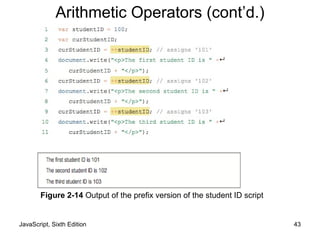
– Example: ++count; and count++;
• Both increase the count variable by one, but return
different values
JavaScript, Sixth Edition 43
Figure 2-14 Output of the prefix version of the student ID script
Arithmetic Operators (cont’d.)
JavaScript, Sixth Edition 44
Figure 2-15 Output of the postfix version of the student ID script
Arithmetic Operators (cont’d.)
JavaScript, Sixth Edition 45
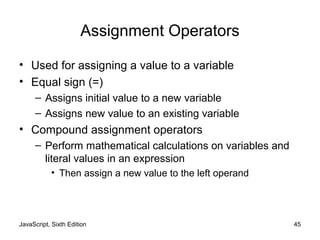
Assignment Operators
• Used for assigning a value to a variable
• Equal sign (=)
– Assigns initial value to a new variable
– Assigns new value to an existing variable
• Compound assignment operators
– Perform mathematical calculations on variables and
literal values in an expression
• Then assign a new value to the left operand
JavaScript, Sixth Edition 46
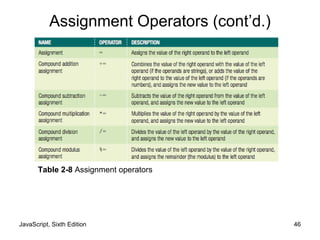
Table 2-8 Assignment operators
Assignment Operators (cont’d.)
JavaScript, Sixth Edition 47
Assignment Operators (cont’d.)
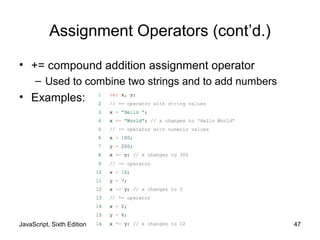
• += compound addition assignment operator
– Used to combine two strings and to add numbers
• Examples:
JavaScript, Sixth Edition 48
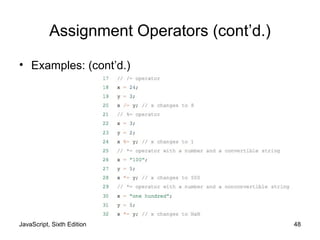
Assignment Operators (cont’d.)
• Examples: (cont’d.)
JavaScript, Sixth Edition 49
Comparison and Conditional Operators
• Comparison operators
– Compare two operands
• Determine if one numeric value is greater than another
– Boolean value of true or false returned after compare
• Operands of comparison operators
– Two numeric values: compared numerically
– Two nonnumeric values: compared in alphabetical
order
– Number and a string: convert string value to a number
• If conversion fails: value of false returned
JavaScript, Sixth Edition 50
Table 2-9 Comparison operators
Comparison and Conditional Operators
(cont’d.)
JavaScript, Sixth Edition 51
Comparison and Conditional Operators
(cont’d.)
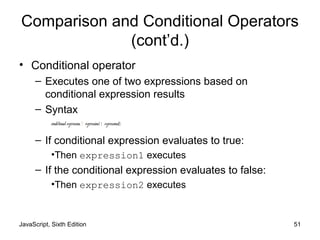
• Conditional operator
– Executes one of two expressions based on
conditional expression results
– Syntax
conditional expression ? expression1 : expression2;
– If conditional expression evaluates to true:
•Then expression1 executes
– If the conditional expression evaluates to false:
•Then expression2 executes
JavaScript, Sixth Edition 52
Comparison and Conditional Operators
(cont’d.)
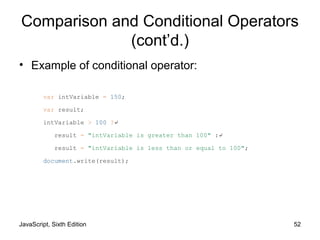
• Example of conditional operator:
var intVariable = 150;
var result;
intVariable > 100 ?↵
result = "intVariable is greater than 100" :↵
result = "intVariable is less than or equal to 100";
document.write(result);
JavaScript, Sixth Edition 53
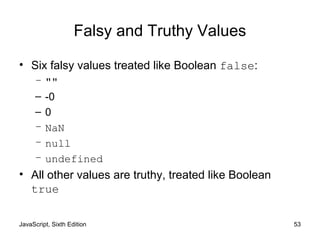
Falsy and Truthy Values
• Six falsy values treated like Boolean false:
– ""
– -0
– 0
– NaN
– null
– undefined
• All other values are truthy, treated like Boolean
true
JavaScript, Sixth Edition 54
Logical Operators
• Compare two Boolean operands for equality
Table 2-10 Logical operators
JavaScript, Sixth Edition 55
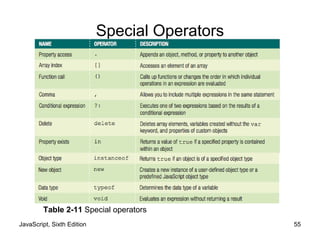
Table 2-11 Special operators
Special Operators
JavaScript, Sixth Edition 56
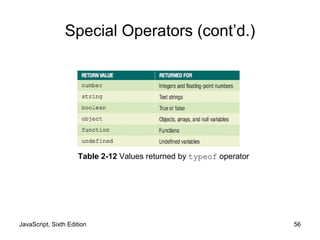
Special Operators (cont’d.)
Table 2-12 Values returned by typeof operator
JavaScript, Sixth Edition 57
Understanding Operator Precedence
• Operator precedence
– Order in which operations in an expression evaluate
• Associativity
– Order in which operators of equal precedence
execute
– Left to right associativity
– Right to left associativity
JavaScript, Sixth Edition 58
Understanding Operator Precedence
(cont’d.)
• Evaluating associativity
– Example: multiplication and division operators
• Associativity of left to right
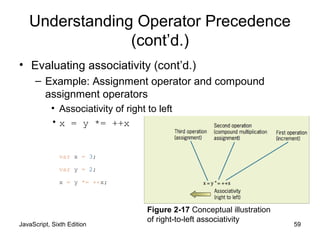
Figure 2-16 Conceptual illustration
of left to right associativity
JavaScript, Sixth Edition 59
Understanding Operator Precedence
(cont’d.)
• Evaluating associativity (cont’d.)
– Example: Assignment operator and compound
assignment operators
• Associativity of right to left
• x = y *= ++x
Figure 2-17 Conceptual illustration
of right-to-left associativity
var x = 3;
var y = 2;
x = y *= ++x;
JavaScript, Sixth Edition 60
Summary
• Functions
– Similar to methods associated with an object
– Pass parameters
– To execute, must be called
• Variable scope
– Where a declared variable can be used
– Global and local variables
• Data type
– Specific category of information a variable contains
– Static typing and dynamic typing
JavaScript, Sixth Edition 61
Summary (cont’d.)
• Numeric data types: integer and floating point
• Boolean values: true and false
• Strings: one or more character surrounded by
double or single quotes
– String operators
– Escape character
• Operators build expressions
• Operator precedence
– Order in which operations in an expression are
evaluated

9781305078444 ppt ch02

  • 1.
    JavaScript, Sixth Edition Chapter2 Working with Functions, Data Types, and Operators
  • 2.
    JavaScript, Sixth Edition2 Objectives When you complete this chapter, you will be able to: • Use functions to organize your JavaScript code • Use expressions and operators • Identify the order of operator precedence in an expression
  • 3.
    JavaScript, Sixth Edition3 Working with Functions • Methods – Procedures associated with an object • Functions – Related group of JavaScript statements – Executed as a single unit – Virtually identical to methods • Not associated with an object – Must be contained within a script element
  • 4.
    JavaScript, Sixth Edition4 Defining Functions • Named function – Related statements assigned a name – Call, or reference, named function to execute it • Anonymous function – Related statements with no name assigned – Work only where they are located in code • Use named function when you want to reuse code • Use anonymous function for code that runs only once
  • 5.
    JavaScript, Sixth Edition5 Defining Functions (cont'd.) • Function definition – Lines making up a function • Named function syntax function name_of_function(parameters) { statements; } • Anonymous function syntax function (parameters) { statements; }
  • 6.
    JavaScript, Sixth Edition6 Defining Functions (cont'd.) • Parameter – Variable used within a function – Placed within parentheses following a function name – Multiple parameters allowed calculateVolume(length, width, height)
  • 7.
    JavaScript, Sixth Edition7 Defining Functions (cont'd.) • Function statements – Do the actual work – Contained within function braces • Put functions in an external .js file – Reference at bottom of body section function calculateVolume(length, width, height) { var volume = length * width * height; document.write(volume); }
  • 8.
    Calling Functions • Toexecute a named function: – Must invoke, or call, it • Function call – Code calling a function – Consists of function name followed by parentheses • Contains any variables or values assigned to the function parameters • Arguments (actual parameters) – Variables (values) placed in the function call statement parentheses JavaScript, Sixth Edition 8
  • 9.
    JavaScript, Sixth Edition9 Calling Functions (cont'd.) • Passing arguments – Sending arguments to parameters of a called function • Argument value assigned to the corresponding parameter value in the function definition
  • 10.
    JavaScript, Sixth Edition10 Calling Functions (cont'd.) • Handling events – Three options • Specify function as value for HTML attribute <input type="submit" onclick="showMessage()" /> • Specify function as property value for object document.getElementById("submitButton").onclick =↵ showMessage; • Use addEventListener() method var submit = document.getElementById("submitButton"); submit.addEventListener("click", showMessage, false);
  • 11.
    JavaScript, Sixth Edition11 Calling Functions (cont'd.) • Adding an event listener is most flexible – Separates HTML and JavaScript code – Can specify several event handlers for a single event • IE8 requires use of the attachEvent() method instead of addEventListener() (see Chapter 3)
  • 12.
    JavaScript, Sixth Edition12 Locating Errors with the Browser Console • Unintentional coding mistakes keep code from working – Browsers generate error messages in response – Messages displayed in browser console pane – Hidden by default to avoid alarming users • Developers display browser console to see errors
  • 13.
    JavaScript, Sixth Edition13 Locating Errors with the Browser Console (cont'd.) • Consoles specify a line number with each error Figure 2-3: Internet Explorer browser console Figure 2-4: Chrome browser console
  • 14.
    JavaScript, Sixth Edition14 Using Return Statements • Can return function value to a calling statement • Return statement – Returns a value to the statement calling the function – Use the return keyword with the variable or value to send to the calling statement • Example: function averageNumbers(a, b, c) { var sum_of_numbers = a + b + c; var result = sum_of_numbers / 3; return result; }
  • 15.
    JavaScript, Sixth Edition15 Understanding Variable Scope • Variable scope – Where in code a declared variable can be used • Global variable – Declared outside a function • Available to all parts of code • Local variable – Declared inside a function • Only available within the function in which it is declared – Cease to exist when the function ends – Keyword var required
  • 16.
    JavaScript, Sixth Edition16 Understanding Variable Scope (cont’d.) • Good programming technique – Always use the var keyword when declaring variables • Clarifies where and when variable used • Poor programming technique – Declaring a global variable inside of a function by not using the var keyword • Harder to identify global variables in your scripts
  • 17.
    Understanding Variable Scope(cont’d.) • If variable declared within a function and does not include the var keyword – Variable automatically becomes a global variable • Program may contain global and local variables with the same name – Local variable takes precedence – Value assigned to local variable of the same name • Not assigned to global variable of the same name JavaScript, Sixth Edition 17
  • 18.
    JavaScript, Sixth Edition18 var color = "green"; function duplicateVariableNames() { var color = "purple"; document.write(color); // value printed is purple } duplicateVariableNames(); document.write(color); // value printed is green Understanding Variable Scope (cont’d.)
  • 19.
    JavaScript, Sixth Edition19 Using Built-in JavaScript Functions • Called the same way a custom function is called Table 2-2 Built-in JavaScript functions
  • 20.
    JavaScript, Sixth Edition20 Working with Data Types • Data type – Specific information category a variable contains • Primitive types – Data types assigned a single value Table 2-3 Primitive JavaScript data types
  • 21.
    JavaScript, Sixth Edition21 Working with Data Types (cont’d.) • The null value: data type and a value – Can be assigned to a variable – Indicates no usable value – Use: ensure a variable does not contain any data • Undefined variable – Never had a value assigned to it, has not been declared, or does not exist – Indicates variable never assigned a value: not even null – Use: determine if a value being used by another part of a script
  • 22.
    JavaScript, Sixth Edition22 Figure 2-7 Variable assigned values of undefined and null var stateTax; document.write(stateTax); stateTax = 40; document.write(stateTax); stateTax = null; document.write(stateTax); Working with Data Types (cont’d.)
  • 23.
    JavaScript, Sixth Edition23 Working with Data Types (cont’d.) • Strongly typed programming languages – Require declaration of the data types of variables – Strong typing also known as static typing • Data types do not change after declared • Loosely typed programming languages – Do not require declaration of the data types of variables – Loose typing also known as dynamic typing • Data types can change after declared
  • 24.
    JavaScript, Sixth Edition24 Working with Data Types (cont’d.) • JavaScript interpreter automatically determines data type stored in a variable • Examples: diffTypes = "Hello World"; // String diffTypes = 8; // Integer number diffTypes = 5.367; // Floating-point number diffTypes = true; // Boolean diffTypes = null; // Null
  • 25.
    Understanding Numeric DataTypes • JavaScript supports two numeric data types – Integers and floating-point numbers • Integer – Positive or negative number with no decimal places • Floating-point number – Number containing decimal places or written in exponential notation – Exponential notation (scientific notation) • Shortened format for writing very large numbers or numbers with many decimal places JavaScript, Sixth Edition 25
  • 26.
    Using Boolean Values •Logical value of true or false – Used for decision making • Which parts of a program should execute – Used for comparing data • JavaScript programming Boolean values – The words true and false • JavaScript converts true and false values to the integers 1 and 0 when necessary JavaScript, Sixth Edition 26
  • 27.
    JavaScript, Sixth Edition27 Figure 2-9 Boolean values 1 var newCustomer = true; 2 var contractorRates = false; 3 document.write("<p>New customer: " + newCustomer + "</p>"); 4 document.write("<p>Contractor rates: " + contractorRates +↵ 5 "</p>"); Using Boolean Values (cont’d.)
  • 28.
    JavaScript, Sixth Edition28 Working with Strings • Text string – Contains zero or more characters • Surrounded by double or single quotation marks – Can be used as literal values or assigned to a variable • Empty string – Zero-length string value – Valid for literal strings • Not considered to be null or undefined
  • 29.
    Working with Strings(cont’d.) • To include a quoted string within a literal string surrounded by double quotation marks – Surround the quoted string with single quotation marks • To include a quoted string within a literal string surrounded by single quotation marks – Surround the quoted string with double quotation marks • String must begin and end with the same type of quotation marks JavaScript, Sixth Edition 29
  • 30.
    JavaScript, Sixth Edition30 Figure 2-10 String examples in a browser Working with Strings (cont’d.) document.write("<h1>Speech at the Berlin Wall↵ (excerpt)</h1>"); document.write("<p>Two thousand years ago, the proudest boast↵ was 'civis Romanus sum.'<br />"); document.write('Today, in the world of freedom, the proudest↵ boast is "Ich bin ein Berliner."</p>'); var speaker = "<p>John F. Kennedy</br>"; var date = 'June 26, 1963</p>'; document.write(speaker); document.write(date);
  • 31.
    JavaScript, Sixth Edition31 Working with Strings (cont’d.) • String operators – Concatenation operator (+): combines two strings var destination = "Honolulu"; var location = "Hawaii"; destination = destination + " is in " + location; • Compound assignment operator (+=): combines two strings var destination = "Honolulu"; destination += " is in Hawaii"; • Plus sign – Concatenation operator and addition operator
  • 32.
    Working with Strings(cont’d.) • Escape characters and sequences – Escape character • Tells the compiler or interpreter that the character that follows has a special purpose • In JavaScript, escape character is backslash () – Escape sequence • Escape character combined with other characters • Most escape sequences carry out special functions JavaScript, Sixth Edition 32
  • 33.
    JavaScript, Sixth Edition33 Table 2-4 JavaScript escape sequences Working with Strings (cont’d.)
  • 34.
    JavaScript, Sixth Edition34 Using Operators to Build Expressions Table 2-5 JavaScript operator types (continues)
  • 35.
    JavaScript, Sixth Edition35 Table 2-5 JavaScript operator types (cont'd.) Using Operators to Build Expressions (cont’d.)
  • 36.
    JavaScript, Sixth Edition36 Using Operators to Build Expressions (cont’d.) • Binary operator – Requires an operand before and after the operator • Unary operator – Requires a single operand either before or after the operator
  • 37.
    JavaScript, Sixth Edition37 Arithmetic Operators • Perform mathematical calculations – Addition, subtraction, multiplication, division – Returns the modulus of a calculation • Arithmetic binary operators Table 2-6 Arithmetic binary operators
  • 38.
    JavaScript, Sixth Edition38 Arithmetic Operators (cont’d.) • Arithmetic binary operators (cont’d.) – Value of operation on right side of the assignment operator assigned to variable on the left side – Example: arithmeticValue = x + y; • Result assigned to the arithmeticValue variable – Division operator (/) • Standard mathematical division operation – Modulus operator (%) • Returns the remainder resulting from the division of two integers
  • 39.
    JavaScript, Sixth Edition39 Figure 2-13 Division and modulus expressions Arithmetic Operators (cont’d.) var divisionResult = 15 / 6; var modulusResult = 15 % 6; document.write("<p>15 divided by 6 is "↵ + divisionResult + ".</p>"); // prints '2.5' document.write("<p>The whole number 6 goes into 15 twice,↵ with a remainder of "+ modulusResult + ".</p>");↵ // prints '3'
  • 40.
    JavaScript, Sixth Edition40 Arithmetic Operators (cont’d.) • Arithmetic binary operators (cont’d.) – Assignment statement • Can include combination of variables and literal values on the right side • Cannot include a literal value as the left operand – JavaScript interpreter • Attempts to convert the string values to numbers • Does not convert strings to numbers when using the addition operator
  • 41.
    JavaScript, Sixth Edition41 Arithmetic Operators (cont’d.) • Prefix operator – Placed before a variable • Postfix operator – Placed after a variable Table 2-7 Arithmetic unary operators
  • 42.
    JavaScript, Sixth Edition42 Arithmetic Operators (cont’d.) • Arithmetic unary operators – Performed on a single variable using unary operators – Increment (++) unary operator: used as prefix operators • Prefix operator placed before a variable – Decrement (--) unary operator: used as postfix operator • Postfix operator placed after a variable – Example: ++count; and count++; • Both increase the count variable by one, but return different values
  • 43.
    JavaScript, Sixth Edition43 Figure 2-14 Output of the prefix version of the student ID script Arithmetic Operators (cont’d.)
  • 44.
    JavaScript, Sixth Edition44 Figure 2-15 Output of the postfix version of the student ID script Arithmetic Operators (cont’d.)
  • 45.
    JavaScript, Sixth Edition45 Assignment Operators • Used for assigning a value to a variable • Equal sign (=) – Assigns initial value to a new variable – Assigns new value to an existing variable • Compound assignment operators – Perform mathematical calculations on variables and literal values in an expression • Then assign a new value to the left operand
  • 46.
    JavaScript, Sixth Edition46 Table 2-8 Assignment operators Assignment Operators (cont’d.)
  • 47.
    JavaScript, Sixth Edition47 Assignment Operators (cont’d.) • += compound addition assignment operator – Used to combine two strings and to add numbers • Examples:
  • 48.
    JavaScript, Sixth Edition48 Assignment Operators (cont’d.) • Examples: (cont’d.)
  • 49.
    JavaScript, Sixth Edition49 Comparison and Conditional Operators • Comparison operators – Compare two operands • Determine if one numeric value is greater than another – Boolean value of true or false returned after compare • Operands of comparison operators – Two numeric values: compared numerically – Two nonnumeric values: compared in alphabetical order – Number and a string: convert string value to a number • If conversion fails: value of false returned
  • 50.
    JavaScript, Sixth Edition50 Table 2-9 Comparison operators Comparison and Conditional Operators (cont’d.)
  • 51.
    JavaScript, Sixth Edition51 Comparison and Conditional Operators (cont’d.) • Conditional operator – Executes one of two expressions based on conditional expression results – Syntax conditional expression ? expression1 : expression2; – If conditional expression evaluates to true: •Then expression1 executes – If the conditional expression evaluates to false: •Then expression2 executes
  • 52.
    JavaScript, Sixth Edition52 Comparison and Conditional Operators (cont’d.) • Example of conditional operator: var intVariable = 150; var result; intVariable > 100 ?↵ result = "intVariable is greater than 100" :↵ result = "intVariable is less than or equal to 100"; document.write(result);
  • 53.
    JavaScript, Sixth Edition53 Falsy and Truthy Values • Six falsy values treated like Boolean false: – "" – -0 – 0 – NaN – null – undefined • All other values are truthy, treated like Boolean true
  • 54.
    JavaScript, Sixth Edition54 Logical Operators • Compare two Boolean operands for equality Table 2-10 Logical operators
  • 55.
    JavaScript, Sixth Edition55 Table 2-11 Special operators Special Operators
  • 56.
    JavaScript, Sixth Edition56 Special Operators (cont’d.) Table 2-12 Values returned by typeof operator
  • 57.
    JavaScript, Sixth Edition57 Understanding Operator Precedence • Operator precedence – Order in which operations in an expression evaluate • Associativity – Order in which operators of equal precedence execute – Left to right associativity – Right to left associativity
  • 58.
    JavaScript, Sixth Edition58 Understanding Operator Precedence (cont’d.) • Evaluating associativity – Example: multiplication and division operators • Associativity of left to right Figure 2-16 Conceptual illustration of left to right associativity
  • 59.
    JavaScript, Sixth Edition59 Understanding Operator Precedence (cont’d.) • Evaluating associativity (cont’d.) – Example: Assignment operator and compound assignment operators • Associativity of right to left • x = y *= ++x Figure 2-17 Conceptual illustration of right-to-left associativity var x = 3; var y = 2; x = y *= ++x;
  • 60.
    JavaScript, Sixth Edition60 Summary • Functions – Similar to methods associated with an object – Pass parameters – To execute, must be called • Variable scope – Where a declared variable can be used – Global and local variables • Data type – Specific category of information a variable contains – Static typing and dynamic typing
  • 61.
    JavaScript, Sixth Edition61 Summary (cont’d.) • Numeric data types: integer and floating point • Boolean values: true and false • Strings: one or more character surrounded by double or single quotes – String operators – Escape character • Operators build expressions • Operator precedence – Order in which operations in an expression are evaluated