Chapter 14:
Exception Handling
Objectives
• In this chapter, you will:
– Learn what an exception is
– Learn how to handle exceptions within a program
– Learn how a try/catch block is used to handle
exceptions
– Learn how to throw an exception
– Become familiar with C++ exception classes and
how to use them in a program
2C++ Programming: From Problem Analysis to Program Design, Seventh Edition
Objectives (cont’d.)
– Learn how to create your own exception classes
– Discover how to throw and rethrow an exception
– Explore exception handling techniques
– Explore stack unwinding
3C++ Programming: From Problem Analysis to Program Design, Seventh Edition
Introduction
• Exception: undesirable event detectable
during program execution
• Code to handle exceptions depends on the
type of application being developed
• May or may not want the program to terminate
when an exception occurs
• Can add exception-handling code at point
where an error can occur
4C++ Programming: From Problem Analysis to Program Design, Seventh Edition
Handling Exceptions Within a
Program
• Assert function:
– Checks if an expression meets certain condition(s)
– If conditions are not met, it terminates the
program
• Example: division by 0
– If divisor is zero, assert terminates the program
with an error message
5C++ Programming: From Problem Analysis to Program Design, Seventh Edition
C++ Mechanisms
of Exception Handling
• try/catch block: used to handle exceptions
• Exception must be thrown in a try block and
caught by a catch block
• C++ provides support to handle exceptions via
a hierarchy of classes
6C++ Programming: From Problem Analysis to Program Design, Seventh Edition
try/catch Block
• Statements that may generate an exception
are placed in a try block
• The try block also contains statements that
should not be executed if an exception occurs
• try block is followed by one or more catch
blocks
7C++ Programming: From Problem Analysis to Program Design, Seventh Edition
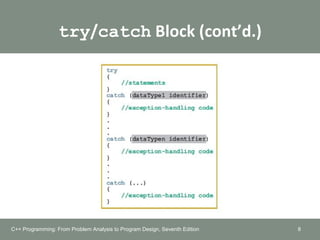
try/catch Block (cont’d.)
8C++ Programming: From Problem Analysis to Program Design, Seventh Edition
try/catch Block (cont’d.)
• catch block:
– Specifies the type of exception it can catch
– Contains an exception handler
• If the heading of a catch block contains ...
(ellipses) in place of parameters
– Block can catch exceptions of all types
• If no exception is thrown in a try block
– All catch blocks are ignored
– Execution resumes after the last catch block
9C++ Programming: From Problem Analysis to Program Design, Seventh Edition
try/catch Block (cont’d.)
• If an exception is thrown in a try block
– Remaining statements (in block) are ignored
• Program searches catch blocks in order,
looking for an appropriate exception handler
– If the type of thrown exception matches the
parameter type in one of the catch blocks:
• Code of that catch block executes
• Remaining catch blocks are ignored
10C++ Programming: From Problem Analysis to Program Design, Seventh Edition
try/catch Block (cont’d.)
• A catch block can have at most one catch
block parameter
– catch block parameter becomes a placeholder
for the value thrown
11C++ Programming: From Problem Analysis to Program Design, Seventh Edition
Throwing an Exception
• For try/catch to work, the exception
must be thrown in the try block
• General syntax:
throw exception;
where expression is a constant value,
variable, or object
• Object being thrown can be a specific object
or an anonymous object
• In C++, an exception is a value
12C++ Programming: From Problem Analysis to Program Design, Seventh Edition
Order of catch Blocks
• catch block can catch:
– All exceptions of a specific type
– All types of exceptions
• A catch block with an ellipsis (. . .) catches
any type of exception
– If used, it should be the last catch block of
that sequence
• Be careful about the order in which you list
catch blocks
13C++ Programming: From Problem Analysis to Program Design, Seventh Edition
Using C++ Exception Classes
• C++ provides support to handle exceptions via
a hierarchy of classes
• what function: returns a string containing the
exception object thrown by C++’s built-in
exception classes
• class exception: base class of the
exception classes provided by C++
– Contained in the header file exception
14C++ Programming: From Problem Analysis to Program Design, Seventh Edition
Using C++ Exception Classes (cont’d.)
• Two subclasses of exception (defined in
stdexcept):
– logic_error includes subclasses:
• invalid_argument: for use when illegal
arguments are used in a function call
• out_of_range: string subscript out of range error
• length_error: if a length greater than the
maximum allowed for a string object is used
– runtime_error includes subclasses:
• overflow_error and underflow_error
15C++ Programming: From Problem Analysis to Program Design, Seventh Edition
Creating Your Own Exception Classes
• Can create your own exception classes to
handle specific exceptions
– C++ uses the same mechanism to process these
exceptions
• throw statement: used to throw your own
exceptions
• Any class can be an exception class
– How you use the class makes it an exception class
16C++ Programming: From Problem Analysis to Program Design, Seventh Edition
Creating Your Own Exception Classes
(cont’d.)
• Exception class with member variables
typically includes:
– Constructors
– The function what
17C++ Programming: From Problem Analysis to Program Design, Seventh Edition
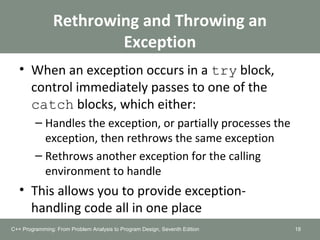
Rethrowing and Throwing an
Exception
• When an exception occurs in a try block,
control immediately passes to one of the
catch blocks, which either:
– Handles the exception, or partially processes the
exception, then rethrows the same exception
– Rethrows another exception for the calling
environment to handle
• This allows you to provide exception-
handling code all in one place
18C++ Programming: From Problem Analysis to Program Design, Seventh Edition
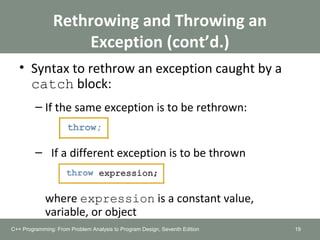
Rethrowing and Throwing an
Exception (cont’d.)
• Syntax to rethrow an exception caught by a
catch block:
– If the same exception is to be rethrown:
– If a different exception is to be thrown
where expression is a constant value,
variable, or object
19C++ Programming: From Problem Analysis to Program Design, Seventh Edition
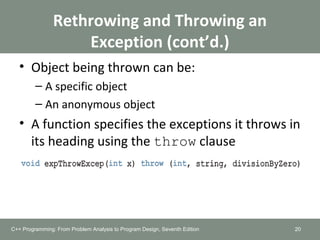
Rethrowing and Throwing an
Exception (cont’d.)
• Object being thrown can be:
– A specific object
– An anonymous object
• A function specifies the exceptions it throws in
its heading using the throw clause
20C++ Programming: From Problem Analysis to Program Design, Seventh Edition
Exception-Handling Techniques
• When an exception occurs, the programmer
usually has three choices:
– Terminate the program
– Include code to recover from the exception
– Log the error and continue
21C++ Programming: From Problem Analysis to Program Design, Seventh Edition
Terminate the Program
• In some cases, it is best to terminate the
program when an exception occurs
• Example: if an input file does not exist when
the program executes
– There is no point in continuing with the program
– Program can output an appropriate error message
and terminate
22C++ Programming: From Problem Analysis to Program Design, Seventh Edition
Fix the Error and Continue
• In some cases, you will want to handle the
exception and let the program continue
• Example: a user inputs a letter instead of a
number
– The input stream will enter the fail state
– Can include the necessary code to keep prompting
the user to input a number until the entry is valid
23C++ Programming: From Problem Analysis to Program Design, Seventh Edition
Log the Error and Continue
• Example: if the program is designed to run a
nuclear reactor or continuously monitor a
satellite
– It cannot be terminated if an exception occurs
• When an exception occurs
– The program should write the exception into a file
and continue to run
24C++ Programming: From Problem Analysis to Program Design, Seventh Edition
Stack Unwinding
• When an exception is thrown in a function,
the function can do the following:
– Do nothing
– Partially process the exception and throw the
same exception or a new exception
– Throw a new exception
• In each case, the function-call stack is
unwound so that the exception can be caught
in the next try/catch block
25C++ Programming: From Problem Analysis to Program Design, Seventh Edition
Stack Unwinding (cont’d.)
• When the function call stack is unwound:
– The function in which the exception was not
caught and/or rethrown terminates
– Memory for its local variables is destroyed
• Stack unwinding continues until:
– A try/catch handles the exception, or
– The program does not handle the exception
• The function terminate is called to terminate
the program
26C++ Programming: From Problem Analysis to Program Design, Seventh Edition
Summary
• Exception: an undesirable event detectable
during program execution
• assert checks whether an expression
meets a specified condition; terminates if
not met
• try/catch block handles exceptions
• Statements that may generate an
exception are placed in a try block
27C++ Programming: From Problem Analysis to Program Design, Seventh Edition
Summary (cont’d.)
• catch block specifies type of exception it
can catch and contains an exception handler
• If no exceptions are thrown in a try block,
all catch blocks for that try block are
ignored
• Data type of catch block parameter
specifies type of exception that catch block
can catch
28C++ Programming: From Problem Analysis to Program Design, Seventh Edition
Summary (cont’d.)
• exception: base class for exception
classes
• what function: returns a string containing
the exception object thrown by built-in
exception classes
• You can create your own exception classes
• A function specifies the exceptions it throws
in its heading with the throw clause
29C++ Programming: From Problem Analysis to Program Design, Seventh Edition
Summary (cont’d.)
• If the program does not handle the
exception, then the function terminate
terminates the program
• Any class can be considered an exception
class, based on how it is used
30C++ Programming: From Problem Analysis to Program Design, Seventh Edition

9781285852744 ppt ch14

  • 1.
  • 2.
    Objectives • In thischapter, you will: – Learn what an exception is – Learn how to handle exceptions within a program – Learn how a try/catch block is used to handle exceptions – Learn how to throw an exception – Become familiar with C++ exception classes and how to use them in a program 2C++ Programming: From Problem Analysis to Program Design, Seventh Edition
  • 3.
    Objectives (cont’d.) – Learnhow to create your own exception classes – Discover how to throw and rethrow an exception – Explore exception handling techniques – Explore stack unwinding 3C++ Programming: From Problem Analysis to Program Design, Seventh Edition
  • 4.
    Introduction • Exception: undesirableevent detectable during program execution • Code to handle exceptions depends on the type of application being developed • May or may not want the program to terminate when an exception occurs • Can add exception-handling code at point where an error can occur 4C++ Programming: From Problem Analysis to Program Design, Seventh Edition
  • 5.
    Handling Exceptions Withina Program • Assert function: – Checks if an expression meets certain condition(s) – If conditions are not met, it terminates the program • Example: division by 0 – If divisor is zero, assert terminates the program with an error message 5C++ Programming: From Problem Analysis to Program Design, Seventh Edition
  • 6.
    C++ Mechanisms of ExceptionHandling • try/catch block: used to handle exceptions • Exception must be thrown in a try block and caught by a catch block • C++ provides support to handle exceptions via a hierarchy of classes 6C++ Programming: From Problem Analysis to Program Design, Seventh Edition
  • 7.
    try/catch Block • Statementsthat may generate an exception are placed in a try block • The try block also contains statements that should not be executed if an exception occurs • try block is followed by one or more catch blocks 7C++ Programming: From Problem Analysis to Program Design, Seventh Edition
  • 8.
    try/catch Block (cont’d.) 8C++Programming: From Problem Analysis to Program Design, Seventh Edition
  • 9.
    try/catch Block (cont’d.) •catch block: – Specifies the type of exception it can catch – Contains an exception handler • If the heading of a catch block contains ... (ellipses) in place of parameters – Block can catch exceptions of all types • If no exception is thrown in a try block – All catch blocks are ignored – Execution resumes after the last catch block 9C++ Programming: From Problem Analysis to Program Design, Seventh Edition
  • 10.
    try/catch Block (cont’d.) •If an exception is thrown in a try block – Remaining statements (in block) are ignored • Program searches catch blocks in order, looking for an appropriate exception handler – If the type of thrown exception matches the parameter type in one of the catch blocks: • Code of that catch block executes • Remaining catch blocks are ignored 10C++ Programming: From Problem Analysis to Program Design, Seventh Edition
  • 11.
    try/catch Block (cont’d.) •A catch block can have at most one catch block parameter – catch block parameter becomes a placeholder for the value thrown 11C++ Programming: From Problem Analysis to Program Design, Seventh Edition
  • 12.
    Throwing an Exception •For try/catch to work, the exception must be thrown in the try block • General syntax: throw exception; where expression is a constant value, variable, or object • Object being thrown can be a specific object or an anonymous object • In C++, an exception is a value 12C++ Programming: From Problem Analysis to Program Design, Seventh Edition
  • 13.
    Order of catchBlocks • catch block can catch: – All exceptions of a specific type – All types of exceptions • A catch block with an ellipsis (. . .) catches any type of exception – If used, it should be the last catch block of that sequence • Be careful about the order in which you list catch blocks 13C++ Programming: From Problem Analysis to Program Design, Seventh Edition
  • 14.
    Using C++ ExceptionClasses • C++ provides support to handle exceptions via a hierarchy of classes • what function: returns a string containing the exception object thrown by C++’s built-in exception classes • class exception: base class of the exception classes provided by C++ – Contained in the header file exception 14C++ Programming: From Problem Analysis to Program Design, Seventh Edition
  • 15.
    Using C++ ExceptionClasses (cont’d.) • Two subclasses of exception (defined in stdexcept): – logic_error includes subclasses: • invalid_argument: for use when illegal arguments are used in a function call • out_of_range: string subscript out of range error • length_error: if a length greater than the maximum allowed for a string object is used – runtime_error includes subclasses: • overflow_error and underflow_error 15C++ Programming: From Problem Analysis to Program Design, Seventh Edition
  • 16.
    Creating Your OwnException Classes • Can create your own exception classes to handle specific exceptions – C++ uses the same mechanism to process these exceptions • throw statement: used to throw your own exceptions • Any class can be an exception class – How you use the class makes it an exception class 16C++ Programming: From Problem Analysis to Program Design, Seventh Edition
  • 17.
    Creating Your OwnException Classes (cont’d.) • Exception class with member variables typically includes: – Constructors – The function what 17C++ Programming: From Problem Analysis to Program Design, Seventh Edition
  • 18.
    Rethrowing and Throwingan Exception • When an exception occurs in a try block, control immediately passes to one of the catch blocks, which either: – Handles the exception, or partially processes the exception, then rethrows the same exception – Rethrows another exception for the calling environment to handle • This allows you to provide exception- handling code all in one place 18C++ Programming: From Problem Analysis to Program Design, Seventh Edition
  • 19.
    Rethrowing and Throwingan Exception (cont’d.) • Syntax to rethrow an exception caught by a catch block: – If the same exception is to be rethrown: – If a different exception is to be thrown where expression is a constant value, variable, or object 19C++ Programming: From Problem Analysis to Program Design, Seventh Edition
  • 20.
    Rethrowing and Throwingan Exception (cont’d.) • Object being thrown can be: – A specific object – An anonymous object • A function specifies the exceptions it throws in its heading using the throw clause 20C++ Programming: From Problem Analysis to Program Design, Seventh Edition
  • 21.
    Exception-Handling Techniques • Whenan exception occurs, the programmer usually has three choices: – Terminate the program – Include code to recover from the exception – Log the error and continue 21C++ Programming: From Problem Analysis to Program Design, Seventh Edition
  • 22.
    Terminate the Program •In some cases, it is best to terminate the program when an exception occurs • Example: if an input file does not exist when the program executes – There is no point in continuing with the program – Program can output an appropriate error message and terminate 22C++ Programming: From Problem Analysis to Program Design, Seventh Edition
  • 23.
    Fix the Errorand Continue • In some cases, you will want to handle the exception and let the program continue • Example: a user inputs a letter instead of a number – The input stream will enter the fail state – Can include the necessary code to keep prompting the user to input a number until the entry is valid 23C++ Programming: From Problem Analysis to Program Design, Seventh Edition
  • 24.
    Log the Errorand Continue • Example: if the program is designed to run a nuclear reactor or continuously monitor a satellite – It cannot be terminated if an exception occurs • When an exception occurs – The program should write the exception into a file and continue to run 24C++ Programming: From Problem Analysis to Program Design, Seventh Edition
  • 25.
    Stack Unwinding • Whenan exception is thrown in a function, the function can do the following: – Do nothing – Partially process the exception and throw the same exception or a new exception – Throw a new exception • In each case, the function-call stack is unwound so that the exception can be caught in the next try/catch block 25C++ Programming: From Problem Analysis to Program Design, Seventh Edition
  • 26.
    Stack Unwinding (cont’d.) •When the function call stack is unwound: – The function in which the exception was not caught and/or rethrown terminates – Memory for its local variables is destroyed • Stack unwinding continues until: – A try/catch handles the exception, or – The program does not handle the exception • The function terminate is called to terminate the program 26C++ Programming: From Problem Analysis to Program Design, Seventh Edition
  • 27.
    Summary • Exception: anundesirable event detectable during program execution • assert checks whether an expression meets a specified condition; terminates if not met • try/catch block handles exceptions • Statements that may generate an exception are placed in a try block 27C++ Programming: From Problem Analysis to Program Design, Seventh Edition
  • 28.
    Summary (cont’d.) • catchblock specifies type of exception it can catch and contains an exception handler • If no exceptions are thrown in a try block, all catch blocks for that try block are ignored • Data type of catch block parameter specifies type of exception that catch block can catch 28C++ Programming: From Problem Analysis to Program Design, Seventh Edition
  • 29.
    Summary (cont’d.) • exception:base class for exception classes • what function: returns a string containing the exception object thrown by built-in exception classes • You can create your own exception classes • A function specifies the exceptions it throws in its heading with the throw clause 29C++ Programming: From Problem Analysis to Program Design, Seventh Edition
  • 30.
    Summary (cont’d.) • Ifthe program does not handle the exception, then the function terminate terminates the program • Any class can be considered an exception class, based on how it is used 30C++ Programming: From Problem Analysis to Program Design, Seventh Edition