Contents
Introduction
Operations on queue
Array representation of queues
Linked representation of queues
Types of queues
Circular queues
Deques
Priority queues
Application of queues
References
DATA STRUCTURE
A data structure is a particular way of
organizing data in a computer so that it can be
used efficiently.
Different kind of data structure suits for the
different kind of applications.
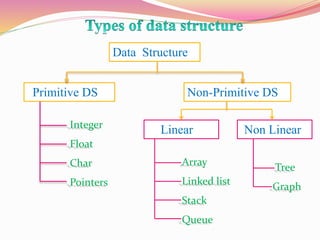
Data Structure
Linear
Array
Linked list
Stack
Queue
Primitive DS Non-Primitive DS
Non Linear
Tree
Graph
Integer
Float
Char
Pointers
• Queue is a linear data structure.
• It is used for temporary storage of data values.
• A new element is added at one end called rear
end.
• The existing elements deleted from the other
end called front end.
• First-in-First-out property.
34 12 53 61 9 23 42
front
rear
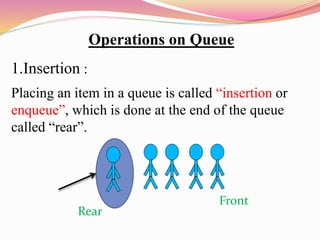
Operations on Queue
1.Insertion :
Placing an item in a queue is called “insertion or
enqueue”, which is done at the end of the queue
called “rear”.
Front
Rear
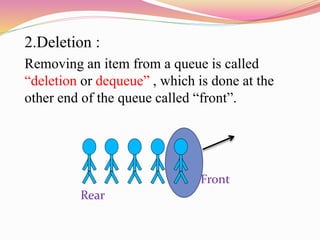
2.Deletion :
Removing an item from a queue is called
“deletion or dequeue” , which is done at the
other end of the queue called “front”.
Front
Rear
Array Representation of Queues
12 9 7 18
12 9 7 18 14
A[0] A[1] A[2] A[3] A[4]
QUEUE
front
rear
front
rearQueue after insertion of a new element
9 7 18 14
front rear
Queue after deletion of an element
Algorithm to insert an element in queue
STEP-1 IF REAR= MAX-1
write OVERFLOW
go to step 4
[end of if]
STEP-2 if REAR = -1
set FRONT=REAR= 0
else
set REAR = REAR+1
STEP-3 set QUEUE [ REAR ] = NUM
STEP-4 EXIT
INITIALLY
REAR = -1
FRONT =-1
Algorithm to delete an element from queue
STEP-1 If FRONT = -1 or FRONT > REAR
write UNDERFLOW
Else
set VAL = QUEUE [ FRONT ]
set FRONT = FRONT + 1
[end of if]
STEP-2 EXIT
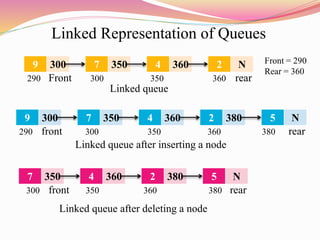
Linked Representation of Queues
9 300 7 350 4 360 2 N
290 Front 300 350 360 rear
Linked queue
9 300 7 350 4 360 2 380
290 front 300 350 360 380 rear
5 N
Linked queue after inserting a node
7 350 4 360 2 380
380 rear
5 N
300 front 350 360
Linked queue after deleting a node
Front = 290
Rear = 360
Algorithm to insert an element in queue
using linked list
STEP-1 Allocate memory for the new node & name it as TEMP.
STEP-2 set TEMP data = NUM
set TEMP link = NULL
STEP-3 If FRONT = NULL
FRONT = REAR = TEMP
Else
REAR link = TEMP
REAR = TEMP
[ end of if]
STEP-4 EXIT
INITIALLY
FRONT=NULL
REAR=NULL
Algorithm to delete an element from queue
STEP-1 If FRONT = NULL
write underflow
go to step 3.
[end of if]
STEP-2 set TEMP = FRONT
FRONT = FRONT link
if FRONT = NULL
REAR = NULL
STEP-3 EXIT
Types of Queues
1. Deque
2. Circular Queue
3. Priority Queue
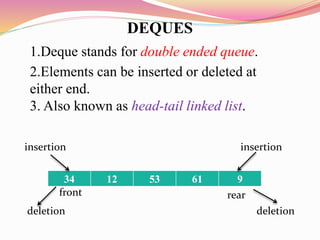
DEQUES
1.Deque stands for double ended queue.
2.Elements can be inserted or deleted at
either end.
3. Also known as head-tail linked list.
34 12 53 61 9
insertion
deletion deletion
insertion
front rear
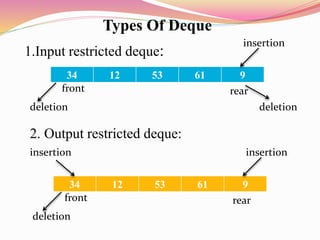
Types Of Deque
1.Input restricted deque:
34 12 53 61 9
deletion deletion
insertion
front rear
2. Output restricted deque:
34 12 53 61 9
insertion
deletion
insertion
front rear
CIRCULAR QUEUES
• Circular queue are used to remove the
drawback of simple queue.
• Both the front and the rear pointers wrap
around to the beginning of the array.
•It is also called as “Ring buffer”.
Algorithm to insert an element in queue
STEP-1 If FRONT = (REAR+1)%MAX
write OVERFLOW
go to step 4
[end of if]
STEP-2 If FRONT = -1
REAR = FRONT = 0
Else REAR = (REAR +1)%MAX
[ end of if ]
STEP-3 CQ[REAR] = NUM
STEP-4 EXIT
INITIALLY
FRONT= -1
REAR= 0
Algorithm to delete an element from queue
STEP-1 If FRONT = -1
write UNDERFLOW
go to step 3
[ end of if ]
STEP-2 If FRONT = REAR
FRONT = REAR= -1
Else
FRONT = (FRONT +1)%MAX
STEP-3 EXIT
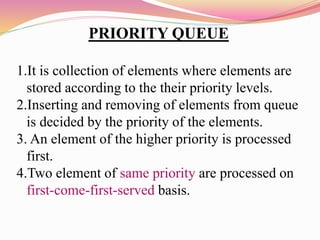
PRIORITY QUEUE
1.It is collection of elements where elements are
stored according to the their priority levels.
2.Inserting and removing of elements from queue
is decided by the priority of the elements.
3. An element of the higher priority is processed
first.
4.Two element of same priority are processed on
first-come-first-served basis.
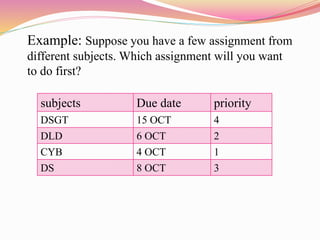
Example: Suppose you have a few assignment from
different subjects. Which assignment will you want
to do first?
subjects Due date priority
DSGT 15 OCT 4
DLD 6 OCT 2
CYB 4 OCT 1
DS 8 OCT 3
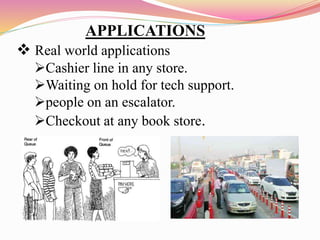
APPLICATIONS
 Real world applications
Cashier line in any store.
Waiting on hold for tech support.
people on an escalator.
Checkout at any book store.
Applications related to computer science:
1.When data is transferred asynchronously between
two processes. eg. IO Buffers.
2.When a resource is shared among multiple
consumers. Examples include CPU scheduling,
Disk Scheduling.
3.In recognizing palindrome.
4.In shared resources management.
5.Keyboard buffer.
6.Round robin scheduling.
7.Job scheduling.
8.Simulation
queue & its applications

queue & its applications

  • 2.
    Contents Introduction Operations on queue Arrayrepresentation of queues Linked representation of queues Types of queues Circular queues Deques Priority queues Application of queues References
  • 3.
    DATA STRUCTURE A datastructure is a particular way of organizing data in a computer so that it can be used efficiently. Different kind of data structure suits for the different kind of applications.
  • 4.
    Data Structure Linear Array Linked list Stack Queue PrimitiveDS Non-Primitive DS Non Linear Tree Graph Integer Float Char Pointers
  • 5.
    • Queue isa linear data structure. • It is used for temporary storage of data values. • A new element is added at one end called rear end. • The existing elements deleted from the other end called front end. • First-in-First-out property. 34 12 53 61 9 23 42 front rear
  • 6.
    Operations on Queue 1.Insertion: Placing an item in a queue is called “insertion or enqueue”, which is done at the end of the queue called “rear”. Front Rear
  • 7.
    2.Deletion : Removing anitem from a queue is called “deletion or dequeue” , which is done at the other end of the queue called “front”. Front Rear
  • 8.
    Array Representation ofQueues 12 9 7 18 12 9 7 18 14 A[0] A[1] A[2] A[3] A[4] QUEUE front rear front rearQueue after insertion of a new element 9 7 18 14 front rear Queue after deletion of an element
  • 9.
    Algorithm to insertan element in queue STEP-1 IF REAR= MAX-1 write OVERFLOW go to step 4 [end of if] STEP-2 if REAR = -1 set FRONT=REAR= 0 else set REAR = REAR+1 STEP-3 set QUEUE [ REAR ] = NUM STEP-4 EXIT INITIALLY REAR = -1 FRONT =-1
  • 10.
    Algorithm to deletean element from queue STEP-1 If FRONT = -1 or FRONT > REAR write UNDERFLOW Else set VAL = QUEUE [ FRONT ] set FRONT = FRONT + 1 [end of if] STEP-2 EXIT
  • 11.
    Linked Representation ofQueues 9 300 7 350 4 360 2 N 290 Front 300 350 360 rear Linked queue 9 300 7 350 4 360 2 380 290 front 300 350 360 380 rear 5 N Linked queue after inserting a node 7 350 4 360 2 380 380 rear 5 N 300 front 350 360 Linked queue after deleting a node Front = 290 Rear = 360
  • 12.
    Algorithm to insertan element in queue using linked list STEP-1 Allocate memory for the new node & name it as TEMP. STEP-2 set TEMP data = NUM set TEMP link = NULL STEP-3 If FRONT = NULL FRONT = REAR = TEMP Else REAR link = TEMP REAR = TEMP [ end of if] STEP-4 EXIT INITIALLY FRONT=NULL REAR=NULL
  • 13.
    Algorithm to deletean element from queue STEP-1 If FRONT = NULL write underflow go to step 3. [end of if] STEP-2 set TEMP = FRONT FRONT = FRONT link if FRONT = NULL REAR = NULL STEP-3 EXIT
  • 14.
    Types of Queues 1.Deque 2. Circular Queue 3. Priority Queue
  • 15.
    DEQUES 1.Deque stands fordouble ended queue. 2.Elements can be inserted or deleted at either end. 3. Also known as head-tail linked list. 34 12 53 61 9 insertion deletion deletion insertion front rear
  • 16.
    Types Of Deque 1.Inputrestricted deque: 34 12 53 61 9 deletion deletion insertion front rear 2. Output restricted deque: 34 12 53 61 9 insertion deletion insertion front rear
  • 17.
    CIRCULAR QUEUES • Circularqueue are used to remove the drawback of simple queue. • Both the front and the rear pointers wrap around to the beginning of the array. •It is also called as “Ring buffer”.
  • 18.
    Algorithm to insertan element in queue STEP-1 If FRONT = (REAR+1)%MAX write OVERFLOW go to step 4 [end of if] STEP-2 If FRONT = -1 REAR = FRONT = 0 Else REAR = (REAR +1)%MAX [ end of if ] STEP-3 CQ[REAR] = NUM STEP-4 EXIT INITIALLY FRONT= -1 REAR= 0
  • 19.
    Algorithm to deletean element from queue STEP-1 If FRONT = -1 write UNDERFLOW go to step 3 [ end of if ] STEP-2 If FRONT = REAR FRONT = REAR= -1 Else FRONT = (FRONT +1)%MAX STEP-3 EXIT
  • 20.
    PRIORITY QUEUE 1.It iscollection of elements where elements are stored according to the their priority levels. 2.Inserting and removing of elements from queue is decided by the priority of the elements. 3. An element of the higher priority is processed first. 4.Two element of same priority are processed on first-come-first-served basis.
  • 21.
    Example: Suppose youhave a few assignment from different subjects. Which assignment will you want to do first? subjects Due date priority DSGT 15 OCT 4 DLD 6 OCT 2 CYB 4 OCT 1 DS 8 OCT 3
  • 22.
    APPLICATIONS  Real worldapplications Cashier line in any store. Waiting on hold for tech support. people on an escalator. Checkout at any book store.
  • 23.
    Applications related tocomputer science: 1.When data is transferred asynchronously between two processes. eg. IO Buffers. 2.When a resource is shared among multiple consumers. Examples include CPU scheduling, Disk Scheduling. 3.In recognizing palindrome. 4.In shared resources management. 5.Keyboard buffer. 6.Round robin scheduling. 7.Job scheduling. 8.Simulation