Chapter 16:
Searching, Sorting,
and the vector Type
Objectives
• In this chapter, you will:
– Learn about list processing and how to search a
list using sequential search
– Explore how to sort an array using the bubble sort
and insertion sort algorithms
– Learn how to implement the binary search
algorithm
– Become familiar with the vector type
C++ Programming: From Problem Analysis to Program Design, Seventh Edition 2
List Processing
• List: a collection of values of the same type
• Array is a convenient place to store a list
• Basic list operations:
– Search the list for a given item
– Sort the list
– Insert an item in the list
– Delete an item from the list
– Print the list
C++ Programming: From Problem Analysis to Program Design, Seventh Edition 3
Searching
• Sequential search algorithm:
– Not very efficient for large lists
– On average, number of key comparisons is equal
to half the size of the list
– Does not assume that the list is sorted
• If the list is sorted, the search algorithm can
be improved
C++ Programming: From Problem Analysis to Program Design, Seventh Edition 4
Bubble Sort
• list[0]...list[n - 1]
– List of n elements, indexed 0 to n – 1
– Example: a list of five elements (Figure 16-1)
C++ Programming: From Problem Analysis to Program Design, Seventh Edition 5
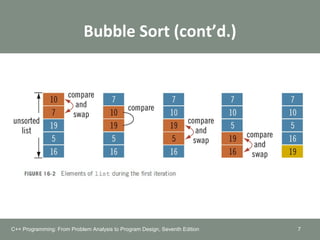
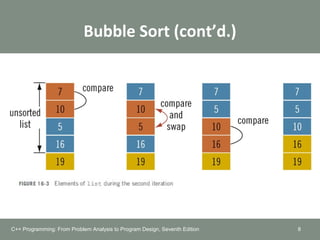
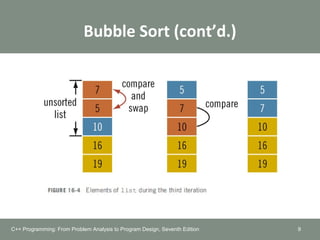
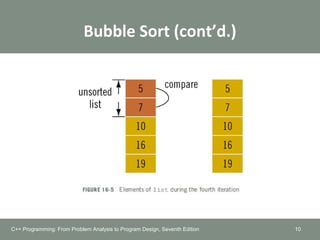
Bubble Sort (cont’d.)
• Series of n - 1 iterations
– Successive elements list[index] and
list[index + 1] of list are compared
– If list[index] > list[index + 1]
• Swap list[index] and list[index + 1]
– Smaller elements move toward the top (beginning
of the list)
– Larger elements move toward the bottom (end of
the list)
C++ Programming: From Problem Analysis to Program Design, Seventh Edition 6
Bubble Sort (cont’d.)
C++ Programming: From Problem Analysis to Program Design, Seventh Edition 7
Bubble Sort (cont’d.)
C++ Programming: From Problem Analysis to Program Design, Seventh Edition 8
Bubble Sort (cont’d.)
C++ Programming: From Problem Analysis to Program Design, Seventh Edition 9
Bubble Sort (cont’d.)
C++ Programming: From Problem Analysis to Program Design, Seventh Edition 10
Bubble Sort (cont’d.)
• List of length n
– Exactly n(n - 1) / 2 key comparisons
– On average n(n - 1) / 4 item assignments
• If n = 1000
– 500,000 key comparisons and 250,000 item
assignments
• Can improve performance if we stop the sort
when no swapping occurs in an iteration
C++ Programming: From Problem Analysis to Program Design, Seventh Edition 11
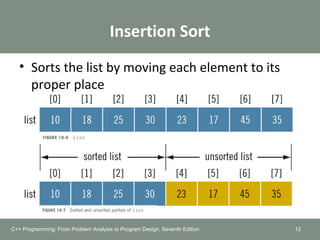
Insertion Sort
• Sorts the list by moving each element to its
proper place
C++ Programming: From Problem Analysis to Program Design, Seventh Edition 12
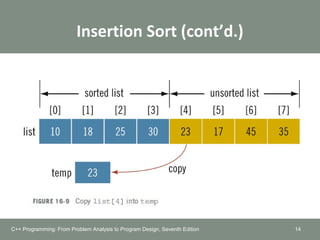
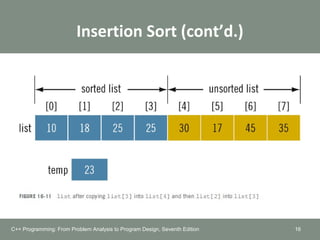
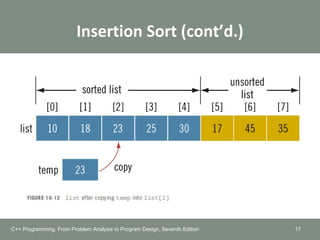
Insertion Sort (cont’d.)
• Consider the element list[4]
– First element of unsorted list
– list[4] < list[3]
• Move list[4] to proper location at list[2]
C++ Programming: From Problem Analysis to Program Design, Seventh Edition 13
Insertion Sort (cont’d.)
C++ Programming: From Problem Analysis to Program Design, Seventh Edition 14
Insertion Sort (cont’d.)
C++ Programming: From Problem Analysis to Program Design, Seventh Edition 15
Insertion Sort (cont’d.)
C++ Programming: From Problem Analysis to Program Design, Seventh Edition 16
Insertion Sort (cont’d.)
C++ Programming: From Problem Analysis to Program Design, Seventh Edition 17
Insertion Sort (cont’d.)
• During the sorting phase, the array is divided
into two sublists: sorted and unsorted
– Sorted sublist elements are sorted
– Elements in the unsorted sublist are to be moved
into their proper places in the sorted sublist, one
at a time
C++ Programming: From Problem Analysis to Program Design, Seventh Edition 18
Insertion Sort (cont’d.)
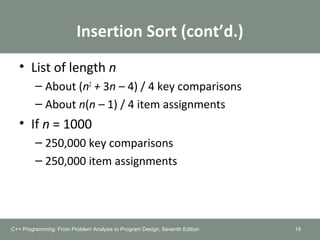
• List of length n
– About (n2
+ 3n – 4) / 4 key comparisons
– About n(n – 1) / 4 item assignments
• If n = 1000
– 250,000 key comparisons
– 250,000 item assignments
C++ Programming: From Problem Analysis to Program Design, Seventh Edition 19
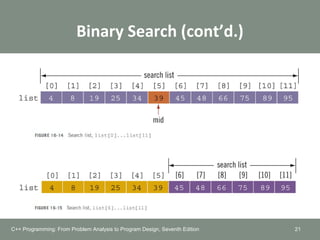
Binary Search
• Much faster than a sequential search
• List must be sorted
• “Divide and conquer”
• Compare search item with middle element
– If less than middle: search only upper half of list
– If more than middle: search only lower half of list
C++ Programming: From Problem Analysis to Program Design, Seventh Edition 20
Binary Search (cont’d.)
C++ Programming: From Problem Analysis to Program Design, Seventh Edition 21
Performance of Binary Search
• If L is a sorted list of size 1024
– Every iteration of the while loop cuts the size of
the search list by half
– At most, 11 iterations to determine whether x is in L
– Binary search will make 22 comparisons at most
• If L has1,048,576 elements
– Binary search makes 42 item comparisons at most
C++ Programming: From Problem Analysis to Program Design, Seventh Edition 22
Performance of Binary Search
(cont’d.)
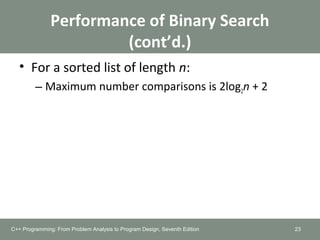
• For a sorted list of length n:
– Maximum number comparisons is 2log2n + 2
C++ Programming: From Problem Analysis to Program Design, Seventh Edition 23
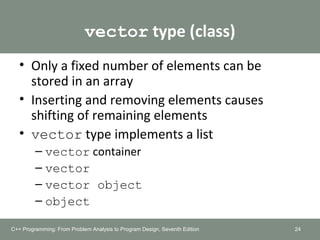
vector type (class)
• Only a fixed number of elements can be
stored in an array
• Inserting and removing elements causes
shifting of remaining elements
• vector type implements a list
– vector container
– vector
– vector object
– object
C++ Programming: From Problem Analysis to Program Design, Seventh Edition 24
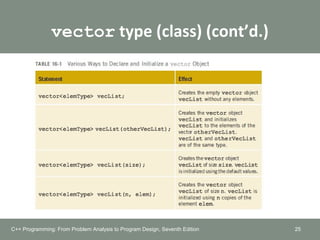
vector type (class) (cont’d.)
C++ Programming: From Problem Analysis to Program Design, Seventh Edition 25
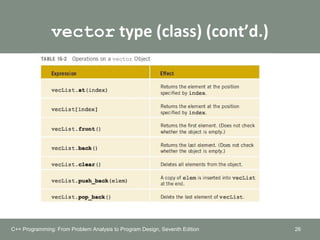
vector type (class) (cont’d.)
C++ Programming: From Problem Analysis to Program Design, Seventh Edition 26
vector type (class) (cont’d.)
C++ Programming: From Problem Analysis to Program Design, Seventh Edition 27
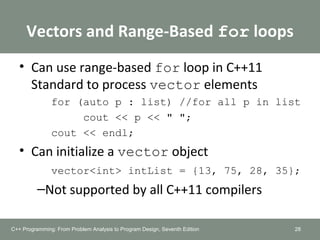
Vectors and Range-Based for loops
• Can use range-based for loop in C++11
Standard to process vector elements
for (auto p : list) //for all p in list
cout << p << " ";
cout << endl;
• Can initialize a vector object
vector<int> intList = {13, 75, 28, 35};
–Not supported by all C++11 compilers
C++ Programming: From Problem Analysis to Program Design, Seventh Edition 28
Summary
• List
– Set of elements of the same type
• Sequential search
– Searches each element until item is found
• Sorting algorithms
– Bubble sort
– Insertion sort
C++ Programming: From Problem Analysis to Program Design, Seventh Edition 29
Summary (cont’d.)
• Binary search
– Much faster than sequential search
– Requires that the list is sorted
• vector type
– Implements a list
– Can increase/decrease in size during program
execution
– Must specify the type of object the vector stores
C++ Programming: From Problem Analysis to Program Design, Seventh Edition 30

9781285852744 ppt ch16

  • 1.
  • 2.
    Objectives • In thischapter, you will: – Learn about list processing and how to search a list using sequential search – Explore how to sort an array using the bubble sort and insertion sort algorithms – Learn how to implement the binary search algorithm – Become familiar with the vector type C++ Programming: From Problem Analysis to Program Design, Seventh Edition 2
  • 3.
    List Processing • List:a collection of values of the same type • Array is a convenient place to store a list • Basic list operations: – Search the list for a given item – Sort the list – Insert an item in the list – Delete an item from the list – Print the list C++ Programming: From Problem Analysis to Program Design, Seventh Edition 3
  • 4.
    Searching • Sequential searchalgorithm: – Not very efficient for large lists – On average, number of key comparisons is equal to half the size of the list – Does not assume that the list is sorted • If the list is sorted, the search algorithm can be improved C++ Programming: From Problem Analysis to Program Design, Seventh Edition 4
  • 5.
    Bubble Sort • list[0]...list[n- 1] – List of n elements, indexed 0 to n – 1 – Example: a list of five elements (Figure 16-1) C++ Programming: From Problem Analysis to Program Design, Seventh Edition 5
  • 6.
    Bubble Sort (cont’d.) •Series of n - 1 iterations – Successive elements list[index] and list[index + 1] of list are compared – If list[index] > list[index + 1] • Swap list[index] and list[index + 1] – Smaller elements move toward the top (beginning of the list) – Larger elements move toward the bottom (end of the list) C++ Programming: From Problem Analysis to Program Design, Seventh Edition 6
  • 7.
    Bubble Sort (cont’d.) C++Programming: From Problem Analysis to Program Design, Seventh Edition 7
  • 8.
    Bubble Sort (cont’d.) C++Programming: From Problem Analysis to Program Design, Seventh Edition 8
  • 9.
    Bubble Sort (cont’d.) C++Programming: From Problem Analysis to Program Design, Seventh Edition 9
  • 10.
    Bubble Sort (cont’d.) C++Programming: From Problem Analysis to Program Design, Seventh Edition 10
  • 11.
    Bubble Sort (cont’d.) •List of length n – Exactly n(n - 1) / 2 key comparisons – On average n(n - 1) / 4 item assignments • If n = 1000 – 500,000 key comparisons and 250,000 item assignments • Can improve performance if we stop the sort when no swapping occurs in an iteration C++ Programming: From Problem Analysis to Program Design, Seventh Edition 11
  • 12.
    Insertion Sort • Sortsthe list by moving each element to its proper place C++ Programming: From Problem Analysis to Program Design, Seventh Edition 12
  • 13.
    Insertion Sort (cont’d.) •Consider the element list[4] – First element of unsorted list – list[4] < list[3] • Move list[4] to proper location at list[2] C++ Programming: From Problem Analysis to Program Design, Seventh Edition 13
  • 14.
    Insertion Sort (cont’d.) C++Programming: From Problem Analysis to Program Design, Seventh Edition 14
  • 15.
    Insertion Sort (cont’d.) C++Programming: From Problem Analysis to Program Design, Seventh Edition 15
  • 16.
    Insertion Sort (cont’d.) C++Programming: From Problem Analysis to Program Design, Seventh Edition 16
  • 17.
    Insertion Sort (cont’d.) C++Programming: From Problem Analysis to Program Design, Seventh Edition 17
  • 18.
    Insertion Sort (cont’d.) •During the sorting phase, the array is divided into two sublists: sorted and unsorted – Sorted sublist elements are sorted – Elements in the unsorted sublist are to be moved into their proper places in the sorted sublist, one at a time C++ Programming: From Problem Analysis to Program Design, Seventh Edition 18
  • 19.
    Insertion Sort (cont’d.) •List of length n – About (n2 + 3n – 4) / 4 key comparisons – About n(n – 1) / 4 item assignments • If n = 1000 – 250,000 key comparisons – 250,000 item assignments C++ Programming: From Problem Analysis to Program Design, Seventh Edition 19
  • 20.
    Binary Search • Muchfaster than a sequential search • List must be sorted • “Divide and conquer” • Compare search item with middle element – If less than middle: search only upper half of list – If more than middle: search only lower half of list C++ Programming: From Problem Analysis to Program Design, Seventh Edition 20
  • 21.
    Binary Search (cont’d.) C++Programming: From Problem Analysis to Program Design, Seventh Edition 21
  • 22.
    Performance of BinarySearch • If L is a sorted list of size 1024 – Every iteration of the while loop cuts the size of the search list by half – At most, 11 iterations to determine whether x is in L – Binary search will make 22 comparisons at most • If L has1,048,576 elements – Binary search makes 42 item comparisons at most C++ Programming: From Problem Analysis to Program Design, Seventh Edition 22
  • 23.
    Performance of BinarySearch (cont’d.) • For a sorted list of length n: – Maximum number comparisons is 2log2n + 2 C++ Programming: From Problem Analysis to Program Design, Seventh Edition 23
  • 24.
    vector type (class) •Only a fixed number of elements can be stored in an array • Inserting and removing elements causes shifting of remaining elements • vector type implements a list – vector container – vector – vector object – object C++ Programming: From Problem Analysis to Program Design, Seventh Edition 24
  • 25.
    vector type (class)(cont’d.) C++ Programming: From Problem Analysis to Program Design, Seventh Edition 25
  • 26.
    vector type (class)(cont’d.) C++ Programming: From Problem Analysis to Program Design, Seventh Edition 26
  • 27.
    vector type (class)(cont’d.) C++ Programming: From Problem Analysis to Program Design, Seventh Edition 27
  • 28.
    Vectors and Range-Basedfor loops • Can use range-based for loop in C++11 Standard to process vector elements for (auto p : list) //for all p in list cout << p << " "; cout << endl; • Can initialize a vector object vector<int> intList = {13, 75, 28, 35}; –Not supported by all C++11 compilers C++ Programming: From Problem Analysis to Program Design, Seventh Edition 28
  • 29.
    Summary • List – Setof elements of the same type • Sequential search – Searches each element until item is found • Sorting algorithms – Bubble sort – Insertion sort C++ Programming: From Problem Analysis to Program Design, Seventh Edition 29
  • 30.
    Summary (cont’d.) • Binarysearch – Much faster than sequential search – Requires that the list is sorted • vector type – Implements a list – Can increase/decrease in size during program execution – Must specify the type of object the vector stores C++ Programming: From Problem Analysis to Program Design, Seventh Edition 30