C++ Programming: FromProblem Analysis to Program Design, Fourth Edition 2
Objectives
In this chapter, you will:
• Learn how to construct and use void
functions in a program
• Discover the difference between value and
reference parameters
• Explore reference parameters and value-
returning functions
• Learn about the scope of an identifier
3.
C++ Programming: FromProblem Analysis to Program Design, Fourth Edition 3
Objectives (continued)
• Examine the difference between local and
global identifiers
• Discover static variables
• Learn function overloading
• Explore functions with default parameters
4.
C++ Programming: FromProblem Analysis to Program Design, Fourth Edition 4
Void Functions
• Void functions and value-returning functions
have similar structures
− Both have a heading part and a statement part
• User-defined void functions can be placed
either before or after the function main
• If user-defined void functions are placed after
the function main
− The function prototype must be placed before
the function main
5.
C++ Programming: FromProblem Analysis to Program Design, Fourth Edition 5
Void Functions (continued)
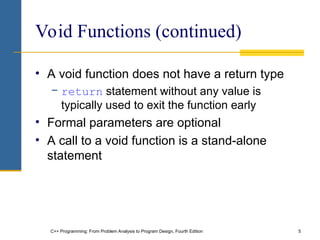
• A void function does not have a return type
− return statement without any value is
typically used to exit the function early
• Formal parameters are optional
• A call to a void function is a stand-alone
statement
6.
C++ Programming: FromProblem Analysis to Program Design, Fourth Edition 6
Void Functions without Parameters
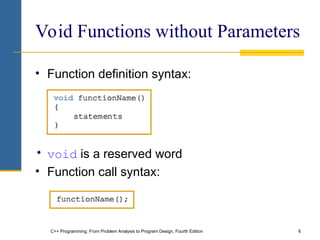
• Function definition syntax:
• void is a reserved word
• Function call syntax:
7.
C++ Programming: FromProblem Analysis to Program Design, Fourth Edition 7
Void Functions with Parameters
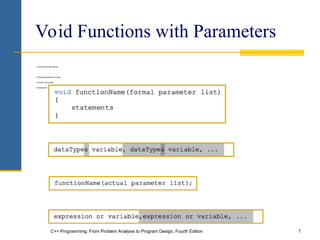
• Function definition syntax:
• Formal parameter list syntax:
• Function call syntax:
• Actual parameter list syntax:
8.
C++ Programming: FromProblem Analysis to Program Design, Fourth Edition 8
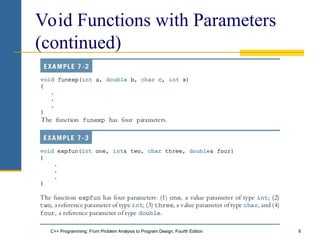
Void Functions with Parameters
(continued)
9.
C++ Programming: FromProblem Analysis to Program Design, Fourth Edition 9
Void Functions with Parameters
(continued)
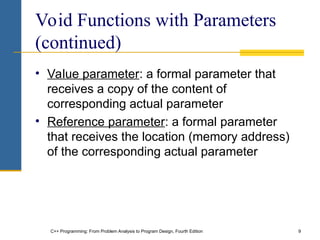
• Value parameter: a formal parameter that
receives a copy of the content of
corresponding actual parameter
• Reference parameter: a formal parameter
that receives the location (memory address)
of the corresponding actual parameter
10.
C++ Programming: FromProblem Analysis to Program Design, Fourth Edition 10
Value Parameters
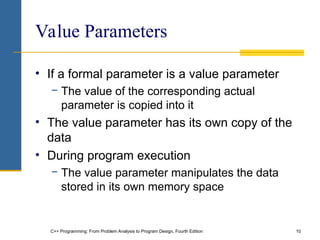
• If a formal parameter is a value parameter
− The value of the corresponding actual
parameter is copied into it
• The value parameter has its own copy of the
data
• During program execution
− The value parameter manipulates the data
stored in its own memory space
11.
C++ Programming: FromProblem Analysis to Program Design, Fourth Edition 11
Reference Variables as Parameters
• If a formal parameter is a reference
parameter
− It receives the memory address of the
corresponding actual parameter
• A reference parameter stores the address of
the corresponding actual parameter
• During program execution to manipulate data
− The address stored in the reference parameter
directs it to the memory space of the
corresponding actual parameter
12.
Reference Variables asParameters
(continued)
• Reference parameters can:
− Pass one or more values from a function
− Change the value of the actual parameter
• Reference parameters are useful in three
situations:
− Returning more than one value
− Changing the actual parameter
− When passing the address would save
memory space and time
C++ Programming: From Problem Analysis to Program Design, Fourth Edition 12
13.
C++ Programming: FromProblem Analysis to Program Design, Fourth Edition 13
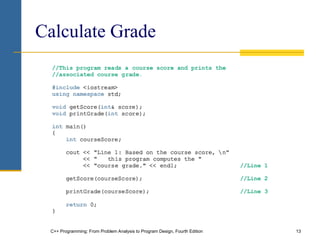
Calculate Grade
14.
C++ Programming: FromProblem Analysis to Program Design, Fourth Edition 14
Calculate Grade (continued)
16.
C++ Programming: FromProblem Analysis to Program Design, Fourth Edition 16
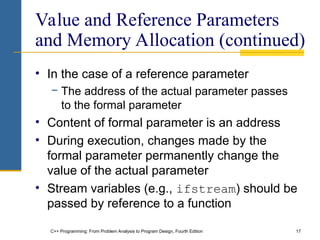
Value and Reference Parameters
and Memory Allocation
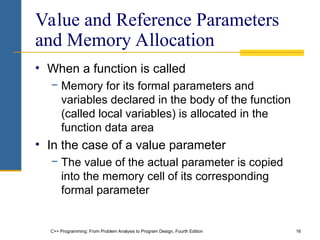
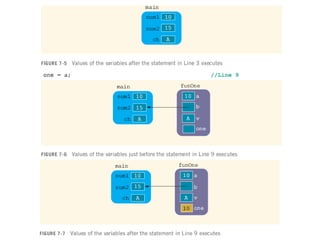
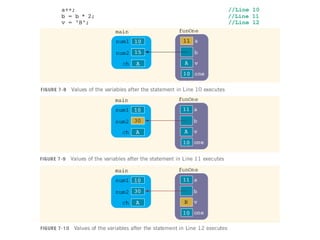
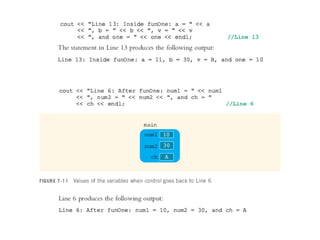
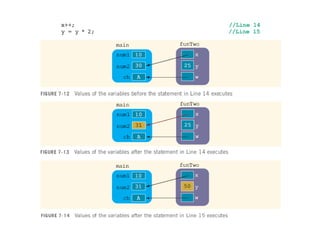
• When a function is called
− Memory for its formal parameters and
variables declared in the body of the function
(called local variables) is allocated in the
function data area
• In the case of a value parameter
− The value of the actual parameter is copied
into the memory cell of its corresponding
formal parameter
17.
C++ Programming: FromProblem Analysis to Program Design, Fourth Edition 17
Value and Reference Parameters
and Memory Allocation (continued)
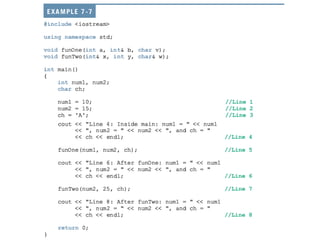
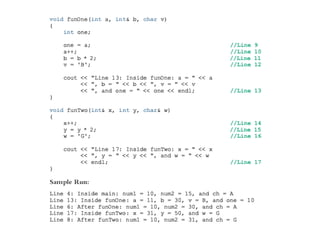
• In the case of a reference parameter
− The address of the actual parameter passes
to the formal parameter
• Content of formal parameter is an address
• During execution, changes made by the
formal parameter permanently change the
value of the actual parameter
• Stream variables (e.g., ifstream) should be
passed by reference to a function
25.
C++ Programming: FromProblem Analysis to Program Design, Fourth Edition 25
Reference Parameters and Value-
Returning Functions
• You can also use reference parameters in a
value-returning function
− Not recommended
• By definition, a value-returning function
returns a single value
− This value is returned via the return statement
• If a function needs to return more than one
value, you should change it to a void function
and use the appropriate reference
parameters to return the values
26.
C++ Programming: FromProblem Analysis to Program Design, Fourth Edition 26
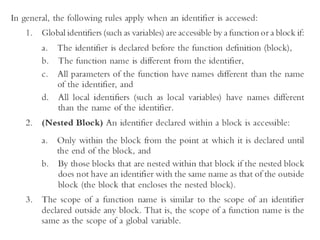
Scope of an Identifier
• The scope of an identifier refers to where in
the program an identifier is accessible
• Local identifier: identifiers declared within a
function (or block)
• Global identifier: identifiers declared outside
of every function definition
• C++ does not allow nested functions
− The definition of one function cannot be
included in the body of another function
28.
C++ Programming: FromProblem Analysis to Program Design, Fourth Edition 28
Scope of an Identifier (continued)
• Some compilers initialize global variables to
default values
• The operator :: is called the scope resolution
operator
• By using the scope resolution operator
− A global variable declared before the definition
of a function (block) can be accessed by the
function (or block) even if the function (or block)
has an identifier with the same name as the
variable
29.
C++ Programming: FromProblem Analysis to Program Design, Fourth Edition 29
Scope of an Identifier (continued)
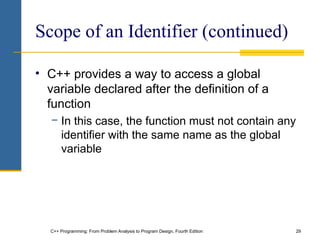
• C++ provides a way to access a global
variable declared after the definition of a
function
− In this case, the function must not contain any
identifier with the same name as the global
variable
30.
C++ Programming: FromProblem Analysis to Program Design, Fourth Edition 30
Global Variables, Named
Constants, and Side Effects
• Using global variables has side effects
• A function that uses global variables is not
independent
• If more than one function uses the same
global variable and something goes wrong
− It is difficult to find what went wrong and where
− Problems caused in one area of the program
may appear to be from another area
• Global named constants have no side effects
31.
C++ Programming: FromProblem Analysis to Program Design, Fourth Edition 31
Function Overloading: An
Introduction
• In a C++ program, several functions can have
the same name
− This is called function overloading or
overloading a function name
32.
C++ Programming: FromProblem Analysis to Program Design, Fourth Edition 32
Function Overloading (continued)
• Two functions are said to have different
formal parameter lists if both functions have:
− A different number of formal parameters, or
− If the number of formal parameters is the
same, then the data type of the formal
parameters, in the order you list them, must
differ in at least one position
33.
C++ Programming: FromProblem Analysis to Program Design, Fourth Edition 33
• The following functions all have different
formal parameter lists:
• The following functions have the same formal
parameter list:
Function Overloading (continued)
34.
C++ Programming: FromProblem Analysis to Program Design, Fourth Edition 34
Function Overloading (continued)
• Function overloading: creating several
functions with the same name
• The signature of a function consists of the
function name and its formal parameter list
• Two functions have different signatures if
they have either different names or different
formal parameter lists
• Note that the signature of a function does not
include the return type of the function
35.
C++ Programming: FromProblem Analysis to Program Design, Fourth Edition 35
Function Overloading (continued)
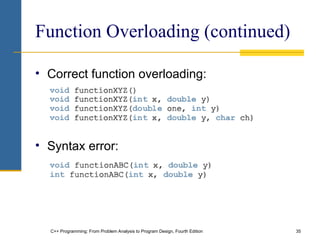
• Correct function overloading:
• Syntax error:
36.
C++ Programming: FromProblem Analysis to Program Design, Fourth Edition 36
Functions with Default Parameters
• In a function call, the number of actual and
formal parameters must be the same
− C++ relaxes this condition for functions with
default parameters
• You specify the value of a default parameter
when the function name appears for the first
time (e.g., in the prototype)
• If you do not specify the value of a default
parameter, the default value is used
37.
C++ Programming: FromProblem Analysis to Program Design, Fourth Edition 37
Functions with Default Parameters
(continued)
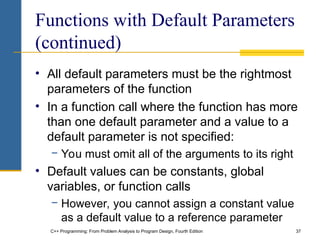
• All default parameters must be the rightmost
parameters of the function
• In a function call where the function has more
than one default parameter and a value to a
default parameter is not specified:
− You must omit all of the arguments to its right
• Default values can be constants, global
variables, or function calls
− However, you cannot assign a constant value
as a default value to a reference parameter
38.
C++ Programming: FromProblem Analysis to Program Design, Fourth Edition 38
Functions with Default Parameters
(continued)
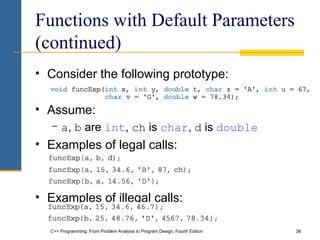
• Consider the following prototype:
• Assume:
− a, b are int, ch is char, d is double
• Examples of legal calls:
• Examples of illegal calls:
39.
C++ Programming: FromProblem Analysis to Program Design, Fourth Edition 39
Functions with Default Parameters
(continued)
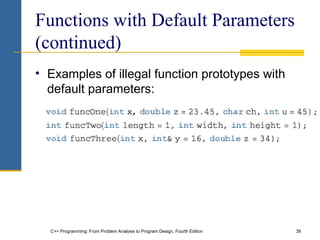
• Examples of illegal function prototypes with
default parameters:
40.
C++ Programming: FromProblem Analysis to Program Design, Fourth Edition 40
Programming Example: Classify
Numbers
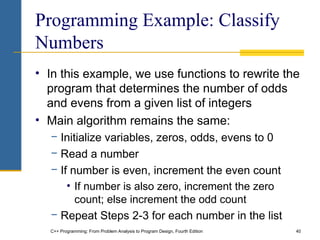
• In this example, we use functions to rewrite the
program that determines the number of odds
and evens from a given list of integers
• Main algorithm remains the same:
− Initialize variables, zeros, odds, evens to 0
− Read a number
− If number is even, increment the even count
• If number is also zero, increment the zero
count; else increment the odd count
− Repeat Steps 2-3 for each number in the list
41.
C++ Programming: FromProblem Analysis to Program Design, Fourth Edition 41
Programming Example: Classify
Numbers (continued)
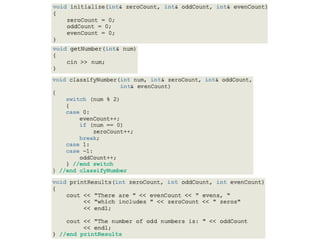
• The program functions include:
− initialize: initialize the variables, such as
zeros, odds, and evens
− getNumber: get the number
− classifyNumber: determine if number is
odd or even (and whether it is also zero); this
function also increments the appropriate count
− printResults: print the results
43.
C++ Programming: FromProblem Analysis to Program Design, Fourth Edition 43
Programming Example: Main
Algorithm
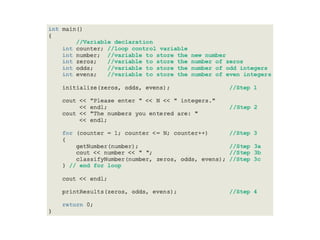
• Call initialize to initialize variables
• Prompt the user to enter 20 numbers
• For each number in the list
− Call getNumber to read a number
− Output the number
− Call classifyNumber to classify the number
and increment the appropriate count
• Call printResults to print the final results
45.
C++ Programming: FromProblem Analysis to Program Design, Fourth Edition 45
Summary
• Void function: does not have a data type
− A return statement without any value can be
used in a void function to exit it early
− The heading starts with the word void
− To call the function, you use the function name
together with the actual parameters in a stand-
alone statement
• Two types of formal parameters:
− Value parameters
− Reference parameters
46.
C++ Programming: FromProblem Analysis to Program Design, Fourth Edition 46
Summary (continued)
• A value parameter receives a copy of its
corresponding actual parameter
• A reference parameter receives the memory
address of its corresponding actual parameter
− If a formal parameter needs to change the value
of an actual parameter, you must declare this
formal parameter as a reference parameter in
the function heading
47.
C++ Programming: FromProblem Analysis to Program Design, Fourth Edition 47
Summary (continued)
• Variables declared within a function (or block)
are called local variables
• Variables declared outside of every function
definition (and block) are global variables
• Automatic variable: variable for which
memory is allocated on function/block entry
and deallocated on function/block exit
• Static variable: memory remains allocated
throughout the execution of the program
• C++ functions can have default parameters