GENOMICS
Presented by :
AISHWARYA LAKSHMI M
3DC BIOTECHNOLOGY
CMS COLLEGE KOTTAYAM
INTRODUCTION
• The branch of molecular biology concerned with the
structure, function, evolution, and mapping of genomes.
• It is devoted to the mapping , sequencing and functional
analysis of genome
• The field includes studies of inter genomic phenomenon
and focuses on the interactions between loci and alleles
within the genome and other interaction such as :
 EPISTASIS - The interaction of genes that are not alleles
, in particular the suppression effect of one of such genome
by another
 PLEIOTROPY - The ability of a single gene to have
multiple phenotypic traits
 HETEROSIS -It refers to the phenomenon in which
hybrid offspring exhibit characteristics that lie outside the
range of the parents.
“A discipline in genetics that
applies recombinant DNA
technology(RDT), DNA Sequencing
methods and Bioinformatics to
sequence , assemble , and analyze
the structure and function of
genomes .”
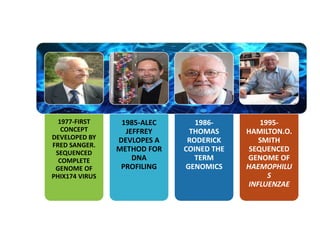
1977-FIRST
CONCEPT
DEVELOPED BY
FRED SANGER.
SEQUENCED
COMPLETE
GENOME OF
PHIX174 VIRUS
1985-ALEC
JEFFREY
DEVLOPES A
METHOD FOR
DNA
PROFILING
1986-
THOMAS
RODERICK
COINED THE
TERM
GENOMICS
1995-
HAMILTON.O.
SMITH
SEQUENCED
GENOME OF
HAEMOPHILU
S
INFLUENZAE
OBJECTIVES OF GENOMICS
Describe the importance and impact
of genomics and bioinformatics in
biology and biomedical research.
Identify appropriate resources to
gather persistent information.
Perform searches using accessible
database and tools.
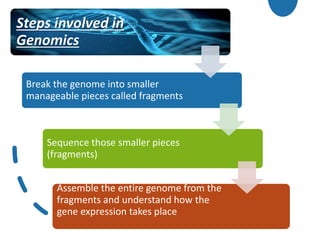
Break the genome into smaller
manageable pieces called fragments
Steps involved in
Genomics
Sequence those smaller pieces
(fragments)
Assemble the entire genome from the
fragments and understand how the
gene expression takes place
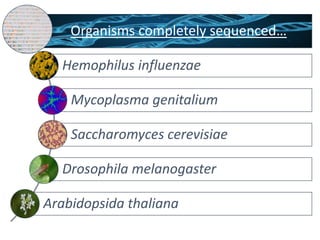
Organisms completely sequenced…
Hemophilus influenzae
Mycoplasma genitalium
Saccharomyces cerevisiae
Drosophila melanogaster
Arabidopsida thaliana
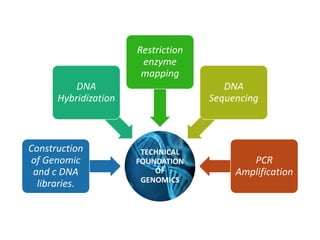
TECHNICAL
FOUNDATION
OF
GENOMICS
Construction
of Genomic
and c DNA
libraries.
DNA
Hybridization
Restriction
enzyme
mapping
DNA
Sequencing
PCR
Amplification
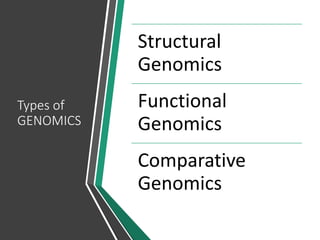
Types of
GENOMICS
Structural
Genomics
Functional
Genomics
Comparative
Genomics
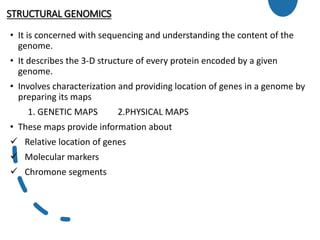
STRUCTURAL GENOMICS
• It is concerned with sequencing and understanding the content of the
genome.
• It describes the 3-D structure of every protein encoded by a given
genome.
• Involves characterization and providing location of genes in a genome by
preparing its maps
1. GENETIC MAPS 2.PHYSICAL MAPS
• These maps provide information about
 Relative location of genes
 Molecular markers
 Chromone segments
1] Genetic Maps
• Also called linkage maps . Provide rough approximation of location of
genes relative to the locations of other known genes.
• These are based on the genetic function of recombination.
• For linked genes, rate of recombination is proportional to physical
distance between loci. It is determined by determining the progeny.
• Distance of genetic maps measures in percent recombination
(centimorgans) or map units.
RECOMBINATION
FREQUENCY BETWEEN LOCI
CONCLUSION
=50% Loci are located on different chromosome
or far apart on same chromosome
<50% Both loci are linked,
2] Physical maps
• Based on direct analysis of DNA and place genes in relation
to distances measured in number of base pairs ,kilobase
or mega-base.
• Used to order cloned DNA fragments and to find the order
and physical distance between DNA base pairs by DNA
markers.
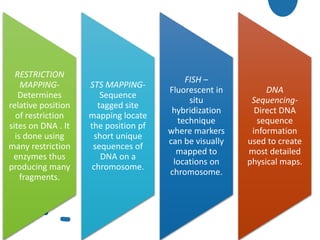
• The techniques used :
 Restriction mapping
 STS Mapping
 FISH
 DNA Sequencing
RESTRICTION
MAPPING-
Determines
relative position
of restriction
sites on DNA . It
is done using
many restriction
enzymes thus
producing many
fragments.
STS MAPPING-
Sequence
tagged site
mapping locate
the position pf
short unique
sequences of
DNA on a
chromosome.
FISH –
Fluorescent in
situ
hybridization
technique
where markers
can be visually
mapped to
locations on
chromosome.
DNA
Sequencing-
Direct DNA
sequence
information
used to create
most detailed
physical maps.
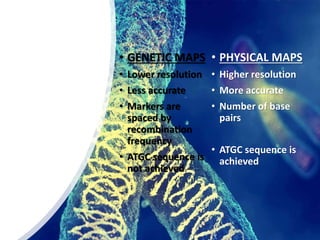
• GENETIC MAPS
• Lower resolution
• Less accurate
• Markers are
spaced by
recombination
frequency
• ATGC sequence is
not achieved.
• PHYSICAL MAPS
• Higher resolution
• More accurate
• Number of base
pairs
• ATGC sequence is
achieved
WHOLE GENOME SEQUENCING
To determine the ordered nucleotide sequence of an
organism entire genome is the ultimate aim of structural
genomics. Since they are billions of base pairs long it is
tedious task. For this DNA is broken into fragments and
then sequenced. Putting the fragments back in correct
order is also a problems. The two approaches used for
this are
1. Map Based Sequencing
2. Whole Genome Shotgun Sequencing.
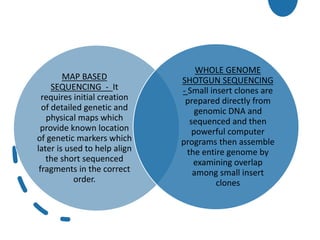
MAP BASED
SEQUENCING - It
requires initial creation
of detailed genetic and
physical maps which
provide known location
of genetic markers which
later is used to help align
the short sequenced
fragments in the correct
order.
WHOLE GENOME
SHOTGUN SEQUENCING
- Small insert clones are
prepared directly from
genomic DNA and
sequenced and then
powerful computer
programs then assemble
the entire genome by
examining overlap
among small insert
clones
FUNCTIONAL GENOMICS
• Also known as Transcriptomic or Proteomics.
• It attempts to understand dynamic aspects like
transcription , translation and protein interactions .
• It focus on understanding gene function and interaction
at the whole genome level using high throughput
approaches.
• The high throughput analysis of all expressed genes is
termed TRANSCRIPTOME ANALYSIS
• It is conducted by two approaches:
Sequence based approaches
Microarray based approaches
1] SEQUENCE BASED APPROACHES
Expressed Sequence Tags : ESTs are short
sequences of c DNA typically 200-400
nucleotide in length obtained either from
5’ or 3’ end of c DNA inserts of c DNA
library. They provide a rough estimate of
genes that are actively expressed in a
genome under a particular physiological
condition.
Serial Analysis of Gene Expression-Used
for gene expression profile analysis . It is
more quantitative in determining m RNA
expression in a cell. Short fragments of
DNA excised from c DNA sequences act
as unique markers of gene transcript.
Software tools for SAGE Analysis are
SAGE map , SAGE xprofiler ,SAGE Genie
2] MICROARRAY BASED TECHNIQUE
A microarray is a pattern of ss DNA probes which are immobilized
on a surface called chip They use hybridization to detect a specific
DNA or RNA in a sample .It uses a million different probes fixed on
a solid surface .It involved from Southern BlottingIt is used to
analyse the expression of thousands of genes in single reaction and
to understand the genetic causes for abnormal functioning of the
body. Software programs to perform microarray image analysis:
 ArrayDB
 TIGR Spotfinder
Software programs for microarray data normalization are:
 Arrayplot
 SNOMAD
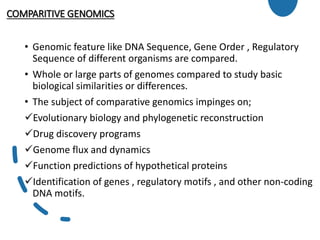
COMPARITIVE GENOMICS
• Genomic feature like DNA Sequence, Gene Order , Regulatory
Sequence of different organisms are compared.
• Whole or large parts of genomes compared to study basic
biological similarities or differences.
• The subject of comparative genomics impinges on;
Evolutionary biology and phylogenetic reconstruction
Drug discovery programs
Genome flux and dynamics
Function predictions of hypothetical proteins
Identification of genes , regulatory motifs , and other non-coding
DNA motifs.
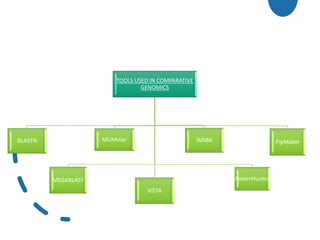
TOOLS USED IN COMPARATIVE
GENOMICS
BLASTN
MEGABLAST
MUMmer
VISTA
WABA
PaternHunter
PipMaker
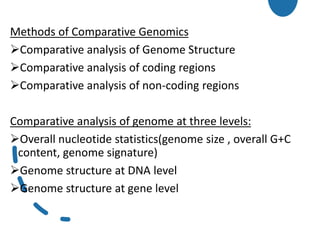
Methods of Comparative Genomics
Comparative analysis of Genome Structure
Comparative analysis of coding regions
Comparative analysis of non-coding regions
Comparative analysis of genome at three levels:
Overall nucleotide statistics(genome size , overall G+C
content, genome signature)
Genome structure at DNA level
Genome structure at gene level
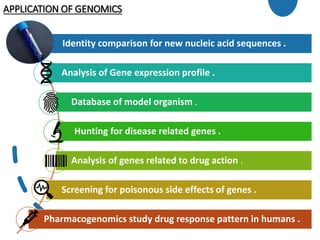
APPLICATION OF GENOMICS
Identity comparison for new nucleic acid sequences .
Analysis of Gene expression profile .
Database of model organism .
Hunting for disease related genes .
Analysis of genes related to drug action .
Screening for poisonous side effects of genes .
Pharmacogenomics study drug response pattern in humans .
THANK YOU

Genomics

  • 1.
    GENOMICS Presented by : AISHWARYALAKSHMI M 3DC BIOTECHNOLOGY CMS COLLEGE KOTTAYAM
  • 2.
    INTRODUCTION • The branchof molecular biology concerned with the structure, function, evolution, and mapping of genomes. • It is devoted to the mapping , sequencing and functional analysis of genome • The field includes studies of inter genomic phenomenon and focuses on the interactions between loci and alleles within the genome and other interaction such as :  EPISTASIS - The interaction of genes that are not alleles , in particular the suppression effect of one of such genome by another  PLEIOTROPY - The ability of a single gene to have multiple phenotypic traits  HETEROSIS -It refers to the phenomenon in which hybrid offspring exhibit characteristics that lie outside the range of the parents.
  • 3.
    “A discipline ingenetics that applies recombinant DNA technology(RDT), DNA Sequencing methods and Bioinformatics to sequence , assemble , and analyze the structure and function of genomes .”
  • 4.
    1977-FIRST CONCEPT DEVELOPED BY FRED SANGER. SEQUENCED COMPLETE GENOMEOF PHIX174 VIRUS 1985-ALEC JEFFREY DEVLOPES A METHOD FOR DNA PROFILING 1986- THOMAS RODERICK COINED THE TERM GENOMICS 1995- HAMILTON.O. SMITH SEQUENCED GENOME OF HAEMOPHILU S INFLUENZAE
  • 5.
    OBJECTIVES OF GENOMICS Describethe importance and impact of genomics and bioinformatics in biology and biomedical research. Identify appropriate resources to gather persistent information. Perform searches using accessible database and tools.
  • 6.
    Break the genomeinto smaller manageable pieces called fragments Steps involved in Genomics Sequence those smaller pieces (fragments) Assemble the entire genome from the fragments and understand how the gene expression takes place
  • 7.
    Organisms completely sequenced… Hemophilusinfluenzae Mycoplasma genitalium Saccharomyces cerevisiae Drosophila melanogaster Arabidopsida thaliana
  • 8.
    TECHNICAL FOUNDATION OF GENOMICS Construction of Genomic and cDNA libraries. DNA Hybridization Restriction enzyme mapping DNA Sequencing PCR Amplification
  • 9.
  • 10.
    STRUCTURAL GENOMICS • Itis concerned with sequencing and understanding the content of the genome. • It describes the 3-D structure of every protein encoded by a given genome. • Involves characterization and providing location of genes in a genome by preparing its maps 1. GENETIC MAPS 2.PHYSICAL MAPS • These maps provide information about  Relative location of genes  Molecular markers  Chromone segments
  • 11.
    1] Genetic Maps •Also called linkage maps . Provide rough approximation of location of genes relative to the locations of other known genes. • These are based on the genetic function of recombination. • For linked genes, rate of recombination is proportional to physical distance between loci. It is determined by determining the progeny. • Distance of genetic maps measures in percent recombination (centimorgans) or map units. RECOMBINATION FREQUENCY BETWEEN LOCI CONCLUSION =50% Loci are located on different chromosome or far apart on same chromosome <50% Both loci are linked,
  • 12.
    2] Physical maps •Based on direct analysis of DNA and place genes in relation to distances measured in number of base pairs ,kilobase or mega-base. • Used to order cloned DNA fragments and to find the order and physical distance between DNA base pairs by DNA markers. • The techniques used :  Restriction mapping  STS Mapping  FISH  DNA Sequencing
  • 13.
    RESTRICTION MAPPING- Determines relative position of restriction siteson DNA . It is done using many restriction enzymes thus producing many fragments. STS MAPPING- Sequence tagged site mapping locate the position pf short unique sequences of DNA on a chromosome. FISH – Fluorescent in situ hybridization technique where markers can be visually mapped to locations on chromosome. DNA Sequencing- Direct DNA sequence information used to create most detailed physical maps.
  • 14.
    • GENETIC MAPS •Lower resolution • Less accurate • Markers are spaced by recombination frequency • ATGC sequence is not achieved. • PHYSICAL MAPS • Higher resolution • More accurate • Number of base pairs • ATGC sequence is achieved
  • 15.
    WHOLE GENOME SEQUENCING Todetermine the ordered nucleotide sequence of an organism entire genome is the ultimate aim of structural genomics. Since they are billions of base pairs long it is tedious task. For this DNA is broken into fragments and then sequenced. Putting the fragments back in correct order is also a problems. The two approaches used for this are 1. Map Based Sequencing 2. Whole Genome Shotgun Sequencing.
  • 16.
    MAP BASED SEQUENCING -It requires initial creation of detailed genetic and physical maps which provide known location of genetic markers which later is used to help align the short sequenced fragments in the correct order. WHOLE GENOME SHOTGUN SEQUENCING - Small insert clones are prepared directly from genomic DNA and sequenced and then powerful computer programs then assemble the entire genome by examining overlap among small insert clones
  • 17.
    FUNCTIONAL GENOMICS • Alsoknown as Transcriptomic or Proteomics. • It attempts to understand dynamic aspects like transcription , translation and protein interactions . • It focus on understanding gene function and interaction at the whole genome level using high throughput approaches. • The high throughput analysis of all expressed genes is termed TRANSCRIPTOME ANALYSIS • It is conducted by two approaches: Sequence based approaches Microarray based approaches
  • 18.
    1] SEQUENCE BASEDAPPROACHES Expressed Sequence Tags : ESTs are short sequences of c DNA typically 200-400 nucleotide in length obtained either from 5’ or 3’ end of c DNA inserts of c DNA library. They provide a rough estimate of genes that are actively expressed in a genome under a particular physiological condition. Serial Analysis of Gene Expression-Used for gene expression profile analysis . It is more quantitative in determining m RNA expression in a cell. Short fragments of DNA excised from c DNA sequences act as unique markers of gene transcript. Software tools for SAGE Analysis are SAGE map , SAGE xprofiler ,SAGE Genie
  • 19.
    2] MICROARRAY BASEDTECHNIQUE A microarray is a pattern of ss DNA probes which are immobilized on a surface called chip They use hybridization to detect a specific DNA or RNA in a sample .It uses a million different probes fixed on a solid surface .It involved from Southern BlottingIt is used to analyse the expression of thousands of genes in single reaction and to understand the genetic causes for abnormal functioning of the body. Software programs to perform microarray image analysis:  ArrayDB  TIGR Spotfinder Software programs for microarray data normalization are:  Arrayplot  SNOMAD
  • 20.
    COMPARITIVE GENOMICS • Genomicfeature like DNA Sequence, Gene Order , Regulatory Sequence of different organisms are compared. • Whole or large parts of genomes compared to study basic biological similarities or differences. • The subject of comparative genomics impinges on; Evolutionary biology and phylogenetic reconstruction Drug discovery programs Genome flux and dynamics Function predictions of hypothetical proteins Identification of genes , regulatory motifs , and other non-coding DNA motifs.
  • 21.
    TOOLS USED INCOMPARATIVE GENOMICS BLASTN MEGABLAST MUMmer VISTA WABA PaternHunter PipMaker
  • 22.
    Methods of ComparativeGenomics Comparative analysis of Genome Structure Comparative analysis of coding regions Comparative analysis of non-coding regions Comparative analysis of genome at three levels: Overall nucleotide statistics(genome size , overall G+C content, genome signature) Genome structure at DNA level Genome structure at gene level
  • 23.
    APPLICATION OF GENOMICS Identitycomparison for new nucleic acid sequences . Analysis of Gene expression profile . Database of model organism . Hunting for disease related genes . Analysis of genes related to drug action . Screening for poisonous side effects of genes . Pharmacogenomics study drug response pattern in humans .
  • 24.