Fuel Nano-Additive
Technology
Fuel Nano Additive
Technology
Fuel Nano-Additive
Technology
WHAT IS NANOTECHNOLOGY?
 Development of technologies to exploit the distinct
property enhancement observed at nanoscale such that the
following benefits are observed:
 Improvements to existing products in terms of performance
or value
 New functionality paradigms
 Improve our control and understanding of processes
Fuel Nano-Additive
Technology
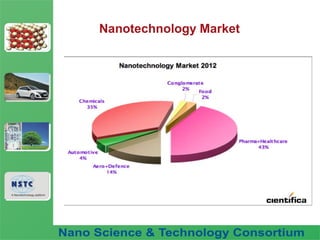
Nanotechnology Market
Fuel Nano-Additive
Technology
Our Technology Outline
 Fuel Borne Catalyst
 Results of Testing FBC in Vietnam
 Test Protocol & Discussion
Fuel Nano-Additive
Technology
Objectives
 To increase combustion efficiency; Travel
range per unit fuel or save fuel cost
 To reduce unwanted emission
 To have a secured supply; Technology
should be amenable for local manufacturing
Fuel Nano-Additive
Technology
 Catalyst is a substance that accelerate a
chemical reaction and itself is not consumed by
the overall reaction. It provides an alternative
route of reaction where the activation energy is
lower than the original chemical reaction
 When the catalyst is homogeneously mixed in
the fuel, it is known as fuel borne catalyst
Fuel Nano-Additive
Technology
Cerium Oxide as a Fuel Borne Catalyst
Cerium-oxide (ceria) is a catalyst widely used in
petroleum cracking, metal alloying,
semiconductor polishing, car catalytic converters,
etc.
When Ceria is mixed in fuel to promote fuel
combustion, it is called FBC (Fuel Borne
Catalyst)
Fuel Nano-Additive
Technology
How Cerium Oxide acts as a Catalyst?
Provides highly reactive surface atomic oxygen during
transformation from stoichiometric +4ve state to +3ve state
with relatively low required activation energy
Fluorite structure is retained and is readily be reoxidized back
to CeO2 in oxidizing environment
Used as an oxygen storage material in catalysis via the
following reaction:
2CeO2
Ce2
O3
+ O
Its REDOX properties have promoted combustion and
reduce Nox
as:
Hydrocarbon Combustion: (2x+y)CeO2
+ Cx
Hy
→ (2x+y)Ce2
O3
/2 +
CO2
+ H2
O
Soot Burning: 4CeO2
+ Csoot
→ 2Ce2
O3
+ CO2
NOx Reduction: xCe2
O3
+ NOx
→ 2xCeO2
+ N2
Fuel Nano-Additive
Technology
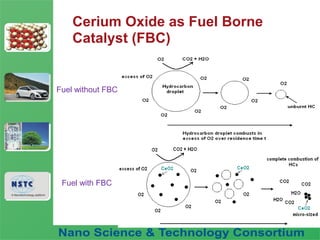
Cerium Oxide as Fuel Borne
Catalyst (FBC)
Fuel without FBC
Fuel with FBC
Fuel Nano-Additive
Technology
Fuel Nano-Additive
Technology
Nano Cerium Oxide as Fuel Borne
Catalyst (FBC)
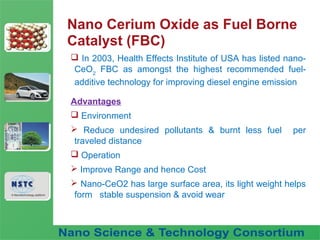
 In 2003, Health Effects Institute of USA has listed nano-
CeO2
FBC as amongst the highest recommended fuel-
additive technology for improving diesel engine emission
Advantages
 Environment
 Reduce undesired pollutants & burnt less fuel per
traveled distance
 Operation
 Improve Range and hence Cost
 Nano-CeO2 has large surface area, its light weight helps
form stable suspension & avoid wear
Fuel Nano-Additive
Technology
Product and Properties
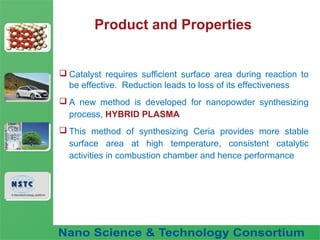
 Catalyst requires sufficient surface area during reaction to
be effective. Reduction leads to loss of its effectiveness
 A new method is developed for nanopowder synthesizing
process, HYBRID PLASMA
 This method of synthesizing Ceria provides more stable
surface area at high temperature, consistent catalytic
activities in combustion chamber and hence performance
Fuel Nano-Additive
Technology
Product and Properties-Contd.
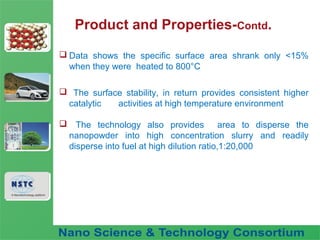
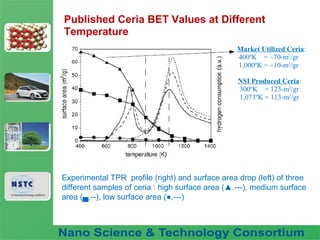
 Data shows the specific surface area shrank only <15%
when they were heated to 800°C
 The surface stability, in return provides consistent higher
catalytic activities at high temperature environment
 The technology also provides area to disperse the
nanopowder into high concentration slurry and readily
disperse into fuel at high dilution ratio,1:20,000
Fuel Nano-Additive
Technology
Published Ceria BET Values at Different
Temperature
Market Utilized Ceria:
400ºK = ~70-m2
/gr
1,000ºK = ~10-m2
/gr
NSI Produced Ceria:
300ºK = 123-m2
/gr
1,073ºK = 113-m2
/gr
Experimental TPR profile (right) and surface area drop (left) of three
different samples of ceria : high surface area (▲.---), medium surface
area (▄,--), low surface area (●,---)
Fuel Nano-Additive
Technology
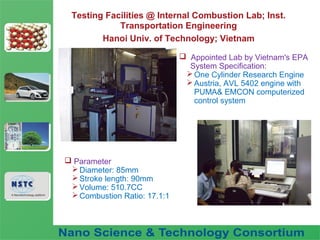
Testing Facilities @ Internal Combustion Lab; Inst.
Transportation Engineering
Hanoi Univ. of Technology; Vietnam
 Appointed Lab by Vietnam's EPA
System Specification:
One Cylinder Research Engine
Austria, AVL 5402 engine with
PUMA& EMCON computerized
control system
 Parameter
Diameter: 85mm
Stroke length: 90mm
Volume: 510.7CC
Combustion Ratio: 17.1:1
Fuel Nano-Additive
Technology
NSI's FBC Laboratory Test
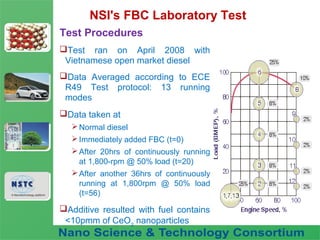
Test Procedures
Test ran on April 2008 with
Vietnamese open market diesel
Data Averaged according to ECE
R49 Test protocol: 13 running
modes
Data taken at
Normal diesel
Immediately added FBC (t=0)
After 20hrs of continuously running
at 1,800-rpm @ 50% load (t=20)
After another 36hrs of continuously
running at 1,800rpm @ 50% load
(t=56)
Additive resulted with fuel contains
<10pmm of CeO2
nanoparticles
Fuel Nano-Additive
Technology
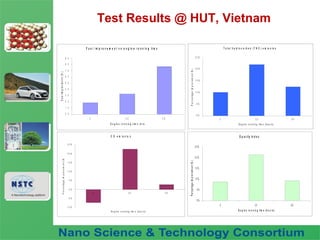
F u e l i m p r o v e m e n t v s e n g i n e r u n n i n g ti m e
0 . 0
1 . 0
2 . 0
3 . 0
4 . 0
5 . 0
6 . 0
7 . 0
8 . 0
9 . 0
4 2 0 5 6
E n g in e r u n n in g t im e ( h r s )
Fuelimprovment(%)
Test Results @ HUT, Vietnam
T o t a l h y d r o c a r b o n ( T H C ) e m is s io n
0 %
5 %
1 0 %
1 5 %
2 0 %
2 5 %
0 2 0 5 6
E n g i n e r u n n i n g ti m e ( h o u r s )
Percentageimprovement(%)
C O e m is s io n
-1 0 %
-5 %
0 %
5 %
1 0 %
1 5 %
2 0 %
2 5 %
0 2 0 5 6
E n g i n e r u n n i n g t i m e ( h o u r s )
Percentageimprovement(%)
O p a c ity In d e x
0 %
5 %
1 0 %
1 5 %
2 0 %
2 5 %
0 2 0 5 6
E n g in e r u n n in g tim e (h o u r s )
Percentageimprovement(%)
Fuel Nano-Additive
Technology
Test Results @ HUT, Vietnam
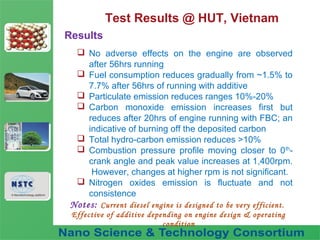
N O x e m is s io n
-1 0 %
-8 %
-6 %
-4 %
-2 %
0 %
2 %
4 %
0 2 0 5 6
E n g i n e r u n n i n g tim e (h o u r s )
Percentageimprovement(%)
0
1 0
2 0
3 0
4 0
5 0
6 0
7 0
- 9 0 - 8 0 - 7 0 - 6 0 - 5 0 - 4 0 - 3 0 - 2 0 - 1 0 0 1 0 2 0 3 0 4 0 5 0 6 0 7 0 8 0 9 0
C r a n k a n g l e [ d e g r e e ]
Pressure[bar]
p _ c y l i n d e r _ D i e s e l
p _ c y l i n d e r _ C e O 2 _ L 1
p _ c y l i n d e r _ C e O 2 _ L 2
p _ c y l i n d e r _ C e O 2 _ L 3
0
1 0
2 0
3 0
4 0
5 0
6 0
7 0
- 9 0 - 8 0 - 7 0 - 6 0 - 5 0 - 4 0 - 3 0 - 2 0 - 1 0 0 1 0 2 0 3 0 4 0 5 0 6 0 7 0 8 0 9 0
C r a n k a n g le [ d e g r e e ]
Pressure[bar]
p _ c y l i n d e r _ D i e s e l
p _ c y l i n d e r _ C e O 2 _ L 1
p _ c y l i n d e r _ C e O 2 - L 2
p _ c y l i n d e r _ C e O 2 _ L 3
0
1 0
2 0
3 0
4 0
5 0
6 0
7 0
- 9 0 - 8 0 - 7 0 - 6 0 - 5 0 - 4 0 - 3 0 - 2 0 - 1 0 0 1 0 2 0 3 0 4 0 5 0 6 0 7 0 8 0 9 0
C r a n k a n g l e [ d e g r e e ]
Pressure[bar]
P _ C y l i n d e r_ D i e s e l
p _ c y l i n d e r_ C e O 2 _ L 1
P _ C y l i n d e r_ C e O 2 _ L 2
p _ c y l i n d e r_ C e O 2 _ L 3
Fuel Nano-Additive
Technology
Test Results @ HUT, Vietnam
Results
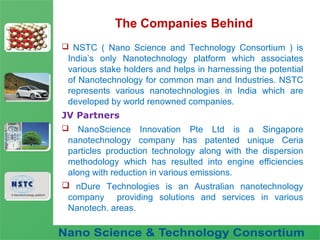
 No adverse effects on the engine are observed
after 56hrs running
 Fuel consumption reduces gradually from ~1.5% to
7.7% after 56hrs of running with additive
 Particulate emission reduces ranges 10%-20%
 Carbon monoxide emission increases first but
reduces after 20hrs of engine running with FBC; an
indicative of burning off the deposited carbon
 Total hydro-carbon emission reduces >10%
 Combustion pressure profile moving closer to 0th
-
crank angle and peak value increases at 1,400rpm.
However, changes at higher rpm is not significant.
 Nitrogen oxides emission is fluctuate and not
consistence
Notes: Current diesel engine is designed to be very efficient.
Effective of additive depending on engine design & operating
condition
Fuel Nano-Additive
Technology
The Companies Behind
 NSTC ( Nano Science and Technology Consortium ) is
India’s only Nanotechnology platform which associates
various stake holders and helps in harnessing the potential
of Nanotechnology for common man and Industries. NSTC
represents various nanotechnologies in India which are
developed by world renowned companies.
JV Partners
 NanoScience Innovation Pte Ltd is a Singapore
nanotechnology company has patented unique Ceria
particles production technology along with the dispersion
methodology which has resulted into engine efficiencies
along with reduction in various emissions.
 nDure Technologies is an Australian nanotechnology
company providing solutions and services in various
Nanotech. areas.
Fuel Nano-Additive
Technology
Why NSTC
 Technological Development of Nano-Additive
 Commercialisation of Nano-Additive Technology
 Delivery of Nano-Additive
Fuel Nano-Additive
Technology
Nano Science and Technology
Consortium
A-105, Level-III, Sector-63,
Noida-201301, U.P., (India)
For Queries/Concerns
Tel: +91-120- 4781215-17
Mob: +91-9818206463
Website: www.nstc.in
E-mail: info@nstc.in
Chat: Yahoo ID- nstcchat

Fuel nano additive technology

  • 1.
  • 2.
    Fuel Nano-Additive Technology WHAT ISNANOTECHNOLOGY?  Development of technologies to exploit the distinct property enhancement observed at nanoscale such that the following benefits are observed:  Improvements to existing products in terms of performance or value  New functionality paradigms  Improve our control and understanding of processes
  • 3.
  • 4.
    Fuel Nano-Additive Technology Our TechnologyOutline  Fuel Borne Catalyst  Results of Testing FBC in Vietnam  Test Protocol & Discussion
  • 5.
    Fuel Nano-Additive Technology Objectives  Toincrease combustion efficiency; Travel range per unit fuel or save fuel cost  To reduce unwanted emission  To have a secured supply; Technology should be amenable for local manufacturing
  • 6.
    Fuel Nano-Additive Technology  Catalystis a substance that accelerate a chemical reaction and itself is not consumed by the overall reaction. It provides an alternative route of reaction where the activation energy is lower than the original chemical reaction  When the catalyst is homogeneously mixed in the fuel, it is known as fuel borne catalyst
  • 7.
    Fuel Nano-Additive Technology Cerium Oxideas a Fuel Borne Catalyst Cerium-oxide (ceria) is a catalyst widely used in petroleum cracking, metal alloying, semiconductor polishing, car catalytic converters, etc. When Ceria is mixed in fuel to promote fuel combustion, it is called FBC (Fuel Borne Catalyst)
  • 8.
    Fuel Nano-Additive Technology How CeriumOxide acts as a Catalyst? Provides highly reactive surface atomic oxygen during transformation from stoichiometric +4ve state to +3ve state with relatively low required activation energy Fluorite structure is retained and is readily be reoxidized back to CeO2 in oxidizing environment Used as an oxygen storage material in catalysis via the following reaction: 2CeO2 Ce2 O3 + O Its REDOX properties have promoted combustion and reduce Nox as: Hydrocarbon Combustion: (2x+y)CeO2 + Cx Hy → (2x+y)Ce2 O3 /2 + CO2 + H2 O Soot Burning: 4CeO2 + Csoot → 2Ce2 O3 + CO2 NOx Reduction: xCe2 O3 + NOx → 2xCeO2 + N2
  • 9.
    Fuel Nano-Additive Technology Cerium Oxideas Fuel Borne Catalyst (FBC) Fuel without FBC Fuel with FBC
  • 10.
  • 11.
    Fuel Nano-Additive Technology Nano CeriumOxide as Fuel Borne Catalyst (FBC)  In 2003, Health Effects Institute of USA has listed nano- CeO2 FBC as amongst the highest recommended fuel- additive technology for improving diesel engine emission Advantages  Environment  Reduce undesired pollutants & burnt less fuel per traveled distance  Operation  Improve Range and hence Cost  Nano-CeO2 has large surface area, its light weight helps form stable suspension & avoid wear
  • 12.
    Fuel Nano-Additive Technology Product andProperties  Catalyst requires sufficient surface area during reaction to be effective. Reduction leads to loss of its effectiveness  A new method is developed for nanopowder synthesizing process, HYBRID PLASMA  This method of synthesizing Ceria provides more stable surface area at high temperature, consistent catalytic activities in combustion chamber and hence performance
  • 13.
    Fuel Nano-Additive Technology Product andProperties-Contd.  Data shows the specific surface area shrank only <15% when they were heated to 800°C  The surface stability, in return provides consistent higher catalytic activities at high temperature environment  The technology also provides area to disperse the nanopowder into high concentration slurry and readily disperse into fuel at high dilution ratio,1:20,000
  • 14.
    Fuel Nano-Additive Technology Published CeriaBET Values at Different Temperature Market Utilized Ceria: 400ºK = ~70-m2 /gr 1,000ºK = ~10-m2 /gr NSI Produced Ceria: 300ºK = 123-m2 /gr 1,073ºK = 113-m2 /gr Experimental TPR profile (right) and surface area drop (left) of three different samples of ceria : high surface area (▲.---), medium surface area (▄,--), low surface area (●,---)
  • 15.
    Fuel Nano-Additive Technology Testing Facilities@ Internal Combustion Lab; Inst. Transportation Engineering Hanoi Univ. of Technology; Vietnam  Appointed Lab by Vietnam's EPA System Specification: One Cylinder Research Engine Austria, AVL 5402 engine with PUMA& EMCON computerized control system  Parameter Diameter: 85mm Stroke length: 90mm Volume: 510.7CC Combustion Ratio: 17.1:1
  • 16.
    Fuel Nano-Additive Technology NSI's FBCLaboratory Test Test Procedures Test ran on April 2008 with Vietnamese open market diesel Data Averaged according to ECE R49 Test protocol: 13 running modes Data taken at Normal diesel Immediately added FBC (t=0) After 20hrs of continuously running at 1,800-rpm @ 50% load (t=20) After another 36hrs of continuously running at 1,800rpm @ 50% load (t=56) Additive resulted with fuel contains <10pmm of CeO2 nanoparticles
  • 17.
    Fuel Nano-Additive Technology F ue l i m p r o v e m e n t v s e n g i n e r u n n i n g ti m e 0 . 0 1 . 0 2 . 0 3 . 0 4 . 0 5 . 0 6 . 0 7 . 0 8 . 0 9 . 0 4 2 0 5 6 E n g in e r u n n in g t im e ( h r s ) Fuelimprovment(%) Test Results @ HUT, Vietnam T o t a l h y d r o c a r b o n ( T H C ) e m is s io n 0 % 5 % 1 0 % 1 5 % 2 0 % 2 5 % 0 2 0 5 6 E n g i n e r u n n i n g ti m e ( h o u r s ) Percentageimprovement(%) C O e m is s io n -1 0 % -5 % 0 % 5 % 1 0 % 1 5 % 2 0 % 2 5 % 0 2 0 5 6 E n g i n e r u n n i n g t i m e ( h o u r s ) Percentageimprovement(%) O p a c ity In d e x 0 % 5 % 1 0 % 1 5 % 2 0 % 2 5 % 0 2 0 5 6 E n g in e r u n n in g tim e (h o u r s ) Percentageimprovement(%)
  • 18.
    Fuel Nano-Additive Technology Test Results@ HUT, Vietnam N O x e m is s io n -1 0 % -8 % -6 % -4 % -2 % 0 % 2 % 4 % 0 2 0 5 6 E n g i n e r u n n i n g tim e (h o u r s ) Percentageimprovement(%) 0 1 0 2 0 3 0 4 0 5 0 6 0 7 0 - 9 0 - 8 0 - 7 0 - 6 0 - 5 0 - 4 0 - 3 0 - 2 0 - 1 0 0 1 0 2 0 3 0 4 0 5 0 6 0 7 0 8 0 9 0 C r a n k a n g l e [ d e g r e e ] Pressure[bar] p _ c y l i n d e r _ D i e s e l p _ c y l i n d e r _ C e O 2 _ L 1 p _ c y l i n d e r _ C e O 2 _ L 2 p _ c y l i n d e r _ C e O 2 _ L 3 0 1 0 2 0 3 0 4 0 5 0 6 0 7 0 - 9 0 - 8 0 - 7 0 - 6 0 - 5 0 - 4 0 - 3 0 - 2 0 - 1 0 0 1 0 2 0 3 0 4 0 5 0 6 0 7 0 8 0 9 0 C r a n k a n g le [ d e g r e e ] Pressure[bar] p _ c y l i n d e r _ D i e s e l p _ c y l i n d e r _ C e O 2 _ L 1 p _ c y l i n d e r _ C e O 2 - L 2 p _ c y l i n d e r _ C e O 2 _ L 3 0 1 0 2 0 3 0 4 0 5 0 6 0 7 0 - 9 0 - 8 0 - 7 0 - 6 0 - 5 0 - 4 0 - 3 0 - 2 0 - 1 0 0 1 0 2 0 3 0 4 0 5 0 6 0 7 0 8 0 9 0 C r a n k a n g l e [ d e g r e e ] Pressure[bar] P _ C y l i n d e r_ D i e s e l p _ c y l i n d e r_ C e O 2 _ L 1 P _ C y l i n d e r_ C e O 2 _ L 2 p _ c y l i n d e r_ C e O 2 _ L 3
  • 19.
    Fuel Nano-Additive Technology Test Results@ HUT, Vietnam Results  No adverse effects on the engine are observed after 56hrs running  Fuel consumption reduces gradually from ~1.5% to 7.7% after 56hrs of running with additive  Particulate emission reduces ranges 10%-20%  Carbon monoxide emission increases first but reduces after 20hrs of engine running with FBC; an indicative of burning off the deposited carbon  Total hydro-carbon emission reduces >10%  Combustion pressure profile moving closer to 0th - crank angle and peak value increases at 1,400rpm. However, changes at higher rpm is not significant.  Nitrogen oxides emission is fluctuate and not consistence Notes: Current diesel engine is designed to be very efficient. Effective of additive depending on engine design & operating condition
  • 20.
    Fuel Nano-Additive Technology The CompaniesBehind  NSTC ( Nano Science and Technology Consortium ) is India’s only Nanotechnology platform which associates various stake holders and helps in harnessing the potential of Nanotechnology for common man and Industries. NSTC represents various nanotechnologies in India which are developed by world renowned companies. JV Partners  NanoScience Innovation Pte Ltd is a Singapore nanotechnology company has patented unique Ceria particles production technology along with the dispersion methodology which has resulted into engine efficiencies along with reduction in various emissions.  nDure Technologies is an Australian nanotechnology company providing solutions and services in various Nanotech. areas.
  • 21.
    Fuel Nano-Additive Technology Why NSTC Technological Development of Nano-Additive  Commercialisation of Nano-Additive Technology  Delivery of Nano-Additive
  • 22.
    Fuel Nano-Additive Technology Nano Scienceand Technology Consortium A-105, Level-III, Sector-63, Noida-201301, U.P., (India) For Queries/Concerns Tel: +91-120- 4781215-17 Mob: +91-9818206463 Website: www.nstc.in E-mail: info@nstc.in Chat: Yahoo ID- nstcchat