EKTINTERACTIVE.COM
INTRODUCTION TO
REFINING
OIL 101
EKTINTERACTIVE.COM
This Intro to Refining overview includes:
Why We Refine Crude Oil
Refining Distillation Process
Historical Perspective
R E F I N I N G
EKTINTERACTIVE.COM
Complete Refining Module includes:
Crude Oil and Products
Refinery Processes
Drivers that Impact Refining Probability
Learn More
EKTINTERACTIVE.COM
Why Do We Refine Crude Oil?
EKTINTERACTIVE.COM
Why Refine Crude Oil
Crude oil cannot be used as it occurs in nature, other
than burning for fuel, which is wasteful.
EKTINTERACTIVE.COM
Distillation –
Splitting Crude into Fractions
In the refinery, crude oil components can first be split
by carefully applying heat to capture various parts,
called fractions, within certain boiling ranges. This is
called distillation.
EKTINTERACTIVE.COM
The yield of products from straight distillation of crude oil is
not the same as the “demand barrel” needed for the
marketplace.
The Demand Barrel
EKTINTERACTIVE.COM
Additional Processing
A large part of refinery processing is concerned with converting
unwanted heavy fuel oil into marketable gasoline and diesel,
using various processing methods.
EKTINTERACTIVE.COM
Distillation – A Boiling Process
As we mentioned, the distillation of crude oil is the
start of the refining process, and is primarily a
boiling operation.
EKTINTERACTIVE.COM
Crude Distillation Unit
Crude oil is first washed to remove salt, heated
in a furnace, and introduced to the Crude
Distillation Unit (CDU).
EKTINTERACTIVE.COM
In the CDU, the crude oil is separated by boiling range into
a number of fractions.
EKTINTERACTIVE.COM
Fractions
A fraction is the term used for a specific hydrocarbon
which is produced and captured according to its
molecular weight and boiling point.
EKTINTERACTIVE.COM
Some fractions have all the qualities needed as
refined products and are ready for sale.
Other require further processing.
EKTINTERACTIVE.COM
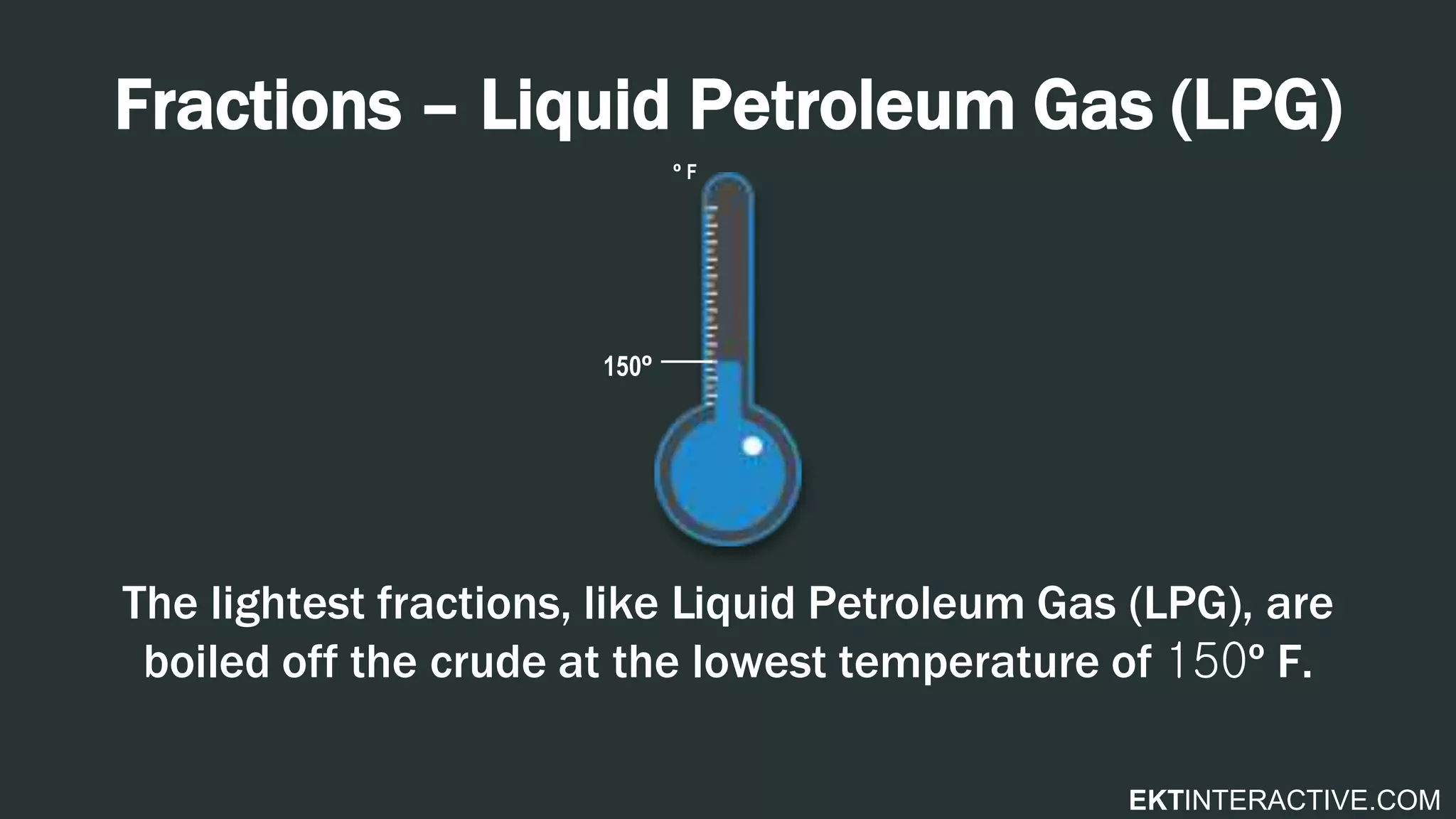
Fractions – Liquid Petroleum Gas (LPG)
The lightest fractions, like Liquid Petroleum Gas (LPG), are
boiled off the crude at the lowest temperature of 150º F.
150º
º F
EKTINTERACTIVE.COM
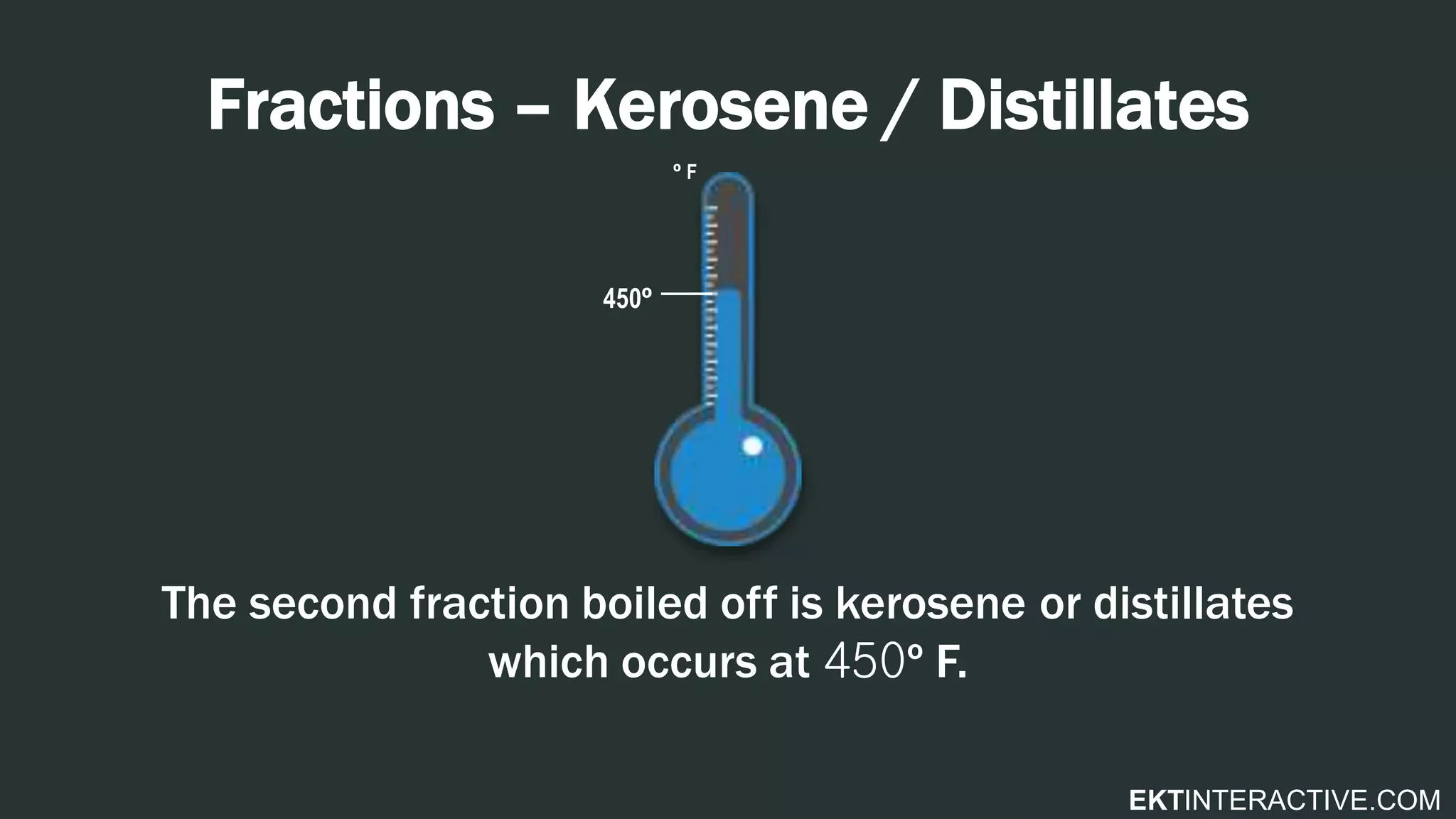
Fractions – Kerosene / Distillates
The second fraction boiled off is kerosene or distillates
which occurs at 450º F.
450º
º F
EKTINTERACTIVE.COM
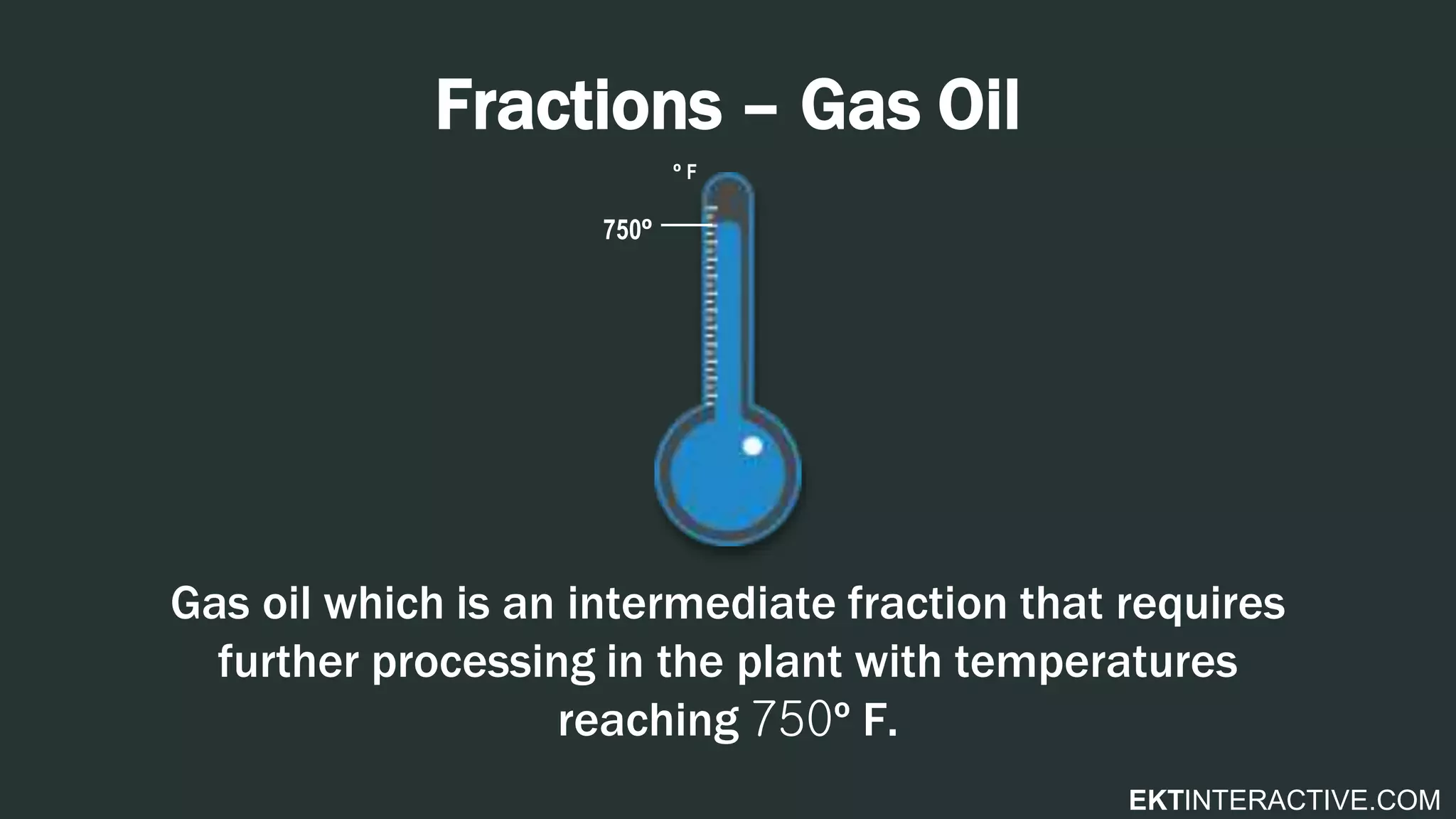
Fractions – Gas Oil
Gas oil which is an intermediate fraction that requires
further processing in the plant with temperatures
reaching 750º F.
750º
º F
EKTINTERACTIVE.COM
Fractions – Fuel Oil
The heaviest fraction, with the highest boiling point in the
distillation process is fuel oil. These heavy fractions require
more severe processing to be useful.
EKTINTERACTIVE.COM
Join now for access to free eBooks,
members only forums, and a growing
body of digital learning content.
Free eBooks include:
 History of Oil
 Upstream Fundamentals
 Midstream Fundamentals
 Downstream Fundamentals
 Business Processes/Risk Management
 Industry Trends
Learn More!
EKTINTERACTIVE.COM
History of Refining
The history of refining innovation is really driven by the
evolution of product demand.
EKTINTERACTIVE.COM
Early Distillation Stills
The earliest petroleum refineries in the 1880’s were really
little more than stills - like those to make “moonshine” alcohol
in the old movies!
They were designed to extract both kerosene from crude oil for
use as lamp oil and petroleum grease.
EKTINTERACTIVE.COM
Enter The Automobile
By the early 1920’s the automobile and airplane were
firmly established as major modes of transportation in
the developed economies.
This growth forced global refiners to expand.
EKTINTERACTIVE.COM
Motor Fuels Dominate
Refiners also developed new refining technologies to
increase yields of gasoline and other motor fuels.
EKTINTERACTIVE.COM
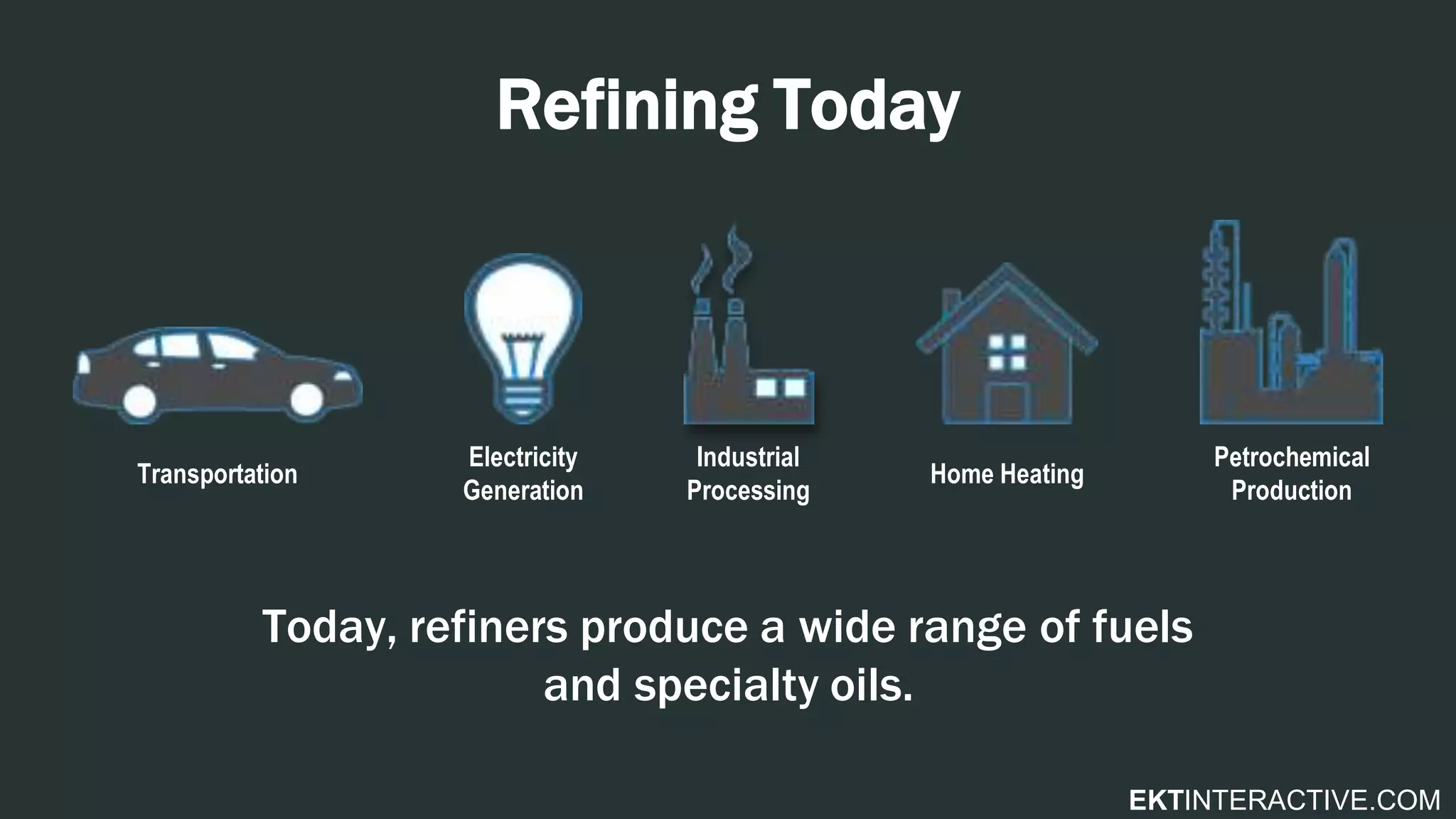
Refining Today
Today, refiners produce a wide range of fuels
and specialty oils.
Transportation
Electricity
Generation
Industrial
Processing
Home Heating
Petrochemical
Production
EKTINTERACTIVE.COM
Multi-Billion Dollar Business
These modern facilities cost billions of dollars to build.
They can also incur billions of dollars in annual operating
expenses.
EKTINTERACTIVE.COM
Refining in Emerging Economies
Emerging economies are now adopting the best of western
refining technologies.
EKTINTERACTIVE.COM
There’s More?
This Intro to Refining material was taken from our free
Oil 101: Introduction to Oil & Gas
course.
EKTINTERACTIVE.COM
EKT Interactive staff have provided oil and gas training
since 1986.
Visit us at www.ektinteractive.com to learn more.
Who are we?

Oil 101 - Introduction to Refining

Editor's Notes

  • #2 Hi, and welcome to Oil 101, the podcast. My name is Doug Stetzer and I’m content and community manager for EKT Interactive.   Today we will be drilling deeper into Downstream segments, starting with refining. We’ll be sure to put the link to the Downstream Overview in the program notes in case you missed it or just want a review since it’s been a while. If you want more information  about our free Oil 101 content be sure to visit www.ektinteractive.com.
  • #3 This refining overview includes segments on: Why we refine crude oil, a basic summary of the refining distillation process, and some historical perspective on the evolution of refining.
  • #4 The complete refining module includes lessons on crude oil and products, refinery processes, key business drivers that impact refining probability and more.
  • #5 So Why Do We Refine Crude Oil?
  • #6 Crude oil cannot be used as it occurs in nature, other than burning for fuel, which is wasteful. It must be refined to manufacture finished products such as gasoline and heating oil.  
  • #7 In the refinery, crude oil components can first be split by carefully applying heat to capture various parts, called fractions, within certain boiling ranges. This is called distillation.   The quality of these initial fractions produced is not sufficient to be sold directly as petroleum products without further treatment.
  • #8 The yield of products from straight distillation of crude oil is not the same as the “demand barrel” needed for the marketplace. Crude oil must therefore, be further  processed using both heat and pressure to improve qualities and meet market demand.
  • #9 A large part of refinery processing is concerned with converting unwanted heavy fuel oil into marketable gasoline and diesel, using various processing methods.
  • #10 As we mentioned, the distillation of crude oil is the start of the refining process, and is primarily a boiling operation.
  • #11 Crude oil is first washed to remove salt, heated in a furnace, and introduced to the Crude Distillation Unit, called a CDU.
  • #12 In the CDU, the crude oil is separated by boiling range into a number of fractions.
  • #13 A fraction is the term used for a specific hydrocarbon which is produced and captured according to its molecular weight and boiling point.
  • #14 Some fractions from the distillation process have all the qualities needed as refined products and are ready for sale. Other require further processing before their sold to customers.
  • #15 The lightest fractions, like liquid petroleum gas (or LPG), are boiled off the crude at the lowest temperature of 150º F.
  • #16 The second fraction boiled off is kerosene or distillates which occurs at 450º F.
  • #17 Gas oil which is an intermediate fraction that requires further processing in the plant with temperatures reaching 750º F.
  • #18 The heaviest fraction, with the highest boiling point in the distillation process is fuel oil. These heavy fractions require more severe processing to be useful.
  • #19 This episode is brought to you by EKT Interactive’s Oil 101 - a free Introduction to Oil and gas.  Our Oil 101 materials are available at www.EKTInteractive.com.  Within this free, members-only content area you’ll find eBooks on oil and gas industry fundamentals, relevant articles on key oil and gas topics, and a growing body of digital learning content. Claim your free membership and join the Oil 101 learning community at www.ektinteractive.com today.
  • #20 The history of refining innovation is really driven by the evolution of product demand.  
  • #21 The earliest petroleum refineries in the 1880’s were really little more than stills - like those to make “moonshine” alcohol in the old movies!  They were designed to extract both kerosene from crude oil for use as lamp oil and petroleum grease, which at the time was exported around the world from the US. Whatever products remained, including gasoline, were treated as waste.
  • #22 The advent of the internal combustion engine and the subsequent explosion in automotive transport changed everything. By the early 1920’s the automobile and airplane were firmly established as major modes of transportation in the developed economies. This growth forced global refiners to expand.
  • #23 Along with an expansion in capacity refiners also developed new refining technologies to increase yields of gasoline and other motor fuels. After the second world war rapid fuel in jet fuel consumption also place new demands on refineries around the world.
  • #24 Today, refiners produce a wide range of fuels and specialty oils used in transportation, electricity generation, industrial processing, home heating, petrochemical production, and thousands of other uses.  
  • #25 These modern facilities cost billions of dollars to build. They can also incur billions of dollars in annual operating expenses to employ a variety of high pressure and high temperature technologies which squeeze the most out of a barrel of crude oil. This also gives refiners the flexibility required to meet shifting seasonal and global product demand patterns.
  • #26 The rapidly growing emerging economies are now adopting the best of western refining technologies to meet growing demand for their transportation fuels.
  • #27 Thanks for listening, and we hope you’ve learned a few things about the refining function of downstream oil and gas.
  • #28 Be sure to share this as you see fit, and review us on itunes if you have a chance.  Your feedback really helps us improve as we move forward. If you want more information about our Oil 101 “Microbes to Markets” content go to www.ektinteractive.com and register to access our free content library. OK.  See you next time.