What is Biodiesel ?
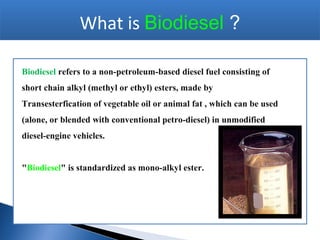
Biodiesel refers to a non-petroleum-based diesel fuel consisting of
short chain alkyl (methyl or ethyl) esters, made by
Transesterfication of vegetable oil or animal fat , which can be used
(alone, or blended with conventional petro-diesel) in unmodified
diesel-engine vehicles.
"Biodiesel" is standardized as mono-alkyl ester.
History of Vegetable Oil Based
Fuels
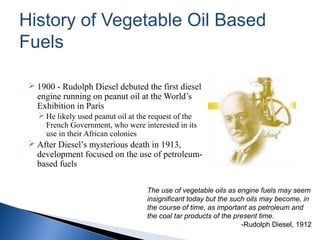
 1900 - Rudolph Diesel debuted the first diesel
engine running on peanut oil at the World’s
Exhibition in Paris
 He likely used peanut oil at the request of the
French Government, who were interested in its
use in their African colonies
 After Diesel’s mysterious death in 1913,
development focused on the use of petroleum-
based fuels
The use of vegetable oils as engine fuels may seem
insignificant today but the such oils may become, in
the course of time, as important as petroleum and
the coal tar products of the present time.
-Rudolph Diesel, 1912
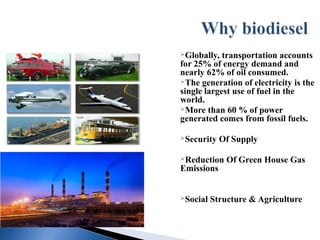
Globally, transportation accounts
for 25% of energy demand and
nearly 62% of oil consumed.
The generation of electricity is the
single largest use of fuel in the
world.
More than 60 % of power
generated comes from fossil fuels.
Security Of Supply
Reduction Of Green House Gas
Emissions
Social Structure & Agriculture
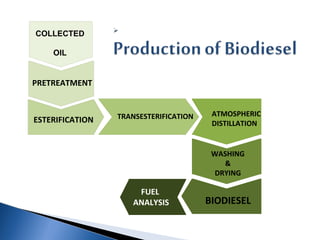
FUEL
ANALYSIS BIODIESEL
WASHING
&
DRYING
ATMOSPHERIC
DISTILLATION
TRANSESTERIFICATIONESTERIFICATION
PRETREATMENT
COLLECTED
OIL
6
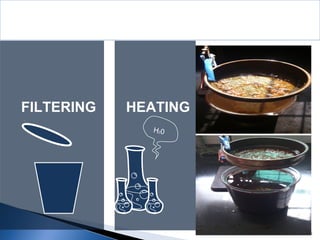
Pretreatments
FILTERING HEATING
H20
CALCULATING
FFA
FFA=
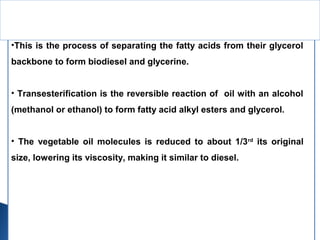
•This is the process of separating the fatty acids from their glycerol
backbone to form biodiesel and glycerine.
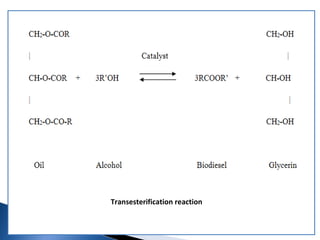
• Transesterification is the reversible reaction of oil with an alcohol
(methanol or ethanol) to form fatty acid alkyl esters and glycerol.
• The vegetable oil molecules is reduced to about 1/3rd
its original
size, lowering its viscosity, making it similar to diesel.
Transesterification
Transesterification reaction
Washing biodiesel with water is the oldest and most common method
of cleaning biodiesel. Methanol is a solvent, it captures soap and
other impurities and holds them dissolved in the biodiesel. Water
soaks up that methanol, releasing impurities to be washed away with
water.
Type of Water washing used :
 Water Washing
 Air / Bubble Washing
Washing and Drying
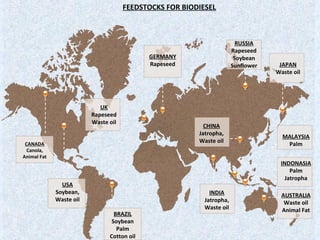
INDIA
Jatropha,
Waste oil
USA
Soybean,
Waste oil
CANADA
Canola,
Animal Fat
GERMANY
Rapeseed
MALAYSIA
Palm
INDONASIA
Palm
Jatropha
AUSTRALIA
Waste oil
Animal Fat
RUSSIA
Rapeseed
Soybean
Sunflower JAPAN
Waste oil
CHINA
Jatropha,
Waste oil
BRAZIL
Soybean
Palm
Cotton oil
UK
Rapeseed
Waste oil
FEEDSTOCKS FOR BIODIESEL
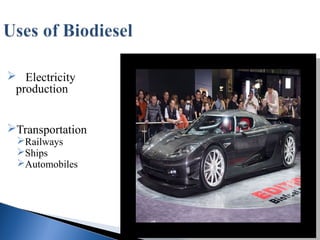
 Electricity
production
Transportation
Railways
Ships
Automobiles
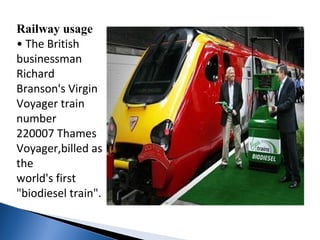
Railway usage
• The British
businessman
Richard
Branson's Virgin
Voyager train
number
220007 Thames
Voyager,billed as
the
world's first
"biodiesel train".
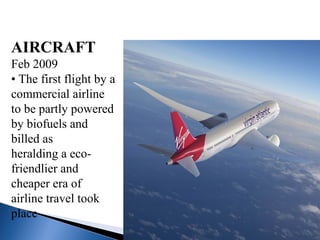
AIRCRAFT
Feb 2009
• The first flight by a
commercial airline
to be partly powered
by biofuels and
billed as
heralding a eco-
friendlier and
cheaper era of
airline travel took
place
Indian Initiatives
 National Mission on Biodiesel has been launched
by GOI
 State Governments designated special
authorities/bodies to manage
 Ministry of Petroleum and Natural Gas notified
biodiesel purchase policy
 Government Institutes are working on technology
and promotion
 Public and private sectors are working on
processing and end use
Some more practicalities
 The former President of India,
Late Dr. Abdul Kalam, is one
of the strong advocaters of
Jatropha cultivation for
production of bio-diesel.
 The State Bank of India
provided a boost to the
cultivation of Jatropha in India
by signing a MoU with D1
Mohan, a joint venture of D1
Oils plc, to give loans to the
tune of 1.3 billion rupees to
local farmers in India.
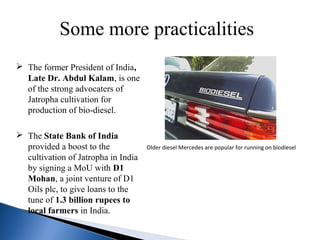
Older diesel Mercedes are popular for running on biodiesel
Biodiesel : First trial run on train
 First successful trial run of a superfast passenger train was
conducted on Dec 31, 2009
 Delhi - Amritsar Shatabdi Express used 5% of biodiesel fuel.
 Railway annual fuel bill = Rs 3400 crore (for Diesel)
 10% mixture with Diesel = reduced
(Rs.300-400 crore / annum)
 5% substitution is accepted.
Andhra Pradesh has entered into a formal agreement with
Reliance Industries for Jatropha planting.
The company has selected 200 acres (0.81 km2
) of land at
Kakinada to grow Jatropha for high quality bio-diesel fuel.
Chhattisgarh has decided to plant 160 million saplings of
Jatropha in all its 16 districts during 2006 with the aim of
becoming a bio-fuel self-reliant state by 2015.
On Nov 2005, the Maharashtra Government aimed to cultivate
Jatropha on 600 km² in the state.
September 2007-Hindustan Petroleum Corporation Limited(HPCL)
joined hands with the Maharashtra State Farming Corporation
Ltd(MSFCL) for a Jatropha seed-based bio-diesel venture.
Jatropha plant would be grown on 500 acres (2 km²) in Nashik and
Aurangabad.
09/13/15
Land Availability
Certified High Yielding Varieties
Plant Health
Availability of labor
Irrigation
Costs
 High yielding certified seed / planting material
 Dedicated Government Financial Support
Allotment of funds to promote Energy Crop plantations
 Nil VAT/ST on “Biodiesel Portion” of blended HSD.
Direct investments by Corporate to be treated as R&D expense / CSR
activity
 Waste Land Allotment Policy : Integrated (revenue cum
forest) wasteland allotment policy
Bio diesel is environmental friendly.
It can help reduce dependency on foreign oil.
It helps to lubricate the engine itself, decreasing engine wear.
It offers similar power to diesel fuel.
It is safer than conventional diesel.
It can be made from waste products.
It can be made at home easily.
 Its storage for long period is not suitable for engine
operation.
 It becomes gel in cold weather.
 It has water content. (Hygroscopic)
 It has higher (10%) Nox emissions.
 It decreases horsepower. (25%)
 By mixing of 20 per cent biodiesel with diesel will help India to save
7.3x10⁶
tones of diesel per year.
 In India about 33 million hectares of wasteland is available and can
effectively be used for cultivation of jatropha plants.
 It offers business possibility to agricultural enterprises and rural
employment.
 Biodiesel is least-cost-strategy to comply with state and federal
regulations.
 Use of biodiesel does not require major engine modifications. The only
thing that changes is air quality.
 Biodiesel has positive attributes such as increased cetane, high fuel
lubricity & high oxygen content.
 Biodiesel reduces by as much as 65 % the emission of small particles of
solid combustion products.
 The ozone (smog) forming potentials of hydrocarbons is less than diesel
fuel.
 Sulfur emissions are essentially eliminated with pure biodiesel .
 Biodiesel contain no petroleum, but can be blended with conventional diesel
fuel.
 These fuel can be used in any diesel engine without any modification.
 Biodiesel is degradable , non toxic and free from sulphur and lead.
 Graboski MS,McCormick RL. (1998)Combustion of fat and vegetable oil
derived fuels in diesel engines.
 Lapuerta M, Armas O, Rodriguez-Fernandez J.
 (1999)Effect of biodiesel fuels on diesel engine emissions.
 Basha SA, Raja Gopal K, Jebaraj S. (2011)A review on biodiesel production,
combustion, emissions and performance.
 Aydin H, Bayindir H. (2012)Performance and emission analysis of cottonseed
oil methyl ester in a diesel engine.
 Hazar H. Effects of biodiesel on a low heat loss diesel engine.
 Andree, A. & Pachernegg, S.J. (1969) Ignition conditions in diesel engines.
Society of Automotive Engineering Transaction
 Babu, A.K. & Devaradjane, G. (2003) Vegetable oils and their derivatives as
fuels for CI engine
THANKYOU

Biodiesel presentation1

  • 2.
    What is Biodiesel? Biodiesel refers to a non-petroleum-based diesel fuel consisting of short chain alkyl (methyl or ethyl) esters, made by Transesterfication of vegetable oil or animal fat , which can be used (alone, or blended with conventional petro-diesel) in unmodified diesel-engine vehicles. "Biodiesel" is standardized as mono-alkyl ester.
  • 3.
    History of VegetableOil Based Fuels  1900 - Rudolph Diesel debuted the first diesel engine running on peanut oil at the World’s Exhibition in Paris  He likely used peanut oil at the request of the French Government, who were interested in its use in their African colonies  After Diesel’s mysterious death in 1913, development focused on the use of petroleum- based fuels The use of vegetable oils as engine fuels may seem insignificant today but the such oils may become, in the course of time, as important as petroleum and the coal tar products of the present time. -Rudolph Diesel, 1912
  • 4.
    Globally, transportation accounts for25% of energy demand and nearly 62% of oil consumed. The generation of electricity is the single largest use of fuel in the world. More than 60 % of power generated comes from fossil fuels. Security Of Supply Reduction Of Green House Gas Emissions Social Structure & Agriculture
  • 5.
  • 6.
  • 7.
    •This is theprocess of separating the fatty acids from their glycerol backbone to form biodiesel and glycerine. • Transesterification is the reversible reaction of oil with an alcohol (methanol or ethanol) to form fatty acid alkyl esters and glycerol. • The vegetable oil molecules is reduced to about 1/3rd its original size, lowering its viscosity, making it similar to diesel. Transesterification
  • 8.
  • 9.
    Washing biodiesel withwater is the oldest and most common method of cleaning biodiesel. Methanol is a solvent, it captures soap and other impurities and holds them dissolved in the biodiesel. Water soaks up that methanol, releasing impurities to be washed away with water. Type of Water washing used :  Water Washing  Air / Bubble Washing Washing and Drying
  • 11.
    INDIA Jatropha, Waste oil USA Soybean, Waste oil CANADA Canola, AnimalFat GERMANY Rapeseed MALAYSIA Palm INDONASIA Palm Jatropha AUSTRALIA Waste oil Animal Fat RUSSIA Rapeseed Soybean Sunflower JAPAN Waste oil CHINA Jatropha, Waste oil BRAZIL Soybean Palm Cotton oil UK Rapeseed Waste oil FEEDSTOCKS FOR BIODIESEL
  • 12.
  • 13.
    Railway usage • TheBritish businessman Richard Branson's Virgin Voyager train number 220007 Thames Voyager,billed as the world's first "biodiesel train".
  • 14.
    AIRCRAFT Feb 2009 • Thefirst flight by a commercial airline to be partly powered by biofuels and billed as heralding a eco- friendlier and cheaper era of airline travel took place
  • 15.
    Indian Initiatives  NationalMission on Biodiesel has been launched by GOI  State Governments designated special authorities/bodies to manage  Ministry of Petroleum and Natural Gas notified biodiesel purchase policy  Government Institutes are working on technology and promotion  Public and private sectors are working on processing and end use
  • 16.
    Some more practicalities The former President of India, Late Dr. Abdul Kalam, is one of the strong advocaters of Jatropha cultivation for production of bio-diesel.  The State Bank of India provided a boost to the cultivation of Jatropha in India by signing a MoU with D1 Mohan, a joint venture of D1 Oils plc, to give loans to the tune of 1.3 billion rupees to local farmers in India. Older diesel Mercedes are popular for running on biodiesel
  • 17.
    Biodiesel : Firsttrial run on train  First successful trial run of a superfast passenger train was conducted on Dec 31, 2009  Delhi - Amritsar Shatabdi Express used 5% of biodiesel fuel.  Railway annual fuel bill = Rs 3400 crore (for Diesel)  10% mixture with Diesel = reduced (Rs.300-400 crore / annum)  5% substitution is accepted.
  • 18.
    Andhra Pradesh hasentered into a formal agreement with Reliance Industries for Jatropha planting. The company has selected 200 acres (0.81 km2 ) of land at Kakinada to grow Jatropha for high quality bio-diesel fuel. Chhattisgarh has decided to plant 160 million saplings of Jatropha in all its 16 districts during 2006 with the aim of becoming a bio-fuel self-reliant state by 2015.
  • 19.
    On Nov 2005,the Maharashtra Government aimed to cultivate Jatropha on 600 km² in the state. September 2007-Hindustan Petroleum Corporation Limited(HPCL) joined hands with the Maharashtra State Farming Corporation Ltd(MSFCL) for a Jatropha seed-based bio-diesel venture. Jatropha plant would be grown on 500 acres (2 km²) in Nashik and Aurangabad. 09/13/15
  • 20.
    Land Availability Certified HighYielding Varieties Plant Health Availability of labor Irrigation Costs
  • 21.
     High yieldingcertified seed / planting material  Dedicated Government Financial Support Allotment of funds to promote Energy Crop plantations  Nil VAT/ST on “Biodiesel Portion” of blended HSD. Direct investments by Corporate to be treated as R&D expense / CSR activity  Waste Land Allotment Policy : Integrated (revenue cum forest) wasteland allotment policy
  • 22.
    Bio diesel isenvironmental friendly. It can help reduce dependency on foreign oil. It helps to lubricate the engine itself, decreasing engine wear. It offers similar power to diesel fuel. It is safer than conventional diesel. It can be made from waste products. It can be made at home easily.
  • 23.
     Its storagefor long period is not suitable for engine operation.  It becomes gel in cold weather.  It has water content. (Hygroscopic)  It has higher (10%) Nox emissions.  It decreases horsepower. (25%)
  • 24.
     By mixingof 20 per cent biodiesel with diesel will help India to save 7.3x10⁶ tones of diesel per year.  In India about 33 million hectares of wasteland is available and can effectively be used for cultivation of jatropha plants.  It offers business possibility to agricultural enterprises and rural employment.  Biodiesel is least-cost-strategy to comply with state and federal regulations.  Use of biodiesel does not require major engine modifications. The only thing that changes is air quality.  Biodiesel has positive attributes such as increased cetane, high fuel lubricity & high oxygen content.
  • 25.
     Biodiesel reducesby as much as 65 % the emission of small particles of solid combustion products.  The ozone (smog) forming potentials of hydrocarbons is less than diesel fuel.  Sulfur emissions are essentially eliminated with pure biodiesel .  Biodiesel contain no petroleum, but can be blended with conventional diesel fuel.  These fuel can be used in any diesel engine without any modification.  Biodiesel is degradable , non toxic and free from sulphur and lead.
  • 26.
     Graboski MS,McCormickRL. (1998)Combustion of fat and vegetable oil derived fuels in diesel engines.  Lapuerta M, Armas O, Rodriguez-Fernandez J.  (1999)Effect of biodiesel fuels on diesel engine emissions.  Basha SA, Raja Gopal K, Jebaraj S. (2011)A review on biodiesel production, combustion, emissions and performance.  Aydin H, Bayindir H. (2012)Performance and emission analysis of cottonseed oil methyl ester in a diesel engine.  Hazar H. Effects of biodiesel on a low heat loss diesel engine.  Andree, A. & Pachernegg, S.J. (1969) Ignition conditions in diesel engines. Society of Automotive Engineering Transaction  Babu, A.K. & Devaradjane, G. (2003) Vegetable oils and their derivatives as fuels for CI engine
  • 27.