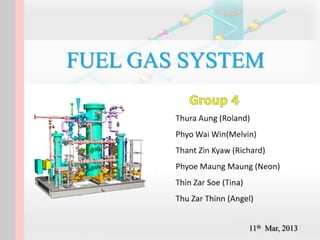
FUEL GAS SYSTEM
11th Mar, 2013
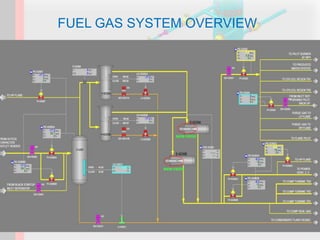
Fuel Gas System
• To supply dry, filtered fuel gas for gas turbines,
• Start-up seal gas for compressor, flare header purge and
blanket gas users.
Main Components
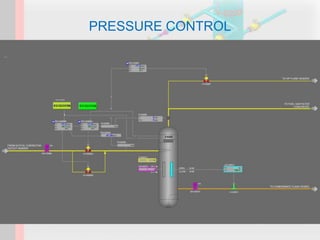
• Fuel Gas Scrubber (V-6200)
• Fuel Gas filter Separators (V6220 A/B)
• Fuel Gas Superheaters (E-6230 A/B)
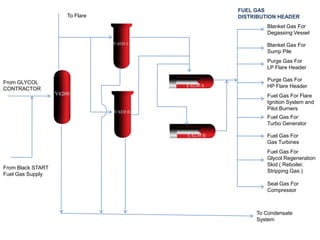
Blanket Gas For
Degassing Vessel
Blanket Gas For
Sump Pile
Purge Gas For
LP Flare Header
Purge Gas For
HP Flare Header
Fuel Gas For Flare
Ignition System and
Pilot Burners
Fuel Gas For
Turbo Generator
Fuel Gas For
Gas Turbines
Fuel Gas For
Glycol Regeneration
Skid ( Reboiler,
Stripping Gas )
Seal Gas For
Compressor
To Condensate
System
From Black START
Fuel Gas Supply
FUEL GAS
DISTRIBUTION HEADER
From GLYCOL
CONTRACTOR
To Flare
SOURCES :
• During normal operation, the gas is taken from the outlet of
Glycol Contactor.
• During start-up, the gas comes from Inlet Separator.

FUEL GAS SCRUBBER
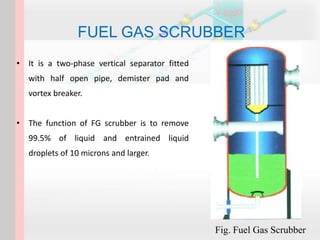
Fig. Fuel Gas Scrubber
• It is a two-phase vertical separator fitted
with half open pipe, demister pad and
vortex breaker.
• The function of FG scrubber is to remove
99.5% of liquid and entrained liquid
droplets of 10 microns and larger.
FUEL GAS SCRUBBER
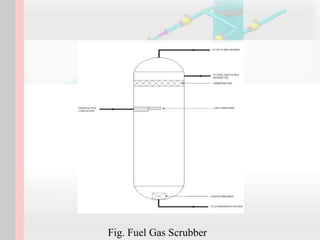
Fig. Fuel Gas Scrubber
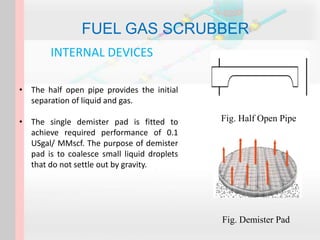
• The half open pipe provides the initial
separation of liquid and gas.
• The single demister pad is fitted to
achieve required performance of 0.1
USgal/ MMscf. The purpose of demister
pad is to coalesce small liquid droplets
that do not settle out by gravity.
FUEL GAS SCRUBBER
Fig. Demister Pad
Fig. Half Open Pipe
INTERNAL DEVICES
Fuel Gas Scrubber
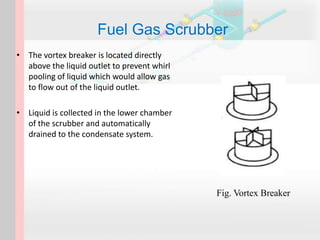
• The vortex breaker is located directly
above the liquid outlet to prevent whirl
pooling of liquid which would allow gas
to flow out of the liquid outlet.
• Liquid is collected in the lower chamber
of the scrubber and automatically
drained to the condensate system.
Fig. Vortex Breaker
Protection of
Fuel Gas Scrubber
• The Scrubber is protected from overpressure and under pressure by
presetting high and low pressure trips that will automatically
shutdown the FG system.
• High liquid level in the scrubber will also shutdown the system.
FG Filter Separator
• Receives the gas that is coming from Fuel Gas Scrubber
• Function
-Remove particles that can’t be removed by Fuel Gas Scrubber
-Mist, fogs, and dust from gas streams
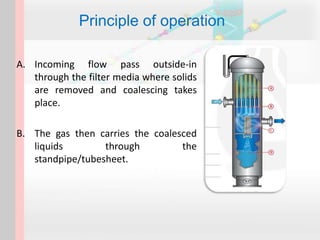
• Three Sections
 Coalescing Section with filter element
 Separation section with either a wire mesh or vane type mist
extractor
 A liquid accumulation section - to properly collect and discharge the
liquid for further processing or disposal
FG Filter Separator
Coalescing Section or
Filtration Section
Separation Section
Liquid Accumulating
Section
Fig: Vertical Gas Filter Separator
Principle of operation
A. Incoming flow pass outside-in
through the filter media where solids
are removed and coalescing takes
place.
B. The gas then carries the coalesced
liquids through the
standpipe/tubesheet.
Principle of operation
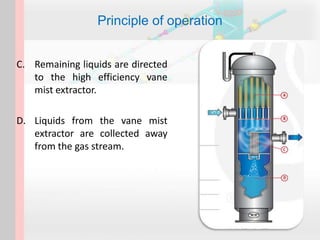
C. Remaining liquids are directed
to the high efficiency vane
mist extractor.
D. Liquids from the vane mist
extractor are collected away
from the gas stream.
In Zawtika Project
• 2 x 100% (Duty/Standby)
• Remove 99.98% of particles of size 0.3 micron and larger
• Removal of 99.98% aerosols of size 0.1 micron and larger before
feed to the FG Superheater.
• Single stage coalescer which employs the use of filter coalescer
cartridge type elements.
FG Filter Separator
FG Filter Separator
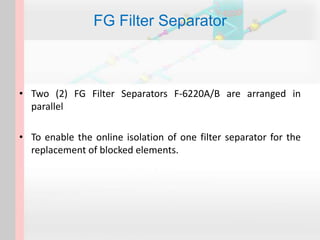
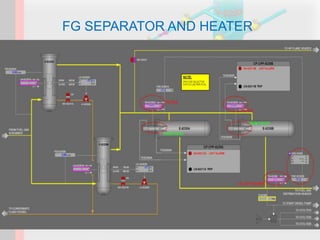
• Two (2) FG Filter Separators F-6220A/B are arranged in
parallel
• To enable the online isolation of one filter separator for the
replacement of blocked elements.
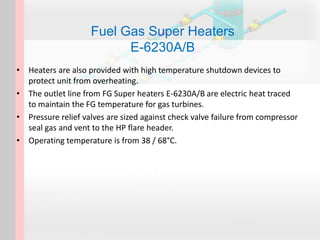
Fuel Gas Super heaters
E-6230A/B
• 2 x 100% (Duty/Standby) FG Super heater E-6230A/B is required
to provide 30°C of superheat to the FG in order to prevent liquids
forming downstream as a result of pressure drop across the
system.
• FG Super heaters E-6230A/B are designed with reduced active
element length and a larger bundle diameter to ensure bundle
removal for maintenance and inspection activities can be
accommodated on the available skid footprint.
Fuel Gas Super Heaters
E-6230A/B
• Heaters are also provided with high temperature shutdown devices to
protect unit from overheating.
• The outlet line from FG Super heaters E-6230A/B are electric heat traced
to maintain the FG temperature for gas turbines.
• Pressure relief valves are sized against check valve failure from compressor
seal gas and vent to the HP flare header.
• Operating temperature is from 38 / 68°C.
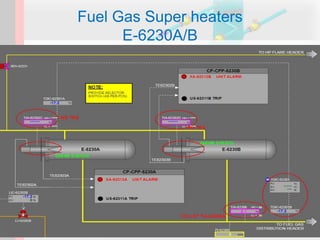
Fuel Gas Super heaters
E-6230A/B
Fuel Gas Super heaters
E-6230A/B
• Each heater is provided with a dedicated thyristor control panel.
• Heater is protected by a high element temperature shutdown device and a
high tube sheet temperature shutdown device.
• Electrical power supply for fuel gas heaters E-6230A/B are from LSWG-
CPP-200 (LV Switchgear/MCC) at MSR (Main Switchgear Room).
• Capacity of each heater is 186.5 kW and working voltage is 415V.
Maintenance of Fuel Gas
Super heaters E-6230A/B
• In this test, a high potential AC voltage is applied between the heating
element and the outer metal sheath (between the live parts and ground).
• This potential AC voltage is typically calculated by the following equation:
- 2× E +1000 (Volts),
- Where E is the line voltage rating of the heater
• The applied voltage is increased from zero to the test voltage and held for
1 minute.
• The insulation resistance test measures the resistance passing between
the central element coil and terminal to the outer metal sheath.
• Any elements which are below 2MΩ should be dried out for about 12
hours in an oven at 250-300°C.
• To determine the insulation resistance, it is recommended that a 500 VDC
or a 1000 VDC mega ohmmeter (Megger) can be used.
• Apply the leads from the megger to the heater terminals or circuits buss
bars and the ground or heater chassis.
Insulation Resistance Test
• Leakage current tests on single elements for appliances are conducted by
energizing the element using 120 or 240 volt power source and connecting
a sensitive current meter between a line terminal and the sheath.
• UL standards limit the leakage current to 0.005 amps (5 mA) or less.
• Properly dried elements have passed leakage tests with as low as
30microamps (0.000030 amp) leakage current.
Leakage Current Test
• Element resistance test is measuring electrical resistance in ohms from
terminal to terminal.
• If the heating elements are operational, the best way to check proper
heater operation is to measure the current with a clamp on ammeter.
• If all circuits are drawing proper current, it can be assumed that all heater
elements have continuity.
• If this test method is not possible, then it will be necessary to measure
individual circuits or elements for continuity and proper resistance.
Continuity and Element Resistance Test
• Keep the equipment clean, particularly around the terminals, wiring
enclosure, and heater itself through a regular maintenance program.
• While heating elements do have a long service life in most applications,
the possibility of ultimate failure must be considered.
• Provisions should be made for ready replacement if the potential
downtime will be expensive or critical to production or other operations.
• Replacement parts should be stocked as necessary so that a failed
element can be replaced in a short period of time without completely
stopping or disrupting the process.
Routine Service
Mechanical Maintenance
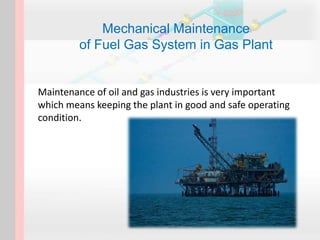
of Fuel Gas System in Gas Plant
Maintenance of oil and gas industries is very important
which means keeping the plant in good and safe operating
condition.
Type of Inspection
In general, there are about eight types of inspection which are
commonly done by the plant inspection personal,
1. Routine or periodic inspection
2. Shutdown or Turnaround and Inspection
3. Equipment Inspection
4. Fabrication Inspection
5. Painting and Coating Inspection
6. Non-destructive Test (NDT)
7. Corrosion Check
8. Materials Check
The maintenance craftsman whose responsibility is the maintenance of piping
systems, will be concerned:-
• Checking the pipe and flange connection leakage and corrosion.
• Checking to be sure that valves are in working order.
• Repacking valves, maintaining and replacing gaskets.
• Checking insulation and possibly installing it as needed.
• Checking hangers and pipe supports.
• Reporting anything of an unusual nature.
Pipe and Flange Connection Part:
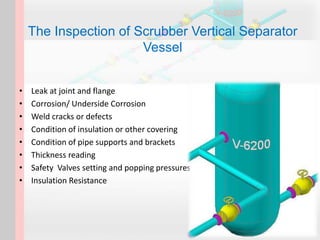
The Inspection of Scrubber Vertical Separator
Vessel
• Leak at joint and flange
• Corrosion/ Underside Corrosion
• Weld cracks or defects
• Condition of insulation or other covering
• Condition of pipe supports and brackets
• Thickness reading
• Safety Valves setting and popping pressures
• Insulation Resistance
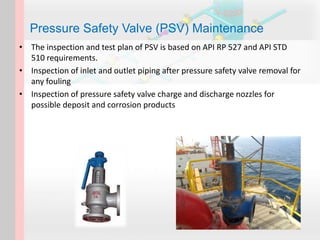
• The inspection and test plan of PSV is based on API RP 527 and API STD
510 requirements.
• Inspection of inlet and outlet piping after pressure safety valve removal for
any fouling
• Inspection of pressure safety valve charge and discharge nozzles for
possible deposit and corrosion products
Pressure Safety Valve (PSV) Maintenance
FUEL GAS SYSTEM OVERVIEW
PRESSURE CONTROL
FG SEPARATOR AND HEATER
FG DISTRIBUTION HEADER
Q & A
Thank You
Group (4) ,
POT Myanmar

Fuel gas system of gas production

  • 1.
  • 2.
    Fuel Gas System •To supply dry, filtered fuel gas for gas turbines, • Start-up seal gas for compressor, flare header purge and blanket gas users.
  • 3.
    Main Components • FuelGas Scrubber (V-6200) • Fuel Gas filter Separators (V6220 A/B) • Fuel Gas Superheaters (E-6230 A/B)
  • 4.
    Blanket Gas For DegassingVessel Blanket Gas For Sump Pile Purge Gas For LP Flare Header Purge Gas For HP Flare Header Fuel Gas For Flare Ignition System and Pilot Burners Fuel Gas For Turbo Generator Fuel Gas For Gas Turbines Fuel Gas For Glycol Regeneration Skid ( Reboiler, Stripping Gas ) Seal Gas For Compressor To Condensate System From Black START Fuel Gas Supply FUEL GAS DISTRIBUTION HEADER From GLYCOL CONTRACTOR To Flare
  • 5.
    SOURCES : • Duringnormal operation, the gas is taken from the outlet of Glycol Contactor. • During start-up, the gas comes from Inlet Separator. FUEL GAS SCRUBBER
  • 6.
    Fig. Fuel GasScrubber • It is a two-phase vertical separator fitted with half open pipe, demister pad and vortex breaker. • The function of FG scrubber is to remove 99.5% of liquid and entrained liquid droplets of 10 microns and larger. FUEL GAS SCRUBBER
  • 7.
    Fig. Fuel GasScrubber
  • 8.
    • The halfopen pipe provides the initial separation of liquid and gas. • The single demister pad is fitted to achieve required performance of 0.1 USgal/ MMscf. The purpose of demister pad is to coalesce small liquid droplets that do not settle out by gravity. FUEL GAS SCRUBBER Fig. Demister Pad Fig. Half Open Pipe INTERNAL DEVICES
  • 9.
    Fuel Gas Scrubber •The vortex breaker is located directly above the liquid outlet to prevent whirl pooling of liquid which would allow gas to flow out of the liquid outlet. • Liquid is collected in the lower chamber of the scrubber and automatically drained to the condensate system. Fig. Vortex Breaker
  • 10.
    Protection of Fuel GasScrubber • The Scrubber is protected from overpressure and under pressure by presetting high and low pressure trips that will automatically shutdown the FG system. • High liquid level in the scrubber will also shutdown the system.
  • 11.
    FG Filter Separator •Receives the gas that is coming from Fuel Gas Scrubber • Function -Remove particles that can’t be removed by Fuel Gas Scrubber -Mist, fogs, and dust from gas streams
  • 12.
    • Three Sections Coalescing Section with filter element  Separation section with either a wire mesh or vane type mist extractor  A liquid accumulation section - to properly collect and discharge the liquid for further processing or disposal FG Filter Separator
  • 13.
    Coalescing Section or FiltrationSection Separation Section Liquid Accumulating Section Fig: Vertical Gas Filter Separator
  • 14.
    Principle of operation A.Incoming flow pass outside-in through the filter media where solids are removed and coalescing takes place. B. The gas then carries the coalesced liquids through the standpipe/tubesheet.
  • 15.
    Principle of operation C.Remaining liquids are directed to the high efficiency vane mist extractor. D. Liquids from the vane mist extractor are collected away from the gas stream.
  • 16.
    In Zawtika Project •2 x 100% (Duty/Standby) • Remove 99.98% of particles of size 0.3 micron and larger • Removal of 99.98% aerosols of size 0.1 micron and larger before feed to the FG Superheater. • Single stage coalescer which employs the use of filter coalescer cartridge type elements. FG Filter Separator
  • 17.
    FG Filter Separator •Two (2) FG Filter Separators F-6220A/B are arranged in parallel • To enable the online isolation of one filter separator for the replacement of blocked elements.
  • 18.
    Fuel Gas Superheaters E-6230A/B • 2 x 100% (Duty/Standby) FG Super heater E-6230A/B is required to provide 30°C of superheat to the FG in order to prevent liquids forming downstream as a result of pressure drop across the system. • FG Super heaters E-6230A/B are designed with reduced active element length and a larger bundle diameter to ensure bundle removal for maintenance and inspection activities can be accommodated on the available skid footprint.
  • 19.
    Fuel Gas SuperHeaters E-6230A/B • Heaters are also provided with high temperature shutdown devices to protect unit from overheating. • The outlet line from FG Super heaters E-6230A/B are electric heat traced to maintain the FG temperature for gas turbines. • Pressure relief valves are sized against check valve failure from compressor seal gas and vent to the HP flare header. • Operating temperature is from 38 / 68°C.
  • 20.
    Fuel Gas Superheaters E-6230A/B
  • 21.
    Fuel Gas Superheaters E-6230A/B • Each heater is provided with a dedicated thyristor control panel. • Heater is protected by a high element temperature shutdown device and a high tube sheet temperature shutdown device. • Electrical power supply for fuel gas heaters E-6230A/B are from LSWG- CPP-200 (LV Switchgear/MCC) at MSR (Main Switchgear Room). • Capacity of each heater is 186.5 kW and working voltage is 415V.
  • 22.
    Maintenance of FuelGas Super heaters E-6230A/B • In this test, a high potential AC voltage is applied between the heating element and the outer metal sheath (between the live parts and ground). • This potential AC voltage is typically calculated by the following equation: - 2× E +1000 (Volts), - Where E is the line voltage rating of the heater • The applied voltage is increased from zero to the test voltage and held for 1 minute.
  • 23.
    • The insulationresistance test measures the resistance passing between the central element coil and terminal to the outer metal sheath. • Any elements which are below 2MΩ should be dried out for about 12 hours in an oven at 250-300°C. • To determine the insulation resistance, it is recommended that a 500 VDC or a 1000 VDC mega ohmmeter (Megger) can be used. • Apply the leads from the megger to the heater terminals or circuits buss bars and the ground or heater chassis. Insulation Resistance Test
  • 24.
    • Leakage currenttests on single elements for appliances are conducted by energizing the element using 120 or 240 volt power source and connecting a sensitive current meter between a line terminal and the sheath. • UL standards limit the leakage current to 0.005 amps (5 mA) or less. • Properly dried elements have passed leakage tests with as low as 30microamps (0.000030 amp) leakage current. Leakage Current Test
  • 25.
    • Element resistancetest is measuring electrical resistance in ohms from terminal to terminal. • If the heating elements are operational, the best way to check proper heater operation is to measure the current with a clamp on ammeter. • If all circuits are drawing proper current, it can be assumed that all heater elements have continuity. • If this test method is not possible, then it will be necessary to measure individual circuits or elements for continuity and proper resistance. Continuity and Element Resistance Test
  • 26.
    • Keep theequipment clean, particularly around the terminals, wiring enclosure, and heater itself through a regular maintenance program. • While heating elements do have a long service life in most applications, the possibility of ultimate failure must be considered. • Provisions should be made for ready replacement if the potential downtime will be expensive or critical to production or other operations. • Replacement parts should be stocked as necessary so that a failed element can be replaced in a short period of time without completely stopping or disrupting the process. Routine Service
  • 27.
    Mechanical Maintenance of FuelGas System in Gas Plant Maintenance of oil and gas industries is very important which means keeping the plant in good and safe operating condition.
  • 28.
    Type of Inspection Ingeneral, there are about eight types of inspection which are commonly done by the plant inspection personal, 1. Routine or periodic inspection 2. Shutdown or Turnaround and Inspection 3. Equipment Inspection 4. Fabrication Inspection 5. Painting and Coating Inspection 6. Non-destructive Test (NDT) 7. Corrosion Check 8. Materials Check
  • 29.
    The maintenance craftsmanwhose responsibility is the maintenance of piping systems, will be concerned:- • Checking the pipe and flange connection leakage and corrosion. • Checking to be sure that valves are in working order. • Repacking valves, maintaining and replacing gaskets. • Checking insulation and possibly installing it as needed. • Checking hangers and pipe supports. • Reporting anything of an unusual nature. Pipe and Flange Connection Part:
  • 30.
    The Inspection ofScrubber Vertical Separator Vessel • Leak at joint and flange • Corrosion/ Underside Corrosion • Weld cracks or defects • Condition of insulation or other covering • Condition of pipe supports and brackets • Thickness reading • Safety Valves setting and popping pressures • Insulation Resistance
  • 31.
    • The inspectionand test plan of PSV is based on API RP 527 and API STD 510 requirements. • Inspection of inlet and outlet piping after pressure safety valve removal for any fouling • Inspection of pressure safety valve charge and discharge nozzles for possible deposit and corrosion products Pressure Safety Valve (PSV) Maintenance
  • 32.
  • 33.
  • 34.
  • 35.
  • 36.
  • 37.
    Thank You Group (4), POT Myanmar