Download as PDF, PPTX





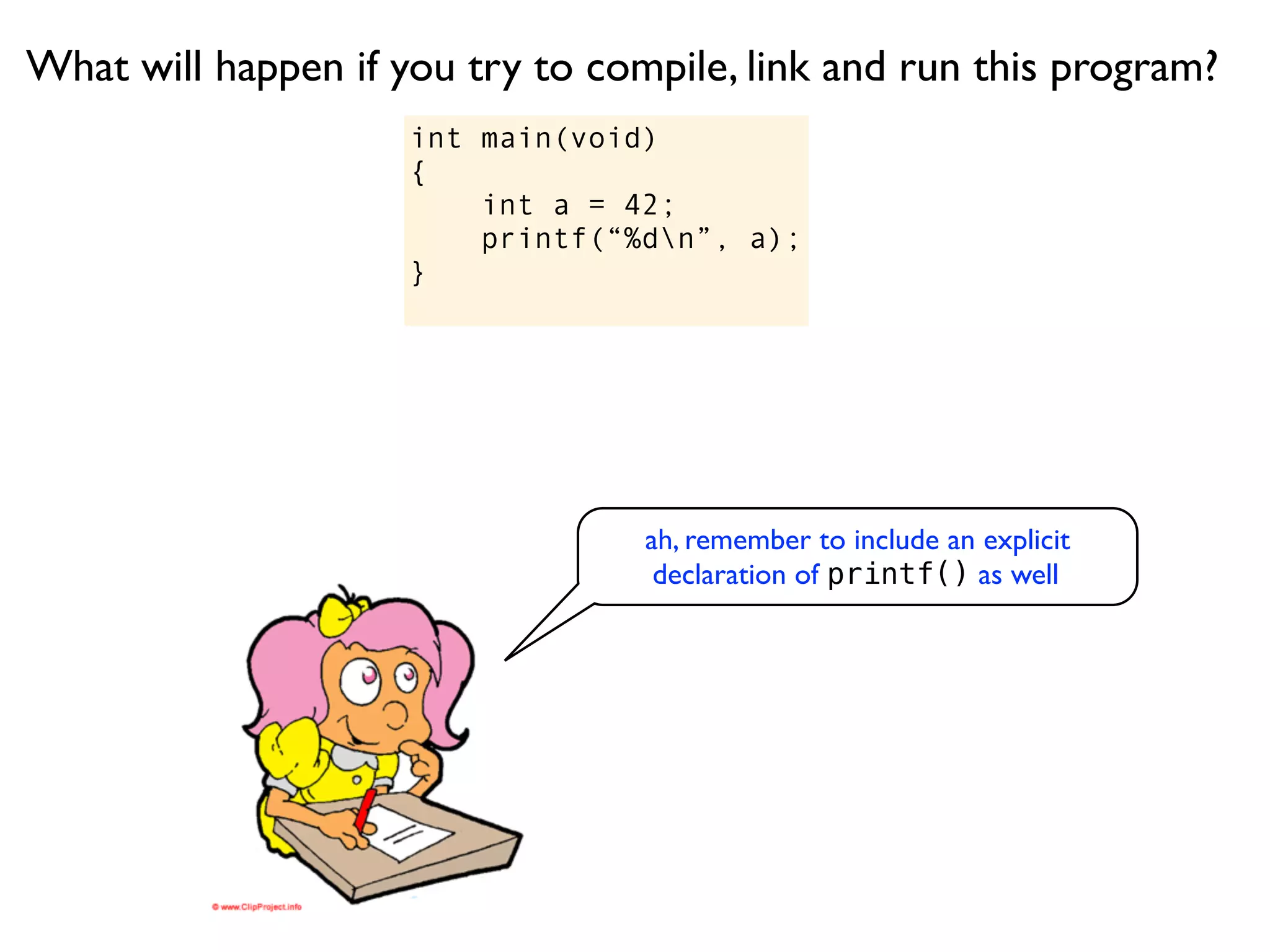
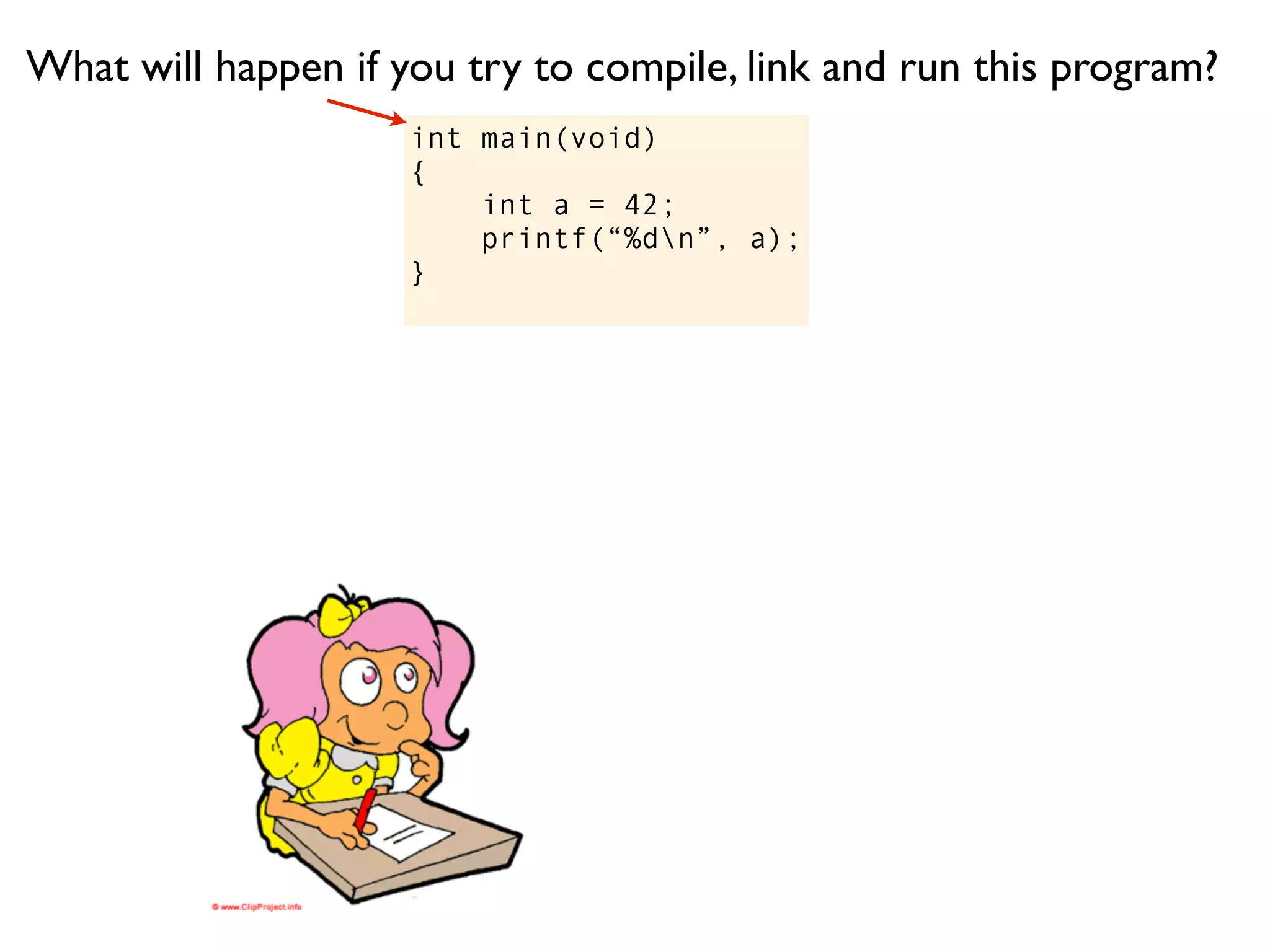
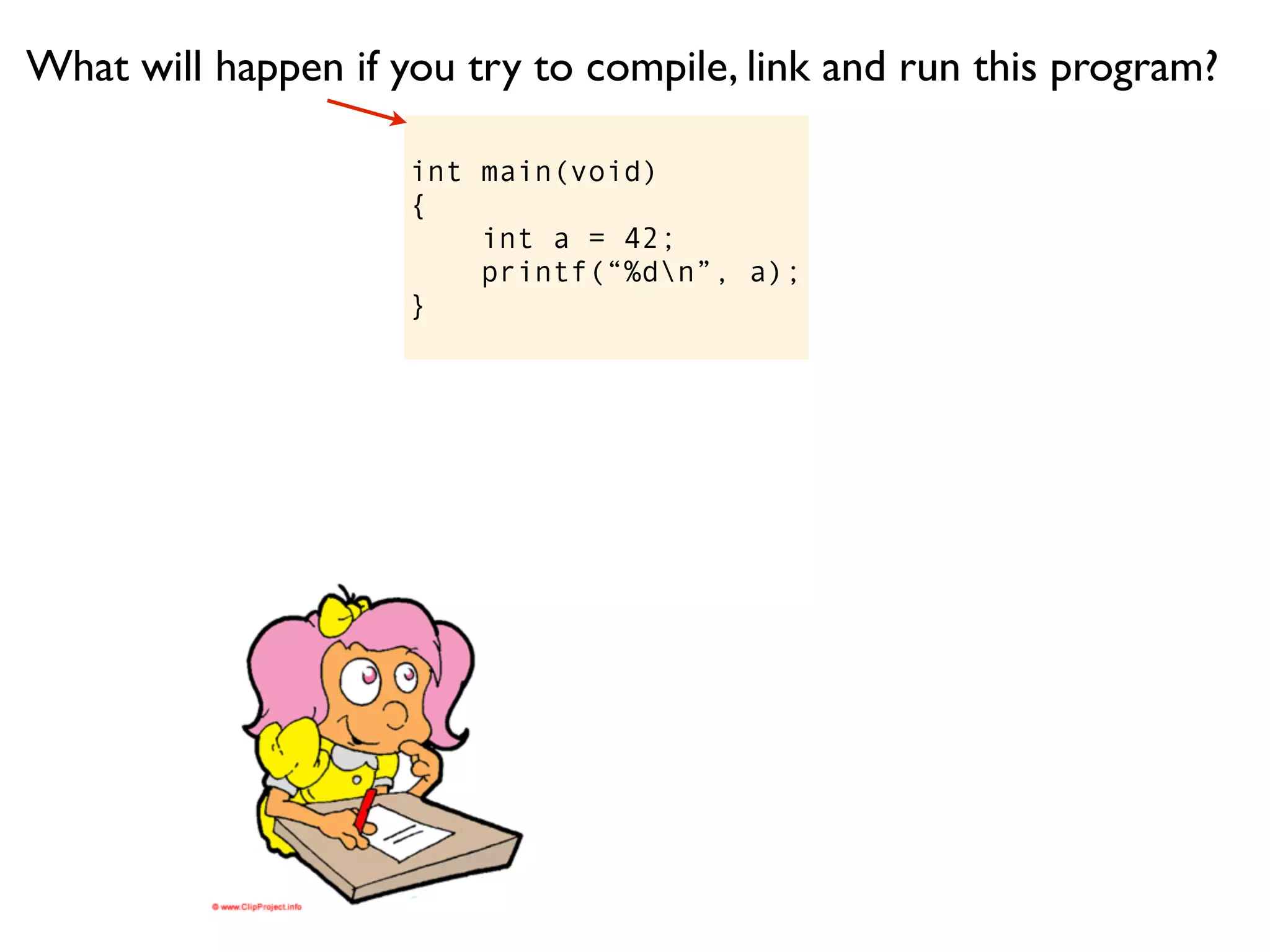

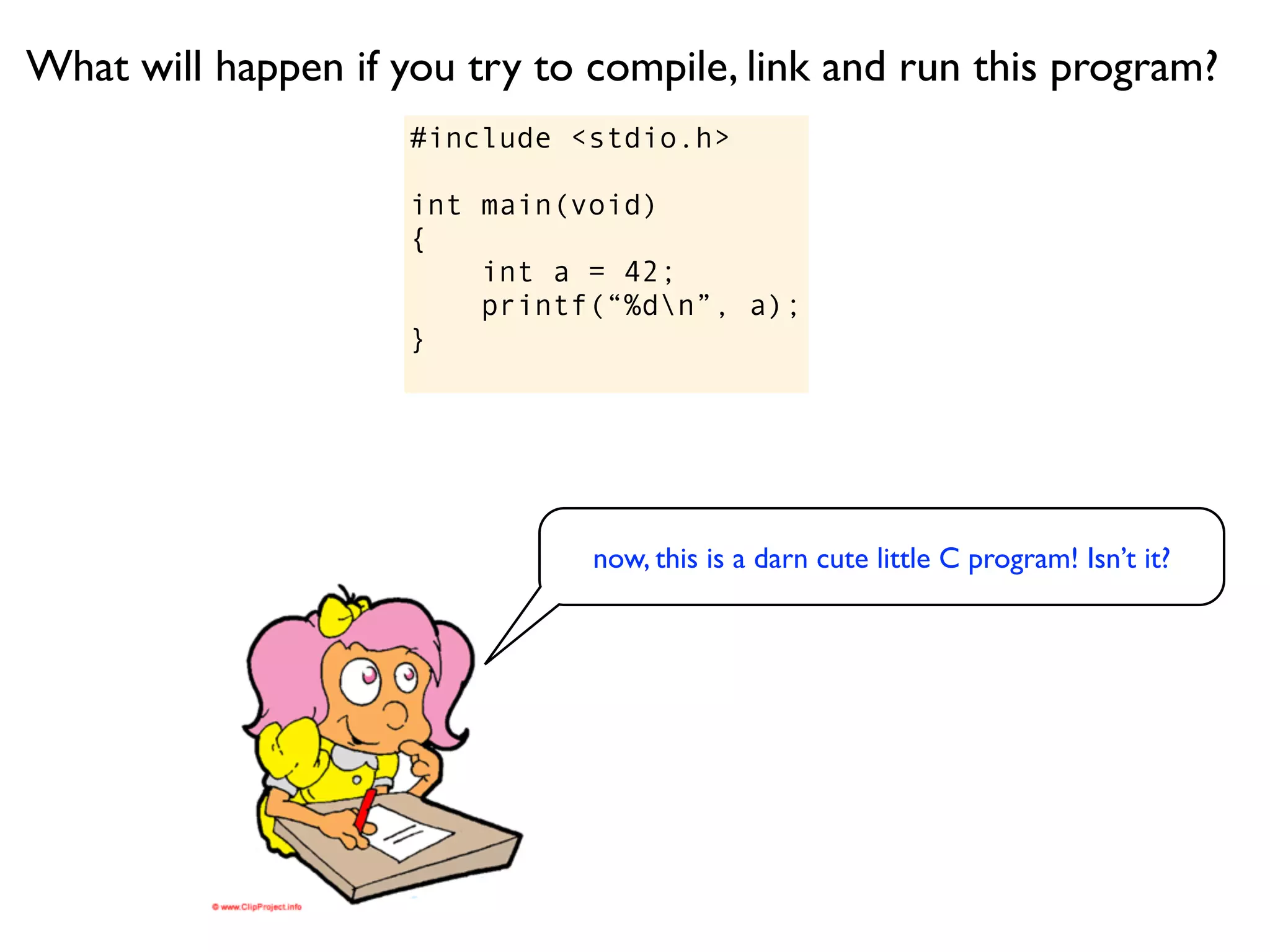
























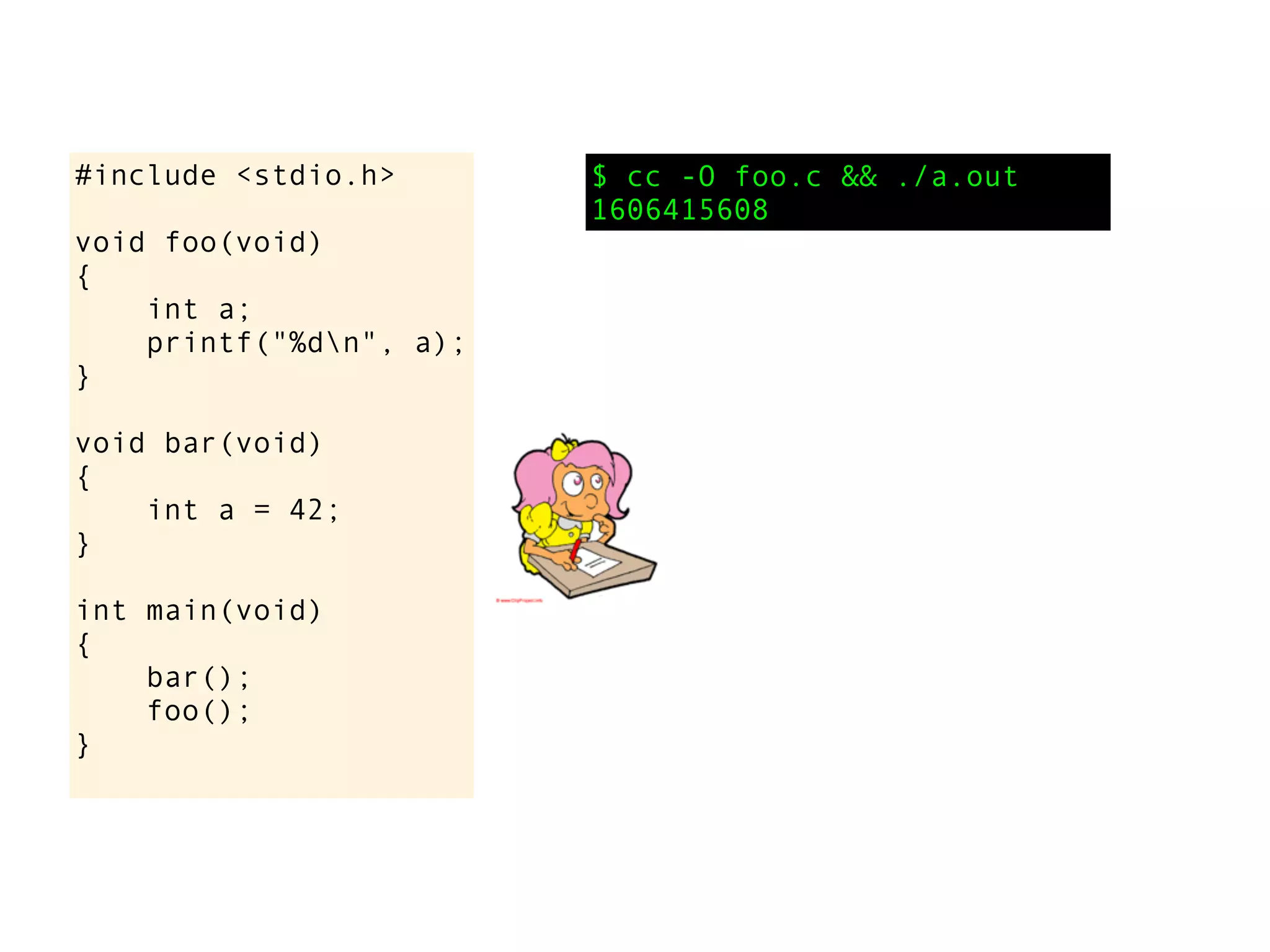

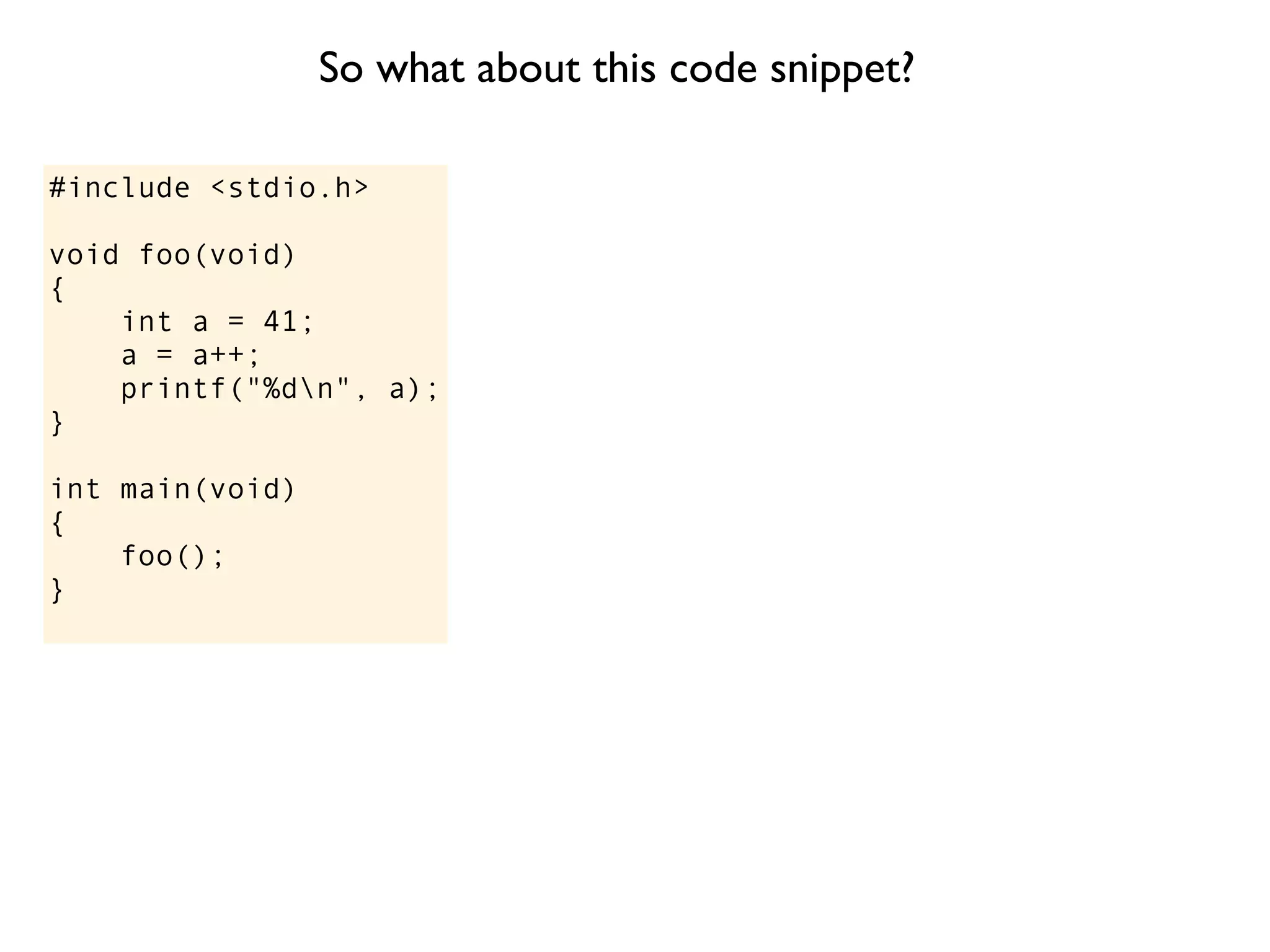

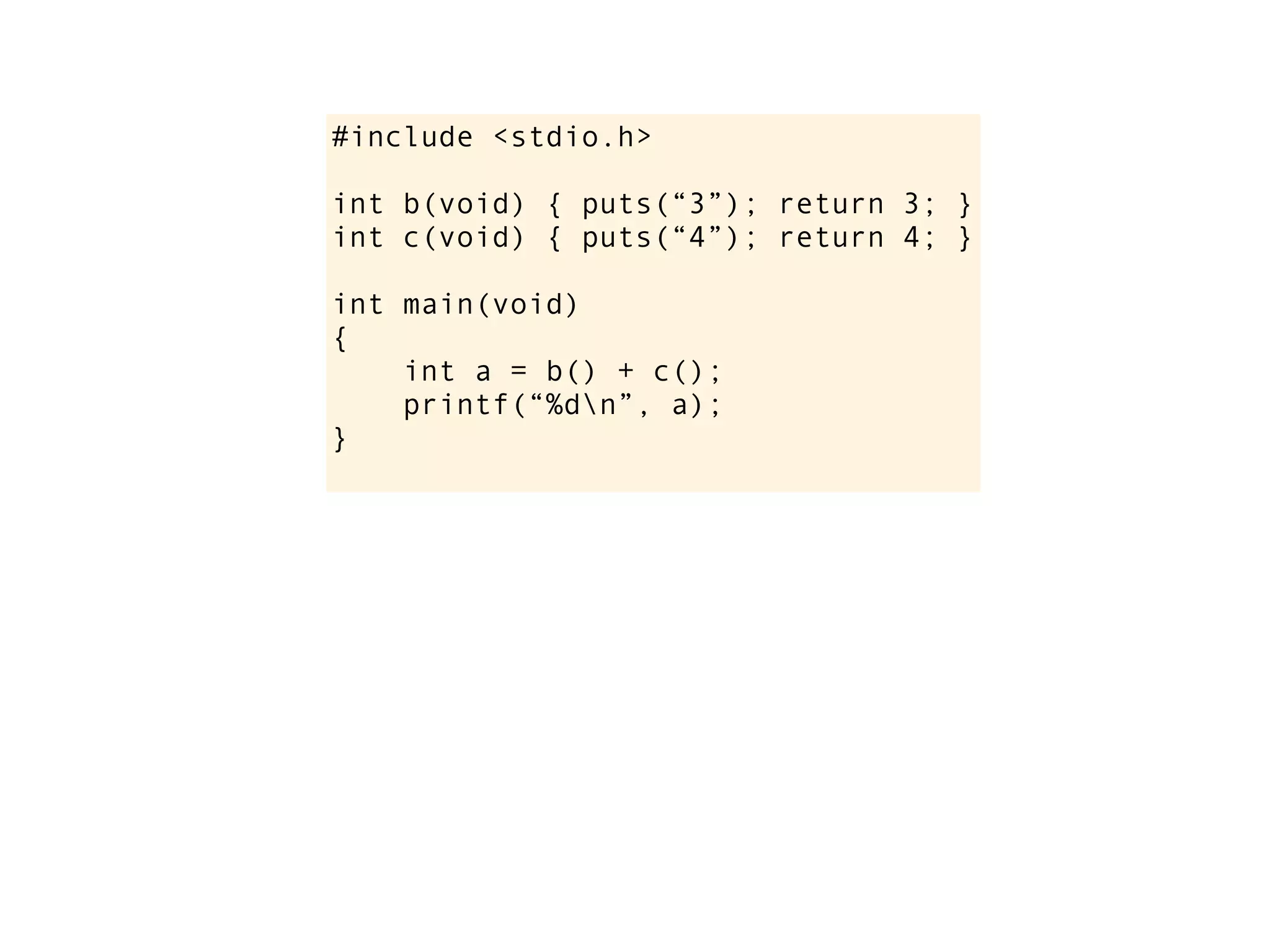
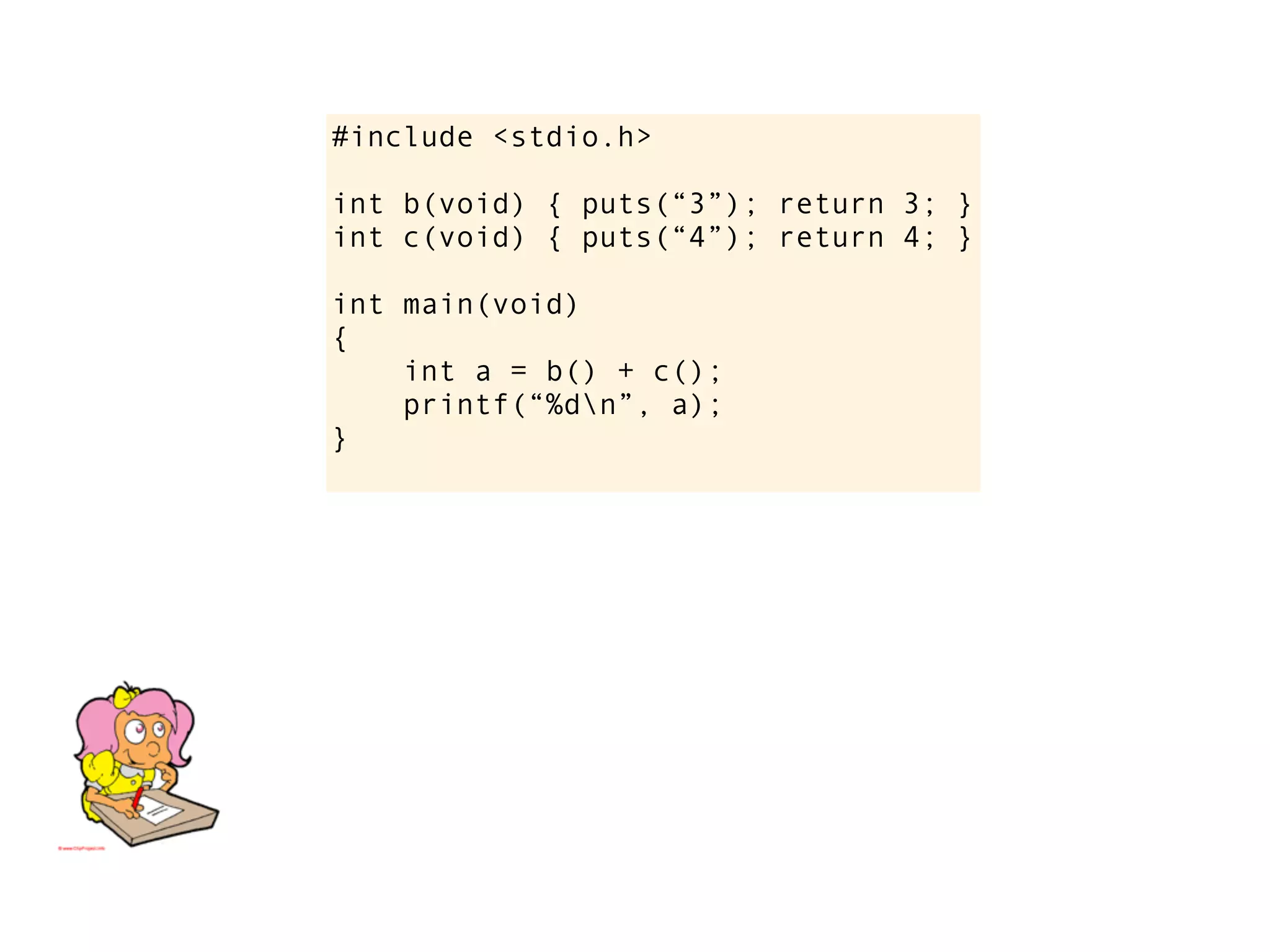
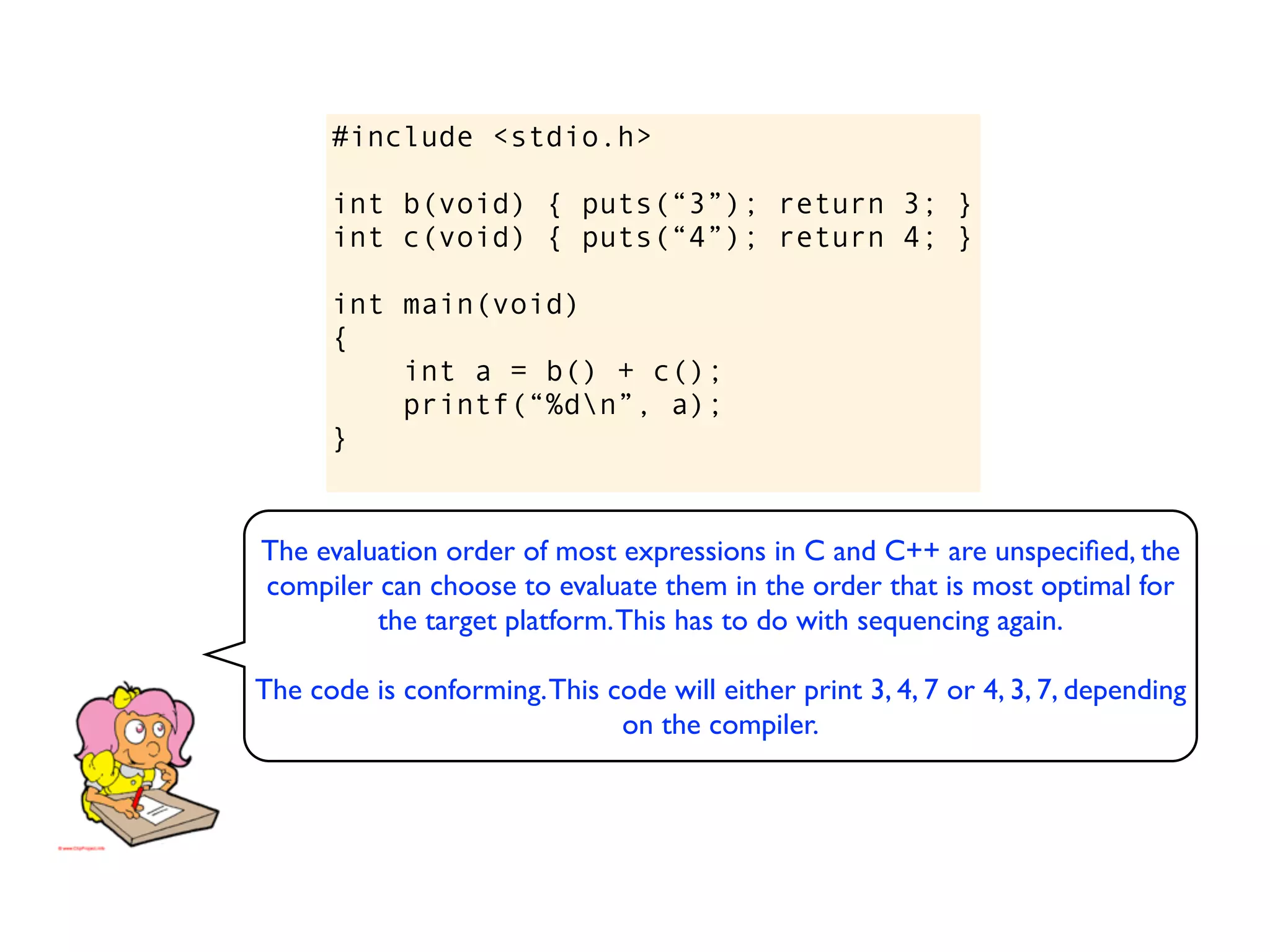
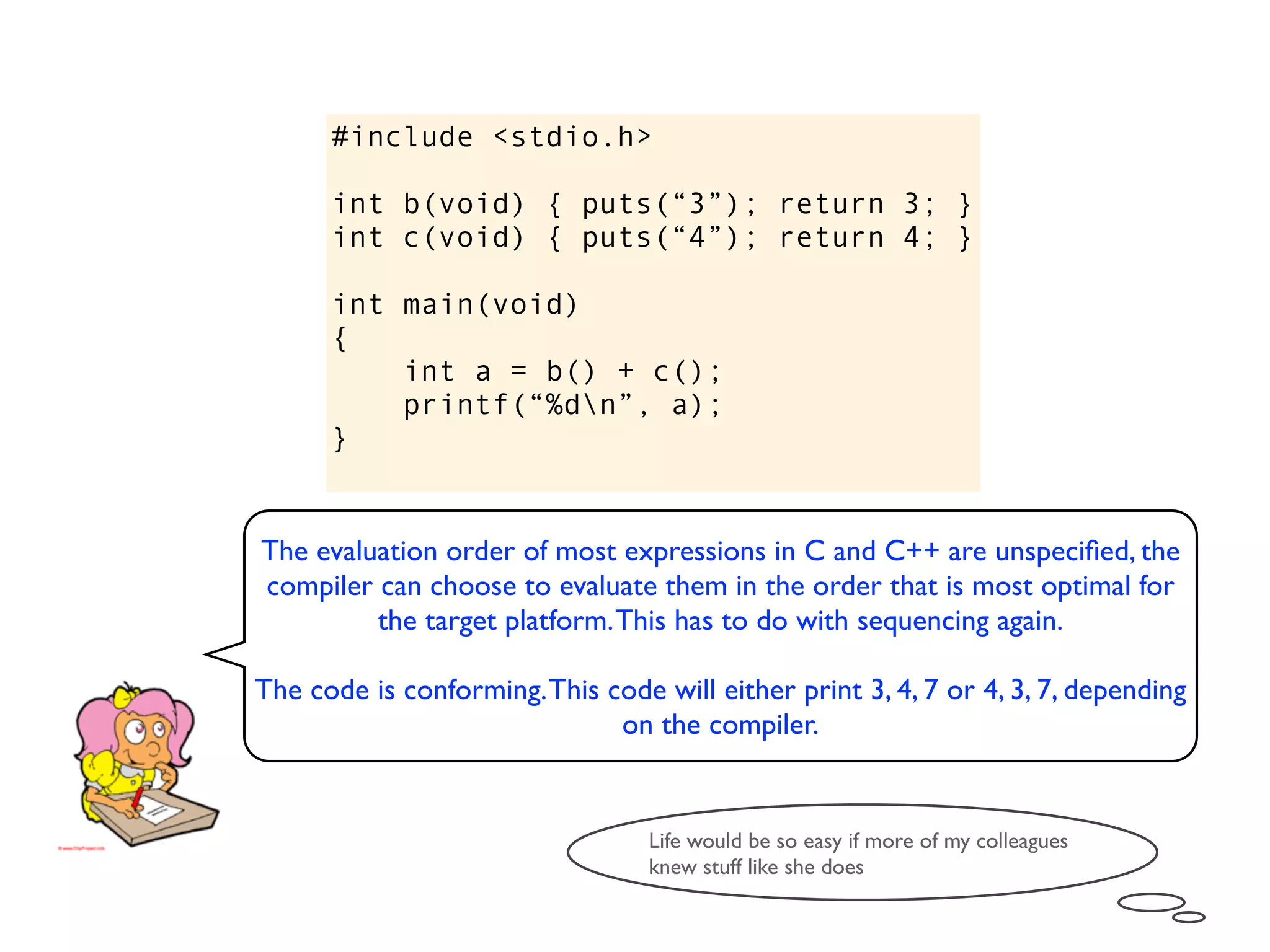

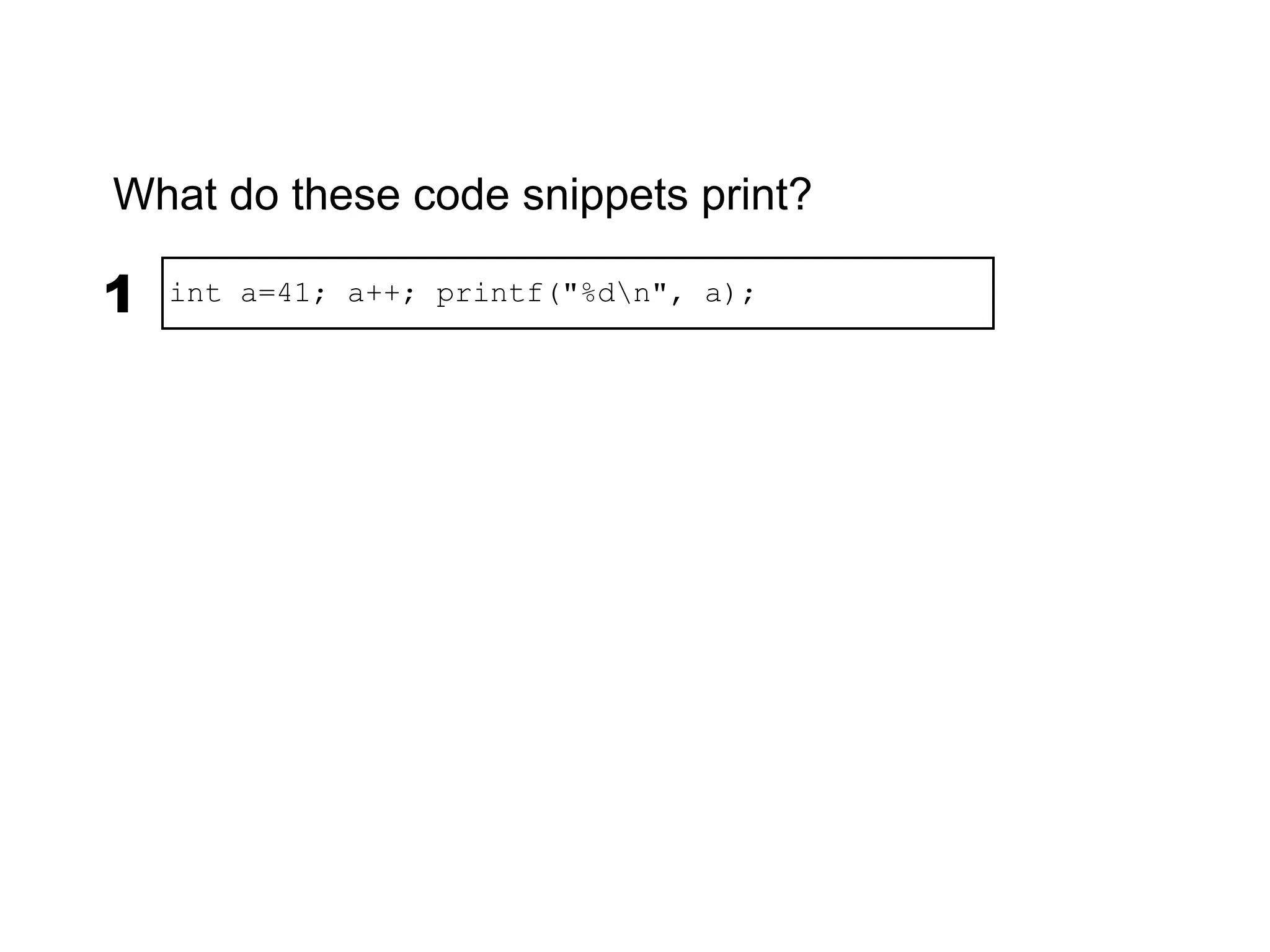
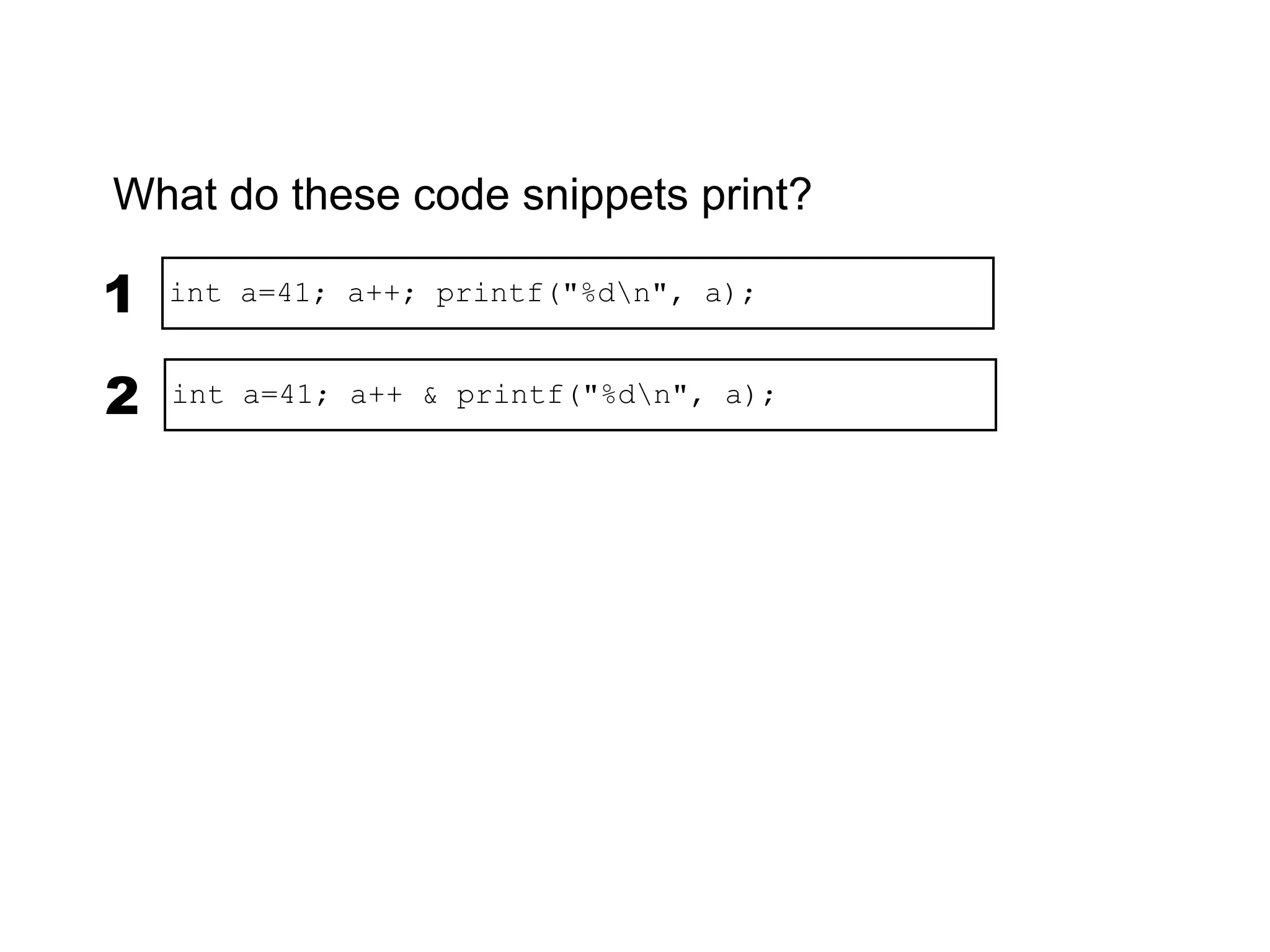



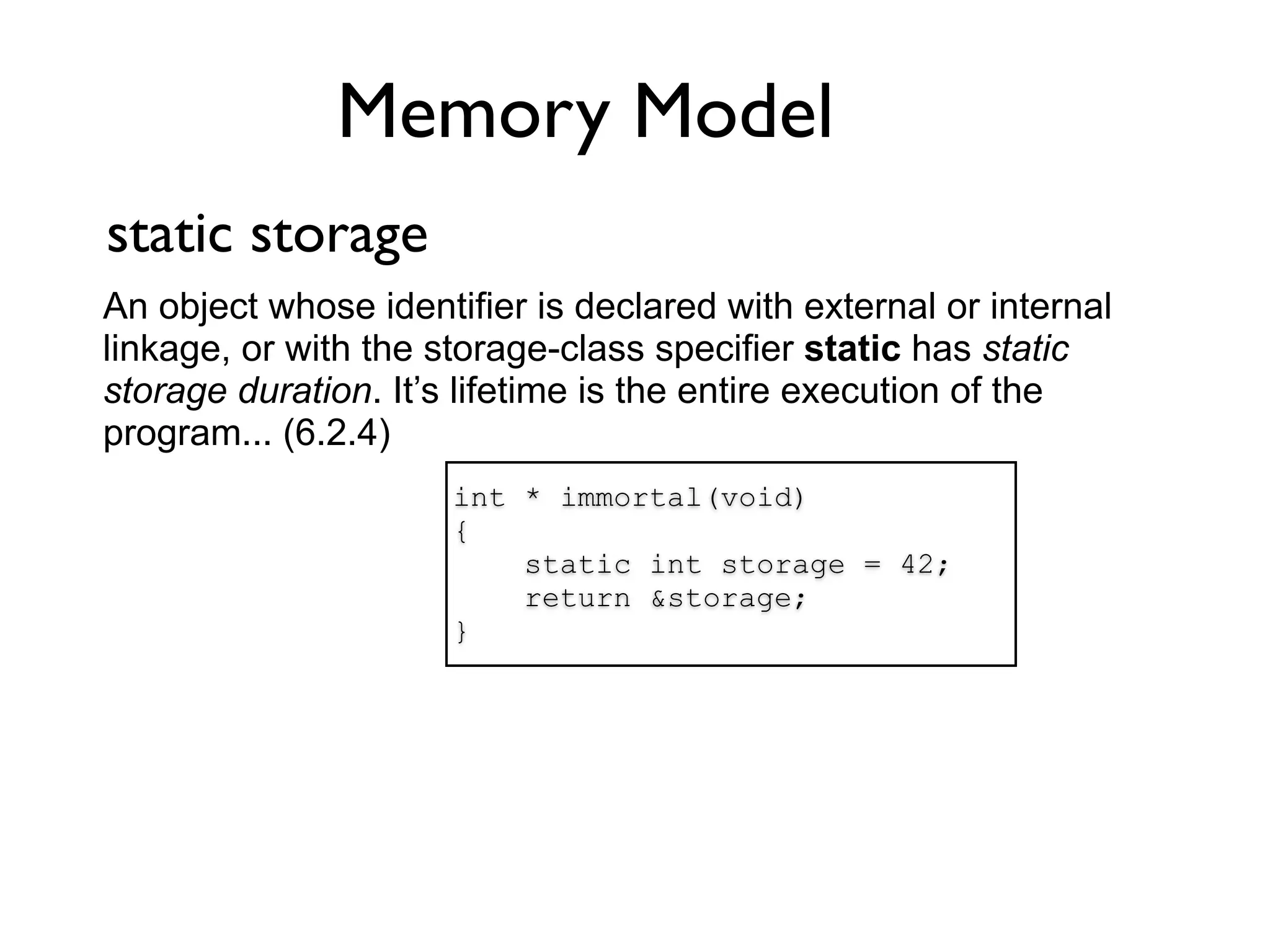
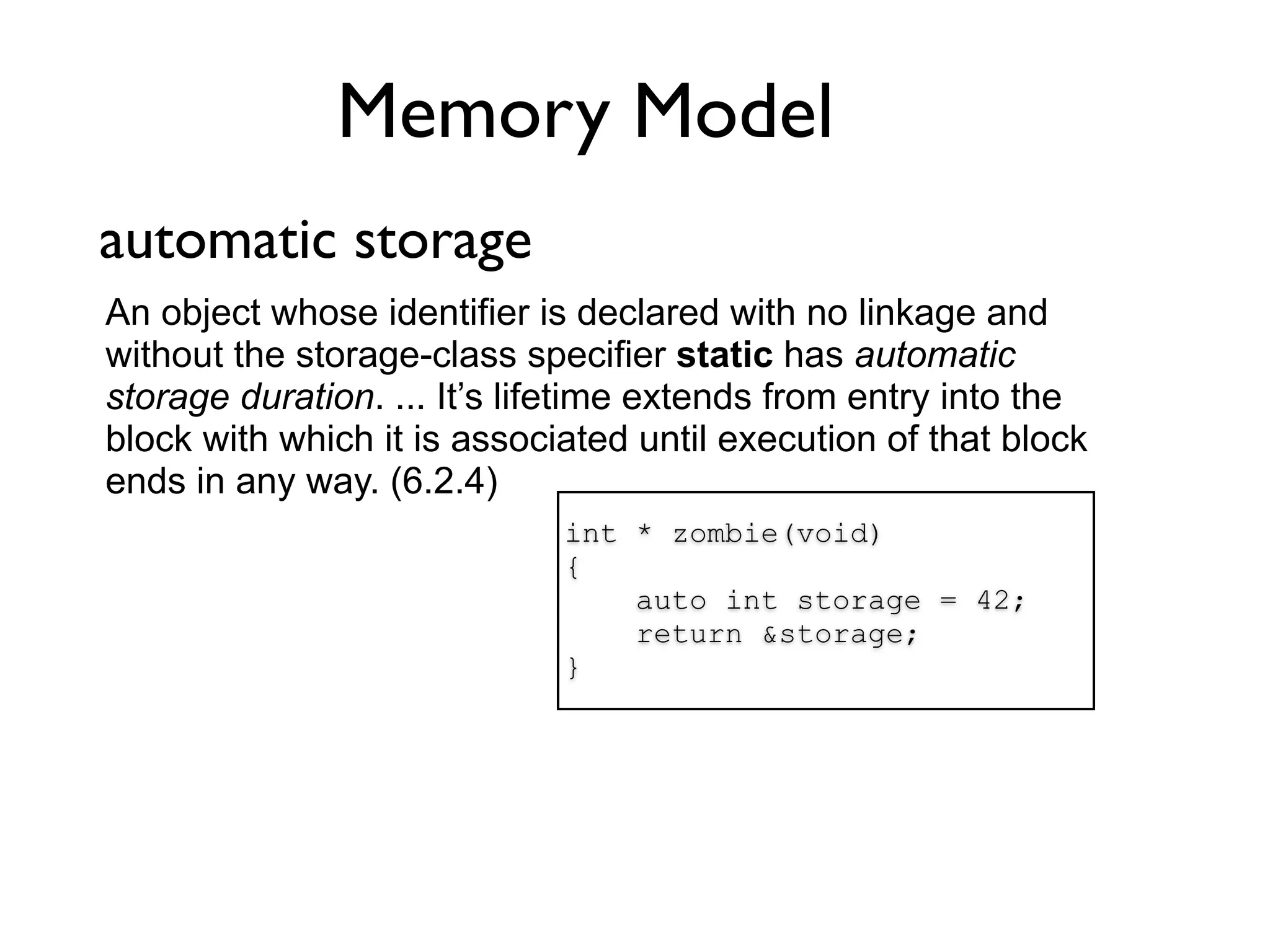
![/* K&R C */ // C++ (C++98)
void say_it(a, s) #include <cstdio>
int a;
char s[]; struct X {
{ int a;
printf("%s %dn", s, a); const char * s;
} explicit X(const char * s, int a = 42)
: a(a), s(s) {}
main() void say_it() const {
{ std::printf("%s %dn", s, a);
int a = 42; }
puts("Welcome to classic C"); };
say_it(a, "the answer is");
} int main()
{
X("the answer is").say_it();
/* C89 */ }
void say_it(int a, char * s)
// C99
{
printf("%s %dn", s, a);
struct X
}
{
int a;
main()
char * s;
{
};
int a = 42;
puts("Welcome to C89");
int main(void)
say_it(a, "the answer is");
{
}
puts("Welcome to C99");
struct X x = { .s = "the answer is", .a = 42 };
printf("%s %dn", x.s, x.a);
}](https://image.slidesharecdn.com/deepcslidesoct2012-111010033910-phpapp01/75/Deep-C-200-2048.jpg)



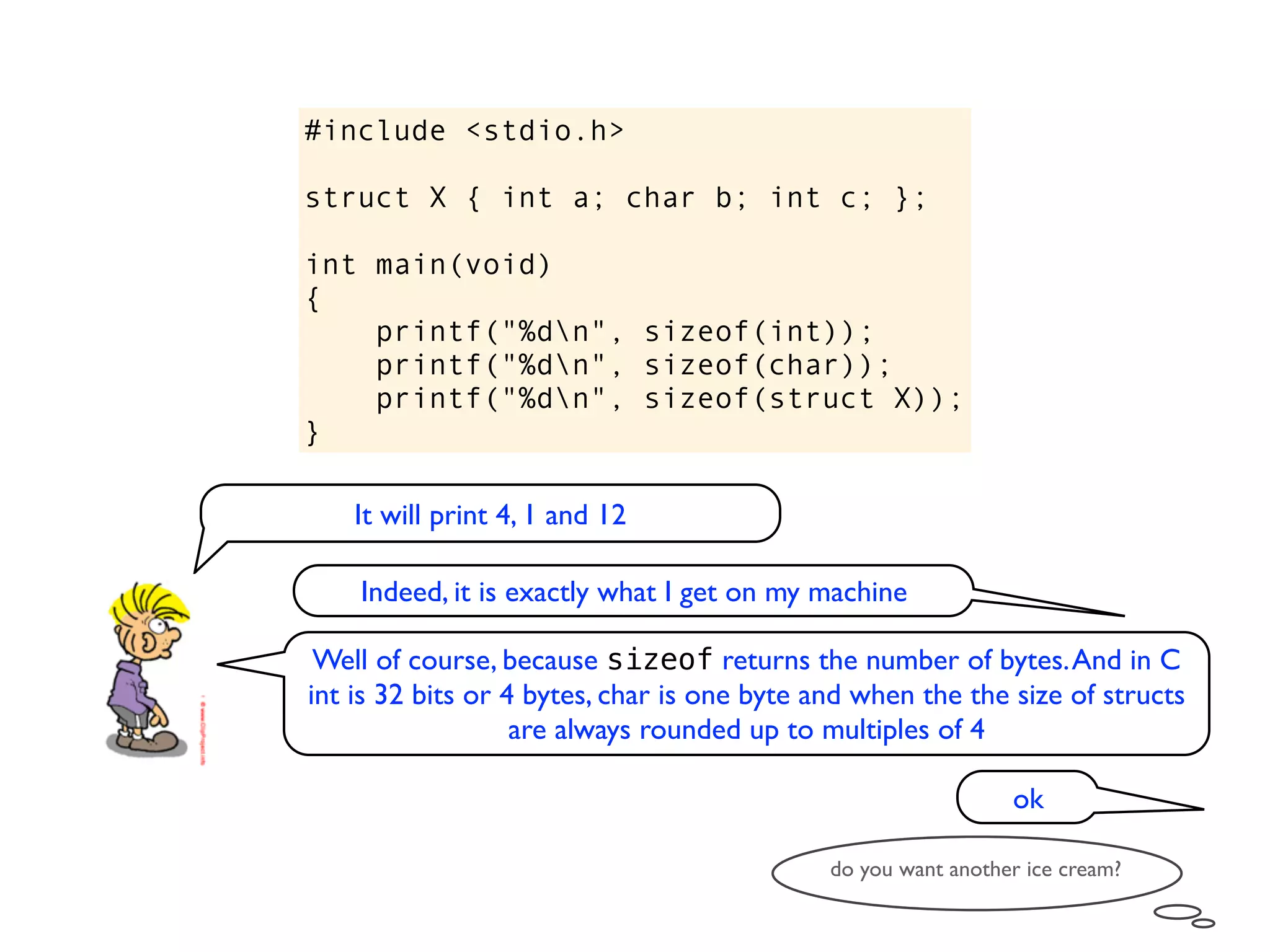
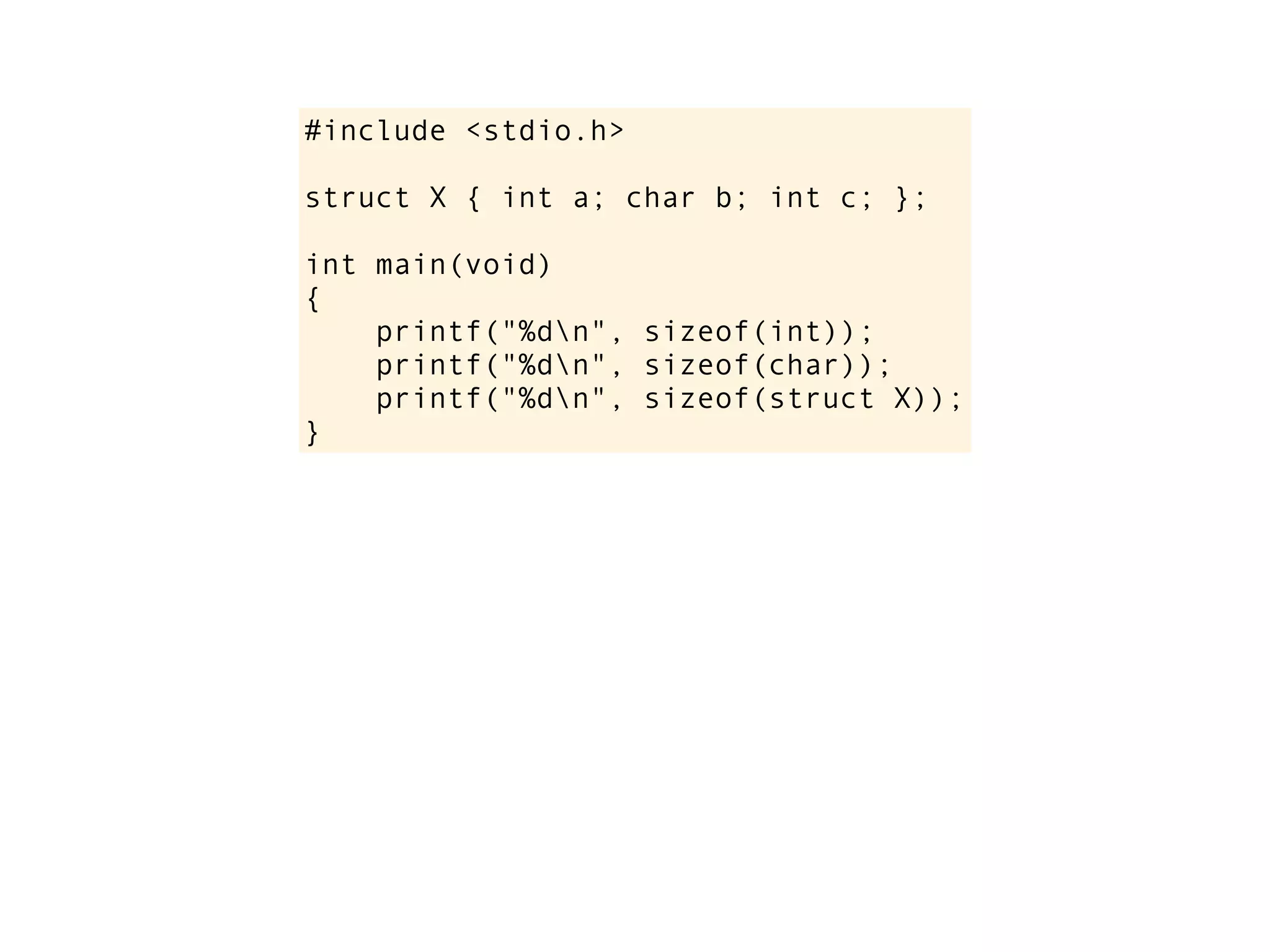
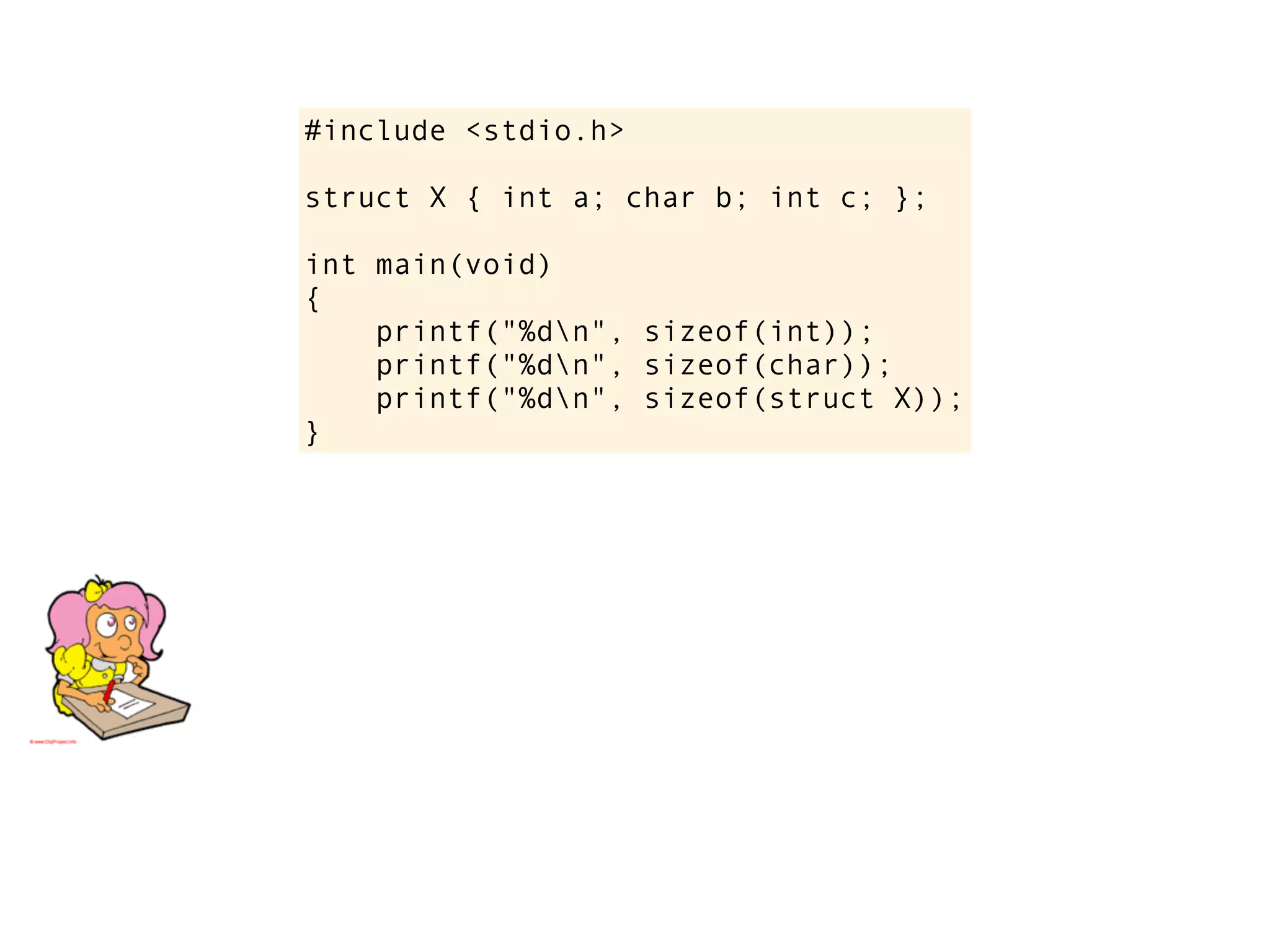
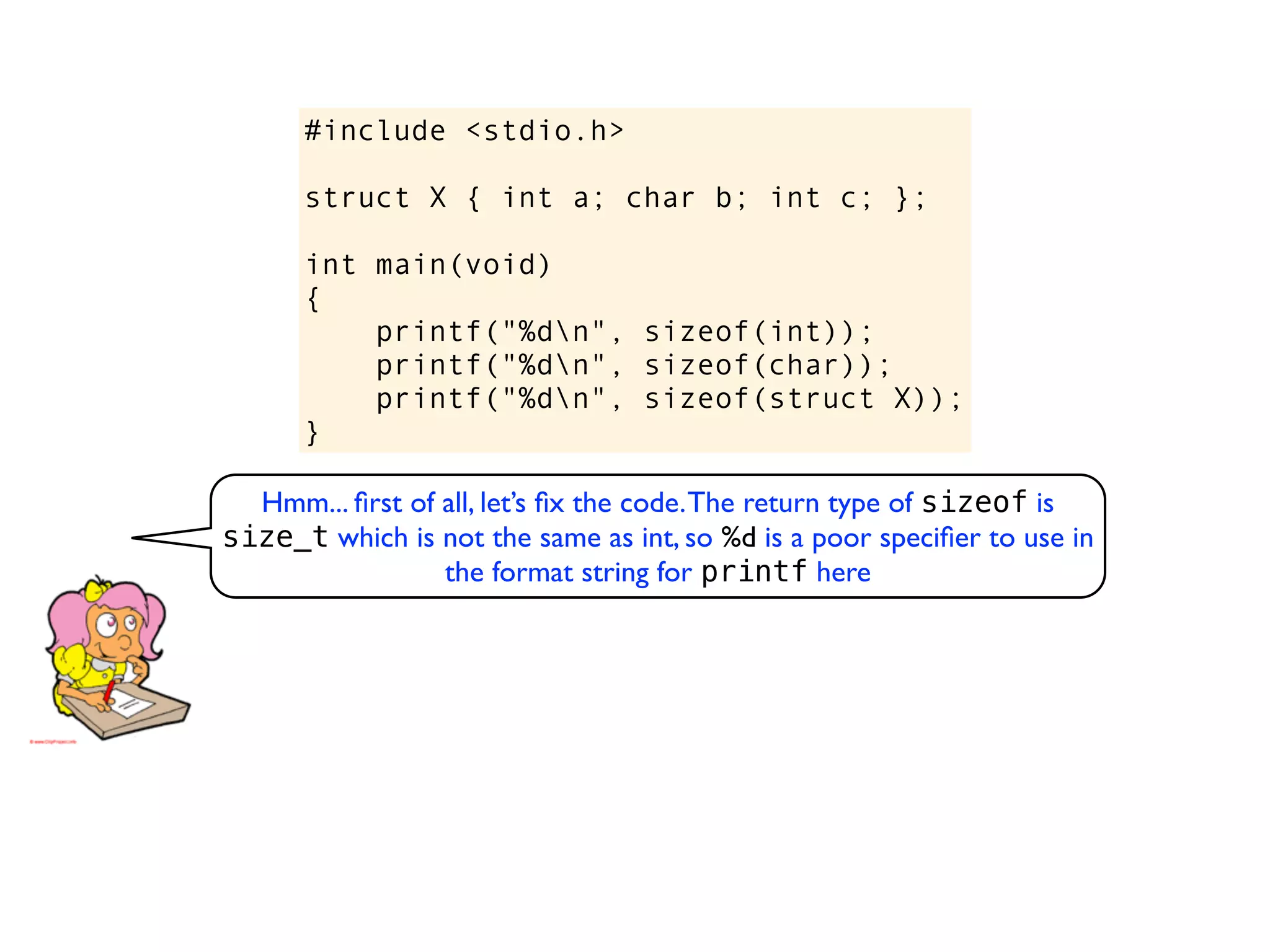
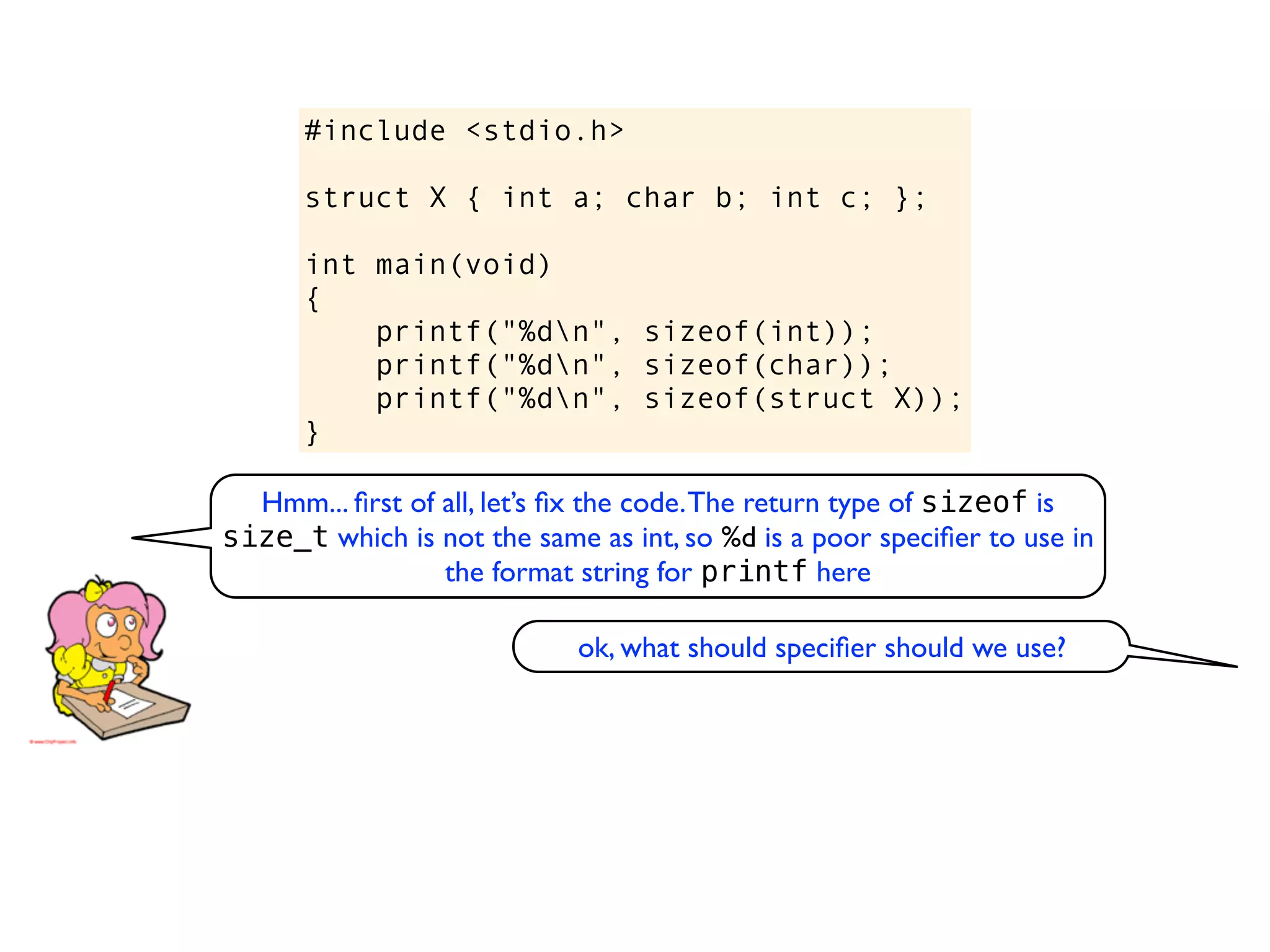
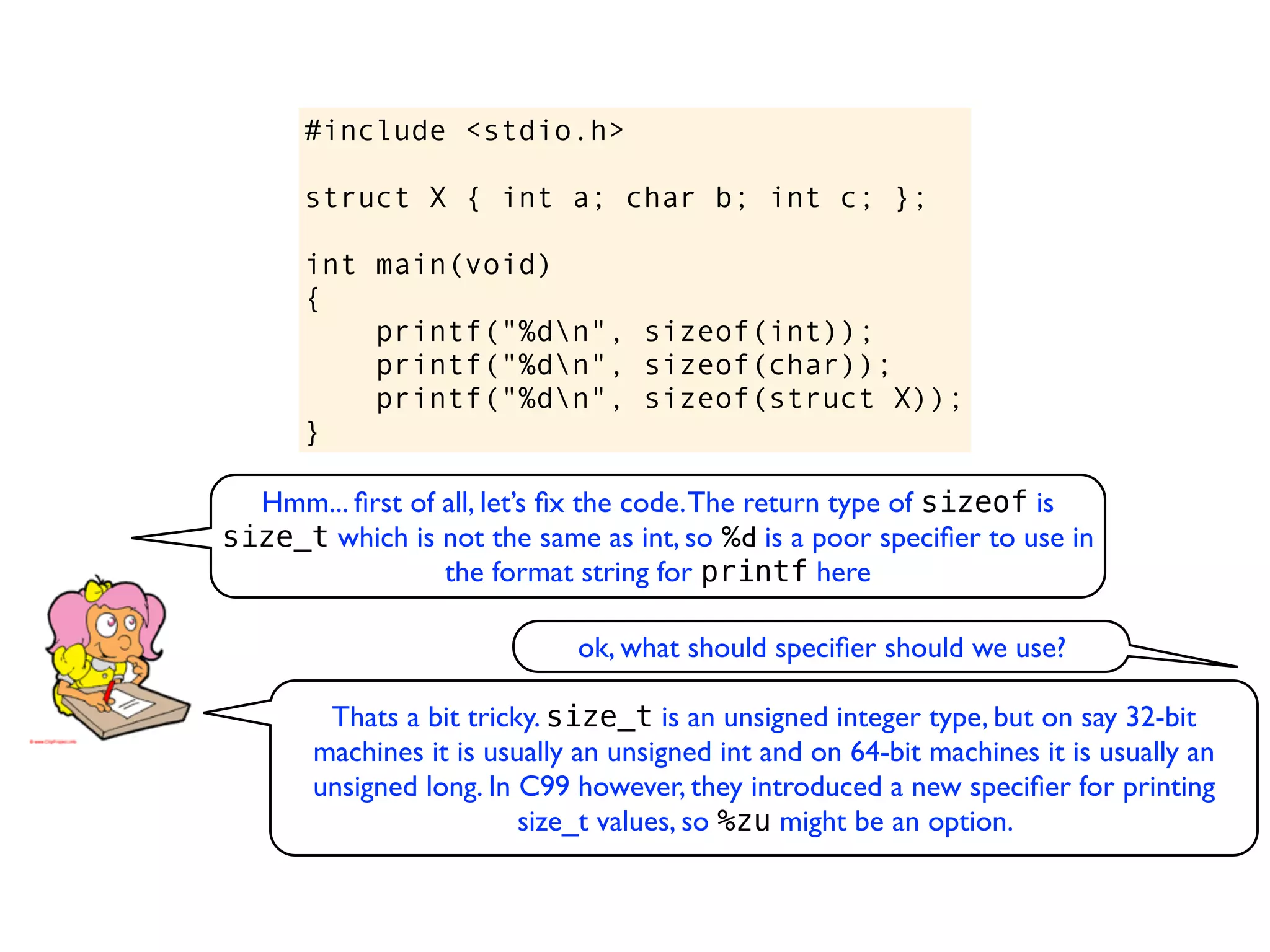
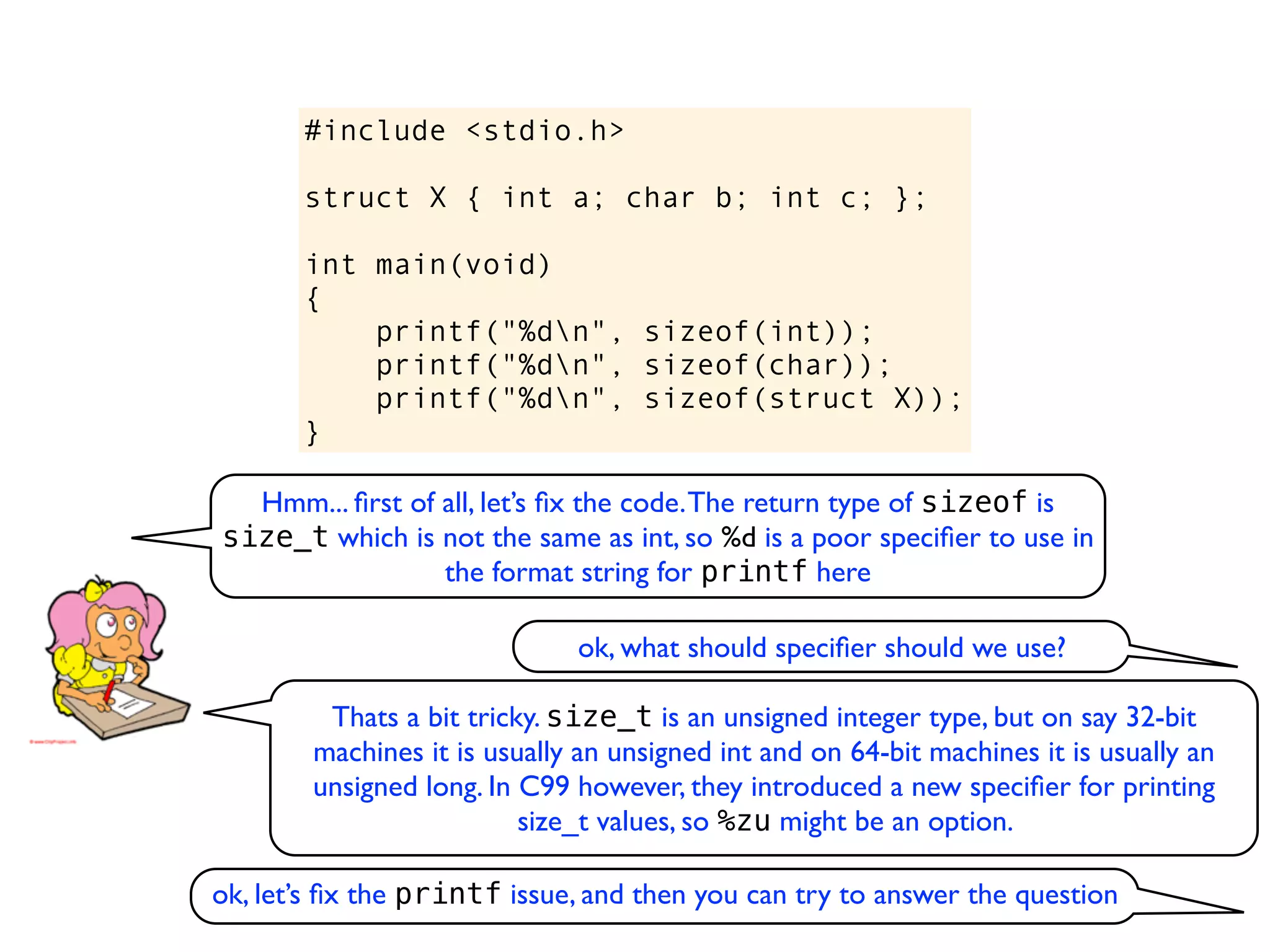
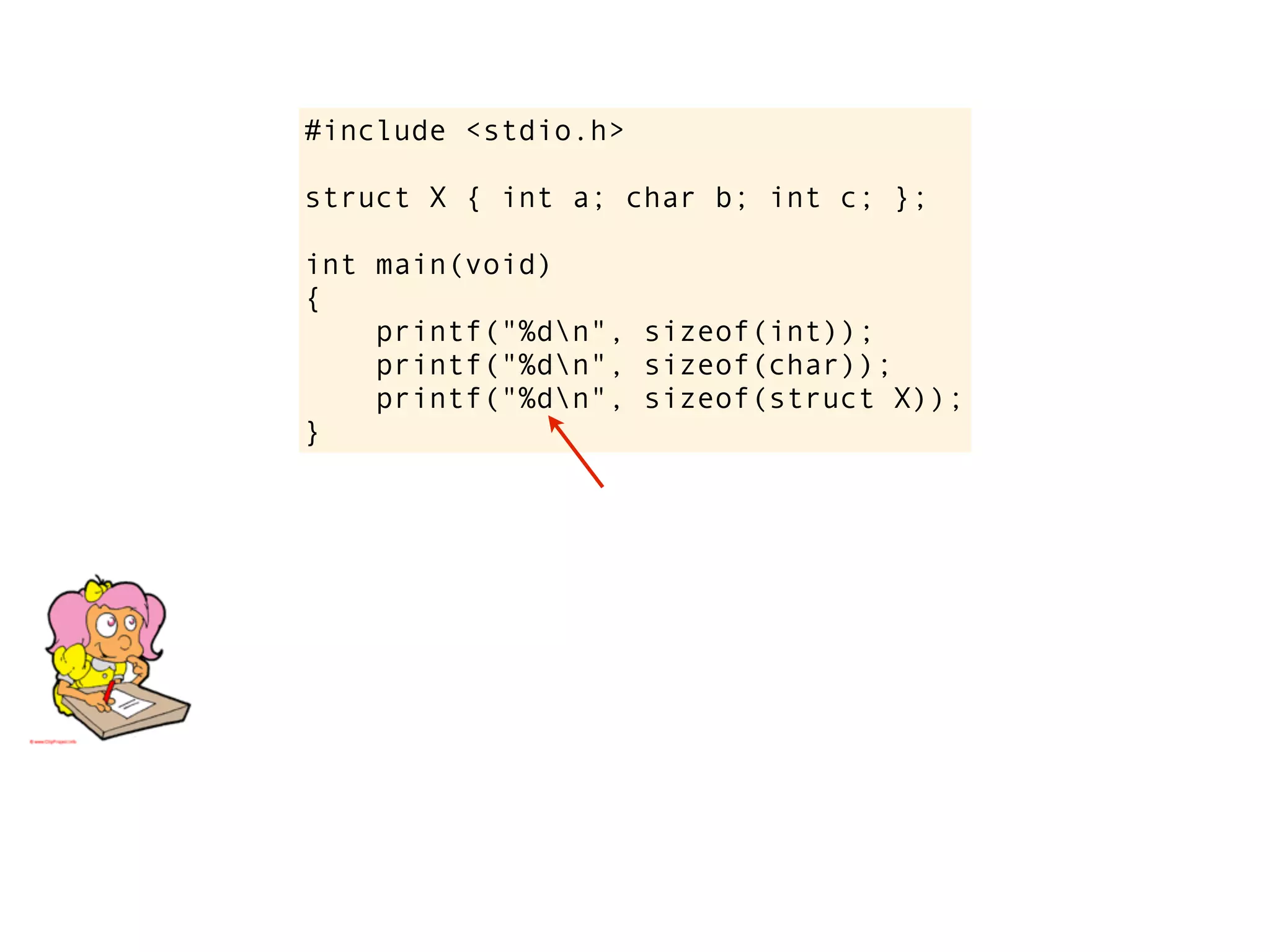


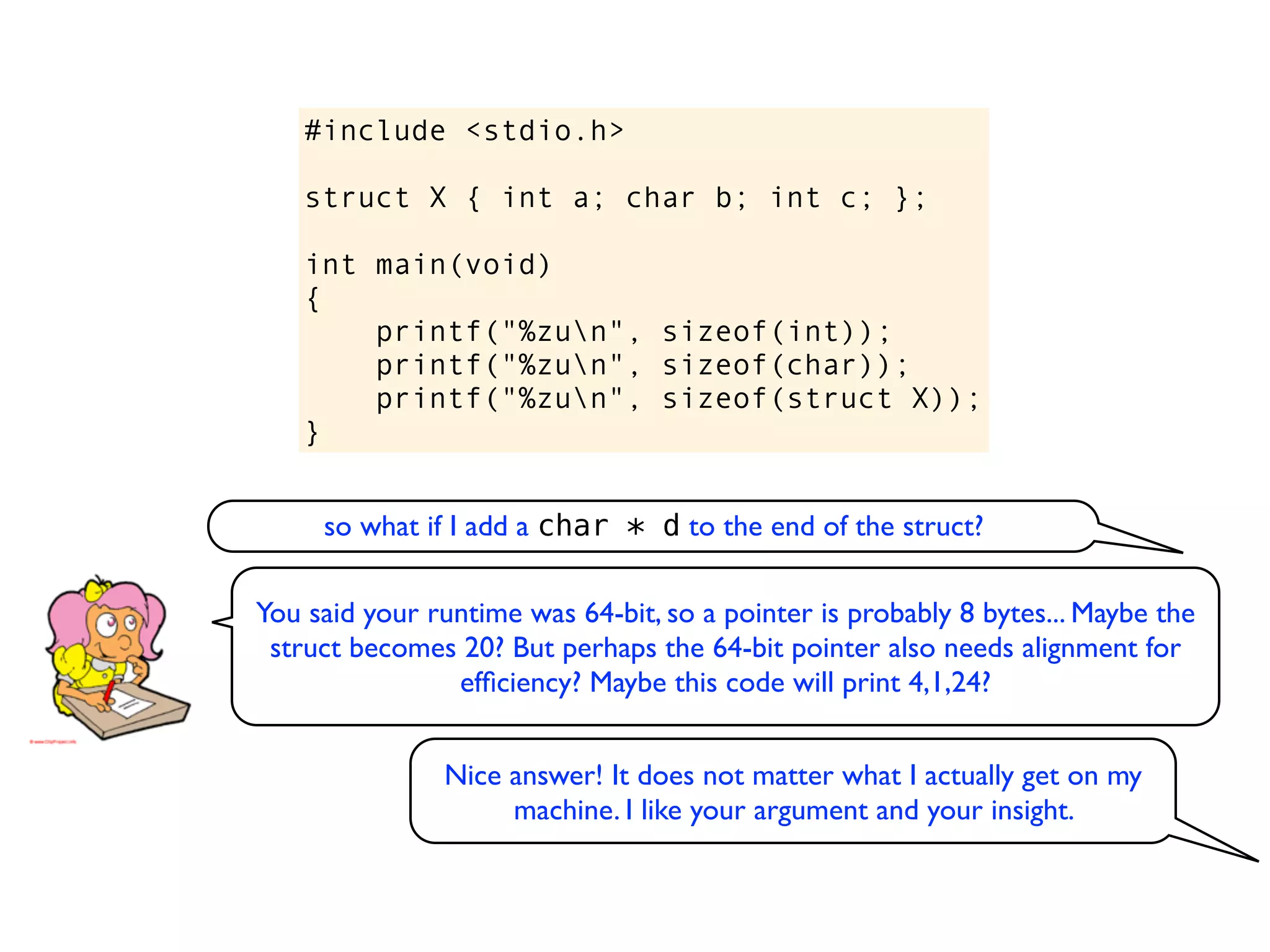



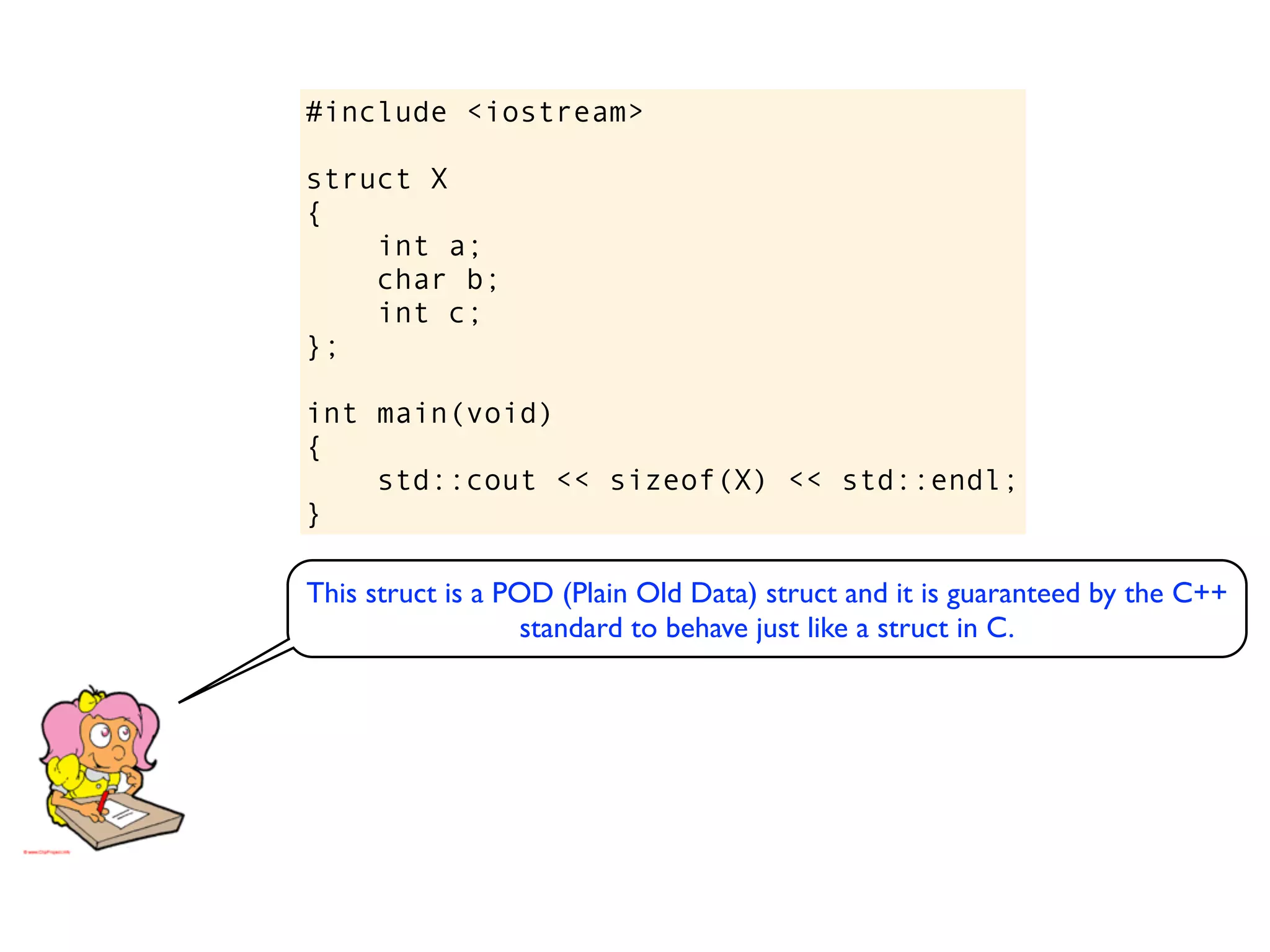
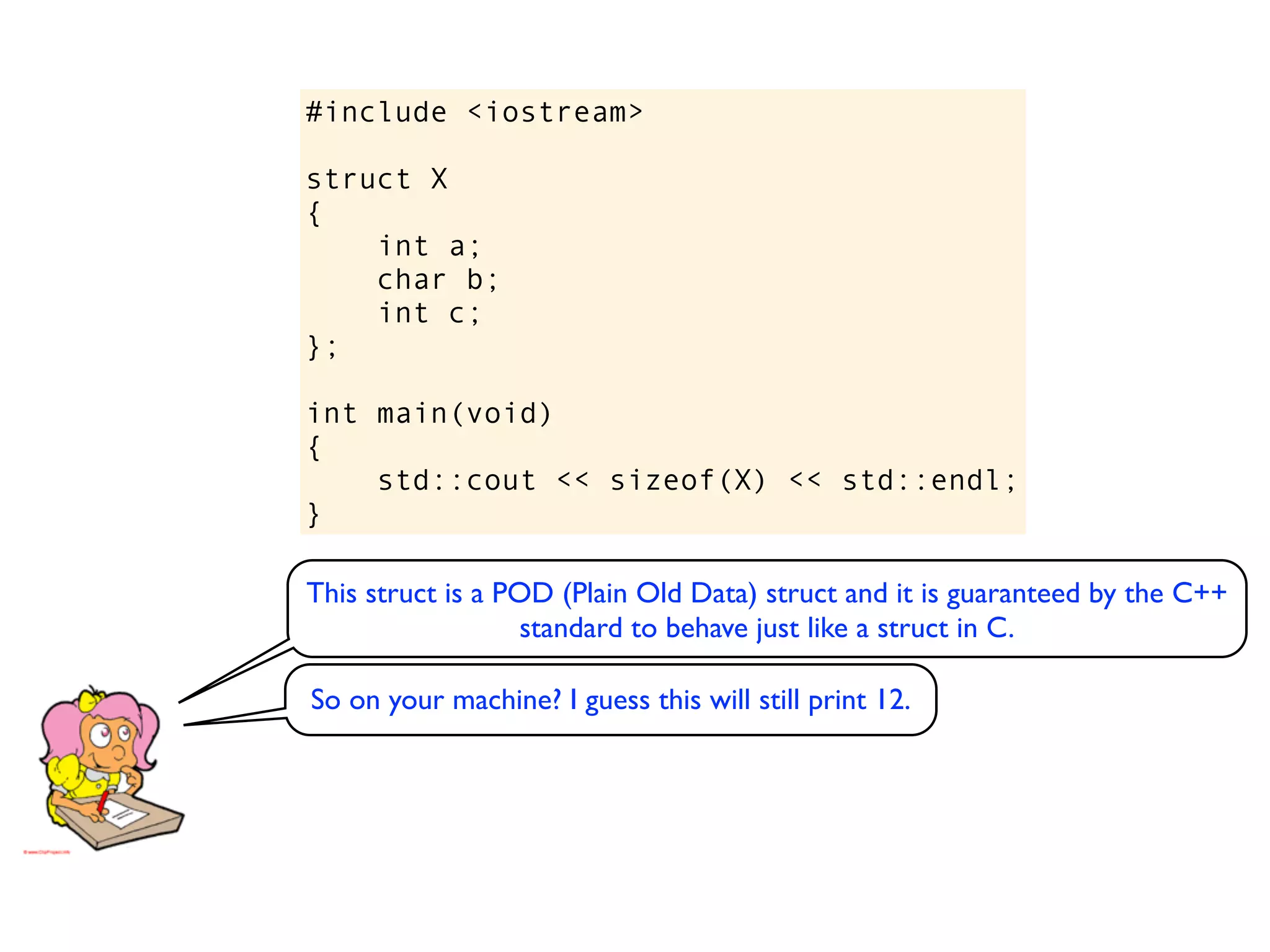
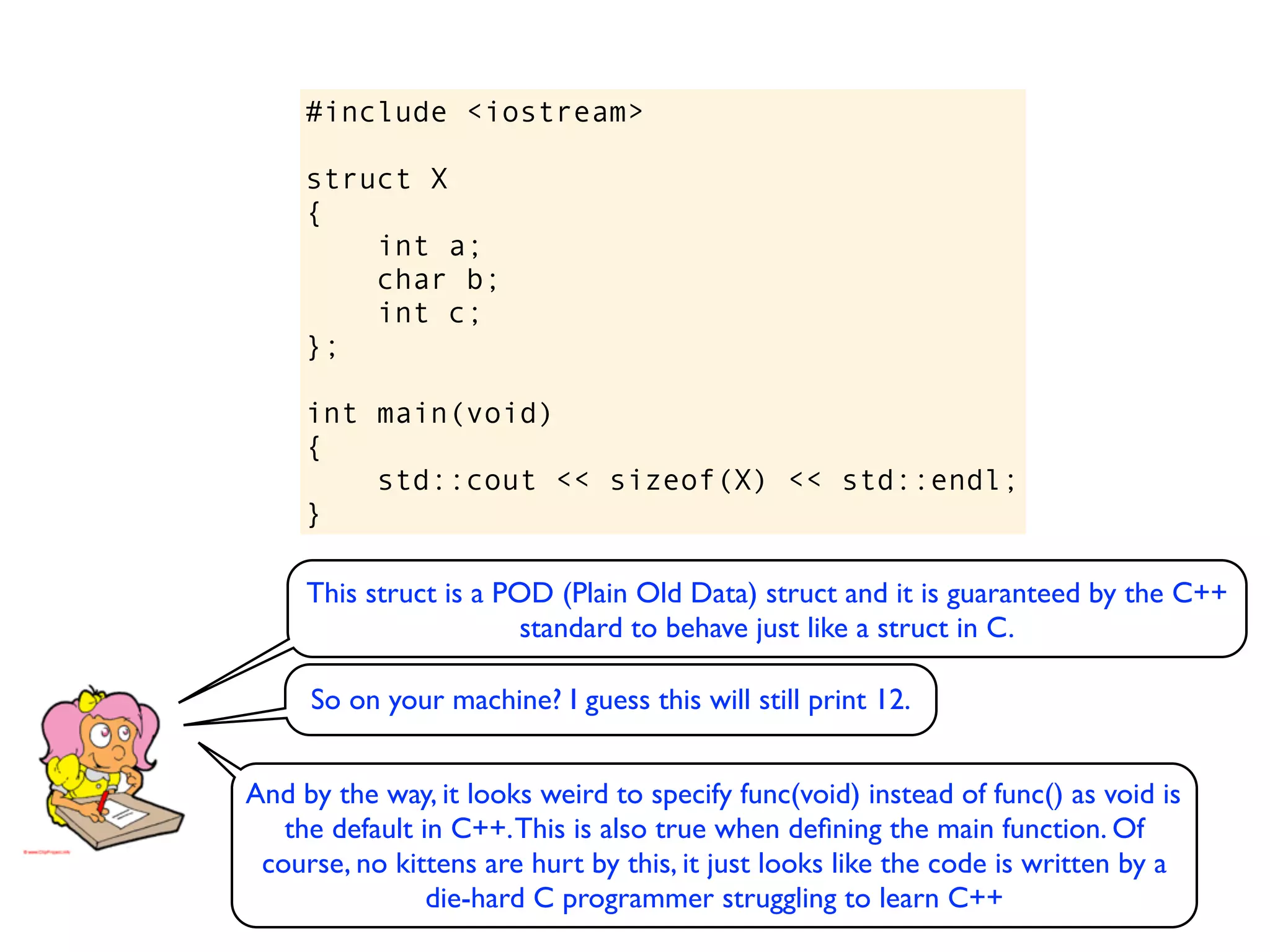
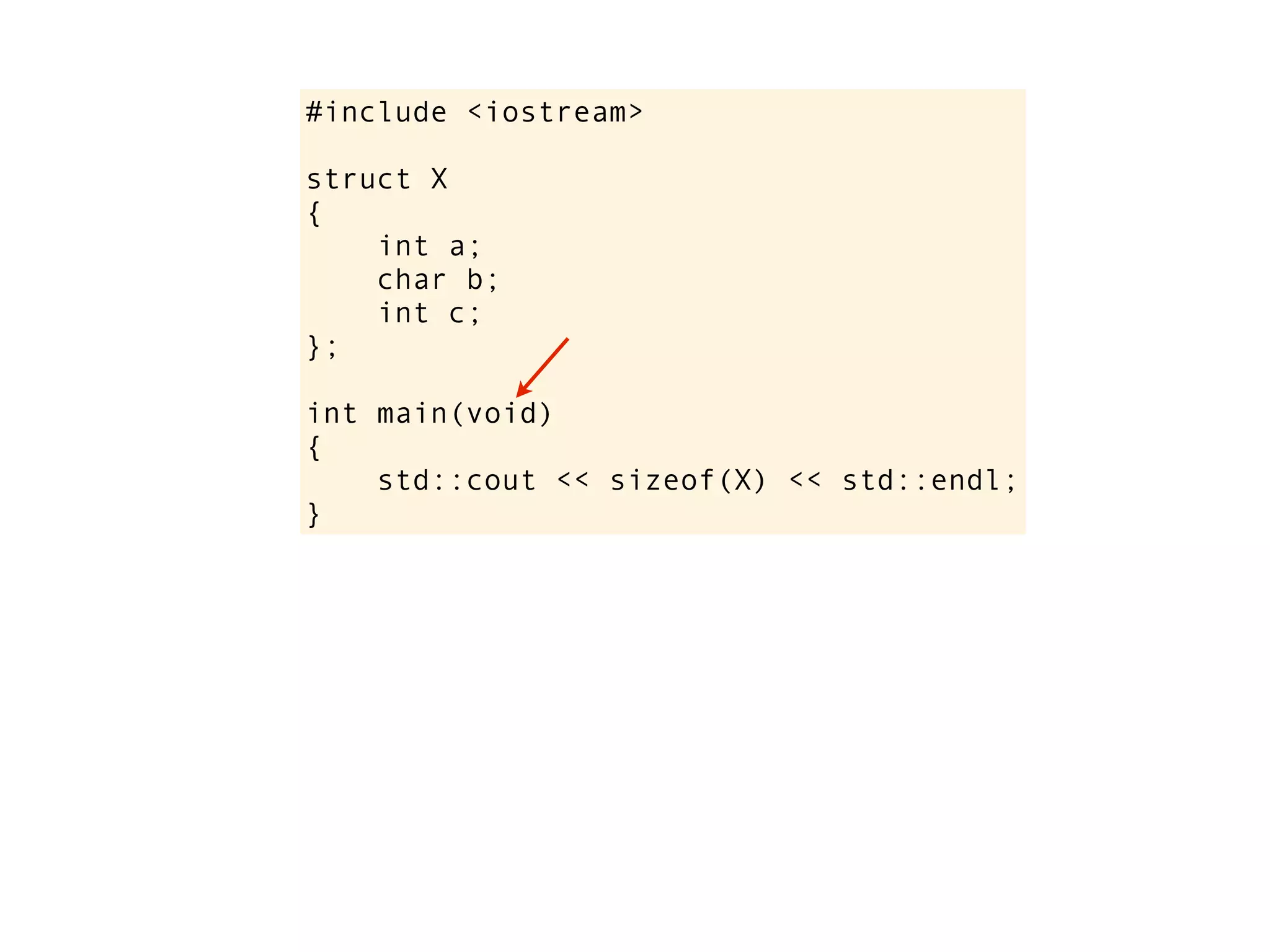
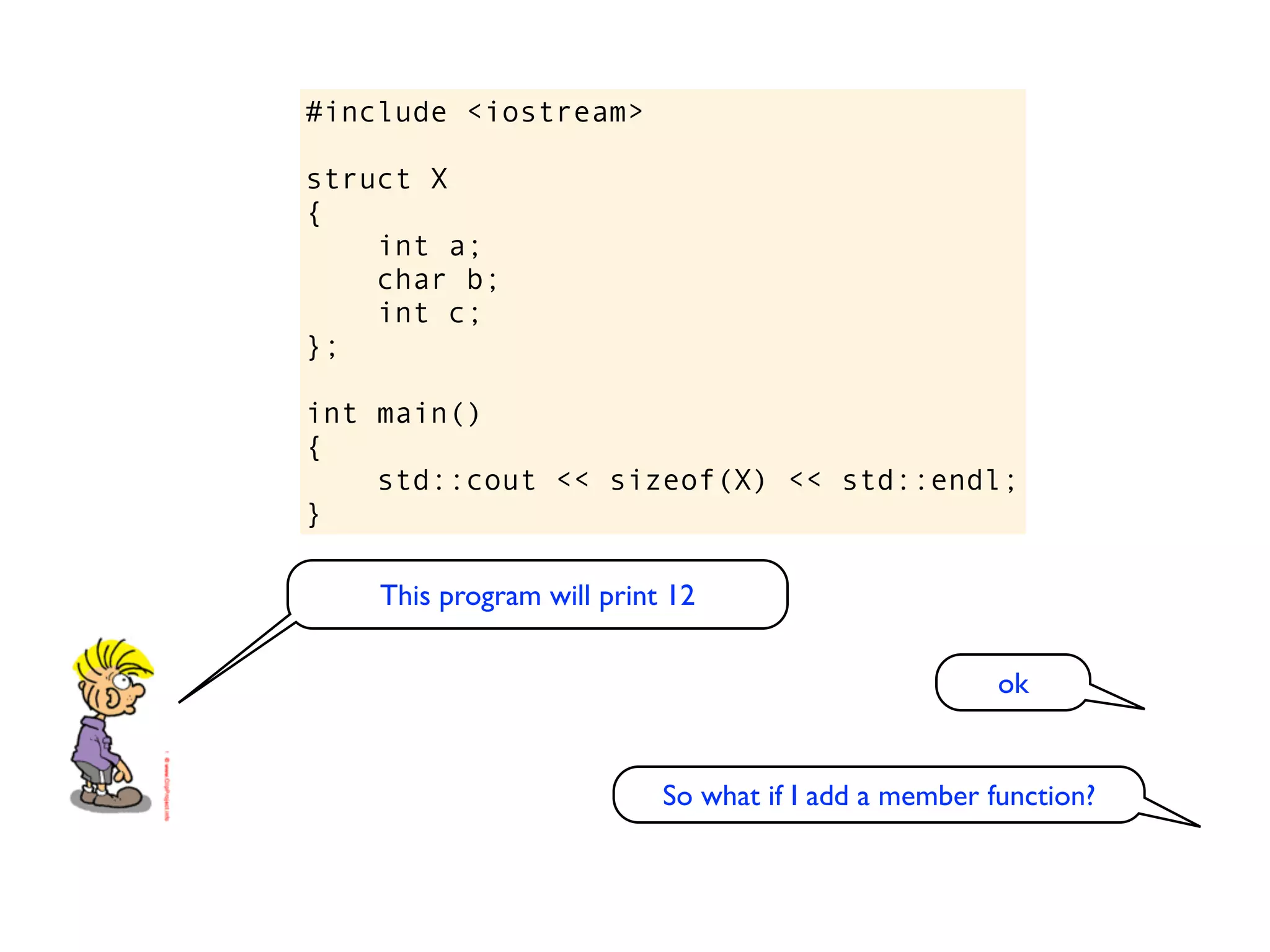
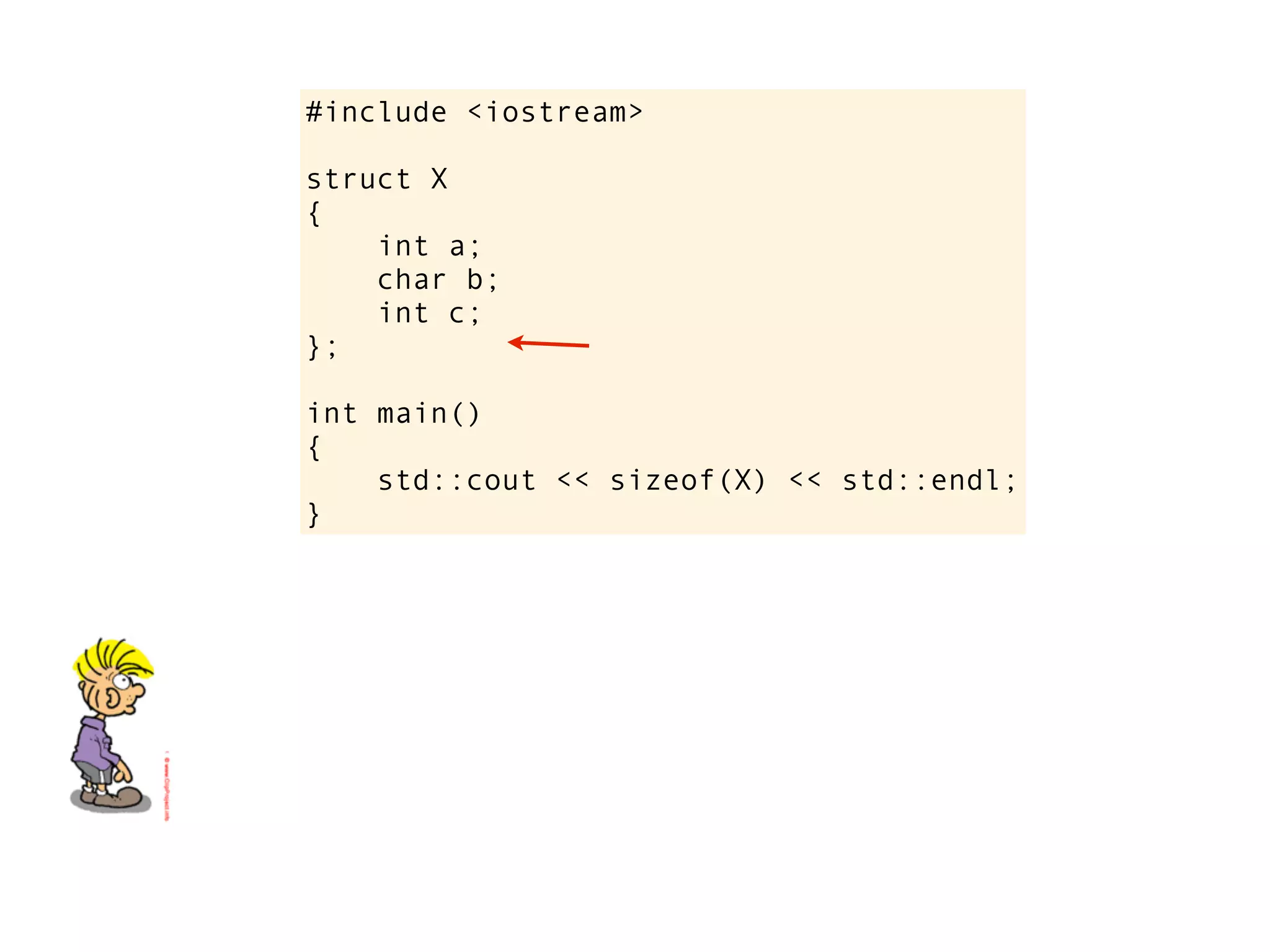

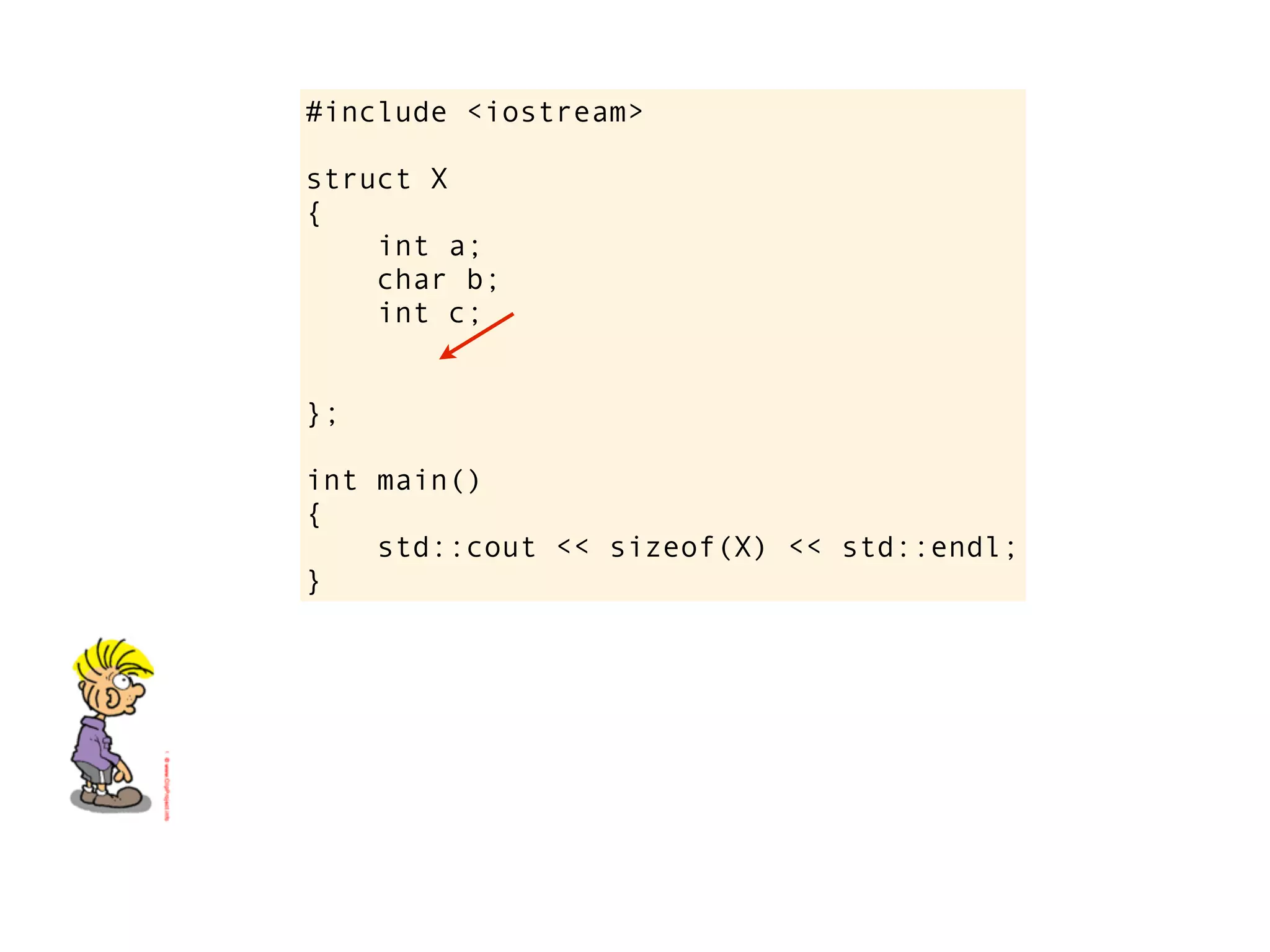
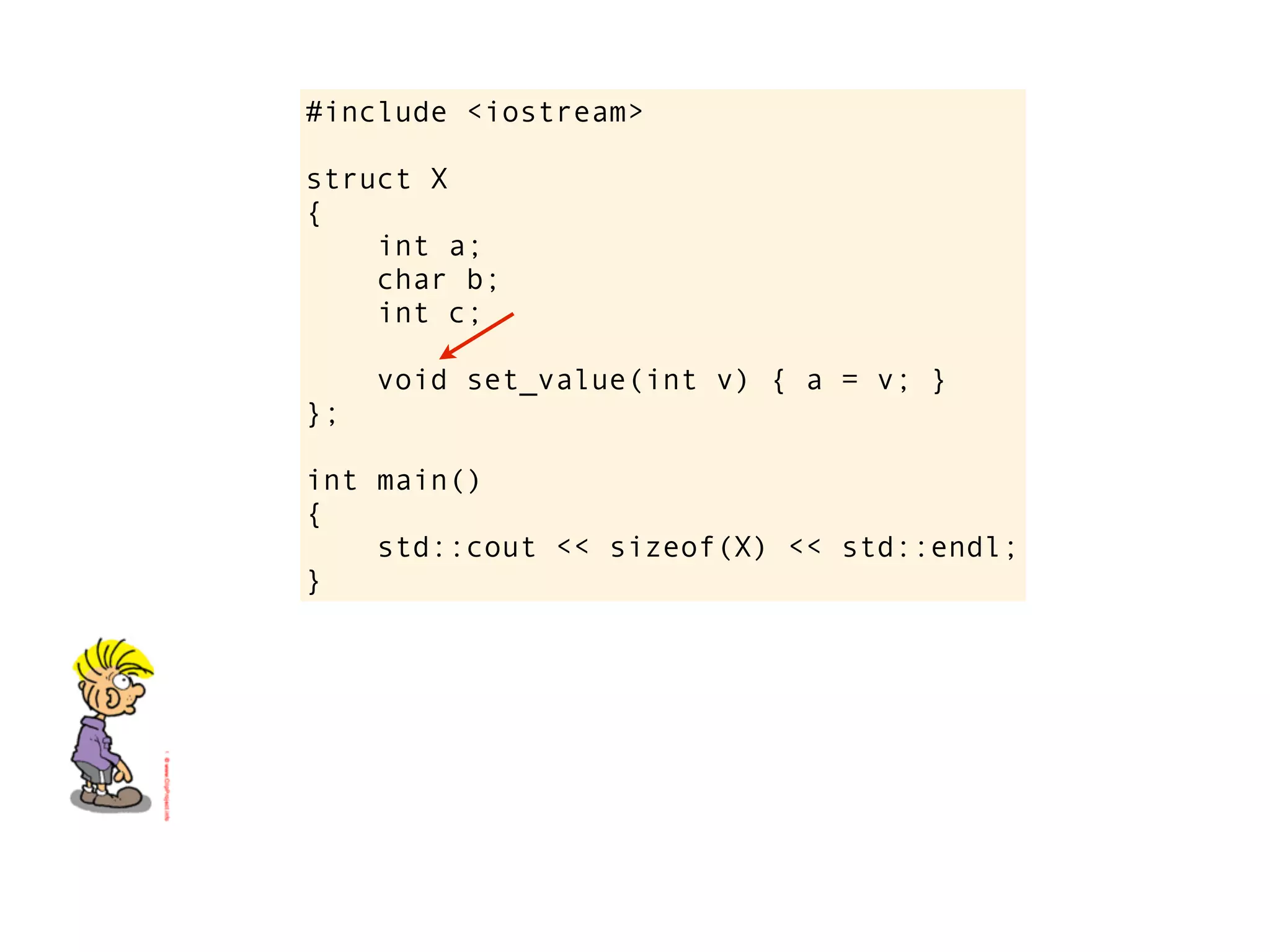
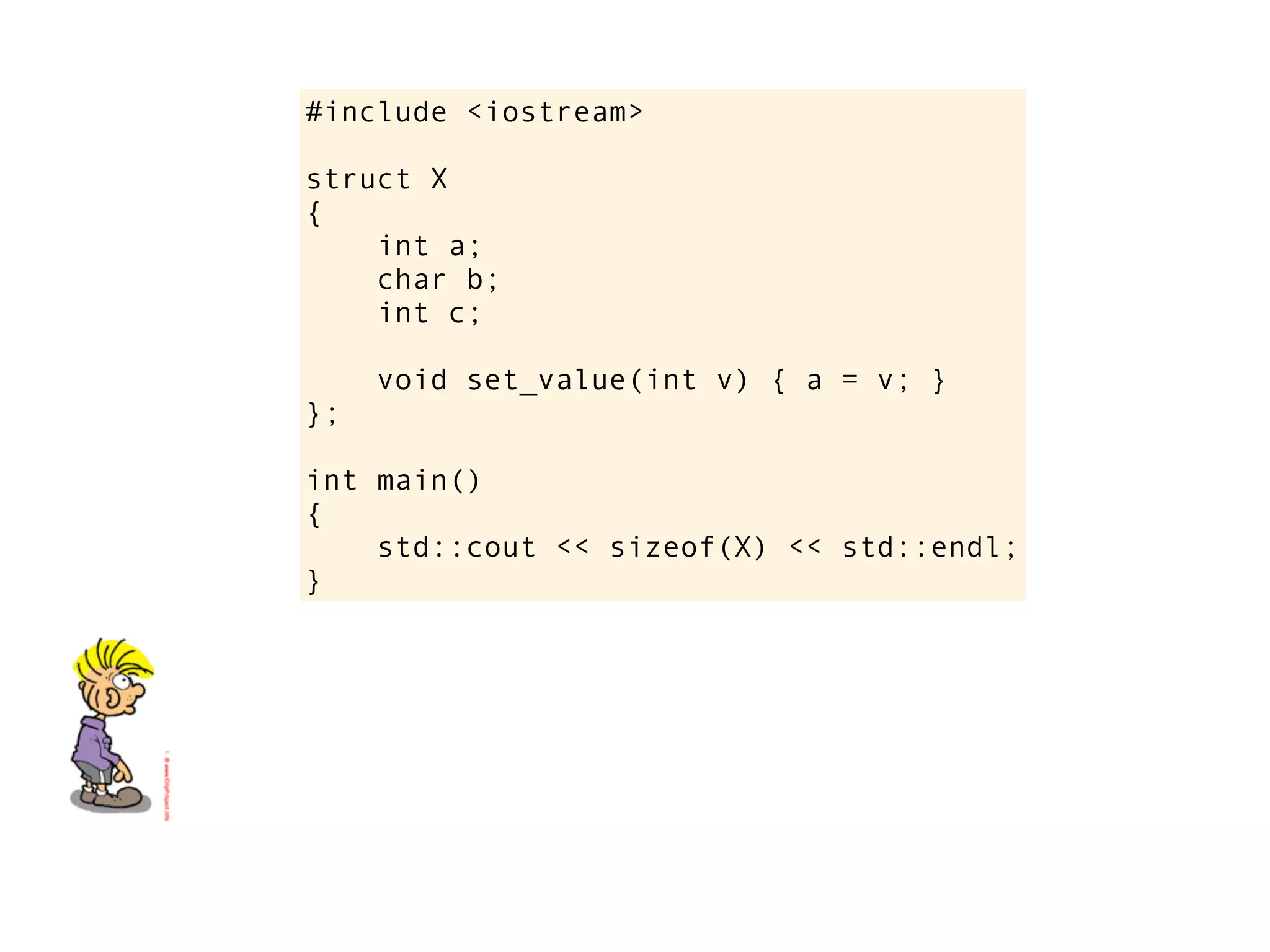
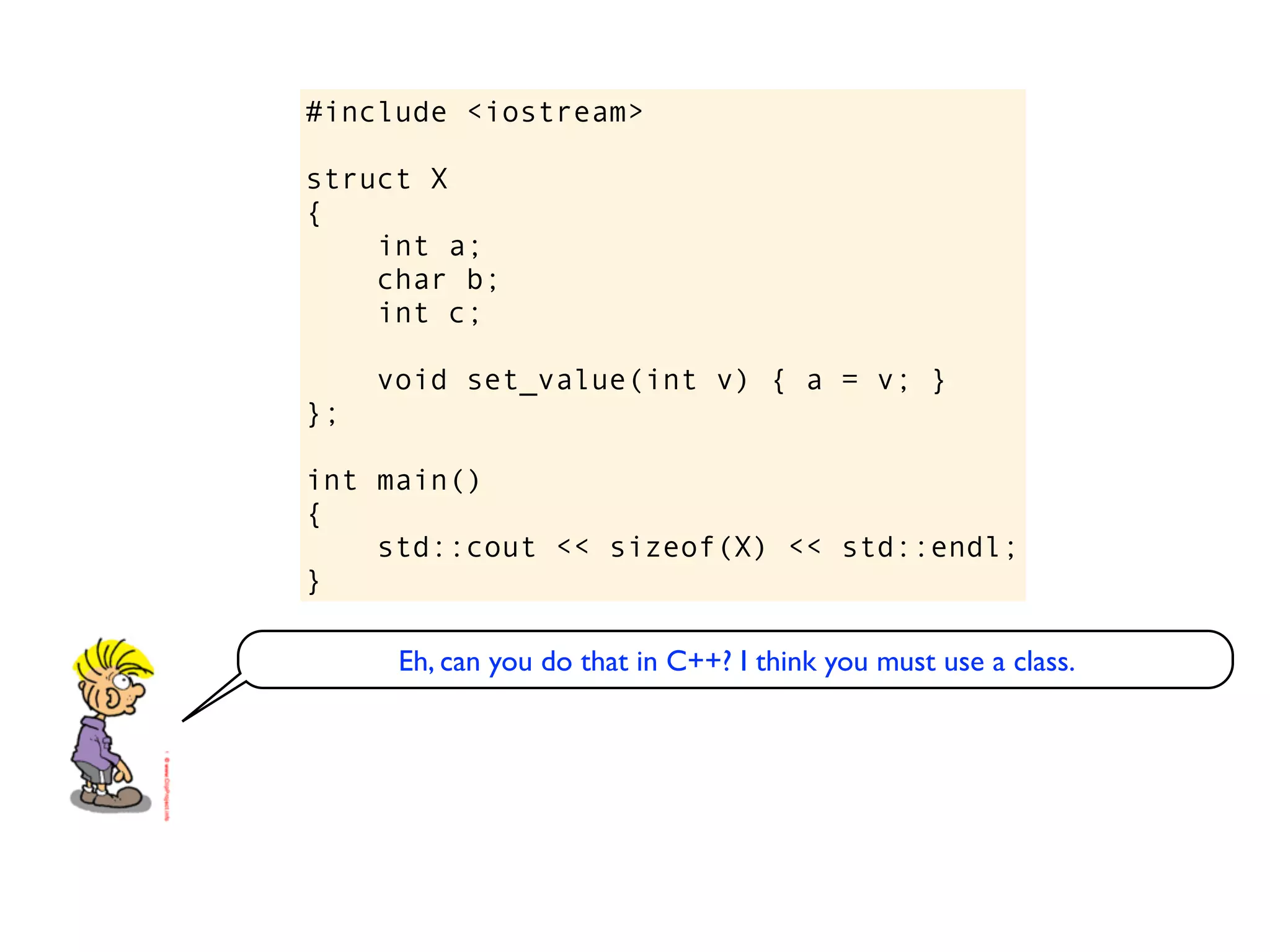
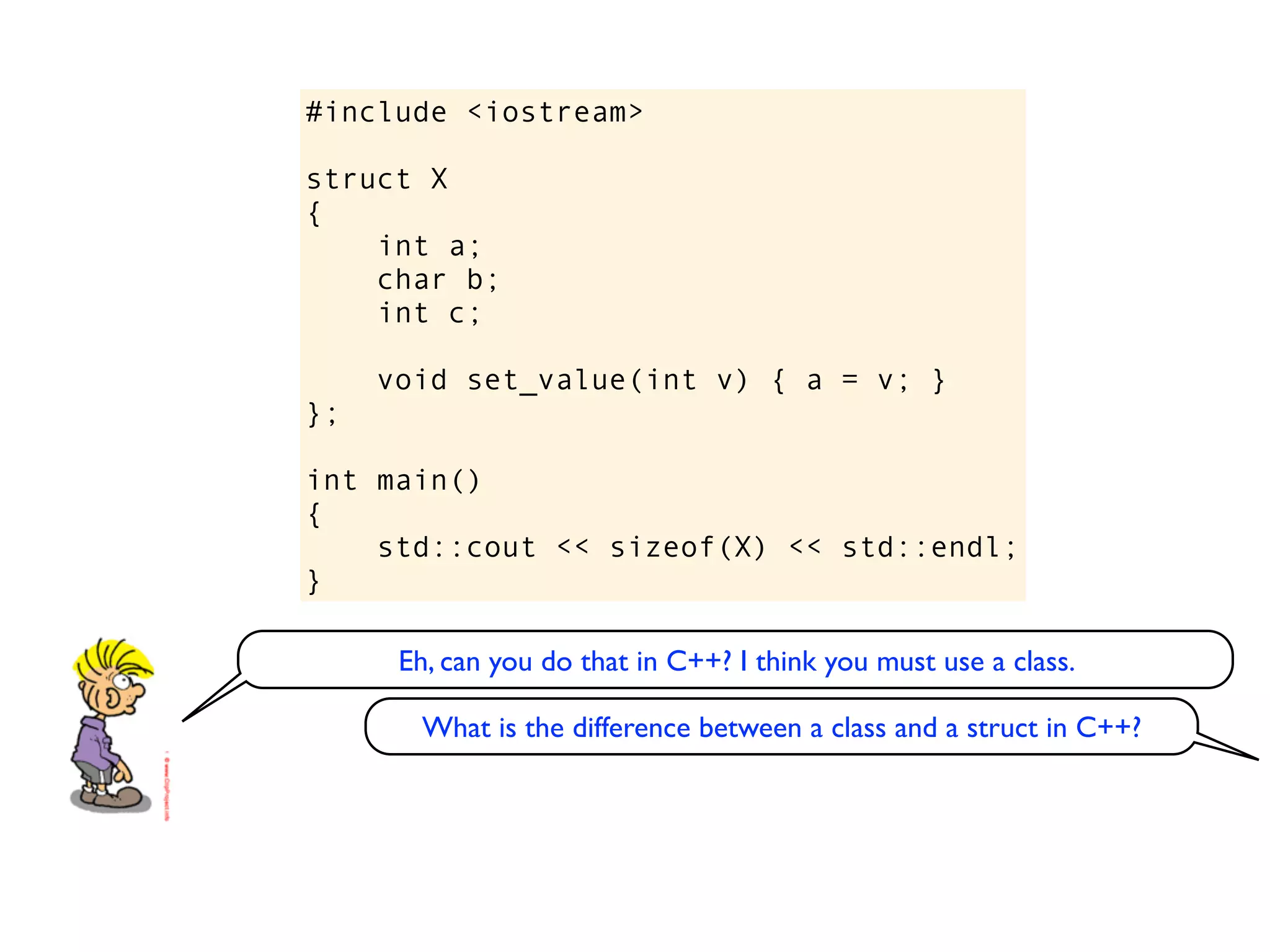
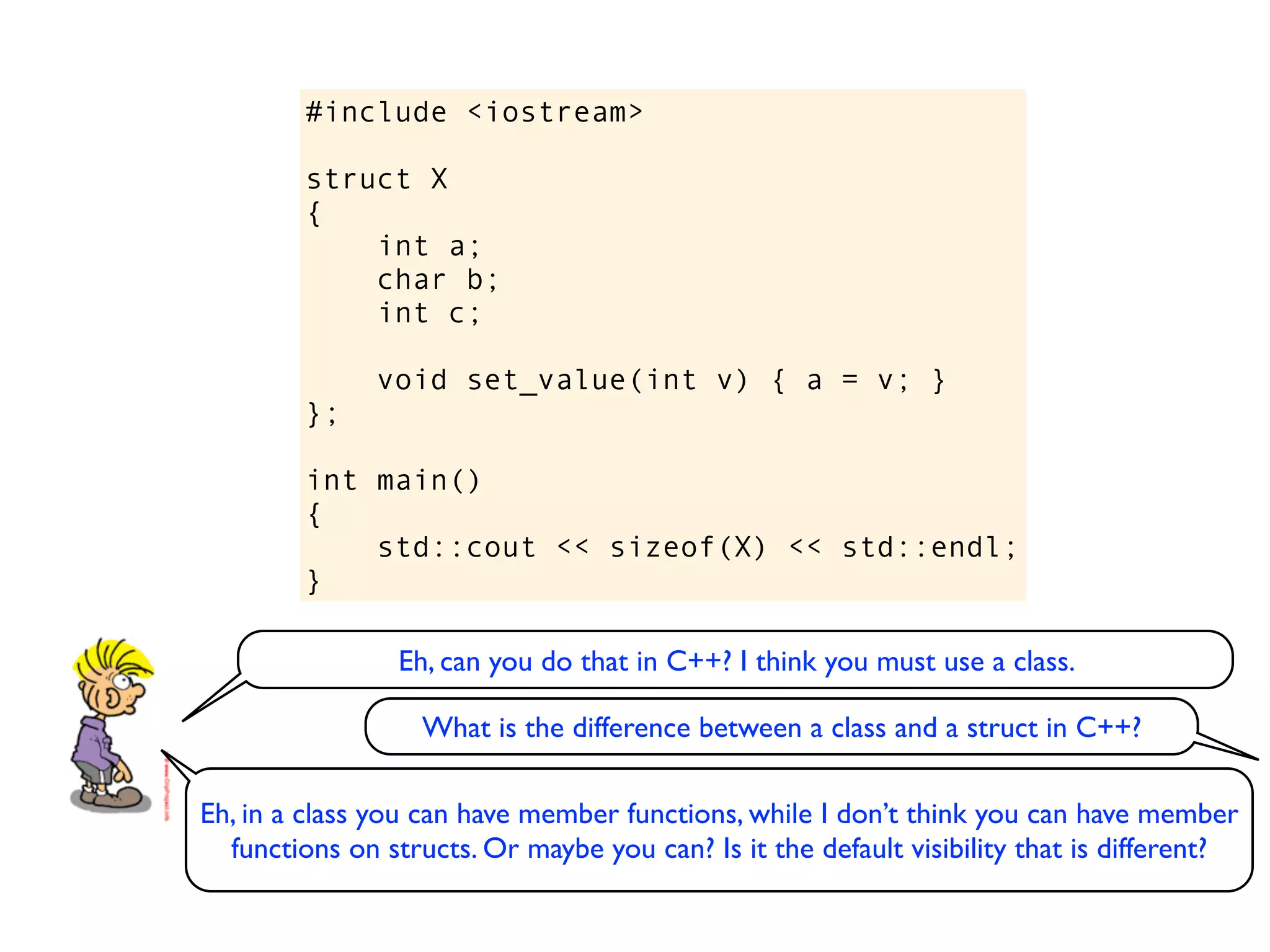
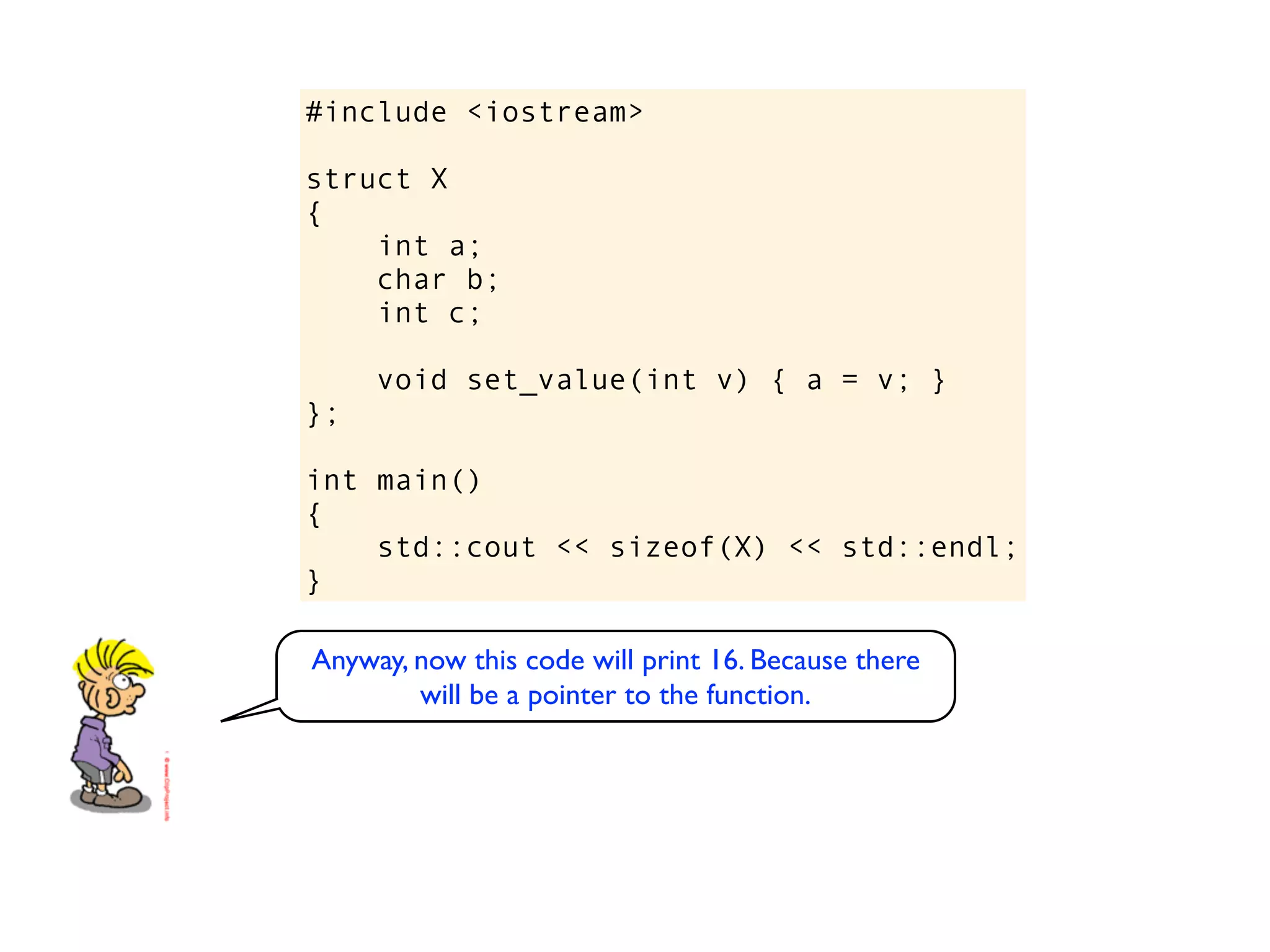
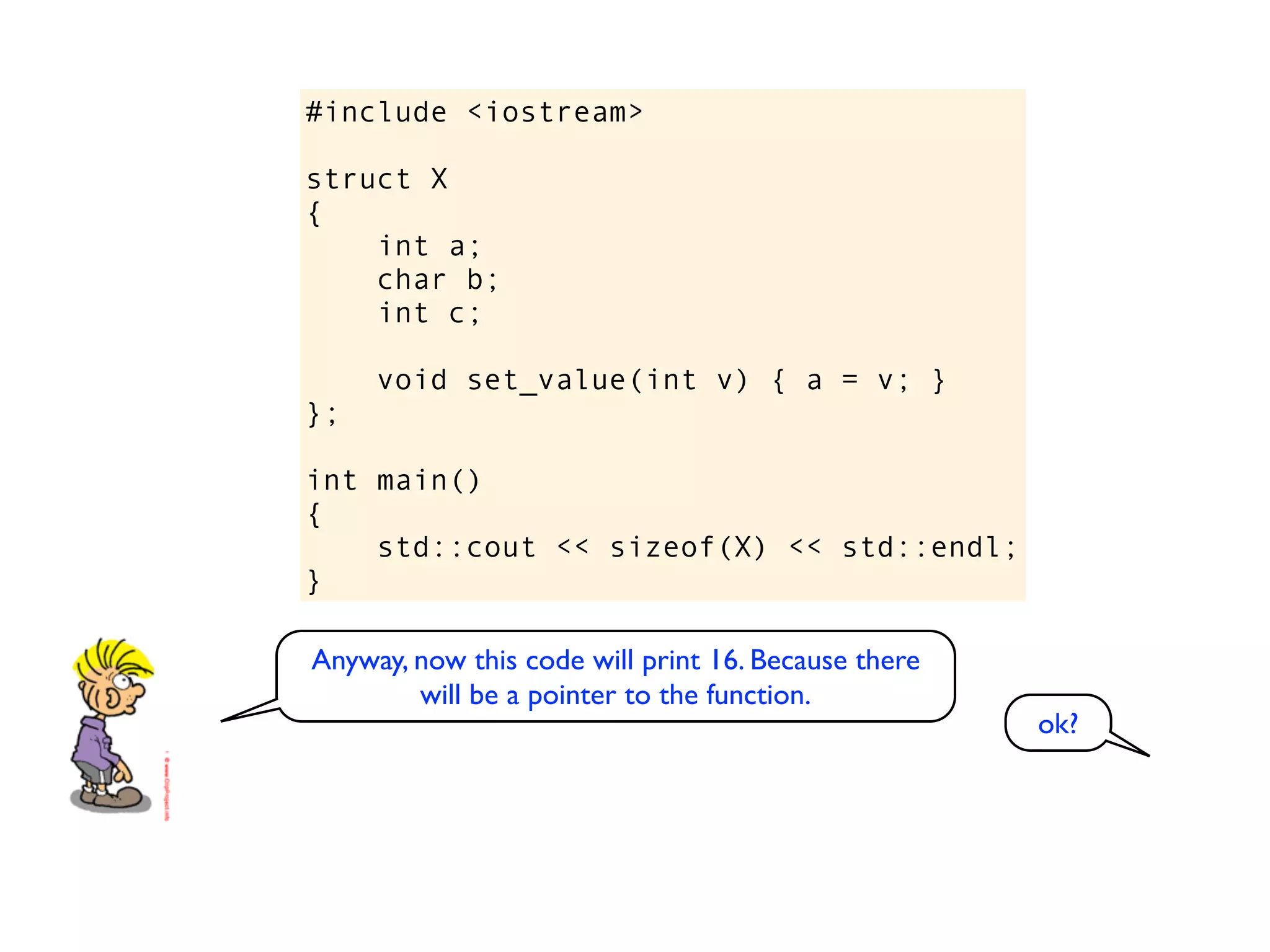
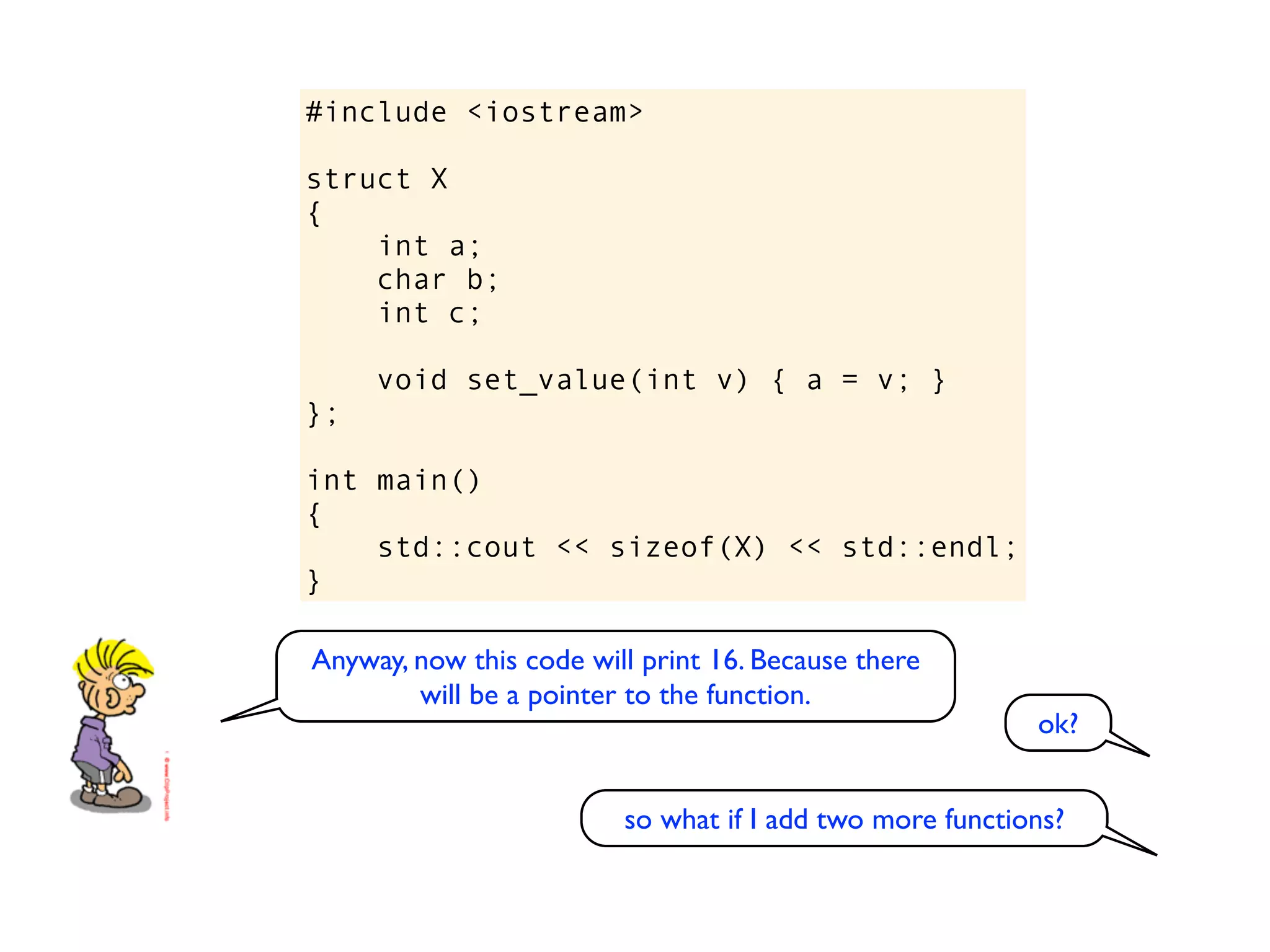
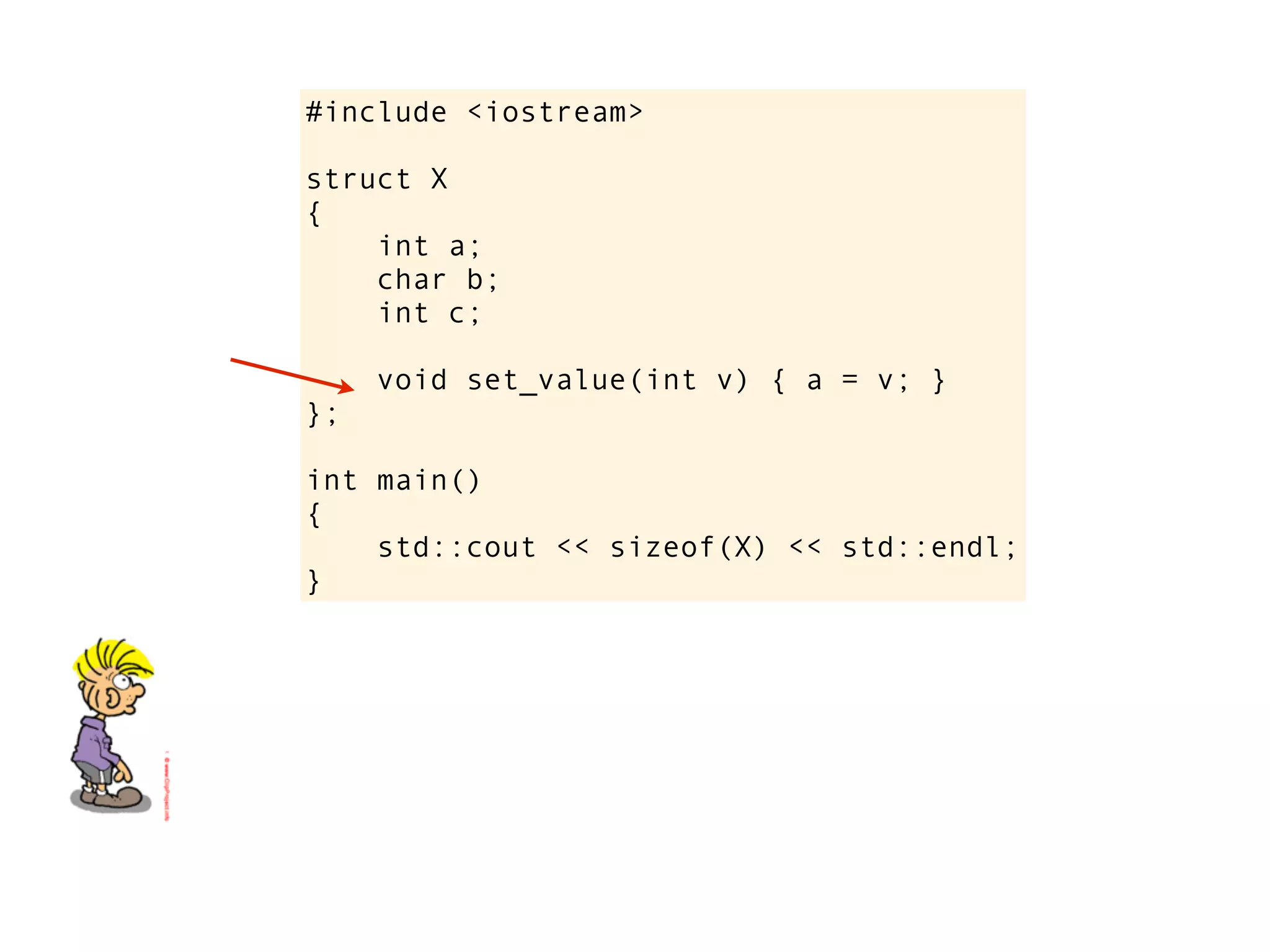
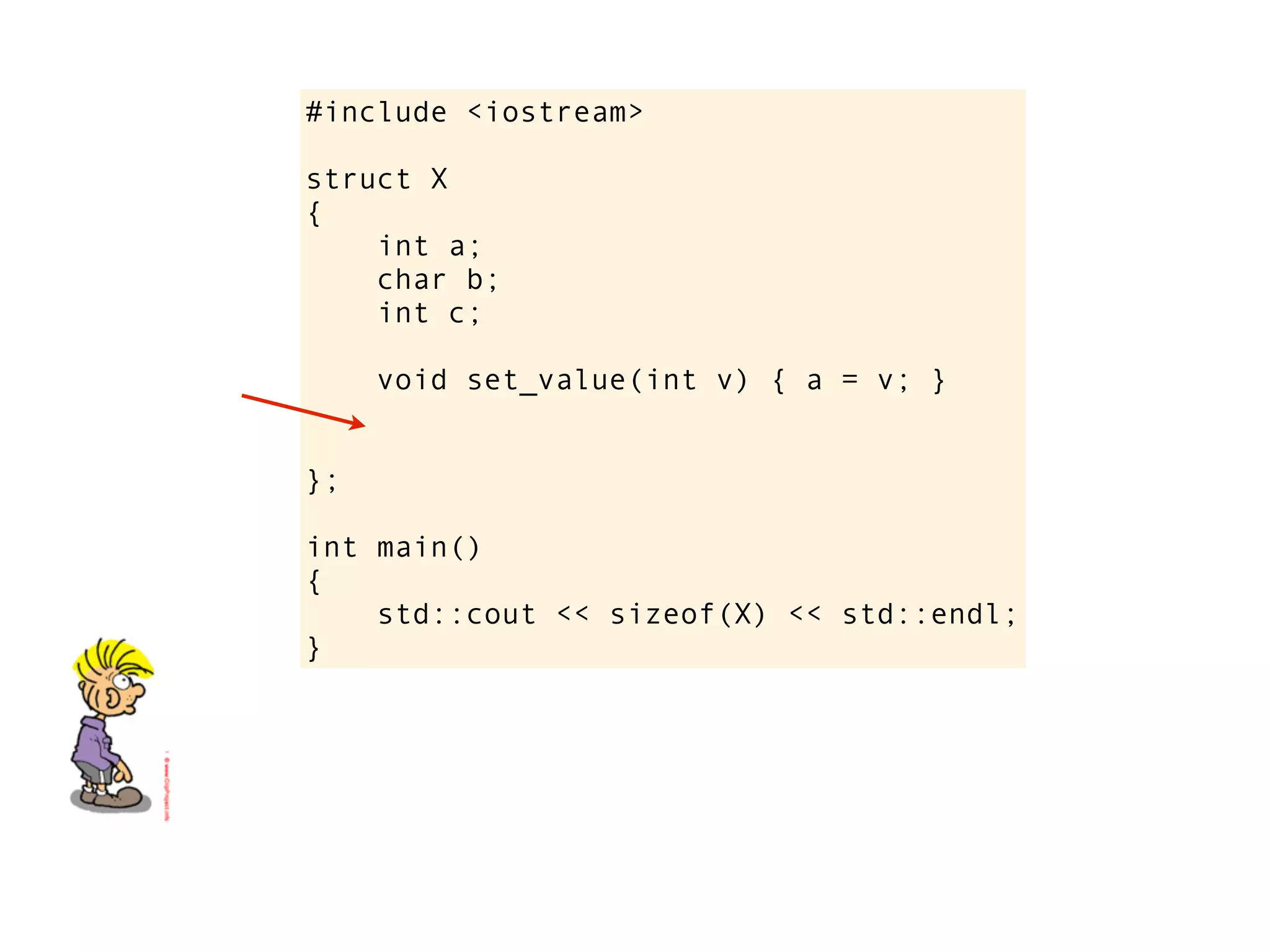
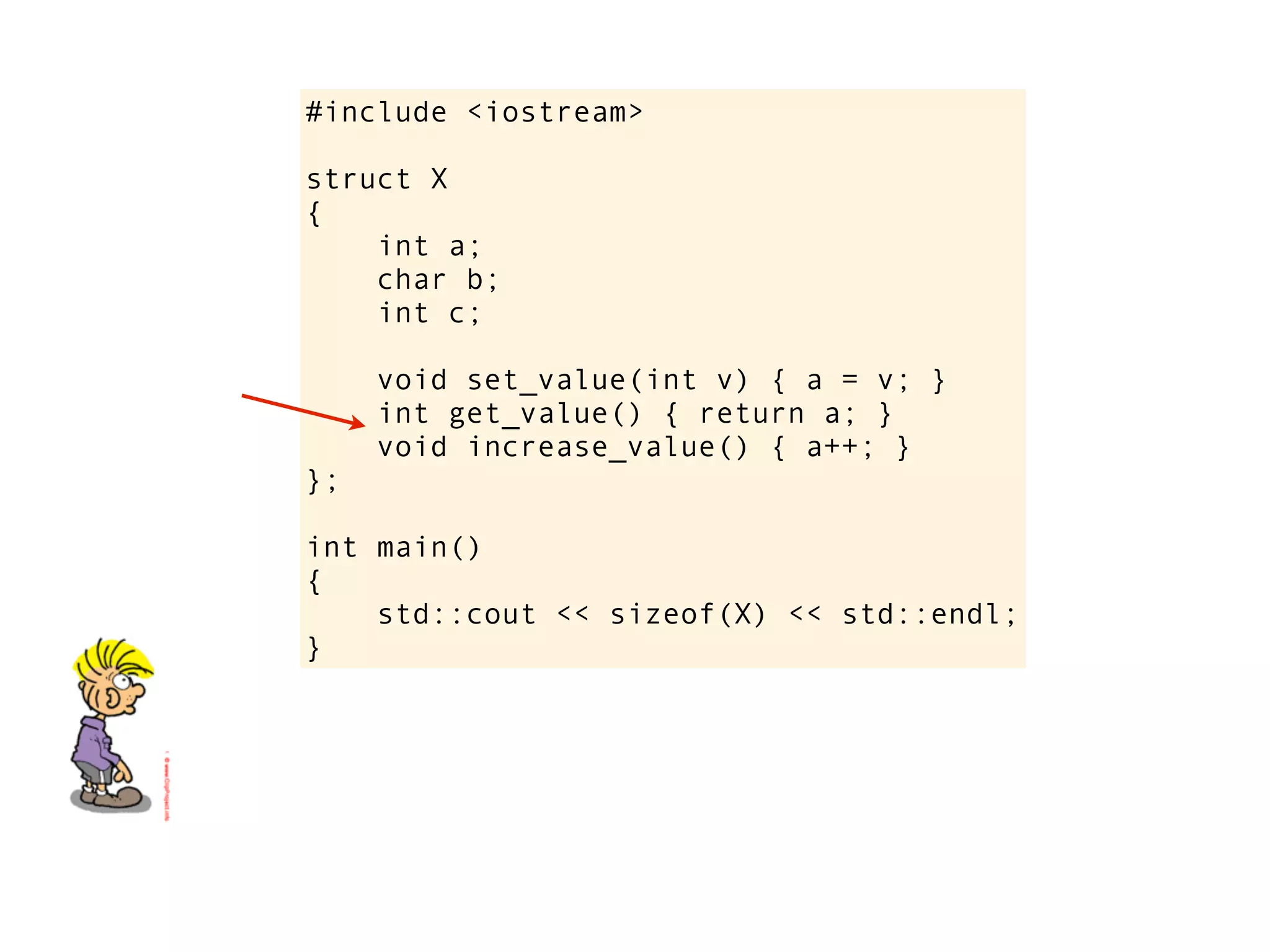
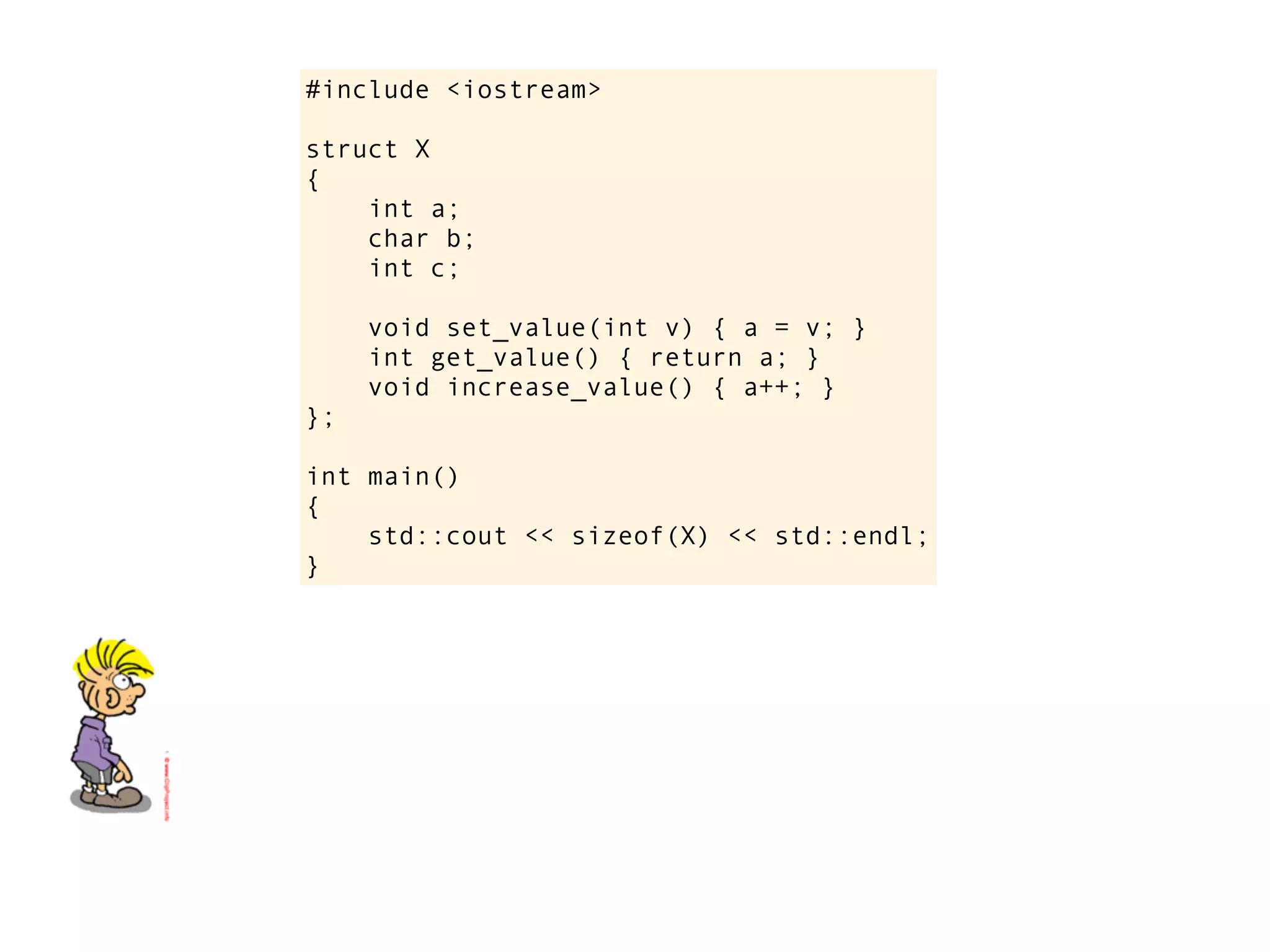
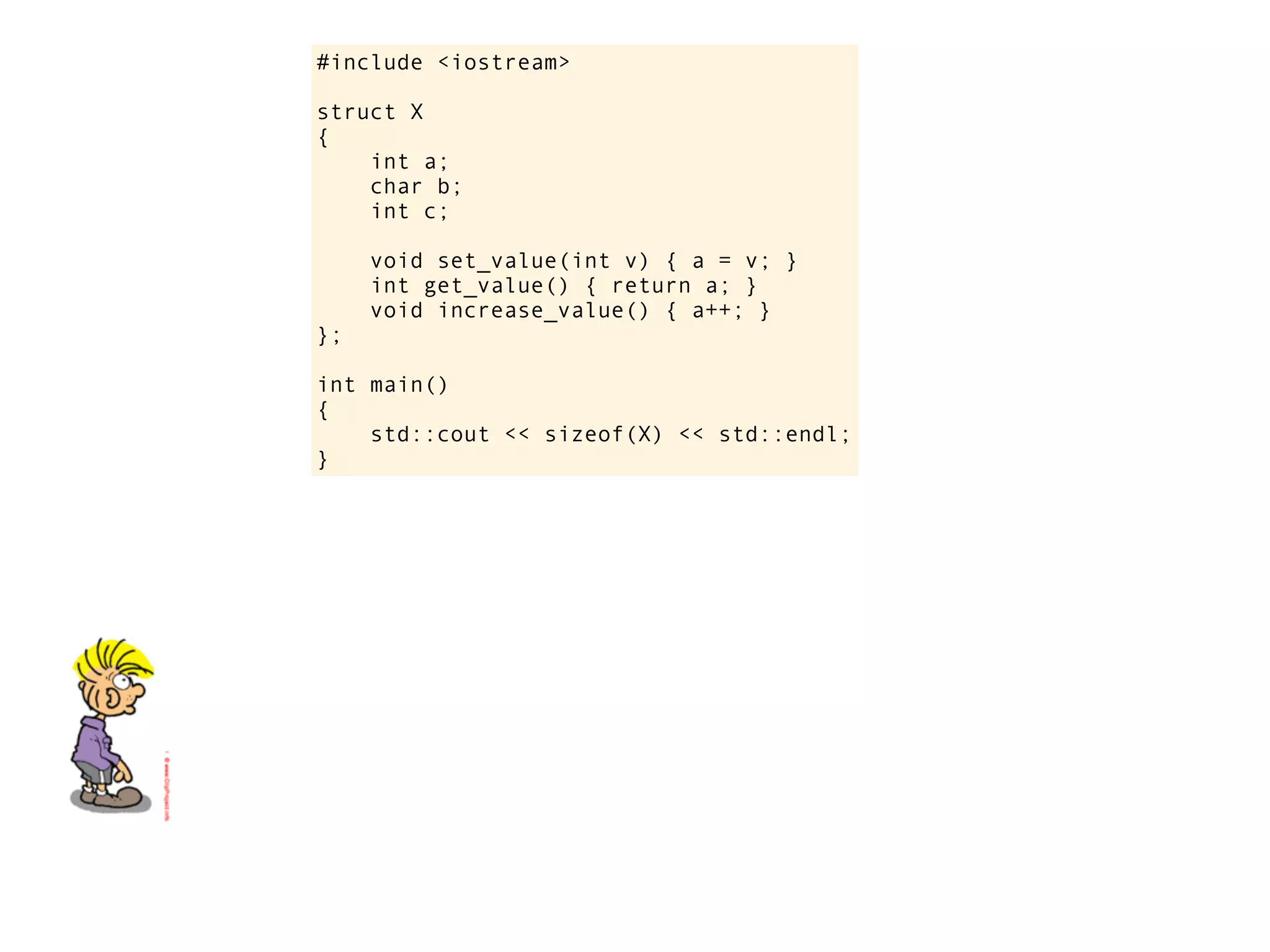
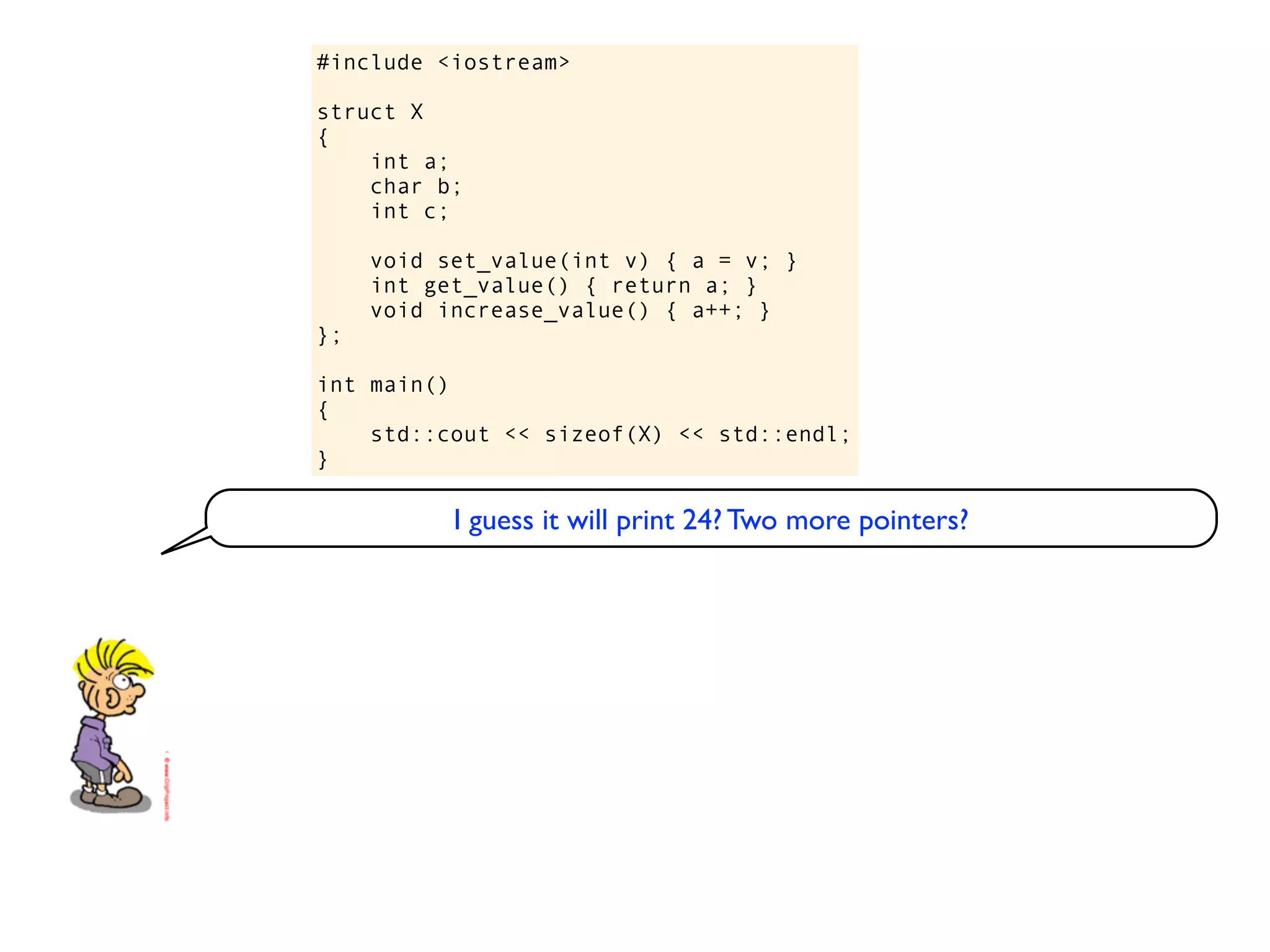
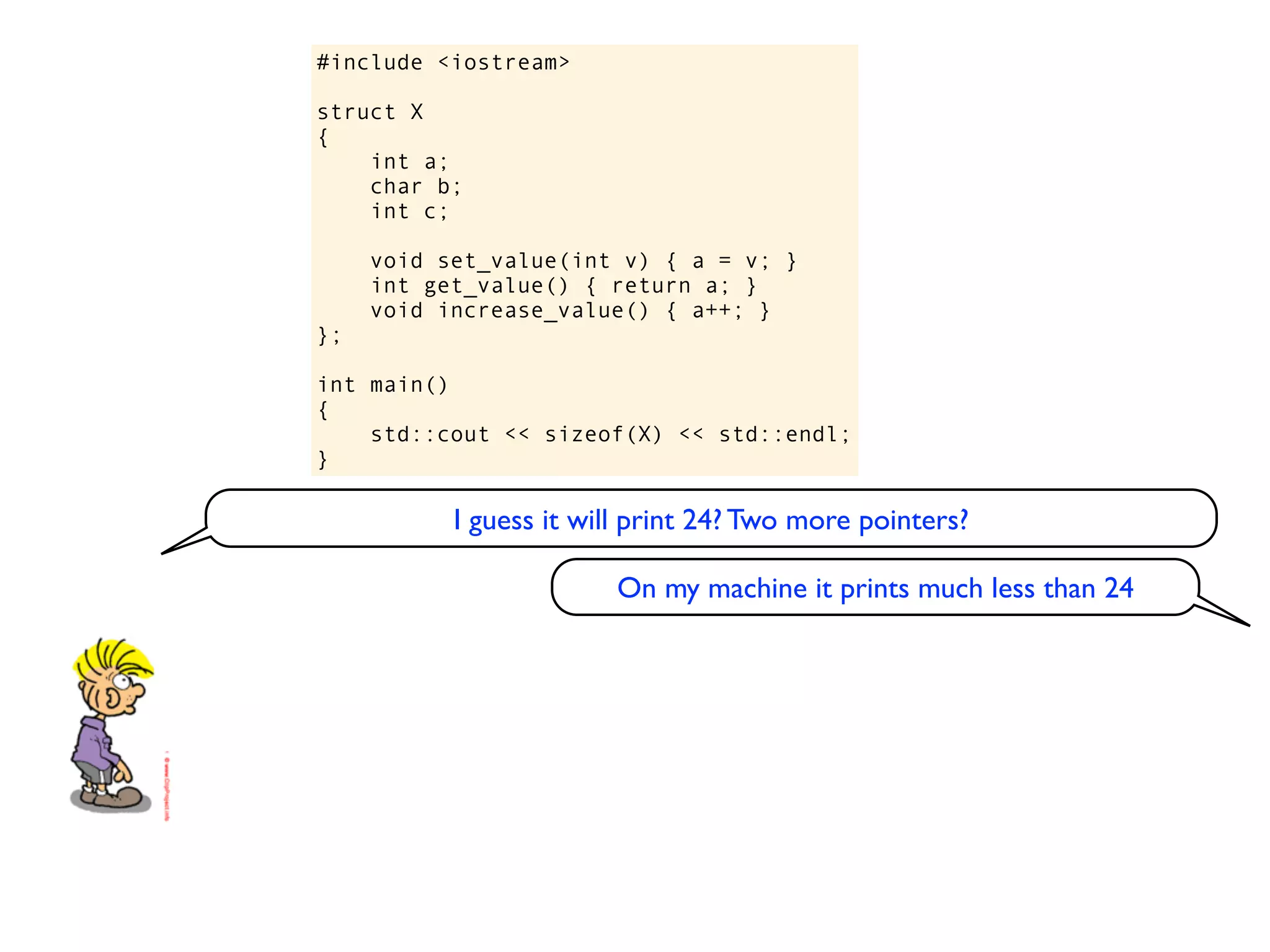
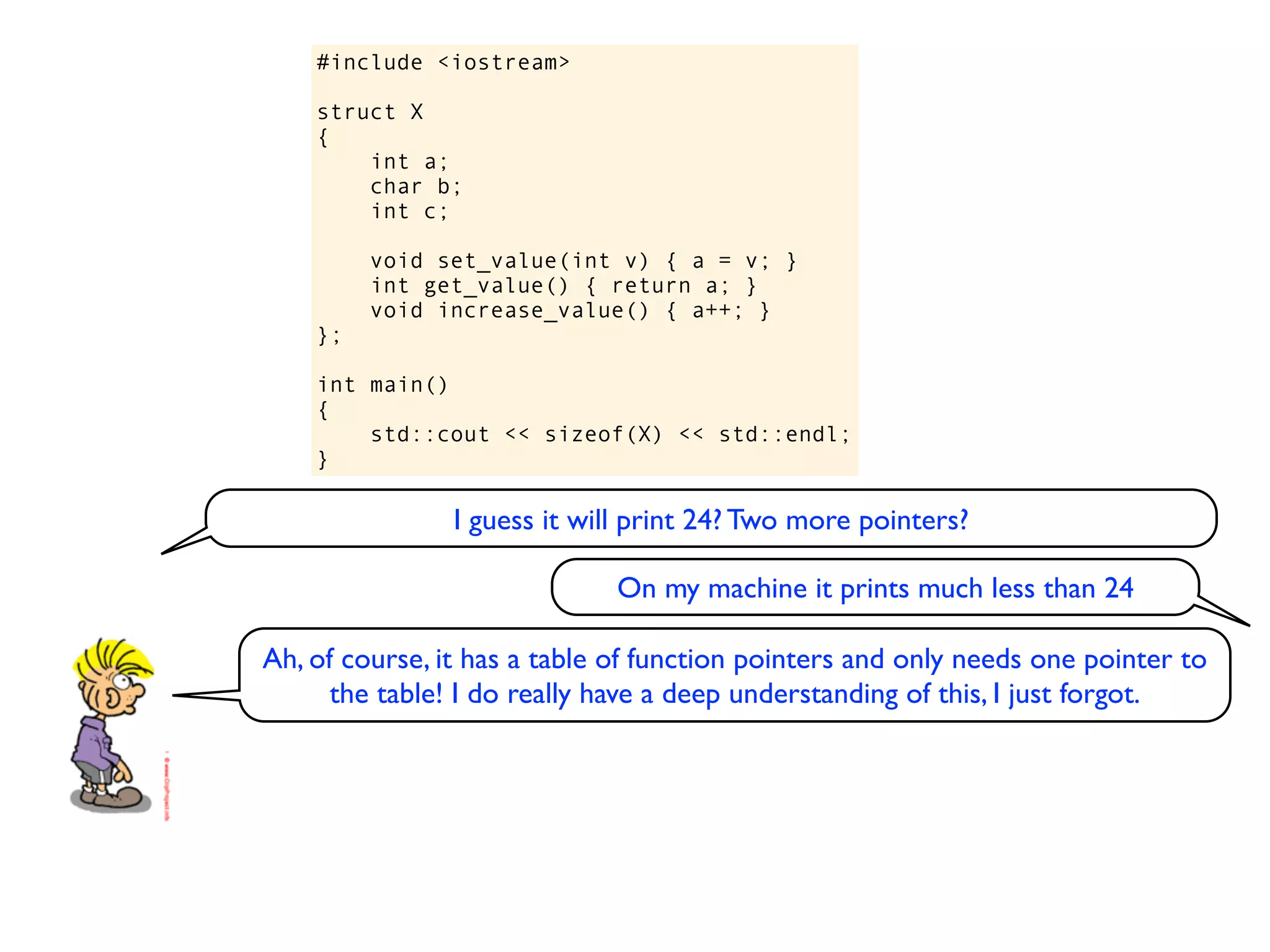
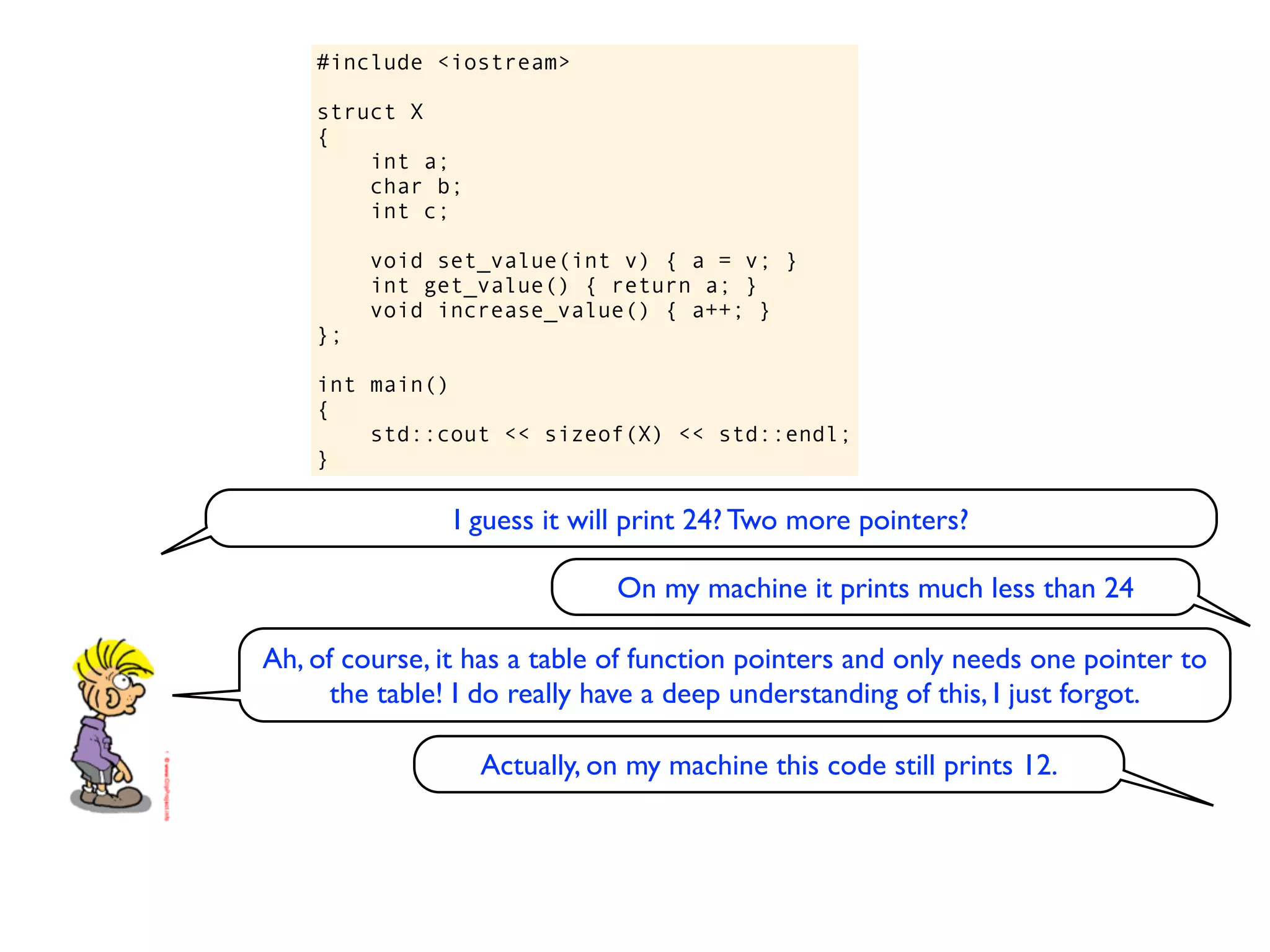
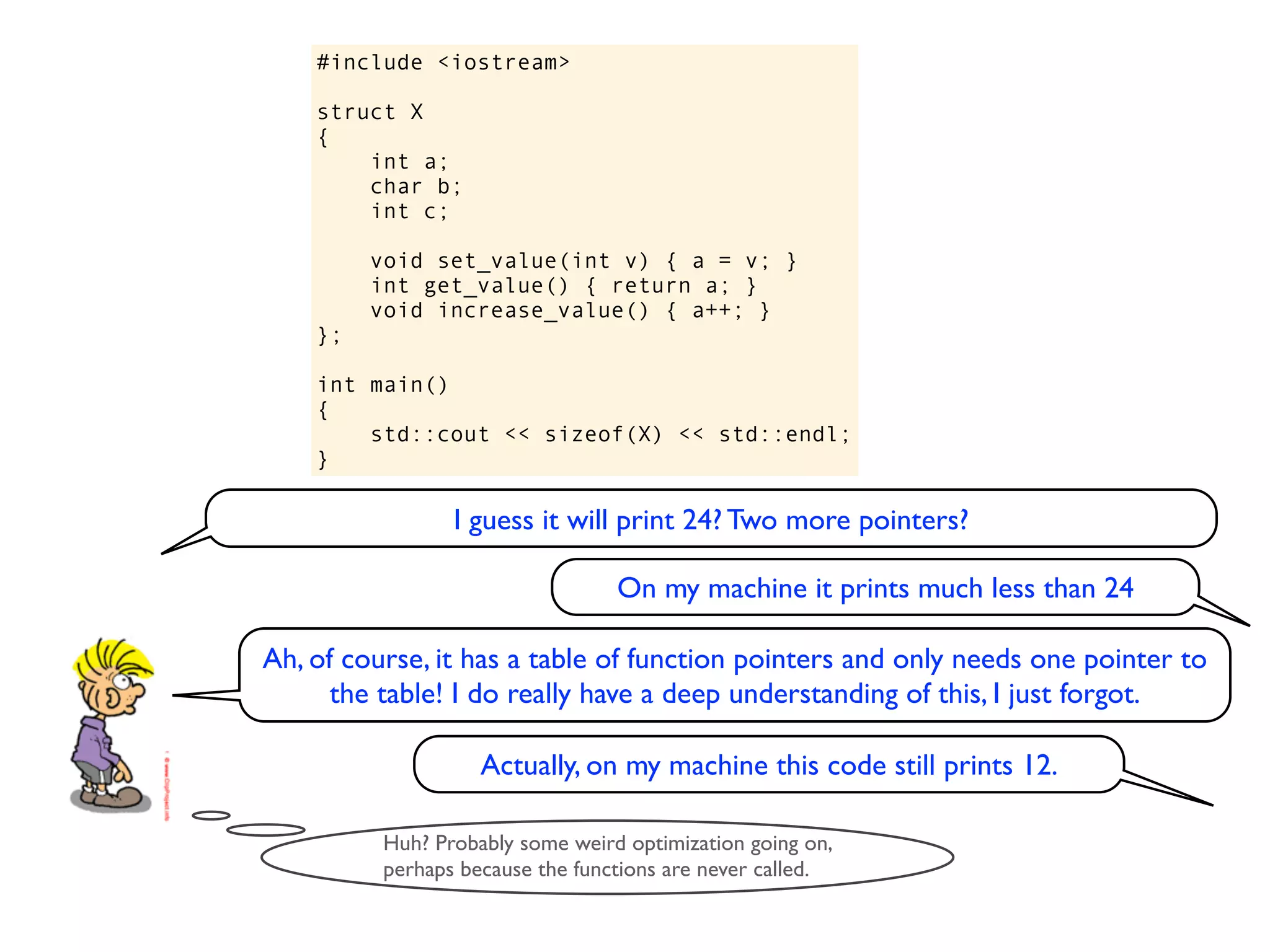
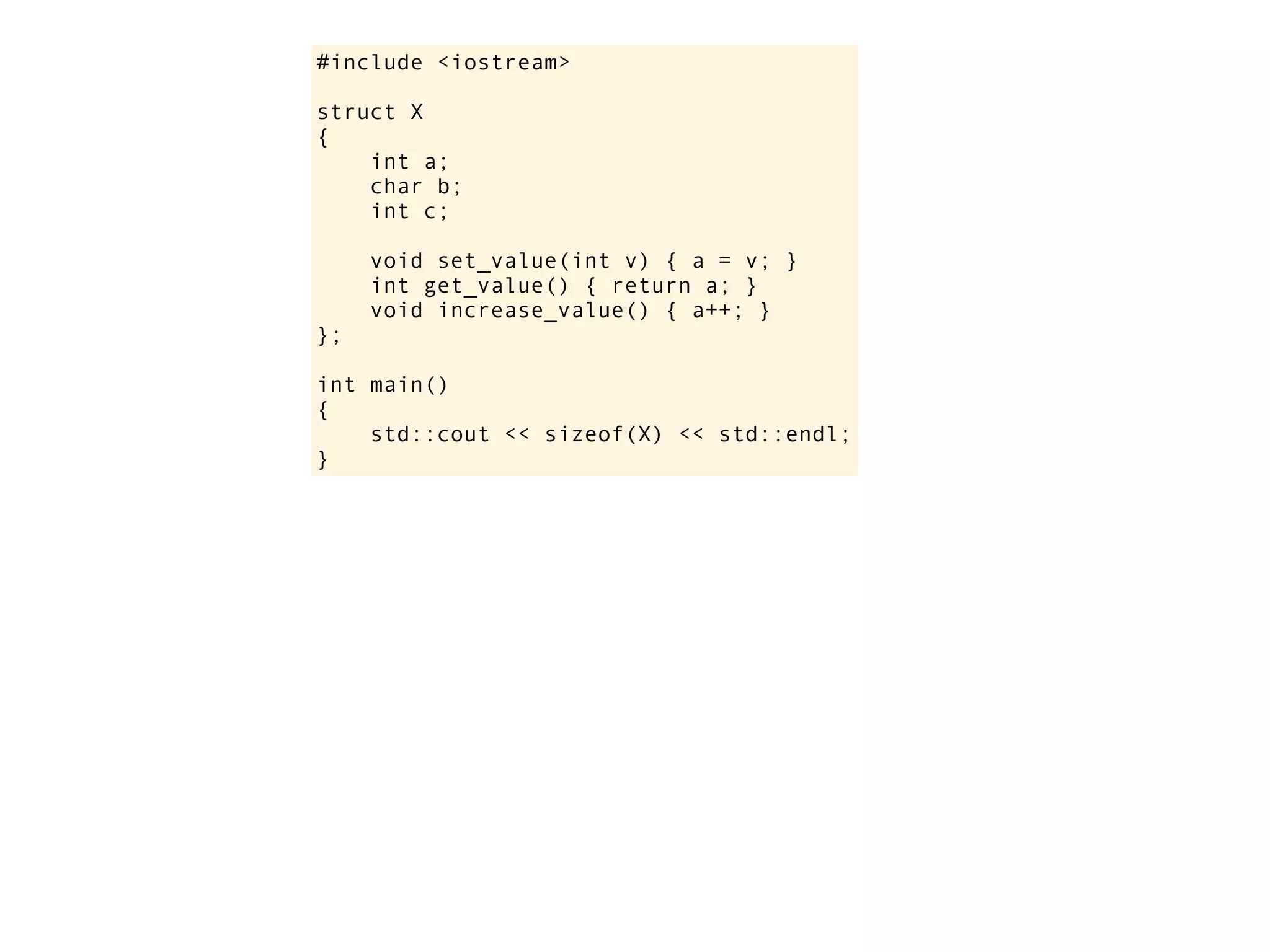
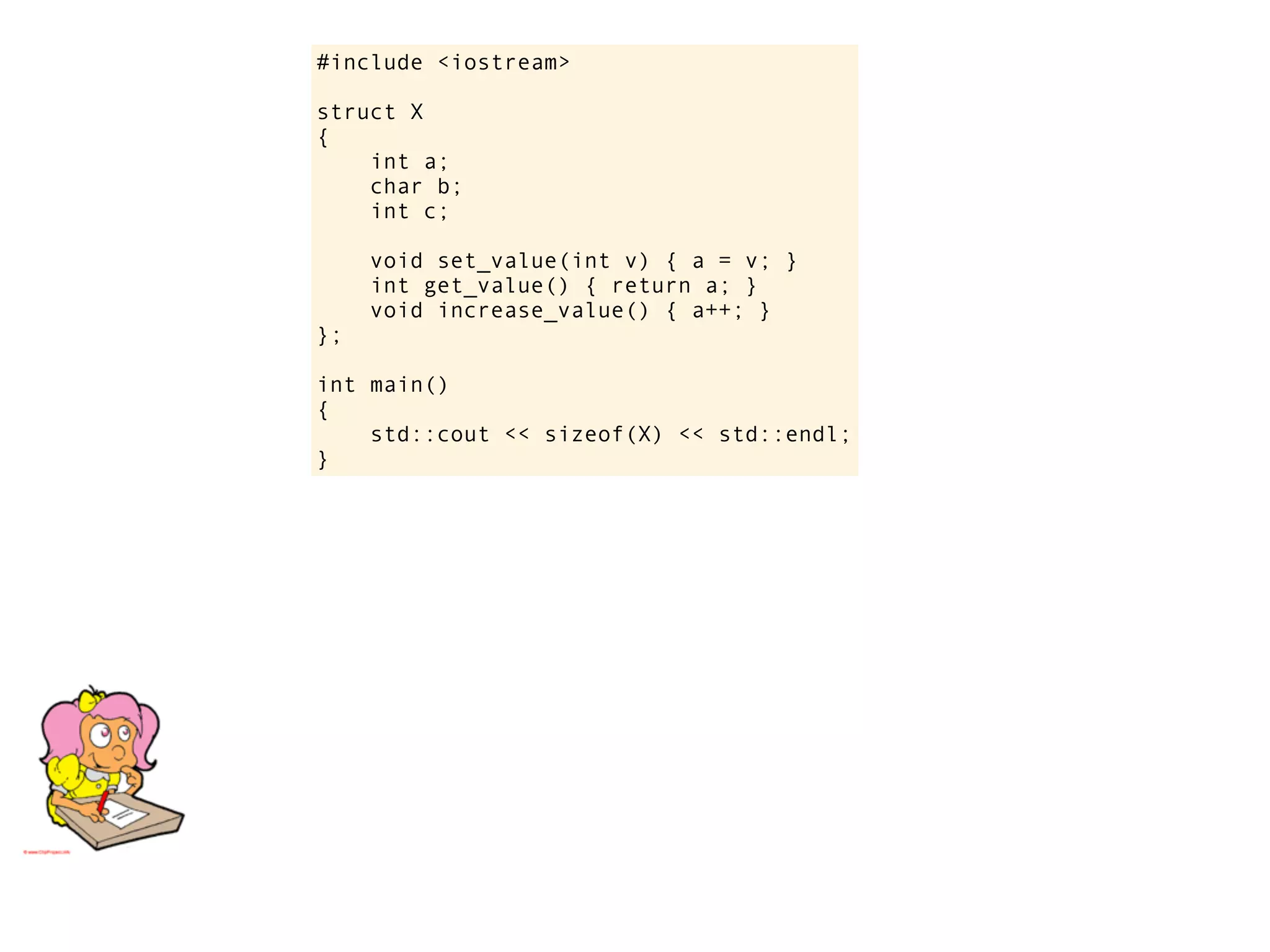
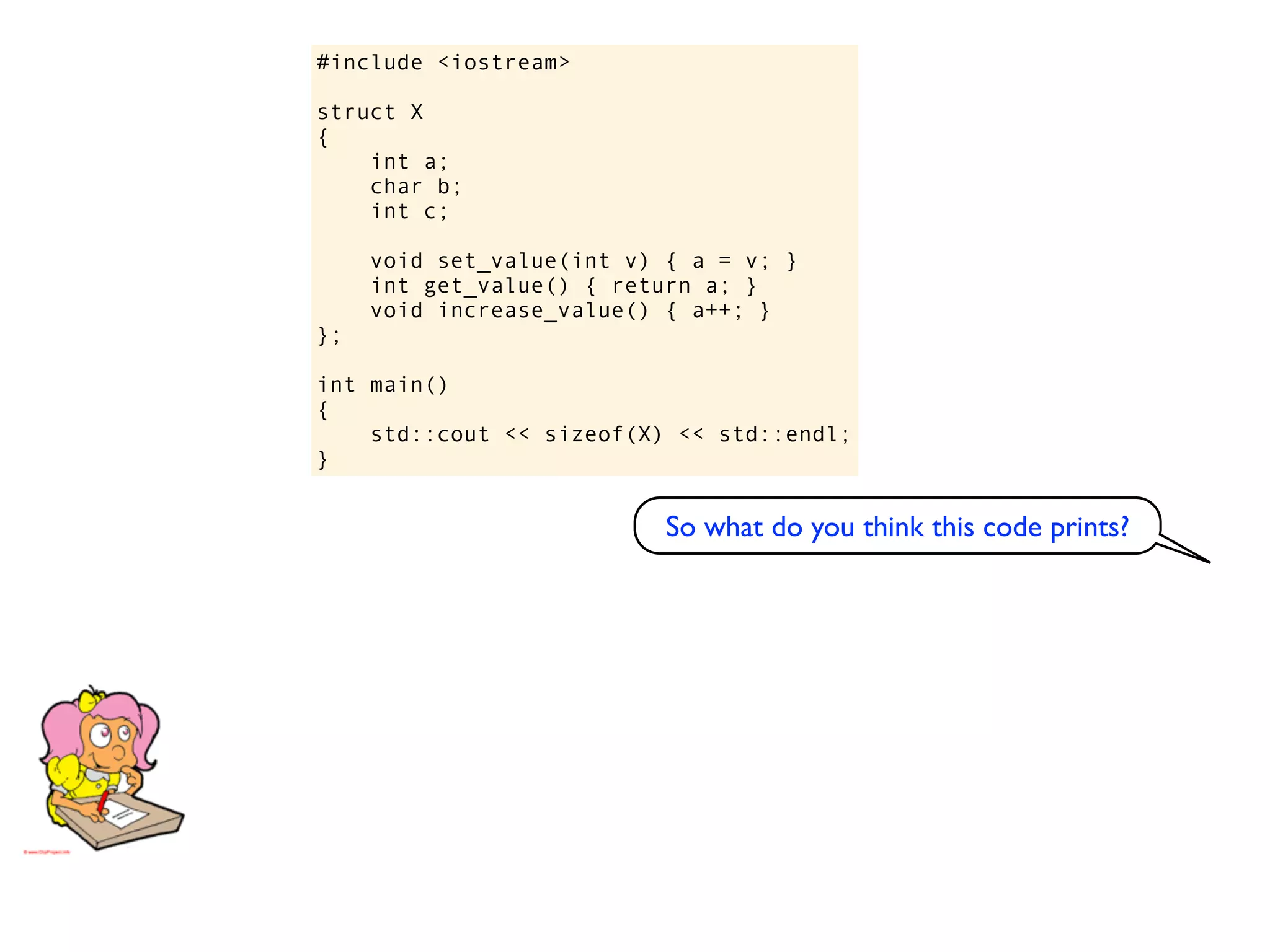
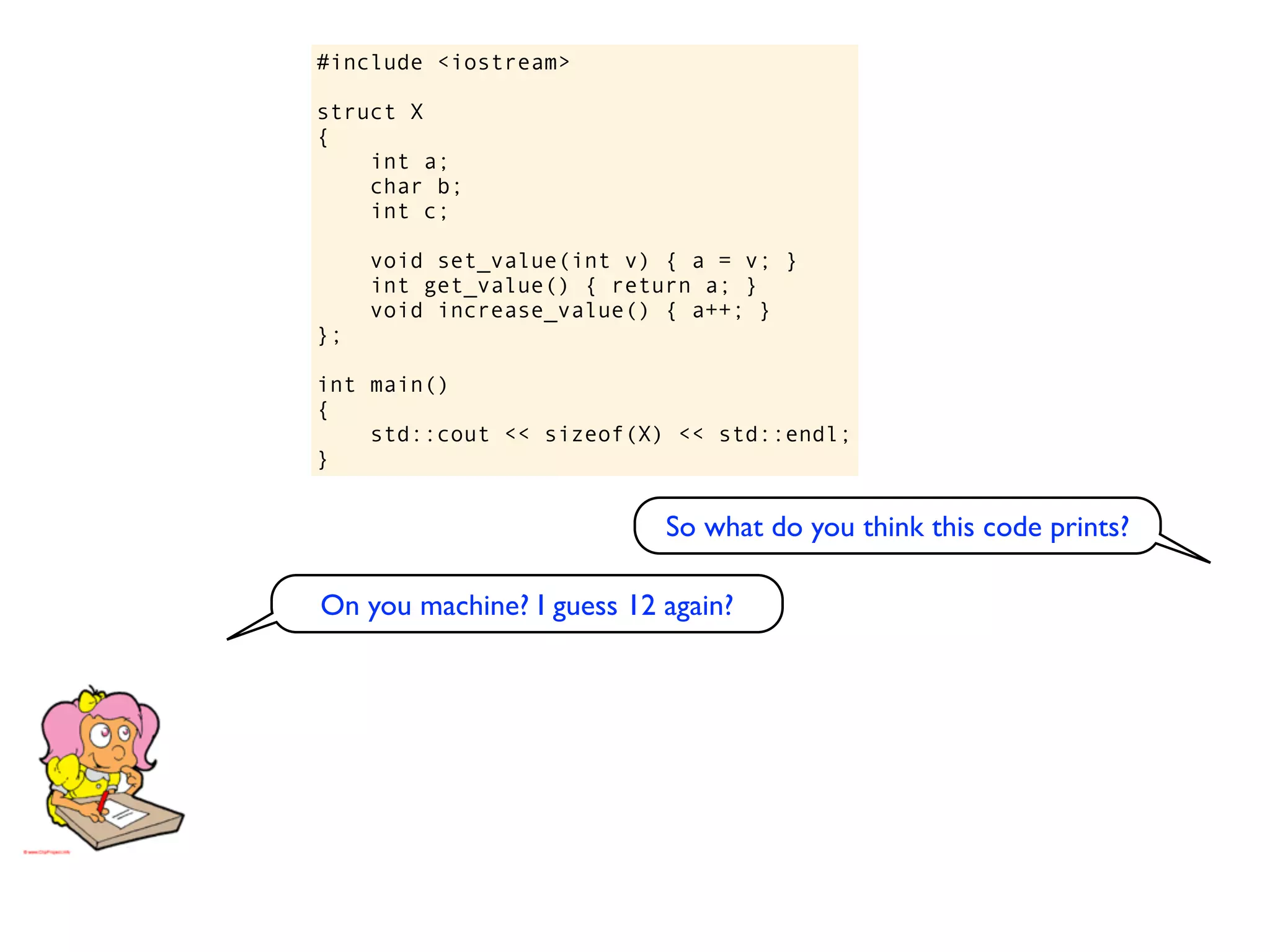

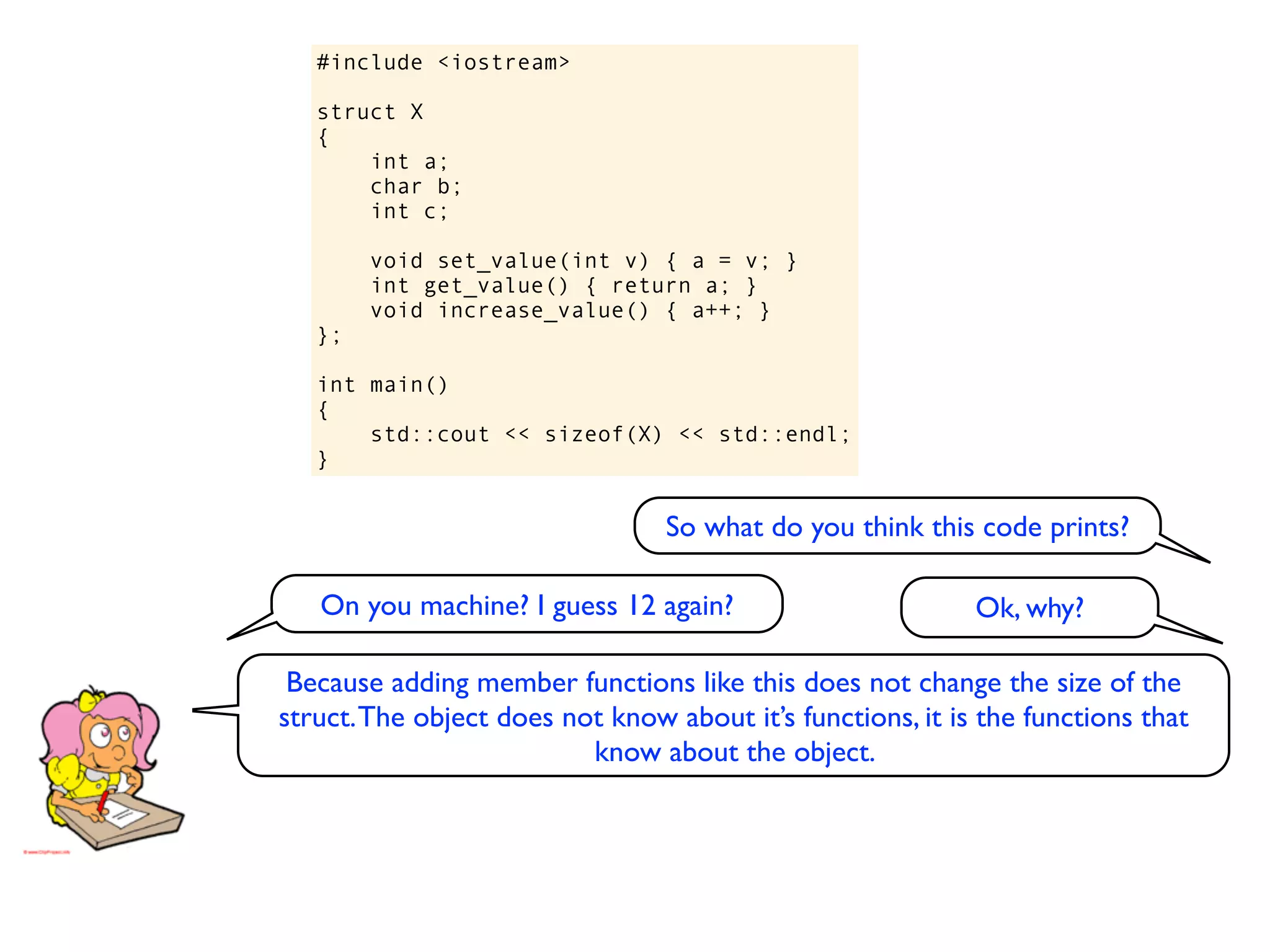
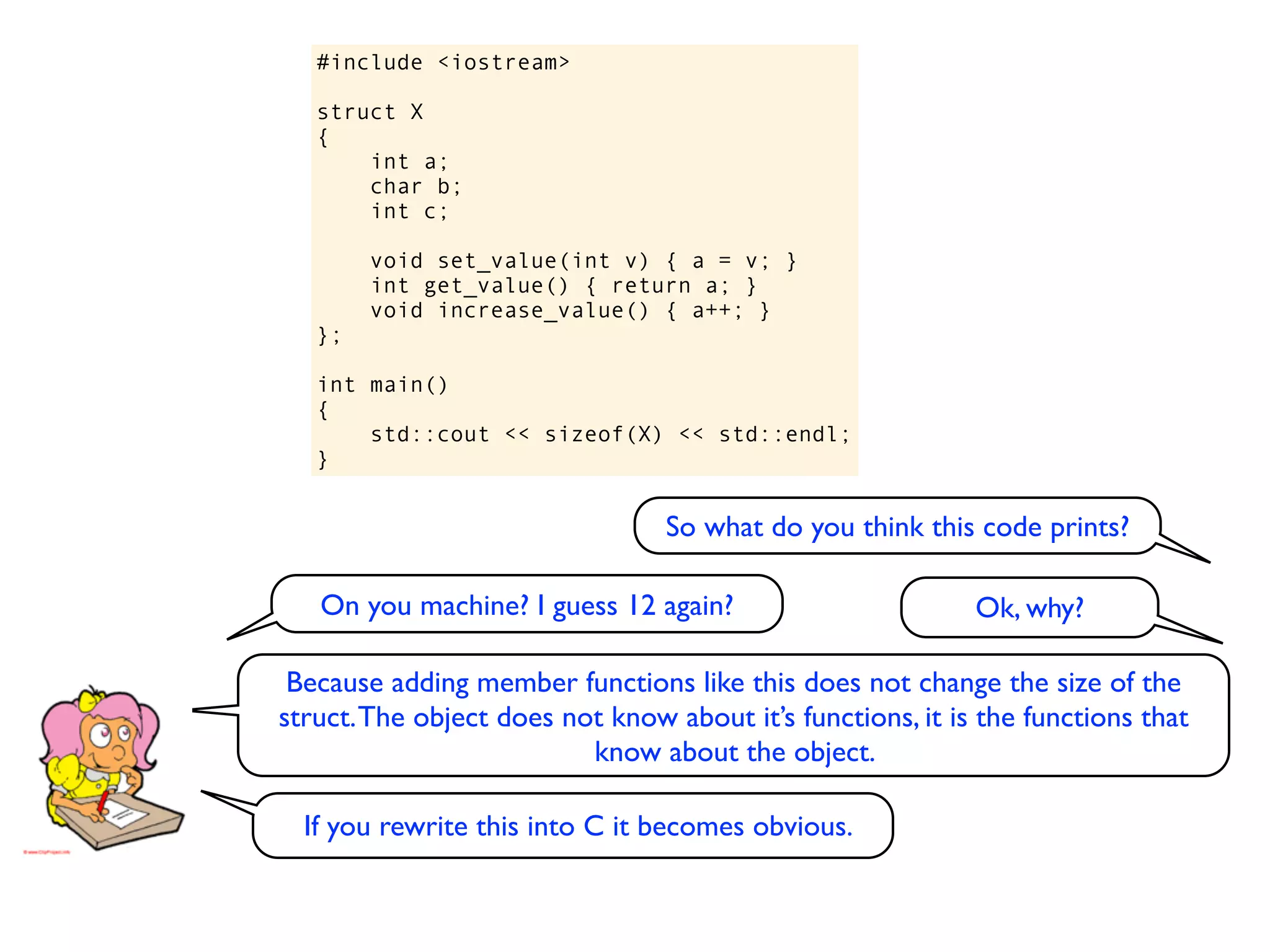
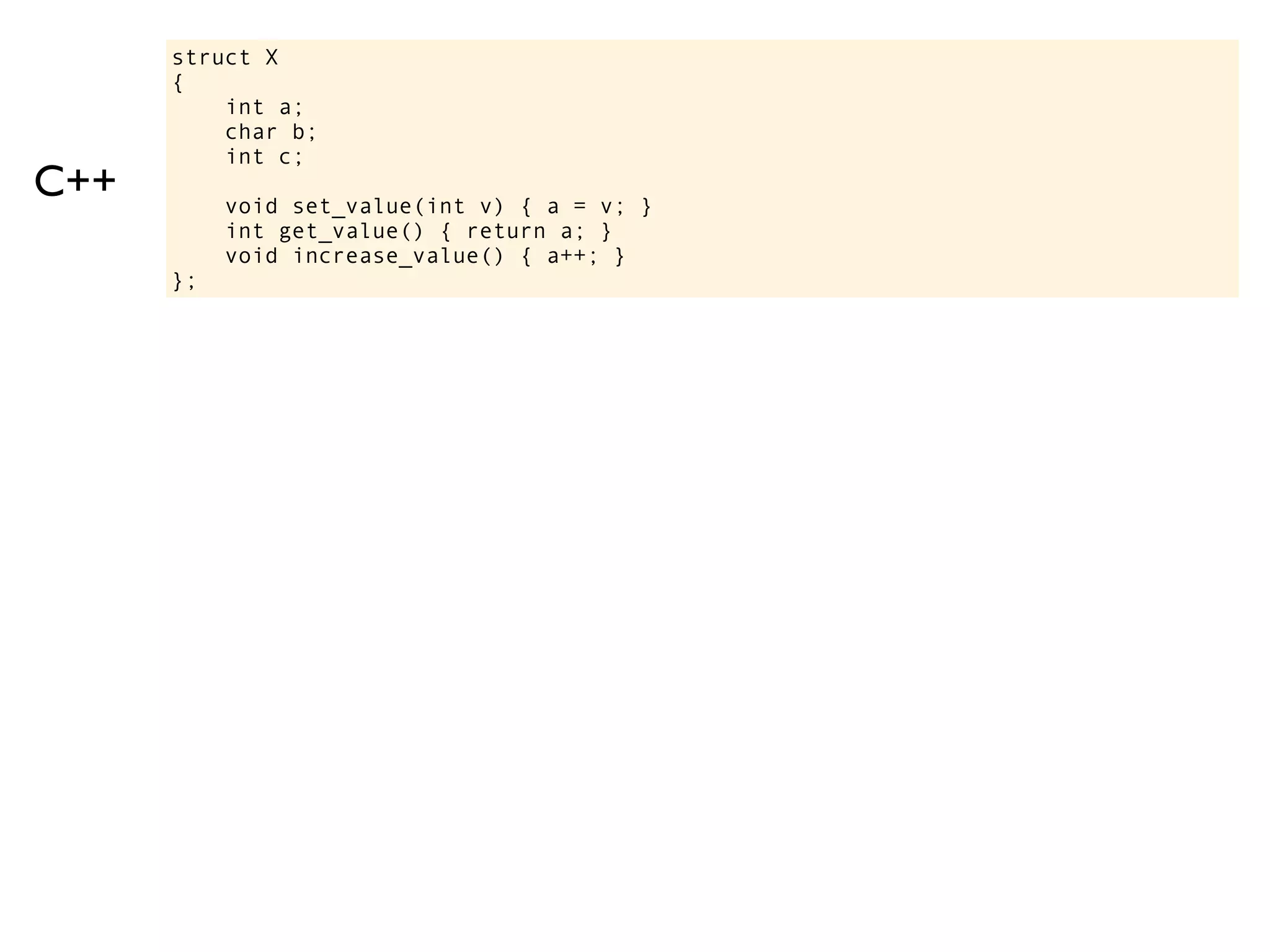
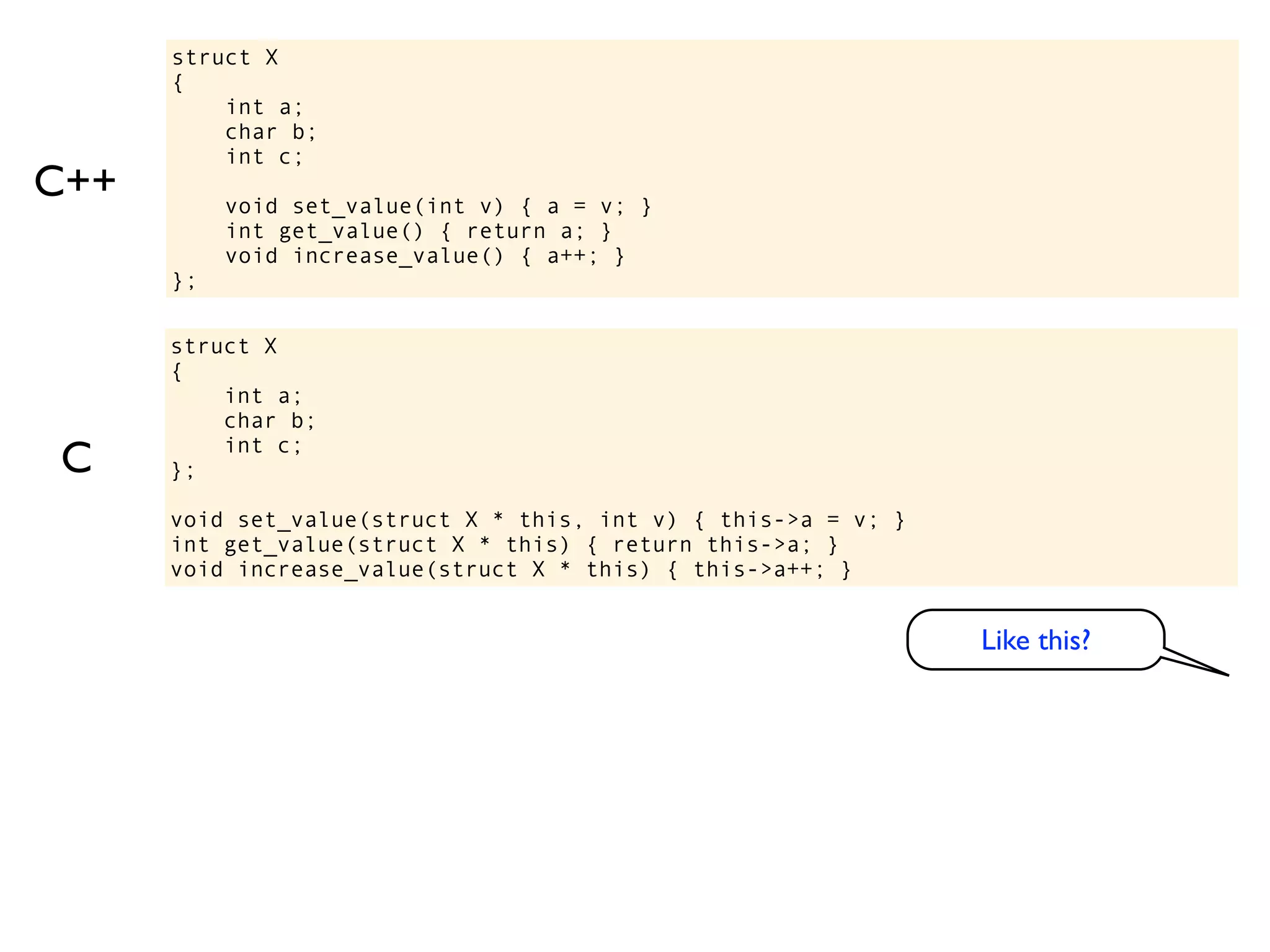
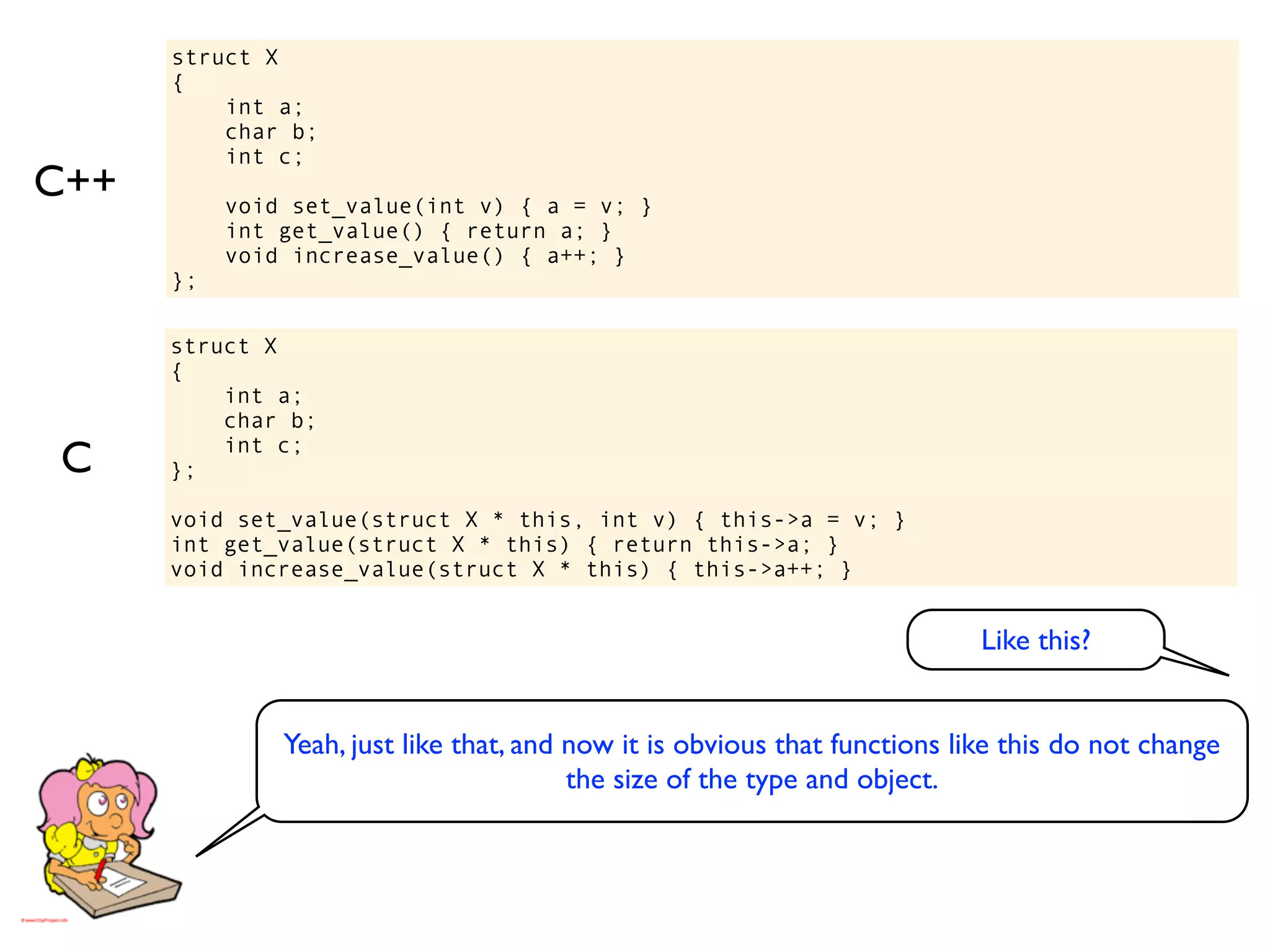
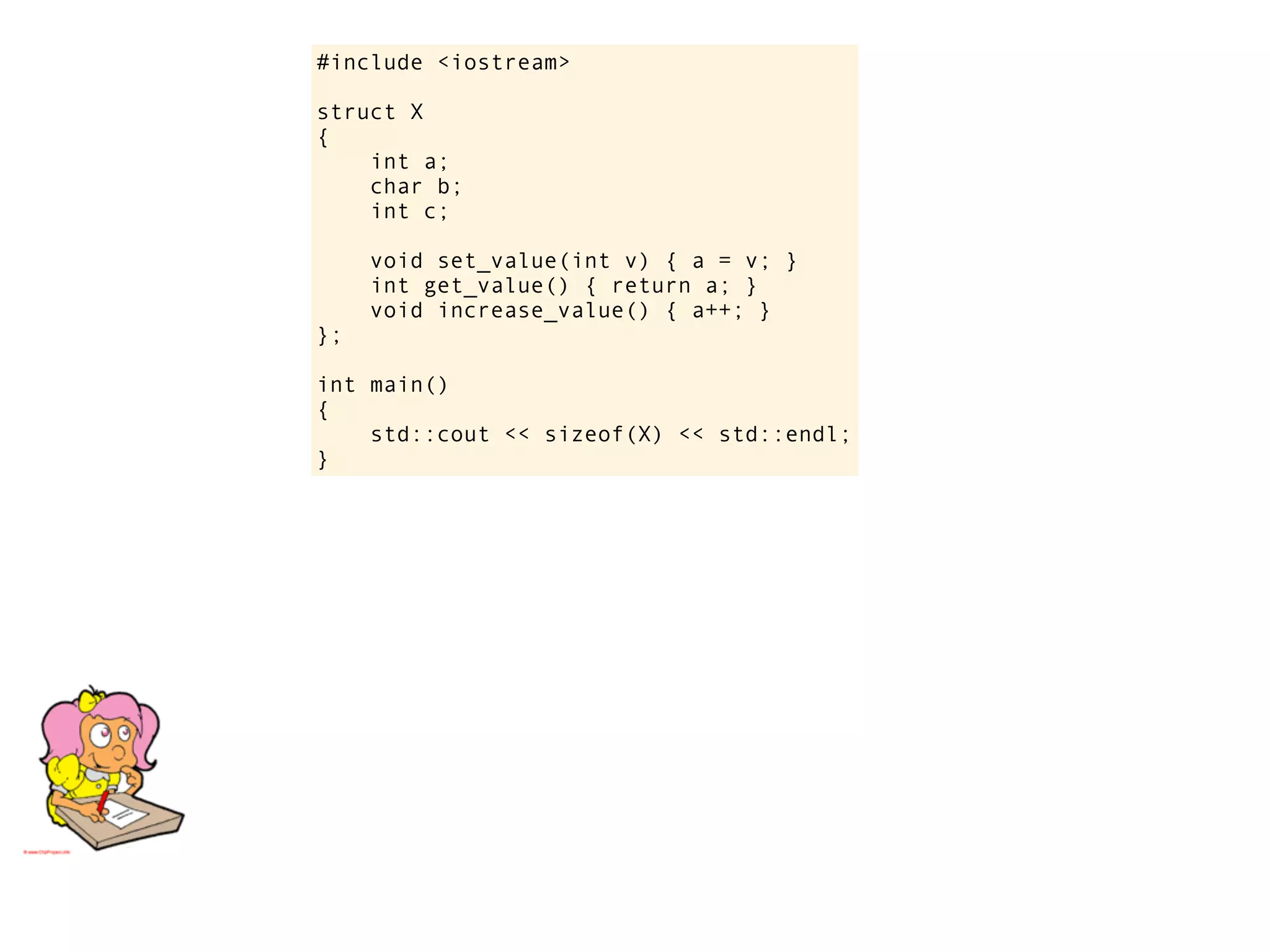
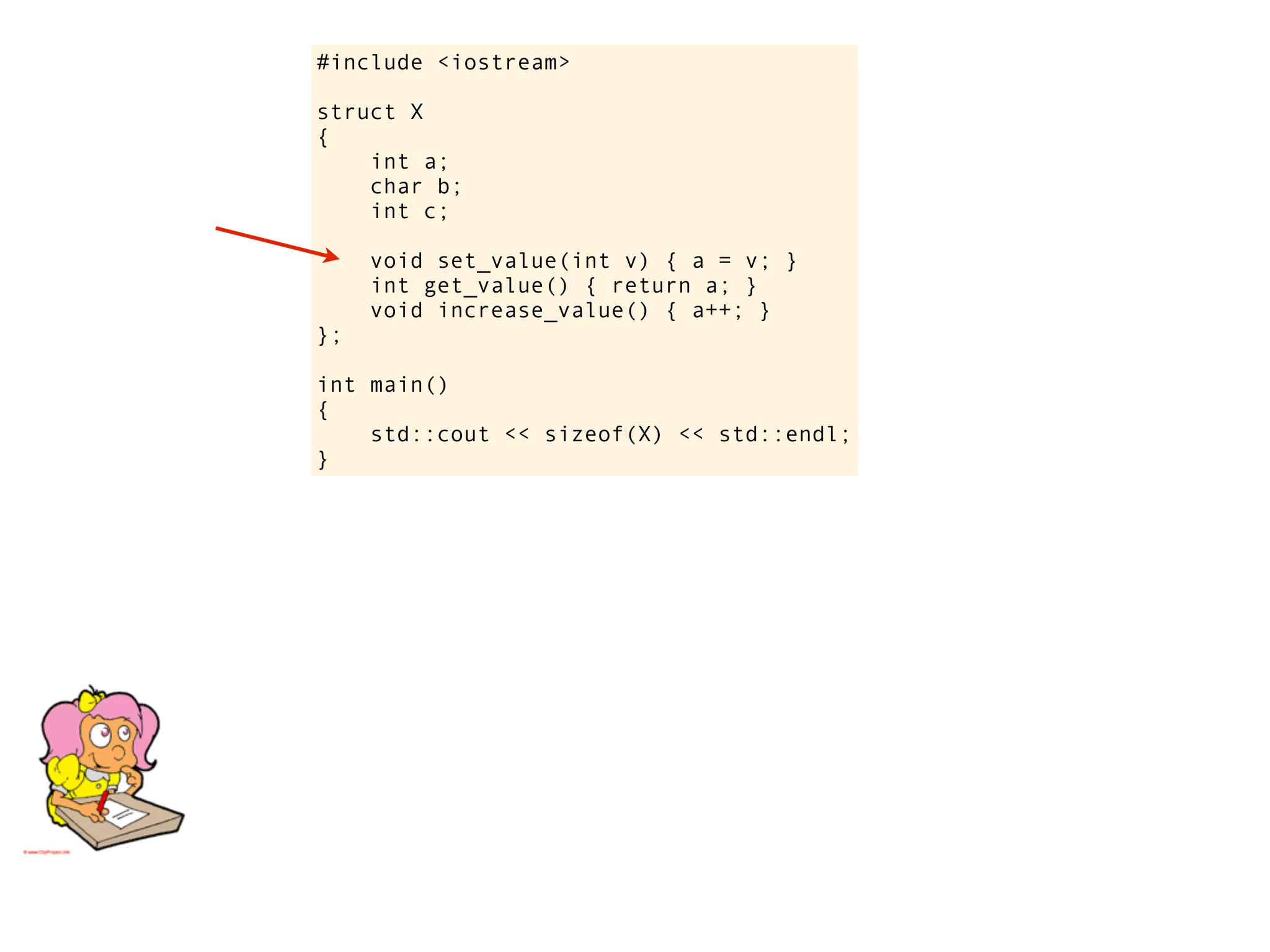

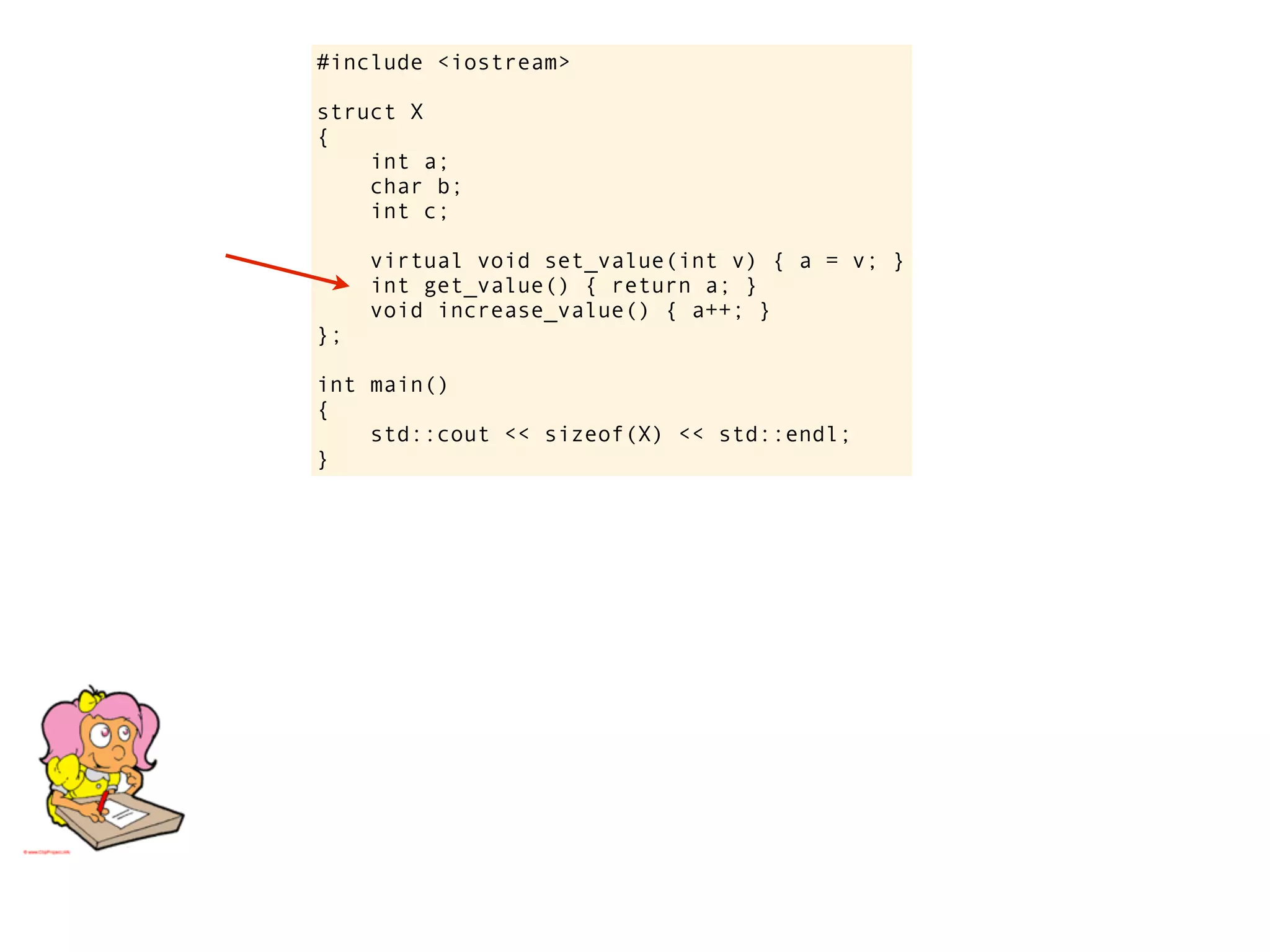
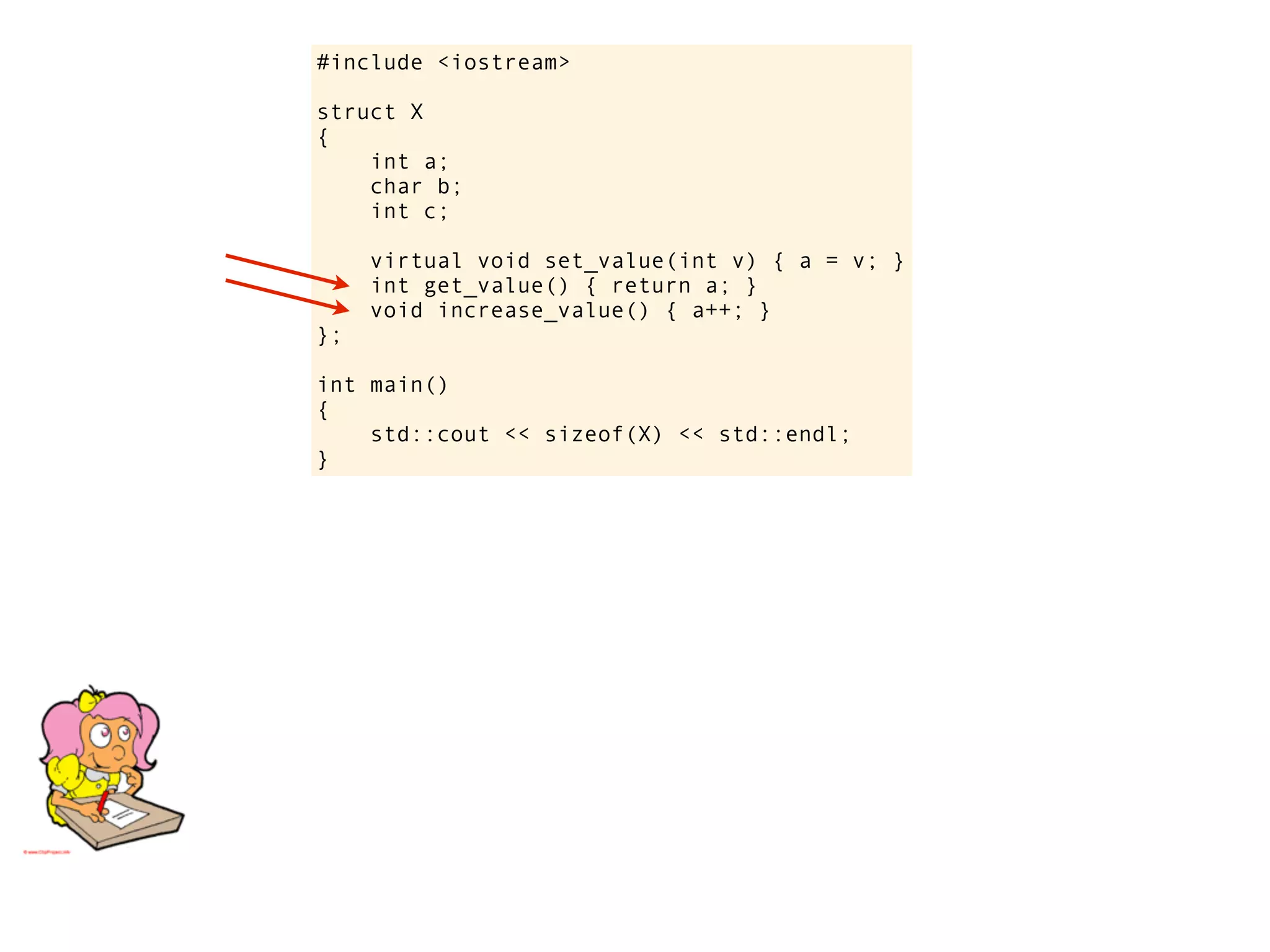
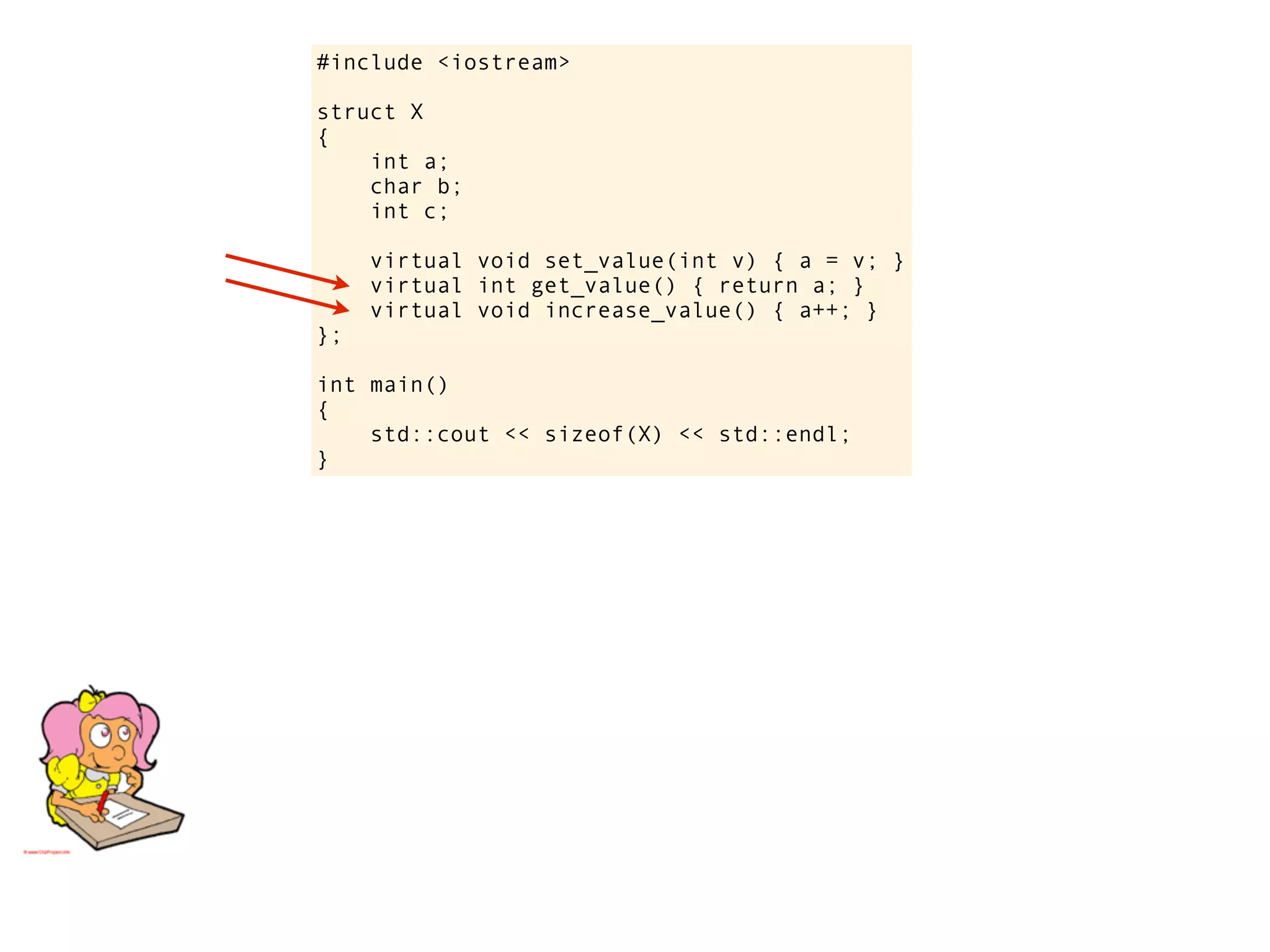
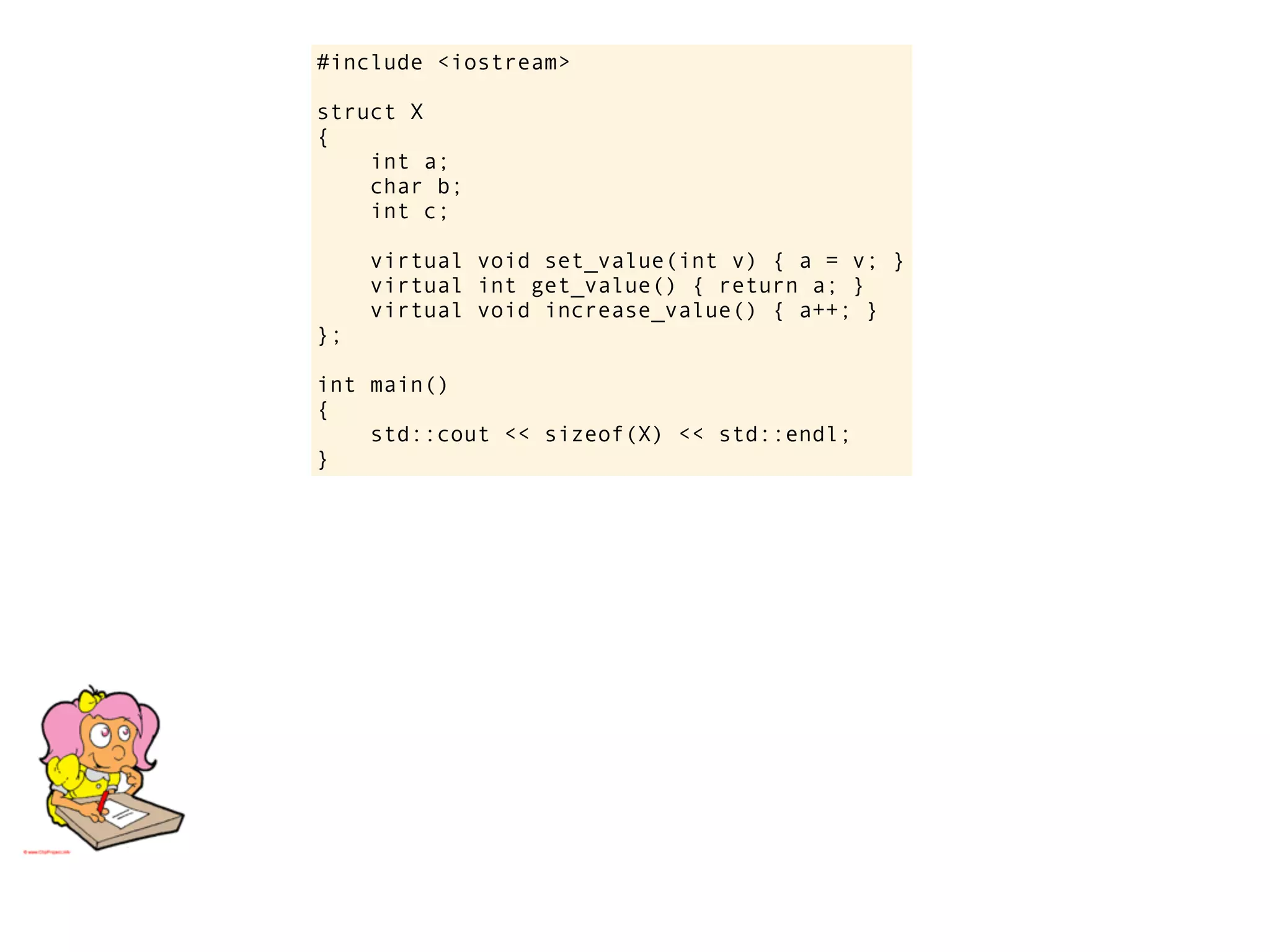
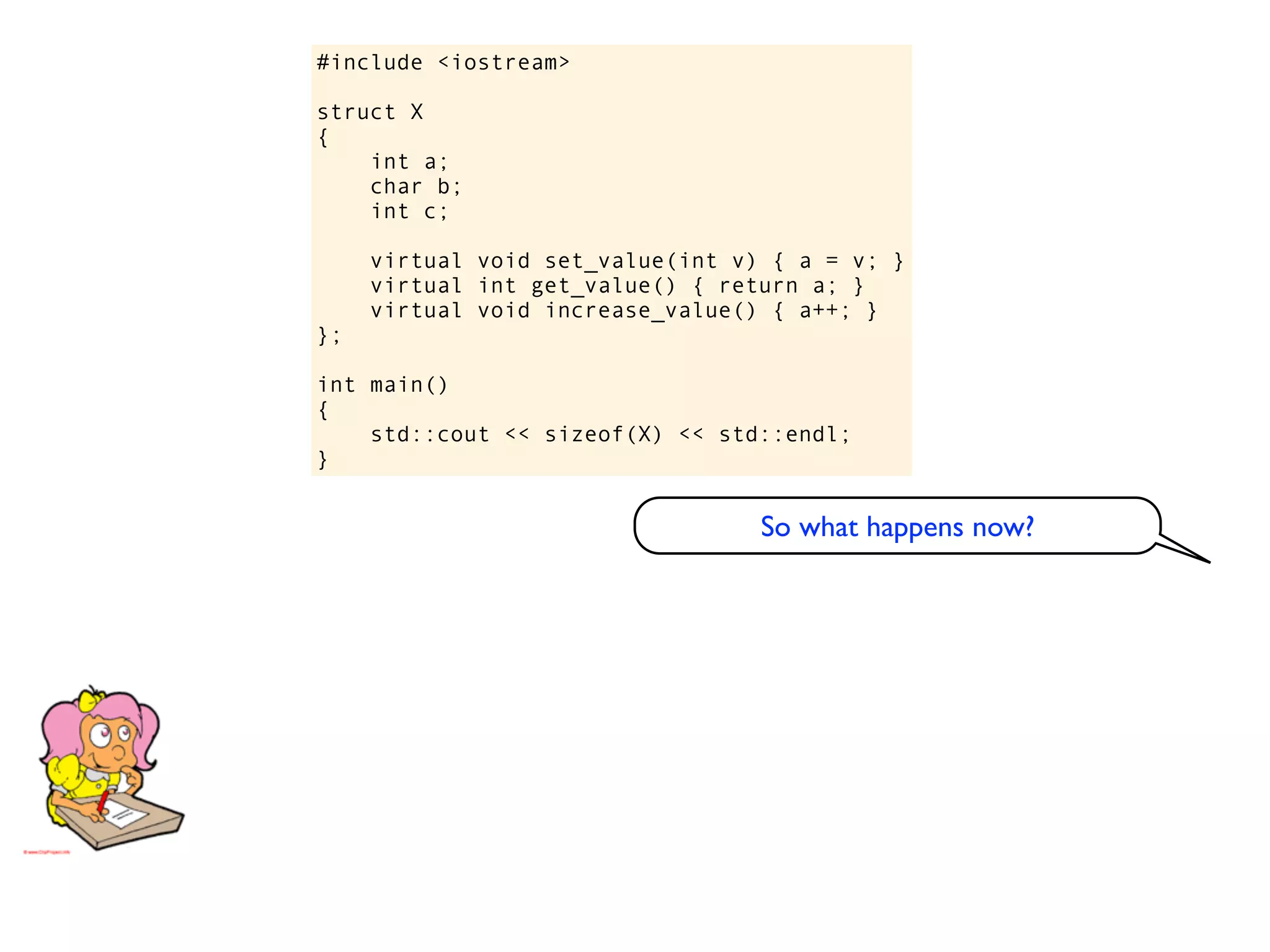
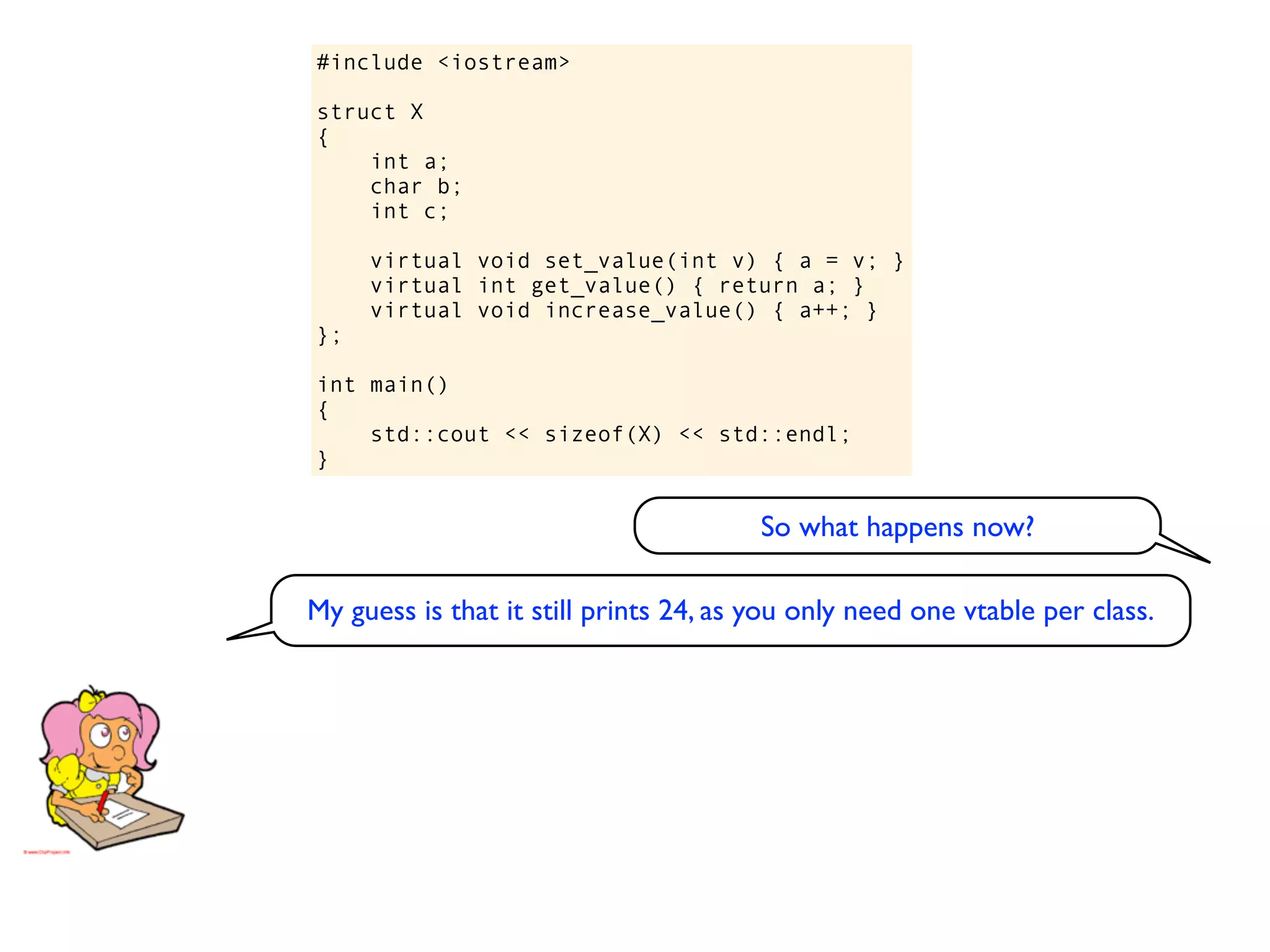

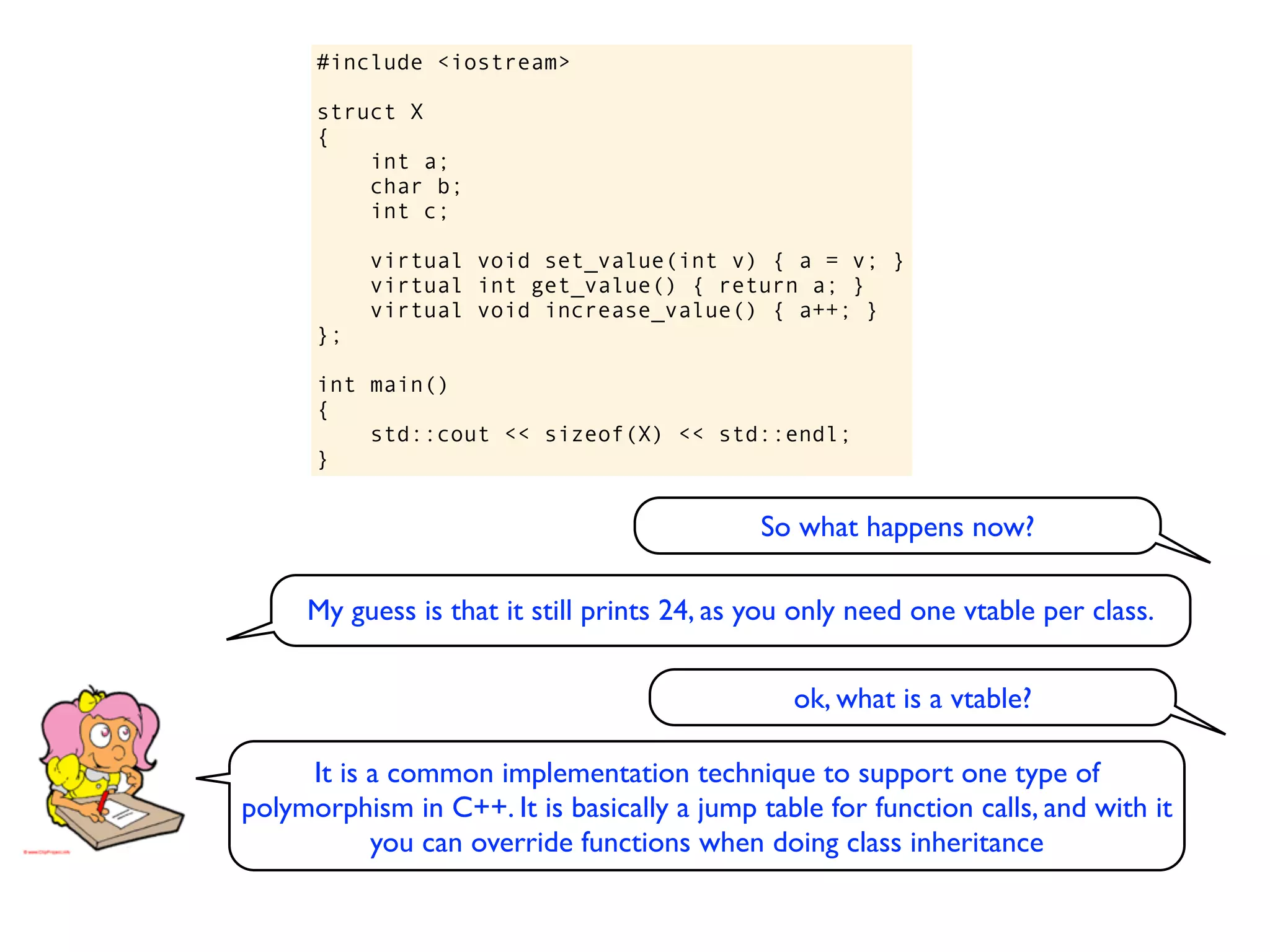
![#include "B.hpp"
class A {
public:
A(int sz) { sz_ = sz; v = new B[sz_]; }
~A() { delete v; }
// ...
private:
// ...
B * v;
int sz_;
};](https://image.slidesharecdn.com/deepcslidesoct2012-111010033910-phpapp01/75/Deep-C-314-2048.jpg)
![#include "B.hpp"
class A {
public:
A(int sz) { sz_ = sz; v = new B[sz_]; }
~A() { delete v; }
// ...
private:
// ...
B * v;
int sz_;
};
Take a look at this piece of code. Pretend like I am a junior C++ programmer
joining your team. Here is a piece of code that I might present to you. Please
be pedantic and try to gently introduce me to pitfalls of C++ and perhaps
teach me something about the C++ way of doing things.](https://image.slidesharecdn.com/deepcslidesoct2012-111010033910-phpapp01/75/Deep-C-315-2048.jpg)
![#include "B.hpp"
class A {
public:
A(int sz) { sz_ = sz; v = new B[sz_]; }
~A() { delete v; }
// ...
private:
// ...
B * v;
int sz_;
};
Take a look at this piece of code. Pretend like I am a junior C++ programmer
joining your team. Here is a piece of code that I might present to you. Please
be pedantic and try to gently introduce me to pitfalls of C++ and perhaps
teach me something about the C++ way of doing things.](https://image.slidesharecdn.com/deepcslidesoct2012-111010033910-phpapp01/75/Deep-C-316-2048.jpg)
![#include "B.hpp"
class A {
public:
A(int sz) { sz_ = sz; v = new B[sz_]; }
~A() { delete v; }
// ...
private:
// ...
B * v;
int sz_;
};
Take a look at this piece of code. Pretend like I am a junior C++ programmer
joining your team. Here is a piece of code that I might present to you. Please
be pedantic and try to gently introduce me to pitfalls of C++ and perhaps
teach me something about the C++ way of doing things.
This is a piece of shitty C++ code. Is this your code? First of all....](https://image.slidesharecdn.com/deepcslidesoct2012-111010033910-phpapp01/75/Deep-C-317-2048.jpg)
![#include "B.hpp"
class A {
public:
A(int sz) { sz_ = sz; v = new B[sz_]; }
~A() { delete v; }
// ...
private:
// ...
B * v;
int sz_;
};
Take a look at this piece of code. Pretend like I am a junior C++ programmer
joining your team. Here is a piece of code that I might present to you. Please
be pedantic and try to gently introduce me to pitfalls of C++ and perhaps
teach me something about the C++ way of doing things.
This is a piece of shitty C++ code. Is this your code? First of all....
never use 2 spaces for indentation.](https://image.slidesharecdn.com/deepcslidesoct2012-111010033910-phpapp01/75/Deep-C-318-2048.jpg)
![#include "B.hpp"
class A {
public:
A(int sz) { sz_ = sz; v = new B[sz_]; }
~A() { delete v; }
// ...
private:
// ...
B * v;
int sz_;
};
Take a look at this piece of code. Pretend like I am a junior C++ programmer
joining your team. Here is a piece of code that I might present to you. Please
be pedantic and try to gently introduce me to pitfalls of C++ and perhaps
teach me something about the C++ way of doing things.
This is a piece of shitty C++ code. Is this your code? First of all....
never use 2 spaces for indentation.
The curly brace after class A should definitely start on a new line](https://image.slidesharecdn.com/deepcslidesoct2012-111010033910-phpapp01/75/Deep-C-319-2048.jpg)
![#include "B.hpp"
class A {
public:
A(int sz) { sz_ = sz; v = new B[sz_]; }
~A() { delete v; }
// ...
private:
// ...
B * v;
int sz_;
};
Take a look at this piece of code. Pretend like I am a junior C++ programmer
joining your team. Here is a piece of code that I might present to you. Please
be pedantic and try to gently introduce me to pitfalls of C++ and perhaps
teach me something about the C++ way of doing things.
This is a piece of shitty C++ code. Is this your code? First of all....
never use 2 spaces for indentation.
The curly brace after class A should definitely start on a new line
sz_? I have never seen that naming convention, you should always use the GoF
standard _sz or the Microsoft standard m_sz.](https://image.slidesharecdn.com/deepcslidesoct2012-111010033910-phpapp01/75/Deep-C-320-2048.jpg)
![#include "B.hpp"
class A {
public:
A(int sz) { sz_ = sz; v = new B[sz_]; }
~A() { delete v; }
// ...
private:
// ...
B * v;
int sz_;
};](https://image.slidesharecdn.com/deepcslidesoct2012-111010033910-phpapp01/75/Deep-C-321-2048.jpg)
![#include "B.hpp"
class A {
public:
A(int sz) { sz_ = sz; v = new B[sz_]; }
~A() { delete v; }
// ...
private:
// ...
B * v;
int sz_;
};
Do you see anything else?](https://image.slidesharecdn.com/deepcslidesoct2012-111010033910-phpapp01/75/Deep-C-322-2048.jpg)
![#include "B.hpp"
class A {
public:
A(int sz) { sz_ = sz; v = new B[sz_]; }
~A() { delete v; }
// ...
private:
// ...
B * v;
int sz_;
};
Do you see anything else?
eh?](https://image.slidesharecdn.com/deepcslidesoct2012-111010033910-phpapp01/75/Deep-C-323-2048.jpg)
![#include "B.hpp"
class A {
public:
A(int sz) { sz_ = sz; v = new B[sz_]; }
~A() { delete v; }
// ...
private:
// ...
B * v;
int sz_;
};
Do you see anything else?
eh? Are you thinking about using ‘delete[]’ instead of ‘delete’ when
deleting an array of objects? Well, I am experienced enough to know
that it is not really needed, modern compilers will handle that.](https://image.slidesharecdn.com/deepcslidesoct2012-111010033910-phpapp01/75/Deep-C-324-2048.jpg)
![#include "B.hpp"
class A {
public:
A(int sz) { sz_ = sz; v = new B[sz_]; }
~A() { delete v; }
// ...
private:
// ...
B * v;
int sz_;
};
Do you see anything else?
eh? Are you thinking about using ‘delete[]’ instead of ‘delete’ when
deleting an array of objects? Well, I am experienced enough to know
that it is not really needed, modern compilers will handle that.
Ok? What about the “rule of three”? Do you need
to support or disable copying of this object?](https://image.slidesharecdn.com/deepcslidesoct2012-111010033910-phpapp01/75/Deep-C-325-2048.jpg)
![#include "B.hpp"
class A {
public:
A(int sz) { sz_ = sz; v = new B[sz_]; }
~A() { delete v; }
// ...
private:
// ...
B * v;
int sz_;
};
Do you see anything else?
eh? Are you thinking about using ‘delete[]’ instead of ‘delete’ when
deleting an array of objects? Well, I am experienced enough to know
that it is not really needed, modern compilers will handle that.
Ok? What about the “rule of three”? Do you need
to support or disable copying of this object?
Yeah, whatever... never heard of the tree-rule but of course if people copy this
object they might get problems. But I guess that is the spirit of C++... give
programmers a really hard time.](https://image.slidesharecdn.com/deepcslidesoct2012-111010033910-phpapp01/75/Deep-C-326-2048.jpg)
![#include "B.hpp"
class A {
public:
A(int sz) { sz_ = sz; v = new B[sz_]; }
~A() { delete v; }
// ...
private:
// ...
B * v;
int sz_;
};](https://image.slidesharecdn.com/deepcslidesoct2012-111010033910-phpapp01/75/Deep-C-327-2048.jpg)
![#include "B.hpp"
class A {
public:
A(int sz) { sz_ = sz; v = new B[sz_]; }
~A() { delete v; }
// ...
private:
// ...
B * v;
int sz_;
};
And by the way, I guess you know that in C++ all destructors should
always be declared as virtual. I read it in some book and it is very
important to avoid slicing when deleting objects of subtypes.](https://image.slidesharecdn.com/deepcslidesoct2012-111010033910-phpapp01/75/Deep-C-328-2048.jpg)
![#include "B.hpp"
class A {
public:
A(int sz) { sz_ = sz; v = new B[sz_]; }
~A() { delete v; }
// ...
private:
// ...
B * v;
int sz_;
};
And by the way, I guess you know that in C++ all destructors should
always be declared as virtual. I read it in some book and it is very
important to avoid slicing when deleting objects of subtypes.
or something like that...](https://image.slidesharecdn.com/deepcslidesoct2012-111010033910-phpapp01/75/Deep-C-329-2048.jpg)
![#include "B.hpp"
class A {
public:
A(int sz) { sz_ = sz; v = new B[sz_]; }
~A() { delete v; }
// ...
private:
// ...
B * v;
int sz_;
};
And by the way, I guess you know that in C++ all destructors should
always be declared as virtual. I read it in some book and it is very
important to avoid slicing when deleting objects of subtypes.
or something like that...
another ice cream perhaps?](https://image.slidesharecdn.com/deepcslidesoct2012-111010033910-phpapp01/75/Deep-C-330-2048.jpg)
![#include "B.hpp"
class A {
public:
A(int sz) { sz_ = sz; v = new B[sz_]; }
~A() { delete v; }
// ...
private:
// ...
B * v;
int sz_;
};](https://image.slidesharecdn.com/deepcslidesoct2012-111010033910-phpapp01/75/Deep-C-331-2048.jpg)
![#include "B.hpp"
class A {
public:
A(int sz) { sz_ = sz; v = new B[sz_]; }
~A() { delete v; }
// ...
private:
// ...
B * v;
int sz_;
};
Take a look at this piece of code. Pretend like I am a junior C++ programmer
joining your team. Here is a piece of code that I might present to you. Please
be pedantic and try to gently introduce me to pitfalls of C++ and perhaps
teach me something about the C++ way of doing things.](https://image.slidesharecdn.com/deepcslidesoct2012-111010033910-phpapp01/75/Deep-C-332-2048.jpg)
![#include "B.hpp"
class A {
public:
A(int sz) { sz_ = sz; v = new B[sz_]; }
~A() { delete v; }
// ...
private:
// ...
B * v;
int sz_;
};
Take a look at this piece of code. Pretend like I am a junior C++ programmer
joining your team. Here is a piece of code that I might present to you. Please
be pedantic and try to gently introduce me to pitfalls of C++ and perhaps
teach me something about the C++ way of doing things.
Oh, where should I start... let’s focus on the most important stuff first](https://image.slidesharecdn.com/deepcslidesoct2012-111010033910-phpapp01/75/Deep-C-333-2048.jpg)
![#include "B.hpp"
class A {
public:
A(int sz) { sz_ = sz; v = new B[sz_]; }
~A() { delete v; }
// ...
private:
// ...
B * v;
int sz_;
};
Take a look at this piece of code. Pretend like I am a junior C++ programmer
joining your team. Here is a piece of code that I might present to you. Please
be pedantic and try to gently introduce me to pitfalls of C++ and perhaps
teach me something about the C++ way of doing things.
Oh, where should I start... let’s focus on the most important stuff first
In the destructor. If you use operator new[] you should destroy with operator
delete[]. With operator delete[] the allocated memory will be deallocated after the
destructor for every object in the array will be called. Eg, as it stands now, the B
constructor will be called sz times, but the B destructor will only be called once. In
this case, bad things will happen if B allocates resources that need to be released in
its destructor.](https://image.slidesharecdn.com/deepcslidesoct2012-111010033910-phpapp01/75/Deep-C-334-2048.jpg)
![#include "B.hpp"
class A {
public:
A(int sz) { sz_ = sz; v = new B[sz_]; }
~A() { delete v; }
// ...
private:
// ...
B * v;
int sz_;
};
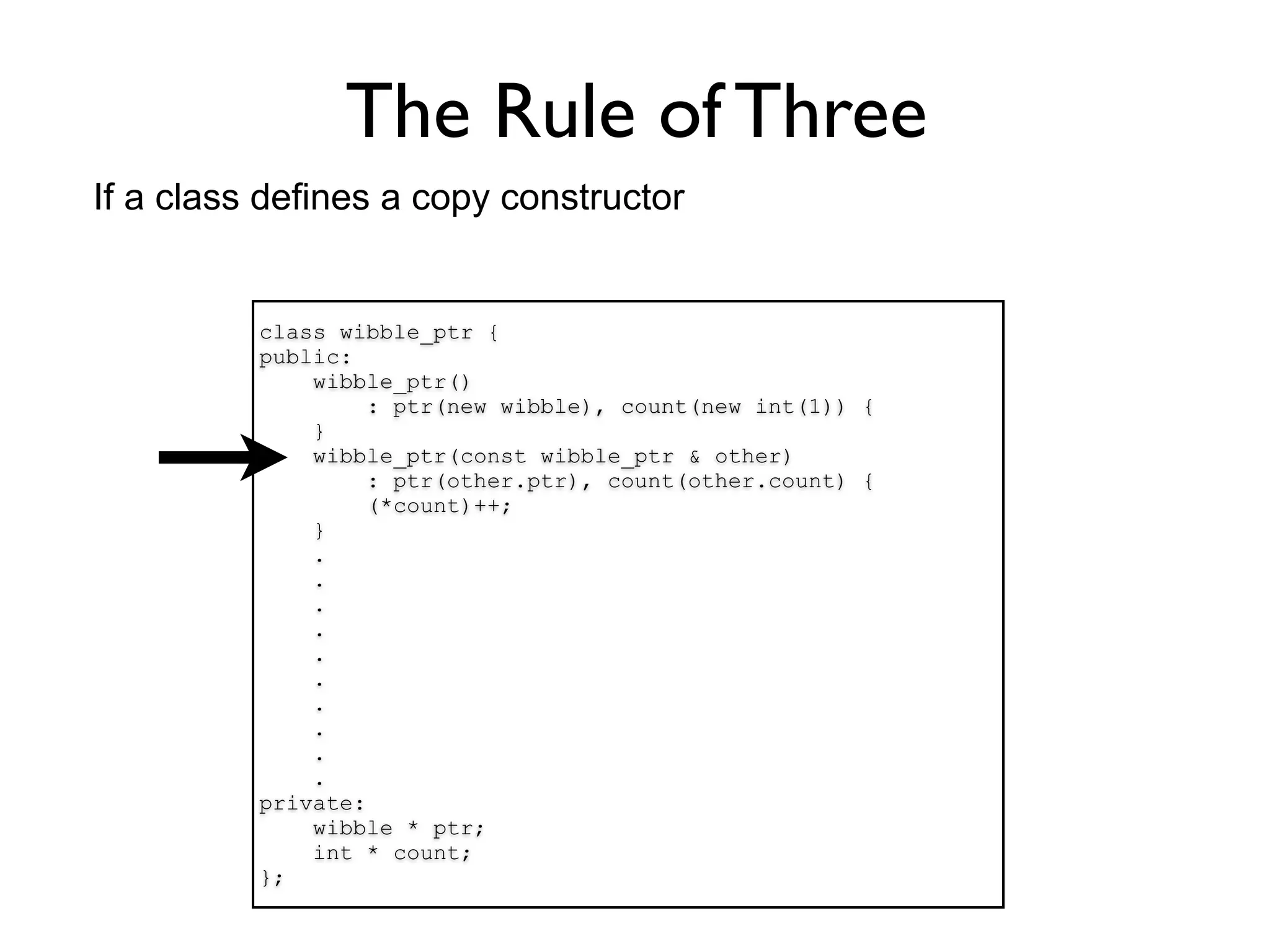
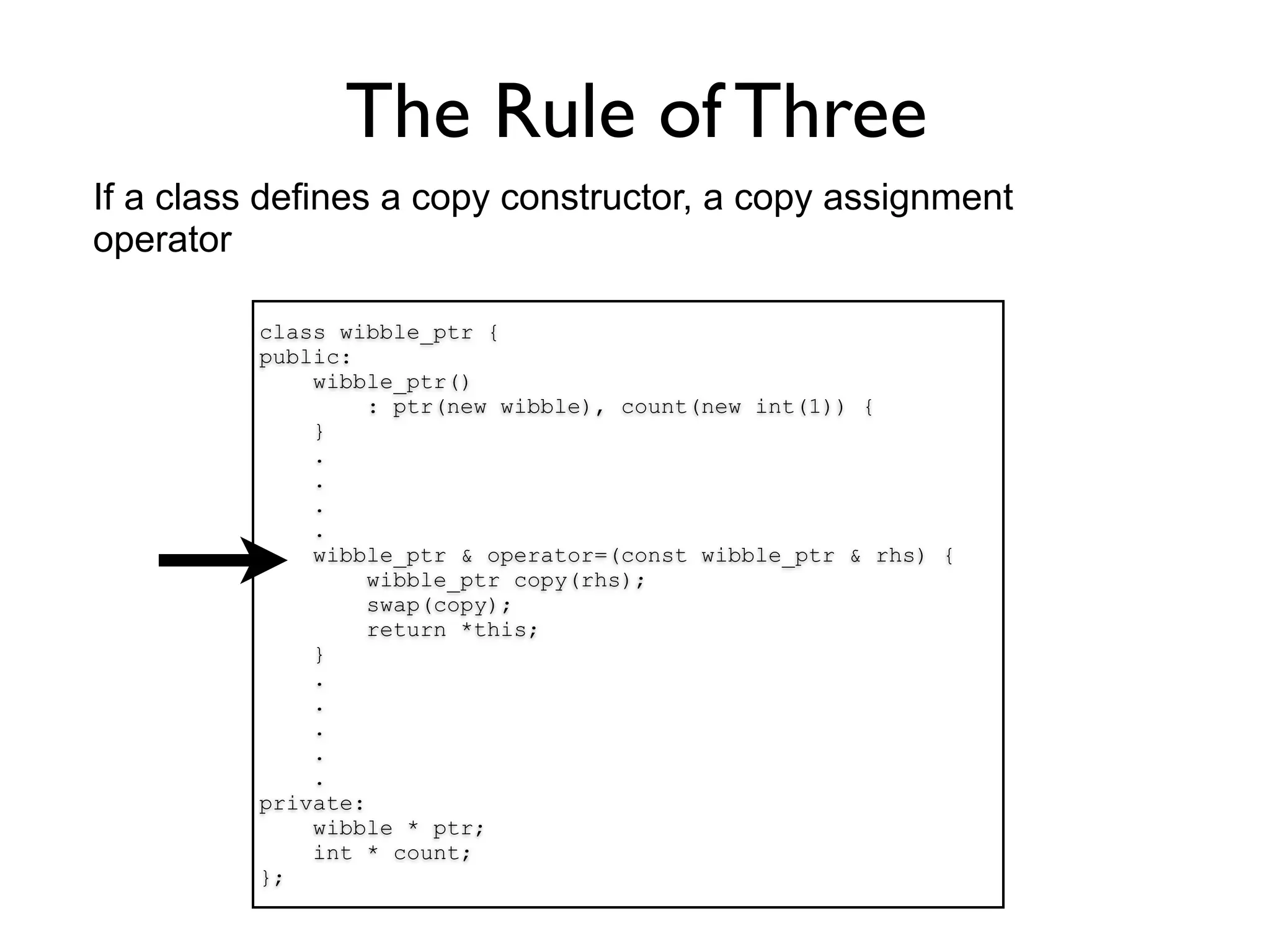
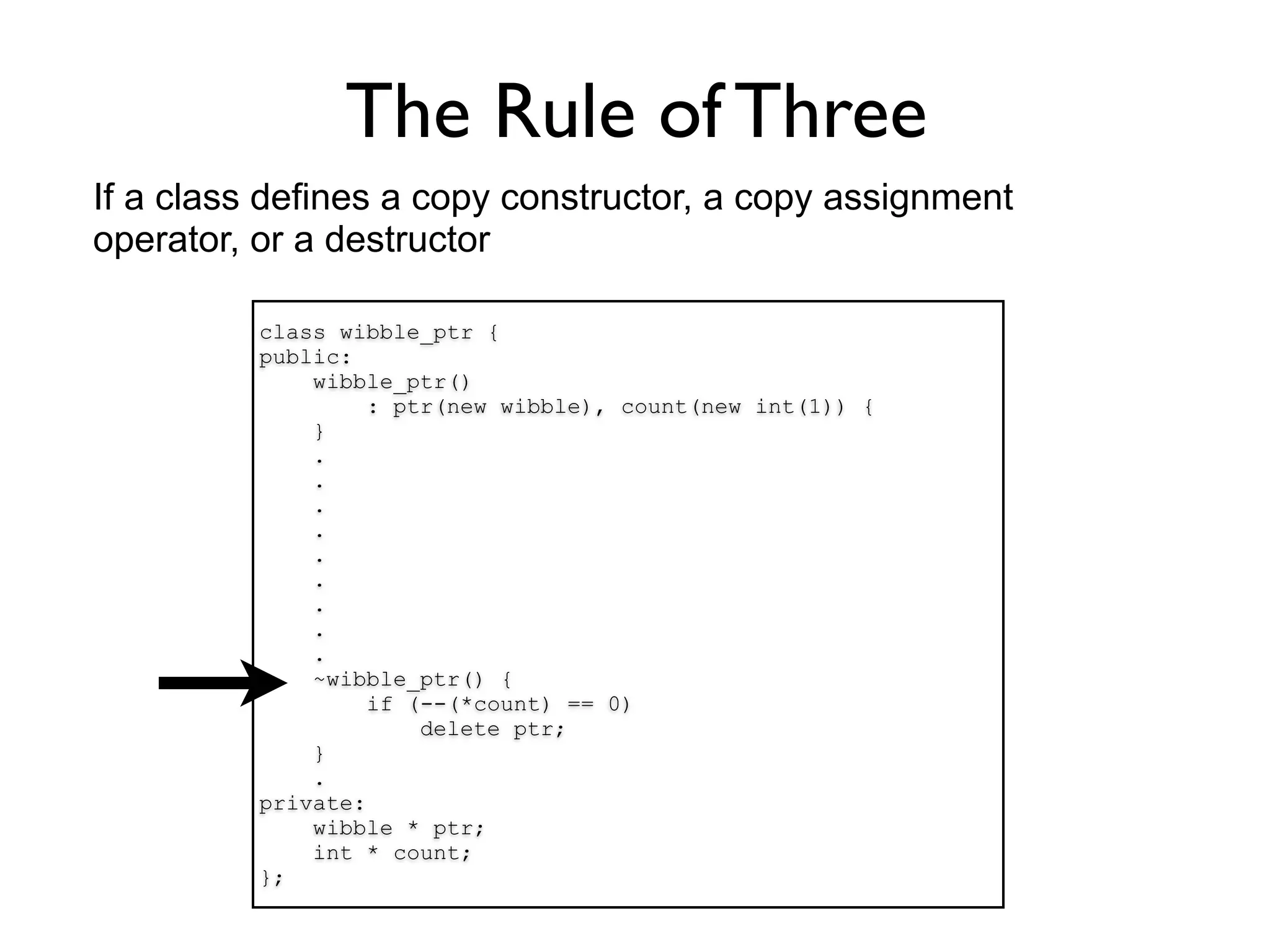
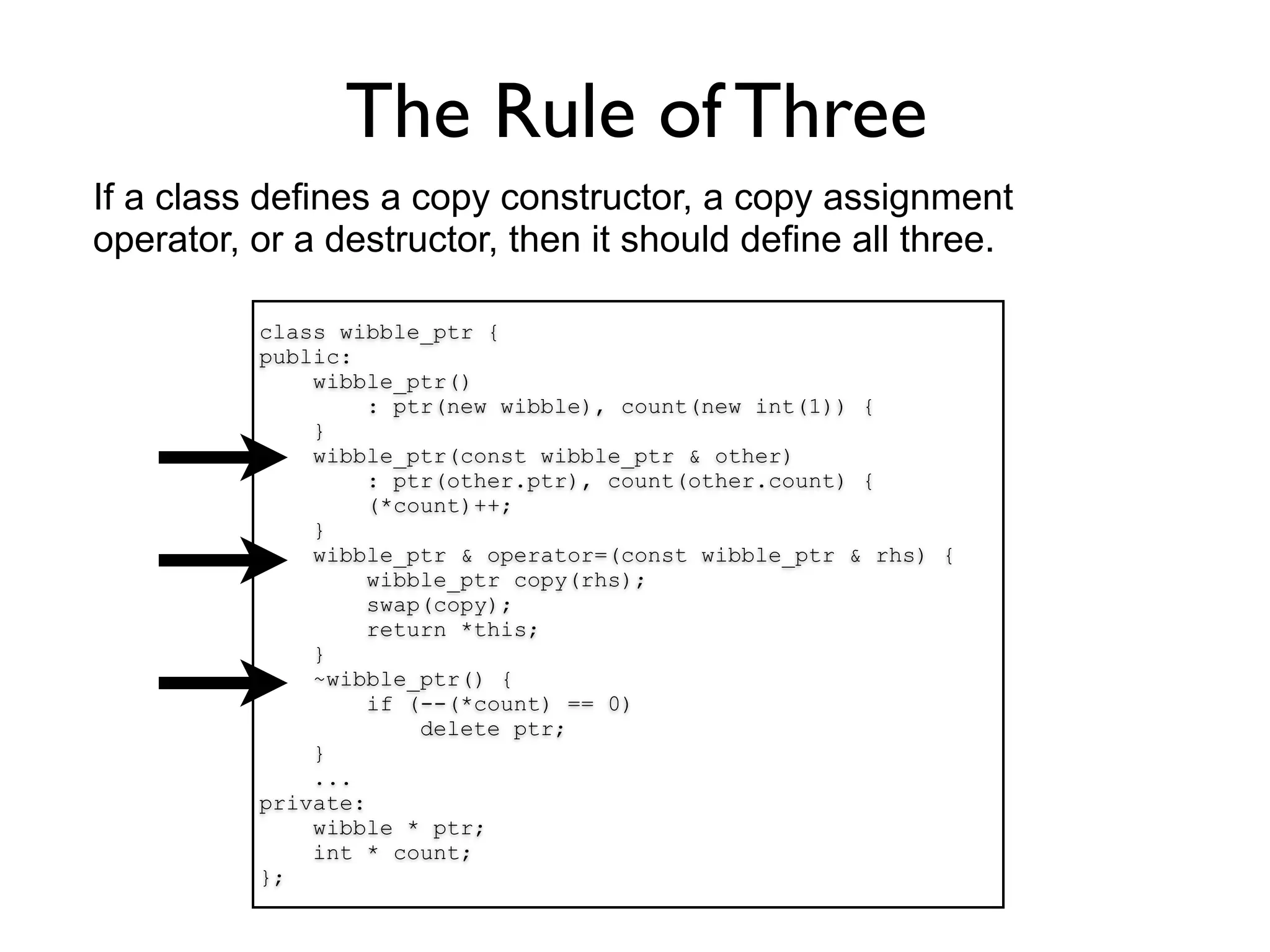
And the next thing is the often referred to as the “rule of three”. If you need a
destructor, you probably also need to either implement or disable the copy
constructor and the assignment operator, the default ones created by the
compiler are probably not correct.](https://image.slidesharecdn.com/deepcslidesoct2012-111010033910-phpapp01/75/Deep-C-335-2048.jpg)
![#include "B.hpp"
class A {
public:
A(int sz) { sz_ = sz; v = new B[sz_]; }
~A() { delete v; }
// ...
private:
// ...
B * v;
int sz_;
};
And the next thing is the often referred to as the “rule of three”. If you need a
destructor, you probably also need to either implement or disable the copy
constructor and the assignment operator, the default ones created by the
compiler are probably not correct.
A perhaps smaller issue, but also important, is to use the member initializer list to
initialize an object. In the example above it does not really matter much, but when
member objects are more complex it makes sense to explicitly initialize the
members (using the initalizer list), rather than letting the object implicitly initialize all
its member objects to default values, and then assign them some particular value.](https://image.slidesharecdn.com/deepcslidesoct2012-111010033910-phpapp01/75/Deep-C-336-2048.jpg)
![#include "B.hpp"
class A {
public:
A(int sz) { sz_ = sz; v = new B[sz_]; }
~A() { delete v; }
// ...
private:
// ...
B * v;
int sz_;
};
And the next thing is the often referred to as the “rule of three”. If you need a
destructor, you probably also need to either implement or disable the copy
constructor and the assignment operator, the default ones created by the
compiler are probably not correct.
A perhaps smaller issue, but also important, is to use the member initializer list to
initialize an object. In the example above it does not really matter much, but when
member objects are more complex it makes sense to explicitly initialize the
members (using the initalizer list), rather than letting the object implicitly initialize all
its member objects to default values, and then assign them some particular value.
Please fix the code and I will tell you more...](https://image.slidesharecdn.com/deepcslidesoct2012-111010033910-phpapp01/75/Deep-C-337-2048.jpg)
![#include "B.hpp"
class A {
public:
A(int sz) { sz_ = sz; v = new B[sz_]; }
~A() { delete v; }
// ...
private:
// ...
B * v;
int sz_;
};](https://image.slidesharecdn.com/deepcslidesoct2012-111010033910-phpapp01/75/Deep-C-338-2048.jpg)
![#include "B.hpp"
class A {
public:
A(int sz) { sz_ = sz; v = new B[sz_]; }
~A() { delete[] v; }
// ...
private:
// ...
B * v;
int sz_;
};](https://image.slidesharecdn.com/deepcslidesoct2012-111010033910-phpapp01/75/Deep-C-339-2048.jpg)
![#include "B.hpp"
class A {
public:
A(int sz) { sz_ = sz; v = new B[sz_]; }
~A() { delete[] v; }
// ...
private:
// ...
B * v;
int sz_;
};](https://image.slidesharecdn.com/deepcslidesoct2012-111010033910-phpapp01/75/Deep-C-340-2048.jpg)
![#include "B.hpp"
class A {
public:
A(int sz) { sz_ = sz; v = new B[sz_]; }
~A() { delete[] v; }
// ...
private:
// ...
B * v;
int sz_;
};](https://image.slidesharecdn.com/deepcslidesoct2012-111010033910-phpapp01/75/Deep-C-341-2048.jpg)
![#include "B.hpp"
class A {
public:
A(int sz) { sz_ = sz; v = new B[sz_]; }
~A() { delete[] v; }
// ...
private:
// ...
B * v;
int sz_;
};](https://image.slidesharecdn.com/deepcslidesoct2012-111010033910-phpapp01/75/Deep-C-342-2048.jpg)
![#include "B.hpp"
class A {
public:
A(int sz) { sz_ = sz; v = new B[sz_]; }
~A() { delete[] v; }
// ...
private:
A(const A &);
A & operator=(const A &);
// ...
B * v;
int sz_;
};](https://image.slidesharecdn.com/deepcslidesoct2012-111010033910-phpapp01/75/Deep-C-343-2048.jpg)
![#include "B.hpp"
class A {
public:
A(int sz) { sz_ = sz; v = new B[sz_]; }
~A() { delete[] v; }
// ...
private:
A(const A &);
A & operator=(const A &);
// ...
B * v;
int sz_;
};
Better](https://image.slidesharecdn.com/deepcslidesoct2012-111010033910-phpapp01/75/Deep-C-344-2048.jpg)
![#include "B.hpp"
class A {
public:
A(int sz) { sz_ = sz; v = new B[sz_]; }
~A() { delete[] v; }
// ...
private:
A(const A &);
A & operator=(const A &);
// ...
B * v;
int sz_;
};](https://image.slidesharecdn.com/deepcslidesoct2012-111010033910-phpapp01/75/Deep-C-345-2048.jpg)
![#include "B.hpp"
class A {
public:
A(int sz) { sz_ = sz; v = new B[sz_]; }
virtual ~A() { delete[] v; }
// ...
private:
A(const A &);
A & operator=(const A &);
// ...
B * v;
int sz_;
};](https://image.slidesharecdn.com/deepcslidesoct2012-111010033910-phpapp01/75/Deep-C-346-2048.jpg)
![#include "B.hpp"
class A {
public:
A(int sz) { sz_ = sz; v = new B[sz_]; }
virtual ~A() { delete[] v; }
// ...
private:
A(const A &);
A & operator=(const A &);
// ...
B * v;
int sz_;
};
nah, nah, nah... hold your horses](https://image.slidesharecdn.com/deepcslidesoct2012-111010033910-phpapp01/75/Deep-C-347-2048.jpg)
![#include "B.hpp"
class A {
public:
A(int sz) { sz_ = sz; v = new B[sz_]; }
virtual ~A() { delete[] v; }
// ...
private:
A(const A &);
A & operator=(const A &);
// ...
B * v;
int sz_;
};
nah, nah, nah... hold your horses
What is the point of having a virtual destructor on a class like this?
There are no virtual functions so it does not make sense to inherit
from it. I know that there are programmers who do inherit from
non-virtual classes, but I suspect they have misunderstood a key
concept of object orientation. I suggest you remove the virtual
specifier from the destructor, it indicates that the class is designed
to be used as a base class - while it obviously is not.](https://image.slidesharecdn.com/deepcslidesoct2012-111010033910-phpapp01/75/Deep-C-348-2048.jpg)
![#include "B.hpp"
class A {
public:
A(int sz) { sz_ = sz; v = new B[sz_]; }
virtual ~A() { delete[] v; }
// ...
private:
A(const A &);
A & operator=(const A &);
// ...
B * v;
int sz_;
};
nah, nah, nah... hold your horses
What is the point of having a virtual destructor on a class like this?
There are no virtual functions so it does not make sense to inherit
from it. I know that there are programmers who do inherit from
non-virtual classes, but I suspect they have misunderstood a key
concept of object orientation. I suggest you remove the virtual
specifier from the destructor, it indicates that the class is designed
to be used as a base class - while it obviously is not.
why don’t you fix the initializer list issue instead](https://image.slidesharecdn.com/deepcslidesoct2012-111010033910-phpapp01/75/Deep-C-349-2048.jpg)
![#include "B.hpp"
class A {
public:
A(int sz) { sz_ = sz; v = new B[sz_]; }
virtual ~A() { delete[] v; }
// ...
private:
A(const A &);
A & operator=(const A &);
// ...
B * v;
int sz_;
};](https://image.slidesharecdn.com/deepcslidesoct2012-111010033910-phpapp01/75/Deep-C-350-2048.jpg)
![#include "B.hpp"
class A {
public:
A(int sz) { sz_ = sz; v = new B[sz_]; }
~A() { delete[] v; }
// ...
private:
A(const A &);
A & operator=(const A &);
// ...
B * v;
int sz_;
};](https://image.slidesharecdn.com/deepcslidesoct2012-111010033910-phpapp01/75/Deep-C-351-2048.jpg)
![#include "B.hpp"
class A {
public:
A(int sz) { sz_ = sz; v = new B[sz_]; }
~A() { delete[] v; }
// ...
private:
A(const A &);
A & operator=(const A &);
// ...
B * v;
int sz_;
};](https://image.slidesharecdn.com/deepcslidesoct2012-111010033910-phpapp01/75/Deep-C-352-2048.jpg)
![#include "B.hpp"
class A {
public:
A(int sz) : sz_(sz) { sz_ = sz; v = new B[sz_]; }
~A() { delete[] v; }
// ...
private:
A(const A &);
A & operator=(const A &);
// ...
B * v;
int sz_;
};](https://image.slidesharecdn.com/deepcslidesoct2012-111010033910-phpapp01/75/Deep-C-353-2048.jpg)
![#include "B.hpp"
class A {
public:
A(int sz) : sz_(sz) { v = new B[sz_]; }
~A() { delete[] v; }
// ...
private:
A(const A &);
A & operator=(const A &);
// ...
B * v;
int sz_;
};](https://image.slidesharecdn.com/deepcslidesoct2012-111010033910-phpapp01/75/Deep-C-354-2048.jpg)
![#include "B.hpp"
class A {
public:
A(int sz) : sz_(sz) { v = new B[sz_]; }
~A() { delete[] v; }
// ...
private:
A(const A &);
A & operator=(const A &);
// ...
B * v;
int sz_;
};](https://image.slidesharecdn.com/deepcslidesoct2012-111010033910-phpapp01/75/Deep-C-355-2048.jpg)
![#include "B.hpp"
class A {
public:
A(int sz) : sz_(sz), v(new B[sz_]) { v = new B[sz_]; }
~A() { delete[] v; }
// ...
private:
A(const A &);
A & operator=(const A &);
// ...
B * v;
int sz_;
};](https://image.slidesharecdn.com/deepcslidesoct2012-111010033910-phpapp01/75/Deep-C-356-2048.jpg)
![#include "B.hpp"
class A {
public:
A(int sz) : sz_(sz), v(new B[sz_]) {}
~A() { delete[] v; }
// ...
private:
A(const A &);
A & operator=(const A &);
// ...
B * v;
int sz_;
};](https://image.slidesharecdn.com/deepcslidesoct2012-111010033910-phpapp01/75/Deep-C-357-2048.jpg)
![#include "B.hpp"
class A {
public:
A(int sz) : sz_(sz), v(new B[sz_]) {}
~A() { delete[] v; }
// ...
private:
A(const A &);
A & operator=(const A &);
// ...
B * v;
int sz_;
};
now we have an initializer list...](https://image.slidesharecdn.com/deepcslidesoct2012-111010033910-phpapp01/75/Deep-C-358-2048.jpg)
![#include "B.hpp"
class A {
public:
A(int sz) : sz_(sz), v(new B[sz_]) {}
~A() { delete[] v; }
// ...
private:
A(const A &);
A & operator=(const A &);
// ...
B * v;
int sz_;
};
ouch... but do you see the problem we just introduced?](https://image.slidesharecdn.com/deepcslidesoct2012-111010033910-phpapp01/75/Deep-C-359-2048.jpg)
![#include "B.hpp"
class A {
public:
A(int sz) : sz_(sz), v(new B[sz_]) {}
~A() { delete[] v; }
// ...
private:
A(const A &);
A & operator=(const A &);
// ...
B * v;
int sz_;
};
ouch... but do you see the problem we just introduced?
Are you compiling with -Wall? You should consider -Wextra -
pedantic and -Weffc++ as well](https://image.slidesharecdn.com/deepcslidesoct2012-111010033910-phpapp01/75/Deep-C-360-2048.jpg)
![#include "B.hpp"
class A {
public:
A(int sz) : sz_(sz), v(new B[sz_]) {}
~A() { delete[] v; }
// ...
private:
A(const A &);
A & operator=(const A &);
// ...
B * v;
int sz_;
};
ouch... but do you see the problem we just introduced?
Are you compiling with -Wall? You should consider -Wextra -
pedantic and -Weffc++ as well
Without warning flags you might not notice the mistake here. But if you
increase the warning levelsl it will scream the problem in your face...](https://image.slidesharecdn.com/deepcslidesoct2012-111010033910-phpapp01/75/Deep-C-361-2048.jpg)
![#include "B.hpp"
class A {
public:
A(int sz) : sz_(sz), v(new B[sz_]) {}
~A() { delete[] v; }
// ...
private:
A(const A &);
A & operator=(const A &);
// ...
B * v;
int sz_;
};
ouch... but do you see the problem we just introduced?
Are you compiling with -Wall? You should consider -Wextra -
pedantic and -Weffc++ as well
Without warning flags you might not notice the mistake here. But if you
increase the warning levelsl it will scream the problem in your face...
A nice rule of thumb is to always write the member initializers in the order they are defined. In
this case, when v(new B[sz_]) is evaluated sz_ is undefined, and then sz_ is initialized with sz.
Actually, these things are just too common in C++ code.](https://image.slidesharecdn.com/deepcslidesoct2012-111010033910-phpapp01/75/Deep-C-362-2048.jpg)
![#include "B.hpp"
class A {
public:
A(int sz) : sz_(sz), v(new B[sz_]) {}
~A() { delete[] v; }
// ...
private:
A(const A &);
A & operator=(const A &);
// ...
B * v;
int sz_;
};](https://image.slidesharecdn.com/deepcslidesoct2012-111010033910-phpapp01/75/Deep-C-363-2048.jpg)
![#include "B.hpp"
class A {
public:
A(int sz) : sz_(sz), v(new B[sz]) {}
~A() { delete[] v; }
// ...
private:
A(const A &);
A & operator=(const A &);
// ...
B * v;
int sz_;
};](https://image.slidesharecdn.com/deepcslidesoct2012-111010033910-phpapp01/75/Deep-C-364-2048.jpg)
![#include "B.hpp"
class A {
public:
A(int sz) : sz_(sz), v(new B[sz]) {}
~A() { delete[] v; }
// ...
private:
A(const A &);
A & operator=(const A &);
// ...
B * v;
int sz_;
};](https://image.slidesharecdn.com/deepcslidesoct2012-111010033910-phpapp01/75/Deep-C-365-2048.jpg)
![#include "B.hpp"
class A {
public:
A(int sz) : v(new B[sz]), sz_(sz) {}
~A() { delete[] v; }
// ...
private:
A(const A &);
A & operator=(const A &);
// ...
B * v;
int sz_;
};](https://image.slidesharecdn.com/deepcslidesoct2012-111010033910-phpapp01/75/Deep-C-366-2048.jpg)
![#include "B.hpp"
class A {
public:
A(int sz) : v(new B[sz]), sz_(sz) {}
~A() { delete[] v; }
// ...
private:
A(const A &);
A & operator=(const A &);
// ...
B * v;
int sz_;
};](https://image.slidesharecdn.com/deepcslidesoct2012-111010033910-phpapp01/75/Deep-C-367-2048.jpg)
![#include "B.hpp"
class A {
public:
A(int sz) : v(new B[sz]), sz_(sz) {}
~A() { delete[] v; }
// ...
private:
A(const A &);
A & operator=(const A &);
// ...
B * v;
int sz_;
};
Now this looks better! Is there anything else that needs to be
improved? Perhaps some small stuff that I would like to mention...](https://image.slidesharecdn.com/deepcslidesoct2012-111010033910-phpapp01/75/Deep-C-368-2048.jpg)
![#include "B.hpp"
class A {
public:
A(int sz) : v(new B[sz]), sz_(sz) {}
~A() { delete[] v; }
// ...
private:
A(const A &);
A & operator=(const A &);
// ...
B * v;
int sz_;
};
Now this looks better! Is there anything else that needs to be
improved? Perhaps some small stuff that I would like to mention...
When I see bald pointers in C++ it is usually a bad sign. A lot of good C++
programmers tend to avoid using them like this. In this case of course, it
looks like v is a candidate for being an STL vector or something like that.](https://image.slidesharecdn.com/deepcslidesoct2012-111010033910-phpapp01/75/Deep-C-369-2048.jpg)
![#include "B.hpp"
class A {
public:
A(int sz) : v(new B[sz]), sz_(sz) {}
~A() { delete[] v; }
// ...
private:
A(const A &);
A & operator=(const A &);
// ...
B * v;
int sz_;
};
Now this looks better! Is there anything else that needs to be
improved? Perhaps some small stuff that I would like to mention...
When I see bald pointers in C++ it is usually a bad sign. A lot of good C++
programmers tend to avoid using them like this. In this case of course, it
looks like v is a candidate for being an STL vector or something like that.
You seem to use different naming conventions for private member variables, but as long as it is
private stuff I think you can do whatever you want. But I guess either postfixing all member
variables with _ is fine, so is prefixing with m_, but you should never just prefix with _ because
you might stumble into reserved naming conventions for C, Posix and/or compilers.](https://image.slidesharecdn.com/deepcslidesoct2012-111010033910-phpapp01/75/Deep-C-370-2048.jpg)
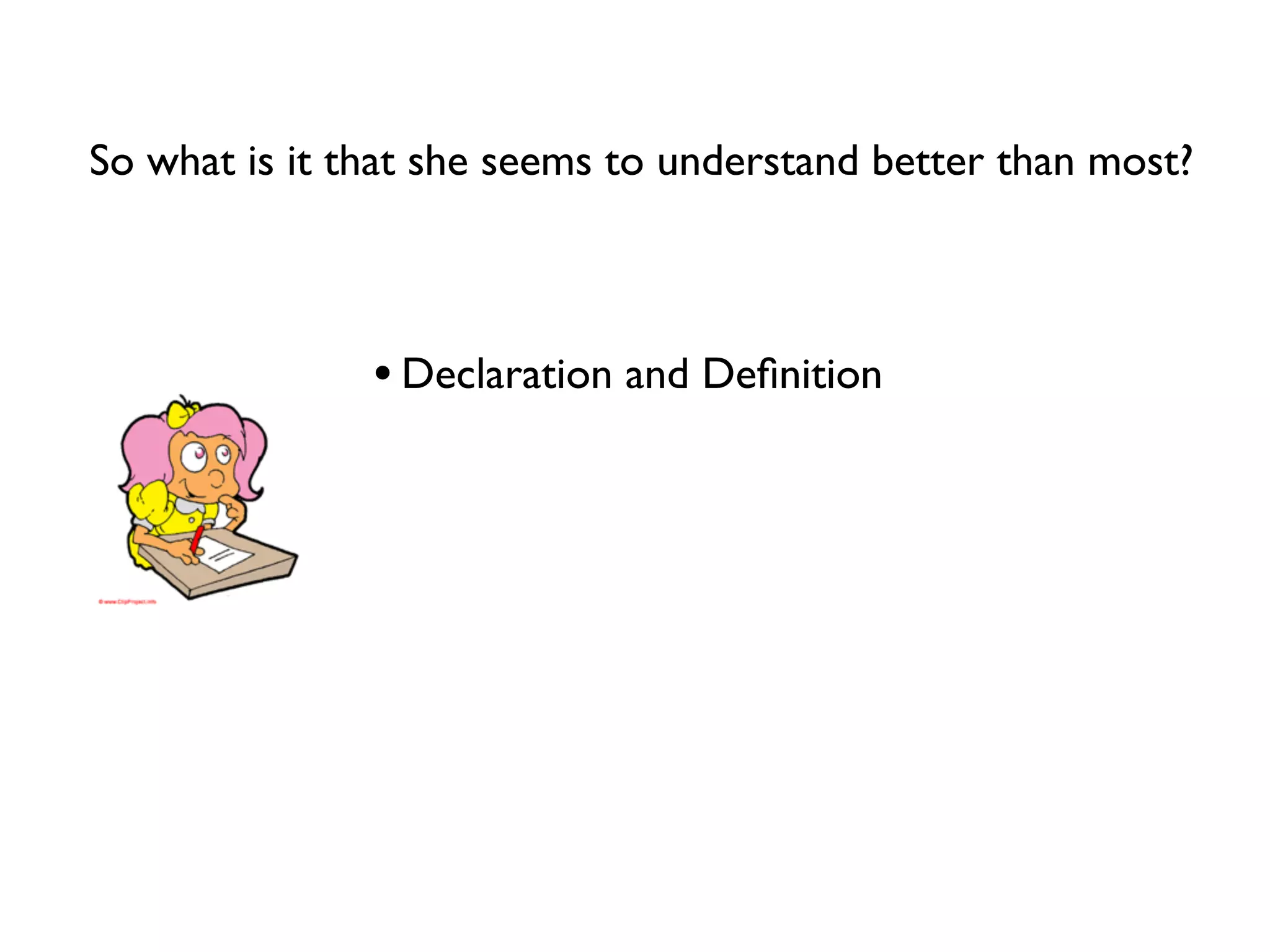
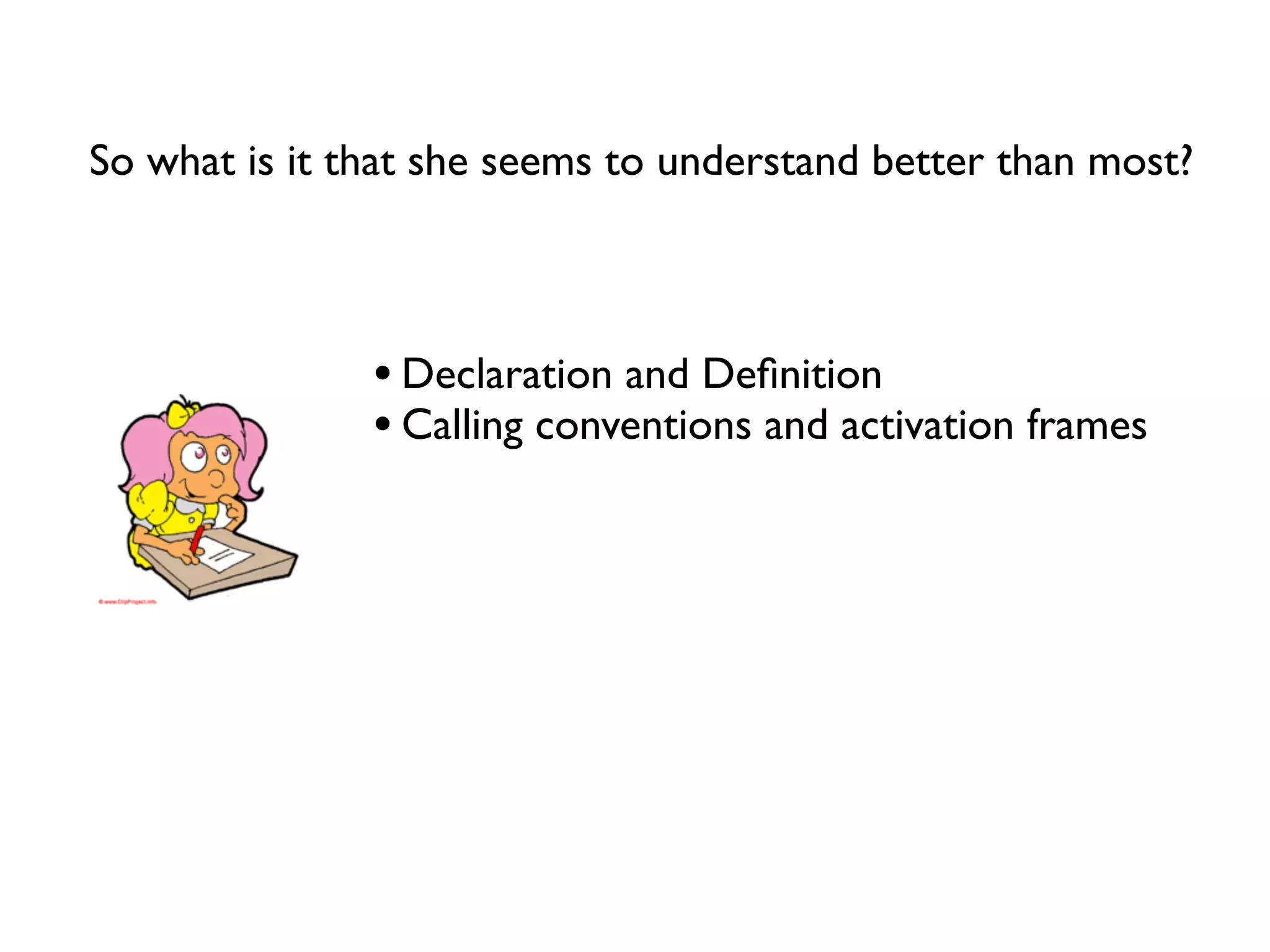
![So what is it that she seems to understand better than most?
• the connection between C and C++
• some techniques for polymorphism
• how to initialize objects properly
• rule of three
• operator new[] and delete[]](https://image.slidesharecdn.com/deepcslidesoct2012-111010033910-phpapp01/75/Deep-C-376-2048.jpg)
![So what is it that she seems to understand better than most?
• the connection between C and C++
• some techniques for polymorphism
• how to initialize objects properly
• rule of three
• operator new[] and delete[]
• common naming conventions](https://image.slidesharecdn.com/deepcslidesoct2012-111010033910-phpapp01/75/Deep-C-377-2048.jpg)
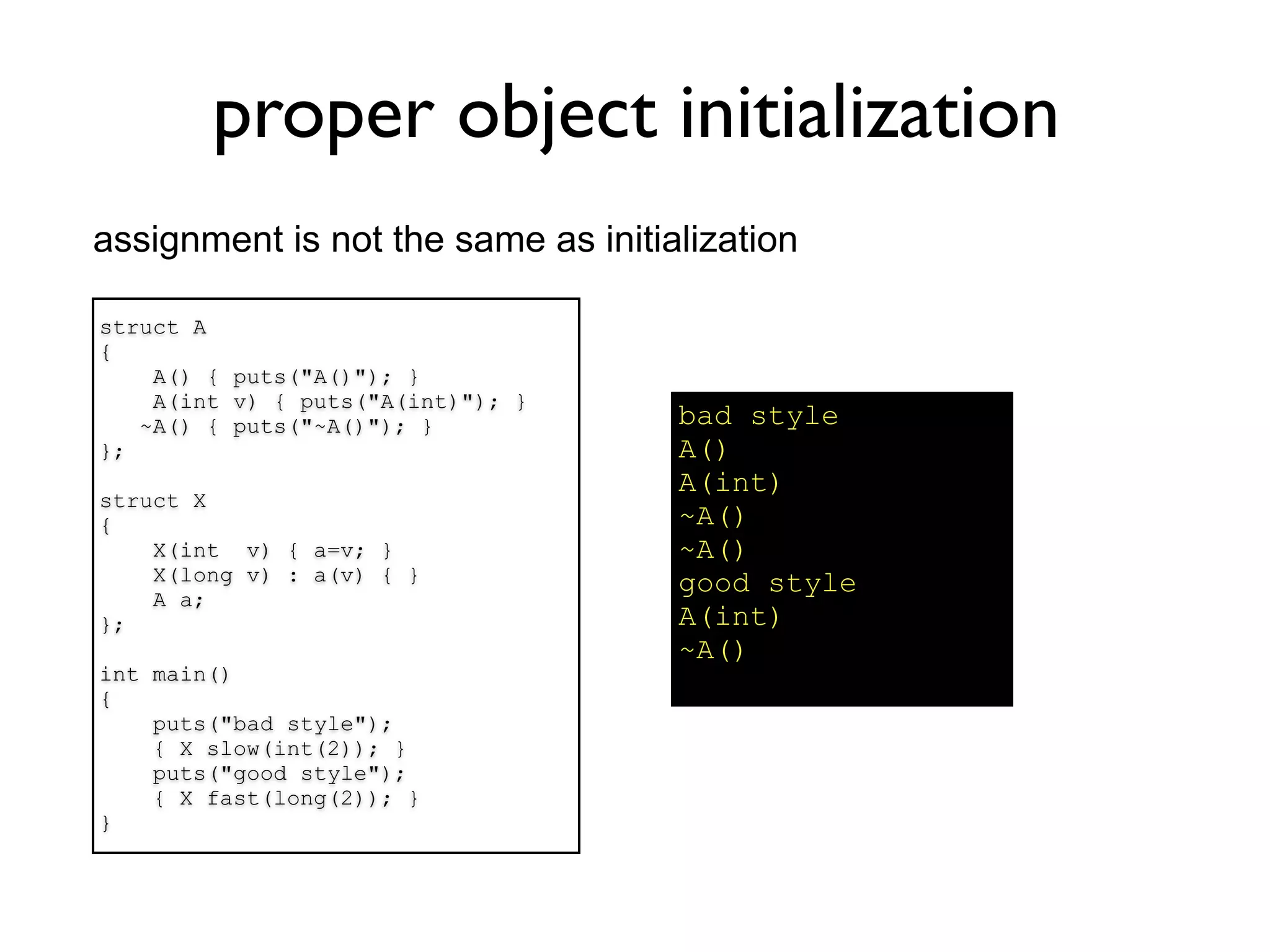
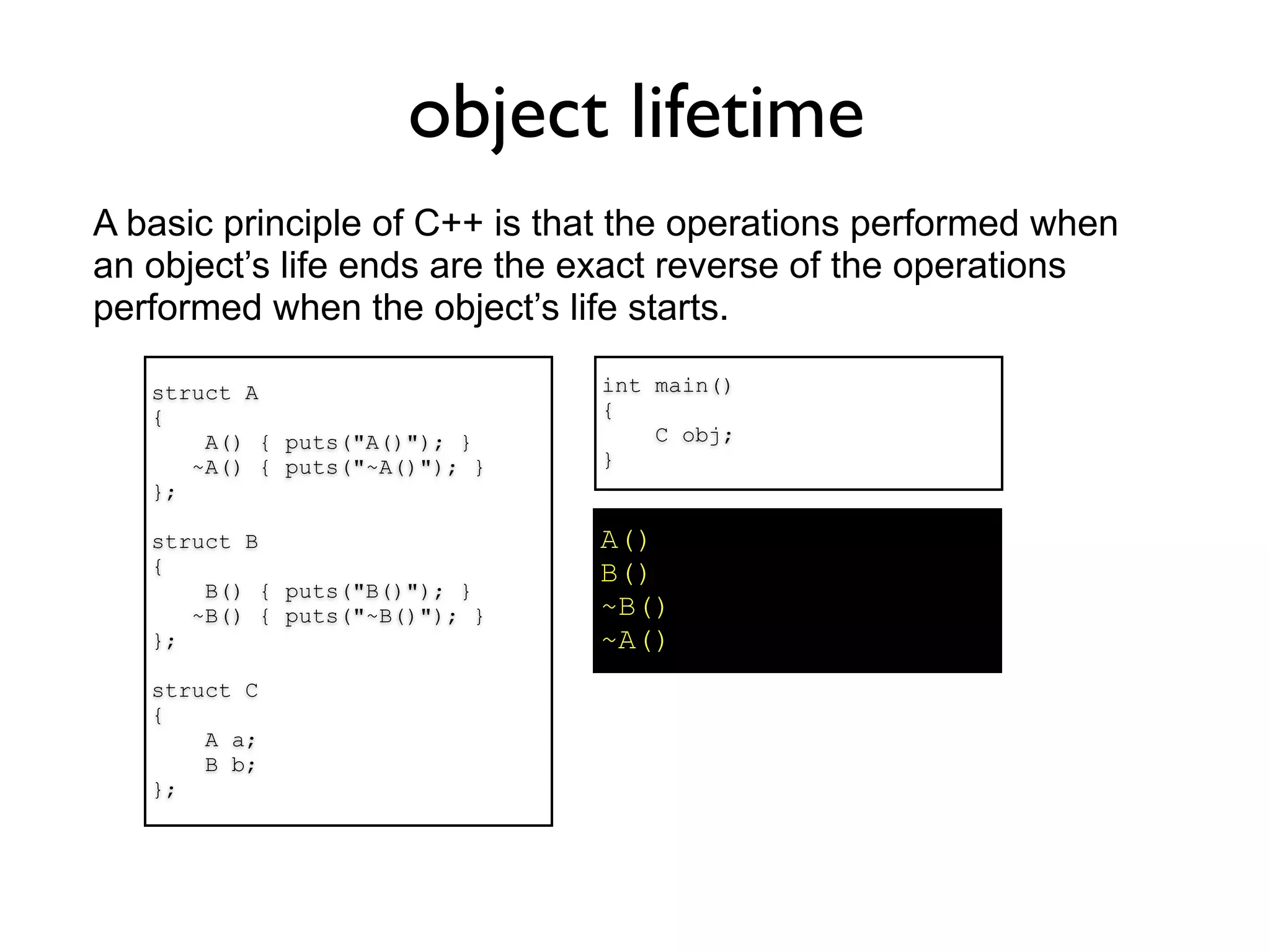
![object lifetime
A basic principle of C++ is that the operations performed when
an object’s life ends are the exact reverse of the operations
performed when the object’s life starts.
struct A int main()
{ {
A() : id(count++) A array[4];
{ }
printf("A(%d)n", id);
}
~A() A(0)
{
printf("~A(%d)n", id); A(1)
} A(2)
int id; A(3)
static int count;
}; ~A(3)
~A(2)
~A(1)
~A(0)](https://image.slidesharecdn.com/deepcslidesoct2012-111010033910-phpapp01/75/Deep-C-381-2048.jpg)
![object lifetime
A basic principle of C++ is that the operations performed when
an object’s life ends are the exact reverse of the operations
performed when the object’s life starts.
int main() int main()
struct A { {
{ A * array = new A[4]; A * array = new A[4];
A() : id(count++) delete[] array; delete array;
{ } }
printf("A(%d)n", id);
}
~A() A(0)
A(0)
{ A(1)
printf("~A(%d)n", id); A(1)
} A(2)
A(2)
int id; A(3)
static int count; A(3)
}; ~A(0)
~A(3)
~A(2)
~A(1)
~A(0)](https://image.slidesharecdn.com/deepcslidesoct2012-111010033910-phpapp01/75/Deep-C-382-2048.jpg)






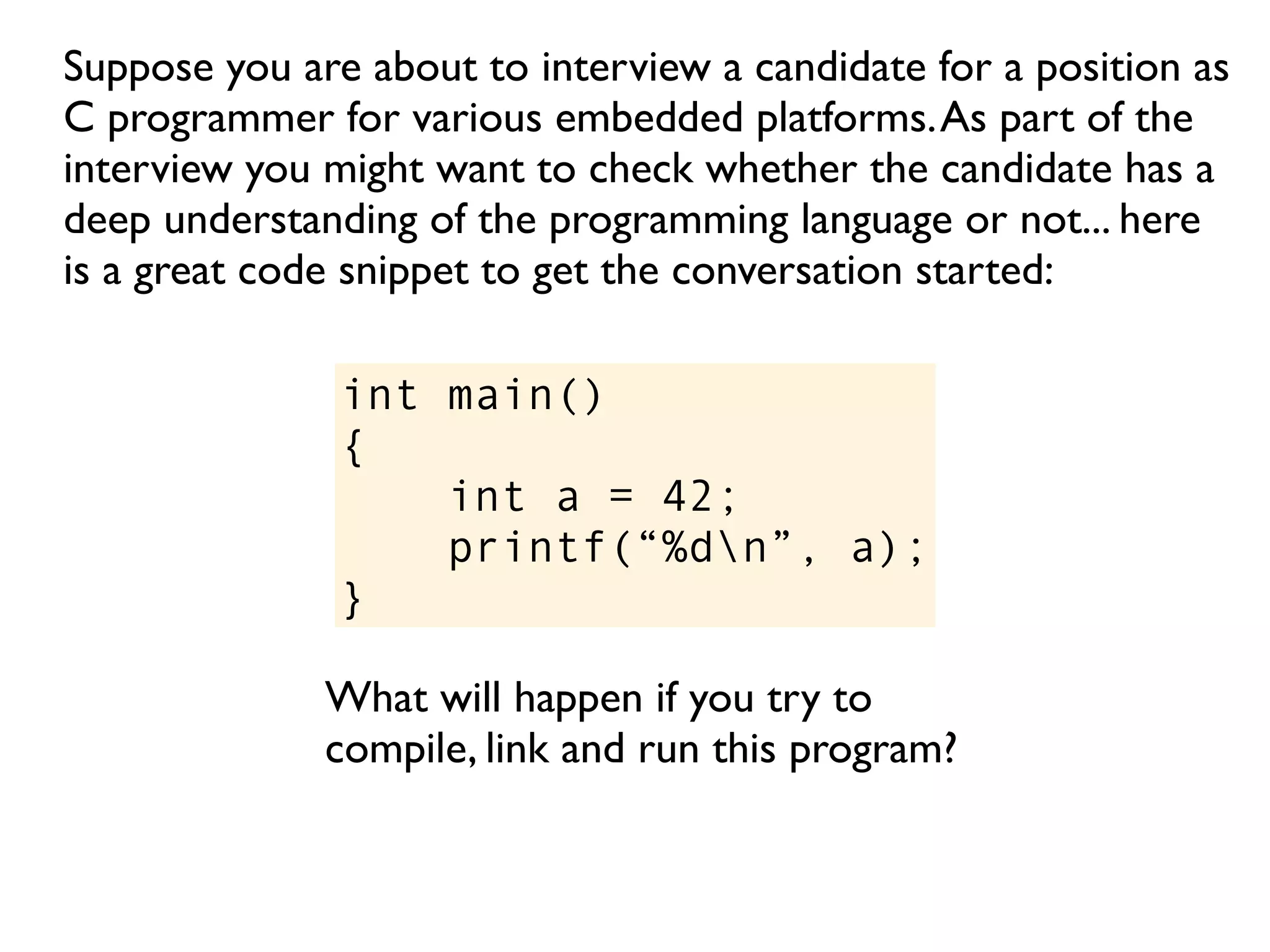
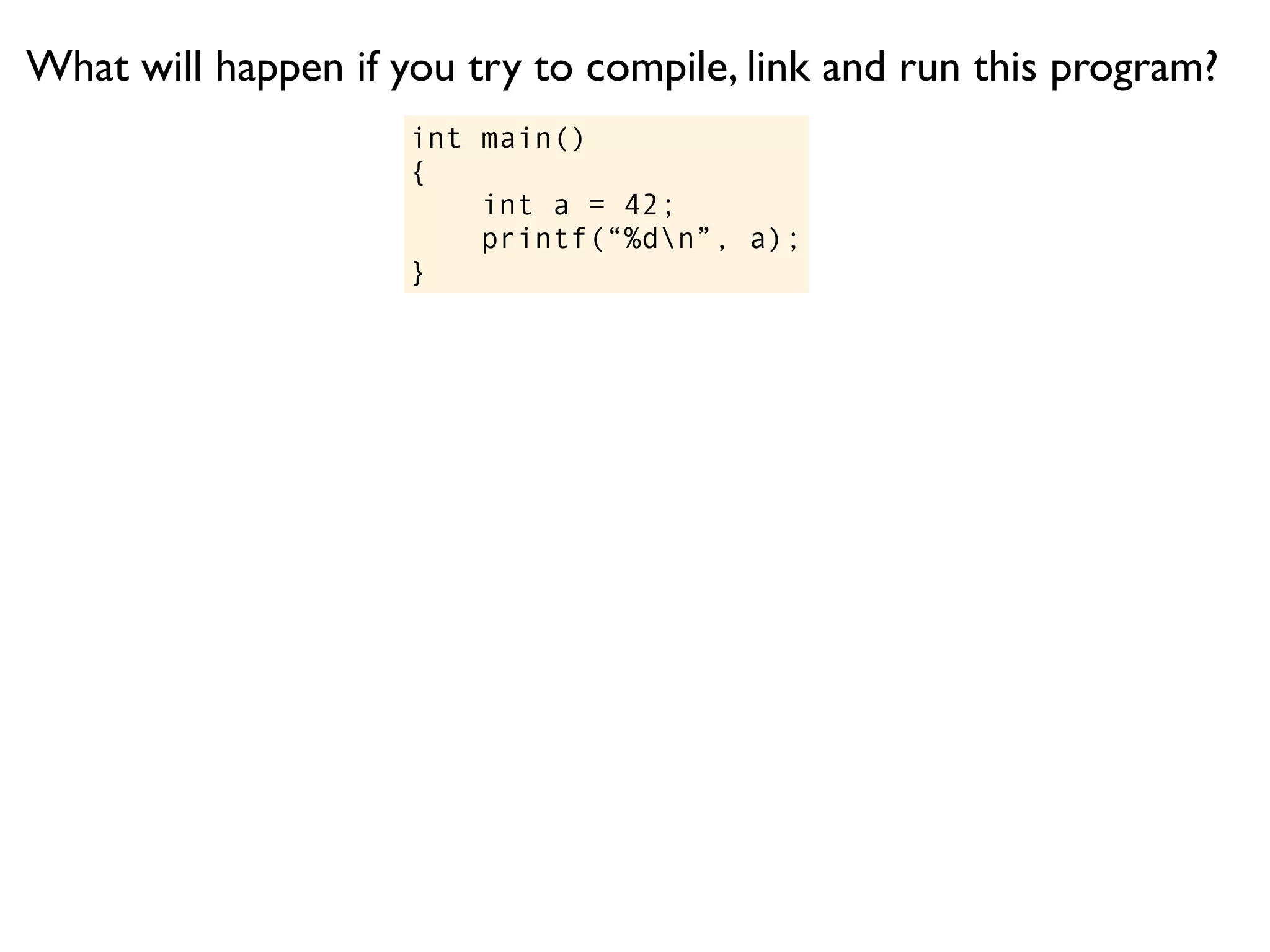
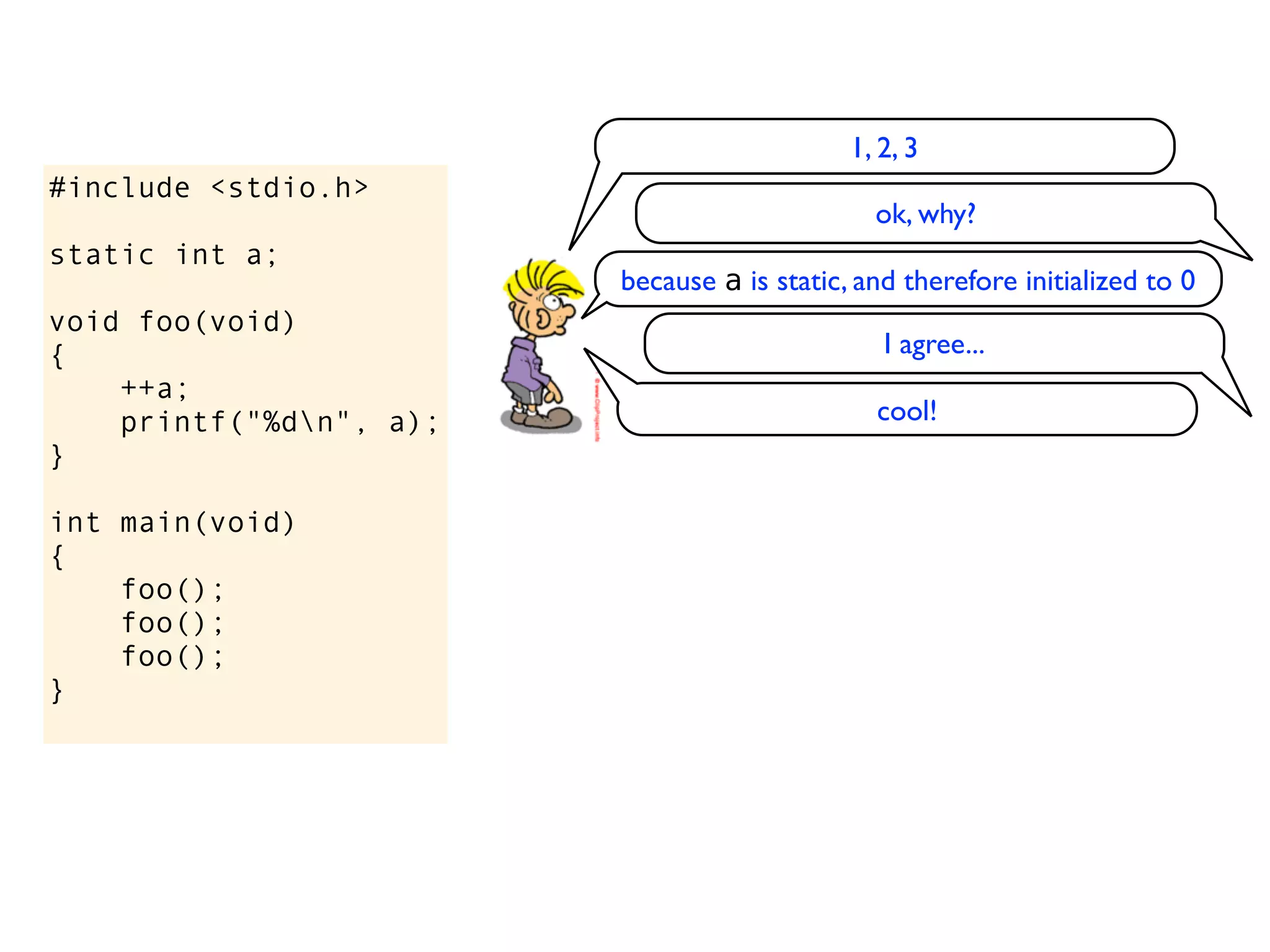
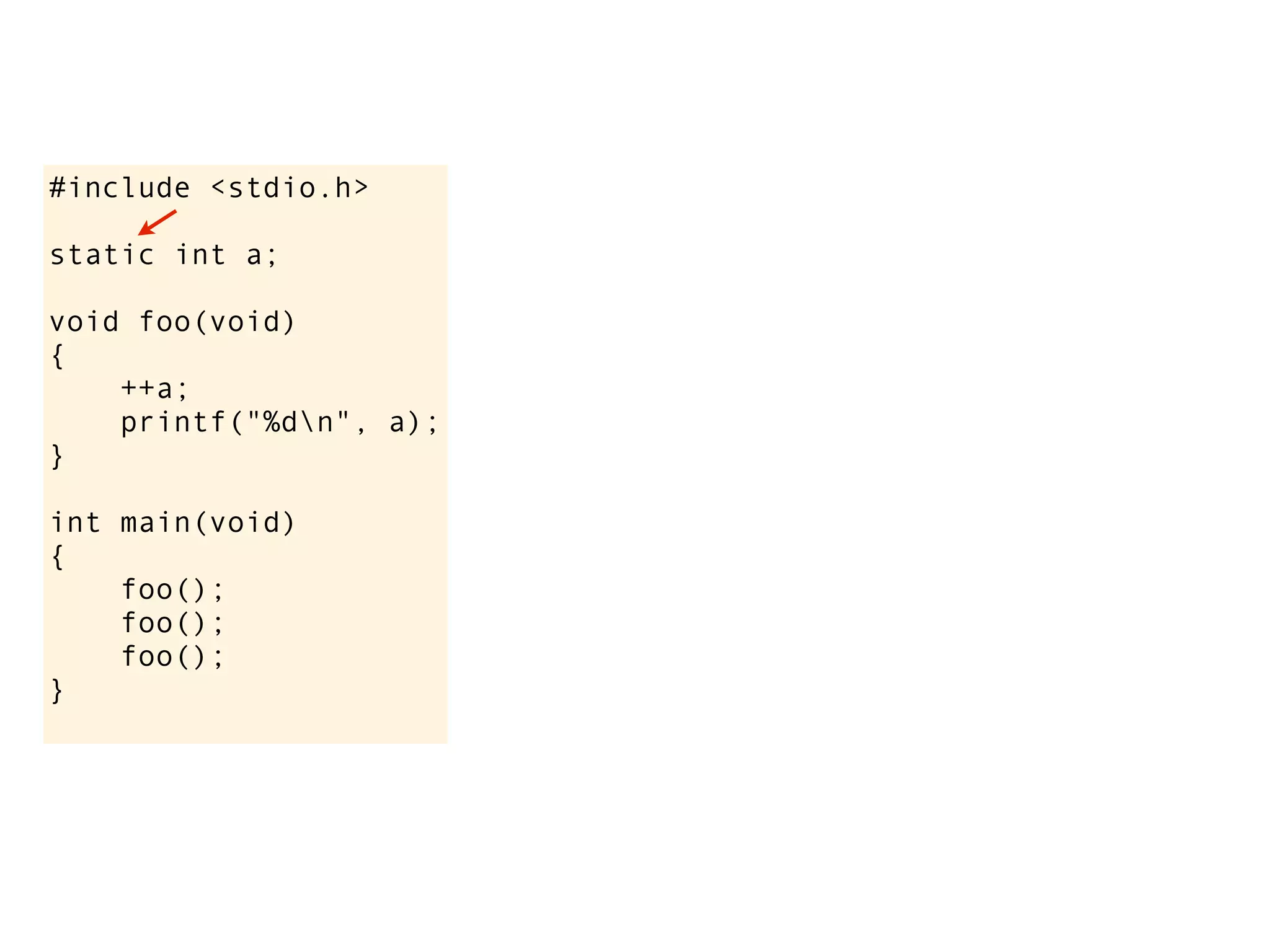
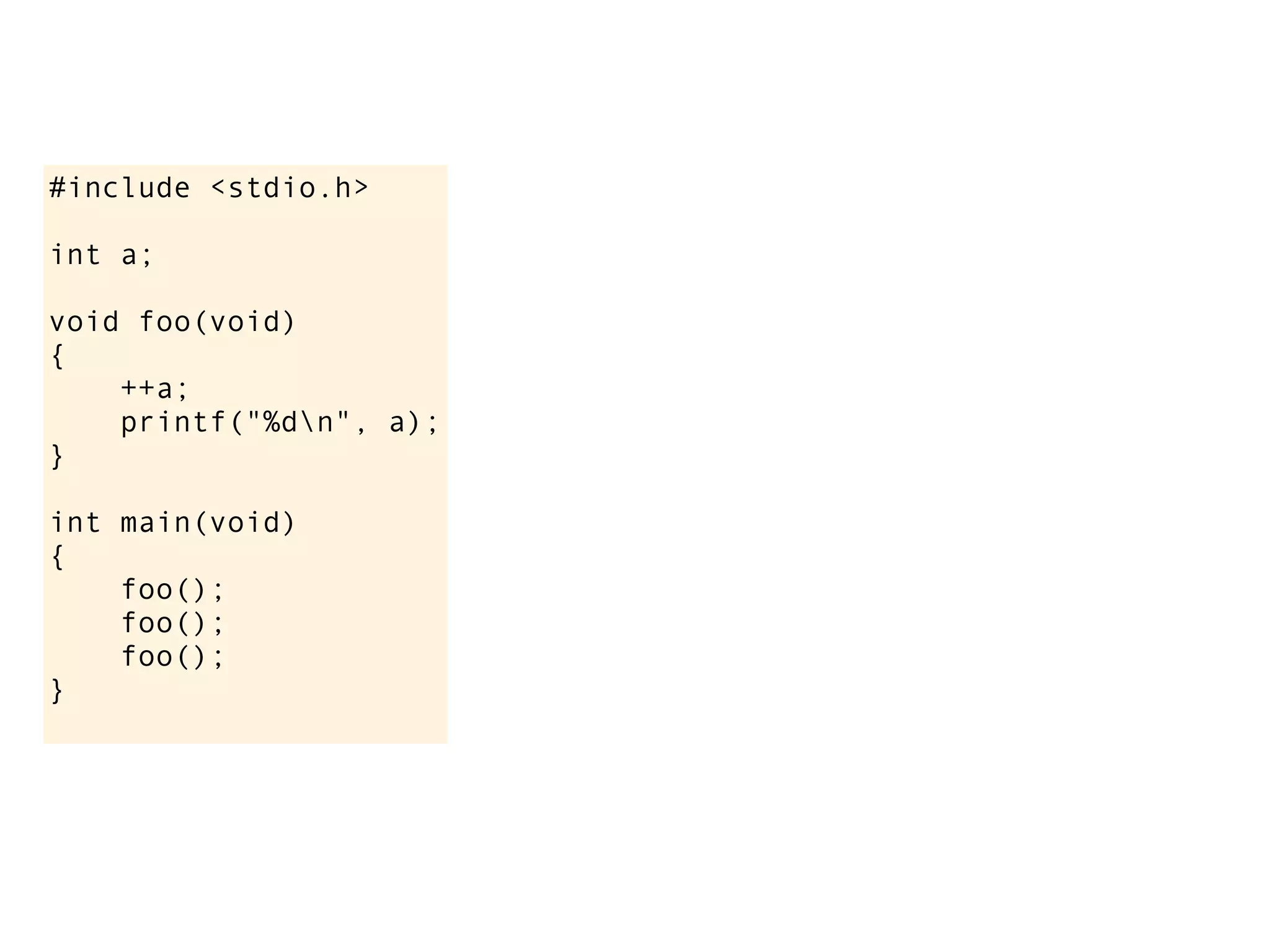
The document discusses the complexities of programming in C and C++, emphasizing that many programmers lack a deep understanding of the language, which leads to common errors. It uses code snippets to explore basic principles, limitations, and specific requirements of these languages, such as the necessity of including specific headers and explicit declarations. Interviewing candidates for C programming roles is suggested as a way to gauge their knowledge through detailed discussions on code behavior.


