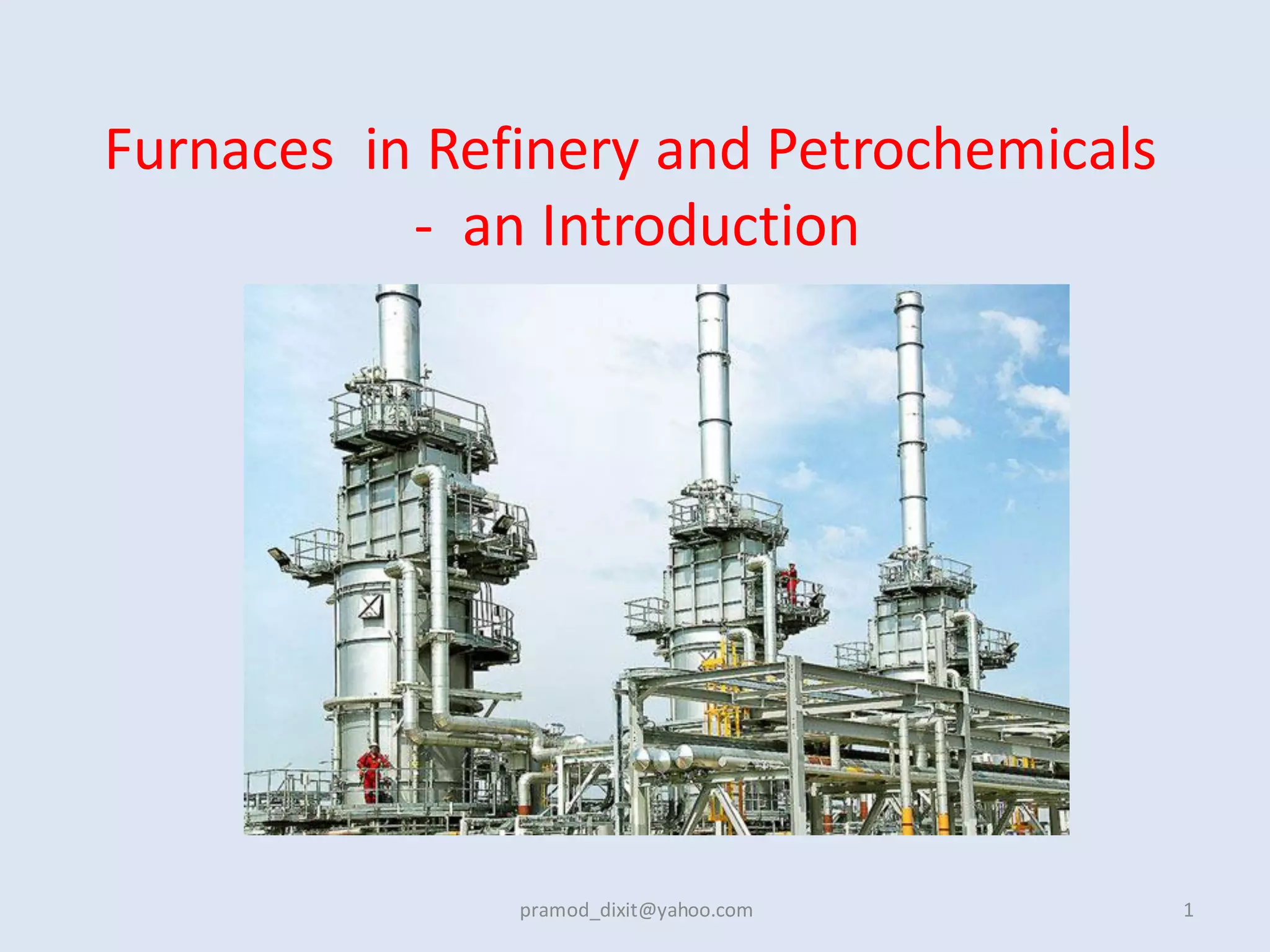
Furnaces in Refinery and Petrochemicals
- an Introduction
pramod_dixit@yahoo.com 1
Process furnaces
• Process furnaces are widely used in petroleum
refineries and petrochemicals. These are also called
fired heaters.
• They generate heat by combustion of fuels and
transfer to process fluid which is in side coil.
• The heat duty can be few Thousand MW to few
Million MW.
• Process fluid in side coil may either liquid or gas .
pramod_dixit@yahoo.com 2
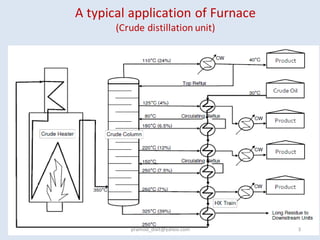
A typical application of Furnace
(Crude distillation unit)
3
pramod_dixit@yahoo.com
CDU (Crude distillation Unit) Heater
1. CDU heater is direct fired heater. It converts most of
the hydrocarbon fractions in to vapour phase which
are separated in distillation column.
2. No cracking or reaction takes place in this heater.
3. Flame radiation & hot flue gases of combustion
transfers heat & raise temperature of process fluid.
4. Every heater is tailored / designed for its specific
application.
4
pramod_dixit@yahoo.com
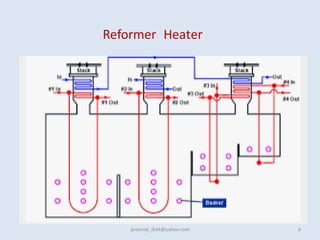
Reaction Heaters
1. In reaction heaters , these are filled with catalyst and
perform reaction inside tubes, besides heating.
2. These are called reaction heaters.
e.g. : Hydrogen reformer
Methanol heater
Catalytic reformers
5
pramod_dixit@yahoo.com
Reformer Heater
6
pramod_dixit@yahoo.com
Heater Performance objectives
• Maximize heat delivery to feed
• Minimal fuel consumption
• Flexibility of operation with varying fuel type/ quality and
also process flow variation in heater tubes.
• Easy to operate with safe start-up, operation and shut down.
• Minimize stack emissions (HC, Nox, Sox also hot flue gases)
• Achieve maximum thermal efficiency.
7
pramod_dixit@yahoo.com
Reasons to save Energy
• Energy costs 60 to 65% of a Refinery / process plant.
Highest energy requirement is in Furnaces .
• Cost of energy going up every day compels plant
operators to make use of waste Off –Gas or oil.
• In today ‘s scenario waste ( Off gases) usage is
maximized saving clean fuels like Natural gas or LPG.
• Due to waste gases of combustion, we have to be more
careful of environment pollution.
8
pramod_dixit@yahoo.com
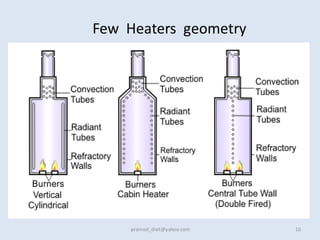
Heater Types
(based on their shape & geometry)
1. Vertical cylindrical furnaces.
2. Box type with vertical tubes
3. Cabin furnaces with horizontal tubes.
4. Radiant wall furnaces.
5. Double fired furnaces
6. Multi cell
7. All convection
pramod_dixit@yahoo.com 9
Few Heaters geometry
pramod_dixit@yahoo.com 10
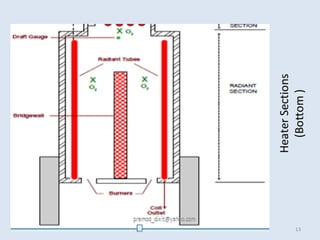
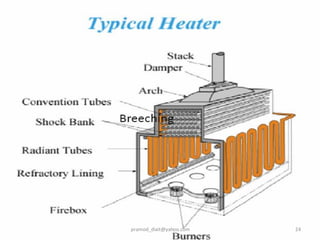
Heater Sections
• BottomRadiant Section : where Tubes directly see the burners /
radiant wall.
• Coils : Carry process feed to be heated
• ConvectionSection: Packed bundle of bare/ finned tubes
absorbing balance heat of flue gas before it is goes to stack.
• Cross Over Section: Section in-between the radiant & convection
• Stack: Finally dischargesfue gas to atmosphere
• Air Pre-heaters: Used to preheat the fresh air feed to burners by
exchanging with flue gases being discharged
All above sectionsare confinedin a Caron Steelbody structure
designedto take care of all operation,wind and seismic loads
11
pramod_dixit@yahoo.com
Heater
Sections
(TOP)
12
pramod_dixit@yahoo.com
Heater
Sections
(Bottom
)
13
pramod_dixit@yahoo.com
Radiant section
1. The radiant section is where the tubes receive
almost all its heat by radiation from the flame
2. The tubes are a distance away from the Refractory
so radiation can be reflected back to tubes to
maintain a uniform tube wall temperature.
3. Tubes are held at one end & guided at another
end to allow them to expand. These can not have
fixed ends.
14
pramod_dixit@yahoo.com
Convection section
1. Located above radiant section where Heat transfer takes
place by convection .
2. Tubes are studded or finned to increase heat transfer
surface area.
3. The first two tube rows in the bottom of the convection
section are bare tubes called shield or shock tubes. They
protect the finned tubes from direct radiation.
15
pramod_dixit@yahoo.com
Crossover section
1. A crossover is the tube that connects from the convection
section outlet to the radiant section inlet.
2. The crossover piping is normally located outside so that the
temperature can be monitored and the efficiency of the
convection section can be calculated.
16
pramod_dixit@yahoo.com
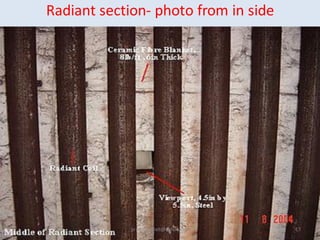
Radiant section- photo from in side
17
pramod_dixit@yahoo.com
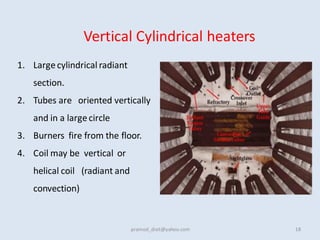
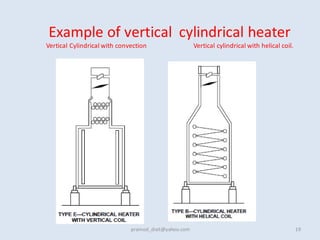
Vertical Cylindrical heaters
1. Largecylindrical radiant
section.
2. Tubes are oriented vertically
and in a largecircle
3. Burners fire from the floor.
4. Coil may be vertical or
helical coil (radiant and
convection)
pramod_dixit@yahoo.com 18
Example of vertical cylindrical heater
Vertical Cylindrical with convection Vertical cylindrical with helical coil.
19
pramod_dixit@yahoo.com
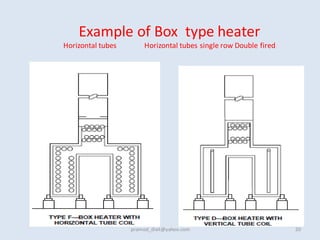
Example of Box type heater
Horizontal tubes Horizontal tubes single row Double fired
20
pramod_dixit@yahoo.com
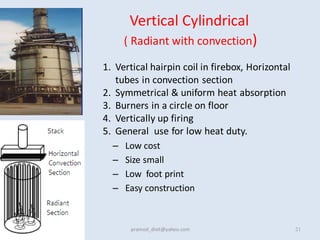
Vertical Cylindrical
( Radiant with convection)
1. Vertical hairpin coil in firebox, Horizontal
tubes in convection section
2. Symmetrical & uniform heat absorption
3. Burners in a circle on floor
4. Vertically up firing
5. General use for low heat duty.
– Low cost
– Size small
– Low foot print
– Easy construction
21
pramod_dixit@yahoo.com
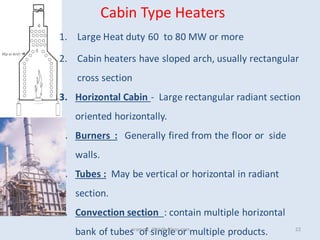
Cabin Type Heaters
1. Large Heat duty 60 to 80 MW or more
2. Cabin heaters have sloped arch, usually rectangular
cross section
3. Horizontal Cabin - Large rectangular radiant section
oriented horizontally.
4. Burners : Generally fired from the floor or side
walls.
5. Tubes : May be vertical or horizontal in radiant
section.
6. Convection section : contain multiple horizontal
bank of tubes of single or multiple products.
pramod_dixit@yahoo.com 22
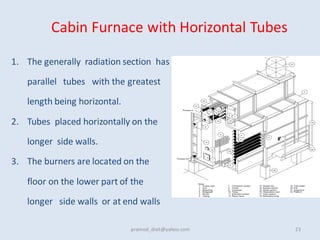
Cabin Furnace with Horizontal Tubes
1. The generally radiation section has
parallel tubes with the greatest
length being horizontal.
2. Tubes placed horizontally on the
longer side walls.
3. The burners are located on the
floor on the lower part of the
longer side walls or at end walls
pramod_dixit@yahoo.com 23
24
pramod_dixit@yahoo.com
Burners
25
pramod_dixit@yahoo.com
Burners
Burners are most important players in heater
performance. Placed in lower radiant section.
Flue gases travel vertically through :
1. Radiant section
2. Convection section
3. Air pre-heater if required
4. Finally through stack.
26
pramod_dixit@yahoo.com
Burners and its accessories
The combustion components include:
• Burner
• Fuel supply Piping
• Flame Safety Supervision & Control System.
• Burner management system
• Low Nox and staged burning is a preferred choice
27
pramod_dixit@yahoo.com
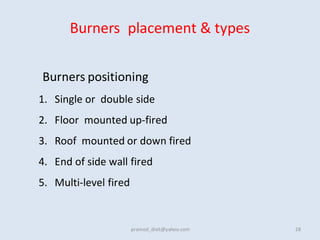
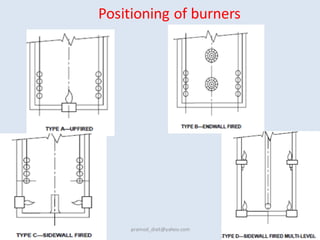
Burners placement & types
Burners positioning
1. Single or double side
2. Floor mounted up-fired
3. Roof mounted or down fired
4. End of side wall fired
5. Multi-level fired
28
pramod_dixit@yahoo.com
Positioning of burners
29
pramod_dixit@yahoo.com
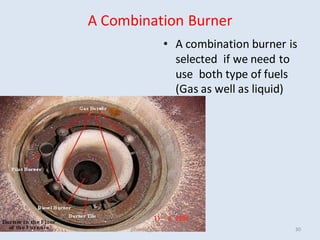
A Combination Burner
• A combination burner is
selected if we need to
use both type of fuels
(Gas as well as liquid)
pramod_dixit@yahoo.com 30
Burner Control Panel
Consistsof :
– Burner managementsystems
– Single loop controllers
– Limit controllers
– NFPA & local regulation requirements.
– The control system provides a pre-purgeand post-purge of the
heater, automatic ignition, low flame start (high turn down
burner), continuous main flame detected by UV sensor.
– Control options !!!!!! virtually limitless !!!!!
31
pramod_dixit@yahoo.com
Role of air pre-heaters in furnace
32
pramod_dixit@yahoo.com
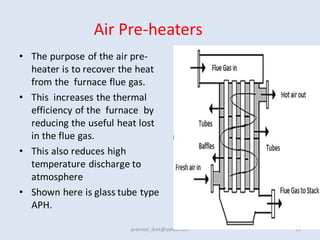
Air Pre-heaters
• The purpose of the air pre-
heater is to recover the heat
from the furnace flue gas.
• This increases the thermal
efficiency of the furnace by
reducing the useful heat lost
in the flue gas.
• This also reduces high
temperature discharge to
atmosphere
• Shown here is glass tube type
APH.
pramod_dixit@yahoo.com 33
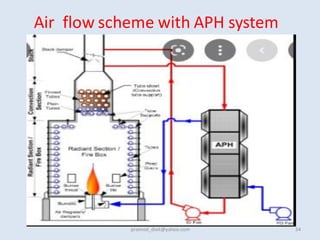
Air flow scheme with APH system
pramod_dixit@yahoo.com 34
Furnace types based on DRAFTs
Once we have APH in the system, we need to have a
draft control on Flue gas flow.
1.Natural ( no APH possible in this case)
2.Forced
3.Induced
4.Balanced
A word of caution :
Flue gas discharge temperature to atmosphere
should be above DEW POINT, to avoid acid attack
by gas condensation. Which corrodes the stack.
35
pramod_dixit@yahoo.com
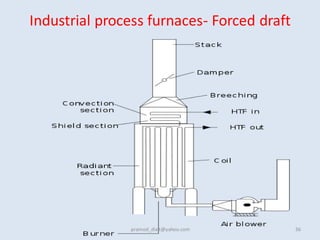
Industrial process furnaces- Forced draft
36
pramod_dixit@yahoo.com
Fuel used in heaters
• Refinery waste gas
• Natural gas
• Fuel Oil / waste oil
• Process combustible gases ( like H2 )
pramod_dixit@yahoo.com 37
Refractory & Insulation
• Since all heater parts are associated with heat , suitable
Refractory is required to protect all CABIN structure as
well as prevent heat loss to atmosphere.
• Refractory radiates back the heat to tubes
• Materials : Fire bricks, insulating & heat resistant cast able,
ceramic fibre etc .
• Ceramic fibre is light and easy to apply, used for roof & wall,
not used for oil fired burners in radiant zone.
38
pramod_dixit@yahoo.com
Applicable Codes for Fired heater design
• API 535 : guidelines for the selection and/or evaluation of burners
installed in fired heaters in general refinery services.
• API 538 : recommendations for design, operation, and maintenance
considerations for industrial fired boilers.
• API 560 : Fired Heaters for General Refinery Service,
recommendations for the design, materials, fabrication, inspection,
testing, preparation for shipment, and erection of fired heaters, air pre-
heaters (APHs), fans etc.
• API 573 : inspection practices for fired boilers and process heaters.
39
pramod_dixit@yahoo.com
Thank you
40
pramod_dixit@yahoo.com

An introduction to Fired Heaters.pdf

  • 1.
    Furnaces in Refineryand Petrochemicals - an Introduction pramod_dixit@yahoo.com 1
  • 2.
    Process furnaces • Processfurnaces are widely used in petroleum refineries and petrochemicals. These are also called fired heaters. • They generate heat by combustion of fuels and transfer to process fluid which is in side coil. • The heat duty can be few Thousand MW to few Million MW. • Process fluid in side coil may either liquid or gas . pramod_dixit@yahoo.com 2
  • 3.
    A typical applicationof Furnace (Crude distillation unit) 3 pramod_dixit@yahoo.com
  • 4.
    CDU (Crude distillationUnit) Heater 1. CDU heater is direct fired heater. It converts most of the hydrocarbon fractions in to vapour phase which are separated in distillation column. 2. No cracking or reaction takes place in this heater. 3. Flame radiation & hot flue gases of combustion transfers heat & raise temperature of process fluid. 4. Every heater is tailored / designed for its specific application. 4 pramod_dixit@yahoo.com
  • 5.
    Reaction Heaters 1. Inreaction heaters , these are filled with catalyst and perform reaction inside tubes, besides heating. 2. These are called reaction heaters. e.g. : Hydrogen reformer Methanol heater Catalytic reformers 5 pramod_dixit@yahoo.com
  • 6.
  • 7.
    Heater Performance objectives •Maximize heat delivery to feed • Minimal fuel consumption • Flexibility of operation with varying fuel type/ quality and also process flow variation in heater tubes. • Easy to operate with safe start-up, operation and shut down. • Minimize stack emissions (HC, Nox, Sox also hot flue gases) • Achieve maximum thermal efficiency. 7 pramod_dixit@yahoo.com
  • 8.
    Reasons to saveEnergy • Energy costs 60 to 65% of a Refinery / process plant. Highest energy requirement is in Furnaces . • Cost of energy going up every day compels plant operators to make use of waste Off –Gas or oil. • In today ‘s scenario waste ( Off gases) usage is maximized saving clean fuels like Natural gas or LPG. • Due to waste gases of combustion, we have to be more careful of environment pollution. 8 pramod_dixit@yahoo.com
  • 9.
    Heater Types (based ontheir shape & geometry) 1. Vertical cylindrical furnaces. 2. Box type with vertical tubes 3. Cabin furnaces with horizontal tubes. 4. Radiant wall furnaces. 5. Double fired furnaces 6. Multi cell 7. All convection pramod_dixit@yahoo.com 9
  • 10.
  • 11.
    Heater Sections • BottomRadiantSection : where Tubes directly see the burners / radiant wall. • Coils : Carry process feed to be heated • ConvectionSection: Packed bundle of bare/ finned tubes absorbing balance heat of flue gas before it is goes to stack. • Cross Over Section: Section in-between the radiant & convection • Stack: Finally dischargesfue gas to atmosphere • Air Pre-heaters: Used to preheat the fresh air feed to burners by exchanging with flue gases being discharged All above sectionsare confinedin a Caron Steelbody structure designedto take care of all operation,wind and seismic loads 11 pramod_dixit@yahoo.com
  • 12.
  • 13.
  • 14.
    Radiant section 1. Theradiant section is where the tubes receive almost all its heat by radiation from the flame 2. The tubes are a distance away from the Refractory so radiation can be reflected back to tubes to maintain a uniform tube wall temperature. 3. Tubes are held at one end & guided at another end to allow them to expand. These can not have fixed ends. 14 pramod_dixit@yahoo.com
  • 15.
    Convection section 1. Locatedabove radiant section where Heat transfer takes place by convection . 2. Tubes are studded or finned to increase heat transfer surface area. 3. The first two tube rows in the bottom of the convection section are bare tubes called shield or shock tubes. They protect the finned tubes from direct radiation. 15 pramod_dixit@yahoo.com
  • 16.
    Crossover section 1. Acrossover is the tube that connects from the convection section outlet to the radiant section inlet. 2. The crossover piping is normally located outside so that the temperature can be monitored and the efficiency of the convection section can be calculated. 16 pramod_dixit@yahoo.com
  • 17.
    Radiant section- photofrom in side 17 pramod_dixit@yahoo.com
  • 18.
    Vertical Cylindrical heaters 1.Largecylindrical radiant section. 2. Tubes are oriented vertically and in a largecircle 3. Burners fire from the floor. 4. Coil may be vertical or helical coil (radiant and convection) pramod_dixit@yahoo.com 18
  • 19.
    Example of verticalcylindrical heater Vertical Cylindrical with convection Vertical cylindrical with helical coil. 19 pramod_dixit@yahoo.com
  • 20.
    Example of Boxtype heater Horizontal tubes Horizontal tubes single row Double fired 20 pramod_dixit@yahoo.com
  • 21.
    Vertical Cylindrical ( Radiantwith convection) 1. Vertical hairpin coil in firebox, Horizontal tubes in convection section 2. Symmetrical & uniform heat absorption 3. Burners in a circle on floor 4. Vertically up firing 5. General use for low heat duty. – Low cost – Size small – Low foot print – Easy construction 21 pramod_dixit@yahoo.com
  • 22.
    Cabin Type Heaters 1.Large Heat duty 60 to 80 MW or more 2. Cabin heaters have sloped arch, usually rectangular cross section 3. Horizontal Cabin - Large rectangular radiant section oriented horizontally. 4. Burners : Generally fired from the floor or side walls. 5. Tubes : May be vertical or horizontal in radiant section. 6. Convection section : contain multiple horizontal bank of tubes of single or multiple products. pramod_dixit@yahoo.com 22
  • 23.
    Cabin Furnace withHorizontal Tubes 1. The generally radiation section has parallel tubes with the greatest length being horizontal. 2. Tubes placed horizontally on the longer side walls. 3. The burners are located on the floor on the lower part of the longer side walls or at end walls pramod_dixit@yahoo.com 23
  • 24.
  • 25.
  • 26.
    Burners Burners are mostimportant players in heater performance. Placed in lower radiant section. Flue gases travel vertically through : 1. Radiant section 2. Convection section 3. Air pre-heater if required 4. Finally through stack. 26 pramod_dixit@yahoo.com
  • 27.
    Burners and itsaccessories The combustion components include: • Burner • Fuel supply Piping • Flame Safety Supervision & Control System. • Burner management system • Low Nox and staged burning is a preferred choice 27 pramod_dixit@yahoo.com
  • 28.
    Burners placement &types Burners positioning 1. Single or double side 2. Floor mounted up-fired 3. Roof mounted or down fired 4. End of side wall fired 5. Multi-level fired 28 pramod_dixit@yahoo.com
  • 29.
  • 30.
    A Combination Burner •A combination burner is selected if we need to use both type of fuels (Gas as well as liquid) pramod_dixit@yahoo.com 30
  • 31.
    Burner Control Panel Consistsof: – Burner managementsystems – Single loop controllers – Limit controllers – NFPA & local regulation requirements. – The control system provides a pre-purgeand post-purge of the heater, automatic ignition, low flame start (high turn down burner), continuous main flame detected by UV sensor. – Control options !!!!!! virtually limitless !!!!! 31 pramod_dixit@yahoo.com
  • 32.
    Role of airpre-heaters in furnace 32 pramod_dixit@yahoo.com
  • 33.
    Air Pre-heaters • Thepurpose of the air pre- heater is to recover the heat from the furnace flue gas. • This increases the thermal efficiency of the furnace by reducing the useful heat lost in the flue gas. • This also reduces high temperature discharge to atmosphere • Shown here is glass tube type APH. pramod_dixit@yahoo.com 33
  • 34.
    Air flow schemewith APH system pramod_dixit@yahoo.com 34
  • 35.
    Furnace types basedon DRAFTs Once we have APH in the system, we need to have a draft control on Flue gas flow. 1.Natural ( no APH possible in this case) 2.Forced 3.Induced 4.Balanced A word of caution : Flue gas discharge temperature to atmosphere should be above DEW POINT, to avoid acid attack by gas condensation. Which corrodes the stack. 35 pramod_dixit@yahoo.com
  • 36.
    Industrial process furnaces-Forced draft 36 pramod_dixit@yahoo.com
  • 37.
    Fuel used inheaters • Refinery waste gas • Natural gas • Fuel Oil / waste oil • Process combustible gases ( like H2 ) pramod_dixit@yahoo.com 37
  • 38.
    Refractory & Insulation •Since all heater parts are associated with heat , suitable Refractory is required to protect all CABIN structure as well as prevent heat loss to atmosphere. • Refractory radiates back the heat to tubes • Materials : Fire bricks, insulating & heat resistant cast able, ceramic fibre etc . • Ceramic fibre is light and easy to apply, used for roof & wall, not used for oil fired burners in radiant zone. 38 pramod_dixit@yahoo.com
  • 39.
    Applicable Codes forFired heater design • API 535 : guidelines for the selection and/or evaluation of burners installed in fired heaters in general refinery services. • API 538 : recommendations for design, operation, and maintenance considerations for industrial fired boilers. • API 560 : Fired Heaters for General Refinery Service, recommendations for the design, materials, fabrication, inspection, testing, preparation for shipment, and erection of fired heaters, air pre- heaters (APHs), fans etc. • API 573 : inspection practices for fired boilers and process heaters. 39 pramod_dixit@yahoo.com
  • 40.