Håvard Devold 
 

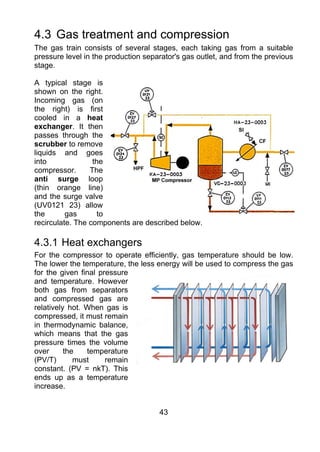
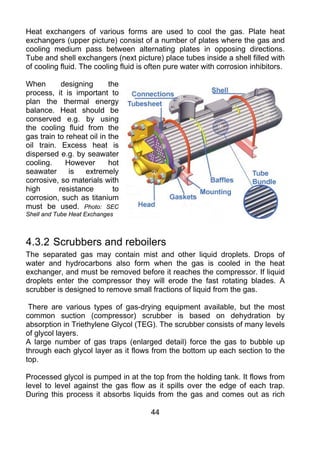
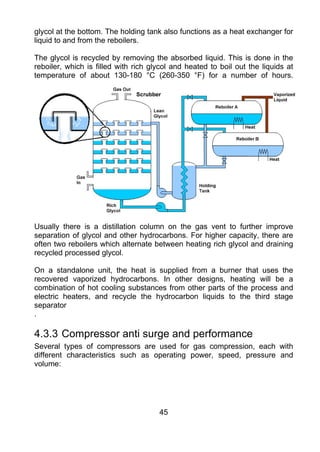
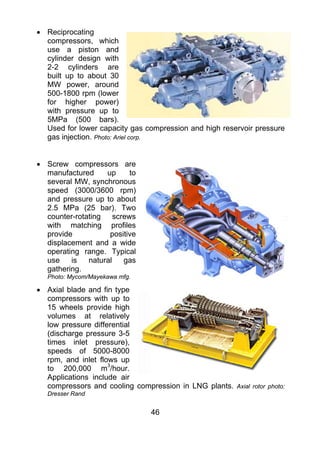
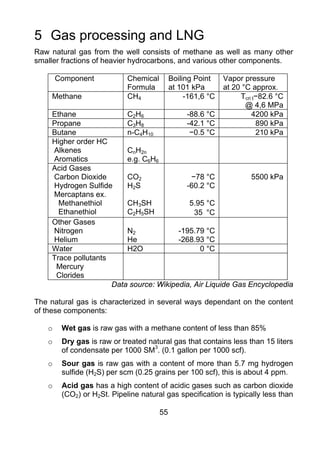
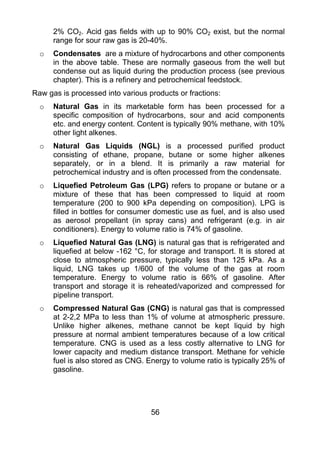
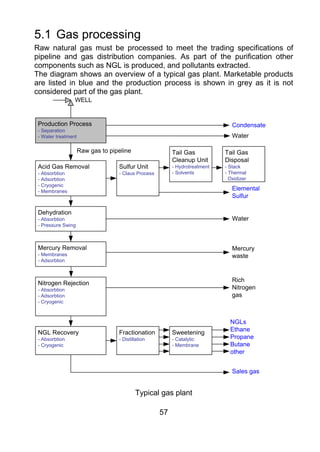
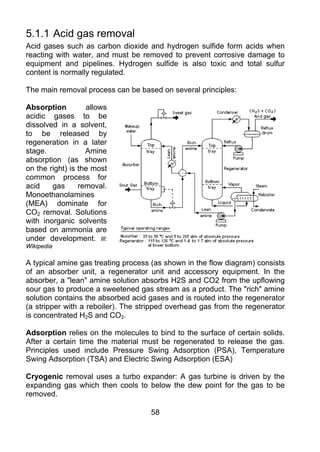
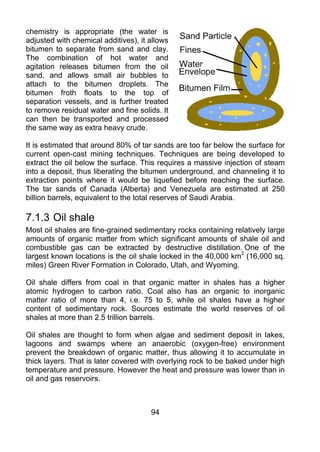
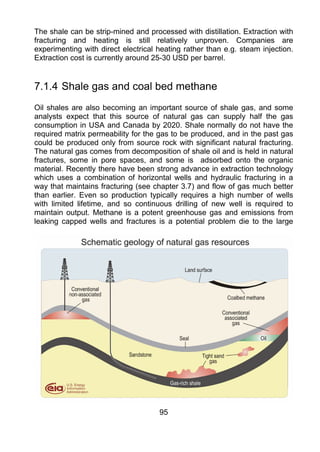
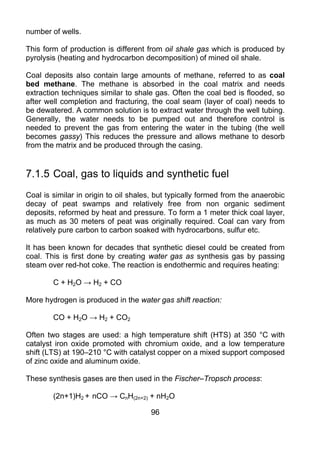
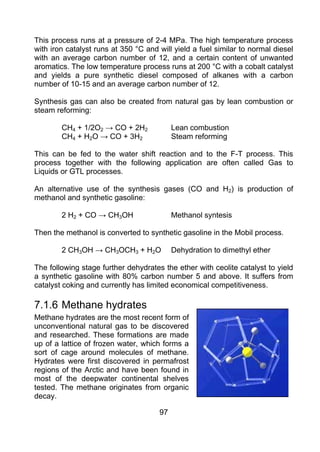
Oil and gas production handbook 
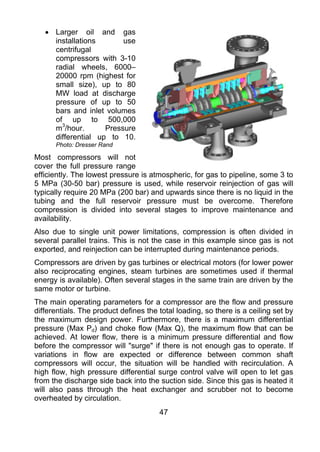
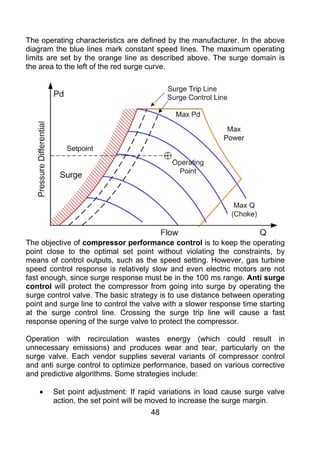
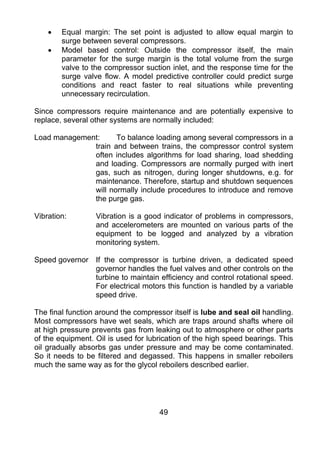
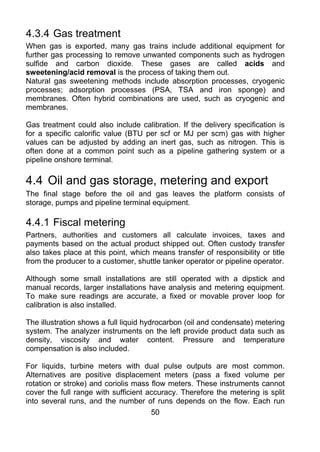
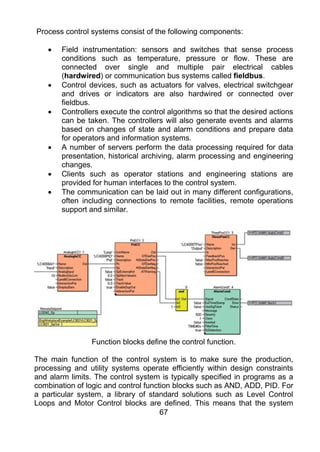
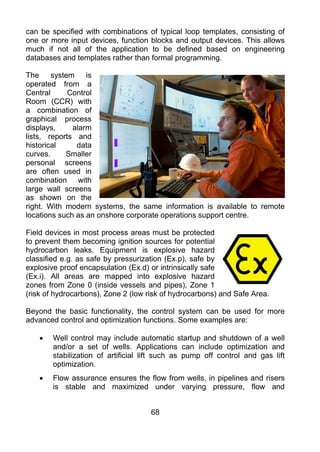
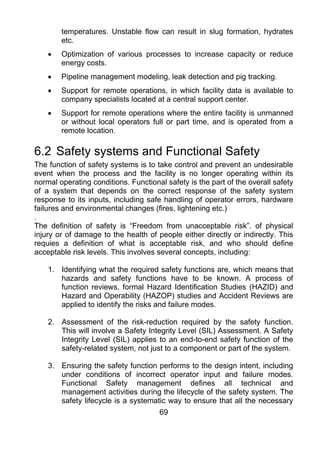
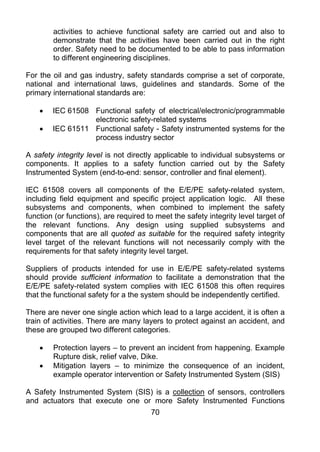
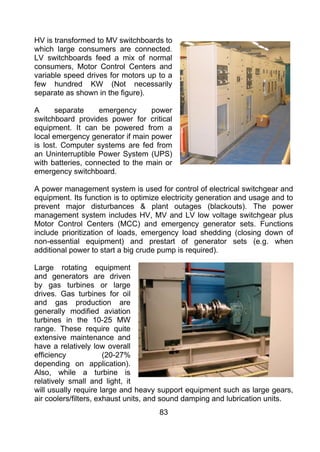
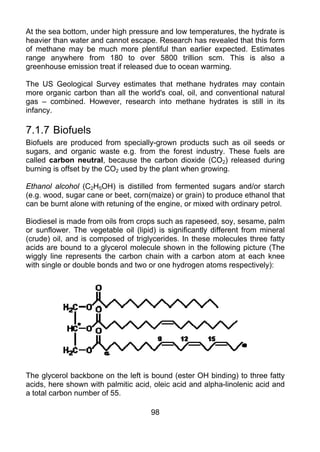
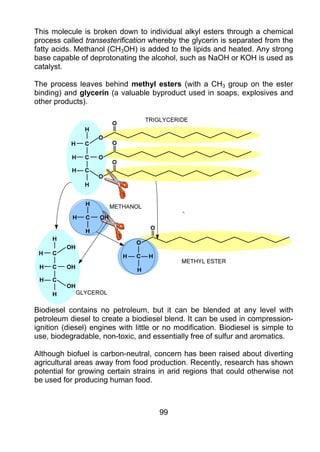
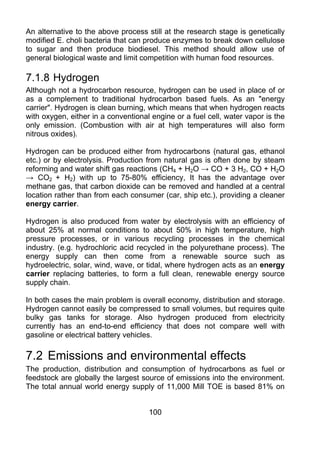
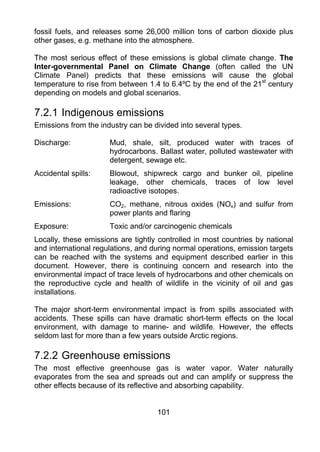
An introduction to oil and gas production  
ISBN 978-82-997886-2-5


          2
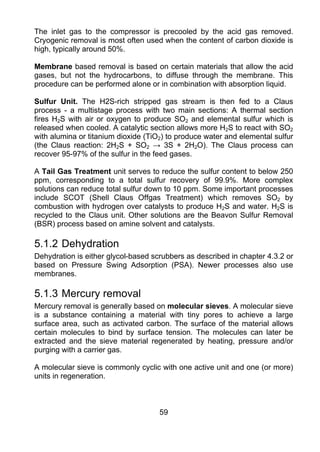
PREFACE 
This handbook has been compiled for readers with an interest in the oil and
gas industry. It is an overview of the main processes and equipment. When
we searched for a suitable introduction to be used for new engineers, I
discovered that much of the equipment is described in standards, equipment
manuals and project documentation. But little material was found to quickly
give the reader an overview of the entire upstream area, whilst still
preserving enough detail to let the engineer have an appreciation of the main
characteristics and design issues.

This book is by no means a complete description on the detailed design of
any part of this process, and many details have been omitted in order to
summarize a vast subject.

The material has been compiled from various online resources as well as
ABB and customer documents. I am grateful to my colleagues in the industry
for providing their valuable input and comments. I have included many
photos to give you, the reader an impression what typical facilities or
equipment look like. Non-ABB photo sources are given below pictures, other
pictures and illustrations are copyright ABB

                               Edition 2.3 Oslo, April 2010
                                     Håvard Devold


                            ©2006 - 2010 ABB Oil and Gas
Except as otherwise indicated, all materials, including but not limited to design, text, graphics,
other files, and the selection and arrangement thereof, are the copyright property of ABB, ALL
RIGHTS RESERVED. You may electronically copy and print a hard-copy of this document only
for non-commercial or personal use, within the organization that employs you, provided that the
materials are not modified and all copyright or proprietary notices are retained. Use of photos
and graphics and references form other sources in no way promotes or endorses these products
and services and is for illustration only. Pictures credited to Wikipedia are licensed under GNU
Free Documentation License (GFDL) or Public Domain (PD) and is published here with the
same license. Originals and full information on www.wikimedia.org.


                                                i
CONTENTS
1     Introduction............................................................................................. 1 
2     Process overview ................................................................................... 3 
   2.1      Facilities ......................................................................................... 4 
      2.1.1        Onshore ................................................................................ 5 
      2.1.2        Offshore ................................................................................ 6 
   2.2      Main process sections ................................................................... 9 
      2.2.1        Wellheads ........................................................................... 10 
      2.2.2        Manifolds/gathering ............................................................ 10 
      2.2.3        Separation........................................................................... 11 
      2.2.4        Gas compression ................................................................ 12 
      2.2.5        Metering, storage and export .............................................. 13 
   2.3      Utility systems .............................................................................. 14 
3     Reservoir and wellheads ...................................................................... 15 
   3.1      Crude oil and natural gas ............................................................ 15 
      3.1.1        Crude oil.............................................................................. 15 
      3.1.2        Natural gas.......................................................................... 17 
      3.1.3        Condensates ....................................................................... 18 
   3.2      The reservoir ............................................................................... 18 
   3.3      Exploration and drilling ................................................................ 20 
   3.4      The well ....................................................................................... 23 
      3.4.1        Well casing.......................................................................... 23 
      3.4.2        Completion .......................................................................... 25 
   3.5      Wellhead ...................................................................................... 26 
      3.5.1        Subsea wells ....................................................................... 28 
      3.5.2        Injection............................................................................... 29 
   3.6      Artificial lift ................................................................................... 29 
      3.6.1        Rod pumps.......................................................................... 30 
      3.6.2        Downhole pumps ................................................................ 30 
      3.6.3        Gas lift ................................................................................. 31 
      3.6.4        Plunger lift ........................................................................... 32 
   3.7      Well workover, intervention and stimulation. ............................... 33 
4     The oil and gas process ....................................................................... 35 
   4.1      Manifolds and gathering .............................................................. 37 
      4.1.1        Pipelines and risers ............................................................ 37 
      4.1.2        Production, test and injection manifolds ............................. 37 
   4.2      Separation ................................................................................... 38 
      4.2.1        Test separators and well test .............................................. 38 
      4.2.2        Production separators ......................................................... 38 
      4.2.3        Second stage separator ...................................................... 40 
      4.2.4        Third stage separator .......................................................... 40 
      4.2.5        Coalescer ............................................................................ 41 
                                                     ii
4.2.6        Electrostatic desalter .......................................................... 41 
      4.2.7        Water treatment .................................................................. 41 
   4.3       Gas treatment and compression ................................................. 43 
      4.3.1        Heat exchangers ................................................................. 43 
      4.3.2        Scrubbers and reboilers...................................................... 44 
      4.3.3        Compressor anti surge and performance ........................... 45 
      4.3.4        Gas treatment ..................................................................... 50 
   4.4       Oil and gas storage, metering and export ................................... 50 
      4.4.1        Fiscal metering.................................................................... 50 
      4.4.2        Storage ............................................................................... 53 
      4.4.3        Marine loading .................................................................... 54 
      4.4.4        Pipeline terminal ................................................................. 54 
5     Gas processing and LNG ..................................................................... 55 
   5.1       Gas processing............................................................................ 57 
      5.1.1        Acid gas removal ................................................................ 58 
      5.1.2        Dehydration......................................................................... 59 
      5.1.3        Mercury removal ................................................................. 59 
      5.1.4        Nitrogen rejection ................................................................ 60 
      5.1.5        NGL recovery and treatment .............................................. 60 
      5.1.6        Sales gas specifications ..................................................... 60 
   5.2       LNG ............................................................................................. 62 
      5.2.1        LNG liquefaction ................................................................. 62 
      5.2.2        Storage, transport and regasification .................................. 65 
6     Utility systems ...................................................................................... 66 
   6.1       Process Control Systems ............................................................ 66 
   6.2       Safety systems and Functional Safety ........................................ 69 
      6.2.1        Emergency Shutdown and Process Shutdown .................. 71 
      6.2.2        Fire and Gas System .......................................................... 73 
   6.3       Telemetry/SCADA ....................................................................... 75 
   6.4       Integrated Operations .................................................................. 76 
      6.4.1        Reservoir management and drilling operations .................. 77 
      6.4.2        Production optimization ...................................................... 77 
      6.4.3        Asset Optimization and maintenance Support ................... 78 
      6.4.4        Information Management Systems (IMS) ........................... 80 
      6.4.5        Training simulators ............................................................. 81 
   6.5       Power generation, distribution and drives ................................... 82 
   6.6       Flare and atmospheric ventilation ............................................... 84 
   6.7       Instrument air............................................................................... 85 
   6.8       HVAC ........................................................................................... 85 
   6.9       Water systems ............................................................................. 85 
      6.9.1        Potable water ...................................................................... 85 
      6.9.2        Seawater ............................................................................. 86 
      6.9.3        Ballast water ....................................................................... 86 
                                                       iii
6.10  Chemicals and additives.............................................................. 87 
   6.11  Telecom ....................................................................................... 89 
7     Unconventional and conventional resources and environmental effects
      92 
   7.1      Unconventional sources of oil and gas........................................ 92 
      7.1.1         Extra heavy crude ............................................................... 93 
      7.1.2         Tar sands ............................................................................ 93 
      7.1.3         Oil shale .............................................................................. 94 
      7.1.4         Shale gas and coal bed methane ....................................... 95 
      7.1.5         Coal, gas to liquids and synthetic fuel ................................ 96 
      7.1.6         Methane hydrates ............................................................... 97 
      7.1.7         Biofuels ............................................................................... 98 
      7.1.8         Hydrogen .......................................................................... 100 
   7.2      Emissions and environmental effects ........................................ 100 
      7.2.1         Indigenous emissions ....................................................... 101 
      7.2.2         Greenhouse emissions ..................................................... 101 
      7.2.3         Carbon capture and sequestration ................................... 104 
8     Units ................................................................................................... 107 
9     Acronyms ........................................................................................... 109 
10  References ......................................................................................... 111 
11  Index................................................................................................... 112 


                                                        iv
1 Introduction
Oil has been used for lighting purposes for many thousands of years. In
areas where oil is found in shallow reservoirs, seeps of crude oil or gas may
naturally develop, and some oil could simply be collected from seepage or
tar ponds.

Historically, we know of the tales of eternal fires where oil and gas seeps
would ignite and burn. One example from is the site where the famous oracle
of Delphi was built around 1000 B.C. Written sources from 500 B.C. describe
how the Chinese used natural gas to boil water.

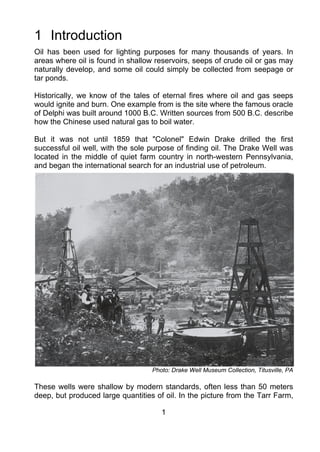
But it was not until 1859 that "Colonel" Edwin Drake drilled the first
successful oil well, with the sole purpose of finding oil. The Drake Well was
located in the middle of quiet farm country in north-western Pennsylvania,
and began the international search for an industrial use of petroleum.


                                   Photo: Drake Well Museum Collection, Titusville, PA

These wells were shallow by modern standards, often less than 50 meters
deep, but produced large quantities of oil. In the picture from the Tarr Farm,

                                      1
Oil Creek Valley, The Phillips well on the right initially produced 4000 barrels
a day in October 1861 and the Woodford well on the left came in at 1500
barrels a day in July, 1862.

The oil was collected in the wooden tank pictured, in the foreground. As you
will no doubt notice, there are many different sized barrels in the background
of the picture. At this time, barrel size had not been standardized, which
made terms like "Oil is selling at $5 per barrel" very confusing (today a barrel
is 159 liters, see units at the back). But even in those days, overproduction
was something to be avoided. When the "Empire well" was completed in
September 1861, it gave 3,000 barrels per day, flooding the market, and the
price of oil plummeted to 10 cents a barrel.

Soon, oil had replaced most other fuels for motorized transport. The
automobile industry developed at the end of the 19th century, and quickly
adopted oil as fuel. Gasoline engines were essential for designing successful
aircraft. Ships driven by oil could move up to twice as fast as their coal
powered counterparts, a vital military advantage. Gas was burned off or left
in the ground.

Despite attempts at gas transportation as far back as 1821, it was not until
after the World War II that welding techniques, pipe rolling, and metallurgical
advances allowed for the construction of reliable long distance pipelines,
resulting in a natural gas industry boom. At the same time the petrochemical
industry with its new plastic materials quickly increased production. Even
now gas production is gaining market share as LNG provides an economical
way of transporting the gas from even the remotest sites.

With oil prices of 70 dollars a barrel or more, even more difficult to access
sources have become economically viable. Such sources include tar sands
in Venezuela and Canada as well as oil shales and coal bed methane,.
Synthetic diesel (syndiesel) from natural gas and biological sources
(biodiesel, ethanol) have seen a dramatic increase over the last 10 years.
These sources may eventually more than triple the potential reserves of
hydrocarbon fuels.


                                       2
2 Process overview
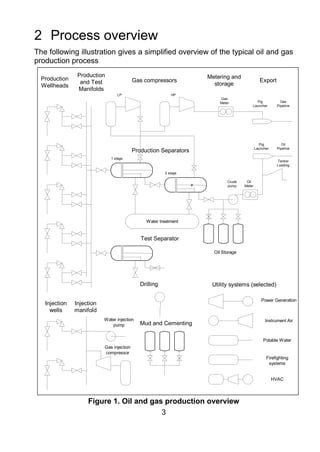
The following illustration gives a simplified overview of the typical oil and gas
production process
                Production                                             Metering and
  Production                               Gas compressors                                        Export
                 and Test                                                storage
  Wellheads
                Manifolds
                                 LP                         HP
                                                                           Gas
                                                                           Meter             Pig             Gas
                                                                                           Launcher        Pipeline


                                                                                                 Pig          Oil
                                                                                               Launcher    Pipeline
                                           Production Separators
                              1 stage
                                                                                                           Tanker
                                                                                                           Loading

                                                         2 stage

                                                                               Crude    Oil
                                                                   ø           pump    Meter


                                                Water treatment


                                              Test Separator

                                                                         Oil Storage


                                              Drilling                  Utility systems (selected)

                                                                                                  Power Generation
   Injection   Injection
     wells     manifold
                           Water injection                                                          Instrument Air
                              pump            Mud and Cementing

                                                                                                   Potable Water
                           Gas injection
                           compressor
                                                                                                     Firefighting
                                                                                                      systems


                                                                                                          HVAC


                    Figure 1. Oil and gas production overview
                                         3
Today oil and gas is produced in almost every part of the world, from the
small 100 barrels a day private wells, to the large bore 4000 barrel a day
wells; in shallow 20 meter deep reservoirs to 3000 meter deep wells in more
than 2000 meters of water; in 10,000 dollar onshore wells to 10 billion dollar
offshore developments. Despite this range many parts of the process are
quite similar in principle.

At the left side, we find the wellheads. They feed into production and test
manifolds. In a distributed production system this would be called the
gathering system. The remainder of the diagram is the actual process, often
called the Gas Oil Separation Plant (GOSP). While there are oil or gas only
installations, more often the well-stream will consist of a full range of
hydrocarbons from gas (methane, butane, propane etc.), condensates
(medium density hydrocarbons) to crude oil. With this well flow we will also
get a variety of unwanted components such as water, carbon dioxide, salts,
sulfur and sand. The purpose of the GOSP is to process the well flow into
clean marketable products: oil, natural gas or condensates. Also included
are a number of utility systems, not part of the actual process, but providing
energy, water, air or some other utility to the plant.

2.1 Facilities


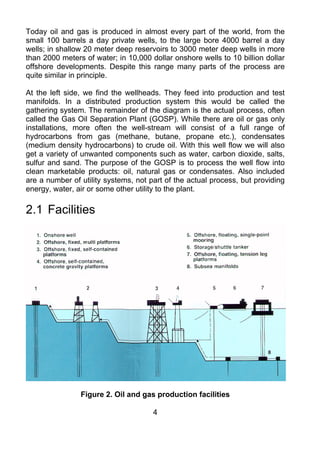
                Figure 2. Oil and gas production facilities

                                      4
2.1.1 Onshore
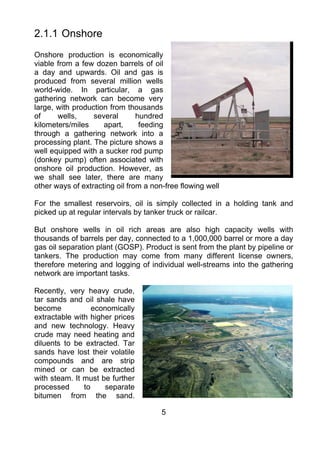
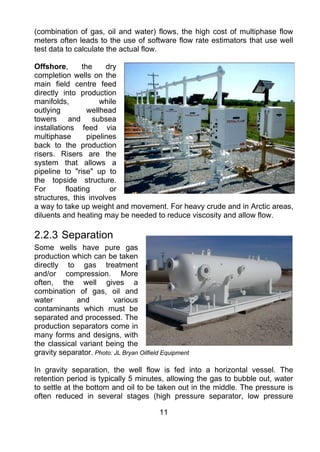
Onshore production is economically
viable from a few dozen barrels of oil
a day and upwards. Oil and gas is
produced from several million wells
world-wide. In particular, a gas
gathering network can become very
large, with production from thousands
of     wells,     several       hundred
kilometers/miles     apart,      feeding
through a gathering network into a
processing plant. The picture shows a
well equipped with a sucker rod pump
(donkey pump) often associated with
onshore oil production. However, as
we shall see later, there are many
other ways of extracting oil from a non-free flowing well

For the smallest reservoirs, oil is simply collected in a holding tank and
picked up at regular intervals by tanker truck or railcar.

But onshore wells in oil rich areas are also high capacity wells with
thousands of barrels per day, connected to a 1,000,000 barrel or more a day
gas oil separation plant (GOSP). Product is sent from the plant by pipeline or
tankers. The production may come from many different license owners,
therefore metering and logging of individual well-streams into the gathering
network are important tasks.

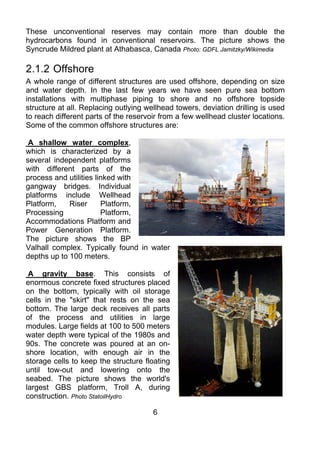
Recently, very heavy crude,
tar sands and oil shale have
become            economically
extractable with higher prices
and new technology. Heavy
crude may need heating and
diluents to be extracted. Tar
sands have lost their volatile
compounds and are strip
mined or can be extracted
with steam. It must be further
processed      to    separate
bitumen from the sand.

                                       5
These unconventional reserves may contain more than double the
hydrocarbons found in conventional reservoirs. The picture shows the
Syncrude Mildred plant at Athabasca, Canada Photo: GDFL Jamitzky/Wikimedia

2.1.2 Offshore
A whole range of different structures are used offshore, depending on size
and water depth. In the last few years we have seen pure sea bottom
installations with multiphase piping to shore and no offshore topside
structure at all. Replacing outlying wellhead towers, deviation drilling is used
to reach different parts of the reservoir from a few wellhead cluster locations.
Some of the common offshore structures are:

 A shallow water complex,
which is characterized by a
several independent platforms
with different parts of the
process and utilities linked with
gangway bridges. Individual
platforms include Wellhead
Platform,    Riser      Platform,
Processing              Platform,
Accommodations Platform and
Power Generation Platform.
The picture shows the BP
Valhall complex. Typically found in water
depths up to 100 meters.

 A gravity base. This consists of
enormous concrete fixed structures placed
on the bottom, typically with oil storage
cells in the "skirt" that rests on the sea
bottom. The large deck receives all parts
of the process and utilities in large
modules. Large fields at 100 to 500 meters
water depth were typical of the 1980s and
90s. The concrete was poured at an on-
shore location, with enough air in the
storage cells to keep the structure floating
until tow-out and lowering onto the
seabed. The picture shows the world's
largest GBS platform, Troll A, during
construction. Photo StatoilHydro

                                       6
Compliant towers are much like fixed platforms. They consist of a narrow
tower, attached to a foundation on the seafloor and extending up to the
platform. This tower is flexible, as opposed to the relatively rigid legs of a
fixed platform. This flexibility allows them to operate in much deeper water,
as they can 'absorb' much of the pressure exerted by the wind and sea.
Compliant towers are used between 500 and 1000 meters water depth.
Floating production, where all
topside systems are located on
a floating structure with dry or
subsea wells. Some floaters are:
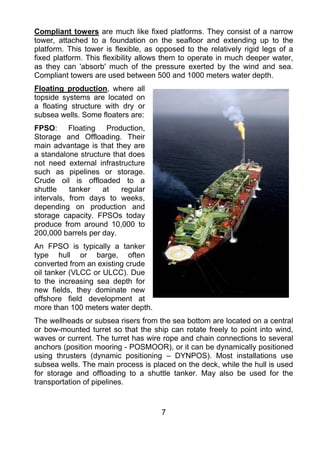
FPSO: Floating Production,
Storage and Offloading. Their
main advantage is that they are
a standalone structure that does
not need external infrastructure
such as pipelines or storage.
Crude oil is offloaded to a
shuttle    tanker   at   regular
intervals, from days to weeks,
depending on production and
storage capacity. FPSOs today
produce from around 10,000 to
200,000 barrels per day.
An FPSO is typically a tanker
type hull or barge, often
converted from an existing crude
oil tanker (VLCC or ULCC). Due
to the increasing sea depth for
new fields, they dominate new
offshore field development at
more than 100 meters water depth.
The wellheads or subsea risers from the sea bottom are located on a central
or bow-mounted turret so that the ship can rotate freely to point into wind,
waves or current. The turret has wire rope and chain connections to several
anchors (position mooring - POSMOOR), or it can be dynamically positioned
using thrusters (dynamic positioning – DYNPOS). Most installations use
subsea wells. The main process is placed on the deck, while the hull is used
for storage and offloading to a shuttle tanker. May also be used for the
transportation of pipelines.


                                      7
FPSOs with additional processing and systems such as drilling and
production and stranded gas LNG production are planned.
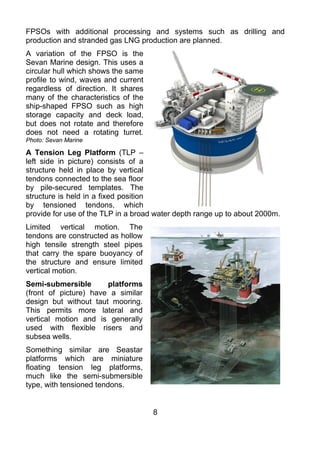
A variation of the FPSO is the
Sevan Marine design. This uses a
circular hull which shows the same
profile to wind, waves and current
regardless of direction. It shares
many of the characteristics of the
ship-shaped FPSO such as high
storage capacity and deck load,
but does not rotate and therefore
does not need a rotating turret.
Photo: Sevan Marine

A Tension Leg Platform (TLP –
left side in picture) consists of a
structure held in place by vertical
tendons connected to the sea floor
by pile-secured templates. The
structure is held in a fixed position
by tensioned tendons, which
provide for use of the TLP in a broad water depth range up to about 2000m.
Limited vertical motion. The
tendons are constructed as hollow
high tensile strength steel pipes
that carry the spare buoyancy of
the structure and ensure limited
vertical motion.
Semi-submersible       platforms
(front of picture) have a similar
design but without taut mooring.
This permits more lateral and
vertical motion and is generally
used with flexible risers and
subsea wells.
Something similar are Seastar
platforms which are miniature
floating tension leg platforms,
much like the semi-submersible
type, with tensioned tendons.


                                     8
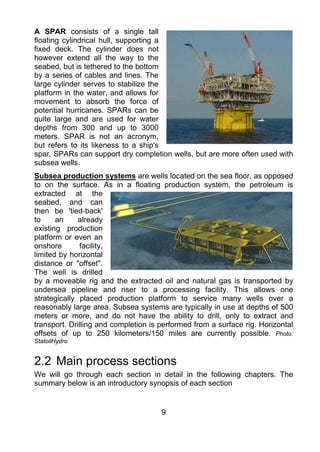
A SPAR consists of a single tall
floating cylindrical hull, supporting a
fixed deck. The cylinder does not
however extend all the way to the
seabed, but is tethered to the bottom
by a series of cables and lines. The
large cylinder serves to stabilize the
platform in the water, and allows for
movement to absorb the force of
potential hurricanes. SPARs can be
quite large and are used for water
depths from 300 and up to 3000
meters. SPAR is not an acronym,
but refers to its likeness to a ship's
spar. SPARs can support dry completion wells, but are more often used with
subsea wells.
Subsea production systems are wells located on the sea floor, as opposed
to on the surface. As in a floating production system, the petroleum is
extracted at the
seabed, and can
then be 'tied-back'
to     an     already
existing production
platform or even an
onshore       facility,
limited by horizontal
distance or "offset".
The well is drilled
by a moveable rig and the extracted oil and natural gas is transported by
undersea pipeline and riser to a processing facility. This allows one
strategically placed production platform to service many wells over a
reasonably large area. Subsea systems are typically in use at depths of 500
meters or more, and do not have the ability to drill, only to extract and
transport. Drilling and completion is performed from a surface rig. Horizontal
offsets of up to 250 kilometers/150 miles are currently possible. Photo:
StatoilHydro


2.2 Main process sections
We will go through each section in detail in the following chapters. The
summary below is an introductory synopsis of each section


                                      9
2.2.1 Wellheads
The wellhead sits on top of the actual oil or gas well leading down to the
reservoir. A wellhead may also be an injection well, used to inject water or
gas back into the reservoir to maintain pressure and levels to maximize
production.

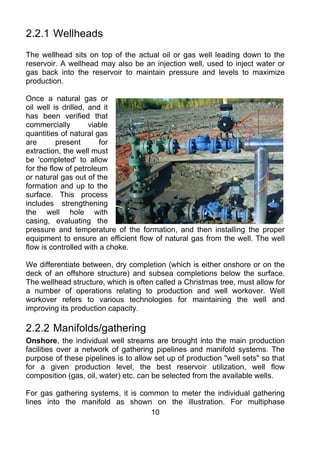
Once a natural gas or
oil well is drilled, and it
has been verified that
commercially         viable
quantities of natural gas
are       present       for
extraction, the well must
be 'completed' to allow
for the flow of petroleum
or natural gas out of the
formation and up to the
surface. This process
includes strengthening
the well hole with
casing, evaluating the
pressure and temperature of the formation, and then installing the proper
equipment to ensure an efficient flow of natural gas from the well. The well
flow is controlled with a choke.

We differentiate between, dry completion (which is either onshore or on the
deck of an offshore structure) and subsea completions below the surface.
The wellhead structure, which is often called a Christmas tree, must allow for
a number of operations relating to production and well workover. Well
workover refers to various technologies for maintaining the well and
improving its production capacity.

2.2.2 Manifolds/gathering
Onshore, the individual well streams are brought into the main production
facilities over a network of gathering pipelines and manifold systems. The
purpose of these pipelines is to allow set up of production "well sets" so that
for a given production level, the best reservoir utilization, well flow
composition (gas, oil, water) etc. can be selected from the available wells.

For gas gathering systems, it is common to meter the individual gathering
lines into the manifold as shown on the illustration. For multiphase
                                    10
(combination of gas, oil and water) flows, the high cost of multiphase flow
meters often leads to the use of software flow rate estimators that use well
test data to calculate the actual flow.

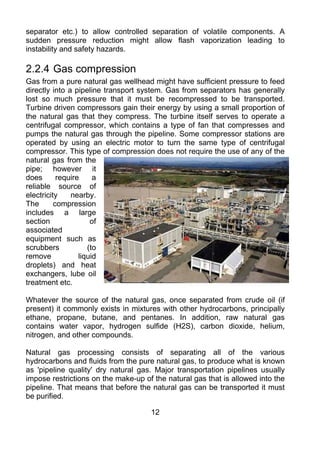
Offshore,        the     dry
completion wells on the
main field centre feed
directly into production
manifolds,             while
outlying           wellhead
towers and subsea
installations feed via
multiphase         pipelines
back to the production
risers. Risers are the
system that allows a
pipeline to "rise" up to
the topside structure.
For        floating       or
structures, this involves
a way to take up weight and movement. For heavy crude and in Arctic areas,
diluents and heating may be needed to reduce viscosity and allow flow.

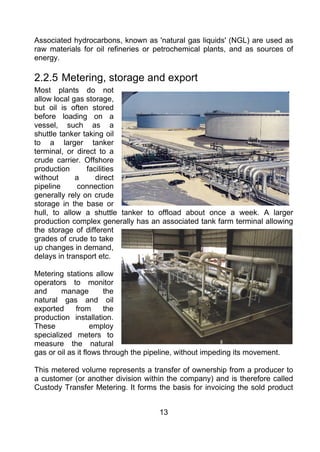
2.2.3 Separation
Some wells have pure gas
production which can be taken
directly to gas treatment
and/or compression. More
often, the well gives a
combination of gas, oil and
water        and          various
contaminants which must be
separated and processed. The
production separators come in
many forms and designs, with
the classical variant being the
gravity separator. Photo: JL Bryan Oilfield Equipment

In gravity separation, the well flow is fed into a horizontal vessel. The
retention period is typically 5 minutes, allowing the gas to bubble out, water
to settle at the bottom and oil to be taken out in the middle. The pressure is
often reduced in several stages (high pressure separator, low pressure

                                          11
separator etc.) to allow controlled separation of volatile components. A
sudden pressure reduction might allow flash vaporization leading to
instability and safety hazards.

2.2.4 Gas compression
Gas from a pure natural gas wellhead might have sufficient pressure to feed
directly into a pipeline transport system. Gas from separators has generally
lost so much pressure that it must be recompressed to be transported.
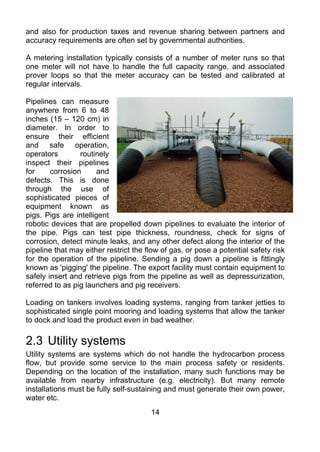
Turbine driven compressors gain their energy by using a small proportion of
the natural gas that they compress. The turbine itself serves to operate a
centrifugal compressor, which contains a type of fan that compresses and
pumps the natural gas through the pipeline. Some compressor stations are
operated by using an electric motor to turn the same type of centrifugal
compressor. This type of compression does not require the use of any of the
natural gas from the
pipe; however it
does       require     a
reliable source of
electricity    nearby.
The       compression
includes a large
section               of
associated
equipment such as
scrubbers            (to
remove            liquid
droplets) and heat
exchangers, lube oil
treatment etc.

Whatever the source of the natural gas, once separated from crude oil (if
present) it commonly exists in mixtures with other hydrocarbons, principally
ethane, propane, butane, and pentanes. In addition, raw natural gas
contains water vapor, hydrogen sulfide (H2S), carbon dioxide, helium,
nitrogen, and other compounds.

Natural gas processing consists of separating all of the various
hydrocarbons and fluids from the pure natural gas, to produce what is known
as 'pipeline quality' dry natural gas. Major transportation pipelines usually
impose restrictions on the make-up of the natural gas that is allowed into the
pipeline. That means that before the natural gas can be transported it must
be purified.

                                     12
Associated hydrocarbons, known as 'natural gas liquids' (NGL) are used as
raw materials for oil refineries or petrochemical plants, and as sources of
energy.

2.2.5 Metering, storage and export
Most plants do not
allow local gas storage,
but oil is often stored
before loading on a
vessel, such as a
shuttle tanker taking oil
to a larger tanker
terminal, or direct to a
crude carrier. Offshore
production      facilities
without      a     direct
pipeline      connection
generally rely on crude
storage in the base or
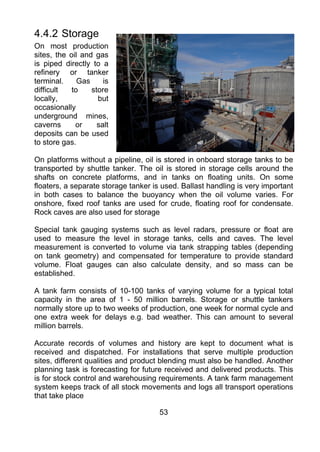
hull, to allow a shuttle tanker to offload about once a week. A larger
production complex generally has an associated tank farm terminal allowing
the storage of different
grades of crude to take
up changes in demand,
delays in transport etc.

Metering stations allow
operators to monitor
and     manage         the
natural gas and oil
exported     from      the
production installation.
These              employ
specialized meters to
measure the natural
gas or oil as it flows through the pipeline, without impeding its movement.

This metered volume represents a transfer of ownership from a producer to
a customer (or another division within the company) and is therefore called
Custody Transfer Metering. It forms the basis for invoicing the sold product


                                      13
and also for production taxes and revenue sharing between partners and
accuracy requirements are often set by governmental authorities.

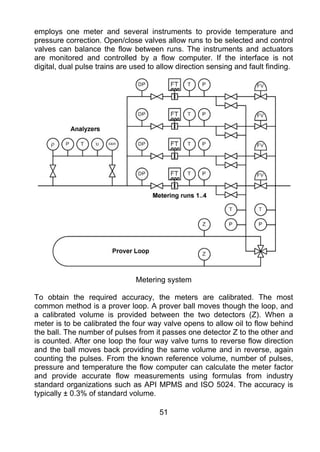
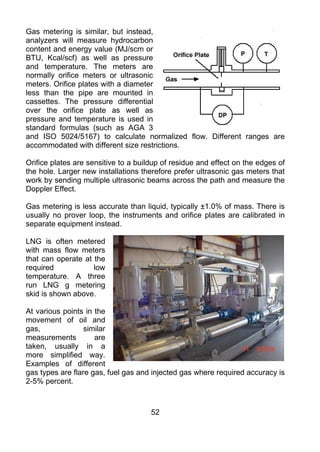
A metering installation typically consists of a number of meter runs so that
one meter will not have to handle the full capacity range, and associated
prover loops so that the meter accuracy can be tested and calibrated at
regular intervals.

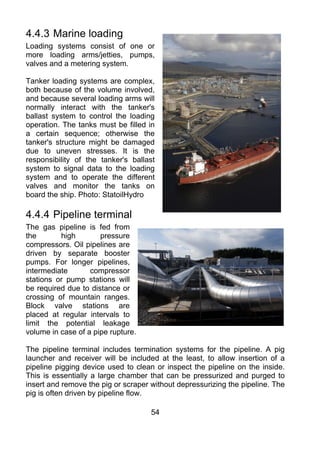
Pipelines can measure
anywhere from 6 to 48
inches (15 – 120 cm) in
diameter. In order to
ensure their efficient
and safe operation,
operators        routinely
inspect their pipelines
for     corrosion      and
defects. This is done
through the use of
sophisticated pieces of
equipment known as
pigs. Pigs are intelligent
robotic devices that are propelled down pipelines to evaluate the interior of
the pipe. Pigs can test pipe thickness, roundness, check for signs of
corrosion, detect minute leaks, and any other defect along the interior of the
pipeline that may either restrict the flow of gas, or pose a potential safety risk
for the operation of the pipeline. Sending a pig down a pipeline is fittingly
known as 'pigging' the pipeline. The export facility must contain equipment to
safely insert and retrieve pigs from the pipeline as well as depressurization,
referred to as pig launchers and pig receivers.

Loading on tankers involves loading systems, ranging from tanker jetties to
sophisticated single point mooring and loading systems that allow the tanker
to dock and load the product even in bad weather.

2.3 Utility systems
Utility systems are systems which do not handle the hydrocarbon process
flow, but provide some service to the main process safety or residents.
Depending on the location of the installation, many such functions may be
available from nearby infrastructure (e.g. electricity). But many remote
installations must be fully self-sustaining and must generate their own power,
water etc.
                                       14
3 Reservoir and wellheads
There are three main types of conventional wells. The most common is an oil
well with associated gas. Natural gas wells are drilled specifically for natural
gas, and contain little or no oil. Condensate wells contain natural gas, as well
as a liquid condensate. This condensate is a liquid hydrocarbon mixture that
is often separated from the natural gas either at the wellhead, or during the
processing of the natural gas. Depending on the type of well that is being
drilled, completion may differ slightly. It is important to remember that natural
gas, being lighter than air, will naturally rise to the surface of a well.
Consequently, lifting equipment and well treatment are not necessary in
many natural gas and condensate wells, while for oil wells many types of
artificial lift might be installed, particularly as the reservoir pressure falls
during years of production.


3.1 Crude oil and natural gas
3.1.1 Crude oil
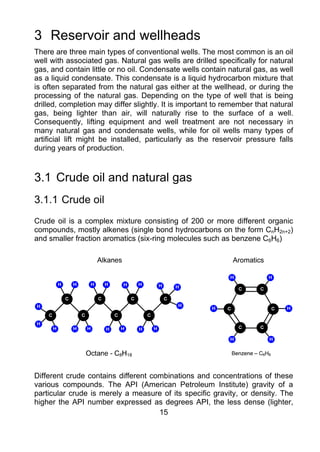
Crude oil is a complex mixture consisting of 200 or more different organic
compounds, mostly alkenes (single bond hydrocarbons on the form CnH2n+2)
and smaller fraction aromatics (six-ring molecules such as benzene C6H6)


Different crude contains different combinations and concentrations of these
various compounds. The API (American Petroleum Institute) gravity of a
particular crude is merely a measure of its specific gravity, or density. The
higher the API number expressed as degrees API, the less dense (lighter,
                                     15
thinner) the crude. This means, put simply, that the lower the degrees API,
the denser (heavier, thicker) the crude. Crude from different fields and from
different formations within a field can be similar in composition or be
significantly different.

In addition to API grade and hydrocarbons, crude is characterized for other
undesired elements like sulfur etc, which is regulated and needs to be
removed.

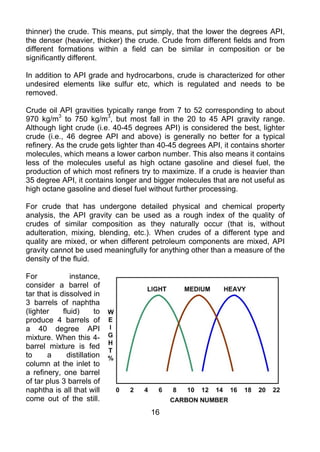
Crude oil API gravities typically range from 7 to 52 corresponding to about
970 kg/m3 to 750 kg/m3, but most fall in the 20 to 45 API gravity range.
Although light crude (i.e. 40-45 degrees API) is considered the best, lighter
crude (i.e., 46 degree API and above) is generally no better for a typical
refinery. As the crude gets lighter than 40-45 degrees API, it contains shorter
molecules, which means a lower carbon number. This also means it contains
less of the molecules useful as high octane gasoline and diesel fuel, the
production of which most refiners try to maximize. If a crude is heavier than
35 degree API, it contains longer and bigger molecules that are not useful as
high octane gasoline and diesel fuel without further processing.

For crude that has undergone detailed physical and chemical property
analysis, the API gravity can be used as a rough index of the quality of
crudes of similar composition as they naturally occur (that is, without
adulteration, mixing, blending, etc.). When crudes of a different type and
quality are mixed, or when different petroleum components are mixed, API
gravity cannot be used meaningfully for anything other than a measure of the
density of the fluid.

For             instance,
consider a barrel of
tar that is dissolved in
3 barrels of naphtha
(lighter     fluid)       to
produce 4 barrels of
a 40 degree API
mixture. When this 4-
barrel mixture is fed
to     a       distillation
column at the inlet to
a refinery, one barrel
of tar plus 3 barrels of
naphtha is all that will
come out of the still.
                                      16
On the other hand, 4 barrels of a naturally occurring 40 degree API crude fed
to the distillation column at the refinery, could come out of the still as 1.4
barrels of gasoline and naphtha (typically C8H18), 0.6 barrels of kerosene (jet
fuel C12-15 ), 0.7 barrels of diesel fuel (average C12H26), 0.5 barrels of heavy
distillate (C20-70), 0.3 barrels of lubricating stock, and 0.5 barrels of residue
(bitumen, mainly poly-cyclic aromatics).

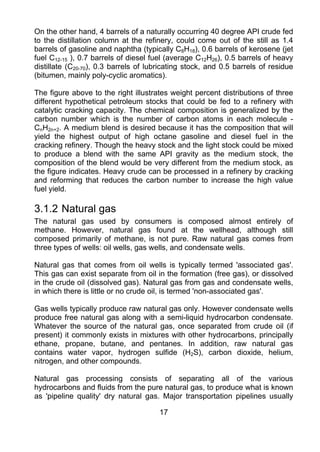
The figure above to the right illustrates weight percent distributions of three
different hypothetical petroleum stocks that could be fed to a refinery with
catalytic cracking capacity. The chemical composition is generalized by the
carbon number which is the number of carbon atoms in each molecule -
CnH2n+2. A medium blend is desired because it has the composition that will
yield the highest output of high octane gasoline and diesel fuel in the
cracking refinery. Though the heavy stock and the light stock could be mixed
to produce a blend with the same API gravity as the medium stock, the
composition of the blend would be very different from the medium stock, as
the figure indicates. Heavy crude can be processed in a refinery by cracking
and reforming that reduces the carbon number to increase the high value
fuel yield.

3.1.2 Natural gas
The natural gas used by consumers is composed almost entirely of
methane. However, natural gas found at the wellhead, although still
composed primarily of methane, is not pure. Raw natural gas comes from
three types of wells: oil wells, gas wells, and condensate wells.

Natural gas that comes from oil wells is typically termed 'associated gas'.
This gas can exist separate from oil in the formation (free gas), or dissolved
in the crude oil (dissolved gas). Natural gas from gas and condensate wells,
in which there is little or no crude oil, is termed 'non-associated gas'.

Gas wells typically produce raw natural gas only. However condensate wells
produce free natural gas along with a semi-liquid hydrocarbon condensate.
Whatever the source of the natural gas, once separated from crude oil (if
present) it commonly exists in mixtures with other hydrocarbons, principally
ethane, propane, butane, and pentanes. In addition, raw natural gas
contains water vapor, hydrogen sulfide (H2S), carbon dioxide, helium,
nitrogen, and other compounds.

Natural gas processing consists of separating all of the various
hydrocarbons and fluids from the pure natural gas, to produce what is known
as 'pipeline quality' dry natural gas. Major transportation pipelines usually

                                       17
impose restrictions on the composition of the natural gas that is allowed into
the pipeline and measure energy content in kJ/kg (also called calorific value
or Wobbe index).

3.1.3 Condensates
While the ethane, propane, butane, and pentanes must be removed from
natural gas, this does not mean that they are all 'waste products'. In fact,
associated hydrocarbons, known as 'natural gas liquids' (NGL) can be very
valuable by-products of natural gas processing. NGLs include ethane,
propane, butane, iso-butane, and natural gasoline. These are sold
separately and have a variety of different uses such as raw materials for oil
refineries or petrochemical plants, as sources of energy, and for enhancing
oil recovery in oil wells. Condensates are also useful as diluents for heavy
crude, see below.

3.2 The reservoir
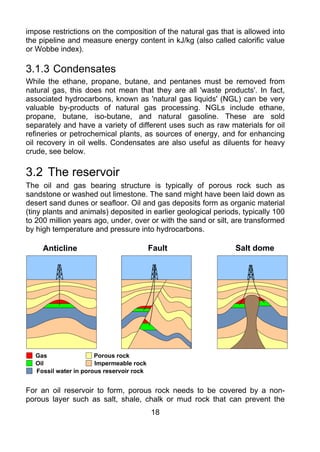
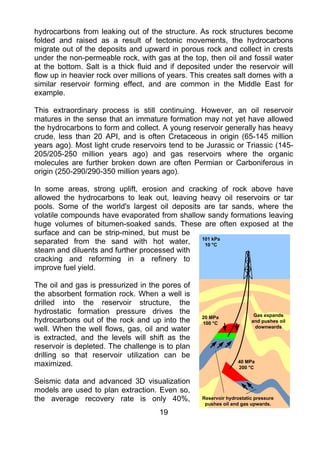
The oil and gas bearing structure is typically of porous rock such as
sandstone or washed out limestone. The sand might have been laid down as
desert sand dunes or seafloor. Oil and gas deposits form as organic material
(tiny plants and animals) deposited in earlier geological periods, typically 100
to 200 million years ago, under, over or with the sand or silt, are transformed
by high temperature and pressure into hydrocarbons.

     Anticline                            Fault                 Salt dome


  Gas                 Porous rock
  Oil                 Impermeable rock
  Fossil water in porous reservoir rock


For an oil reservoir to form, porous rock needs to be covered by a non-
porous layer such as salt, shale, chalk or mud rock that can prevent the
                                          18
hydrocarbons from leaking out of the structure. As rock structures become
folded and raised as a result of tectonic movements, the hydrocarbons
migrate out of the deposits and upward in porous rock and collect in crests
under the non-permeable rock, with gas at the top, then oil and fossil water
at the bottom. Salt is a thick fluid and if deposited under the reservoir will
flow up in heavier rock over millions of years. This creates salt domes with a
similar reservoir forming effect, and are common in the Middle East for
example.

This extraordinary process is still continuing. However, an oil reservoir
matures in the sense that an immature formation may not yet have allowed
the hydrocarbons to form and collect. A young reservoir generally has heavy
crude, less than 20 API, and is often Cretaceous in origin (65-145 million
years ago). Most light crude reservoirs tend to be Jurassic or Triassic (145-
205/205-250 million years ago) and gas reservoirs where the organic
molecules are further broken down are often Permian or Carboniferous in
origin (250-290/290-350 million years ago).

In some areas, strong uplift, erosion and cracking of rock above have
allowed the hydrocarbons to leak out, leaving heavy oil reservoirs or tar
pools. Some of the world's largest oil deposits are tar sands, where the
volatile compounds have evaporated from shallow sandy formations leaving
huge volumes of bitumen-soaked sands. These are often exposed at the
surface and can be strip-mined, but must be
separated from the sand with hot water,        101 kPa
                                                10 °C
steam and diluents and further processed with
cracking and reforming in a refinery to
improve fuel yield.

The oil and gas is pressurized in the pores of
the absorbent formation rock. When a well is
drilled into the reservoir structure, the
hydrostatic formation pressure drives the                              Gas expands
hydrocarbons out of the rock and up into the      20 MPa
                                                  100 °C              and pushes oil
well. When the well flows, gas, oil and water                          downwards

is extracted, and the levels will shift as the
reservoir is depleted. The challenge is to plan
drilling so that reservoir utilization can be
maximized.                                                       40 MPa
                                                                 200 °C

Seismic data and advanced 3D visualization
models are used to plan extraction. Even so,
the average recovery rate is only 40%,            Reservoir hydrostatic pressure
                                                   pushes oil and gas upwards.
                                     19
leaving 60% of the hydrocarbons trapped in the reservoir. The best
reservoirs with advanced Enhanced Oil Recovery (EOR) allow up to 70%.
Reservoirs can be quite complex, with many folds and several layers of
hydrocarbon-bearing rock above each other (in some areas more than 10).
Modern wells are drilled with large horizontal offsets to reach different parts
of the structure and with multiple completions so that one well can produce
from several locations.

3.3 Exploration and drilling
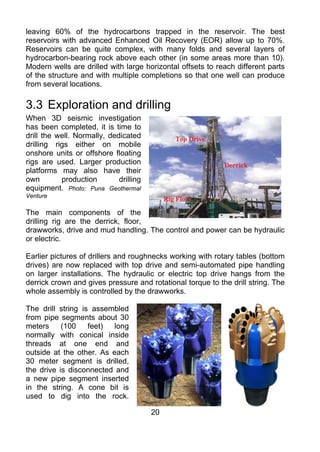
When 3D seismic investigation
has been completed, it is time to
drill the well. Normally, dedicated
drilling rigs either on mobile
onshore units or offshore floating
rigs are used. Larger production
platforms may also have their
own        production        drilling
equipment. Photo: Puna Geothermal
Venture

The main components of the
drilling rig are the derrick, floor,
drawworks, drive and mud handling. The control and power can be hydraulic
or electric.

Earlier pictures of drillers and roughnecks working with rotary tables (bottom
drives) are now replaced with top drive and semi-automated pipe handling
on larger installations. The hydraulic or electric top drive hangs from the
derrick crown and gives pressure and rotational torque to the drill string. The
whole assembly is controlled by the drawworks.

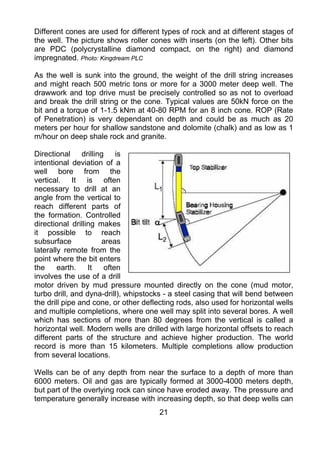
The drill string is assembled
from pipe segments about 30
meters     (100    feet)  long
normally with conical inside
threads at one end and
outside at the other. As each
30 meter segment is drilled,
the drive is disconnected and
a new pipe segment inserted
in the string. A cone bit is
used to dig into the rock.

                                        20
Different cones are used for different types of rock and at different stages of
the well. The picture shows roller cones with inserts (on the left). Other bits
are PDC (polycrystalline diamond compact, on the right) and diamond
impregnated. Photo: Kingdream PLC

As the well is sunk into the ground, the weight of the drill string increases
and might reach 500 metric tons or more for a 3000 meter deep well. The
drawwork and top drive must be precisely controlled so as not to overload
and break the drill string or the cone. Typical values are 50kN force on the
bit and a torque of 1-1.5 kNm at 40-80 RPM for an 8 inch cone. ROP (Rate
of Penetration) is very dependant on depth and could be as much as 20
meters per hour for shallow sandstone and dolomite (chalk) and as low as 1
m/hour on deep shale rock and granite.

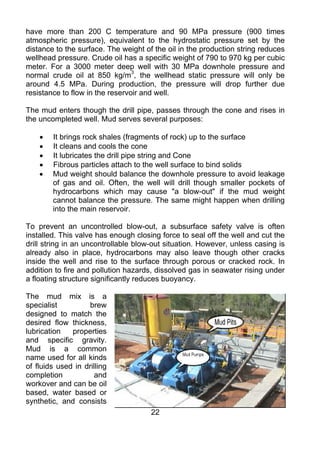
Directional drilling is
intentional deviation of a
well bore from the
vertical. It is often
necessary to drill at an
angle from the vertical to
reach different parts of
the formation. Controlled
directional drilling makes
it possible to reach
subsurface            areas
laterally remote from the
point where the bit enters
the     earth.    It  often
involves the use of a drill
motor driven by mud pressure mounted directly on the cone (mud motor,
turbo drill, and dyna-drill), whipstocks - a steel casing that will bend between
the drill pipe and cone, or other deflecting rods, also used for horizontal wells
and multiple completions, where one well may split into several bores. A well
which has sections of more than 80 degrees from the vertical is called a
horizontal well. Modern wells are drilled with large horizontal offsets to reach
different parts of the structure and achieve higher production. The world
record is more than 15 kilometers. Multiple completions allow production
from several locations.

Wells can be of any depth from near the surface to a depth of more than
6000 meters. Oil and gas are typically formed at 3000-4000 meters depth,
but part of the overlying rock can since have eroded away. The pressure and
temperature generally increase with increasing depth, so that deep wells can
                                       21
have more than 200 C temperature and 90 MPa pressure (900 times
atmospheric pressure), equivalent to the hydrostatic pressure set by the
distance to the surface. The weight of the oil in the production string reduces
wellhead pressure. Crude oil has a specific weight of 790 to 970 kg per cubic
meter. For a 3000 meter deep well with 30 MPa downhole pressure and
normal crude oil at 850 kg/m3, the wellhead static pressure will only be
around 4.5 MPa. During production, the pressure will drop further due
resistance to flow in the reservoir and well.

The mud enters though the drill pipe, passes through the cone and rises in
the uncompleted well. Mud serves several purposes:

    •   It brings rock shales (fragments of rock) up to the surface
    •   It cleans and cools the cone
    •   It lubricates the drill pipe string and Cone
    •   Fibrous particles attach to the well surface to bind solids
    •   Mud weight should balance the downhole pressure to avoid leakage
        of gas and oil. Often, the well will drill though smaller pockets of
        hydrocarbons which may cause "a blow-out" if the mud weight
        cannot balance the pressure. The same might happen when drilling
        into the main reservoir.

To prevent an uncontrolled blow-out, a subsurface safety valve is often
installed. This valve has enough closing force to seal off the well and cut the
drill string in an uncontrollable blow-out situation. However, unless casing is
already also in place, hydrocarbons may also leave though other cracks
inside the well and rise to the surface through porous or cracked rock. In
addition to fire and pollution hazards, dissolved gas in seawater rising under
a floating structure significantly reduces buoyancy.

The mud mix is a
specialist          brew
designed to match the
desired flow thickness,
lubrication   properties
and specific gravity.
Mud is a common
name used for all kinds
of fluids used in drilling
completion            and
workover and can be oil
based, water based or
synthetic, and consists
                                      22
of powdered clays such as bentonite, oil, water and various additives and
chemicals such as caustic soda, barite (sulfurous mineral), lignite (brown
coal), polymers and emulsifiers. Photo: OSHA.gov

A special high density mud called Kill Fluid is used to shut down a well for
workover.

Mud is recirculated. Coarse rock shales are separated in a shale shaker
before it is passed though finer filters and recalibrated with new additives
before returning to the mud holding tanks

3.4 The well
When the well has been drilled, it must be completed. Completing a well
consists of a number of steps, such as installing the well casing, completion,
installing the wellhead, and installing lifting equipment or treating the
formation should that be required.

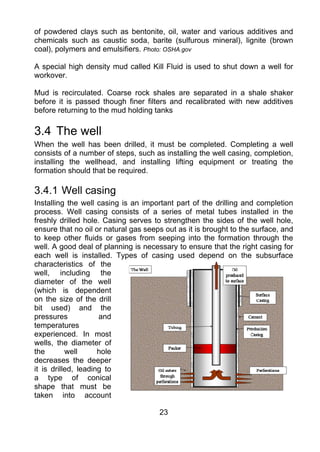
3.4.1 Well casing
Installing the well casing is an important part of the drilling and completion
process. Well casing consists of a series of metal tubes installed in the
freshly drilled hole. Casing serves to strengthen the sides of the well hole,
ensure that no oil or natural gas seeps out as it is brought to the surface, and
to keep other fluids or gases from seeping into the formation through the
well. A good deal of planning is necessary to ensure that the right casing for
each well is installed. Types of casing used depend on the subsurface
characteristics of the
well, including the
diameter of the well
(which is dependent
on the size of the drill
bit used) and the
pressures            and
temperatures
experienced. In most
wells, the diameter of
the        well      hole
decreases the deeper
it is drilled, leading to
a type of conical
shape that must be
taken into account

                                      23
when installing casing. The casing is normally cemented in place.                Ill:
wikipedia.org

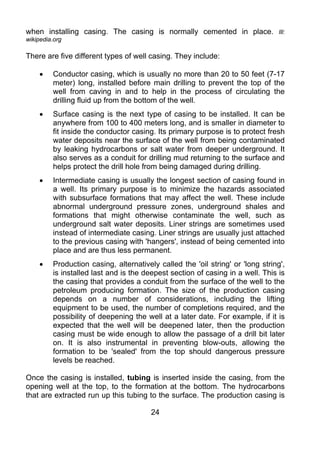
There are five different types of well casing. They include:

    •    Conductor casing, which is usually no more than 20 to 50 feet (7-17
         meter) long, installed before main drilling to prevent the top of the
         well from caving in and to help in the process of circulating the
         drilling fluid up from the bottom of the well.
    •    Surface casing is the next type of casing to be installed. It can be
         anywhere from 100 to 400 meters long, and is smaller in diameter to
         fit inside the conductor casing. Its primary purpose is to protect fresh
         water deposits near the surface of the well from being contaminated
         by leaking hydrocarbons or salt water from deeper underground. It
         also serves as a conduit for drilling mud returning to the surface and
         helps protect the drill hole from being damaged during drilling.
    •    Intermediate casing is usually the longest section of casing found in
         a well. Its primary purpose is to minimize the hazards associated
         with subsurface formations that may affect the well. These include
         abnormal underground pressure zones, underground shales and
         formations that might otherwise contaminate the well, such as
         underground salt water deposits. Liner strings are sometimes used
         instead of intermediate casing. Liner strings are usually just attached
         to the previous casing with 'hangers', instead of being cemented into
         place and are thus less permanent.
    •    Production casing, alternatively called the 'oil string' or 'long string',
         is installed last and is the deepest section of casing in a well. This is
         the casing that provides a conduit from the surface of the well to the
         petroleum producing formation. The size of the production casing
         depends on a number of considerations, including the lifting
         equipment to be used, the number of completions required, and the
         possibility of deepening the well at a later date. For example, if it is
         expected that the well will be deepened later, then the production
         casing must be wide enough to allow the passage of a drill bit later
         on. It is also instrumental in preventing blow-outs, allowing the
         formation to be 'sealed' from the top should dangerous pressure
         levels be reached.

Once the casing is installed, tubing is inserted inside the casing, from the
opening well at the top, to the formation at the bottom. The hydrocarbons
that are extracted run up this tubing to the surface. The production casing is

                                        24
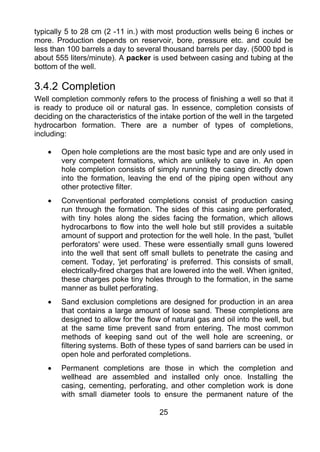
typically 5 to 28 cm (2 -11 in.) with most production wells being 6 inches or
more. Production depends on reservoir, bore, pressure etc. and could be
less than 100 barrels a day to several thousand barrels per day. (5000 bpd is
about 555 liters/minute). A packer is used between casing and tubing at the
bottom of the well.

3.4.2 Completion
Well completion commonly refers to the process of finishing a well so that it
is ready to produce oil or natural gas. In essence, completion consists of
deciding on the characteristics of the intake portion of the well in the targeted
hydrocarbon formation. There are a number of types of completions,
including:

    •   Open hole completions are the most basic type and are only used in
        very competent formations, which are unlikely to cave in. An open
        hole completion consists of simply running the casing directly down
        into the formation, leaving the end of the piping open without any
        other protective filter.
    •   Conventional perforated completions consist of production casing
        run through the formation. The sides of this casing are perforated,
        with tiny holes along the sides facing the formation, which allows
        hydrocarbons to flow into the well hole but still provides a suitable
        amount of support and protection for the well hole. In the past, 'bullet
        perforators' were used. These were essentially small guns lowered
        into the well that sent off small bullets to penetrate the casing and
        cement. Today, 'jet perforating' is preferred. This consists of small,
        electrically-fired charges that are lowered into the well. When ignited,
        these charges poke tiny holes through to the formation, in the same
        manner as bullet perforating.
    •   Sand exclusion completions are designed for production in an area
        that contains a large amount of loose sand. These completions are
        designed to allow for the flow of natural gas and oil into the well, but
        at the same time prevent sand from entering. The most common
        methods of keeping sand out of the well hole are screening, or
        filtering systems. Both of these types of sand barriers can be used in
        open hole and perforated completions.
    •   Permanent completions are those in which the completion and
        wellhead are assembled and installed only once. Installing the
        casing, cementing, perforating, and other completion work is done
        with small diameter tools to ensure the permanent nature of the

                                       25
completion. Completing a well in this manner can lead to significant
        cost savings compared to other types
    •   Multiple zone completion is the practice of completing a well such
        that hydrocarbons from two or more formations may be produced
        simultaneously, without mixing with each other. For example, a well
        may be drilled that passes through a number of formations on its
        way deeper underground, or it may be more desirable in a horizontal
        well to add multiple completions to drain the formation most
        effectively. When it is necessary to separate different completions,
        hard rubber 'packing' instruments are used to maintain separation.
    •   Drainhole completions are a form of horizontal or slanted drilling.
        This type of completion consists of drilling out horizontally into the
        formation from a vertical well, essentially providing a 'drain' for the
        hydrocarbons to run down into the well. These completions are more
        commonly associated with oil wells than with natural gas wells.

3.5 Wellhead
Wellheads can involve dry or subsea
completion. Dry completion means
that the well is onshore or on the
topside structure on an offshore
installation. Subsea wellheads are
located under water on a special sea
bed template.

The     wellhead   has     equipment
mounted at the opening of the well to
regulate and monitor the extraction of
hydrocarbons from the underground
formation. This also prevents oil or
natural gas leaking out of the well,
and prevents blow-outs due to high
pressure formations. Formations that
are under high pressure typically
require wellheads that can withstand
a great deal of upward pressure from
the escaping gases and liquids.
These must be able to withstand
pressures of up to 140 MPa (1400
Bar). The wellhead consists of three

                                      26
components: the casing head, the tubing head, and the 'Christmas tree'
Photo: Vetco Gray

A typical Christmas tree
composed of a master gate
valve, a pressure gauge, a
wing valve, a swab valve and
a choke is shown here. The
Christmas tree may also
have a number of check
valves. The functions of
these devices are explained
in the following paragraphs.
Ill: Vetco Gray

At the bottom we find the
casing head and casing
hangers.
The casing will be screwed,
bolted or welded to the
hanger. Several valves and
plugs will normally be fitted to
give access to the casing.
This will permit the casing to
be opened, closed, bled
down, and in some cases,
allow the flowing well to be
produced through the casing
as well as the tubing. The
valve can be used to
determine leaks in casing,
tubing or the packer, and will also be used for lift gas injection into the
casing.

The tubing hanger (also called a donut) is used to position the tubing
correctly in the well. Sealing also allows Christmas tree removal with
pressure in the casing.

Master gate valve. The master gate valve is a high quality valve. It provides
full opening, which means that it opens to the same inside diameter as the
tubing so that specialized tools may be run through it. It must be capable of
holding the full pressure of the well safely for all anticipated purposes. This
valve is usually left fully open and is not used to control flow.

                                      27
The pressure gauge. The minimum instrumentation is a pressure gauge
placed above the master gate valve before the wing valve. In addition other
instruments such as a temperature gauge will normally be fitted.

The wing valve. The wing valve can be a gate or ball valve. When shutting
in the well, the wing gate or valve is normally used so that the tubing
pressure can be easily read.

The swab valve. The swab valve is used to gain access to the well for
wireline operations, intervention and other workover procedures (see below).
On top of it is a tree adapter and cap that will mate with a range of
equipment.

The variable flow choke valve. The variable flow choke valve is typically a
large needle valve. Its calibrated opening is adjustable in 1/64 inch
increments (called beans). High-quality steel is used in order to withstand
the high-speed flow of abrasive materials that pass through the choke,
usually over many years, with little damage except to the dart or seat. If a
variable choke is not required, a less expensive positive choke is normally
installed on smaller wells. This has a built-in restriction that limits flow when
the wing valve is fully open.

This is a vertical tree. Christmas trees can also be horizontal, where the
master, wing and choke are on a horizontal axis. This reduces the height
and may allow easier intervention. Horizontal trees are especially used on
subsea wells.

3.5.1 Subsea wells
Subsea wells are essentially the
same as dry completion wells.
Mechanically however, they are
placed in a subsea structure
(template) that allows the wells to
be drilled and serviced remotely
from the surface, and protected
from damage e.g. from trawlers.
The wellhead is placed in a slot
in the template where it mates to
the outgoing pipeline as well as
hydraulic and electric control signals. Ill: StatoilHydro


                                          28
Control is from the
surface        where       a
hydraulic power unit
(HPU) provides power to
the subsea installation
via an umbilical. The
umbilical is a composite
cable containing tension
wires, hydraulic pipes,
electrical power, control
and         communication
signals. A control pod
with inert gas and/or oil protection contains control electronics, and operates
most equipment via hydraulic switches. More complex subsea solutions may
contain subsea separation/stabilization and electrical multiphase pumping.
This may be necessary if reservoir pressure is low, offset (distance to main
facility) is long or there are flow assurance problems so that the gas and
liquids will not stably flow to the surface.

The product is piped back through pipelines and risers to the surface. The
main choke may be located topside.

3.5.2 Injection
Wells are also divided into production and injection wells. The former are for
production of oil and gas. Injection wells are drilled to inject gas or water into
the reservoir. The purpose of injection is to maintain overall and hydrostatic
reservoir pressure and force the oil toward the production wells. When
injected water reaches the production well, it is called 'injected water
breakthrough'. Special logging instruments, often based on radioactive
isotopes added to injection water, are used to detect breakthrough.

Injection wells are fundamentally the same as production wellheads The
difference being their direction of flow and therefore mounting of some
directional components such as the choke.

3.6 Artificial lift
Production wells are free flowing or lifted. A free flowing oil well has enough
downhole pressure to reach suitable wellhead production pressure and
maintain an acceptable well-flow. If the formation pressure is too low, and

                                       29
water or gas injection cannot maintain pressure or are not suitable, the well
must be artificially lifted. For smaller wells, 0.7 MPa (100 PSI) wellhead
pressure with a standing column of liquid in the tubing is measured, by a
rule-of-thumb method, to allow the well to flow. Larger wells will be equipped
with artificial lift to increase production even at much higher pressures. Some
artificial lift methods are:

3.6.1 Rod pumps
Sucker rod pumps, also called donkey or beam pumps, are the most
common artificial-lift system used in land-based operations. A motor drives a
reciprocating beam, connected to a polished rod passing into the tubing via a
stuffing box. The sucker rod continues down to the oil level and is connected
to a plunger with a valve.

On          each
upward stroke,
the plunger lifts
a volume of oil
up and through
the     wellhead
discharge. On
the downward
stroke it sinks
(it should sink,
and not be
pushed) allowing oil to flow though the valve. The motor speed and torque is
controlled for efficiency and
minimal wear with a Pump
off Controller (PoC). Use is
limited      to       shallow
reservoirs down to a few
hundred meters, and flows
up to about 40 liters (10
gal) per stroke.


3.6.2 Downhole
      pumps
 A downhole pump inserts
the    whole     pumping
mechanism into the well. In

                                      30
modern installations, an Electrical Submerged Pump (ESP) is inserted into
the well. Here the whole assembly consisting of a long narrow motor and a
multi phase pump, such as a PCP (progressive cavity pump) or centrifugal
pump, hangs by an electrical cable with tension members down the tubing. Ill:
Wikipedia.org

Installations down to 3.7 km with power up to 750 kW have been installed. At
these depths and power ratings, medium voltage drives (up to 5kV) must be
used.

ESPs work in deep reservoirs, but are sensitive to contaminants such as
sand, and efficiency is sensitive to GOR (Gas Oil Ratio) where gas over 10%
dramatically lowers efficiency.


3.6.3 Gas lift
 A gas lift injects gas into
the     well    flow.    The
downhole            reservoir
pressure falls off to the
wellhead due to the
counter pressure from
weight of the oil column in
the tubing. Thus a 150
MPa reservoir pressure at
1600 meters will fall to
zero in the wellhead if the
specific gravity is 800
kg/m2. (0.8 times water).
By injecting gas into this
oil, the specific gravity is
lowered and the well will
start to flow. Typically gas
injected between the
casing and tubing, and a
release valve on a gas lift
mandrel is inserted into
the tubing above the packer.
The valve will open at a set pressure to inject lift gas into the tubing. Several
mandrels with valves set at different pressure ranges can be used to
improve lifting and startup. Ill: Schlumberger oilfield glossary


                                       31
Gas lift can be controlled for a single well to optimize production, and to
reduce slugging effects where the gas droplets collect to form large bubbles
that can upset production. Gas lift can also be optimized over several wells
to use available gas in the most efficient way.

3.6.4 Plunger lift
 The Plunger lift is normally used on low pressure gas wells with some
condensate, oil or water, or high gas ratio oil wells. In this case the well flow
conditions can be such that liquid starts to collect downhole and eventually
blocks gas so that the well production stops. In this case a plunger with an
open/close valve can be inserted in the tubing. A plunger catcher at the top
opens the valve and can hold the plunger, while another mechanism
downhole will close the valve.

The cycle starts with
the plunger falling
into the well with its
valve             open.
Condensed gas and
oil can pass though
the plunger until it
reaches         bottom.
There the valve is
closed, now with a
volume       of      oil,
condensate or water
on top. Gas pressure
starts to accumulate
under the plunger
and after a time
pushes the plunger
upwards, with liquid
on      top,     which
eventually flows out
of    the     wellhead
discharge.

When the plunger
reaches the wellhead plunger catcher, the valve opens and allows gas to
flow freely for some time while new liquid collects at the bottom. After a
preset time the catcher will release the plunger and the cycle repeats.


                                       32
3.7 Well workover, intervention and stimulation.
After operating for some time, a well may become less productive or faulty
due to residue build up, sand erosion, corrosion or reservoir clogging.

Well workover is the process of performing major maintenance on an oil or
gas well. This might include replacement of the tubing, a cleanup or new
completions, new perforations and various other maintenance works such as
the installation of gas lift mandrels, new packing etc.

Through-tubing workover operation is work performed with special tools that
do not require the time-consuming full workover procedure including
replacement or removal of tubing. Well maintenance without killing the well
and performing full workover is time-saving and often called well
intervention. Various operations that are performed by lowering instruments
or tools on a wire into the well are called wireline operations.

Work on the reservoir such as chemical injection, acid treatment, heating etc
is referred to as reservoir stimulation. Stimulation serves to correct various
forms of structure damage and improve flow. Damage is a generic term for
accumulation of particles and fluids that block fractures and pores and limit
reservoir permeability.

    •   Acids, such as HCL (Hydrochloric Acid) are used to open up
        calcareous reservoirs and to treat accumulation of calcium
        carbonates in the reservoir structure around the well. Several
        hundred liters of acid (typically 15% solution in water) are pumped
        into the well under pressure to increase permeability of the
        formation. When the pressure is high enough to open the fractures,
        the process is called fracture acidizing. If the pressure is lower, it is
        called matrix acidizing.
    •   Hydraulic fracturing is an operation in which a specially blended
        liquid is pumped down a well and into a formation under pressure
        high enough to cause the formation to crack open, forming passages
        through which oil can flow into the well bore. Sand grains, aluminum
        pellets, walnut shells, glass beads, or similar materials (propping
        agents) are carried in suspension by this fluid into the fractures.
        When the pressure is released at the surface, the fractures partially
        close on the propping agents, leaving channels for oil to flow through
        to the well. The fracture channels may be up to 100 meters long.
    •   Explosive fracturing uses explosives to fracture a formation. At the
        moment of detonation, the explosion furnishes a source of high-
                                      33
pressure gas to force fluid into the formation. The rubble prevents
       fracture healing, making the use of propping agents unnecessary.
   •   Damage removal refers to other forms of removing formation
       damage, such as flushing out of drill fluids.
Flexible coiled tubing can be wound around a large diameter drum and
inserted or removed much quicker than tubing installed from rigid pipe
segments. Well workover equipment including coiled tubing is often mounted
on well workover rigs.


                                   34
4 The oil and gas process
The oil and gas process is the process equipment that takes the product
from the wellhead manifolds and delivers stabilized marketable products, in
the form of crude oil, condensates or gas. Components of the process also
exist to test products and clean waste products such as produced water.

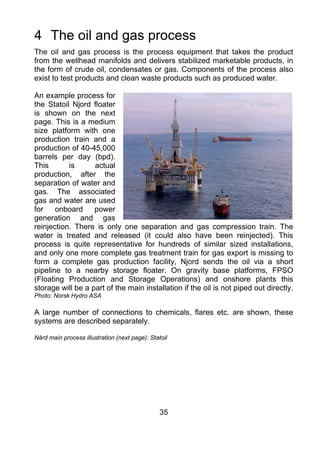
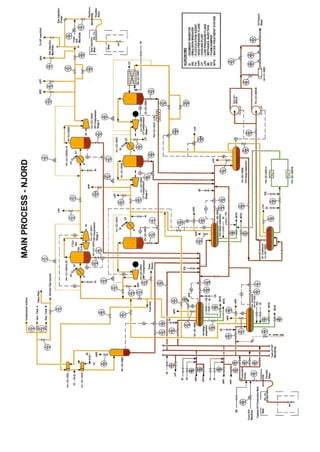
An example process for
the Statoil Njord floater
is shown on the next
page. This is a medium
size platform with one
production train and a
production of 40-45,000
barrels per day (bpd).
This       is      actual
production, after the
separation of water and
gas. The associated
gas and water are used
for    onboard     power
generation and gas
reinjection. There is only one separation and gas compression train. The
water is treated and released (it could also have been reinjected). This
process is quite representative for hundreds of similar sized installations,
and only one more complete gas treatment train for gas export is missing to
form a complete gas production facility, Njord sends the oil via a short
pipeline to a nearby storage floater. On gravity base platforms, FPSO
(Floating Production and Storage Operations) and onshore plants this
storage will be a part of the main installation if the oil is not piped out directly.
Photo: Norsk Hydro ASA

A large number of connections to chemicals, flares etc. are shown, these
systems are described separately.

Nård main process illustration (next page): Statoil


                                                35
36
4.1 Manifolds and gathering
4.1.1 Pipelines and risers
This facility uses subsea production wells. The typical High Pressure (HP)
wellhead at the bottom right, with its Christmas tree and choke, is located on
the sea bed. A production riser (offshore) or gathering line (onshore) brings
the well flow into the manifolds. As the reservoir is produced, wells may fall
in pressure and become Low Pressure (LP) wells.

This line may include several check valves. The choke, master and wing
valves are relatively slow, therefore in the case of production shutdown, the
pressure on the first sectioning valve closed will rise to the maximum
wellhead pressure before these valves can close. The pipelines and risers
are designed with this in mind.

Short pipeline distances are not a problem, but longer distances may cause
a multiphase well flow to separate and form severe slugs - plugs of liquid
with gas in between - traveling in the pipeline. Severe slugging may upset
the separation process and cause overpressure safety shutdowns. Slugging
might also occur in the well as described earlier. Slugging can be controlled
manually by adjusting the choke, or by automatic slug controls. Furthermore,
areas of heavy condensate might form in the pipelines. At high pressure,
these plugs may freeze at normal sea temperature, e.g. if production is shut
down or with long offsets. This can be prevented by injecting ethylene glycol.
Glycol injection is not used at Njord.

The Njord floater has topside chokes for subsea wells. The diagram also
shows that Kill Fluid, essentially high specific gravity mud, can be injected
into the well before the choke.

4.1.2 Production, test and injection manifolds
Check valves allow each well to be routed into one or more of several
manifold lines. There will be at least one for each process train plus
additional manifolds for test and balancing purposes. In the diagram we
show three: test, low pressure and high pressure manifolds. The test
manifold allows one or more wells to be routed to the test separator. Since
there is only one process train, the HP and LP manifolds allow groups of HP
and LP wells to be taken to the first and second stage separators
respectively. The chokes are set to reduce the wellhead flow and pressure to
the desired HP and LP pressures respectively.

                                     37
The desired setting for each well and which of the wells produce at HP and
LP for various production levels are defined by reservoir specialists to
ensure the optimum production and recovery rate.

4.2 Separation
As described earlier, the well-stream may consist of crude oil, gas,
condensates, water and various contaminants. The purpose of the
separators is to split the flow into desirable fractions.

4.2.1 Test separators and well test
Test separators are used to separate the well flow from one or more wells for
analysis and detailed flow measurement. In this way, the behavior of each
well under different pressure flow conditions can be defined. This normally
takes place when the well is taken into production and later at regular
intervals, typically 1-2 months and will measure the total and component flow
rates under different production conditions. Undesirable consequences such
as slugging or sand can also be determined. The separated components are
analyzed in the laboratory to determine hydrocarbon composition of the gas
oil and condensate.

Test separators can also be used to produce fuel gas for power generation
when the main process is
not running. Alternatively, a
three phase flow meter
could be used to save
weight.

4.2.2 Production
      separators
The main separators shown
here are gravity types. On
the right you see the main
components around the first
stage      separator.    As
mentioned     before,   the
production choke reduces
well pressure to the HP
manifold and first stage
separator to about 3-5 MPa

                                     38
(30-50 times atmospheric pressure). Inlet temperature is often in the range
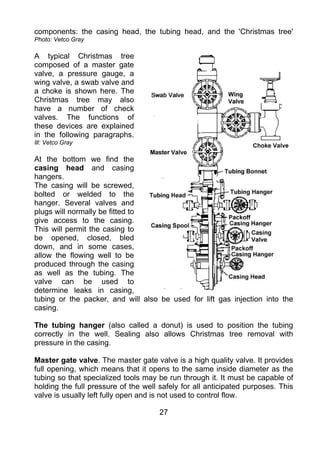
of 100-150 degrees C. On the example platform, the well stream is colder
due to subsea wells and risers.

The pressure is often
reduced in several
stages, in this instance
three stages are used
to allow the controlled
separation of volatile
components. The idea
is to achieve maximum
liquid recovery and
stabilized oil and gas
and to separate water.
A      large    pressure
reduction in a single separator will cause flash vaporization leading to
instability and safety hazards.

The retention period is typically 5 minutes, allowing the gas to bubble out,
water to settle at the bottom and oil to be taken out in the middle. In this
platform the water cut (percentage water in the well flow) is almost 40%
which is quite high. In the first stage separator, the water content is typically
reduced to less than 5%.

At the crude entrance, there is a baffle slug catcher that will reduce the
effect of slugs (large gas bubbles or liquid plugs). However some turbulence
is desirable as this will release gas bubbles faster than a laminar flow.

At the end, there are barriers up to a certain level to keep back the
separated oil and water. The main control loops are the oil level control loop
(EV0101 20 above) controlling the oil flow out of the separator on the right,
and the gas pressure loop at the top.(FV0105 20 above) These loops are
operated by the Control System. An important function is also to prevent gas
blow-by which happens when a low oil level causes gas to exit via the oil
output causing high pressure downstream. There are generally many more
instruments and control devices mounted on the separator. These will be
discussed later.

The liquid outlets from the separator will be equipped with vortex breakers
to reduce disturbance on the liquid table inside. This is basically a flange trap
to break any vortex formation and ensure that only separated liquid is tapped
off and not mixed with oil or water drawn in though these vortices. Similarly
                                       39
the gas outlets are equipped with demisters, essential filters that will
remove liquid droplets in the gas.

Emergency Valves (EV) are sectioning valves that will separate the process
components and blow-down valves, this will allows excess hydrocarbons to
be burned off in the flare. These valves are operated if critical operating
conditions are detected or on manual command, by a dedicated Emergency
Shutdown System. This might involve partial shutdown and shutdown
sequences since the flare might not be able to handle a full blow-down of all
process sections simultaneously.

A 45,000 bpd design production with gas and 40% water cut will give about
10 cubic meters from the wellheads per minute. There also needs to be
enough capacity to handle normal slugging from wells and risers. This
means the separator has to be about 100 cubic meters, e.g. a cylinder 3
meters in diameter and 14 meters in length at the rated operating pressure.
This means a very heavy piece of equipment, typically around 50 tons for
this size, which limits the practical number of stages. Other types of
separators such as vertical separators or cyclones (centrifugal separation)
can be used to save weight, space or improve separation (see later).

There also has to be a certain minimum pressure difference between each
stage to allow satisfactory performance in the pressure and level control
loops. Chemical additives will be discussed later.

4.2.3 Second stage separator
The second stage separator is quite similar to the first stage HP separator. In
addition to output from the first stage, it will also receive production from
wells connected to the Low Pressure manifold. The pressure is now around
1 MPa (10 atmospheres) and temperature below 100 degrees C. The water
content will be reduced to below 2%.

An oil heater could be located between the first and second stage separator
to reheat the oil/water/gas mixture. This will make it easier to separate out
water when initial water cut is high and temperature is low. The heat
exchanger is normally a tube/shell type where oil passes though tubes in a
heating medium placed inside an outer shell.

4.2.4 Third stage separator
The final separator here is a two-phase separator, also called a flash drum.
The pressure is now reduced to atmospheric pressure of around 100 kPa, so
that the last heavy gas components will boil out. In some processes where
                                     40
the initial temperature is low, it might be necessary to heat the liquid (in a
heat exchanger) again before the flash drum to achieve good separation of
the heavy components. There are level and pressure control loops.

As an alternative, when the production is mainly gas, and remaining liquid
droplets have to be separated out, the two-phase separator can be a Knock-
Out Drum (K.O. Drum).

4.2.5 Coalescer
After the third stage separator, the oil can go to a coalescer for final removal
of water. In this unit the water content can be reduced to below 0.1%. The
coalescer is completely filled with liquid: water at the bottom and oil on top.
Internal electrodes form an electric field to break surface bonds between
conductive water and isolating oil in an oil water emulsion. The coalescer
field plates are generally steel, sometimes covered with dielectric material to
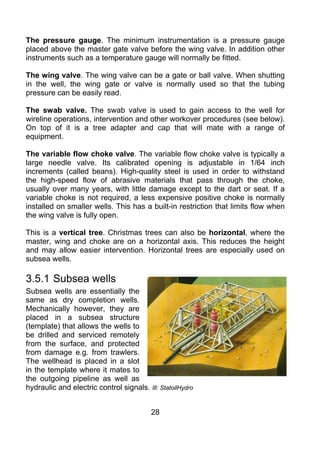
prevent short-circuits. The critical field strength in oil is in the range of 0.2 to
2 kV/cm. Field intensity and frequency as well as the coalescer grid layout
are different for different manufacturers and oil types.

4.2.6 Electrostatic desalter
If the separated oil
contains unacceptable
amounts of salts, they
can be removed in an
electrostatic  desalter
(not used in the Njord
example) The salts,
which may be sodium,
calcium or magnesium
chlorides come from the reservoir water and are also dissolved in the oil.
The desalters will be placed after the first or second stage separator
depending on Gas Oil Ratio (GOR) and water cut. Photo: Burgess Manning Europe
PLC


4.2.7 Water treatment
On an installation such as this, where the water cut is high, there will be a
huge amount of water produced. In our example, a water cut of 40% gives
water production of about 4000 cubic meters per day (4 million liters) that
must be cleaned before discharge to sea. Often this water contains sand
particles bound to the oil/water emulsion.


                                        41
The environmental regulations in most countries are quite strict, for example,
in the North-East Atlantic the OSPAR convention limits oil in water
discharged to sea to 40 mg/liter (ppm).


It also places limits on other forms of contaminants. This still means that the
equivalent of up to one barrel of oil per day in contaminants from the above
production is discharged into the sea, but in this form, the microscopic oil
drops are broken down fast by natural bacteria.

Various pieces of equipment are used. This illustration shows a typical water
treatment system. Water from the separators and coalescers first goes to a
sand cyclone, which removes most of the sand. The sand is further washed
before it is discharged.

The water then goes to a hydrocyclone, a centrifugal separator that will
remove oil drops. The hydrocyclone creates a standing vortex where oil
collects in the middle and water is forced to the side.

Finally the water is collected in the water de-gassing drum. Dispersed gas
will slowly rise to the surface and pull remaining oil droplets to the surface by
flotation. The surface oil film is drained, and the produced water can be
discharged to sea. Recovered oil in the water treatment system is typically
recycled to the third stage separator.


                                       42
4.3 Gas treatment and compression
The gas train consists of several stages, each taking gas from a suitable
pressure level in the production separator's gas outlet, and from the previous
stage.

A typical stage is
shown on the right.
Incoming gas (on
the right) is first
cooled in a heat
exchanger. It then
passes through the
scrubber to remove
liquids and goes
into              the
compressor.      The
anti surge loop
(thin orange line)
and the surge valve
(UV0121 23) allow
the       gas       to
recirculate. The components are described below.

4.3.1 Heat exchangers
For the compressor to operate efficiently, gas temperature should be low.
The lower the temperature, the less energy will be used to compress the gas
for the given final pressure
and temperature. However
both gas from separators
and compressed gas are
relatively hot. When gas is
compressed, it must remain
in thermodynamic balance,
which means that the gas
pressure times the volume
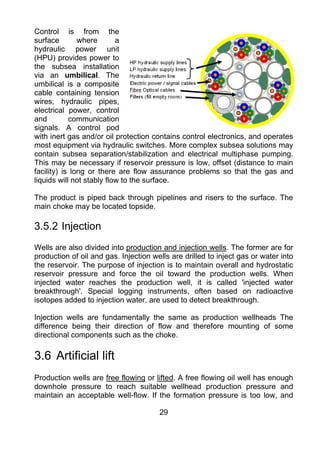
over      the   temperature
(PV/T)       must     remain
constant. (PV = nkT). This
ends up as a temperature
increase.


                                     43
Heat exchangers of various forms are used to cool the gas. Plate heat
exchangers (upper picture) consist of a number of plates where the gas and
cooling medium pass between alternating plates in opposing directions.
Tube and shell exchangers (next picture) place tubes inside a shell filled with
of cooling fluid. The cooling fluid is often pure water with corrosion inhibitors.

When        designing      the
process, it is important to
plan the thermal energy
balance. Heat should be
conserved e.g. by using
the cooling fluid from the
gas train to reheat oil in the
oil train. Excess heat is
dispersed e.g. by seawater
cooling.     However       hot
seawater      is   extremely
corrosive, so materials with
high       resistance        to
corrosion, such as titanium
must be used. Photo: SEC
Shell and Tube Heat Exchanges


4.3.2 Scrubbers and reboilers
The separated gas may contain mist and other liquid droplets. Drops of
water and hydrocarbons also form when the gas is cooled in the heat
exchanger, and must be removed before it reaches the compressor. If liquid
droplets enter the compressor they will erode the fast rotating blades. A
scrubber is designed to remove small fractions of liquid from the gas.

 There are various types of gas-drying equipment available, but the most
common suction (compressor) scrubber is based on dehydration by
absorption in Triethylene Glycol (TEG). The scrubber consists of many levels
of glycol layers.
A large number of gas traps (enlarged detail) force the gas to bubble up
through each glycol layer as it flows from the bottom up each section to the
top.

Processed glycol is pumped in at the top from the holding tank. It flows from
level to level against the gas flow as it spills over the edge of each trap.
During this process it absorbs liquids from the gas and comes out as rich
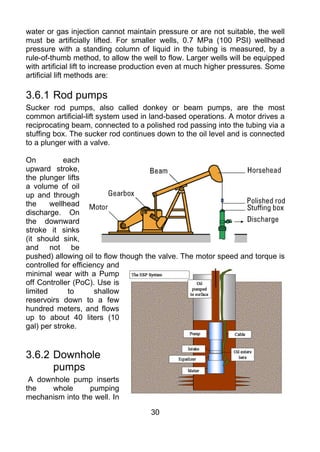
                                       44
glycol at the bottom. The holding tank also functions as a heat exchanger for
liquid to and from the reboilers.

The glycol is recycled by removing the absorbed liquid. This is done in the
reboiler, which is filled with rich glycol and heated to boil out the liquids at
temperature of about 130-180 °C (260-350 °F) for a number of hours.


Usually there is a distillation column on the gas vent to further improve
separation of glycol and other hydrocarbons. For higher capacity, there are
often two reboilers which alternate between heating rich glycol and draining
recycled processed glycol.

On a standalone unit, the heat is supplied from a burner that uses the
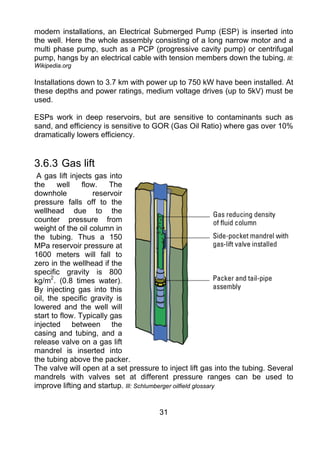
recovered vaporized hydrocarbons. In other designs, heating will be a
combination of hot cooling substances from other parts of the process and
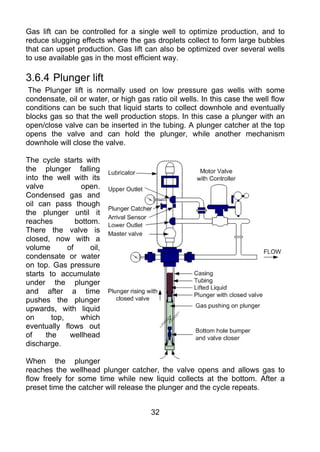
electric heaters, and recycle the hydrocarbon liquids to the third stage
separator
.

4.3.3 Compressor anti surge and performance
Several types of compressors are used for gas compression, each with
different characteristics such as operating power, speed, pressure and
volume:


                                      45
• Reciprocating
  compressors, which
  use a piston and
  cylinder design with
  2-2 cylinders are
  built up to about 30
  MW power, around
  500-1800 rpm (lower
  for higher power)
  with pressure up to
  5MPa (500 bars).
  Used for lower capacity gas compression and high reservoir pressure
  gas injection. Photo: Ariel corp.


• Screw compressors are
  manufactured     up      to
  several MW, synchronous
  speed (3000/3600 rpm)
  and pressure up to about
  2.5 MPa (25 bar). Two
  counter-rotating    screws
  with matching profiles
  provide           positive
  displacement and a wide
  operating range. Typical
  use    is   natural    gas
  gathering.
   Photo: Mycom/Mayekawa mfg.

• Axial blade and fin type
  compressors with up to
  15 wheels provide high
  volumes at relatively
  low pressure differential
  (discharge pressure 3-5
  times inlet pressure),
  speeds of 5000-8000
  rpm, and inlet flows up
  to 200,000 m3/hour.
  Applications include air
  compressors and cooling compression in LNG plants.   Axial rotor photo:
   Dresser Rand


                                46
• Larger oil and gas
     installations       use
     centrifugal
     compressors with 3-10
     radial wheels, 6000–
     20000 rpm (highest for
     small size), up to 80
     MW load at discharge
     pressure of up to 50
     bars and inlet volumes
     of up to 500,000
     m3/hour.       Pressure
     differential up to 10.
      Photo: Dresser Rand

Most compressors will not
cover the full pressure range
efficiently. The lowest pressure is atmospheric, for gas to pipeline, some 3 to
5 MPa (30-50 bar) pressure is used, while reservoir reinjection of gas will
typically require 20 MPa (200 bar) and upwards since there is no liquid in the
tubing and the full reservoir pressure must be overcome. Therefore
compression is divided into several stages to improve maintenance and
availability.
Also due to single unit power limitations, compression is often divided in
several parallel trains. This is not the case in this example since gas is not
exported, and reinjection can be interrupted during maintenance periods.
Compressors are driven by gas turbines or electrical motors (for lower power
also reciprocating engines, steam turbines are sometimes used if thermal
energy is available). Often several stages in the same train are driven by the
same motor or turbine.
The main operating parameters for a compressor are the flow and pressure
differentials. The product defines the total loading, so there is a ceiling set by
the maximum design power. Furthermore, there is a maximum differential
pressure (Max Pd) and choke flow (Max Q), the maximum flow that can be
achieved. At lower flow, there is a minimum pressure differential and flow
before the compressor will "surge" if there is not enough gas to operate. If
variations in flow are expected or difference between common shaft
compressors will occur, the situation will be handled with recirculation. A
high flow, high pressure differential surge control valve will open to let gas
from the discharge side back into the suction side. Since this gas is heated it
will also pass through the heat exchanger and scrubber not to become
overheated by circulation.
                                       47
The operating characteristics are defined by the manufacturer. In the above
diagram the blue lines mark constant speed lines. The maximum operating
limits are set by the orange line as described above. The surge domain is
the area to the left of the red surge curve.


The objective of compressor performance control is to keep the operating
point close to the optimal set point without violating the constraints, by
means of control outputs, such as the speed setting. However, gas turbine
speed control response is relatively slow and even electric motors are not
fast enough, since surge response must be in the 100 ms range. Anti surge
control will protect the compressor from going into surge by operating the
surge control valve. The basic strategy is to use distance between operating
point and surge line to control the valve with a slower response time starting
at the surge control line. Crossing the surge trip line will cause a fast
response opening of the surge valve to protect the compressor.

Operation with recirculation wastes energy (which could result in
unnecessary emissions) and produces wear and tear, particularly on the
surge valve. Each vendor supplies several variants of compressor control
and anti surge control to optimize performance, based on various corrective
and predictive algorithms. Some strategies include:

    •   Set point adjustment: If rapid variations in load cause surge valve
        action, the set point will be moved to increase the surge margin.
                                     48
•   Equal margin: The set point is adjusted to allow equal margin to
        surge between several compressors.
    •   Model based control: Outside the compressor itself, the main
        parameter for the surge margin is the total volume from the surge
        valve to the compressor suction inlet, and the response time for the
        surge valve flow. A model predictive controller could predict surge
        conditions and react faster to real situations while preventing
        unnecessary recirculation.

Since compressors require maintenance and are potentially expensive to
replace, several other systems are normally included:

Load management:     To balance loading among several compressors in a
              train and between trains, the compressor control system
              often includes algorithms for load sharing, load shedding
              and loading. Compressors are normally purged with inert
              gas, such as nitrogen, during longer shutdowns, e.g. for
              maintenance. Therefore, startup and shutdown sequences
              will normally include procedures to introduce and remove
              the purge gas.

Vibration:        Vibration is a good indicator of problems in compressors,
                  and accelerometers are mounted on various parts of the
                  equipment to be logged and analyzed by a vibration
                  monitoring system.

Speed governor If the compressor is turbine driven, a dedicated speed
               governor handles the fuel valves and other controls on the
               turbine to maintain efficiency and control rotational speed.
               For electrical motors this function is handled by a variable
               speed drive.

The final function around the compressor itself is lube and seal oil handling.
Most compressors have wet seals, which are traps around shafts where oil
at high pressure prevents gas from leaking out to atmosphere or other parts
of the equipment. Oil is used for lubrication of the high speed bearings. This
oil gradually absorbs gas under pressure and may be come contaminated.
So it needs to be filtered and degassed. This happens in smaller reboilers
much the same way as for the glycol reboilers described earlier.


                                     49
4.3.4 Gas treatment
When gas is exported, many gas trains include additional equipment for
further gas processing to remove unwanted components such as hydrogen
sulfide and carbon dioxide. These gases are called acids and
sweetening/acid removal is the process of taking them out.
Natural gas sweetening methods include absorption processes, cryogenic
processes; adsorption processes (PSA, TSA and iron sponge) and
membranes. Often hybrid combinations are used, such as cryogenic and
membranes.

Gas treatment could also include calibration. If the delivery specification is
for a specific calorific value (BTU per scf or MJ per scm) gas with higher
values can be adjusted by adding an inert gas, such as nitrogen. This is
often done at a common point such as a pipeline gathering system or a
pipeline onshore terminal.

4.4 Oil and gas storage, metering and export
The final stage before the oil and gas leaves the platform consists of
storage, pumps and pipeline terminal equipment.

4.4.1 Fiscal metering
Partners, authorities and customers all calculate invoices, taxes and
payments based on the actual product shipped out. Often custody transfer
also takes place at this point, which means transfer of responsibility or title
from the producer to a customer, shuttle tanker operator or pipeline operator.

Although some small installations are still operated with a dipstick and
manual records, larger installations have analysis and metering equipment.
To make sure readings are accurate, a fixed or movable prover loop for
calibration is also installed.

The illustration shows a full liquid hydrocarbon (oil and condensate) metering
system. The analyzer instruments on the left provide product data such as
density, viscosity and water content. Pressure and temperature
compensation is also included.

For liquids, turbine meters with dual pulse outputs are most common.
Alternatives are positive displacement meters (pass a fixed volume per
rotation or stroke) and coriolis mass flow meters. These instruments cannot
cover the full range with sufficient accuracy. Therefore the metering is split
into several runs, and the number of runs depends on the flow. Each run
                                      50
employs one meter and several instruments to provide temperature and
pressure correction. Open/close valves allow runs to be selected and control
valves can balance the flow between runs. The instruments and actuators
are monitored and controlled by a flow computer. If the interface is not
digital, dual pulse trains are used to allow direction sensing and fault finding.


                               Metering system

To obtain the required accuracy, the meters are calibrated. The most
common method is a prover loop. A prover ball moves though the loop, and
a calibrated volume is provided between the two detectors (Z). When a
meter is to be calibrated the four way valve opens to allow oil to flow behind
the ball. The number of pulses from it passes one detector Z to the other and
is counted. After one loop the four way valve turns to reverse flow direction
and the ball moves back providing the same volume and in reverse, again
counting the pulses. From the known reference volume, number of pulses,
pressure and temperature the flow computer can calculate the meter factor
and provide accurate flow measurements using formulas from industry
standard organizations such as API MPMS and ISO 5024. The accuracy is
typically ± 0.3% of standard volume.

                                       51
Gas metering is similar, but instead,
analyzers will measure hydrocarbon
content and energy value (MJ/scm or
BTU, Kcal/scf) as well as pressure
and temperature. The meters are
normally orifice meters or ultrasonic
meters. Orifice plates with a diameter
less than the pipe are mounted in
cassettes. The pressure differential
over the orifice plate as well as
pressure and temperature is used in
standard formulas (such as AGA 3
and ISO 5024/5167) to calculate normalized flow. Different ranges are
accommodated with different size restrictions.

Orifice plates are sensitive to a buildup of residue and effect on the edges of
the hole. Larger new installations therefore prefer ultrasonic gas meters that
work by sending multiple ultrasonic beams across the path and measure the
Doppler Effect.

Gas metering is less accurate than liquid, typically ±1.0% of mass. There is
usually no prover loop, the instruments and orifice plates are calibrated in
separate equipment instead.

LNG is often metered
with mass flow meters
that can operate at the
required            low
temperature. A three
run LNG g metering
skid is shown above.

At various points in the
movement of oil and
gas,              similar
measurements         are
taken, usually in a
more simplified way.
Examples of different
gas types are flare gas, fuel gas and injected gas where required accuracy is
2-5% percent.


                                      52
4.4.2 Storage
On most production
sites, the oil and gas
is piped directly to a
refinery or tanker
terminal.     Gas     is
difficult   to    store
locally,            but
occasionally
underground mines,
caverns      or     salt
deposits can be used
to store gas.

On platforms without a pipeline, oil is stored in onboard storage tanks to be
transported by shuttle tanker. The oil is stored in storage cells around the
shafts on concrete platforms, and in tanks on floating units. On some
floaters, a separate storage tanker is used. Ballast handling is very important
in both cases to balance the buoyancy when the oil volume varies. For
onshore, fixed roof tanks are used for crude, floating roof for condensate.
Rock caves are also used for storage

Special tank gauging systems such as level radars, pressure or float are
used to measure the level in storage tanks, cells and caves. The level
measurement is converted to volume via tank strapping tables (depending
on tank geometry) and compensated for temperature to provide standard
volume. Float gauges can also calculate density, and so mass can be
established.

A tank farm consists of 10-100 tanks of varying volume for a typical total
capacity in the area of 1 - 50 million barrels. Storage or shuttle tankers
normally store up to two weeks of production, one week for normal cycle and
one extra week for delays e.g. bad weather. This can amount to several
million barrels.

Accurate records of volumes and history are kept to document what is
received and dispatched. For installations that serve multiple production
sites, different qualities and product blending must also be handled. Another
planning task is forecasting for future received and delivered products. This
is for stock control and warehousing requirements. A tank farm management
system keeps track of all stock movements and logs all transport operations
that take place

                                      53
4.4.3 Marine loading
Loading systems consist of one or
more loading arms/jetties, pumps,
valves and a metering system.

Tanker loading systems are complex,
both because of the volume involved,
and because several loading arms will
normally interact with the tanker's
ballast system to control the loading
operation. The tanks must be filled in
a certain sequence; otherwise the
tanker's structure might be damaged
due to uneven stresses. It is the
responsibility of the tanker's ballast
system to signal data to the loading
system and to operate the different
valves and monitor the tanks on
board the ship. Photo: StatoilHydro

4.4.4 Pipeline terminal
The gas pipeline is fed from
the       high        pressure
compressors. Oil pipelines are
driven by separate booster
pumps. For longer pipelines,
intermediate       compressor
stations or pump stations will
be required due to distance or
crossing of mountain ranges.
Block valve stations are
placed at regular intervals to
limit the potential leakage
volume in case of a pipe rupture.

The pipeline terminal includes termination systems for the pipeline. A pig
launcher and receiver will be included at the least, to allow insertion of a
pipeline pigging device used to clean or inspect the pipeline on the inside.
This is essentially a large chamber that can be pressurized and purged to
insert and remove the pig or scraper without depressurizing the pipeline. The
pig is often driven by pipeline flow.

                                     54
5 Gas processing and LNG
Raw natural gas from the well consists of methane as well as many other
smaller fractions of heavier hydrocarbons, and various other components.

       Component            Chemical        Boiling Point    Vapor pressure
                            Formula         at 101 kPa       at 20 °C approx.
     Methane                CH4                  -161,6 °C        Tcri t−82.6 °C
                                                                    @ 4,6 MPa
     Ethane               C2H6             -88.6 °C                   4200 kPa
     Propane              C3H8             -42.1 °C                     890 kPa
     Butane               n-C4H10           −0.5 °C                     210 kPa
     Higher order HC
     Alkenes              CnH2n
     Aromatics            e.g. C6H6
     Acid Gases
     Carbon Dioxide       CO2                −78 °C            5500 kPa
     Hydrogen Sulfide     H2S              -60.2 °C
     Mercaptans ex.
       Methanethiol       CH3SH             5.95 °C
       Ethanethiol        C2H5SH              35 °C
     Other Gases
     Nitrogen             N2             -195.79 °C
     Helium               He             -268.93 °C
     Water                H2O                   0 °C
     Trace pollutants
      Mercury
      Clorides
                      Data source: Wikipedia, Air Liquide Gas Encyclopedia

The natural gas is characterized in several ways dependant on the content
of these components:

   o    Wet gas is raw gas with a methane content of less than 85%
   o    Dry gas is raw or treated natural gas that contains less than 15 liters
        of condensate per 1000 SM3. (0.1 gallon per 1000 scf).
   o    Sour gas is raw gas with a content of more than 5.7 mg hydrogen
        sulfide (H2S) per scm (0.25 grains per 100 scf), this is about 4 ppm.
   o    Acid gas has a high content of acidic gases such as carbon dioxide
        (CO2) or H2St. Pipeline natural gas specification is typically less than

                                       55
2% CO2. Acid gas fields with up to 90% CO2 exist, but the normal
      range for sour raw gas is 20-40%.
  o   Condensates are a mixture of hydrocarbons and other components
      in the above table. These are normally gaseous from the well but
      condense out as liquid during the production process (see previous
      chapter). This is a refinery and petrochemical feedstock.
Raw gas is processed into various products or fractions:
  o   Natural Gas in its marketable form has been processed for a
      specific composition of hydrocarbons, sour and acid components
      etc. and energy content. Content is typically 90% methane, with 10%
      other light alkenes.
  o   Natural Gas Liquids (NGL) is a processed purified product
      consisting of ethane, propane, butane or some higher alkenes
      separately, or in a blend. It is primarily a raw material for
      petrochemical industry and is often processed from the condensate.
  o   Liquefied Petroleum Gas (LPG) refers to propane or butane or a
      mixture of these that has been compressed to liquid at room
      temperature (200 to 900 kPa depending on composition). LPG is
      filled in bottles for consumer domestic use as fuel, and is also used
      as aerosol propellant (in spray cans) and refrigerant (e.g. in air
      conditioners). Energy to volume ratio is 74% of gasoline.
  o   Liquefied Natural Gas (LNG) is natural gas that is refrigerated and
      liquefied at below -162 °C, for storage and transport. It is stored at
      close to atmospheric pressure, typically less than 125 kPa. As a
      liquid, LNG takes up 1/600 of the volume of the gas at room
      temperature. Energy to volume ratio is 66% of gasoline. After
      transport and storage it is reheated/vaporized and compressed for
      pipeline transport.
  o   Compressed Natural Gas (CNG) is natural gas that is compressed
      at 2-2,2 MPa to less than 1% of volume at atmospheric pressure.
      Unlike higher alkenes, methane cannot be kept liquid by high
      pressure at normal ambient temperatures because of a low critical
      temperature. CNG is used as a less costly alternative to LNG for
      lower capacity and medium distance transport. Methane for vehicle
      fuel is also stored as CNG. Energy to volume ratio is typically 25% of
      gasoline.


                                   56
5.1 Gas processing
Raw natural gas must be processed to meet the trading specifications of
pipeline and gas distribution companies. As part of the purification other
components such as NGL is produced, and pollutants extracted.
The diagram shows an overview of a typical gas plant. Marketable products
are listed in blue and the production process is shown in grey as it is not
considered part of the gas plant.
                 WELL


 Production Process                                                             Condensate
 - Separation
 - Water treatment                                                              Water

                     Raw gas to pipeline                  Tail Gas           Tail Gas
                                                          Cleanup Unit       Disposal
 Acid Gas Removal                  Sulfur Unit            - Hydrotreatment   - Stack
 - Absorbtion                      - Claus Process        - Solvents         - Thermal
 - Adsorbtion                                                                  Oxidizer
 - Cryogenic
 - Membranes                                                                    Elemental
                                                                                Sulfur

 Dehydration
 - Absorbtion                                                                   Water
 - Pressure Swing


 Mercury Removal                                                                Mercury
 - Membranes                                                                    waste
 - Adsorbtion


                                                                                Rich
 Nitrogen Rejection
 - Absorbtion                                                                   Nitrogen
 - Adsorbtion                                                                   gas
 - Cryogenic


                                                                               NGLs
 NGL Recovery                      Fractionation          Sweetening           Ethane
 - Absorbtion                      - Distillation         - Catalytic          Propane
 - Cryogenic                                              - Membrane           Butane
                                                                               other


                                                                                Sales gas


                                           Typical gas plant

                                                     57
5.1.1 Acid gas removal
Acid gases such as carbon dioxide and hydrogen sulfide form acids when
reacting with water, and must be removed to prevent corrosive damage to
equipment and pipelines. Hydrogen sulfide is also toxic and total sulfur
content is normally regulated.

The main removal process can be based on several principles:

Absorption         allows
acidic gases to be
dissolved in a solvent,
to be released by
regeneration in a later
stage.             Amine
absorption (as shown
on the right) is the most
common process for
acid    gas      removal.
Monoethanolamines
(MEA) dominate for
CO2 removal. Solutions
with inorganic solvents
based on ammonia are
under development. Ill:
Wikipedia

A typical amine gas treating process (as shown in the flow diagram) consists
of an absorber unit, a regenerator unit and accessory equipment. In the
absorber, a "lean" amine solution absorbs H2S and CO2 from the upflowing
sour gas to produce a sweetened gas stream as a product. The "rich" amine
solution contains the absorbed acid gases and is routed into the regenerator
(a stripper with a reboiler). The stripped overhead gas from the regenerator
is concentrated H2S and CO2.

Adsorption relies on the molecules to bind to the surface of certain solids.
After a certain time the material must be regenerated to release the gas.
Principles used include Pressure Swing Adsorption (PSA), Temperature
Swing Adsorption (TSA) and Electric Swing Adsorption (ESA)

Cryogenic removal uses a turbo expander: A gas turbine is driven by the
expanding gas which then cools to below the dew point for the gas to be
removed.

                                    58
The inlet gas to the compressor is precooled by the acid gas removed.
Cryogenic removal is most often used when the content of carbon dioxide is
high, typically around 50%.

Membrane based removal is based on certain materials that allow the acid
gases, but not the hydrocarbons, to diffuse through the membrane. This
procedure can be performed alone or in combination with absorption liquid.

Sulfur Unit. The H2S-rich stripped gas stream is then fed to a Claus
process - a multistage process with two main sections: A thermal section
fires H2S with air or oxygen to produce SO2 and elemental sulfur which is
released when cooled. A catalytic section allows more H2S to react with SO2
with alumina or titanium dioxide (TiO2) to produce water and elemental sulfur
(the Claus reaction: 2H2S + SO2 → 3S + 2H2O). The Claus process can
recover 95-97% of the sulfur in the feed gases.

A Tail Gas Treatment unit serves to reduce the sulfur content to below 250
ppm, corresponding to a total sulfur recovery of 99.9%. More complex
solutions can reduce total sulfur down to 10 ppm. Some important processes
include SCOT (Shell Claus Offgas Treatment) which removes SO2 by
combustion with hydrogen over catalysts to produce H2S and water. H2S is
recycled to the Claus unit. Other solutions are the Beavon Sulfur Removal
(BSR) process based on amine solvent and catalysts.

5.1.2 Dehydration
Dehydration is either glycol-based scrubbers as described in chapter 4.3.2 or
based on Pressure Swing Adsorption (PSA). Newer processes also use
membranes.

5.1.3 Mercury removal
Mercury removal is generally based on molecular sieves. A molecular sieve
is a substance containing a material with tiny pores to achieve a large
surface area, such as activated carbon. The surface of the material allows
certain molecules to bind by surface tension. The molecules can later be
extracted and the sieve material regenerated by heating, pressure and/or
purging with a carrier gas.

A molecular sieve is commonly cyclic with one active unit and one (or more)
units in regeneration.


                                     59
5.1.4 Nitrogen rejection
Excessive nitrogen is removed by cryogenic distillation and higher
concentrations are removed by absorption with lean oil or another special
solvent if a smaller fraction is detected. (See acid gas removal for both
principles). Cryogenic removal also permits production of helium, if present,
as a valuable by-product.

5.1.5 NGL recovery and treatment
Remaining NGLs are recovered from the gas stream in most modern plants
by a cryogenic turbo expander based process followed by a fractionating
process. This process leads the cooled NGLs though distillation columns
called de-ethanizer, de-propanizer and de-butanizer, to extract ethane,
propane and butane respectively and leave a residual stream of pentane and
higher hydrocarbons.

The final step is to remove mercaptans (smelly organic gases e.g. CH3SH) if
present, in a sweetening process, based on molecular sieves adsorption or
catalytic oxidization such as Merox – mercaptan oxidization or Sulfrex,
where the main difference is a type of catalyst.

5.1.6 Sales gas specifications
The exact sales gas specification is specified by pipeline operators and
distributors. Typical standard sales gas requirements are for the following
parameters:

Volume is measured in standard cubic meters (scm) defined as 1 m3 at 0ºC
and 101.325 kPa or standard cubic feet (scf) as 1 ft3 at 60 °F (16 °C) and
14.73 PSIA

Calorific value specifies the total amount of energy per unit generated
during combustion of the gas. The value is used to calculate the amount of
energy delivered. Several values are listed:

    •   Gross calorific value or gross heat of combustion: is the heat
        released when a specific quantity of fuel in mixture with air is ignited
        and the end products have returned to the initial temperature,
        normally 25ºC. EU specifications are typically 38.8 MJ (10.8 kWh)
        ±5% per scm. In the US 1030 BTU ±5% per scf.


                                      60
•   Net calorific value or net heat of combustion: is the net heat
        generated when the water vapor in the gas does not condense
        (water forms during combustion) and can be 10% lower.

Wobbe index measures the heating effect that a burner is exposed to during
combustion. A higher value means a greater thermal load on the burner.
Different gases with the same Wobbe index will impose the same load on
the burner. An excessively high value is a safety hazard as it can lead to
burner overheating and to excess production of carbon monoxide during
combustion.

Calorific value and Wobbe index can be adjusted by blending gas from
different sources as well as by addition or removal of nitrogen (N2)

Methane Number is a value similar to octane value for gasoline, and is
important when the gas is used for internal combustion engines (as CNG).

Hydrogen Sulfide and Overall Sulfur Content both hydrogen sulfide (H2S)
and total sulfur must be reduced. H2S is toxic as well as corrosive for the
pipeline as it forms sulfuric acid (H2SO4) and should be kept as low as
possible. Typical maximum values are 5 mg per scm. of H2S and total sulfur
at 10 mg per scm.

Mercury should be kept below 0.001 ppb (parts-per-billion) which is its
detectable limit. The goal is to limit emissions and to prevent damage to
equipment and pipelines by mercury amalgamation which would make
aluminum and other metals brittle.

Dew point is a temperature below which some of the hydrocarbons in the
gas might condense at pipeline pressure, forming liquid slugs which could
damage the pipeline. The gas must also be clear of all water vapor to
prevent the formation of methane hydrates within the gas processing plant or
within the sales gas transmission pipeline.

Particles and other substances: must be free of particulate solids and all
liquids to prevent erosion, corrosion or other damage to the pipeline and
satisfy limits on carbon dioxide, nitrogen, mercaptans etc.

Additives: when the natural gas is intended for domestic use,
Tetrahydrothiophene (THT) is added so that the otherwise odorless natural
gas can be detected in the event of a gas leak. The sulfurous smelling
substance added is equal to a sulfur content of 4-7 mg per scm.

                                    61
5.2 LNG
LNG is a gas transport product. The gas, primarily methane (CH4), is
converted to liquid form for ease of storage or transport. It is produced close
to the production facilities in a LNG liquefaction pant, stored, transported in
cryogenic tanks on an LNG carrier and delivered to an LNG regasification
terminal for storage and delivery to a pipeline system.


                   Melkøya LNG Plant with LNG Carrier Arctic Princess Photo: StatoilHydro

LNG carriers are used when the transport distance does not justify the cost
of a pipeline. The main drawback is the cost of the liquefaction, calculated as
how much of the total energy content of the gas is used for liquefaction.
About 6% of energy content is used to produce LNG in a large modern plant,
due to overall thermal efficiency. More than 10% could be consumed with
smaller, gas turbine-driven trains. This compares to losses of about 0, 6-1,
and 0 % per 1000 km of transport distance for large pipeline systems.

The LNG feedstock comes from a gas plant as outlined above. It must
satisfy sales gas specifications. Ethane, propane and butane all have
freezing points of less than -180°C and can be part of the LNG, but the
concentration of methane is generally above 90%. Some NGLs are also
needed as refrigerant for the cryogenic process.


5.2.1 LNG liquefaction
LNG processes are generally patented by large engineering, oil and gas
companies, but are generally based on a two or three stage cooling process.
A three stage liquefaction plant is shown in this simplified figure:
                                         62
The actual design varies considerably with the different processes. The most
critical component is the heat exchanger, also called the cold box, which is
designed for optimum cooling efficiency. Designs may use separate cold
boxes, or two stages may combine into one complex common heat
exchanger.


                                    63
Most processes use a mixed refrigerant (MR) design. The reason is that the
gas has a heat load to temperature (Q/T) curve that must be closely
matched to improve stability and efficiency, see the figure below. The curve
tends to show three distinct regions, matching the pre-cooling, liquefaction
and sub-coiling stages. The refrigerant gas composition will vary based on
the individual design, as will the power requirement of each stage, and is
often a patented, location-specific combination of one or two main
components and several smaller, together with careful selection of the
compressed pressure and expanded pressure of the refrigerant, to match
the LNG gas stream.

Typical LNG train power use is about 28 MW per million tons of LNG per
annum (mtpa), corresponding to typically 200 MW for the largest trains of
7.2 mtpa, or 65 MW per stage. In addition other consumers in gas treatment
and pre-compression add to total energy consumption and bring it to some
35-40 MW per mtpa.

For each train, the cooling medium is first passed though its cooling
compressor. Since Pressure times Volume over Temperature (PV/T)
remains constant, it results in a significant temperature rise which has to be
dissipated, typically in a seawater heat exchanger as shown in the figure
above (as indicated by the blue wavy line). It then goes though one or more
heat exchangers/cold boxes, before it expands either though a valve or a
turbo-expander causing the temperature to drop significantly. It is then
returned to cool its cold box before going on to the compressor.

The pre-cooling stage cools the gas to a temperature of about -30 to -50ºC
in the precooling cold box. The cooling element is generally propane or a
mixture of propane and ethane and small quantities of other gases. The pre-
cooling cold box also cools the cooling medium for the liquefaction and sub
cooling stage.

The liquefaction process takes the gas down from -30ºC to about -100-
125ºC typically based on a mixture of methane and ethane and other gases.
It cools the LNG stream as well as the refrigerant for the final stage.

Sub-cooling serves to bring the gas to final stable LNG state at around
162ºC. The refrigerant is usually methane and/or nitrogen.


                                     64
5.2.2 Storage, transport and regasification
Storage at the terminals and on LNG carriers is done in cryogenic tanks at
atmospheric pressure or slightly above, up to 125 kPa. The tanks are
insulated, but will not keep LNG cold enough to avoid evaporation. Heat
leakage will heat and boil off the LNG. Therefore LNG is stored as a boiling
cryogen, which means that the liquid is stored at its boiling point for its
storage pressure (atmospheric pressure) i.e. about -162ºC. As the vapor
boils off, heat of vaporization is absorbed from and cools the remaining
liquid. The effect is called auto-refrigeration. With efficient insulation, only a
relatively small amount of boil-off is necessary to maintain temperature. Boil-
off gas from land based LNG storage tanks is compressed and fed to natural
gas pipeline networks. On LNG carriers the boil-off gas can be used for fuel.

At the receiving terminal, the LNG is stored in local cryogenic tanks. It is
regasified to ambient temperature on demand, commonly in a sea water
heat exchanger, and then injected into the gas pipeline system.


                                                            Cove point LNG terminal


                                       65
6 Utility systems
This chapter contains an overview of the various systems that provides
utilities or supports for the main process.

6.1 Process Control Systems
A process control system is used to monitor data and control equipment on
the plant. Very small installations may use hydraulic or pneumatic control
systems, but larger plants with up to 250,000 signals to and from the process
require a dedicated distributed control system. The purpose of this system is
to read values from a large number of sensors, run programs to monitor the
process and control valves, switches etc. to control the process. Values,
alarms, reports and other information are also presented to the operator and
command inputs accepted.


                      Typical Process Control System

                                     66
Process control systems consist of the following components:

    •   Field instrumentation: sensors and switches that sense process
        conditions such as temperature, pressure or flow. These are
        connected over single and multiple pair electrical cables
        (hardwired) or communication bus systems called fieldbus.
    •   Control devices, such as actuators for valves, electrical switchgear
        and drives or indicators are also hardwired or connected over
        fieldbus.
    •   Controllers execute the control algorithms so that the desired actions
        can be taken. The controllers will also generate events and alarms
        based on changes of state and alarm conditions and prepare data
        for operators and information systems.
    •   A number of servers perform the data processing required for data
        presentation, historical archiving, alarm processing and engineering
        changes.
    •   Clients such as operator stations and engineering stations are
        provided for human interfaces to the control system.
    •   The communication can be laid out in many different configurations,
        often including connections to remote facilities, remote operations
        support and similar.


                 Function blocks define the control function.

The main function of the control system is to make sure the production,
processing and utility systems operate efficiently within design constraints
and alarm limits. The control system is typically specified in programs as a
combination of logic and control function blocks such as AND, ADD, PID. For
a particular system, a library of standard solutions such as Level Control
Loops and Motor Control blocks are defined. This means that the system
                                      67
can be specified with combinations of typical loop templates, consisting of
one or more input devices, function blocks and output devices. This allows
much if not all of the application to be defined based on engineering
databases and templates rather than formal programming.

The     system    is
operated from a
Central      Control
Room (CCR) with
a combination of
graphical process
displays,     alarm
lists, reports and
historical     data
curves.     Smaller
personal screens
are often used in
combination with
large wall screens
as shown on the
right. With modern systems, the same information is available to remote
locations such as an onshore corporate operations support centre.

Field devices in most process areas must be protected
to prevent them becoming ignition sources for potential
hydrocarbon leaks. Equipment is explosive hazard
classified e.g. as safe by pressurization (Ex.p), safe by
explosive proof encapsulation (Ex.d) or intrinsically safe
(Ex.i). All areas are mapped into explosive hazard
zones from Zone 0 (inside vessels and pipes), Zone 1
(risk of hydrocarbons), Zone 2 (low risk of hydrocarbons) and Safe Area.

Beyond the basic functionality, the control system can be used for more
advanced control and optimization functions. Some examples are:

    •   Well control may include automatic startup and shutdown of a well
        and/or a set of wells. Applications can include optimization and
        stabilization of artificial lift such as pump off control and gas lift
        optimization.
    •   Flow assurance ensures the flow from wells, in pipelines and risers
        is stable and maximized under varying pressure, flow and


                                     68
temperatures. Unstable flow can result in slug formation, hydrates
        etc.
    •   Optimization of various processes to increase capacity or reduce
        energy costs.
    •   Pipeline management modeling, leak detection and pig tracking.
    •   Support for remote operations, in which facility data is available to
        company specialists located at a central support center.
    •   Support for remote operations where the entire facility is unmanned
        or without local operators full or part time, and is operated from a
        remote location.

6.2 Safety systems and Functional Safety
The function of safety systems is to take control and prevent an undesirable
event when the process and the facility is no longer operating within its
normal operating conditions. Functional safety is the part of the overall safety
of a system that depends on the correct response of the safety system
response to its inputs, including safe handling of operator errors, hardware
failures and environmental changes (fires, lightening etc.)
.
The definition of safety is “Freedom from unacceptable risk”. of physical
injury or of damage to the health of people either directly or indirectly. This
requies a definition of what is acceptable risk, and who should define
acceptable risk levels. This involves several concepts, including:

    1. Identifying what the required safety functions are, which means that
       hazards and safety functions have to be known. A process of
       function reviews, formal Hazard Identification Studies (HAZID) and
       Hazard and Operability (HAZOP) studies and Accident Reviews are
       applied to identify the risks and failure modes.

    2. Assessment of the risk-reduction required by the safety function.
       This will involve a Safety Integrity Level (SIL) Assessment. A Safety
       Integrity Level (SIL) applies to an end-to-end safety function of the
       safety-related system, not just to a component or part of the system.

    3. Ensuring the safety function performs to the design intent, including
       under conditions of incorrect operator input and failure modes.
       Functional Safety management defines all technical and
       management activities during the lifecycle of the safety system. The
       safety lifecycle is a systematic way to ensure that all the necessary
                                      69
activities to achieve functional safety are carried out and also to
        demonstrate that the activities have been carried out in the right
        order. Safety need to be documented to be able to pass information
        to different engineering disciplines.

For the oil and gas industry, safety standards comprise a set of corporate,
national and international laws, guidelines and standards. Some of the
primary international standards are:

    •   IEC 61508 Functional safety of electrical/electronic/programmable
                  electronic safety-related systems
    •   IEC 61511 Functional safety - Safety instrumented systems for the
                  process industry sector

A safety integrity level is not directly applicable to individual subsystems or
components. It applies to a safety function carried out by the Safety
Instrumented System (end-to-end: sensor, controller and final element).

IEC 61508 covers all components of the E/E/PE safety-related system,
including field equipment and specific project application logic. All these
subsystems and components, when combined to implement the safety
function (or functions), are required to meet the safety integrity level target of
the relevant functions. Any design using supplied subsystems and
components that are all quoted as suitable for the required safety integrity
level target of the relevant functions will not necessarily comply with the
requirements for that safety integrity level target.

Suppliers of products intended for use in E/E/PE safety-related systems
should provide sufficient information to facilitate a demonstration that the
E/E/PE safety-related system complies with IEC 61508 this often requires
that the functional safety for a the system should be independently certified.

There are never one single action which lead to a large accident, it is often a
train of activities. There are many layers to protect against an accident, and
these are grouped two different categories.

    •   Protection layers – to prevent an incident from happening. Example
        Rupture disk, relief valve, Dike.
    •   Mitigation layers – to minimize the consequence of an incident,
        example operator intervention or Safety Instrumented System (SIS)

A Safety Instrumented System (SIS) is a collection of sensors, controllers
and actuators that execute one or more Safety Instrumented Functions
                                       70
(SIFs/safety loops) that are implemented for a common purpose. Each SIF
has its own SIL and all sensors, controllers and final element in one SIF
must comply to the same SIL (Safety Integrity Level) i.e. the end-to-end
safety interity level. The SIS is typically divided into the following
subsystems:

    •   Emergency Shutdown System (ESD) to handle emergency
        conditions (high criticality shutdown levels)
    •   Process Shutdown System (PSD) to handle non-normal but less
        critical shutdown levels
    •   Fire and Gas Systems to detect fire, gas leakage and initiate
        firefighting, shutdown and isolation of ignition sources.

The Purpose of a Safety Instrumented System is to reduce the risk that a
process may become hazardous to a tolerable level. The SIS does this by
decreasing the frequency of unwanted accidents:

        SIS senses hazardous conditions and takes action to move the
        process to a safe state, preventing an accident from occurring.

        The amount of risk reduction that an SIS can provide is represented
        by its Safety Integrity Level (SIL) which is a measure of the risk
        reduction factor provided by a safety function. IEC 61508 defines
        four levels SIL 1-4 and the corresponding requirements for the risk
        reduction factor (RFF) and Probability of Failure on Demand (PFD):

          SIL      PFD                     RRF
          1        0.1 – 0.01              10 – 100
          2        0.01 – 0.001            100 – 1000
          3        0.001 – 0.0001          1000 – 10.000
          4        0.0001 – 0.00001        10.000 – 100.000

The SIL for a component is given by its PFD, Safe Failure Fraction and
design to avoid influence of systematic errors.

6.2.1 Emergency Shutdown and Process Shutdown
The Emergency Shutdown (ESD) and Process Shutdown (PSD) systems will
take action when the process goes into a malfunction or dangerous state.
For this purpose the system maintains four sets of limits for a process value,
LowLow (LL), Low (L), High (H) and HighHigh (HH). L and H are process
warning limits which alert to process disturbances. LL and HH are alarm

                                      71
conditions and detect that the process is operating out of range and there is
a chance of undesirable events and malfunction.

Separate transmitters are
provided for safety systems.
One example is the LTLL
(Level Transmitter LowLow)
or LSLL (Level Switch
LowLow) alarm for the oil
level. When this condition is
triggered, there is a risk of
blow-by which means gas
leaks out of the oil output and
gives high pressure in the
next separation stage or
other     following     process
equipment       such     as   a
desalter. Transmitters are
preferred      over    switches
because of better diagnostic
capabilities

Emergency shutdown actions are defined in a cause and affect chart based
on a HAZOP of the process. This study identifies possible malfunctions and
how they should be handled. On the left of the chart we have possible
emergency scenarios, on
top     we     find  possible
shutdown actions. At an oil
and gas facility, the primary
response is to isolate and
depressurize. In this case,
the typical action would be
to close the inlet and outlet
sectioning valves (EV 0153
20, EV 0108 20 and EV
0102 20 in the diagram),
and open the blowdown
valve (EV 0114 20). This will
isolate the malfunctioning
unit and reduce pressure by
flaring of the gas.

Events are classified on a
                                     72
scale, e.-g. 0 to 5, where a full Abandon Platform/Facility Shutdown (APS –
ESD 0) as the highest level means a complete shutdown and evacuation of
the facility. The next levels (ESD1, ESD2) define emergency complete
shutdown. The lower levels (i.e. PSD 3, PSD 4, and PSD 5), represent single
equipment or process section shutdowns. A split between APS/ESD and
PSD is done in large installations because most signals are PSD and could
be handled with less strict requirements.

These actions are handled by the Emergency Shut Down system (ESD) and
Process Shut Down system (PSD) according to Functional Safety
Requirements and standards. Thus a typical ESD function might require a
SIL 3 or even 4 level while PSD loops could be SIL 2 or 3.

Smaller ESD systems, e.g. on wellhead platforms, can be hydraulic or
hardwired (non-programmable).

6.2.2 Fire and Gas System
The Fire and Gas System is not
generally related to any particular
process. Instead it divides into fire areas
by geographical location. Each fire area
should be designed to be self-contained,
in that it should detect fire and gas by
several types of sensors, and control fire
protection and firefighting devices to
contain and fight fire within the fire area.
In the event of fire, the area will be
partially shut-off by closing ventilation
fire dampers. A fire area protection data
sheet typically shows what detection exists for each fire area and what fire
protection action should be taken in case of an incident.

The type and number of the detection, protection and fighting devices
depend on the type of equipment and size of the fire area and will vary for
e.g. process areas, electrical rooms and accommodation.

Fire detection:
    • Gas detection:   Combustible and toxic gas, electro-catalytic or
                       optical (IR) detector.
    • Flame detection: Ultraviolet (UV) or infra red (IR) optical detectors
    • Fire detection:  Heat and ionic smoke detectors
    • Manual pushbuttons
                                    73
Firefighting, protection:
    • Gas based firefighting such as CO2
    • Foam based firefighting
    • Water based firefighting: sprinklers, mist (water spray) and deluge
    • Protection: Interface to emergency shutdown and HVAC fire dampers.
    • Warning and escape: PA systems, beacons/lights, fire door and
                     damper release

A separate package related to fire and gas is the diesel- or electrically-driven
fire water pumps for the sprinkler and deluge ring systems.

For fire detection, coincidence and logic are often used to identify false
alarms. In such schemes, several detectors in the same area are required to
detect a fire condition or gas leakage for automatic reaction. This will include
different detection principles e.g. a real fire, but not welding or lightning.

Action is controlled by a Fire
and Gas system. Like the
ESD system, F&G action is
specified in a cause and
action chart called the Fire
Area Protection Datasheet.
This chart shows all detectors
and fire protection systems in
a fire area and how the
system will operate.

The F&G system often
provides            supervisory
functions, either in the F&G or
the Information Management
System (IMS) to handle such
tasks      as     maintenance,
calibration or replacement
and hot work permits, e.g.
welding. Such actions may
require that one or more Fire
and Gas detectors or systems
are overridden or bypassed.
Specific work procedures
should be enforced, such as a placing fire guards on duty and make sure all
devices are re-enabled when the work permit expires or work is complete.
                                    74
6.3 Telemetry/SCADA
Supervisory Control and Data Acquisition (SCADA) is normally associated
with telemetry and wide area communications, for data gathering and control
over large production sites, pipelines, or corporate data from multiple
facilities. With telemetry, the bandwidth is often quite low and based on
telephone or local radio systems. SCADA systems are often optimized for
efficient use of the available bandwidth. Wide area communication operates
with wideband services, such as optical fibers and broadband internet.


Remote Terminal Units (RTU) or local controls systems on wells, wellhead
platforms, compressor and pump stations, and are connected to the SCADA
system by means of the available communication media. SCADA systems
have many of the same functions as the control system, and the difference
mainly comes down to data architecture and use of communications.


                                    75
6.4 Integrated Operations
Integrated Operations (IO) mean full integration of the organizations that
work to plan, operate and maintain the oil and gas fields and their facilities.
As such, it is both a business model and an infrastructure with work
processes. eField, eOperations, Smart Operations and other company
specific names are for all or part of this field of activities. The overall goal is:

•      Increase efficiency
•      Enhance recovery
•      Lower operational costs through effective use of intelligent technology

Optimal production targets and maximum utilization of production resources
are achieved through the use of several sources of information such as
reservoir mass balance calculations and depletion strategies, well test
results and use of simulation models. This is made possible by linking skills,
data and tools together in real time – independent of location.

                                                                   Company Expert
                                                                   Resource Center
                                     Broad-band
                                     Connection


                                                                         Onshore
    Advanced Control                                                     Operation
    and Optimization                                                      Center
         Tools


                                                                          Supplier
                                                                          Support
                                                                           Center


                                Offshore        Onshore


Some of the enabler technology areas are:

      1.   A system and communication IT infrastructure, see 5.1 and 5.2
      2.   Applications for remote operations and remote operations support.
      3.   Reservoir management and drilling operations
      4.   Production optimization
                                           76
5. Information Management Systems
   6. Operation Support and Maintenance

6.4.1 Reservoir management and drilling operations
Solution for data acquisition, modeling
and     visualization between    facility
operators and central company experts
to provide:

    •   Drilling       simulation        and
        visualization,             automatic
        diagnostics        and       decision
        support, real-time measurements
        while drilling in order to locate the best targets
    •   Reservoir models based on real-time reservoir data, analysis of 4D
        seismic, in-situ measurements of changes. On-line integration with
        well-serviced company data
    •   Optimization models for increased production, based on in-reservoir
        properties during production, with decision support incorporated to
        improve productivity

6.4.2 Production optimization
Optimizing the production or
improving productivity is a complex
problem. In addition to the
production optimization of the
downhole-, subsea- and topside
process, one has to consider
operational      costs,     hardware
damage, reservoir performance,
environmental requirements and
operational difficulties within each
well and/or topside. To further
complicate      optimization,    the
individual challenges will change
over time, e.g. reservoir behavior
changes as an effect of depletion, shutdown of wells due to slugging, failed
sensors and the change of efficiencies within the topside process system.
Some of the applications included in production optimization are:


                                    77
•   Flowline Control to stabilize multiphase flow in gathering systems,
        risers and flow lines.
    •   Well Control that will stabilize and optimize gas lift and naturally
        flowing wells. This application should prevent flow and pressure
        surges while maintaining minimal backpressure and maintain
        maximum production as well as continuing production at the
        optimum lift gas rate.
    •   Gas-lift optimization is provided to ensure the best possible
        distribution of lift-gas between gas lifted wells.
    •   Slug management will help mitigate variations in inflow impact. The
        separation and hydrocarbon processing during startup, upset and
        normal operation.
    •   Well Monitoring Systems (WMS) are used to estimate the flow rates
        of oil, gas and water from all the individual wells in an oil field. The
        real-time evaluation is based on data from available sensors in the
        wells and flow lines.
    •   Hydrate Prediction Tools will help to avoid hydrate formation, which
        may occur if a subsea gathering system is allowed to cool down too
        much before the necessary hydrate preventive actions are
        performed.
    •   Optimal operation is defined by a set of constraints in the wells and
        production facilities. A Constraint Monitoring Tool monitors the
        closeness to all constraints. This provides decision support for
        corrective actions needed to move current operation closer to its true
        potential.
    •   Advanced Control and Optimization Solutions to improve the
        performance of product quality control, while adhering to operating
        constraints. This is typically done with two technologies, Model
        Predictive Control to drive the process closer to operating targets
        and Inferential Measurement to increase the frequency of product
        quality feedback information.
    •   Tuning tools are designed to optimize and properly maintain the
        optimal setting of control loops in the process automation system.

6.4.3 Asset Optimization and maintenance Support
An Asset Optimization (AO) system is to reduce costly production disruptions
by enabling predictive maintenance. It records the maintenance history of an
asset and identifies potential problems to avert unscheduled shutdowns,
maximize up-time and operate closer to plant production prognoses. This
functionality supports maintenance workflow as the AO system
communicates with a maintenance system, often denoted CMMS
(computerized maintenance management system).
                                      78
Condition monitoring includes both structural monitoring and condition
monitoring for process equipment such as valves and rotating machinery.
For structural monitoring, the devices are corrosion meters (essentially
plates that corrode, for which that corrosion may be metered), tension force
meters and free swinging strings. These statistics are logged to a central
structure condition monitoring system, to portray what forces are acting
against the installation, and the effect those forces are having.


                                      ERP-System     Maintenance Management
                         Asset
                        Condition                    Create work order
                        Document                     Work order history
          Messenger                   CMMS*          Maintenance status
                                                     Preventive maintenance,…


                      Asset Monitor
          Operator                                          Service staff
                                                            extern


                      Diagnosis
                          and
                      Status Data

   Actuator/
   Valve                                                Heat Exchanger

                    Maximize the utilization of
                 plant assets over their lifecycle

Condition monitoring of machinery is generally used for large rotating
apparatus, such as turbines, compressors, generators and large pumps.
Input devices are vibration meters, temperature (bearing, exhaust gases
etc.) as well as the number of start/stops, running time, lubrication intervals
and over-current trip-outs. For other process equipment such as valves, the
system can register closing times, flow and torque. A valve which exhibits a
negative trend in closing time or torque ("stiction") can be diagnosed. The
maintenance trigger is the mechanism whereby field device or equipment
monitor resident information, in the form of digital status signals or other
numerical or computed variables interpreted to trigger a maintenance

                                      79
request. A Work Order Procedure is then automatically initiated in the
CMMS.

Maintenance support functionality will plan maintenance, based on input
from condition monitoring systems and a periodic maintenance plan. This will
allow the system to schedule personnel, for such tasks as lubrication or
cleaning, and plan larger tasks such as turbine and compressor periodic
maintenance.

6.4.4 Information Management Systems (IMS)
A specific Information Management System can be used to provide
information about the operation and production of the facility. This can be a
separate system, or an integral part of the control system or SCADA system.

                                                      Web Portal
       Enterprise
       Historians


            Integrated                        Data & AE              Applications
            Object Model                      Historians


                     Monitoring      Safety                Sub-
   DCS’s
                                                           Systems
                     systems


For oil and gas, IMS functionality includes:
    • Oil & Gas Production Reporting.
    • Safety Management
    • Maintenance
    • Operator Support
    • Overall systems integrated and external
    • Historical data including post failure "flight recorder" data

Some of the applications provided by an IMS system may be:
                                      80
•   Drilling data acquisition and drilling data logging
    •   Electronic Shift Logbook
    •   Operator Procedures
    •   Chemical Injection
    •   Chemical Consumption
    •   Laboratory Analysis Registration
    •   Alarm and Incidents overview
    •   Alarm Statistics
    •   Valve Leakage Test
    •   Transmitter Surveillance
    •   Run Time Monitoring
    •   Block Log
    •   Production Plan
    •   SIL Statistics Report
    •   Subsea Valve Signatures
    •   Production Overview and Prognosis
    •   Valve Verification
    •   ESD/PSD Verification, including shutdown analysis
    •   Data Export
    •   Data Browser Tool
    •   Historical data and Current Trend
    •   Well Test
    •   Daily Production Report with Metering data
    •   Volumes in storage cells & consolidation of produced stored and
        dispatched volumes.
    •   Environmental Reports
    •   Polynomial allocation (oil/gas/water) based on Well Test results.

6.4.5 Training simulators
Training simulators are used
to provide operator training in
a realistic plant training
environment. They use the
actual control and safety
applications of the plant,
running on operator stations.
Plant models simulate the
feedback from the plant in real
time or in fast or slow motion.
Training simulator applications
include functions for backup
                                   81
and reload including recreation of historical information and snapshots.
Offsite training facilities are often connected (read only) to the live plant to
give information from the real operating situation.

6.5 Power generation, distribution and drives
Power can be provided from mains power or from local gas turbines or diesel
generator sets. Large facilities have high power demands, from 30 MW and
upwards to several hundred MW. There is a tendency to generate electric
power centrally and use electric drives for large equipment rather than
multiple gas turbines, as this decreases maintenance and increases uptime.

The power generation system on a large facility is usually several gas
turbines diving electric generators, 20-40 MW each. If exhaust heat is not
needed in the main process, it can be used to drive exhaust steam turbines
(dual cycle) for additional efficiency.


Voltage levels for high, medium and low voltage distribution boards are 13-
130kV, 2-8 kV and 300-600 V respectively. Power is generated and
exchanged with mains or other facilities on the HV distribution board. Relays
are used for protection functions.
                                      82
HV is transformed to MV switchboards to
which large consumers are connected.
LV switchboards feed a mix of normal
consumers, Motor Control Centers and
variable speed drives for motors up to a
few hundred KW (Not necessarily
separate as shown in the figure).

A      separate    emergency      power
switchboard provides power for critical
equipment. It can be powered from a
local emergency generator if main power
is lost. Computer systems are fed from
an Uninterruptible Power System (UPS)
with batteries, connected to the main or
emergency switchboard.

A power management system is used for control of electrical switchgear and
equipment. Its function is to optimize electricity generation and usage and to
prevent major disturbances & plant outages (blackouts). The power
management system includes HV, MV and LV low voltage switchgear plus
Motor Control Centers (MCC) and emergency generator sets. Functions
include prioritization of loads, emergency load shedding (closing down of
non-essential equipment) and prestart of generator sets (e.g. when
additional power to start a big crude pump is required).

Large rotating equipment
and generators are driven
by gas turbines or large
drives. Gas turbines for oil
and gas production are
generally modified aviation
turbines in the 10-25 MW
range. These require quite
extensive maintenance and
have a relatively low overall
efficiency             (20-27%
depending on application).
Also, while a turbine is
relatively small and light, it
will usually require large and heavy support equipment such as large gears,
air coolers/filters, exhaust units, and sound damping and lubrication units.
                                     83
Therefore use of large variable speed drives is becoming more common. For
pumps on subsea facilities this is the only option. For use on remote
facilities, High Voltage DC transmission and HV motors can be used, from a
main facility or power from shore. This will also avoid local power generation
at each facility and contribute to low manning or remote operation.


6.6 Flare and atmospheric ventilation
Flare subsystems include flare, atmospheric ventilation and blowdown. The
purpose of the flare and vent systems is to provide safe discharge and
disposal of gases and liquids resulting from:

    •   Spill-off flaring from the product
        stabilization       system.     (oil,
        condensate etc.).
    •   Production testing.
    •   Relief of excess pressure caused
        by process upset conditions and
        thermal expansion.
    •   Depressurization        either    in
        response       to   an    emergency
        situation or as part of a normal
        procedure.
    •   Planned        depressurization   of
        subsea production flowlines and
        export pipelines.
    •   Venting from equipment operating
        close to atmospheric pressure (e.g. tanks).

The systems are typically divided into a High Pressure (HP) Flare and a Low
Pressure (LP) flare system. The LP system is operated a little above
atmospheric pressure to prevent atmospheric gases such as oxygen flowing
back into the vent and flare system and generating a combustible mixture.
With low gas flow, inert gas is injected at the flare nozzle to prevent air
ingress.

Traditionally, considerable amounts of hydrocarbons have been more or less
continuously flared. In these cases, a continuously burning pilot is used to
ensure ignition of hydrocarbons in the flare.


                                     84
Stronger environmental focus has eliminated continuous flaring and the pilot
in many areas. Vapors and flare gas are normally recovered, and only in
exceptional situations does flaring occur. To avoid the pilot flame, an ignition
system is used to ensure safe ignition even when large volumes are
discharged. One patented solution is a "ballistic ignition" system which fires
burning pellets into the flare gas flow.

6.7 Instrument air
A large volume of compressed air is required for the control of pneumatic
valves and actuators, tools and purging of cabinets. It is produced by
electrically driven screw compressors and further treated to be free of
particles, oil and water.

6.8 HVAC
The heat, ventilation and air conditioning system (HVAC) feeds conditioned
air to the equipment and accommodation rooms etc. Cooling and heating is
achieved by water-cooled or water/steam-heated heat exchangers. Heat
may also be taken from gas turbine exhaust. In tropic and sub-tropic areas,
cooling is achieved by compressor refrigeration units. In tropical areas, gas
turbine inlet air must be cooled to achieve sufficient efficiency and
performance. The HVAC system is usually delivered as one package, and
may also include air emissions cleaning. Some HVAC subsystems include:

    •   Cool: cooling medium, refrigeration system, freezing system
    •   Heat: heat medium system, hot oil system.

One function is to provide air to equipment rooms that are secured by
positive pressure. This prevents potential influx of explosive gases in case of
a leak.

6.9 Water systems
6.9.1 Potable water
For smaller installations, potable water can be transported in by supply
vessels or tank trucks.

For larger facilities, it is provided on site by desalination of seawater though
distillation or reverse filtering. Onshore potable water is provided by
purification of water from above- or underground reservoirs.

                                      85
Reverse     filtering     or
osmosis     requires       a
membrane             driving
pressure of about 7000
kPa/1 PSI of pressure per
100     ppm     of    solids
dissolved in the water.
For seawater with 3.5%
salt, 2.5 MPa, 350 PSI is
required.
Photo:     Lenntech          Water
treatment & air purification Holding B.V.


6.9.2 Seawater
Seawater is used extensively for cooling purposes. Cold water is provided to
air compressor coolers, gas coolers, main generators and HVAC. In addition,
seawater is used for the production of hypochlorite (see chemicals) and for
fire water. Seawater is treated with hypochlorite to prevent microbiological
growth in process equipment and piping.

Seawater is sometimes used for reservoir water injection. In this case a
deaerator is used to reduce oxygen in the water before injection. Oxygen
can cause microbiological growth in the reservoir. The deaerator is designed
to use strip gas and vacuum.

6.9.3 Ballast water
Ballast systems are found on drilling rigs, floating production ships, rigs and
TLP (tension leg platforms). The object is to keep the platform level and at a
certain depth under varying conditions, such as mode of operation
(stationary drilling, movement), climatic conditions (elevation of rig during
storms), amount of produce in storage tanks, and to adjust loading on TLP
tension members.

Ballasting is accomplished by means of ballast tanks, pumps and valves,
which are used in combination with position measuring instruments and
tension force meters (TLP) to achieve the desired ballasting.

If fresh water is produced, it can be used as ballast to avoid salt water.
Additionally, if ballast water has become contaminated from oil tanks, it must
be cleaned before discharged out to sea.


                                            86
6.10 Chemicals and additives
A wide range of chemical additives
are used in the main process. Some
of these are marked in the process
diagram. The cost of process
chemical additives is considerable.
A typical example is antifoam where
a concentration of about 150 ppm is
used. With a production of 40,000
bpd, about 2000 liters (500 Gallons)
of antifoam could be used. At a cost
of 2 € a liter, 10 $ a gallon in bulk,
antifoam alone will cost some 4000
€ or 5000 USD per day.

The most common chemicals and their uses are:

Scale inhibitor        The well flow contains several different contaminants
                       such as salts, chalk, and traces of radioactive
                       materials. As pressure and temperature changes,
                       these may precipitate and deposit in pipes, heat
                       exchangers, valves and tanks. As a result these may
                       clog up or become stuck. The scale inhibitor will
                       prevent the contaminants from separating out. Scale
                       or sediment inhibitor is applied to wellheads and
                       production equipment.
Emulsion breaker       Water and oil cannot mix to form a solution. However
                       small drops of oil will disperse in water and small
                       water drops will disperse in oil. These drops are held
                       suspended by plus and minus electrostatic forces at
                       the molecular level. This is called an emulsion and will
                       form a layer between the oil and water. Although the
                       emulsion layer will eventually break down naturally, it
                       takes time, too much time. An emulsion breaker is
                       added to prevent formation, and breakdown of the
                       emulsion layer by causing the droplets to merge and
                       grow. Sand and particles will normally be carried out
                       by the water and be extracted in water treatment.
                       However, the emulsion can trap these particles and
                       sink to the bottom as a sticky sludge that is difficult to
                       remove during operation.

                                         87
Antifoam          The sloshing motion inside a separator will cause
                  foaming. This foam will cover the fluid surface and
                  prevent gas from escaping. Foam also reduces the
                  gas space inside the separator, and can pass the
                  demister and escape to the gas outlet in the form of
                  mist and liquid drops. An antifoam agent is introduced
                  upstream of the separator to prevent or break down
                  foam formation, by reducing liquid surface tension.
Polyelectrolyte   Polyelectrolyte is added before the hydrocyclones and
                  causes oil droplets to merge. This works by reducing
                  surface tension and water polarity. This is also called
                  flocculation and polyelectrolyte flocculants and allows
                  emissions to reach 40 ppm or less.
Methanol (MEG)    Methanol or Monoethylene Glycol (MEG) is injected in
                  flowlines to prevent hydrate formation and prevent
                  corrosion. Hydrates are crystalline compounds that
                  form in water crystalline structures as a function of
                  composition, temperature and pressure. Hydrates
                  appear and freeze to hydrate ice that may damage
                  equipment and pipelines.
                  For normal risers, hydrates form only when production
                  stops and the temperature start to drop. Hydrate
                  formation can be prevented by depressurization which
                  adds to startup time or by methanol injection.
                  On longer flowlines in cold seawater or Arctic
                  climates, hydrates may form under normal operating
                  conditions and require continuous methanol injection.
                  In this case the methanol can be separated and
                  recycled.

                  Hydrate prediction model software can be used to
                  determine when there is a risk of hydrate formation
                  and to reduce methanol injection or delay
                  depressurization.
TEG               Triethyleneglycol (TEG) is used to dry gas. See the
                  chapter on scrubbers and reboilers.
Hypochlorite      Hypochlorite is added to seawater to prevent growth
                  of algae and bacteria e.g. in seawater heat
                  exchangers. Hypochlorite is produced by electrolysis
                  of seawater to chlorine. In one variant, copper
                                88
electrodes are used which adds copper salts to the
                      solution which improves effectiveness.
Biocides              Biocides are also preventive chemicals that are added
                      to prevent microbiological activity in oil production
                      systems such as bacteria, fungus or algae growth.
                      Particular problems arise from the growth of sulfate
                      bacteria that produces hydrogen sulfide and clogs
                      filters. Typical uses include diesel tanks, produced
                      water (after hydrocyclones), and slop and ballast
                      tanks.
Corrosion inhibitor Corrosion inhibitor is injected in the export pipelines
                    and storage tanks. Exported oil can be highly
                    corrosive and lead to corrosion of the inside of the
                    pipeline or tank. The corrosion inhibitor will protect by
                    forming a thin film on metal surfaces.
Drag reducers         Drag reducers improve the flow in pipelines. Fluid
                      near the pipe tries to stay stationary while fluid in the
                      center region of the pipe is moving quickly. This large
                      difference in fluid causes turbulent bursts to occur in
                      the buffer region. Turbulent bursts propagate and form
                      turbulent eddies, which cause drag.
                       Drag-reducing polymers are long-chain, ultra-high
                      molecular weight polymers from 1 to 10 million u), with
                      higher molecular weight polymers giving better drag
                      reduction performance. With only parts-per-million
                      levels in the pipeline fluid, drag-reducing polymers
                      suppress the formation of turbulent bursts in the buffer
                      region. The net result of using a drag-reducing
                      polymer in turbulent flow is a decrease in the frictional
                      pressure drop in the pipeline by as much as 70%. This
                      can be used to lower pressure or improve throughput.


6.11 Telecom
By tradition, all electronic systems that do not fall naturally under the
electrical or automation bracket are grouped as telecommunication systems.
And as such the telecom system consists of variety of subsystems for
human and computer wired and wireless communications, monitoring,
observation, messaging and entertainment.

                                     89
Some of the main systems are:

· Public Address & Alarm System/F&G Integration
· Access Control
· Drillers talk back System
· UHF Radio Network System
· Closed Circuit TV System
· Mandatory Radio System
· Security Access Control
· Meteorological System/Sea Wave Radar
· Telecom Antenna Tower and Antennas
· PABX Telephone System
· Entertainment System
· Marine Radar & Vessel Movement System
· Office Data Network and Computer System
· Personnel Paging System
· Platform Personnel Registration and Tracking System
· Telecom Management and Monitoring System
· Ship Communication System/PABX Extension
· Radio Link System
· Mux and Fiber optical Terminal Equipment
· Intrusion detection
· Satellite systems


The systems are very often grouped in four main areas:

1. External communication
External        communication
systems            interconnect
installations and link them to
the surrounding world -
carrying voice, video, process
control and safety system
traffic necessary to allow
uninterrupted safe operations
of the facility. With today's
solutions and technologies,
distance is no longer an issue and bandwidth is available as needed, either
on demand or fixed. This opens up for new ideas and opportunities to reduce
operational costs in the industry.


                                    90
2. Internal communication
Internal telecommunication systems play a
major role in supporting day-to-day
operations and improve the working
environment. They allow any type of system
or operator to communicate within the
facility, enabling reliable and efficient
operations.


3. Safety & Security Systems
Safety & Security Systems are used for
safeguarding personnel and equipment in, on
and around an installation according to
international rules and standards. These
systems are very often adapted to meet
local/company safety requirements. For best
possible performance and flexibility, safety
systems are closely integrated with each other, as well as to other internal
and external systems.

4. Management & utility systems
System and personnel well-being are supported by a number of
management and utility systems, which are intended to ease and simplify
telecom maintenance and operations.

In today's O&G world all of these systems play an important role in laying the
foundations for remote operation, diagnostics and maintenance in Integrated
Operations.


                                     91
7 Unconventional and conventional
  resources and environmental effects
About 81% of the world primary energy consumption in 2008 was fossil
fuels; 26% was coal, oil production was 34,4% or about 3,94 Billon tons, and
20,5% was gas with 3,03 trillion scm or 2,67 Billion Tons Oil Equivalent
(TOE). Thus total oil and gas production was 5,71 Billion TOE, which is
about 114 million barrels of oil equivalent per day (IEA 2008).

The proven reserves are estimated at 183 Billion TOE of oil and 169 Trillion
scm of gas (150 Billion TOE) for a total of 333 Billion TOE (Converted from
estimates by US DOE 2008), indicating that proven reserves will last for
about 60 years at prevailing consumption.

7.1 Unconventional sources of oil and gas
The reservoirs described earlier are called conventional sources of oil and
gas. As demand increases, prices soar and new conventional resources
become economically viable. At the same time, production of oil and gas
from unconventional sources become more attractive. These unconventional
sources include very heavy crudes, oil sands, oil shale, gas and synthetic
crude from coal, coal bed methane, methane hydrates and biofuels. At the
same time improved oil recovery (IOR) can improve the percentage of the
existing reservoirs that can be economically extracted. These effects are
illustrated in principle in the following figure.

           100

           90
           80
                              Recoverable oil
          70
 Marginal
 Cost of 60
  supply
          50
                 Production                                    IOR
  USD/bl   40                                               Technology              Exploration
           30

           20
                                                                         Nonrecoverable oil
           10

            0
             0   100    200       300      400        500   600    700        800      900    1000
                                  Recoverable reserves at prevailing
                                  marginal cost of supply, Billion TOE


                                                 92
Estimates of undiscovered conventional and unconventional sources vary as
widely the oil price among different sources. The figure illustrates that if one
assumes that an oil price of50 USD per barrel prevails, the estimated
economically recoverable reserves with current technology will be about 550
Billion tons of oil equivalent, or 4 Trillion barrels, while an oil price of 100
USD/bl will permit about 800 Billion tons corresponding to more than 5,5
trillion barrels or about 140 years of consumption at current rates.

Economical production cost and discovery are uncertain factors. With
continued high oil prices, figures of around 1-2 trillion barrels of conventional
(more gas than oil) and 3 trillion barrels unconventional are often quoted, for
a total remaining producible hydrocarbon reserve of about 5 trillion barrels of
oil. It is expected that up to a third of oil fuel production may come from
unconventional sources within the next decade.

7.1.1 Extra heavy crude
Very heavy crude are hydrocarbons with an API grade of about 15 or below.
The most extreme heavy crude currently extracted is Venezuelan 8 API
crude e.g. in eastern Venezuela (Orinoco basin). If the reservoir temperature
is high enough, the crude will flow from the reservoir. In other areas, such as
Canada, the reservoir temperature is lower, and steam injection must be
used to stimulate flow from the formation.

When reaching the surface, the crude must be mixed with diluents (often
LPGs) to allow it to flow in pipelines. The crude must be upgraded in a
processing plant to make lighter SynCrude with a higher yield of high value
fuels. Typical SynCrude has an API of 26-30. The diluents are recycled by
separating them out and piping them back to the wellhead site. The crude
undergoes several stages of hydrocracking and coking to form lighter
hydrocarbons and remove coke. It is often rich in sulfur (sour crude) which
must be removed.

7.1.2 Tar sands
Tar sands can be often strip-mined. Typically two tons of tar sand will yield
one barrel of oil. Typical tar sand contains sand grains with a water
envelope, covered by a bitumen film that may contain 70% oil. Various fine
particles can be suspended in the water and bitumen.

This type of tar sand can be processed with water extraction. Hot water is
added to the sand, and the resulting slurry is piped to the extraction plant
where it is agitated and the oil skimmed from the top. Provided that the water
                                      93
chemistry is appropriate (the water is
adjusted with chemical additives), it allows
bitumen to separate from sand and clay.
The combination of hot water and
agitation releases bitumen from the oil
sand, and allows small air bubbles to
attach to the bitumen droplets. The
bitumen froth floats to the top of
separation vessels, and is further treated
to remove residual water and fine solids. It
can then be transported and processed
the same way as extra heavy crude.

It is estimated that around 80% of tar sands are too far below the surface for
current open-cast mining techniques. Techniques are being developed to
extract the oil below the surface. This requires a massive injection of steam
into a deposit, thus liberating the bitumen underground, and channeling it to
extraction points where it would be liquefied before reaching the surface.
The tar sands of Canada (Alberta) and Venezuela are estimated at 250
billion barrels, equivalent to the total reserves of Saudi Arabia.

7.1.3 Oil shale
Most oil shales are fine-grained sedimentary rocks containing relatively large
amounts of organic matter from which significant amounts of shale oil and
combustible gas can be extracted by destructive distillation. One of the
largest known locations is the oil shale locked in the 40,000 km2 (16,000 sq.
miles) Green River Formation in Colorado, Utah, and Wyoming.

Oil shale differs from coal in that organic matter in shales has a higher
atomic hydrogen to carbon ratio. Coal also has an organic to inorganic
matter ratio of more than 4, i.e. 75 to 5, while oil shales have a higher
content of sedimentary rock. Sources estimate the world reserves of oil
shales at more than 2.5 trillion barrels.

Oil shales are thought to form when algae and sediment deposit in lakes,
lagoons and swamps where an anaerobic (oxygen-free) environment
prevent the breakdown of organic matter, thus allowing it to accumulate in
thick layers. That is later covered with overlying rock to be baked under high
temperature and pressure. However the heat and pressure was lower than in
oil and gas reservoirs.


                                      94
The shale can be strip-mined and processed with distillation. Extraction with
fracturing and heating is still relatively unproven. Companies are
experimenting with direct electrical heating rather than e.g. steam injection.
Extraction cost is currently around 25-30 USD per barrel.


7.1.4 Shale gas and coal bed methane
Oil shales are also becoming an important source of shale gas, and some
analysts expect that this source of natural gas can supply half the gas
consumption in USA and Canada by 2020. Shale normally do not have the
required matrix permeability for the gas to be produced, and in the past gas
could be produced only from source rock with significant natural fracturing.
The natural gas comes from decomposition of shale oil and is held in natural
fractures, some in pore spaces, and some is adsorbed onto the organic
material. Recently there have been strong advance in extraction technology
which uses a combination of horizontal wells and hydraulic fracturing in a
way that maintains fracturing (see chapter 3.7) and flow of gas much better
than earlier. Even so production typically requires a high number of wells
with limited lifetime, and so continuous drilling of new well is required to
maintain output. Methane is a potent greenhouse gas and emissions from
leaking capped wells and fractures is a potential problem die to the large


                                     95
number of wells.

This form of production is different from oil shale gas which is produced by
pyrolysis (heating and hydrocarbon decomposition) of mined oil shale.

Coal deposits also contain large amounts of methane, referred to as coal
bed methane. The methane is absorbed in the coal matrix and needs
extraction techniques similar to shale gas. Often the coal bed is flooded, so
after well completion and fracturing, the coal seam (layer of coal) needs to
be dewatered. A common solution is to extract water through the well tubing.
Generally, the water needs to be pumped out and therefore control is
needed to prevent the gas from entering the water in the tubing (the well
becomes gassy) This reduces the pressure and allows methane to desorb
from the matrix and be produced through the casing.


7.1.5 Coal, gas to liquids and synthetic fuel
Coal is similar in origin to oil shales, but typically formed from the anaerobic
decay of peat swamps and relatively free from non organic sediment
deposits, reformed by heat and pressure. To form a 1 meter thick coal layer,
as much as 30 meters of peat was originally required. Coal can vary from
relatively pure carbon to carbon soaked with hydrocarbons, sulfur etc.

It has been known for decades that synthetic diesel could be created from
coal. This is first done by creating water gas as synthesis gas by passing
steam over red-hot coke. The reaction is endothermic and requires heating:

        C + H2O → H2 + CO

More hydrogen is produced in the water gas shift reaction:

        CO + H2O → H2 + CO2

Often two stages are used: a high temperature shift (HTS) at 350 °C with
catalyst iron oxide promoted with chromium oxide, and a low temperature
shift (LTS) at 190–210 °C with catalyst copper on a mixed support composed
of zinc oxide and aluminum oxide.

These synthesis gases are then used in the Fischer–Tropsch process:

        (2n+1)H2 + nCO → CnH(2n+2) + nH2O

                                      96
This process runs at a pressure of 2-4 MPa. The high temperature process
with iron catalyst runs at 350 °C and will yield a fuel similar to normal diesel
with an average carbon number of 12, and a certain content of unwanted
aromatics. The low temperature process runs at 200 °C with a cobalt catalyst
and yields a pure synthetic diesel composed of alkanes with a carbon
number of 10-15 and an average carbon number of 12.

Synthesis gas can also be created from natural gas by lean combustion or
steam reforming:

        CH4 + 1/2O2 → CO + 2H2             Lean combustion
        CH4 + H2O → CO + 3H2               Steam reforming

This can be fed to the water shift reaction and to the F-T process. This
process together with the following application are often called Gas to
Liquids or GTL processes.

An alternative use of the synthesis gases (CO and H2) is production of
methanol and synthetic gasoline:

        2 H2 + CO → CH3OH                  Methanol syntesis

Then the methanol is converted to synthetic gasoline in the Mobil process.

        2 CH3OH → CH3OCH3 + H2O            Dehydration to dimethyl ether

The following stage further dehydrates the ether with ceolite catalyst to yield
a synthetic gasoline with 80% carbon number 5 and above. It suffers from
catalyst coking and currently has limited economical competitiveness.

7.1.6 Methane hydrates
Methane hydrates are the most recent form of
unconventional natural gas to be discovered
and researched. These formations are made
up of a lattice of frozen water, which forms a
sort of cage around molecules of methane.
Hydrates were first discovered in permafrost
regions of the Arctic and have been found in
most of the deepwater continental shelves
tested. The methane originates from organic
decay.

                                      97
At the sea bottom, under high pressure and low temperatures, the hydrate is
heavier than water and cannot escape. Research has revealed that this form
of methane may be much more plentiful than earlier expected. Estimates
range anywhere from 180 to over 5800 trillion scm. This is also a
greenhouse emission treat if released due to ocean warming.

The US Geological Survey estimates that methane hydrates may contain
more organic carbon than all the world's coal, oil, and conventional natural
gas – combined. However, research into methane hydrates is still in its
infancy.

7.1.7 Biofuels
Biofuels are produced from specially-grown products such as oil seeds or
sugars, and organic waste e.g. from the forest industry. These fuels are
called carbon neutral, because the carbon dioxide (CO2) released during
burning is offset by the CO2 used by the plant when growing.

Ethanol alcohol (C2H5OH) is distilled from fermented sugars and/or starch
(e.g. wood, sugar cane or beet, corn(maize) or grain) to produce ethanol that
can be burnt alone with retuning of the engine, or mixed with ordinary petrol.

Biodiesel is made from oils from crops such as rapeseed, soy, sesame, palm
or sunflower. The vegetable oil (lipid) is significantly different from mineral
(crude) oil, and is composed of triglycerides. In these molecules three fatty
acids are bound to a glycerol molecule shown in the following picture (The
wiggly line represents the carbon chain with a carbon atom at each knee
with single or double bonds and two or one hydrogen atoms respectively):


The glycerol backbone on the left is bound (ester OH binding) to three fatty
acids, here shown with palmitic acid, oleic acid and alpha-linolenic acid and
a total carbon number of 55.

                                      98
This molecule is broken down to individual alkyl esters through a chemical
process called transesterification whereby the glycerin is separated from the
fatty acids. Methanol (CH3OH) is added to the lipids and heated. Any strong
base capable of deprotonating the alcohol, such as NaOH or KOH is used as
catalyst.

The process leaves behind methyl esters (with a CH3 group on the ester
binding) and glycerin (a valuable byproduct used in soaps, explosives and
other products).


Biodiesel contains no petroleum, but it can be blended at any level with
petroleum diesel to create a biodiesel blend. It can be used in compression-
ignition (diesel) engines with little or no modification. Biodiesel is simple to
use, biodegradable, non-toxic, and essentially free of sulfur and aromatics.

Although biofuel is carbon-neutral, concern has been raised about diverting
agricultural areas away from food production. Recently, research has shown
potential for growing certain strains in arid regions that could otherwise not
be used for producing human food.


                                      99
An alternative to the above process still at the research stage is genetically
modified E. choli bacteria that can produce enzymes to break down cellulose
to sugar and then produce biodiesel. This method should allow use of
general biological waste and limit competition with human food resources.

7.1.8 Hydrogen
Although not a hydrocarbon resource, hydrogen can be used in place of or
as a complement to traditional hydrocarbon based fuels. As an "energy
carrier". Hydrogen is clean burning, which means that when hydrogen reacts
with oxygen, either in a conventional engine or a fuel cell, water vapor is the
only emission. (Combustion with air at high temperatures will also form
nitrous oxides).

Hydrogen can be produced either from hydrocarbons (natural gas, ethanol
etc.) or by electrolysis. Production from natural gas is often done by steam
reforming and water shift gas reactions (CH4 + H2O → CO + 3 H2, CO + H2O
→ CO2 + H2) with up to 75-80% efficiency, It has the advantage over
methane gas, that carbon dioxide can be removed and handled at a central
location rather than from each consumer (car, ship etc.), providing a cleaner
energy carrier.

Hydrogen is also produced from water by electrolysis with an efficiency of
about 25% at normal conditions to about 50% in high temperature, high
pressure processes, or in various recycling processes in the chemical
industry. (e.g. hydrochloric acid recycled in the polyurethane process). The
energy supply can then come from a renewable source such as
hydroelectric, solar, wind, wave, or tidal, where hydrogen acts as an energy
carrier replacing batteries, to form a full clean, renewable energy source
supply chain.

In both cases the main problem is overall economy, distribution and storage.
Hydrogen cannot easily be compressed to small volumes, but requires quite
bulky gas tanks for storage. Also hydrogen produced from electricity
currently has an end-to-end efficiency that does not compare well with
gasoline or electrical battery vehicles.

7.2 Emissions and environmental effects
The production, distribution and consumption of hydrocarbons as fuel or
feedstock are globally the largest source of emissions into the environment.
The total annual world energy supply of 11,000 Mill TOE is based 81% on


                                     100
fossil fuels, and releases some 26,000 million tons of carbon dioxide plus
other gases, e.g. methane into the atmosphere.

The most serious effect of these emissions is global climate change. The
Inter-governmental Panel on Climate Change (often called the UN
Climate Panel) predicts that these emissions will cause the global
temperature to rise from between 1.4 to 6.4ºC by the end of the 21st century
depending on models and global scenarios.

7.2.1 Indigenous emissions
Emissions from the industry can be divided into several types.

Discharge:            Mud, shale, silt, produced water with traces of
                      hydrocarbons. Ballast water, polluted wastewater with
                      detergent, sewage etc.
Accidental spills:    Blowout, shipwreck cargo and bunker oil, pipeline
                      leakage, other chemicals, traces of low level
                      radioactive isotopes.
Emissions:            CO2, methane, nitrous oxides (NOx) and sulfur from
                      power plants and flaring
Exposure:             Toxic and/or carcinogenic chemicals
Locally, these emissions are tightly controlled in most countries by national
and international regulations, and during normal operations, emission targets
can be reached with the systems and equipment described earlier in this
document. However, there is continuing concern and research into the
environmental impact of trace levels of hydrocarbons and other chemicals on
the reproductive cycle and health of wildlife in the vicinity of oil and gas
installations.

The major short-term environmental impact is from spills associated with
accidents. These spills can have dramatic short-term effects on the local
environment, with damage to marine- and wildlife. However, the effects
seldom last for more than a few years outside Arctic regions.

7.2.2 Greenhouse emissions
The most effective greenhouse gas is water vapor. Water naturally
evaporates from the sea and spreads out and can amplify or suppress the
other effects because of its reflective and absorbing capability.


                                    101
The two most potent emitted greenhouse gases emitted are CO2 and
methane. Because of its heat-trapping properties and lifespan in the
atmosphere, methane's effect on global warming is 22-25 times higher than
CO2 per kilo released to atmosphere. By order of importance to greenhouse
effects, CO2 emissions contributes 72-77%, methane 14-18%, nitrous oxides
8-9% and other gases less than 1%. (Sources: Wikipedia, UNEP)

The main source of carbon dioxide emissions is burning of hydrocarbons.
Out of 29 Billion Tons (many publications use Teragram Tg = Million tons) of
CO2 emitted in 2008, 18 Billion Tons or about 60% of the total comes from oil
and gas, the remainder is coal, peat and renewable bioenergy such as
firewood. 11% or 3,2 Billion tons comes from the oil and gas industry itself in
the form of losses, local heating, power generation etc.


       Fig. Greenhouse emissions         Source: Wikipedia Commons

The annual emissions amount to about 1% of total atmospheric CO2, which
is in balance with about 50 times more carbondioxide dissolved in seawater.
                                     102
This balance is dependent on sea temperature: Ocean CO2 storage is
reduced as temperature increases, but increases with the partial pressure of
CO2 in the atmosphere. Short term the net effect is that about half the CO2
emitted to air contributes to an increase of atmospheric CO2 by about 1,5
ppm annally.

For methane, the largest source of human activity-related methane
emissions to atmosphere, is from rice paddies and enteric fermentation in
ruminant animals (dung and compost) from 1.4 billion cows and buffaloes.
These emissions are estimated at 78.5 Tg/year (source: FAO) out of a total
of 200 Tg, which is equivalent to about 5,000 Tg of CO2. Methane from the
oil and gas industry accounts for around 30% of emissions, mainly from
losses in transmission and distribution pipelines and systems for natural gas.

There are many mechanisms affecting the overall balance of greenhouse
gases in the atmosphere, CO2 has been measured both directly and in ice
cores, and has increased from a pre-industrial value of around 250 ppm to
385 ppm today. Methane has increased from 1732 to 1774 ppb (parts per
billion).
                                                           Absorbtion
                                     Erosion & Sediments


                                                                                           Oil, Gas Coal -------------------------
                 Volcanoes release


                                                                                                                                     Organic Sediments
                                                                        Carbonates


                                                                                     103
There is no full model that describes the net effect of these changes. It is
well accepted that without CO2, methane and water vapor, the global
average temperature would be about 30ºC colder. The current data
correlates well with a current global average temperature increase from a
pre-industrial global average of 13.7ºC to 14.4ºC today. The atmosphere and
seas have large heat trapping capacity, which makes their temperature rise.
These temperature rises lag behind greenhouse gas temperature increases.
It is therefore predicted that the temperature will continue to rise by about
1ºC even if there were no further increase in levels of CO2 and methane.

The heat capacity of the atmosphere and seas also means that when the
temperature increases there will be more energy stored in the atmosphere,
which is expected to drive more violent weather systems.

The main contribution to sea level change in the short to medium term is
thermal expansion of the oceans, currently predicted to have reached about
0.15 m over pre-industrial standards, and currently rising some 3 mm/year.
Although the melting of inland ice in Greenland and Antarctica is reported,
this will mainly have local effects, as this ice will possibly take 15-20,000
years to have any significant contribution to sea levels. However, polar
glaciation and sea ice is an important indicator of global warming, and in
particular, Arctic summer temperatures have risen and sea ice have been
significantly reduced in area and thickness .


7.2.3 Carbon capture and sequestration
Due to these effects and the long-term concerns, it will be a high priority to
reduce the amount of carbon dioxide and methane released into the
atmosphere, and move to more sustainable energy sources. The main
problem is that as much as one third of all emissions comes from planes,
cars and ships, which account for about 45% of emissions from hydrocarbon
fuels, not replaceable by other known energy sources at this time.
There are three main problem areas:
    •   There are losses in production: only about 70% of hydrocarbons
        extracted from the ground reach the private or industrial consumer.
        The rest is lost from production systems, transportation and through
        the refining and distribution of oil and gas.
    •   There are losses in consumption: much of the oil and gas is
        converted to work with an efficiency of 30% in cars for example to
        60% in the best power plants.

                                     104
•   Better methods for capturing and storing emissions must also be
        found.

Efficiency will be improved by maintaining and operating facilities to reduce
losses, and by converting to more efficient systems. As an example, it can
be argued that conversion to electrically-driven equipment in place of gas
turbine-driven equipment could reduce CO2 emissions by more than 50%
even if power is generated by a gas turbine and steam combined cycle unit.
This also moves the emissions to a centralized unit rather than distributed to
a larger number of smaller gas turbines.

To reduce overall emissions, carbon will have to be separated from other
emitted gases (such as water vapor) and disposed of. Current plans call for
re-injection into empty reservoirs, or reservoirs that need pressure
assistance for oil extraction.

Capturing CO2 can be used at large point sites, such as large fossil fuel or
biomass energy facilities, industries with major CO2 emissions, natural gas
processing, synthetic fuel plants and fossil fuel-based hydrogen production
plants:

Overall there are three types of processes:

    •   Pre-combustion systems, where the fuel is gasified and processed
        before combustion and carbon dioxide can be removed from a
        relatively pure exhaust stream.
    •   Post-combustion systems where carbon dioxide is extracted from
        the flue gas, e.g. using an amine process.
    •   Oxyfuel consumption, where fuel is burnt as relatively pure oxygen,
        so the hydrocarbon is burned in oxygen instead of air. This produces
        a flue gas consisting of only carbon dioxide and water vapor, which
        is cooled and condensed.

For storage:

    •   A system to store, transport and inject gas into existing reservoirs.
        This is done by a pipeline, which is generally the cheapest form of
        transport, or may be done by ship if pipelines are not available.
    •   Alternatives to storage include carbonatization, deep sea deposit,
        and planting of photosynthetic plants in otherwise infertile areas.


                                     105
Currently these processes could remove around 90% of CO2 at a cost of 35-
90 USD a ton including injection and storage in a reservoir. This is about 2-3
times the long-term expected emission quota costs.


Source: doe


                                     106
8 Units
Some common units used in the oil and gas industry. I have listed a
representative selection of US and metric units since both are used in
different parts of the oil industry. The non-standard factors differ slightly
between different sources.

API      American Petroleum         API = (141.5 / Specific gravity ) + 131,5
         Institute crude grade      Spec gravity = 141.5/(API + 131,5) kg/l
Bl       Barrel (of oil)            1 Bl = 42 Gallons
                                    1 Bl = 159 liters
                                    1 Bl equiv. to 5487 scf = 147 scm gas
Bpd      Barrel per day             1 Bpd ≈ 50 tons/tonnes per year
BTU      British Thermal Unit       1 BTU = 0.293 Wh = 1,055 kJ
Cal      Calorie                    1 Cal = 4,187 J (Joules)
MMscf    Million Standard Cubic     1 MMscf = 23.8 TOE ≈ 174 barrels
         Feet
psi      Pounds Per Square          1 psi = 6.9 kPa = 0.069 atm
         Inch
Scf      Standard Cubic Feet        1 scf = 1000 BTU = 252 kcal
         (of gas) Defined by           = 293 Wh = 1,055 MJ
         energy not a normalized       ≈ 0.0268 scm
         volume
Scm      Standard Cubic metre       1 Scm = 39 MJ = 10.8 kWh
         (of gas, also Ncm)         1 Scm ≈ 37.33 Scf (not a volume conv.)
         Defined by energy          1 Scm ≈ 1.122 kg
         content
TOE      Tons oil equivalent        1 TOE = 1000 kg = 1 Ton (metric) oil
                                    1 TOE = 1 Tonne oil (US)
         Range 6.6 - 8 barrels at   1 TOE ≈ 7.33 Barrels (at 33 API)
         API range 8 - 52           1 TOE ≈ 42.9 GJ =11,9 MWh
                                    1 TOE ≈ 40.6 MMBTU
                                    1 TOE ≈ 1.51 ton of coal
                                    1 TOE ≈ 0.79 ton LNG
                                    1 TOE ≈ 1,125 Scm = 42,000 Scf
kWh      kiloWatthour               1 kWh = 3.6 MJ = 860 kcal = 3,413 BTU
         = 1000 Joules * 3600 S


                                    107
Product specific gravity, API grades

Product             Liters Per Ton     API      Specific    Barrels per
                    (metric)           Grade    Gravity     Ton
                                                (kg/m3)     At 60°F
LPG                          1835          10        1000           6.29

Jet A-1                      1254          18         934            6.73

Gasoline                     1353          25         904            6.98
premium/super
Gasoline regular             1418          30         876            7.19

Kerosene                     1273          33         860            7.33

Gas Oil                      1177          36         845            7.46

Diesel Fuel                  1159          39         830            7.60

Fuel oil 80 CST              1065          42         816            7.73

Fuel oil 180 CST             1050          50         780            8.06

Fuel oil 230 CST             1047
Fuel oil 280 CST             1044
Bitumen                       979


CO2 Emissions from burning of coal and hydrocarbons

Product       Average      CO2 kg      CO2 kg         Other unit
              Carbon No    per kg      Per kWh
Methane                1        2,75          0,178   1,92 kg CO2 / scm
Gasoline               8        3,09          0,241   2,28 kg CO2 / liter
Diesel                12        3,11          0,249   2,68 kg CO2 / liter
Fuel Oil              25        3,12          0,268   3,97 kg CO2 / liter
Coal                   1        3,67          0,325


                                    108
9 Acronyms
Acronym       Description
AC            Alternating Current
AGA           American Gas Association
API           American Petroleum Institute
AO            Asset Optimization
CAPEX         CAPital EXpenses (Invested capital)
CCR           Central Control Room
CMMS          Computerized Maintenance Management System
CMS           Condition Monitoring Systems
CNG           Compressed Natural Gas
CSP           Collector and Separation Platform
DC            Direct Current
DYNPOS        Dynamic positioning (of rigs and ships)
E&P           Exploration and Production
EOR           Enhanced Oil Recovery (new technology, cf IOR)
ESD           Emergency ShutDown system
ESP           Electric Submerged Pump
F&G           Fire & Gas System
FPSO          Floating Production Storage and Offloading
F-T           Fischer–Tropsch process
GB(S)         Gravity Base Structure
GOR           Gas Oil Ratio from the well
GOSP          Gas Oil Separation Plant
GTL           Gas To Liquids
GTP           Gas Treatment Platform
HAZID         Hazard Identification Study
HAZOP         Hazard and Operability study
HIPPS         High Integrity Pressure (or Pipeline) Protection System
HP            High Pressure
HPU           Hydraulic Power Unit (topside utility for subsea)
HVAC          Heat Ventilation and Air Conditioning
IMS           Information Management System
IO            Integrated Operations
IOR           Improved Oil Recovery (using proven technology)
IR            Infra Red
ISO           International Standards Organization
K-Mass Flow   Coriolis type Mass Flow meter
LNG           Liquid Natural Gas (e.g. Methane)
LP            Low Pressure
LPG           Liquefied Petroleum Gas (e.g. Propane)
MCC           Motor Control Centre
                              109
MTBF       Mean Time Between Failure
NGL        Natural Gas Liquids, Condensates see also LPG
OPEX       Operational Expenses
PCP        Progressive Cavity Pump
PD-Meter   Positive Displacement meter
PFD        Probability of Failure on Demand
PGP        Power Generation Platform
PID        Proportional Integral Derivate control algorithm
PIMS       Production Information Management System
PoC        Pump of controller (for artificial lift)
POSMOOR    Position mooring for a floating facility
PSD        Process Shutdown System
ROV        Remote Operated Vehicle (for subsea workover)
RRF        Risk Reduction Factor
RTU        Remote Terminal Unit
SAS        Safety and Automation System
SCADA      Supervisory Control And Data Acquisition
SIF        Safety Instrumented Function
SIL        Safety Integrity Level (per IEC 61508)
SIS        Safety Instrumented System
TIP        Tie-In Platform
TLP        Tension Leg Platform
UMS        Unmanned Machinery Space class (marine = E0)
URF        Umbilicals, Risers and Flowlines
UV         Ultra Violet
WHP        Well Head Platform


                          110
10 References
Web on line sources and references that has been used in compiling this
document:

  • Schlumberger Oilfield Glossary
     http://www.glossary.oilfield.slb.com/

  • StatoilHydro, Facts about Njord
     http://www.statoilhydro.com/en/ouroperations/explorationprod/ncs/njord/pages/default.a
     spx

  • International Energy Agency (IEA) -Key World Energy Statistics 2008
     http://www.iea.org/Textbase/publications/free_new_Desc.asp?PUBS_ID=1199

  • Wikipedia
     http://en.wikipedia.org/wiki/Main_Page

  • Oklahoma State, Marginal Well Commission, Pumper's Manual
     http://www.marginalwells.com/MWC/pumper_manual.htm

  • Natural Gas Supply Association. See Natural Gas - From Wellhead to
    Burner Tip http://www.naturalgas.org/naturalgas/naturalgas.asp
  • US geological survey:
     http://www.usgs.gov/

  • US department of energy:
     http://www.doe.gov/

  • NORSOK standards, Standards Norway (SN),
     http://www.standard.no/en/sectors/Petroleum/

  • UK Offshore Operators Association (UKOOA) – For Students
     http://www.oilandgas.org.uk/education/students/intro.cfm

  • National Biodiesel Board
     http://www.biodiesel.org/

  • PBS – Public Broadcasting Service - Extreme Oil
     http://www.pbs.org/wnet/extremeoil/index.html

  • The Story of Oil in Pennsylvania
     http://www.priweb.org/ed/pgws/history/pennsylvania/pennsylvania.html

  • Air Liquide Gas Encyclopedia
     http://encyclopedia.airliquide.com/encyclopedia.asp


                                             111
11 Index
absorption ................................. 58              coiled tubing .............................. 34
acid gas ..................................... 55            communication systems ........... 90
acid gas removal ....................... 58                  completion ................................ 25
acronyms ................................ 109                compliant towers ......................... 7
actuator ..................................... 67            compressor ............................... 45
adsorbtion ................................. 58              condensate ......................... 18, 56
alkanes ...................................... 15            condition monitoring.................. 79
anti surge ............................ 43, 48               cone bit ..................................... 20
antifoam .................................... 88             control valves ............................ 66
API .................................. 107, 108              controller ................................... 67
API grade .................................. 15              coriolis massflow....................... 50
aromatics .................................. 15              corrosion inhibitor ..................... 89
artificial lift ................................. 30         crude oil .................................... 15
asset optimization ..................... 78                  cryogenic removal..................... 58
atmospheric ventilation ............. 84                     custody transfer .................. 13, 50
auto-refrigeration....................... 65                 deluge ....................................... 74
axial compressor ....................... 46                  depressurisation ....................... 84
ballast systems ......................... 86                 derrick ....................................... 20
Barrel....................................... 107            dew point .................................. 61
beam pump ............................... 30                 diesel......................................... 17
biocides ..................................... 89            directional drilling ...................... 21
biofuels ...................................... 98           downhole pump ........................ 30
blow out ..................................... 22            drag reducers ............................ 89
blow-down ........................... 40, 84                 Drake .......................................... 1
calorific value ............................ 60              drawworks ................................. 20
carbon capture ........................ 105                  drill string .................................. 20
carbon number .......................... 16                  drilling........................................ 20
casing ........................................ 23           dry gas ...................................... 55
cause and affect chart............... 72                     electric power ............................ 82
CCR .......................................... 68            emergency shutdown................ 71
Central Control Room ............... 68                      emissions ................................ 100
centrifugal compressors ............ 47                      emulsion breaker ...................... 87
chemical additives..................... 87                   energy efficiency ..................... 105
choke valve ............................... 28               environmental impact.............. 101
christmas tree ........................... 27                ESD........................................... 71
claus process ............................ 59                ESP ........................................... 31
CNG .......................................... 56            ethanol ...................................... 98
CO2 ......................................... 102            explosive hazard ....................... 68
coal............................................ 96          F&G........................................... 74
coal bed methane ..................... 96                    facilities ....................................... 4
coalescer ................................... 41             fieldbus...................................... 67
                                                       112
fire and gas system ................... 73                    kill fluid ...................................... 23
fire area ..................................... 73            LNG..................................... 56, 62
fire damper ................................ 74                  Carrier ................................... 65
fire detection ............................. 73                  liquefaction ............................ 64
firefighting ................................. 74                Liquefaction ........................... 62
Fischer–Tropsch process ......... 96                             pre-cooling ............................ 64
flare ........................................... 84             sub-cooling ............................ 64
flash-drum ................................. 40                  terminal ................................. 65
floating production....................... 7                  loading ...................................... 54
FPSO .......................................... 7             LPG ........................................... 56
fracturing ................................... 33             maintenance ............................. 78
free flowing well ........................ 29                 manifold .............................. 10, 37
functional safety ........................ 69                 massflow meter......................... 52
gas ............................................ 17           master valve ............................. 27
gas compression ....................... 12                    MCC .......................................... 83
gas detection............................. 73                 mercury removal ....................... 59
gas oil separation plant (GOSP) . 4                           metering .............................. 13, 51
Gas to Liquids ........................... 97                 methane hydrates ..................... 97
gas volume ................................ 60                methanol ................................... 97
gasoline ..................................... 17             Methanol (MEG) ...................... 88
gathering ................................... 10              mud ........................................... 20
glycol ................................... 45, 88             natural gas .......................... 17, 56
gravity base................................. 6               NGL..................................... 18, 56
greenhouse gas ...................... 101                     NGL recovery............................ 60
GTL ........................................... 97            nitrogen rejection ...................... 60
HAZID ....................................... 69              offshore facilities ......................... 6
HAZOP ...................................... 69                  compliant towers ..................... 7
heat exchanger ......................... 43                      floating production ................... 7
heavy crude .............................. 93                    gravity base ............................. 6
history ......................................... 1              shallow water .......................... 6
horizontal tree ........................... 28                   subsea production systems .... 9
horizontal well ........................... 21                oil shale ................................. 5, 94
HVAC ........................................ 85              oil shale gas .............................. 96
hydrocyclone ............................. 42                 onshore production ..................... 5
hydrogen ................................. 100                operator station ......................... 67
hydrogen sulfide........................ 61                   OSPAR ..................................... 42
hypochlorite............................... 88                PCP........................................... 31
information management system                                 performance control .................. 48
   ............................................... 80         pipeline ..................................... 54
injection wells ............................ 29               polyelectrolyte ........................... 88
instrument air ............................ 85                pores ......................................... 19
instrumentation ......................... 67                  potable water ............................ 85
integrated operations ................ 76                     power generation ...................... 82
                                                        113
power management system ...... 83                            slug catcher .............................. 39
Probability of Failure on Demand                             slugging .................................... 37
   ....................................... 71, 110           sour gas .................................... 55
process control system ............. 66                      SPAR .......................................... 9
process overview ........................ 3                  sprinklers .................................. 74
process shutdown ..................... 71                    storage ................................ 13, 53
production optimization ....... 76, 77                       subsea production systems ........ 9
production separator ................. 38                    subsea separation .................... 29
prover loop ................................ 50              subsea wells ............................. 28
PSD ........................................... 71           sweetening ................................ 50
public address ........................... 90                switchboard ............................... 83
Q/T curve .................................. 64              tail gas treatment ...................... 59
radial compressors.................... 47                    tankfarm .................................... 53
reciprocating compressor.......... 46                        tar sands ............................... 5, 93
references ............................... 111               TEG........................................... 44
refinery ...................................... 17           telecommunication systems ..... 89
remote operations ..................... 76                   telemetry ................................... 75
reservoir .................................... 18            terminal ..................................... 54
reservoir management .............. 77                       test separator ............................ 38
reservoir stimulation .................. 33                  TLP ............................................. 8
riser ........................................... 37         TOE......................................... 107
rod pump ................................... 30              training simulator ...................... 81
RTU ........................................... 75           Tri Ethylene Glycol (TEG) ......... 88
Safety Instrumented System ..... 70                          ultrasonic meter ........................ 52
salt domes ................................. 19              umbilical .................................... 29
SCADA ...................................... 75              unconventional sources ............ 92
scale inhibitor ............................ 87              units ........................................ 107
SCF ......................................... 107            utility system ....................... 14, 66
SCM ........................................ 107             vertical tree ............................... 28
screw compressors ................... 46                     vortex breakers ......................... 39
scrubber .................................... 44             water treatment ......................... 41
seawater ................................... 86              well ...................................... 21, 23
security systems ....................... 91                     casing .................................... 23
semisubmersible ......................... 8                     completion ............................. 25
separation ................................. 11                 wellhead ................................ 26
separator ................................... 38             well intervention ........................ 33
sequestration .......................... 105                 well workover ............................ 33
Sevan Marine FPSO ................... 8                      wellhead .......................... 4, 10, 26
shale.......................................... 18           wet gas...................................... 55
shale gas ................................... 95             wing valve ................................. 28
shallow water .............................. 6               wireline operations .................... 33
shutdown ................................... 40              wobbe index.............................. 61
SIS ............................................ 70          workover ................................... 33
                                                       114
115
Contact Us 


ABB AS


                                 © Copyright 2010 ABB. All rights reserved
P. O. Box 6359 Etterstad
NO-0603 Oslo
Norway

www.abb.com/oilandgas

ISBN 978-82-997886-2-5


                           116

Oil and-gas-production-handbook

  • 1.
          Håvard Devold    Oil and gas production handbook  An introduction to oil and gas production  
  • 2.
  • 3.
    PREFACE  This handbook hasbeen compiled for readers with an interest in the oil and gas industry. It is an overview of the main processes and equipment. When we searched for a suitable introduction to be used for new engineers, I discovered that much of the equipment is described in standards, equipment manuals and project documentation. But little material was found to quickly give the reader an overview of the entire upstream area, whilst still preserving enough detail to let the engineer have an appreciation of the main characteristics and design issues. This book is by no means a complete description on the detailed design of any part of this process, and many details have been omitted in order to summarize a vast subject. The material has been compiled from various online resources as well as ABB and customer documents. I am grateful to my colleagues in the industry for providing their valuable input and comments. I have included many photos to give you, the reader an impression what typical facilities or equipment look like. Non-ABB photo sources are given below pictures, other pictures and illustrations are copyright ABB Edition 2.3 Oslo, April 2010 Håvard Devold ©2006 - 2010 ABB Oil and Gas Except as otherwise indicated, all materials, including but not limited to design, text, graphics, other files, and the selection and arrangement thereof, are the copyright property of ABB, ALL RIGHTS RESERVED. You may electronically copy and print a hard-copy of this document only for non-commercial or personal use, within the organization that employs you, provided that the materials are not modified and all copyright or proprietary notices are retained. Use of photos and graphics and references form other sources in no way promotes or endorses these products and services and is for illustration only. Pictures credited to Wikipedia are licensed under GNU Free Documentation License (GFDL) or Public Domain (PD) and is published here with the same license. Originals and full information on www.wikimedia.org. i
  • 4.
    CONTENTS 1  Introduction............................................................................................. 1  2  Process overview ................................................................................... 3  2.1  Facilities ......................................................................................... 4  2.1.1  Onshore ................................................................................ 5  2.1.2  Offshore ................................................................................ 6  2.2  Main process sections ................................................................... 9  2.2.1  Wellheads ........................................................................... 10  2.2.2  Manifolds/gathering ............................................................ 10  2.2.3  Separation........................................................................... 11  2.2.4  Gas compression ................................................................ 12  2.2.5  Metering, storage and export .............................................. 13  2.3  Utility systems .............................................................................. 14  3  Reservoir and wellheads ...................................................................... 15  3.1  Crude oil and natural gas ............................................................ 15  3.1.1  Crude oil.............................................................................. 15  3.1.2  Natural gas.......................................................................... 17  3.1.3  Condensates ....................................................................... 18  3.2  The reservoir ............................................................................... 18  3.3  Exploration and drilling ................................................................ 20  3.4  The well ....................................................................................... 23  3.4.1  Well casing.......................................................................... 23  3.4.2  Completion .......................................................................... 25  3.5  Wellhead ...................................................................................... 26  3.5.1  Subsea wells ....................................................................... 28  3.5.2  Injection............................................................................... 29  3.6  Artificial lift ................................................................................... 29  3.6.1  Rod pumps.......................................................................... 30  3.6.2  Downhole pumps ................................................................ 30  3.6.3  Gas lift ................................................................................. 31  3.6.4  Plunger lift ........................................................................... 32  3.7  Well workover, intervention and stimulation. ............................... 33  4  The oil and gas process ....................................................................... 35  4.1  Manifolds and gathering .............................................................. 37  4.1.1  Pipelines and risers ............................................................ 37  4.1.2  Production, test and injection manifolds ............................. 37  4.2  Separation ................................................................................... 38  4.2.1  Test separators and well test .............................................. 38  4.2.2  Production separators ......................................................... 38  4.2.3  Second stage separator ...................................................... 40  4.2.4  Third stage separator .......................................................... 40  4.2.5  Coalescer ............................................................................ 41  ii
  • 5.
    4.2.6  Electrostatic desalter .......................................................... 41  4.2.7  Water treatment .................................................................. 41  4.3  Gas treatment and compression ................................................. 43  4.3.1  Heat exchangers ................................................................. 43  4.3.2  Scrubbers and reboilers...................................................... 44  4.3.3  Compressor anti surge and performance ........................... 45  4.3.4  Gas treatment ..................................................................... 50  4.4  Oil and gas storage, metering and export ................................... 50  4.4.1  Fiscal metering.................................................................... 50  4.4.2  Storage ............................................................................... 53  4.4.3  Marine loading .................................................................... 54  4.4.4  Pipeline terminal ................................................................. 54  5  Gas processing and LNG ..................................................................... 55  5.1  Gas processing............................................................................ 57  5.1.1  Acid gas removal ................................................................ 58  5.1.2  Dehydration......................................................................... 59  5.1.3  Mercury removal ................................................................. 59  5.1.4  Nitrogen rejection ................................................................ 60  5.1.5  NGL recovery and treatment .............................................. 60  5.1.6  Sales gas specifications ..................................................... 60  5.2  LNG ............................................................................................. 62  5.2.1  LNG liquefaction ................................................................. 62  5.2.2  Storage, transport and regasification .................................. 65  6  Utility systems ...................................................................................... 66  6.1  Process Control Systems ............................................................ 66  6.2  Safety systems and Functional Safety ........................................ 69  6.2.1  Emergency Shutdown and Process Shutdown .................. 71  6.2.2  Fire and Gas System .......................................................... 73  6.3  Telemetry/SCADA ....................................................................... 75  6.4  Integrated Operations .................................................................. 76  6.4.1  Reservoir management and drilling operations .................. 77  6.4.2  Production optimization ...................................................... 77  6.4.3  Asset Optimization and maintenance Support ................... 78  6.4.4  Information Management Systems (IMS) ........................... 80  6.4.5  Training simulators ............................................................. 81  6.5  Power generation, distribution and drives ................................... 82  6.6  Flare and atmospheric ventilation ............................................... 84  6.7  Instrument air............................................................................... 85  6.8  HVAC ........................................................................................... 85  6.9  Water systems ............................................................................. 85  6.9.1  Potable water ...................................................................... 85  6.9.2  Seawater ............................................................................. 86  6.9.3  Ballast water ....................................................................... 86  iii
  • 6.
    6.10  Chemicals andadditives.............................................................. 87  6.11  Telecom ....................................................................................... 89  7  Unconventional and conventional resources and environmental effects 92  7.1  Unconventional sources of oil and gas........................................ 92  7.1.1  Extra heavy crude ............................................................... 93  7.1.2  Tar sands ............................................................................ 93  7.1.3  Oil shale .............................................................................. 94  7.1.4  Shale gas and coal bed methane ....................................... 95  7.1.5  Coal, gas to liquids and synthetic fuel ................................ 96  7.1.6  Methane hydrates ............................................................... 97  7.1.7  Biofuels ............................................................................... 98  7.1.8  Hydrogen .......................................................................... 100  7.2  Emissions and environmental effects ........................................ 100  7.2.1  Indigenous emissions ....................................................... 101  7.2.2  Greenhouse emissions ..................................................... 101  7.2.3  Carbon capture and sequestration ................................... 104  8  Units ................................................................................................... 107  9  Acronyms ........................................................................................... 109  10  References ......................................................................................... 111  11  Index................................................................................................... 112  iv
  • 7.
    1 Introduction Oil hasbeen used for lighting purposes for many thousands of years. In areas where oil is found in shallow reservoirs, seeps of crude oil or gas may naturally develop, and some oil could simply be collected from seepage or tar ponds. Historically, we know of the tales of eternal fires where oil and gas seeps would ignite and burn. One example from is the site where the famous oracle of Delphi was built around 1000 B.C. Written sources from 500 B.C. describe how the Chinese used natural gas to boil water. But it was not until 1859 that "Colonel" Edwin Drake drilled the first successful oil well, with the sole purpose of finding oil. The Drake Well was located in the middle of quiet farm country in north-western Pennsylvania, and began the international search for an industrial use of petroleum. Photo: Drake Well Museum Collection, Titusville, PA These wells were shallow by modern standards, often less than 50 meters deep, but produced large quantities of oil. In the picture from the Tarr Farm, 1
  • 8.
    Oil Creek Valley,The Phillips well on the right initially produced 4000 barrels a day in October 1861 and the Woodford well on the left came in at 1500 barrels a day in July, 1862. The oil was collected in the wooden tank pictured, in the foreground. As you will no doubt notice, there are many different sized barrels in the background of the picture. At this time, barrel size had not been standardized, which made terms like "Oil is selling at $5 per barrel" very confusing (today a barrel is 159 liters, see units at the back). But even in those days, overproduction was something to be avoided. When the "Empire well" was completed in September 1861, it gave 3,000 barrels per day, flooding the market, and the price of oil plummeted to 10 cents a barrel. Soon, oil had replaced most other fuels for motorized transport. The automobile industry developed at the end of the 19th century, and quickly adopted oil as fuel. Gasoline engines were essential for designing successful aircraft. Ships driven by oil could move up to twice as fast as their coal powered counterparts, a vital military advantage. Gas was burned off or left in the ground. Despite attempts at gas transportation as far back as 1821, it was not until after the World War II that welding techniques, pipe rolling, and metallurgical advances allowed for the construction of reliable long distance pipelines, resulting in a natural gas industry boom. At the same time the petrochemical industry with its new plastic materials quickly increased production. Even now gas production is gaining market share as LNG provides an economical way of transporting the gas from even the remotest sites. With oil prices of 70 dollars a barrel or more, even more difficult to access sources have become economically viable. Such sources include tar sands in Venezuela and Canada as well as oil shales and coal bed methane,. Synthetic diesel (syndiesel) from natural gas and biological sources (biodiesel, ethanol) have seen a dramatic increase over the last 10 years. These sources may eventually more than triple the potential reserves of hydrocarbon fuels. 2
  • 9.
    2 Process overview Thefollowing illustration gives a simplified overview of the typical oil and gas production process Production Metering and Production Gas compressors Export and Test storage Wellheads Manifolds LP HP Gas Meter Pig Gas Launcher Pipeline Pig Oil Launcher Pipeline Production Separators 1 stage Tanker Loading 2 stage Crude Oil ø pump Meter Water treatment Test Separator Oil Storage Drilling Utility systems (selected) Power Generation Injection Injection wells manifold Water injection Instrument Air pump Mud and Cementing Potable Water Gas injection compressor Firefighting systems HVAC Figure 1. Oil and gas production overview 3
  • 10.
    Today oil andgas is produced in almost every part of the world, from the small 100 barrels a day private wells, to the large bore 4000 barrel a day wells; in shallow 20 meter deep reservoirs to 3000 meter deep wells in more than 2000 meters of water; in 10,000 dollar onshore wells to 10 billion dollar offshore developments. Despite this range many parts of the process are quite similar in principle. At the left side, we find the wellheads. They feed into production and test manifolds. In a distributed production system this would be called the gathering system. The remainder of the diagram is the actual process, often called the Gas Oil Separation Plant (GOSP). While there are oil or gas only installations, more often the well-stream will consist of a full range of hydrocarbons from gas (methane, butane, propane etc.), condensates (medium density hydrocarbons) to crude oil. With this well flow we will also get a variety of unwanted components such as water, carbon dioxide, salts, sulfur and sand. The purpose of the GOSP is to process the well flow into clean marketable products: oil, natural gas or condensates. Also included are a number of utility systems, not part of the actual process, but providing energy, water, air or some other utility to the plant. 2.1 Facilities Figure 2. Oil and gas production facilities 4
  • 11.
    2.1.1 Onshore Onshore productionis economically viable from a few dozen barrels of oil a day and upwards. Oil and gas is produced from several million wells world-wide. In particular, a gas gathering network can become very large, with production from thousands of wells, several hundred kilometers/miles apart, feeding through a gathering network into a processing plant. The picture shows a well equipped with a sucker rod pump (donkey pump) often associated with onshore oil production. However, as we shall see later, there are many other ways of extracting oil from a non-free flowing well For the smallest reservoirs, oil is simply collected in a holding tank and picked up at regular intervals by tanker truck or railcar. But onshore wells in oil rich areas are also high capacity wells with thousands of barrels per day, connected to a 1,000,000 barrel or more a day gas oil separation plant (GOSP). Product is sent from the plant by pipeline or tankers. The production may come from many different license owners, therefore metering and logging of individual well-streams into the gathering network are important tasks. Recently, very heavy crude, tar sands and oil shale have become economically extractable with higher prices and new technology. Heavy crude may need heating and diluents to be extracted. Tar sands have lost their volatile compounds and are strip mined or can be extracted with steam. It must be further processed to separate bitumen from the sand. 5
  • 12.
    These unconventional reservesmay contain more than double the hydrocarbons found in conventional reservoirs. The picture shows the Syncrude Mildred plant at Athabasca, Canada Photo: GDFL Jamitzky/Wikimedia 2.1.2 Offshore A whole range of different structures are used offshore, depending on size and water depth. In the last few years we have seen pure sea bottom installations with multiphase piping to shore and no offshore topside structure at all. Replacing outlying wellhead towers, deviation drilling is used to reach different parts of the reservoir from a few wellhead cluster locations. Some of the common offshore structures are: A shallow water complex, which is characterized by a several independent platforms with different parts of the process and utilities linked with gangway bridges. Individual platforms include Wellhead Platform, Riser Platform, Processing Platform, Accommodations Platform and Power Generation Platform. The picture shows the BP Valhall complex. Typically found in water depths up to 100 meters. A gravity base. This consists of enormous concrete fixed structures placed on the bottom, typically with oil storage cells in the "skirt" that rests on the sea bottom. The large deck receives all parts of the process and utilities in large modules. Large fields at 100 to 500 meters water depth were typical of the 1980s and 90s. The concrete was poured at an on- shore location, with enough air in the storage cells to keep the structure floating until tow-out and lowering onto the seabed. The picture shows the world's largest GBS platform, Troll A, during construction. Photo StatoilHydro 6
  • 13.
    Compliant towers aremuch like fixed platforms. They consist of a narrow tower, attached to a foundation on the seafloor and extending up to the platform. This tower is flexible, as opposed to the relatively rigid legs of a fixed platform. This flexibility allows them to operate in much deeper water, as they can 'absorb' much of the pressure exerted by the wind and sea. Compliant towers are used between 500 and 1000 meters water depth. Floating production, where all topside systems are located on a floating structure with dry or subsea wells. Some floaters are: FPSO: Floating Production, Storage and Offloading. Their main advantage is that they are a standalone structure that does not need external infrastructure such as pipelines or storage. Crude oil is offloaded to a shuttle tanker at regular intervals, from days to weeks, depending on production and storage capacity. FPSOs today produce from around 10,000 to 200,000 barrels per day. An FPSO is typically a tanker type hull or barge, often converted from an existing crude oil tanker (VLCC or ULCC). Due to the increasing sea depth for new fields, they dominate new offshore field development at more than 100 meters water depth. The wellheads or subsea risers from the sea bottom are located on a central or bow-mounted turret so that the ship can rotate freely to point into wind, waves or current. The turret has wire rope and chain connections to several anchors (position mooring - POSMOOR), or it can be dynamically positioned using thrusters (dynamic positioning – DYNPOS). Most installations use subsea wells. The main process is placed on the deck, while the hull is used for storage and offloading to a shuttle tanker. May also be used for the transportation of pipelines. 7
  • 14.
    FPSOs with additionalprocessing and systems such as drilling and production and stranded gas LNG production are planned. A variation of the FPSO is the Sevan Marine design. This uses a circular hull which shows the same profile to wind, waves and current regardless of direction. It shares many of the characteristics of the ship-shaped FPSO such as high storage capacity and deck load, but does not rotate and therefore does not need a rotating turret. Photo: Sevan Marine A Tension Leg Platform (TLP – left side in picture) consists of a structure held in place by vertical tendons connected to the sea floor by pile-secured templates. The structure is held in a fixed position by tensioned tendons, which provide for use of the TLP in a broad water depth range up to about 2000m. Limited vertical motion. The tendons are constructed as hollow high tensile strength steel pipes that carry the spare buoyancy of the structure and ensure limited vertical motion. Semi-submersible platforms (front of picture) have a similar design but without taut mooring. This permits more lateral and vertical motion and is generally used with flexible risers and subsea wells. Something similar are Seastar platforms which are miniature floating tension leg platforms, much like the semi-submersible type, with tensioned tendons. 8
  • 15.
    A SPAR consistsof a single tall floating cylindrical hull, supporting a fixed deck. The cylinder does not however extend all the way to the seabed, but is tethered to the bottom by a series of cables and lines. The large cylinder serves to stabilize the platform in the water, and allows for movement to absorb the force of potential hurricanes. SPARs can be quite large and are used for water depths from 300 and up to 3000 meters. SPAR is not an acronym, but refers to its likeness to a ship's spar. SPARs can support dry completion wells, but are more often used with subsea wells. Subsea production systems are wells located on the sea floor, as opposed to on the surface. As in a floating production system, the petroleum is extracted at the seabed, and can then be 'tied-back' to an already existing production platform or even an onshore facility, limited by horizontal distance or "offset". The well is drilled by a moveable rig and the extracted oil and natural gas is transported by undersea pipeline and riser to a processing facility. This allows one strategically placed production platform to service many wells over a reasonably large area. Subsea systems are typically in use at depths of 500 meters or more, and do not have the ability to drill, only to extract and transport. Drilling and completion is performed from a surface rig. Horizontal offsets of up to 250 kilometers/150 miles are currently possible. Photo: StatoilHydro 2.2 Main process sections We will go through each section in detail in the following chapters. The summary below is an introductory synopsis of each section 9
  • 16.
    2.2.1 Wellheads The wellheadsits on top of the actual oil or gas well leading down to the reservoir. A wellhead may also be an injection well, used to inject water or gas back into the reservoir to maintain pressure and levels to maximize production. Once a natural gas or oil well is drilled, and it has been verified that commercially viable quantities of natural gas are present for extraction, the well must be 'completed' to allow for the flow of petroleum or natural gas out of the formation and up to the surface. This process includes strengthening the well hole with casing, evaluating the pressure and temperature of the formation, and then installing the proper equipment to ensure an efficient flow of natural gas from the well. The well flow is controlled with a choke. We differentiate between, dry completion (which is either onshore or on the deck of an offshore structure) and subsea completions below the surface. The wellhead structure, which is often called a Christmas tree, must allow for a number of operations relating to production and well workover. Well workover refers to various technologies for maintaining the well and improving its production capacity. 2.2.2 Manifolds/gathering Onshore, the individual well streams are brought into the main production facilities over a network of gathering pipelines and manifold systems. The purpose of these pipelines is to allow set up of production "well sets" so that for a given production level, the best reservoir utilization, well flow composition (gas, oil, water) etc. can be selected from the available wells. For gas gathering systems, it is common to meter the individual gathering lines into the manifold as shown on the illustration. For multiphase 10
  • 17.
    (combination of gas,oil and water) flows, the high cost of multiphase flow meters often leads to the use of software flow rate estimators that use well test data to calculate the actual flow. Offshore, the dry completion wells on the main field centre feed directly into production manifolds, while outlying wellhead towers and subsea installations feed via multiphase pipelines back to the production risers. Risers are the system that allows a pipeline to "rise" up to the topside structure. For floating or structures, this involves a way to take up weight and movement. For heavy crude and in Arctic areas, diluents and heating may be needed to reduce viscosity and allow flow. 2.2.3 Separation Some wells have pure gas production which can be taken directly to gas treatment and/or compression. More often, the well gives a combination of gas, oil and water and various contaminants which must be separated and processed. The production separators come in many forms and designs, with the classical variant being the gravity separator. Photo: JL Bryan Oilfield Equipment In gravity separation, the well flow is fed into a horizontal vessel. The retention period is typically 5 minutes, allowing the gas to bubble out, water to settle at the bottom and oil to be taken out in the middle. The pressure is often reduced in several stages (high pressure separator, low pressure 11
  • 18.
    separator etc.) toallow controlled separation of volatile components. A sudden pressure reduction might allow flash vaporization leading to instability and safety hazards. 2.2.4 Gas compression Gas from a pure natural gas wellhead might have sufficient pressure to feed directly into a pipeline transport system. Gas from separators has generally lost so much pressure that it must be recompressed to be transported. Turbine driven compressors gain their energy by using a small proportion of the natural gas that they compress. The turbine itself serves to operate a centrifugal compressor, which contains a type of fan that compresses and pumps the natural gas through the pipeline. Some compressor stations are operated by using an electric motor to turn the same type of centrifugal compressor. This type of compression does not require the use of any of the natural gas from the pipe; however it does require a reliable source of electricity nearby. The compression includes a large section of associated equipment such as scrubbers (to remove liquid droplets) and heat exchangers, lube oil treatment etc. Whatever the source of the natural gas, once separated from crude oil (if present) it commonly exists in mixtures with other hydrocarbons, principally ethane, propane, butane, and pentanes. In addition, raw natural gas contains water vapor, hydrogen sulfide (H2S), carbon dioxide, helium, nitrogen, and other compounds. Natural gas processing consists of separating all of the various hydrocarbons and fluids from the pure natural gas, to produce what is known as 'pipeline quality' dry natural gas. Major transportation pipelines usually impose restrictions on the make-up of the natural gas that is allowed into the pipeline. That means that before the natural gas can be transported it must be purified. 12
  • 19.
    Associated hydrocarbons, knownas 'natural gas liquids' (NGL) are used as raw materials for oil refineries or petrochemical plants, and as sources of energy. 2.2.5 Metering, storage and export Most plants do not allow local gas storage, but oil is often stored before loading on a vessel, such as a shuttle tanker taking oil to a larger tanker terminal, or direct to a crude carrier. Offshore production facilities without a direct pipeline connection generally rely on crude storage in the base or hull, to allow a shuttle tanker to offload about once a week. A larger production complex generally has an associated tank farm terminal allowing the storage of different grades of crude to take up changes in demand, delays in transport etc. Metering stations allow operators to monitor and manage the natural gas and oil exported from the production installation. These employ specialized meters to measure the natural gas or oil as it flows through the pipeline, without impeding its movement. This metered volume represents a transfer of ownership from a producer to a customer (or another division within the company) and is therefore called Custody Transfer Metering. It forms the basis for invoicing the sold product 13
  • 20.
    and also forproduction taxes and revenue sharing between partners and accuracy requirements are often set by governmental authorities. A metering installation typically consists of a number of meter runs so that one meter will not have to handle the full capacity range, and associated prover loops so that the meter accuracy can be tested and calibrated at regular intervals. Pipelines can measure anywhere from 6 to 48 inches (15 – 120 cm) in diameter. In order to ensure their efficient and safe operation, operators routinely inspect their pipelines for corrosion and defects. This is done through the use of sophisticated pieces of equipment known as pigs. Pigs are intelligent robotic devices that are propelled down pipelines to evaluate the interior of the pipe. Pigs can test pipe thickness, roundness, check for signs of corrosion, detect minute leaks, and any other defect along the interior of the pipeline that may either restrict the flow of gas, or pose a potential safety risk for the operation of the pipeline. Sending a pig down a pipeline is fittingly known as 'pigging' the pipeline. The export facility must contain equipment to safely insert and retrieve pigs from the pipeline as well as depressurization, referred to as pig launchers and pig receivers. Loading on tankers involves loading systems, ranging from tanker jetties to sophisticated single point mooring and loading systems that allow the tanker to dock and load the product even in bad weather. 2.3 Utility systems Utility systems are systems which do not handle the hydrocarbon process flow, but provide some service to the main process safety or residents. Depending on the location of the installation, many such functions may be available from nearby infrastructure (e.g. electricity). But many remote installations must be fully self-sustaining and must generate their own power, water etc. 14
  • 21.
    3 Reservoir andwellheads There are three main types of conventional wells. The most common is an oil well with associated gas. Natural gas wells are drilled specifically for natural gas, and contain little or no oil. Condensate wells contain natural gas, as well as a liquid condensate. This condensate is a liquid hydrocarbon mixture that is often separated from the natural gas either at the wellhead, or during the processing of the natural gas. Depending on the type of well that is being drilled, completion may differ slightly. It is important to remember that natural gas, being lighter than air, will naturally rise to the surface of a well. Consequently, lifting equipment and well treatment are not necessary in many natural gas and condensate wells, while for oil wells many types of artificial lift might be installed, particularly as the reservoir pressure falls during years of production. 3.1 Crude oil and natural gas 3.1.1 Crude oil Crude oil is a complex mixture consisting of 200 or more different organic compounds, mostly alkenes (single bond hydrocarbons on the form CnH2n+2) and smaller fraction aromatics (six-ring molecules such as benzene C6H6) Different crude contains different combinations and concentrations of these various compounds. The API (American Petroleum Institute) gravity of a particular crude is merely a measure of its specific gravity, or density. The higher the API number expressed as degrees API, the less dense (lighter, 15
  • 22.
    thinner) the crude.This means, put simply, that the lower the degrees API, the denser (heavier, thicker) the crude. Crude from different fields and from different formations within a field can be similar in composition or be significantly different. In addition to API grade and hydrocarbons, crude is characterized for other undesired elements like sulfur etc, which is regulated and needs to be removed. Crude oil API gravities typically range from 7 to 52 corresponding to about 970 kg/m3 to 750 kg/m3, but most fall in the 20 to 45 API gravity range. Although light crude (i.e. 40-45 degrees API) is considered the best, lighter crude (i.e., 46 degree API and above) is generally no better for a typical refinery. As the crude gets lighter than 40-45 degrees API, it contains shorter molecules, which means a lower carbon number. This also means it contains less of the molecules useful as high octane gasoline and diesel fuel, the production of which most refiners try to maximize. If a crude is heavier than 35 degree API, it contains longer and bigger molecules that are not useful as high octane gasoline and diesel fuel without further processing. For crude that has undergone detailed physical and chemical property analysis, the API gravity can be used as a rough index of the quality of crudes of similar composition as they naturally occur (that is, without adulteration, mixing, blending, etc.). When crudes of a different type and quality are mixed, or when different petroleum components are mixed, API gravity cannot be used meaningfully for anything other than a measure of the density of the fluid. For instance, consider a barrel of tar that is dissolved in 3 barrels of naphtha (lighter fluid) to produce 4 barrels of a 40 degree API mixture. When this 4- barrel mixture is fed to a distillation column at the inlet to a refinery, one barrel of tar plus 3 barrels of naphtha is all that will come out of the still. 16
  • 23.
    On the otherhand, 4 barrels of a naturally occurring 40 degree API crude fed to the distillation column at the refinery, could come out of the still as 1.4 barrels of gasoline and naphtha (typically C8H18), 0.6 barrels of kerosene (jet fuel C12-15 ), 0.7 barrels of diesel fuel (average C12H26), 0.5 barrels of heavy distillate (C20-70), 0.3 barrels of lubricating stock, and 0.5 barrels of residue (bitumen, mainly poly-cyclic aromatics). The figure above to the right illustrates weight percent distributions of three different hypothetical petroleum stocks that could be fed to a refinery with catalytic cracking capacity. The chemical composition is generalized by the carbon number which is the number of carbon atoms in each molecule - CnH2n+2. A medium blend is desired because it has the composition that will yield the highest output of high octane gasoline and diesel fuel in the cracking refinery. Though the heavy stock and the light stock could be mixed to produce a blend with the same API gravity as the medium stock, the composition of the blend would be very different from the medium stock, as the figure indicates. Heavy crude can be processed in a refinery by cracking and reforming that reduces the carbon number to increase the high value fuel yield. 3.1.2 Natural gas The natural gas used by consumers is composed almost entirely of methane. However, natural gas found at the wellhead, although still composed primarily of methane, is not pure. Raw natural gas comes from three types of wells: oil wells, gas wells, and condensate wells. Natural gas that comes from oil wells is typically termed 'associated gas'. This gas can exist separate from oil in the formation (free gas), or dissolved in the crude oil (dissolved gas). Natural gas from gas and condensate wells, in which there is little or no crude oil, is termed 'non-associated gas'. Gas wells typically produce raw natural gas only. However condensate wells produce free natural gas along with a semi-liquid hydrocarbon condensate. Whatever the source of the natural gas, once separated from crude oil (if present) it commonly exists in mixtures with other hydrocarbons, principally ethane, propane, butane, and pentanes. In addition, raw natural gas contains water vapor, hydrogen sulfide (H2S), carbon dioxide, helium, nitrogen, and other compounds. Natural gas processing consists of separating all of the various hydrocarbons and fluids from the pure natural gas, to produce what is known as 'pipeline quality' dry natural gas. Major transportation pipelines usually 17
  • 24.
    impose restrictions onthe composition of the natural gas that is allowed into the pipeline and measure energy content in kJ/kg (also called calorific value or Wobbe index). 3.1.3 Condensates While the ethane, propane, butane, and pentanes must be removed from natural gas, this does not mean that they are all 'waste products'. In fact, associated hydrocarbons, known as 'natural gas liquids' (NGL) can be very valuable by-products of natural gas processing. NGLs include ethane, propane, butane, iso-butane, and natural gasoline. These are sold separately and have a variety of different uses such as raw materials for oil refineries or petrochemical plants, as sources of energy, and for enhancing oil recovery in oil wells. Condensates are also useful as diluents for heavy crude, see below. 3.2 The reservoir The oil and gas bearing structure is typically of porous rock such as sandstone or washed out limestone. The sand might have been laid down as desert sand dunes or seafloor. Oil and gas deposits form as organic material (tiny plants and animals) deposited in earlier geological periods, typically 100 to 200 million years ago, under, over or with the sand or silt, are transformed by high temperature and pressure into hydrocarbons. Anticline Fault Salt dome Gas Porous rock Oil Impermeable rock Fossil water in porous reservoir rock For an oil reservoir to form, porous rock needs to be covered by a non- porous layer such as salt, shale, chalk or mud rock that can prevent the 18
  • 25.
    hydrocarbons from leakingout of the structure. As rock structures become folded and raised as a result of tectonic movements, the hydrocarbons migrate out of the deposits and upward in porous rock and collect in crests under the non-permeable rock, with gas at the top, then oil and fossil water at the bottom. Salt is a thick fluid and if deposited under the reservoir will flow up in heavier rock over millions of years. This creates salt domes with a similar reservoir forming effect, and are common in the Middle East for example. This extraordinary process is still continuing. However, an oil reservoir matures in the sense that an immature formation may not yet have allowed the hydrocarbons to form and collect. A young reservoir generally has heavy crude, less than 20 API, and is often Cretaceous in origin (65-145 million years ago). Most light crude reservoirs tend to be Jurassic or Triassic (145- 205/205-250 million years ago) and gas reservoirs where the organic molecules are further broken down are often Permian or Carboniferous in origin (250-290/290-350 million years ago). In some areas, strong uplift, erosion and cracking of rock above have allowed the hydrocarbons to leak out, leaving heavy oil reservoirs or tar pools. Some of the world's largest oil deposits are tar sands, where the volatile compounds have evaporated from shallow sandy formations leaving huge volumes of bitumen-soaked sands. These are often exposed at the surface and can be strip-mined, but must be separated from the sand with hot water, 101 kPa 10 °C steam and diluents and further processed with cracking and reforming in a refinery to improve fuel yield. The oil and gas is pressurized in the pores of the absorbent formation rock. When a well is drilled into the reservoir structure, the hydrostatic formation pressure drives the Gas expands hydrocarbons out of the rock and up into the 20 MPa 100 °C and pushes oil well. When the well flows, gas, oil and water downwards is extracted, and the levels will shift as the reservoir is depleted. The challenge is to plan drilling so that reservoir utilization can be maximized. 40 MPa 200 °C Seismic data and advanced 3D visualization models are used to plan extraction. Even so, the average recovery rate is only 40%, Reservoir hydrostatic pressure pushes oil and gas upwards. 19
  • 26.
    leaving 60% ofthe hydrocarbons trapped in the reservoir. The best reservoirs with advanced Enhanced Oil Recovery (EOR) allow up to 70%. Reservoirs can be quite complex, with many folds and several layers of hydrocarbon-bearing rock above each other (in some areas more than 10). Modern wells are drilled with large horizontal offsets to reach different parts of the structure and with multiple completions so that one well can produce from several locations. 3.3 Exploration and drilling When 3D seismic investigation has been completed, it is time to drill the well. Normally, dedicated drilling rigs either on mobile onshore units or offshore floating rigs are used. Larger production platforms may also have their own production drilling equipment. Photo: Puna Geothermal Venture The main components of the drilling rig are the derrick, floor, drawworks, drive and mud handling. The control and power can be hydraulic or electric. Earlier pictures of drillers and roughnecks working with rotary tables (bottom drives) are now replaced with top drive and semi-automated pipe handling on larger installations. The hydraulic or electric top drive hangs from the derrick crown and gives pressure and rotational torque to the drill string. The whole assembly is controlled by the drawworks. The drill string is assembled from pipe segments about 30 meters (100 feet) long normally with conical inside threads at one end and outside at the other. As each 30 meter segment is drilled, the drive is disconnected and a new pipe segment inserted in the string. A cone bit is used to dig into the rock. 20
  • 27.
    Different cones areused for different types of rock and at different stages of the well. The picture shows roller cones with inserts (on the left). Other bits are PDC (polycrystalline diamond compact, on the right) and diamond impregnated. Photo: Kingdream PLC As the well is sunk into the ground, the weight of the drill string increases and might reach 500 metric tons or more for a 3000 meter deep well. The drawwork and top drive must be precisely controlled so as not to overload and break the drill string or the cone. Typical values are 50kN force on the bit and a torque of 1-1.5 kNm at 40-80 RPM for an 8 inch cone. ROP (Rate of Penetration) is very dependant on depth and could be as much as 20 meters per hour for shallow sandstone and dolomite (chalk) and as low as 1 m/hour on deep shale rock and granite. Directional drilling is intentional deviation of a well bore from the vertical. It is often necessary to drill at an angle from the vertical to reach different parts of the formation. Controlled directional drilling makes it possible to reach subsurface areas laterally remote from the point where the bit enters the earth. It often involves the use of a drill motor driven by mud pressure mounted directly on the cone (mud motor, turbo drill, and dyna-drill), whipstocks - a steel casing that will bend between the drill pipe and cone, or other deflecting rods, also used for horizontal wells and multiple completions, where one well may split into several bores. A well which has sections of more than 80 degrees from the vertical is called a horizontal well. Modern wells are drilled with large horizontal offsets to reach different parts of the structure and achieve higher production. The world record is more than 15 kilometers. Multiple completions allow production from several locations. Wells can be of any depth from near the surface to a depth of more than 6000 meters. Oil and gas are typically formed at 3000-4000 meters depth, but part of the overlying rock can since have eroded away. The pressure and temperature generally increase with increasing depth, so that deep wells can 21
  • 28.
    have more than200 C temperature and 90 MPa pressure (900 times atmospheric pressure), equivalent to the hydrostatic pressure set by the distance to the surface. The weight of the oil in the production string reduces wellhead pressure. Crude oil has a specific weight of 790 to 970 kg per cubic meter. For a 3000 meter deep well with 30 MPa downhole pressure and normal crude oil at 850 kg/m3, the wellhead static pressure will only be around 4.5 MPa. During production, the pressure will drop further due resistance to flow in the reservoir and well. The mud enters though the drill pipe, passes through the cone and rises in the uncompleted well. Mud serves several purposes: • It brings rock shales (fragments of rock) up to the surface • It cleans and cools the cone • It lubricates the drill pipe string and Cone • Fibrous particles attach to the well surface to bind solids • Mud weight should balance the downhole pressure to avoid leakage of gas and oil. Often, the well will drill though smaller pockets of hydrocarbons which may cause "a blow-out" if the mud weight cannot balance the pressure. The same might happen when drilling into the main reservoir. To prevent an uncontrolled blow-out, a subsurface safety valve is often installed. This valve has enough closing force to seal off the well and cut the drill string in an uncontrollable blow-out situation. However, unless casing is already also in place, hydrocarbons may also leave though other cracks inside the well and rise to the surface through porous or cracked rock. In addition to fire and pollution hazards, dissolved gas in seawater rising under a floating structure significantly reduces buoyancy. The mud mix is a specialist brew designed to match the desired flow thickness, lubrication properties and specific gravity. Mud is a common name used for all kinds of fluids used in drilling completion and workover and can be oil based, water based or synthetic, and consists 22
  • 29.
    of powdered clayssuch as bentonite, oil, water and various additives and chemicals such as caustic soda, barite (sulfurous mineral), lignite (brown coal), polymers and emulsifiers. Photo: OSHA.gov A special high density mud called Kill Fluid is used to shut down a well for workover. Mud is recirculated. Coarse rock shales are separated in a shale shaker before it is passed though finer filters and recalibrated with new additives before returning to the mud holding tanks 3.4 The well When the well has been drilled, it must be completed. Completing a well consists of a number of steps, such as installing the well casing, completion, installing the wellhead, and installing lifting equipment or treating the formation should that be required. 3.4.1 Well casing Installing the well casing is an important part of the drilling and completion process. Well casing consists of a series of metal tubes installed in the freshly drilled hole. Casing serves to strengthen the sides of the well hole, ensure that no oil or natural gas seeps out as it is brought to the surface, and to keep other fluids or gases from seeping into the formation through the well. A good deal of planning is necessary to ensure that the right casing for each well is installed. Types of casing used depend on the subsurface characteristics of the well, including the diameter of the well (which is dependent on the size of the drill bit used) and the pressures and temperatures experienced. In most wells, the diameter of the well hole decreases the deeper it is drilled, leading to a type of conical shape that must be taken into account 23
  • 30.
    when installing casing.The casing is normally cemented in place. Ill: wikipedia.org There are five different types of well casing. They include: • Conductor casing, which is usually no more than 20 to 50 feet (7-17 meter) long, installed before main drilling to prevent the top of the well from caving in and to help in the process of circulating the drilling fluid up from the bottom of the well. • Surface casing is the next type of casing to be installed. It can be anywhere from 100 to 400 meters long, and is smaller in diameter to fit inside the conductor casing. Its primary purpose is to protect fresh water deposits near the surface of the well from being contaminated by leaking hydrocarbons or salt water from deeper underground. It also serves as a conduit for drilling mud returning to the surface and helps protect the drill hole from being damaged during drilling. • Intermediate casing is usually the longest section of casing found in a well. Its primary purpose is to minimize the hazards associated with subsurface formations that may affect the well. These include abnormal underground pressure zones, underground shales and formations that might otherwise contaminate the well, such as underground salt water deposits. Liner strings are sometimes used instead of intermediate casing. Liner strings are usually just attached to the previous casing with 'hangers', instead of being cemented into place and are thus less permanent. • Production casing, alternatively called the 'oil string' or 'long string', is installed last and is the deepest section of casing in a well. This is the casing that provides a conduit from the surface of the well to the petroleum producing formation. The size of the production casing depends on a number of considerations, including the lifting equipment to be used, the number of completions required, and the possibility of deepening the well at a later date. For example, if it is expected that the well will be deepened later, then the production casing must be wide enough to allow the passage of a drill bit later on. It is also instrumental in preventing blow-outs, allowing the formation to be 'sealed' from the top should dangerous pressure levels be reached. Once the casing is installed, tubing is inserted inside the casing, from the opening well at the top, to the formation at the bottom. The hydrocarbons that are extracted run up this tubing to the surface. The production casing is 24
  • 31.
    typically 5 to28 cm (2 -11 in.) with most production wells being 6 inches or more. Production depends on reservoir, bore, pressure etc. and could be less than 100 barrels a day to several thousand barrels per day. (5000 bpd is about 555 liters/minute). A packer is used between casing and tubing at the bottom of the well. 3.4.2 Completion Well completion commonly refers to the process of finishing a well so that it is ready to produce oil or natural gas. In essence, completion consists of deciding on the characteristics of the intake portion of the well in the targeted hydrocarbon formation. There are a number of types of completions, including: • Open hole completions are the most basic type and are only used in very competent formations, which are unlikely to cave in. An open hole completion consists of simply running the casing directly down into the formation, leaving the end of the piping open without any other protective filter. • Conventional perforated completions consist of production casing run through the formation. The sides of this casing are perforated, with tiny holes along the sides facing the formation, which allows hydrocarbons to flow into the well hole but still provides a suitable amount of support and protection for the well hole. In the past, 'bullet perforators' were used. These were essentially small guns lowered into the well that sent off small bullets to penetrate the casing and cement. Today, 'jet perforating' is preferred. This consists of small, electrically-fired charges that are lowered into the well. When ignited, these charges poke tiny holes through to the formation, in the same manner as bullet perforating. • Sand exclusion completions are designed for production in an area that contains a large amount of loose sand. These completions are designed to allow for the flow of natural gas and oil into the well, but at the same time prevent sand from entering. The most common methods of keeping sand out of the well hole are screening, or filtering systems. Both of these types of sand barriers can be used in open hole and perforated completions. • Permanent completions are those in which the completion and wellhead are assembled and installed only once. Installing the casing, cementing, perforating, and other completion work is done with small diameter tools to ensure the permanent nature of the 25
  • 32.
    completion. Completing awell in this manner can lead to significant cost savings compared to other types • Multiple zone completion is the practice of completing a well such that hydrocarbons from two or more formations may be produced simultaneously, without mixing with each other. For example, a well may be drilled that passes through a number of formations on its way deeper underground, or it may be more desirable in a horizontal well to add multiple completions to drain the formation most effectively. When it is necessary to separate different completions, hard rubber 'packing' instruments are used to maintain separation. • Drainhole completions are a form of horizontal or slanted drilling. This type of completion consists of drilling out horizontally into the formation from a vertical well, essentially providing a 'drain' for the hydrocarbons to run down into the well. These completions are more commonly associated with oil wells than with natural gas wells. 3.5 Wellhead Wellheads can involve dry or subsea completion. Dry completion means that the well is onshore or on the topside structure on an offshore installation. Subsea wellheads are located under water on a special sea bed template. The wellhead has equipment mounted at the opening of the well to regulate and monitor the extraction of hydrocarbons from the underground formation. This also prevents oil or natural gas leaking out of the well, and prevents blow-outs due to high pressure formations. Formations that are under high pressure typically require wellheads that can withstand a great deal of upward pressure from the escaping gases and liquids. These must be able to withstand pressures of up to 140 MPa (1400 Bar). The wellhead consists of three 26
  • 33.
    components: the casinghead, the tubing head, and the 'Christmas tree' Photo: Vetco Gray A typical Christmas tree composed of a master gate valve, a pressure gauge, a wing valve, a swab valve and a choke is shown here. The Christmas tree may also have a number of check valves. The functions of these devices are explained in the following paragraphs. Ill: Vetco Gray At the bottom we find the casing head and casing hangers. The casing will be screwed, bolted or welded to the hanger. Several valves and plugs will normally be fitted to give access to the casing. This will permit the casing to be opened, closed, bled down, and in some cases, allow the flowing well to be produced through the casing as well as the tubing. The valve can be used to determine leaks in casing, tubing or the packer, and will also be used for lift gas injection into the casing. The tubing hanger (also called a donut) is used to position the tubing correctly in the well. Sealing also allows Christmas tree removal with pressure in the casing. Master gate valve. The master gate valve is a high quality valve. It provides full opening, which means that it opens to the same inside diameter as the tubing so that specialized tools may be run through it. It must be capable of holding the full pressure of the well safely for all anticipated purposes. This valve is usually left fully open and is not used to control flow. 27
  • 34.
    The pressure gauge.The minimum instrumentation is a pressure gauge placed above the master gate valve before the wing valve. In addition other instruments such as a temperature gauge will normally be fitted. The wing valve. The wing valve can be a gate or ball valve. When shutting in the well, the wing gate or valve is normally used so that the tubing pressure can be easily read. The swab valve. The swab valve is used to gain access to the well for wireline operations, intervention and other workover procedures (see below). On top of it is a tree adapter and cap that will mate with a range of equipment. The variable flow choke valve. The variable flow choke valve is typically a large needle valve. Its calibrated opening is adjustable in 1/64 inch increments (called beans). High-quality steel is used in order to withstand the high-speed flow of abrasive materials that pass through the choke, usually over many years, with little damage except to the dart or seat. If a variable choke is not required, a less expensive positive choke is normally installed on smaller wells. This has a built-in restriction that limits flow when the wing valve is fully open. This is a vertical tree. Christmas trees can also be horizontal, where the master, wing and choke are on a horizontal axis. This reduces the height and may allow easier intervention. Horizontal trees are especially used on subsea wells. 3.5.1 Subsea wells Subsea wells are essentially the same as dry completion wells. Mechanically however, they are placed in a subsea structure (template) that allows the wells to be drilled and serviced remotely from the surface, and protected from damage e.g. from trawlers. The wellhead is placed in a slot in the template where it mates to the outgoing pipeline as well as hydraulic and electric control signals. Ill: StatoilHydro 28
  • 35.
    Control is fromthe surface where a hydraulic power unit (HPU) provides power to the subsea installation via an umbilical. The umbilical is a composite cable containing tension wires, hydraulic pipes, electrical power, control and communication signals. A control pod with inert gas and/or oil protection contains control electronics, and operates most equipment via hydraulic switches. More complex subsea solutions may contain subsea separation/stabilization and electrical multiphase pumping. This may be necessary if reservoir pressure is low, offset (distance to main facility) is long or there are flow assurance problems so that the gas and liquids will not stably flow to the surface. The product is piped back through pipelines and risers to the surface. The main choke may be located topside. 3.5.2 Injection Wells are also divided into production and injection wells. The former are for production of oil and gas. Injection wells are drilled to inject gas or water into the reservoir. The purpose of injection is to maintain overall and hydrostatic reservoir pressure and force the oil toward the production wells. When injected water reaches the production well, it is called 'injected water breakthrough'. Special logging instruments, often based on radioactive isotopes added to injection water, are used to detect breakthrough. Injection wells are fundamentally the same as production wellheads The difference being their direction of flow and therefore mounting of some directional components such as the choke. 3.6 Artificial lift Production wells are free flowing or lifted. A free flowing oil well has enough downhole pressure to reach suitable wellhead production pressure and maintain an acceptable well-flow. If the formation pressure is too low, and 29
  • 36.
    water or gasinjection cannot maintain pressure or are not suitable, the well must be artificially lifted. For smaller wells, 0.7 MPa (100 PSI) wellhead pressure with a standing column of liquid in the tubing is measured, by a rule-of-thumb method, to allow the well to flow. Larger wells will be equipped with artificial lift to increase production even at much higher pressures. Some artificial lift methods are: 3.6.1 Rod pumps Sucker rod pumps, also called donkey or beam pumps, are the most common artificial-lift system used in land-based operations. A motor drives a reciprocating beam, connected to a polished rod passing into the tubing via a stuffing box. The sucker rod continues down to the oil level and is connected to a plunger with a valve. On each upward stroke, the plunger lifts a volume of oil up and through the wellhead discharge. On the downward stroke it sinks (it should sink, and not be pushed) allowing oil to flow though the valve. The motor speed and torque is controlled for efficiency and minimal wear with a Pump off Controller (PoC). Use is limited to shallow reservoirs down to a few hundred meters, and flows up to about 40 liters (10 gal) per stroke. 3.6.2 Downhole pumps A downhole pump inserts the whole pumping mechanism into the well. In 30
  • 37.
    modern installations, anElectrical Submerged Pump (ESP) is inserted into the well. Here the whole assembly consisting of a long narrow motor and a multi phase pump, such as a PCP (progressive cavity pump) or centrifugal pump, hangs by an electrical cable with tension members down the tubing. Ill: Wikipedia.org Installations down to 3.7 km with power up to 750 kW have been installed. At these depths and power ratings, medium voltage drives (up to 5kV) must be used. ESPs work in deep reservoirs, but are sensitive to contaminants such as sand, and efficiency is sensitive to GOR (Gas Oil Ratio) where gas over 10% dramatically lowers efficiency. 3.6.3 Gas lift A gas lift injects gas into the well flow. The downhole reservoir pressure falls off to the wellhead due to the counter pressure from weight of the oil column in the tubing. Thus a 150 MPa reservoir pressure at 1600 meters will fall to zero in the wellhead if the specific gravity is 800 kg/m2. (0.8 times water). By injecting gas into this oil, the specific gravity is lowered and the well will start to flow. Typically gas injected between the casing and tubing, and a release valve on a gas lift mandrel is inserted into the tubing above the packer. The valve will open at a set pressure to inject lift gas into the tubing. Several mandrels with valves set at different pressure ranges can be used to improve lifting and startup. Ill: Schlumberger oilfield glossary 31
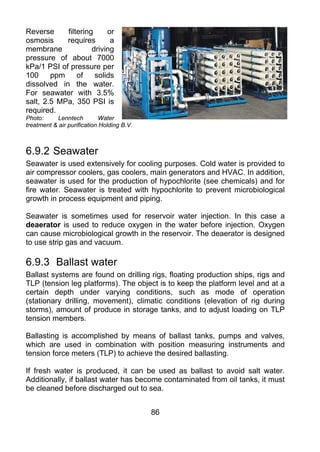
  • 38.
    Gas lift canbe controlled for a single well to optimize production, and to reduce slugging effects where the gas droplets collect to form large bubbles that can upset production. Gas lift can also be optimized over several wells to use available gas in the most efficient way. 3.6.4 Plunger lift The Plunger lift is normally used on low pressure gas wells with some condensate, oil or water, or high gas ratio oil wells. In this case the well flow conditions can be such that liquid starts to collect downhole and eventually blocks gas so that the well production stops. In this case a plunger with an open/close valve can be inserted in the tubing. A plunger catcher at the top opens the valve and can hold the plunger, while another mechanism downhole will close the valve. The cycle starts with the plunger falling into the well with its valve open. Condensed gas and oil can pass though the plunger until it reaches bottom. There the valve is closed, now with a volume of oil, condensate or water on top. Gas pressure starts to accumulate under the plunger and after a time pushes the plunger upwards, with liquid on top, which eventually flows out of the wellhead discharge. When the plunger reaches the wellhead plunger catcher, the valve opens and allows gas to flow freely for some time while new liquid collects at the bottom. After a preset time the catcher will release the plunger and the cycle repeats. 32
  • 39.
    3.7 Well workover,intervention and stimulation. After operating for some time, a well may become less productive or faulty due to residue build up, sand erosion, corrosion or reservoir clogging. Well workover is the process of performing major maintenance on an oil or gas well. This might include replacement of the tubing, a cleanup or new completions, new perforations and various other maintenance works such as the installation of gas lift mandrels, new packing etc. Through-tubing workover operation is work performed with special tools that do not require the time-consuming full workover procedure including replacement or removal of tubing. Well maintenance without killing the well and performing full workover is time-saving and often called well intervention. Various operations that are performed by lowering instruments or tools on a wire into the well are called wireline operations. Work on the reservoir such as chemical injection, acid treatment, heating etc is referred to as reservoir stimulation. Stimulation serves to correct various forms of structure damage and improve flow. Damage is a generic term for accumulation of particles and fluids that block fractures and pores and limit reservoir permeability. • Acids, such as HCL (Hydrochloric Acid) are used to open up calcareous reservoirs and to treat accumulation of calcium carbonates in the reservoir structure around the well. Several hundred liters of acid (typically 15% solution in water) are pumped into the well under pressure to increase permeability of the formation. When the pressure is high enough to open the fractures, the process is called fracture acidizing. If the pressure is lower, it is called matrix acidizing. • Hydraulic fracturing is an operation in which a specially blended liquid is pumped down a well and into a formation under pressure high enough to cause the formation to crack open, forming passages through which oil can flow into the well bore. Sand grains, aluminum pellets, walnut shells, glass beads, or similar materials (propping agents) are carried in suspension by this fluid into the fractures. When the pressure is released at the surface, the fractures partially close on the propping agents, leaving channels for oil to flow through to the well. The fracture channels may be up to 100 meters long. • Explosive fracturing uses explosives to fracture a formation. At the moment of detonation, the explosion furnishes a source of high- 33
  • 40.
    pressure gas toforce fluid into the formation. The rubble prevents fracture healing, making the use of propping agents unnecessary. • Damage removal refers to other forms of removing formation damage, such as flushing out of drill fluids. Flexible coiled tubing can be wound around a large diameter drum and inserted or removed much quicker than tubing installed from rigid pipe segments. Well workover equipment including coiled tubing is often mounted on well workover rigs. 34
  • 41.
    4 The oiland gas process The oil and gas process is the process equipment that takes the product from the wellhead manifolds and delivers stabilized marketable products, in the form of crude oil, condensates or gas. Components of the process also exist to test products and clean waste products such as produced water. An example process for the Statoil Njord floater is shown on the next page. This is a medium size platform with one production train and a production of 40-45,000 barrels per day (bpd). This is actual production, after the separation of water and gas. The associated gas and water are used for onboard power generation and gas reinjection. There is only one separation and gas compression train. The water is treated and released (it could also have been reinjected). This process is quite representative for hundreds of similar sized installations, and only one more complete gas treatment train for gas export is missing to form a complete gas production facility, Njord sends the oil via a short pipeline to a nearby storage floater. On gravity base platforms, FPSO (Floating Production and Storage Operations) and onshore plants this storage will be a part of the main installation if the oil is not piped out directly. Photo: Norsk Hydro ASA A large number of connections to chemicals, flares etc. are shown, these systems are described separately. Nård main process illustration (next page): Statoil 35
  • 42.
  • 43.
    4.1 Manifolds andgathering 4.1.1 Pipelines and risers This facility uses subsea production wells. The typical High Pressure (HP) wellhead at the bottom right, with its Christmas tree and choke, is located on the sea bed. A production riser (offshore) or gathering line (onshore) brings the well flow into the manifolds. As the reservoir is produced, wells may fall in pressure and become Low Pressure (LP) wells. This line may include several check valves. The choke, master and wing valves are relatively slow, therefore in the case of production shutdown, the pressure on the first sectioning valve closed will rise to the maximum wellhead pressure before these valves can close. The pipelines and risers are designed with this in mind. Short pipeline distances are not a problem, but longer distances may cause a multiphase well flow to separate and form severe slugs - plugs of liquid with gas in between - traveling in the pipeline. Severe slugging may upset the separation process and cause overpressure safety shutdowns. Slugging might also occur in the well as described earlier. Slugging can be controlled manually by adjusting the choke, or by automatic slug controls. Furthermore, areas of heavy condensate might form in the pipelines. At high pressure, these plugs may freeze at normal sea temperature, e.g. if production is shut down or with long offsets. This can be prevented by injecting ethylene glycol. Glycol injection is not used at Njord. The Njord floater has topside chokes for subsea wells. The diagram also shows that Kill Fluid, essentially high specific gravity mud, can be injected into the well before the choke. 4.1.2 Production, test and injection manifolds Check valves allow each well to be routed into one or more of several manifold lines. There will be at least one for each process train plus additional manifolds for test and balancing purposes. In the diagram we show three: test, low pressure and high pressure manifolds. The test manifold allows one or more wells to be routed to the test separator. Since there is only one process train, the HP and LP manifolds allow groups of HP and LP wells to be taken to the first and second stage separators respectively. The chokes are set to reduce the wellhead flow and pressure to the desired HP and LP pressures respectively. 37
  • 44.
    The desired settingfor each well and which of the wells produce at HP and LP for various production levels are defined by reservoir specialists to ensure the optimum production and recovery rate. 4.2 Separation As described earlier, the well-stream may consist of crude oil, gas, condensates, water and various contaminants. The purpose of the separators is to split the flow into desirable fractions. 4.2.1 Test separators and well test Test separators are used to separate the well flow from one or more wells for analysis and detailed flow measurement. In this way, the behavior of each well under different pressure flow conditions can be defined. This normally takes place when the well is taken into production and later at regular intervals, typically 1-2 months and will measure the total and component flow rates under different production conditions. Undesirable consequences such as slugging or sand can also be determined. The separated components are analyzed in the laboratory to determine hydrocarbon composition of the gas oil and condensate. Test separators can also be used to produce fuel gas for power generation when the main process is not running. Alternatively, a three phase flow meter could be used to save weight. 4.2.2 Production separators The main separators shown here are gravity types. On the right you see the main components around the first stage separator. As mentioned before, the production choke reduces well pressure to the HP manifold and first stage separator to about 3-5 MPa 38
  • 45.
    (30-50 times atmosphericpressure). Inlet temperature is often in the range of 100-150 degrees C. On the example platform, the well stream is colder due to subsea wells and risers. The pressure is often reduced in several stages, in this instance three stages are used to allow the controlled separation of volatile components. The idea is to achieve maximum liquid recovery and stabilized oil and gas and to separate water. A large pressure reduction in a single separator will cause flash vaporization leading to instability and safety hazards. The retention period is typically 5 minutes, allowing the gas to bubble out, water to settle at the bottom and oil to be taken out in the middle. In this platform the water cut (percentage water in the well flow) is almost 40% which is quite high. In the first stage separator, the water content is typically reduced to less than 5%. At the crude entrance, there is a baffle slug catcher that will reduce the effect of slugs (large gas bubbles or liquid plugs). However some turbulence is desirable as this will release gas bubbles faster than a laminar flow. At the end, there are barriers up to a certain level to keep back the separated oil and water. The main control loops are the oil level control loop (EV0101 20 above) controlling the oil flow out of the separator on the right, and the gas pressure loop at the top.(FV0105 20 above) These loops are operated by the Control System. An important function is also to prevent gas blow-by which happens when a low oil level causes gas to exit via the oil output causing high pressure downstream. There are generally many more instruments and control devices mounted on the separator. These will be discussed later. The liquid outlets from the separator will be equipped with vortex breakers to reduce disturbance on the liquid table inside. This is basically a flange trap to break any vortex formation and ensure that only separated liquid is tapped off and not mixed with oil or water drawn in though these vortices. Similarly 39
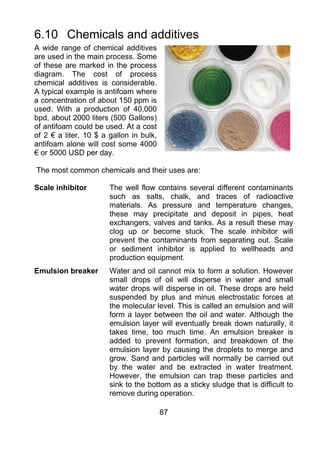
  • 46.
    the gas outletsare equipped with demisters, essential filters that will remove liquid droplets in the gas. Emergency Valves (EV) are sectioning valves that will separate the process components and blow-down valves, this will allows excess hydrocarbons to be burned off in the flare. These valves are operated if critical operating conditions are detected or on manual command, by a dedicated Emergency Shutdown System. This might involve partial shutdown and shutdown sequences since the flare might not be able to handle a full blow-down of all process sections simultaneously. A 45,000 bpd design production with gas and 40% water cut will give about 10 cubic meters from the wellheads per minute. There also needs to be enough capacity to handle normal slugging from wells and risers. This means the separator has to be about 100 cubic meters, e.g. a cylinder 3 meters in diameter and 14 meters in length at the rated operating pressure. This means a very heavy piece of equipment, typically around 50 tons for this size, which limits the practical number of stages. Other types of separators such as vertical separators or cyclones (centrifugal separation) can be used to save weight, space or improve separation (see later). There also has to be a certain minimum pressure difference between each stage to allow satisfactory performance in the pressure and level control loops. Chemical additives will be discussed later. 4.2.3 Second stage separator The second stage separator is quite similar to the first stage HP separator. In addition to output from the first stage, it will also receive production from wells connected to the Low Pressure manifold. The pressure is now around 1 MPa (10 atmospheres) and temperature below 100 degrees C. The water content will be reduced to below 2%. An oil heater could be located between the first and second stage separator to reheat the oil/water/gas mixture. This will make it easier to separate out water when initial water cut is high and temperature is low. The heat exchanger is normally a tube/shell type where oil passes though tubes in a heating medium placed inside an outer shell. 4.2.4 Third stage separator The final separator here is a two-phase separator, also called a flash drum. The pressure is now reduced to atmospheric pressure of around 100 kPa, so that the last heavy gas components will boil out. In some processes where 40
  • 47.
    the initial temperatureis low, it might be necessary to heat the liquid (in a heat exchanger) again before the flash drum to achieve good separation of the heavy components. There are level and pressure control loops. As an alternative, when the production is mainly gas, and remaining liquid droplets have to be separated out, the two-phase separator can be a Knock- Out Drum (K.O. Drum). 4.2.5 Coalescer After the third stage separator, the oil can go to a coalescer for final removal of water. In this unit the water content can be reduced to below 0.1%. The coalescer is completely filled with liquid: water at the bottom and oil on top. Internal electrodes form an electric field to break surface bonds between conductive water and isolating oil in an oil water emulsion. The coalescer field plates are generally steel, sometimes covered with dielectric material to prevent short-circuits. The critical field strength in oil is in the range of 0.2 to 2 kV/cm. Field intensity and frequency as well as the coalescer grid layout are different for different manufacturers and oil types. 4.2.6 Electrostatic desalter If the separated oil contains unacceptable amounts of salts, they can be removed in an electrostatic desalter (not used in the Njord example) The salts, which may be sodium, calcium or magnesium chlorides come from the reservoir water and are also dissolved in the oil. The desalters will be placed after the first or second stage separator depending on Gas Oil Ratio (GOR) and water cut. Photo: Burgess Manning Europe PLC 4.2.7 Water treatment On an installation such as this, where the water cut is high, there will be a huge amount of water produced. In our example, a water cut of 40% gives water production of about 4000 cubic meters per day (4 million liters) that must be cleaned before discharge to sea. Often this water contains sand particles bound to the oil/water emulsion. 41
  • 48.
    The environmental regulationsin most countries are quite strict, for example, in the North-East Atlantic the OSPAR convention limits oil in water discharged to sea to 40 mg/liter (ppm). It also places limits on other forms of contaminants. This still means that the equivalent of up to one barrel of oil per day in contaminants from the above production is discharged into the sea, but in this form, the microscopic oil drops are broken down fast by natural bacteria. Various pieces of equipment are used. This illustration shows a typical water treatment system. Water from the separators and coalescers first goes to a sand cyclone, which removes most of the sand. The sand is further washed before it is discharged. The water then goes to a hydrocyclone, a centrifugal separator that will remove oil drops. The hydrocyclone creates a standing vortex where oil collects in the middle and water is forced to the side. Finally the water is collected in the water de-gassing drum. Dispersed gas will slowly rise to the surface and pull remaining oil droplets to the surface by flotation. The surface oil film is drained, and the produced water can be discharged to sea. Recovered oil in the water treatment system is typically recycled to the third stage separator. 42
  • 49.
    4.3 Gas treatmentand compression The gas train consists of several stages, each taking gas from a suitable pressure level in the production separator's gas outlet, and from the previous stage. A typical stage is shown on the right. Incoming gas (on the right) is first cooled in a heat exchanger. It then passes through the scrubber to remove liquids and goes into the compressor. The anti surge loop (thin orange line) and the surge valve (UV0121 23) allow the gas to recirculate. The components are described below. 4.3.1 Heat exchangers For the compressor to operate efficiently, gas temperature should be low. The lower the temperature, the less energy will be used to compress the gas for the given final pressure and temperature. However both gas from separators and compressed gas are relatively hot. When gas is compressed, it must remain in thermodynamic balance, which means that the gas pressure times the volume over the temperature (PV/T) must remain constant. (PV = nkT). This ends up as a temperature increase. 43
  • 50.
    Heat exchangers ofvarious forms are used to cool the gas. Plate heat exchangers (upper picture) consist of a number of plates where the gas and cooling medium pass between alternating plates in opposing directions. Tube and shell exchangers (next picture) place tubes inside a shell filled with of cooling fluid. The cooling fluid is often pure water with corrosion inhibitors. When designing the process, it is important to plan the thermal energy balance. Heat should be conserved e.g. by using the cooling fluid from the gas train to reheat oil in the oil train. Excess heat is dispersed e.g. by seawater cooling. However hot seawater is extremely corrosive, so materials with high resistance to corrosion, such as titanium must be used. Photo: SEC Shell and Tube Heat Exchanges 4.3.2 Scrubbers and reboilers The separated gas may contain mist and other liquid droplets. Drops of water and hydrocarbons also form when the gas is cooled in the heat exchanger, and must be removed before it reaches the compressor. If liquid droplets enter the compressor they will erode the fast rotating blades. A scrubber is designed to remove small fractions of liquid from the gas. There are various types of gas-drying equipment available, but the most common suction (compressor) scrubber is based on dehydration by absorption in Triethylene Glycol (TEG). The scrubber consists of many levels of glycol layers. A large number of gas traps (enlarged detail) force the gas to bubble up through each glycol layer as it flows from the bottom up each section to the top. Processed glycol is pumped in at the top from the holding tank. It flows from level to level against the gas flow as it spills over the edge of each trap. During this process it absorbs liquids from the gas and comes out as rich 44
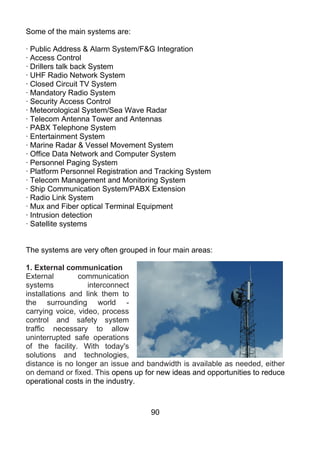
  • 51.
    glycol at thebottom. The holding tank also functions as a heat exchanger for liquid to and from the reboilers. The glycol is recycled by removing the absorbed liquid. This is done in the reboiler, which is filled with rich glycol and heated to boil out the liquids at temperature of about 130-180 °C (260-350 °F) for a number of hours. Usually there is a distillation column on the gas vent to further improve separation of glycol and other hydrocarbons. For higher capacity, there are often two reboilers which alternate between heating rich glycol and draining recycled processed glycol. On a standalone unit, the heat is supplied from a burner that uses the recovered vaporized hydrocarbons. In other designs, heating will be a combination of hot cooling substances from other parts of the process and electric heaters, and recycle the hydrocarbon liquids to the third stage separator . 4.3.3 Compressor anti surge and performance Several types of compressors are used for gas compression, each with different characteristics such as operating power, speed, pressure and volume: 45
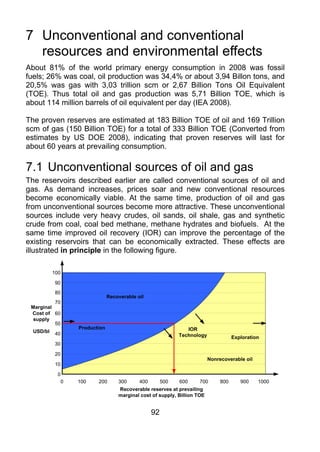
  • 52.
    • Reciprocating compressors, which use a piston and cylinder design with 2-2 cylinders are built up to about 30 MW power, around 500-1800 rpm (lower for higher power) with pressure up to 5MPa (500 bars). Used for lower capacity gas compression and high reservoir pressure gas injection. Photo: Ariel corp. • Screw compressors are manufactured up to several MW, synchronous speed (3000/3600 rpm) and pressure up to about 2.5 MPa (25 bar). Two counter-rotating screws with matching profiles provide positive displacement and a wide operating range. Typical use is natural gas gathering. Photo: Mycom/Mayekawa mfg. • Axial blade and fin type compressors with up to 15 wheels provide high volumes at relatively low pressure differential (discharge pressure 3-5 times inlet pressure), speeds of 5000-8000 rpm, and inlet flows up to 200,000 m3/hour. Applications include air compressors and cooling compression in LNG plants. Axial rotor photo: Dresser Rand 46
  • 53.
    • Larger oiland gas installations use centrifugal compressors with 3-10 radial wheels, 6000– 20000 rpm (highest for small size), up to 80 MW load at discharge pressure of up to 50 bars and inlet volumes of up to 500,000 m3/hour. Pressure differential up to 10. Photo: Dresser Rand Most compressors will not cover the full pressure range efficiently. The lowest pressure is atmospheric, for gas to pipeline, some 3 to 5 MPa (30-50 bar) pressure is used, while reservoir reinjection of gas will typically require 20 MPa (200 bar) and upwards since there is no liquid in the tubing and the full reservoir pressure must be overcome. Therefore compression is divided into several stages to improve maintenance and availability. Also due to single unit power limitations, compression is often divided in several parallel trains. This is not the case in this example since gas is not exported, and reinjection can be interrupted during maintenance periods. Compressors are driven by gas turbines or electrical motors (for lower power also reciprocating engines, steam turbines are sometimes used if thermal energy is available). Often several stages in the same train are driven by the same motor or turbine. The main operating parameters for a compressor are the flow and pressure differentials. The product defines the total loading, so there is a ceiling set by the maximum design power. Furthermore, there is a maximum differential pressure (Max Pd) and choke flow (Max Q), the maximum flow that can be achieved. At lower flow, there is a minimum pressure differential and flow before the compressor will "surge" if there is not enough gas to operate. If variations in flow are expected or difference between common shaft compressors will occur, the situation will be handled with recirculation. A high flow, high pressure differential surge control valve will open to let gas from the discharge side back into the suction side. Since this gas is heated it will also pass through the heat exchanger and scrubber not to become overheated by circulation. 47
  • 54.
    The operating characteristicsare defined by the manufacturer. In the above diagram the blue lines mark constant speed lines. The maximum operating limits are set by the orange line as described above. The surge domain is the area to the left of the red surge curve. The objective of compressor performance control is to keep the operating point close to the optimal set point without violating the constraints, by means of control outputs, such as the speed setting. However, gas turbine speed control response is relatively slow and even electric motors are not fast enough, since surge response must be in the 100 ms range. Anti surge control will protect the compressor from going into surge by operating the surge control valve. The basic strategy is to use distance between operating point and surge line to control the valve with a slower response time starting at the surge control line. Crossing the surge trip line will cause a fast response opening of the surge valve to protect the compressor. Operation with recirculation wastes energy (which could result in unnecessary emissions) and produces wear and tear, particularly on the surge valve. Each vendor supplies several variants of compressor control and anti surge control to optimize performance, based on various corrective and predictive algorithms. Some strategies include: • Set point adjustment: If rapid variations in load cause surge valve action, the set point will be moved to increase the surge margin. 48
  • 55.
    Equal margin: The set point is adjusted to allow equal margin to surge between several compressors. • Model based control: Outside the compressor itself, the main parameter for the surge margin is the total volume from the surge valve to the compressor suction inlet, and the response time for the surge valve flow. A model predictive controller could predict surge conditions and react faster to real situations while preventing unnecessary recirculation. Since compressors require maintenance and are potentially expensive to replace, several other systems are normally included: Load management: To balance loading among several compressors in a train and between trains, the compressor control system often includes algorithms for load sharing, load shedding and loading. Compressors are normally purged with inert gas, such as nitrogen, during longer shutdowns, e.g. for maintenance. Therefore, startup and shutdown sequences will normally include procedures to introduce and remove the purge gas. Vibration: Vibration is a good indicator of problems in compressors, and accelerometers are mounted on various parts of the equipment to be logged and analyzed by a vibration monitoring system. Speed governor If the compressor is turbine driven, a dedicated speed governor handles the fuel valves and other controls on the turbine to maintain efficiency and control rotational speed. For electrical motors this function is handled by a variable speed drive. The final function around the compressor itself is lube and seal oil handling. Most compressors have wet seals, which are traps around shafts where oil at high pressure prevents gas from leaking out to atmosphere or other parts of the equipment. Oil is used for lubrication of the high speed bearings. This oil gradually absorbs gas under pressure and may be come contaminated. So it needs to be filtered and degassed. This happens in smaller reboilers much the same way as for the glycol reboilers described earlier. 49
  • 56.
    4.3.4 Gas treatment Whengas is exported, many gas trains include additional equipment for further gas processing to remove unwanted components such as hydrogen sulfide and carbon dioxide. These gases are called acids and sweetening/acid removal is the process of taking them out. Natural gas sweetening methods include absorption processes, cryogenic processes; adsorption processes (PSA, TSA and iron sponge) and membranes. Often hybrid combinations are used, such as cryogenic and membranes. Gas treatment could also include calibration. If the delivery specification is for a specific calorific value (BTU per scf or MJ per scm) gas with higher values can be adjusted by adding an inert gas, such as nitrogen. This is often done at a common point such as a pipeline gathering system or a pipeline onshore terminal. 4.4 Oil and gas storage, metering and export The final stage before the oil and gas leaves the platform consists of storage, pumps and pipeline terminal equipment. 4.4.1 Fiscal metering Partners, authorities and customers all calculate invoices, taxes and payments based on the actual product shipped out. Often custody transfer also takes place at this point, which means transfer of responsibility or title from the producer to a customer, shuttle tanker operator or pipeline operator. Although some small installations are still operated with a dipstick and manual records, larger installations have analysis and metering equipment. To make sure readings are accurate, a fixed or movable prover loop for calibration is also installed. The illustration shows a full liquid hydrocarbon (oil and condensate) metering system. The analyzer instruments on the left provide product data such as density, viscosity and water content. Pressure and temperature compensation is also included. For liquids, turbine meters with dual pulse outputs are most common. Alternatives are positive displacement meters (pass a fixed volume per rotation or stroke) and coriolis mass flow meters. These instruments cannot cover the full range with sufficient accuracy. Therefore the metering is split into several runs, and the number of runs depends on the flow. Each run 50
  • 57.
    employs one meterand several instruments to provide temperature and pressure correction. Open/close valves allow runs to be selected and control valves can balance the flow between runs. The instruments and actuators are monitored and controlled by a flow computer. If the interface is not digital, dual pulse trains are used to allow direction sensing and fault finding. Metering system To obtain the required accuracy, the meters are calibrated. The most common method is a prover loop. A prover ball moves though the loop, and a calibrated volume is provided between the two detectors (Z). When a meter is to be calibrated the four way valve opens to allow oil to flow behind the ball. The number of pulses from it passes one detector Z to the other and is counted. After one loop the four way valve turns to reverse flow direction and the ball moves back providing the same volume and in reverse, again counting the pulses. From the known reference volume, number of pulses, pressure and temperature the flow computer can calculate the meter factor and provide accurate flow measurements using formulas from industry standard organizations such as API MPMS and ISO 5024. The accuracy is typically ± 0.3% of standard volume. 51
  • 58.
    Gas metering issimilar, but instead, analyzers will measure hydrocarbon content and energy value (MJ/scm or BTU, Kcal/scf) as well as pressure and temperature. The meters are normally orifice meters or ultrasonic meters. Orifice plates with a diameter less than the pipe are mounted in cassettes. The pressure differential over the orifice plate as well as pressure and temperature is used in standard formulas (such as AGA 3 and ISO 5024/5167) to calculate normalized flow. Different ranges are accommodated with different size restrictions. Orifice plates are sensitive to a buildup of residue and effect on the edges of the hole. Larger new installations therefore prefer ultrasonic gas meters that work by sending multiple ultrasonic beams across the path and measure the Doppler Effect. Gas metering is less accurate than liquid, typically ±1.0% of mass. There is usually no prover loop, the instruments and orifice plates are calibrated in separate equipment instead. LNG is often metered with mass flow meters that can operate at the required low temperature. A three run LNG g metering skid is shown above. At various points in the movement of oil and gas, similar measurements are taken, usually in a more simplified way. Examples of different gas types are flare gas, fuel gas and injected gas where required accuracy is 2-5% percent. 52
  • 59.
    4.4.2 Storage On mostproduction sites, the oil and gas is piped directly to a refinery or tanker terminal. Gas is difficult to store locally, but occasionally underground mines, caverns or salt deposits can be used to store gas. On platforms without a pipeline, oil is stored in onboard storage tanks to be transported by shuttle tanker. The oil is stored in storage cells around the shafts on concrete platforms, and in tanks on floating units. On some floaters, a separate storage tanker is used. Ballast handling is very important in both cases to balance the buoyancy when the oil volume varies. For onshore, fixed roof tanks are used for crude, floating roof for condensate. Rock caves are also used for storage Special tank gauging systems such as level radars, pressure or float are used to measure the level in storage tanks, cells and caves. The level measurement is converted to volume via tank strapping tables (depending on tank geometry) and compensated for temperature to provide standard volume. Float gauges can also calculate density, and so mass can be established. A tank farm consists of 10-100 tanks of varying volume for a typical total capacity in the area of 1 - 50 million barrels. Storage or shuttle tankers normally store up to two weeks of production, one week for normal cycle and one extra week for delays e.g. bad weather. This can amount to several million barrels. Accurate records of volumes and history are kept to document what is received and dispatched. For installations that serve multiple production sites, different qualities and product blending must also be handled. Another planning task is forecasting for future received and delivered products. This is for stock control and warehousing requirements. A tank farm management system keeps track of all stock movements and logs all transport operations that take place 53
  • 60.
    4.4.3 Marine loading Loadingsystems consist of one or more loading arms/jetties, pumps, valves and a metering system. Tanker loading systems are complex, both because of the volume involved, and because several loading arms will normally interact with the tanker's ballast system to control the loading operation. The tanks must be filled in a certain sequence; otherwise the tanker's structure might be damaged due to uneven stresses. It is the responsibility of the tanker's ballast system to signal data to the loading system and to operate the different valves and monitor the tanks on board the ship. Photo: StatoilHydro 4.4.4 Pipeline terminal The gas pipeline is fed from the high pressure compressors. Oil pipelines are driven by separate booster pumps. For longer pipelines, intermediate compressor stations or pump stations will be required due to distance or crossing of mountain ranges. Block valve stations are placed at regular intervals to limit the potential leakage volume in case of a pipe rupture. The pipeline terminal includes termination systems for the pipeline. A pig launcher and receiver will be included at the least, to allow insertion of a pipeline pigging device used to clean or inspect the pipeline on the inside. This is essentially a large chamber that can be pressurized and purged to insert and remove the pig or scraper without depressurizing the pipeline. The pig is often driven by pipeline flow. 54
  • 61.
    5 Gas processingand LNG Raw natural gas from the well consists of methane as well as many other smaller fractions of heavier hydrocarbons, and various other components. Component Chemical Boiling Point Vapor pressure Formula at 101 kPa at 20 °C approx. Methane CH4 -161,6 °C Tcri t−82.6 °C @ 4,6 MPa Ethane C2H6 -88.6 °C 4200 kPa Propane C3H8 -42.1 °C 890 kPa Butane n-C4H10 −0.5 °C 210 kPa Higher order HC Alkenes CnH2n Aromatics e.g. C6H6 Acid Gases Carbon Dioxide CO2 −78 °C 5500 kPa Hydrogen Sulfide H2S -60.2 °C Mercaptans ex. Methanethiol CH3SH 5.95 °C Ethanethiol C2H5SH 35 °C Other Gases Nitrogen N2 -195.79 °C Helium He -268.93 °C Water H2O 0 °C Trace pollutants Mercury Clorides Data source: Wikipedia, Air Liquide Gas Encyclopedia The natural gas is characterized in several ways dependant on the content of these components: o Wet gas is raw gas with a methane content of less than 85% o Dry gas is raw or treated natural gas that contains less than 15 liters of condensate per 1000 SM3. (0.1 gallon per 1000 scf). o Sour gas is raw gas with a content of more than 5.7 mg hydrogen sulfide (H2S) per scm (0.25 grains per 100 scf), this is about 4 ppm. o Acid gas has a high content of acidic gases such as carbon dioxide (CO2) or H2St. Pipeline natural gas specification is typically less than 55
  • 62.
    2% CO2. Acidgas fields with up to 90% CO2 exist, but the normal range for sour raw gas is 20-40%. o Condensates are a mixture of hydrocarbons and other components in the above table. These are normally gaseous from the well but condense out as liquid during the production process (see previous chapter). This is a refinery and petrochemical feedstock. Raw gas is processed into various products or fractions: o Natural Gas in its marketable form has been processed for a specific composition of hydrocarbons, sour and acid components etc. and energy content. Content is typically 90% methane, with 10% other light alkenes. o Natural Gas Liquids (NGL) is a processed purified product consisting of ethane, propane, butane or some higher alkenes separately, or in a blend. It is primarily a raw material for petrochemical industry and is often processed from the condensate. o Liquefied Petroleum Gas (LPG) refers to propane or butane or a mixture of these that has been compressed to liquid at room temperature (200 to 900 kPa depending on composition). LPG is filled in bottles for consumer domestic use as fuel, and is also used as aerosol propellant (in spray cans) and refrigerant (e.g. in air conditioners). Energy to volume ratio is 74% of gasoline. o Liquefied Natural Gas (LNG) is natural gas that is refrigerated and liquefied at below -162 °C, for storage and transport. It is stored at close to atmospheric pressure, typically less than 125 kPa. As a liquid, LNG takes up 1/600 of the volume of the gas at room temperature. Energy to volume ratio is 66% of gasoline. After transport and storage it is reheated/vaporized and compressed for pipeline transport. o Compressed Natural Gas (CNG) is natural gas that is compressed at 2-2,2 MPa to less than 1% of volume at atmospheric pressure. Unlike higher alkenes, methane cannot be kept liquid by high pressure at normal ambient temperatures because of a low critical temperature. CNG is used as a less costly alternative to LNG for lower capacity and medium distance transport. Methane for vehicle fuel is also stored as CNG. Energy to volume ratio is typically 25% of gasoline. 56
  • 63.
    5.1 Gas processing Rawnatural gas must be processed to meet the trading specifications of pipeline and gas distribution companies. As part of the purification other components such as NGL is produced, and pollutants extracted. The diagram shows an overview of a typical gas plant. Marketable products are listed in blue and the production process is shown in grey as it is not considered part of the gas plant. WELL Production Process Condensate - Separation - Water treatment Water Raw gas to pipeline Tail Gas Tail Gas Cleanup Unit Disposal Acid Gas Removal Sulfur Unit - Hydrotreatment - Stack - Absorbtion - Claus Process - Solvents - Thermal - Adsorbtion Oxidizer - Cryogenic - Membranes Elemental Sulfur Dehydration - Absorbtion Water - Pressure Swing Mercury Removal Mercury - Membranes waste - Adsorbtion Rich Nitrogen Rejection - Absorbtion Nitrogen - Adsorbtion gas - Cryogenic NGLs NGL Recovery Fractionation Sweetening Ethane - Absorbtion - Distillation - Catalytic Propane - Cryogenic - Membrane Butane other Sales gas Typical gas plant 57
  • 64.
    5.1.1 Acid gasremoval Acid gases such as carbon dioxide and hydrogen sulfide form acids when reacting with water, and must be removed to prevent corrosive damage to equipment and pipelines. Hydrogen sulfide is also toxic and total sulfur content is normally regulated. The main removal process can be based on several principles: Absorption allows acidic gases to be dissolved in a solvent, to be released by regeneration in a later stage. Amine absorption (as shown on the right) is the most common process for acid gas removal. Monoethanolamines (MEA) dominate for CO2 removal. Solutions with inorganic solvents based on ammonia are under development. Ill: Wikipedia A typical amine gas treating process (as shown in the flow diagram) consists of an absorber unit, a regenerator unit and accessory equipment. In the absorber, a "lean" amine solution absorbs H2S and CO2 from the upflowing sour gas to produce a sweetened gas stream as a product. The "rich" amine solution contains the absorbed acid gases and is routed into the regenerator (a stripper with a reboiler). The stripped overhead gas from the regenerator is concentrated H2S and CO2. Adsorption relies on the molecules to bind to the surface of certain solids. After a certain time the material must be regenerated to release the gas. Principles used include Pressure Swing Adsorption (PSA), Temperature Swing Adsorption (TSA) and Electric Swing Adsorption (ESA) Cryogenic removal uses a turbo expander: A gas turbine is driven by the expanding gas which then cools to below the dew point for the gas to be removed. 58
  • 65.
    The inlet gasto the compressor is precooled by the acid gas removed. Cryogenic removal is most often used when the content of carbon dioxide is high, typically around 50%. Membrane based removal is based on certain materials that allow the acid gases, but not the hydrocarbons, to diffuse through the membrane. This procedure can be performed alone or in combination with absorption liquid. Sulfur Unit. The H2S-rich stripped gas stream is then fed to a Claus process - a multistage process with two main sections: A thermal section fires H2S with air or oxygen to produce SO2 and elemental sulfur which is released when cooled. A catalytic section allows more H2S to react with SO2 with alumina or titanium dioxide (TiO2) to produce water and elemental sulfur (the Claus reaction: 2H2S + SO2 → 3S + 2H2O). The Claus process can recover 95-97% of the sulfur in the feed gases. A Tail Gas Treatment unit serves to reduce the sulfur content to below 250 ppm, corresponding to a total sulfur recovery of 99.9%. More complex solutions can reduce total sulfur down to 10 ppm. Some important processes include SCOT (Shell Claus Offgas Treatment) which removes SO2 by combustion with hydrogen over catalysts to produce H2S and water. H2S is recycled to the Claus unit. Other solutions are the Beavon Sulfur Removal (BSR) process based on amine solvent and catalysts. 5.1.2 Dehydration Dehydration is either glycol-based scrubbers as described in chapter 4.3.2 or based on Pressure Swing Adsorption (PSA). Newer processes also use membranes. 5.1.3 Mercury removal Mercury removal is generally based on molecular sieves. A molecular sieve is a substance containing a material with tiny pores to achieve a large surface area, such as activated carbon. The surface of the material allows certain molecules to bind by surface tension. The molecules can later be extracted and the sieve material regenerated by heating, pressure and/or purging with a carrier gas. A molecular sieve is commonly cyclic with one active unit and one (or more) units in regeneration. 59
  • 66.
    5.1.4 Nitrogen rejection Excessivenitrogen is removed by cryogenic distillation and higher concentrations are removed by absorption with lean oil or another special solvent if a smaller fraction is detected. (See acid gas removal for both principles). Cryogenic removal also permits production of helium, if present, as a valuable by-product. 5.1.5 NGL recovery and treatment Remaining NGLs are recovered from the gas stream in most modern plants by a cryogenic turbo expander based process followed by a fractionating process. This process leads the cooled NGLs though distillation columns called de-ethanizer, de-propanizer and de-butanizer, to extract ethane, propane and butane respectively and leave a residual stream of pentane and higher hydrocarbons. The final step is to remove mercaptans (smelly organic gases e.g. CH3SH) if present, in a sweetening process, based on molecular sieves adsorption or catalytic oxidization such as Merox – mercaptan oxidization or Sulfrex, where the main difference is a type of catalyst. 5.1.6 Sales gas specifications The exact sales gas specification is specified by pipeline operators and distributors. Typical standard sales gas requirements are for the following parameters: Volume is measured in standard cubic meters (scm) defined as 1 m3 at 0ºC and 101.325 kPa or standard cubic feet (scf) as 1 ft3 at 60 °F (16 °C) and 14.73 PSIA Calorific value specifies the total amount of energy per unit generated during combustion of the gas. The value is used to calculate the amount of energy delivered. Several values are listed: • Gross calorific value or gross heat of combustion: is the heat released when a specific quantity of fuel in mixture with air is ignited and the end products have returned to the initial temperature, normally 25ºC. EU specifications are typically 38.8 MJ (10.8 kWh) ±5% per scm. In the US 1030 BTU ±5% per scf. 60
  • 67.
    Net calorific value or net heat of combustion: is the net heat generated when the water vapor in the gas does not condense (water forms during combustion) and can be 10% lower. Wobbe index measures the heating effect that a burner is exposed to during combustion. A higher value means a greater thermal load on the burner. Different gases with the same Wobbe index will impose the same load on the burner. An excessively high value is a safety hazard as it can lead to burner overheating and to excess production of carbon monoxide during combustion. Calorific value and Wobbe index can be adjusted by blending gas from different sources as well as by addition or removal of nitrogen (N2) Methane Number is a value similar to octane value for gasoline, and is important when the gas is used for internal combustion engines (as CNG). Hydrogen Sulfide and Overall Sulfur Content both hydrogen sulfide (H2S) and total sulfur must be reduced. H2S is toxic as well as corrosive for the pipeline as it forms sulfuric acid (H2SO4) and should be kept as low as possible. Typical maximum values are 5 mg per scm. of H2S and total sulfur at 10 mg per scm. Mercury should be kept below 0.001 ppb (parts-per-billion) which is its detectable limit. The goal is to limit emissions and to prevent damage to equipment and pipelines by mercury amalgamation which would make aluminum and other metals brittle. Dew point is a temperature below which some of the hydrocarbons in the gas might condense at pipeline pressure, forming liquid slugs which could damage the pipeline. The gas must also be clear of all water vapor to prevent the formation of methane hydrates within the gas processing plant or within the sales gas transmission pipeline. Particles and other substances: must be free of particulate solids and all liquids to prevent erosion, corrosion or other damage to the pipeline and satisfy limits on carbon dioxide, nitrogen, mercaptans etc. Additives: when the natural gas is intended for domestic use, Tetrahydrothiophene (THT) is added so that the otherwise odorless natural gas can be detected in the event of a gas leak. The sulfurous smelling substance added is equal to a sulfur content of 4-7 mg per scm. 61
  • 68.
    5.2 LNG LNG isa gas transport product. The gas, primarily methane (CH4), is converted to liquid form for ease of storage or transport. It is produced close to the production facilities in a LNG liquefaction pant, stored, transported in cryogenic tanks on an LNG carrier and delivered to an LNG regasification terminal for storage and delivery to a pipeline system. Melkøya LNG Plant with LNG Carrier Arctic Princess Photo: StatoilHydro LNG carriers are used when the transport distance does not justify the cost of a pipeline. The main drawback is the cost of the liquefaction, calculated as how much of the total energy content of the gas is used for liquefaction. About 6% of energy content is used to produce LNG in a large modern plant, due to overall thermal efficiency. More than 10% could be consumed with smaller, gas turbine-driven trains. This compares to losses of about 0, 6-1, and 0 % per 1000 km of transport distance for large pipeline systems. The LNG feedstock comes from a gas plant as outlined above. It must satisfy sales gas specifications. Ethane, propane and butane all have freezing points of less than -180°C and can be part of the LNG, but the concentration of methane is generally above 90%. Some NGLs are also needed as refrigerant for the cryogenic process. 5.2.1 LNG liquefaction LNG processes are generally patented by large engineering, oil and gas companies, but are generally based on a two or three stage cooling process. A three stage liquefaction plant is shown in this simplified figure: 62
  • 69.
    The actual designvaries considerably with the different processes. The most critical component is the heat exchanger, also called the cold box, which is designed for optimum cooling efficiency. Designs may use separate cold boxes, or two stages may combine into one complex common heat exchanger. 63
  • 70.
    Most processes usea mixed refrigerant (MR) design. The reason is that the gas has a heat load to temperature (Q/T) curve that must be closely matched to improve stability and efficiency, see the figure below. The curve tends to show three distinct regions, matching the pre-cooling, liquefaction and sub-coiling stages. The refrigerant gas composition will vary based on the individual design, as will the power requirement of each stage, and is often a patented, location-specific combination of one or two main components and several smaller, together with careful selection of the compressed pressure and expanded pressure of the refrigerant, to match the LNG gas stream. Typical LNG train power use is about 28 MW per million tons of LNG per annum (mtpa), corresponding to typically 200 MW for the largest trains of 7.2 mtpa, or 65 MW per stage. In addition other consumers in gas treatment and pre-compression add to total energy consumption and bring it to some 35-40 MW per mtpa. For each train, the cooling medium is first passed though its cooling compressor. Since Pressure times Volume over Temperature (PV/T) remains constant, it results in a significant temperature rise which has to be dissipated, typically in a seawater heat exchanger as shown in the figure above (as indicated by the blue wavy line). It then goes though one or more heat exchangers/cold boxes, before it expands either though a valve or a turbo-expander causing the temperature to drop significantly. It is then returned to cool its cold box before going on to the compressor. The pre-cooling stage cools the gas to a temperature of about -30 to -50ºC in the precooling cold box. The cooling element is generally propane or a mixture of propane and ethane and small quantities of other gases. The pre- cooling cold box also cools the cooling medium for the liquefaction and sub cooling stage. The liquefaction process takes the gas down from -30ºC to about -100- 125ºC typically based on a mixture of methane and ethane and other gases. It cools the LNG stream as well as the refrigerant for the final stage. Sub-cooling serves to bring the gas to final stable LNG state at around 162ºC. The refrigerant is usually methane and/or nitrogen. 64
  • 71.
    5.2.2 Storage, transportand regasification Storage at the terminals and on LNG carriers is done in cryogenic tanks at atmospheric pressure or slightly above, up to 125 kPa. The tanks are insulated, but will not keep LNG cold enough to avoid evaporation. Heat leakage will heat and boil off the LNG. Therefore LNG is stored as a boiling cryogen, which means that the liquid is stored at its boiling point for its storage pressure (atmospheric pressure) i.e. about -162ºC. As the vapor boils off, heat of vaporization is absorbed from and cools the remaining liquid. The effect is called auto-refrigeration. With efficient insulation, only a relatively small amount of boil-off is necessary to maintain temperature. Boil- off gas from land based LNG storage tanks is compressed and fed to natural gas pipeline networks. On LNG carriers the boil-off gas can be used for fuel. At the receiving terminal, the LNG is stored in local cryogenic tanks. It is regasified to ambient temperature on demand, commonly in a sea water heat exchanger, and then injected into the gas pipeline system. Cove point LNG terminal 65
  • 72.
    6 Utility systems Thischapter contains an overview of the various systems that provides utilities or supports for the main process. 6.1 Process Control Systems A process control system is used to monitor data and control equipment on the plant. Very small installations may use hydraulic or pneumatic control systems, but larger plants with up to 250,000 signals to and from the process require a dedicated distributed control system. The purpose of this system is to read values from a large number of sensors, run programs to monitor the process and control valves, switches etc. to control the process. Values, alarms, reports and other information are also presented to the operator and command inputs accepted. Typical Process Control System 66
  • 73.
    Process control systemsconsist of the following components: • Field instrumentation: sensors and switches that sense process conditions such as temperature, pressure or flow. These are connected over single and multiple pair electrical cables (hardwired) or communication bus systems called fieldbus. • Control devices, such as actuators for valves, electrical switchgear and drives or indicators are also hardwired or connected over fieldbus. • Controllers execute the control algorithms so that the desired actions can be taken. The controllers will also generate events and alarms based on changes of state and alarm conditions and prepare data for operators and information systems. • A number of servers perform the data processing required for data presentation, historical archiving, alarm processing and engineering changes. • Clients such as operator stations and engineering stations are provided for human interfaces to the control system. • The communication can be laid out in many different configurations, often including connections to remote facilities, remote operations support and similar. Function blocks define the control function. The main function of the control system is to make sure the production, processing and utility systems operate efficiently within design constraints and alarm limits. The control system is typically specified in programs as a combination of logic and control function blocks such as AND, ADD, PID. For a particular system, a library of standard solutions such as Level Control Loops and Motor Control blocks are defined. This means that the system 67
  • 74.
    can be specifiedwith combinations of typical loop templates, consisting of one or more input devices, function blocks and output devices. This allows much if not all of the application to be defined based on engineering databases and templates rather than formal programming. The system is operated from a Central Control Room (CCR) with a combination of graphical process displays, alarm lists, reports and historical data curves. Smaller personal screens are often used in combination with large wall screens as shown on the right. With modern systems, the same information is available to remote locations such as an onshore corporate operations support centre. Field devices in most process areas must be protected to prevent them becoming ignition sources for potential hydrocarbon leaks. Equipment is explosive hazard classified e.g. as safe by pressurization (Ex.p), safe by explosive proof encapsulation (Ex.d) or intrinsically safe (Ex.i). All areas are mapped into explosive hazard zones from Zone 0 (inside vessels and pipes), Zone 1 (risk of hydrocarbons), Zone 2 (low risk of hydrocarbons) and Safe Area. Beyond the basic functionality, the control system can be used for more advanced control and optimization functions. Some examples are: • Well control may include automatic startup and shutdown of a well and/or a set of wells. Applications can include optimization and stabilization of artificial lift such as pump off control and gas lift optimization. • Flow assurance ensures the flow from wells, in pipelines and risers is stable and maximized under varying pressure, flow and 68
  • 75.
    temperatures. Unstable flowcan result in slug formation, hydrates etc. • Optimization of various processes to increase capacity or reduce energy costs. • Pipeline management modeling, leak detection and pig tracking. • Support for remote operations, in which facility data is available to company specialists located at a central support center. • Support for remote operations where the entire facility is unmanned or without local operators full or part time, and is operated from a remote location. 6.2 Safety systems and Functional Safety The function of safety systems is to take control and prevent an undesirable event when the process and the facility is no longer operating within its normal operating conditions. Functional safety is the part of the overall safety of a system that depends on the correct response of the safety system response to its inputs, including safe handling of operator errors, hardware failures and environmental changes (fires, lightening etc.) . The definition of safety is “Freedom from unacceptable risk”. of physical injury or of damage to the health of people either directly or indirectly. This requies a definition of what is acceptable risk, and who should define acceptable risk levels. This involves several concepts, including: 1. Identifying what the required safety functions are, which means that hazards and safety functions have to be known. A process of function reviews, formal Hazard Identification Studies (HAZID) and Hazard and Operability (HAZOP) studies and Accident Reviews are applied to identify the risks and failure modes. 2. Assessment of the risk-reduction required by the safety function. This will involve a Safety Integrity Level (SIL) Assessment. A Safety Integrity Level (SIL) applies to an end-to-end safety function of the safety-related system, not just to a component or part of the system. 3. Ensuring the safety function performs to the design intent, including under conditions of incorrect operator input and failure modes. Functional Safety management defines all technical and management activities during the lifecycle of the safety system. The safety lifecycle is a systematic way to ensure that all the necessary 69
  • 76.
    activities to achievefunctional safety are carried out and also to demonstrate that the activities have been carried out in the right order. Safety need to be documented to be able to pass information to different engineering disciplines. For the oil and gas industry, safety standards comprise a set of corporate, national and international laws, guidelines and standards. Some of the primary international standards are: • IEC 61508 Functional safety of electrical/electronic/programmable electronic safety-related systems • IEC 61511 Functional safety - Safety instrumented systems for the process industry sector A safety integrity level is not directly applicable to individual subsystems or components. It applies to a safety function carried out by the Safety Instrumented System (end-to-end: sensor, controller and final element). IEC 61508 covers all components of the E/E/PE safety-related system, including field equipment and specific project application logic. All these subsystems and components, when combined to implement the safety function (or functions), are required to meet the safety integrity level target of the relevant functions. Any design using supplied subsystems and components that are all quoted as suitable for the required safety integrity level target of the relevant functions will not necessarily comply with the requirements for that safety integrity level target. Suppliers of products intended for use in E/E/PE safety-related systems should provide sufficient information to facilitate a demonstration that the E/E/PE safety-related system complies with IEC 61508 this often requires that the functional safety for a the system should be independently certified. There are never one single action which lead to a large accident, it is often a train of activities. There are many layers to protect against an accident, and these are grouped two different categories. • Protection layers – to prevent an incident from happening. Example Rupture disk, relief valve, Dike. • Mitigation layers – to minimize the consequence of an incident, example operator intervention or Safety Instrumented System (SIS) A Safety Instrumented System (SIS) is a collection of sensors, controllers and actuators that execute one or more Safety Instrumented Functions 70
  • 77.
    (SIFs/safety loops) thatare implemented for a common purpose. Each SIF has its own SIL and all sensors, controllers and final element in one SIF must comply to the same SIL (Safety Integrity Level) i.e. the end-to-end safety interity level. The SIS is typically divided into the following subsystems: • Emergency Shutdown System (ESD) to handle emergency conditions (high criticality shutdown levels) • Process Shutdown System (PSD) to handle non-normal but less critical shutdown levels • Fire and Gas Systems to detect fire, gas leakage and initiate firefighting, shutdown and isolation of ignition sources. The Purpose of a Safety Instrumented System is to reduce the risk that a process may become hazardous to a tolerable level. The SIS does this by decreasing the frequency of unwanted accidents: SIS senses hazardous conditions and takes action to move the process to a safe state, preventing an accident from occurring. The amount of risk reduction that an SIS can provide is represented by its Safety Integrity Level (SIL) which is a measure of the risk reduction factor provided by a safety function. IEC 61508 defines four levels SIL 1-4 and the corresponding requirements for the risk reduction factor (RFF) and Probability of Failure on Demand (PFD): SIL PFD RRF 1 0.1 – 0.01 10 – 100 2 0.01 – 0.001 100 – 1000 3 0.001 – 0.0001 1000 – 10.000 4 0.0001 – 0.00001 10.000 – 100.000 The SIL for a component is given by its PFD, Safe Failure Fraction and design to avoid influence of systematic errors. 6.2.1 Emergency Shutdown and Process Shutdown The Emergency Shutdown (ESD) and Process Shutdown (PSD) systems will take action when the process goes into a malfunction or dangerous state. For this purpose the system maintains four sets of limits for a process value, LowLow (LL), Low (L), High (H) and HighHigh (HH). L and H are process warning limits which alert to process disturbances. LL and HH are alarm 71
  • 78.
    conditions and detectthat the process is operating out of range and there is a chance of undesirable events and malfunction. Separate transmitters are provided for safety systems. One example is the LTLL (Level Transmitter LowLow) or LSLL (Level Switch LowLow) alarm for the oil level. When this condition is triggered, there is a risk of blow-by which means gas leaks out of the oil output and gives high pressure in the next separation stage or other following process equipment such as a desalter. Transmitters are preferred over switches because of better diagnostic capabilities Emergency shutdown actions are defined in a cause and affect chart based on a HAZOP of the process. This study identifies possible malfunctions and how they should be handled. On the left of the chart we have possible emergency scenarios, on top we find possible shutdown actions. At an oil and gas facility, the primary response is to isolate and depressurize. In this case, the typical action would be to close the inlet and outlet sectioning valves (EV 0153 20, EV 0108 20 and EV 0102 20 in the diagram), and open the blowdown valve (EV 0114 20). This will isolate the malfunctioning unit and reduce pressure by flaring of the gas. Events are classified on a 72
  • 79.
    scale, e.-g. 0to 5, where a full Abandon Platform/Facility Shutdown (APS – ESD 0) as the highest level means a complete shutdown and evacuation of the facility. The next levels (ESD1, ESD2) define emergency complete shutdown. The lower levels (i.e. PSD 3, PSD 4, and PSD 5), represent single equipment or process section shutdowns. A split between APS/ESD and PSD is done in large installations because most signals are PSD and could be handled with less strict requirements. These actions are handled by the Emergency Shut Down system (ESD) and Process Shut Down system (PSD) according to Functional Safety Requirements and standards. Thus a typical ESD function might require a SIL 3 or even 4 level while PSD loops could be SIL 2 or 3. Smaller ESD systems, e.g. on wellhead platforms, can be hydraulic or hardwired (non-programmable). 6.2.2 Fire and Gas System The Fire and Gas System is not generally related to any particular process. Instead it divides into fire areas by geographical location. Each fire area should be designed to be self-contained, in that it should detect fire and gas by several types of sensors, and control fire protection and firefighting devices to contain and fight fire within the fire area. In the event of fire, the area will be partially shut-off by closing ventilation fire dampers. A fire area protection data sheet typically shows what detection exists for each fire area and what fire protection action should be taken in case of an incident. The type and number of the detection, protection and fighting devices depend on the type of equipment and size of the fire area and will vary for e.g. process areas, electrical rooms and accommodation. Fire detection: • Gas detection: Combustible and toxic gas, electro-catalytic or optical (IR) detector. • Flame detection: Ultraviolet (UV) or infra red (IR) optical detectors • Fire detection: Heat and ionic smoke detectors • Manual pushbuttons 73
  • 80.
    Firefighting, protection: • Gas based firefighting such as CO2 • Foam based firefighting • Water based firefighting: sprinklers, mist (water spray) and deluge • Protection: Interface to emergency shutdown and HVAC fire dampers. • Warning and escape: PA systems, beacons/lights, fire door and damper release A separate package related to fire and gas is the diesel- or electrically-driven fire water pumps for the sprinkler and deluge ring systems. For fire detection, coincidence and logic are often used to identify false alarms. In such schemes, several detectors in the same area are required to detect a fire condition or gas leakage for automatic reaction. This will include different detection principles e.g. a real fire, but not welding or lightning. Action is controlled by a Fire and Gas system. Like the ESD system, F&G action is specified in a cause and action chart called the Fire Area Protection Datasheet. This chart shows all detectors and fire protection systems in a fire area and how the system will operate. The F&G system often provides supervisory functions, either in the F&G or the Information Management System (IMS) to handle such tasks as maintenance, calibration or replacement and hot work permits, e.g. welding. Such actions may require that one or more Fire and Gas detectors or systems are overridden or bypassed. Specific work procedures should be enforced, such as a placing fire guards on duty and make sure all devices are re-enabled when the work permit expires or work is complete. 74
  • 81.
    6.3 Telemetry/SCADA Supervisory Controland Data Acquisition (SCADA) is normally associated with telemetry and wide area communications, for data gathering and control over large production sites, pipelines, or corporate data from multiple facilities. With telemetry, the bandwidth is often quite low and based on telephone or local radio systems. SCADA systems are often optimized for efficient use of the available bandwidth. Wide area communication operates with wideband services, such as optical fibers and broadband internet. Remote Terminal Units (RTU) or local controls systems on wells, wellhead platforms, compressor and pump stations, and are connected to the SCADA system by means of the available communication media. SCADA systems have many of the same functions as the control system, and the difference mainly comes down to data architecture and use of communications. 75
  • 82.
    6.4 Integrated Operations IntegratedOperations (IO) mean full integration of the organizations that work to plan, operate and maintain the oil and gas fields and their facilities. As such, it is both a business model and an infrastructure with work processes. eField, eOperations, Smart Operations and other company specific names are for all or part of this field of activities. The overall goal is: • Increase efficiency • Enhance recovery • Lower operational costs through effective use of intelligent technology Optimal production targets and maximum utilization of production resources are achieved through the use of several sources of information such as reservoir mass balance calculations and depletion strategies, well test results and use of simulation models. This is made possible by linking skills, data and tools together in real time – independent of location. Company Expert Resource Center Broad-band Connection Onshore Advanced Control Operation and Optimization Center Tools Supplier Support Center Offshore Onshore Some of the enabler technology areas are: 1. A system and communication IT infrastructure, see 5.1 and 5.2 2. Applications for remote operations and remote operations support. 3. Reservoir management and drilling operations 4. Production optimization 76
  • 83.
    5. Information ManagementSystems 6. Operation Support and Maintenance 6.4.1 Reservoir management and drilling operations Solution for data acquisition, modeling and visualization between facility operators and central company experts to provide: • Drilling simulation and visualization, automatic diagnostics and decision support, real-time measurements while drilling in order to locate the best targets • Reservoir models based on real-time reservoir data, analysis of 4D seismic, in-situ measurements of changes. On-line integration with well-serviced company data • Optimization models for increased production, based on in-reservoir properties during production, with decision support incorporated to improve productivity 6.4.2 Production optimization Optimizing the production or improving productivity is a complex problem. In addition to the production optimization of the downhole-, subsea- and topside process, one has to consider operational costs, hardware damage, reservoir performance, environmental requirements and operational difficulties within each well and/or topside. To further complicate optimization, the individual challenges will change over time, e.g. reservoir behavior changes as an effect of depletion, shutdown of wells due to slugging, failed sensors and the change of efficiencies within the topside process system. Some of the applications included in production optimization are: 77
  • 84.
    Flowline Control to stabilize multiphase flow in gathering systems, risers and flow lines. • Well Control that will stabilize and optimize gas lift and naturally flowing wells. This application should prevent flow and pressure surges while maintaining minimal backpressure and maintain maximum production as well as continuing production at the optimum lift gas rate. • Gas-lift optimization is provided to ensure the best possible distribution of lift-gas between gas lifted wells. • Slug management will help mitigate variations in inflow impact. The separation and hydrocarbon processing during startup, upset and normal operation. • Well Monitoring Systems (WMS) are used to estimate the flow rates of oil, gas and water from all the individual wells in an oil field. The real-time evaluation is based on data from available sensors in the wells and flow lines. • Hydrate Prediction Tools will help to avoid hydrate formation, which may occur if a subsea gathering system is allowed to cool down too much before the necessary hydrate preventive actions are performed. • Optimal operation is defined by a set of constraints in the wells and production facilities. A Constraint Monitoring Tool monitors the closeness to all constraints. This provides decision support for corrective actions needed to move current operation closer to its true potential. • Advanced Control and Optimization Solutions to improve the performance of product quality control, while adhering to operating constraints. This is typically done with two technologies, Model Predictive Control to drive the process closer to operating targets and Inferential Measurement to increase the frequency of product quality feedback information. • Tuning tools are designed to optimize and properly maintain the optimal setting of control loops in the process automation system. 6.4.3 Asset Optimization and maintenance Support An Asset Optimization (AO) system is to reduce costly production disruptions by enabling predictive maintenance. It records the maintenance history of an asset and identifies potential problems to avert unscheduled shutdowns, maximize up-time and operate closer to plant production prognoses. This functionality supports maintenance workflow as the AO system communicates with a maintenance system, often denoted CMMS (computerized maintenance management system). 78
  • 85.
    Condition monitoring includesboth structural monitoring and condition monitoring for process equipment such as valves and rotating machinery. For structural monitoring, the devices are corrosion meters (essentially plates that corrode, for which that corrosion may be metered), tension force meters and free swinging strings. These statistics are logged to a central structure condition monitoring system, to portray what forces are acting against the installation, and the effect those forces are having. ERP-System Maintenance Management Asset Condition Create work order Document Work order history Messenger CMMS* Maintenance status Preventive maintenance,… Asset Monitor Operator Service staff extern Diagnosis and Status Data Actuator/ Valve Heat Exchanger Maximize the utilization of plant assets over their lifecycle Condition monitoring of machinery is generally used for large rotating apparatus, such as turbines, compressors, generators and large pumps. Input devices are vibration meters, temperature (bearing, exhaust gases etc.) as well as the number of start/stops, running time, lubrication intervals and over-current trip-outs. For other process equipment such as valves, the system can register closing times, flow and torque. A valve which exhibits a negative trend in closing time or torque ("stiction") can be diagnosed. The maintenance trigger is the mechanism whereby field device or equipment monitor resident information, in the form of digital status signals or other numerical or computed variables interpreted to trigger a maintenance 79
  • 86.
    request. A WorkOrder Procedure is then automatically initiated in the CMMS. Maintenance support functionality will plan maintenance, based on input from condition monitoring systems and a periodic maintenance plan. This will allow the system to schedule personnel, for such tasks as lubrication or cleaning, and plan larger tasks such as turbine and compressor periodic maintenance. 6.4.4 Information Management Systems (IMS) A specific Information Management System can be used to provide information about the operation and production of the facility. This can be a separate system, or an integral part of the control system or SCADA system. Web Portal Enterprise Historians Integrated Data & AE Applications Object Model Historians Monitoring Safety Sub- DCS’s Systems systems For oil and gas, IMS functionality includes: • Oil & Gas Production Reporting. • Safety Management • Maintenance • Operator Support • Overall systems integrated and external • Historical data including post failure "flight recorder" data Some of the applications provided by an IMS system may be: 80
  • 87.
    Drilling data acquisition and drilling data logging • Electronic Shift Logbook • Operator Procedures • Chemical Injection • Chemical Consumption • Laboratory Analysis Registration • Alarm and Incidents overview • Alarm Statistics • Valve Leakage Test • Transmitter Surveillance • Run Time Monitoring • Block Log • Production Plan • SIL Statistics Report • Subsea Valve Signatures • Production Overview and Prognosis • Valve Verification • ESD/PSD Verification, including shutdown analysis • Data Export • Data Browser Tool • Historical data and Current Trend • Well Test • Daily Production Report with Metering data • Volumes in storage cells & consolidation of produced stored and dispatched volumes. • Environmental Reports • Polynomial allocation (oil/gas/water) based on Well Test results. 6.4.5 Training simulators Training simulators are used to provide operator training in a realistic plant training environment. They use the actual control and safety applications of the plant, running on operator stations. Plant models simulate the feedback from the plant in real time or in fast or slow motion. Training simulator applications include functions for backup 81
  • 88.
    and reload includingrecreation of historical information and snapshots. Offsite training facilities are often connected (read only) to the live plant to give information from the real operating situation. 6.5 Power generation, distribution and drives Power can be provided from mains power or from local gas turbines or diesel generator sets. Large facilities have high power demands, from 30 MW and upwards to several hundred MW. There is a tendency to generate electric power centrally and use electric drives for large equipment rather than multiple gas turbines, as this decreases maintenance and increases uptime. The power generation system on a large facility is usually several gas turbines diving electric generators, 20-40 MW each. If exhaust heat is not needed in the main process, it can be used to drive exhaust steam turbines (dual cycle) for additional efficiency. Voltage levels for high, medium and low voltage distribution boards are 13- 130kV, 2-8 kV and 300-600 V respectively. Power is generated and exchanged with mains or other facilities on the HV distribution board. Relays are used for protection functions. 82
  • 89.
    HV is transformedto MV switchboards to which large consumers are connected. LV switchboards feed a mix of normal consumers, Motor Control Centers and variable speed drives for motors up to a few hundred KW (Not necessarily separate as shown in the figure). A separate emergency power switchboard provides power for critical equipment. It can be powered from a local emergency generator if main power is lost. Computer systems are fed from an Uninterruptible Power System (UPS) with batteries, connected to the main or emergency switchboard. A power management system is used for control of electrical switchgear and equipment. Its function is to optimize electricity generation and usage and to prevent major disturbances & plant outages (blackouts). The power management system includes HV, MV and LV low voltage switchgear plus Motor Control Centers (MCC) and emergency generator sets. Functions include prioritization of loads, emergency load shedding (closing down of non-essential equipment) and prestart of generator sets (e.g. when additional power to start a big crude pump is required). Large rotating equipment and generators are driven by gas turbines or large drives. Gas turbines for oil and gas production are generally modified aviation turbines in the 10-25 MW range. These require quite extensive maintenance and have a relatively low overall efficiency (20-27% depending on application). Also, while a turbine is relatively small and light, it will usually require large and heavy support equipment such as large gears, air coolers/filters, exhaust units, and sound damping and lubrication units. 83
  • 90.
    Therefore use oflarge variable speed drives is becoming more common. For pumps on subsea facilities this is the only option. For use on remote facilities, High Voltage DC transmission and HV motors can be used, from a main facility or power from shore. This will also avoid local power generation at each facility and contribute to low manning or remote operation. 6.6 Flare and atmospheric ventilation Flare subsystems include flare, atmospheric ventilation and blowdown. The purpose of the flare and vent systems is to provide safe discharge and disposal of gases and liquids resulting from: • Spill-off flaring from the product stabilization system. (oil, condensate etc.). • Production testing. • Relief of excess pressure caused by process upset conditions and thermal expansion. • Depressurization either in response to an emergency situation or as part of a normal procedure. • Planned depressurization of subsea production flowlines and export pipelines. • Venting from equipment operating close to atmospheric pressure (e.g. tanks). The systems are typically divided into a High Pressure (HP) Flare and a Low Pressure (LP) flare system. The LP system is operated a little above atmospheric pressure to prevent atmospheric gases such as oxygen flowing back into the vent and flare system and generating a combustible mixture. With low gas flow, inert gas is injected at the flare nozzle to prevent air ingress. Traditionally, considerable amounts of hydrocarbons have been more or less continuously flared. In these cases, a continuously burning pilot is used to ensure ignition of hydrocarbons in the flare. 84
  • 91.
    Stronger environmental focushas eliminated continuous flaring and the pilot in many areas. Vapors and flare gas are normally recovered, and only in exceptional situations does flaring occur. To avoid the pilot flame, an ignition system is used to ensure safe ignition even when large volumes are discharged. One patented solution is a "ballistic ignition" system which fires burning pellets into the flare gas flow. 6.7 Instrument air A large volume of compressed air is required for the control of pneumatic valves and actuators, tools and purging of cabinets. It is produced by electrically driven screw compressors and further treated to be free of particles, oil and water. 6.8 HVAC The heat, ventilation and air conditioning system (HVAC) feeds conditioned air to the equipment and accommodation rooms etc. Cooling and heating is achieved by water-cooled or water/steam-heated heat exchangers. Heat may also be taken from gas turbine exhaust. In tropic and sub-tropic areas, cooling is achieved by compressor refrigeration units. In tropical areas, gas turbine inlet air must be cooled to achieve sufficient efficiency and performance. The HVAC system is usually delivered as one package, and may also include air emissions cleaning. Some HVAC subsystems include: • Cool: cooling medium, refrigeration system, freezing system • Heat: heat medium system, hot oil system. One function is to provide air to equipment rooms that are secured by positive pressure. This prevents potential influx of explosive gases in case of a leak. 6.9 Water systems 6.9.1 Potable water For smaller installations, potable water can be transported in by supply vessels or tank trucks. For larger facilities, it is provided on site by desalination of seawater though distillation or reverse filtering. Onshore potable water is provided by purification of water from above- or underground reservoirs. 85
  • 92.
    Reverse filtering or osmosis requires a membrane driving pressure of about 7000 kPa/1 PSI of pressure per 100 ppm of solids dissolved in the water. For seawater with 3.5% salt, 2.5 MPa, 350 PSI is required. Photo: Lenntech Water treatment & air purification Holding B.V. 6.9.2 Seawater Seawater is used extensively for cooling purposes. Cold water is provided to air compressor coolers, gas coolers, main generators and HVAC. In addition, seawater is used for the production of hypochlorite (see chemicals) and for fire water. Seawater is treated with hypochlorite to prevent microbiological growth in process equipment and piping. Seawater is sometimes used for reservoir water injection. In this case a deaerator is used to reduce oxygen in the water before injection. Oxygen can cause microbiological growth in the reservoir. The deaerator is designed to use strip gas and vacuum. 6.9.3 Ballast water Ballast systems are found on drilling rigs, floating production ships, rigs and TLP (tension leg platforms). The object is to keep the platform level and at a certain depth under varying conditions, such as mode of operation (stationary drilling, movement), climatic conditions (elevation of rig during storms), amount of produce in storage tanks, and to adjust loading on TLP tension members. Ballasting is accomplished by means of ballast tanks, pumps and valves, which are used in combination with position measuring instruments and tension force meters (TLP) to achieve the desired ballasting. If fresh water is produced, it can be used as ballast to avoid salt water. Additionally, if ballast water has become contaminated from oil tanks, it must be cleaned before discharged out to sea. 86
  • 93.
    6.10 Chemicals andadditives A wide range of chemical additives are used in the main process. Some of these are marked in the process diagram. The cost of process chemical additives is considerable. A typical example is antifoam where a concentration of about 150 ppm is used. With a production of 40,000 bpd, about 2000 liters (500 Gallons) of antifoam could be used. At a cost of 2 € a liter, 10 $ a gallon in bulk, antifoam alone will cost some 4000 € or 5000 USD per day. The most common chemicals and their uses are: Scale inhibitor The well flow contains several different contaminants such as salts, chalk, and traces of radioactive materials. As pressure and temperature changes, these may precipitate and deposit in pipes, heat exchangers, valves and tanks. As a result these may clog up or become stuck. The scale inhibitor will prevent the contaminants from separating out. Scale or sediment inhibitor is applied to wellheads and production equipment. Emulsion breaker Water and oil cannot mix to form a solution. However small drops of oil will disperse in water and small water drops will disperse in oil. These drops are held suspended by plus and minus electrostatic forces at the molecular level. This is called an emulsion and will form a layer between the oil and water. Although the emulsion layer will eventually break down naturally, it takes time, too much time. An emulsion breaker is added to prevent formation, and breakdown of the emulsion layer by causing the droplets to merge and grow. Sand and particles will normally be carried out by the water and be extracted in water treatment. However, the emulsion can trap these particles and sink to the bottom as a sticky sludge that is difficult to remove during operation. 87
  • 94.
    Antifoam The sloshing motion inside a separator will cause foaming. This foam will cover the fluid surface and prevent gas from escaping. Foam also reduces the gas space inside the separator, and can pass the demister and escape to the gas outlet in the form of mist and liquid drops. An antifoam agent is introduced upstream of the separator to prevent or break down foam formation, by reducing liquid surface tension. Polyelectrolyte Polyelectrolyte is added before the hydrocyclones and causes oil droplets to merge. This works by reducing surface tension and water polarity. This is also called flocculation and polyelectrolyte flocculants and allows emissions to reach 40 ppm or less. Methanol (MEG) Methanol or Monoethylene Glycol (MEG) is injected in flowlines to prevent hydrate formation and prevent corrosion. Hydrates are crystalline compounds that form in water crystalline structures as a function of composition, temperature and pressure. Hydrates appear and freeze to hydrate ice that may damage equipment and pipelines. For normal risers, hydrates form only when production stops and the temperature start to drop. Hydrate formation can be prevented by depressurization which adds to startup time or by methanol injection. On longer flowlines in cold seawater or Arctic climates, hydrates may form under normal operating conditions and require continuous methanol injection. In this case the methanol can be separated and recycled. Hydrate prediction model software can be used to determine when there is a risk of hydrate formation and to reduce methanol injection or delay depressurization. TEG Triethyleneglycol (TEG) is used to dry gas. See the chapter on scrubbers and reboilers. Hypochlorite Hypochlorite is added to seawater to prevent growth of algae and bacteria e.g. in seawater heat exchangers. Hypochlorite is produced by electrolysis of seawater to chlorine. In one variant, copper 88
  • 95.
    electrodes are usedwhich adds copper salts to the solution which improves effectiveness. Biocides Biocides are also preventive chemicals that are added to prevent microbiological activity in oil production systems such as bacteria, fungus or algae growth. Particular problems arise from the growth of sulfate bacteria that produces hydrogen sulfide and clogs filters. Typical uses include diesel tanks, produced water (after hydrocyclones), and slop and ballast tanks. Corrosion inhibitor Corrosion inhibitor is injected in the export pipelines and storage tanks. Exported oil can be highly corrosive and lead to corrosion of the inside of the pipeline or tank. The corrosion inhibitor will protect by forming a thin film on metal surfaces. Drag reducers Drag reducers improve the flow in pipelines. Fluid near the pipe tries to stay stationary while fluid in the center region of the pipe is moving quickly. This large difference in fluid causes turbulent bursts to occur in the buffer region. Turbulent bursts propagate and form turbulent eddies, which cause drag. Drag-reducing polymers are long-chain, ultra-high molecular weight polymers from 1 to 10 million u), with higher molecular weight polymers giving better drag reduction performance. With only parts-per-million levels in the pipeline fluid, drag-reducing polymers suppress the formation of turbulent bursts in the buffer region. The net result of using a drag-reducing polymer in turbulent flow is a decrease in the frictional pressure drop in the pipeline by as much as 70%. This can be used to lower pressure or improve throughput. 6.11 Telecom By tradition, all electronic systems that do not fall naturally under the electrical or automation bracket are grouped as telecommunication systems. And as such the telecom system consists of variety of subsystems for human and computer wired and wireless communications, monitoring, observation, messaging and entertainment. 89
  • 96.
    Some of themain systems are: · Public Address & Alarm System/F&G Integration · Access Control · Drillers talk back System · UHF Radio Network System · Closed Circuit TV System · Mandatory Radio System · Security Access Control · Meteorological System/Sea Wave Radar · Telecom Antenna Tower and Antennas · PABX Telephone System · Entertainment System · Marine Radar & Vessel Movement System · Office Data Network and Computer System · Personnel Paging System · Platform Personnel Registration and Tracking System · Telecom Management and Monitoring System · Ship Communication System/PABX Extension · Radio Link System · Mux and Fiber optical Terminal Equipment · Intrusion detection · Satellite systems The systems are very often grouped in four main areas: 1. External communication External communication systems interconnect installations and link them to the surrounding world - carrying voice, video, process control and safety system traffic necessary to allow uninterrupted safe operations of the facility. With today's solutions and technologies, distance is no longer an issue and bandwidth is available as needed, either on demand or fixed. This opens up for new ideas and opportunities to reduce operational costs in the industry. 90
  • 97.
    2. Internal communication Internaltelecommunication systems play a major role in supporting day-to-day operations and improve the working environment. They allow any type of system or operator to communicate within the facility, enabling reliable and efficient operations. 3. Safety & Security Systems Safety & Security Systems are used for safeguarding personnel and equipment in, on and around an installation according to international rules and standards. These systems are very often adapted to meet local/company safety requirements. For best possible performance and flexibility, safety systems are closely integrated with each other, as well as to other internal and external systems. 4. Management & utility systems System and personnel well-being are supported by a number of management and utility systems, which are intended to ease and simplify telecom maintenance and operations. In today's O&G world all of these systems play an important role in laying the foundations for remote operation, diagnostics and maintenance in Integrated Operations. 91
  • 98.
    7 Unconventional andconventional resources and environmental effects About 81% of the world primary energy consumption in 2008 was fossil fuels; 26% was coal, oil production was 34,4% or about 3,94 Billon tons, and 20,5% was gas with 3,03 trillion scm or 2,67 Billion Tons Oil Equivalent (TOE). Thus total oil and gas production was 5,71 Billion TOE, which is about 114 million barrels of oil equivalent per day (IEA 2008). The proven reserves are estimated at 183 Billion TOE of oil and 169 Trillion scm of gas (150 Billion TOE) for a total of 333 Billion TOE (Converted from estimates by US DOE 2008), indicating that proven reserves will last for about 60 years at prevailing consumption. 7.1 Unconventional sources of oil and gas The reservoirs described earlier are called conventional sources of oil and gas. As demand increases, prices soar and new conventional resources become economically viable. At the same time, production of oil and gas from unconventional sources become more attractive. These unconventional sources include very heavy crudes, oil sands, oil shale, gas and synthetic crude from coal, coal bed methane, methane hydrates and biofuels. At the same time improved oil recovery (IOR) can improve the percentage of the existing reservoirs that can be economically extracted. These effects are illustrated in principle in the following figure. 100 90 80 Recoverable oil 70 Marginal Cost of 60 supply 50 Production IOR USD/bl 40 Technology Exploration 30 20 Nonrecoverable oil 10 0 0 100 200 300 400 500 600 700 800 900 1000 Recoverable reserves at prevailing marginal cost of supply, Billion TOE 92
  • 99.
    Estimates of undiscoveredconventional and unconventional sources vary as widely the oil price among different sources. The figure illustrates that if one assumes that an oil price of50 USD per barrel prevails, the estimated economically recoverable reserves with current technology will be about 550 Billion tons of oil equivalent, or 4 Trillion barrels, while an oil price of 100 USD/bl will permit about 800 Billion tons corresponding to more than 5,5 trillion barrels or about 140 years of consumption at current rates. Economical production cost and discovery are uncertain factors. With continued high oil prices, figures of around 1-2 trillion barrels of conventional (more gas than oil) and 3 trillion barrels unconventional are often quoted, for a total remaining producible hydrocarbon reserve of about 5 trillion barrels of oil. It is expected that up to a third of oil fuel production may come from unconventional sources within the next decade. 7.1.1 Extra heavy crude Very heavy crude are hydrocarbons with an API grade of about 15 or below. The most extreme heavy crude currently extracted is Venezuelan 8 API crude e.g. in eastern Venezuela (Orinoco basin). If the reservoir temperature is high enough, the crude will flow from the reservoir. In other areas, such as Canada, the reservoir temperature is lower, and steam injection must be used to stimulate flow from the formation. When reaching the surface, the crude must be mixed with diluents (often LPGs) to allow it to flow in pipelines. The crude must be upgraded in a processing plant to make lighter SynCrude with a higher yield of high value fuels. Typical SynCrude has an API of 26-30. The diluents are recycled by separating them out and piping them back to the wellhead site. The crude undergoes several stages of hydrocracking and coking to form lighter hydrocarbons and remove coke. It is often rich in sulfur (sour crude) which must be removed. 7.1.2 Tar sands Tar sands can be often strip-mined. Typically two tons of tar sand will yield one barrel of oil. Typical tar sand contains sand grains with a water envelope, covered by a bitumen film that may contain 70% oil. Various fine particles can be suspended in the water and bitumen. This type of tar sand can be processed with water extraction. Hot water is added to the sand, and the resulting slurry is piped to the extraction plant where it is agitated and the oil skimmed from the top. Provided that the water 93
  • 100.
    chemistry is appropriate(the water is adjusted with chemical additives), it allows bitumen to separate from sand and clay. The combination of hot water and agitation releases bitumen from the oil sand, and allows small air bubbles to attach to the bitumen droplets. The bitumen froth floats to the top of separation vessels, and is further treated to remove residual water and fine solids. It can then be transported and processed the same way as extra heavy crude. It is estimated that around 80% of tar sands are too far below the surface for current open-cast mining techniques. Techniques are being developed to extract the oil below the surface. This requires a massive injection of steam into a deposit, thus liberating the bitumen underground, and channeling it to extraction points where it would be liquefied before reaching the surface. The tar sands of Canada (Alberta) and Venezuela are estimated at 250 billion barrels, equivalent to the total reserves of Saudi Arabia. 7.1.3 Oil shale Most oil shales are fine-grained sedimentary rocks containing relatively large amounts of organic matter from which significant amounts of shale oil and combustible gas can be extracted by destructive distillation. One of the largest known locations is the oil shale locked in the 40,000 km2 (16,000 sq. miles) Green River Formation in Colorado, Utah, and Wyoming. Oil shale differs from coal in that organic matter in shales has a higher atomic hydrogen to carbon ratio. Coal also has an organic to inorganic matter ratio of more than 4, i.e. 75 to 5, while oil shales have a higher content of sedimentary rock. Sources estimate the world reserves of oil shales at more than 2.5 trillion barrels. Oil shales are thought to form when algae and sediment deposit in lakes, lagoons and swamps where an anaerobic (oxygen-free) environment prevent the breakdown of organic matter, thus allowing it to accumulate in thick layers. That is later covered with overlying rock to be baked under high temperature and pressure. However the heat and pressure was lower than in oil and gas reservoirs. 94
  • 101.
    The shale canbe strip-mined and processed with distillation. Extraction with fracturing and heating is still relatively unproven. Companies are experimenting with direct electrical heating rather than e.g. steam injection. Extraction cost is currently around 25-30 USD per barrel. 7.1.4 Shale gas and coal bed methane Oil shales are also becoming an important source of shale gas, and some analysts expect that this source of natural gas can supply half the gas consumption in USA and Canada by 2020. Shale normally do not have the required matrix permeability for the gas to be produced, and in the past gas could be produced only from source rock with significant natural fracturing. The natural gas comes from decomposition of shale oil and is held in natural fractures, some in pore spaces, and some is adsorbed onto the organic material. Recently there have been strong advance in extraction technology which uses a combination of horizontal wells and hydraulic fracturing in a way that maintains fracturing (see chapter 3.7) and flow of gas much better than earlier. Even so production typically requires a high number of wells with limited lifetime, and so continuous drilling of new well is required to maintain output. Methane is a potent greenhouse gas and emissions from leaking capped wells and fractures is a potential problem die to the large 95
  • 102.
    number of wells. Thisform of production is different from oil shale gas which is produced by pyrolysis (heating and hydrocarbon decomposition) of mined oil shale. Coal deposits also contain large amounts of methane, referred to as coal bed methane. The methane is absorbed in the coal matrix and needs extraction techniques similar to shale gas. Often the coal bed is flooded, so after well completion and fracturing, the coal seam (layer of coal) needs to be dewatered. A common solution is to extract water through the well tubing. Generally, the water needs to be pumped out and therefore control is needed to prevent the gas from entering the water in the tubing (the well becomes gassy) This reduces the pressure and allows methane to desorb from the matrix and be produced through the casing. 7.1.5 Coal, gas to liquids and synthetic fuel Coal is similar in origin to oil shales, but typically formed from the anaerobic decay of peat swamps and relatively free from non organic sediment deposits, reformed by heat and pressure. To form a 1 meter thick coal layer, as much as 30 meters of peat was originally required. Coal can vary from relatively pure carbon to carbon soaked with hydrocarbons, sulfur etc. It has been known for decades that synthetic diesel could be created from coal. This is first done by creating water gas as synthesis gas by passing steam over red-hot coke. The reaction is endothermic and requires heating: C + H2O → H2 + CO More hydrogen is produced in the water gas shift reaction: CO + H2O → H2 + CO2 Often two stages are used: a high temperature shift (HTS) at 350 °C with catalyst iron oxide promoted with chromium oxide, and a low temperature shift (LTS) at 190–210 °C with catalyst copper on a mixed support composed of zinc oxide and aluminum oxide. These synthesis gases are then used in the Fischer–Tropsch process: (2n+1)H2 + nCO → CnH(2n+2) + nH2O 96
  • 103.
    This process runsat a pressure of 2-4 MPa. The high temperature process with iron catalyst runs at 350 °C and will yield a fuel similar to normal diesel with an average carbon number of 12, and a certain content of unwanted aromatics. The low temperature process runs at 200 °C with a cobalt catalyst and yields a pure synthetic diesel composed of alkanes with a carbon number of 10-15 and an average carbon number of 12. Synthesis gas can also be created from natural gas by lean combustion or steam reforming: CH4 + 1/2O2 → CO + 2H2 Lean combustion CH4 + H2O → CO + 3H2 Steam reforming This can be fed to the water shift reaction and to the F-T process. This process together with the following application are often called Gas to Liquids or GTL processes. An alternative use of the synthesis gases (CO and H2) is production of methanol and synthetic gasoline: 2 H2 + CO → CH3OH Methanol syntesis Then the methanol is converted to synthetic gasoline in the Mobil process. 2 CH3OH → CH3OCH3 + H2O Dehydration to dimethyl ether The following stage further dehydrates the ether with ceolite catalyst to yield a synthetic gasoline with 80% carbon number 5 and above. It suffers from catalyst coking and currently has limited economical competitiveness. 7.1.6 Methane hydrates Methane hydrates are the most recent form of unconventional natural gas to be discovered and researched. These formations are made up of a lattice of frozen water, which forms a sort of cage around molecules of methane. Hydrates were first discovered in permafrost regions of the Arctic and have been found in most of the deepwater continental shelves tested. The methane originates from organic decay. 97
  • 104.
    At the seabottom, under high pressure and low temperatures, the hydrate is heavier than water and cannot escape. Research has revealed that this form of methane may be much more plentiful than earlier expected. Estimates range anywhere from 180 to over 5800 trillion scm. This is also a greenhouse emission treat if released due to ocean warming. The US Geological Survey estimates that methane hydrates may contain more organic carbon than all the world's coal, oil, and conventional natural gas – combined. However, research into methane hydrates is still in its infancy. 7.1.7 Biofuels Biofuels are produced from specially-grown products such as oil seeds or sugars, and organic waste e.g. from the forest industry. These fuels are called carbon neutral, because the carbon dioxide (CO2) released during burning is offset by the CO2 used by the plant when growing. Ethanol alcohol (C2H5OH) is distilled from fermented sugars and/or starch (e.g. wood, sugar cane or beet, corn(maize) or grain) to produce ethanol that can be burnt alone with retuning of the engine, or mixed with ordinary petrol. Biodiesel is made from oils from crops such as rapeseed, soy, sesame, palm or sunflower. The vegetable oil (lipid) is significantly different from mineral (crude) oil, and is composed of triglycerides. In these molecules three fatty acids are bound to a glycerol molecule shown in the following picture (The wiggly line represents the carbon chain with a carbon atom at each knee with single or double bonds and two or one hydrogen atoms respectively): The glycerol backbone on the left is bound (ester OH binding) to three fatty acids, here shown with palmitic acid, oleic acid and alpha-linolenic acid and a total carbon number of 55. 98
  • 105.
    This molecule isbroken down to individual alkyl esters through a chemical process called transesterification whereby the glycerin is separated from the fatty acids. Methanol (CH3OH) is added to the lipids and heated. Any strong base capable of deprotonating the alcohol, such as NaOH or KOH is used as catalyst. The process leaves behind methyl esters (with a CH3 group on the ester binding) and glycerin (a valuable byproduct used in soaps, explosives and other products). Biodiesel contains no petroleum, but it can be blended at any level with petroleum diesel to create a biodiesel blend. It can be used in compression- ignition (diesel) engines with little or no modification. Biodiesel is simple to use, biodegradable, non-toxic, and essentially free of sulfur and aromatics. Although biofuel is carbon-neutral, concern has been raised about diverting agricultural areas away from food production. Recently, research has shown potential for growing certain strains in arid regions that could otherwise not be used for producing human food. 99
  • 106.
    An alternative tothe above process still at the research stage is genetically modified E. choli bacteria that can produce enzymes to break down cellulose to sugar and then produce biodiesel. This method should allow use of general biological waste and limit competition with human food resources. 7.1.8 Hydrogen Although not a hydrocarbon resource, hydrogen can be used in place of or as a complement to traditional hydrocarbon based fuels. As an "energy carrier". Hydrogen is clean burning, which means that when hydrogen reacts with oxygen, either in a conventional engine or a fuel cell, water vapor is the only emission. (Combustion with air at high temperatures will also form nitrous oxides). Hydrogen can be produced either from hydrocarbons (natural gas, ethanol etc.) or by electrolysis. Production from natural gas is often done by steam reforming and water shift gas reactions (CH4 + H2O → CO + 3 H2, CO + H2O → CO2 + H2) with up to 75-80% efficiency, It has the advantage over methane gas, that carbon dioxide can be removed and handled at a central location rather than from each consumer (car, ship etc.), providing a cleaner energy carrier. Hydrogen is also produced from water by electrolysis with an efficiency of about 25% at normal conditions to about 50% in high temperature, high pressure processes, or in various recycling processes in the chemical industry. (e.g. hydrochloric acid recycled in the polyurethane process). The energy supply can then come from a renewable source such as hydroelectric, solar, wind, wave, or tidal, where hydrogen acts as an energy carrier replacing batteries, to form a full clean, renewable energy source supply chain. In both cases the main problem is overall economy, distribution and storage. Hydrogen cannot easily be compressed to small volumes, but requires quite bulky gas tanks for storage. Also hydrogen produced from electricity currently has an end-to-end efficiency that does not compare well with gasoline or electrical battery vehicles. 7.2 Emissions and environmental effects The production, distribution and consumption of hydrocarbons as fuel or feedstock are globally the largest source of emissions into the environment. The total annual world energy supply of 11,000 Mill TOE is based 81% on 100
  • 107.
    fossil fuels, andreleases some 26,000 million tons of carbon dioxide plus other gases, e.g. methane into the atmosphere. The most serious effect of these emissions is global climate change. The Inter-governmental Panel on Climate Change (often called the UN Climate Panel) predicts that these emissions will cause the global temperature to rise from between 1.4 to 6.4ºC by the end of the 21st century depending on models and global scenarios. 7.2.1 Indigenous emissions Emissions from the industry can be divided into several types. Discharge: Mud, shale, silt, produced water with traces of hydrocarbons. Ballast water, polluted wastewater with detergent, sewage etc. Accidental spills: Blowout, shipwreck cargo and bunker oil, pipeline leakage, other chemicals, traces of low level radioactive isotopes. Emissions: CO2, methane, nitrous oxides (NOx) and sulfur from power plants and flaring Exposure: Toxic and/or carcinogenic chemicals Locally, these emissions are tightly controlled in most countries by national and international regulations, and during normal operations, emission targets can be reached with the systems and equipment described earlier in this document. However, there is continuing concern and research into the environmental impact of trace levels of hydrocarbons and other chemicals on the reproductive cycle and health of wildlife in the vicinity of oil and gas installations. The major short-term environmental impact is from spills associated with accidents. These spills can have dramatic short-term effects on the local environment, with damage to marine- and wildlife. However, the effects seldom last for more than a few years outside Arctic regions. 7.2.2 Greenhouse emissions The most effective greenhouse gas is water vapor. Water naturally evaporates from the sea and spreads out and can amplify or suppress the other effects because of its reflective and absorbing capability. 101
  • 108.
    The two mostpotent emitted greenhouse gases emitted are CO2 and methane. Because of its heat-trapping properties and lifespan in the atmosphere, methane's effect on global warming is 22-25 times higher than CO2 per kilo released to atmosphere. By order of importance to greenhouse effects, CO2 emissions contributes 72-77%, methane 14-18%, nitrous oxides 8-9% and other gases less than 1%. (Sources: Wikipedia, UNEP) The main source of carbon dioxide emissions is burning of hydrocarbons. Out of 29 Billion Tons (many publications use Teragram Tg = Million tons) of CO2 emitted in 2008, 18 Billion Tons or about 60% of the total comes from oil and gas, the remainder is coal, peat and renewable bioenergy such as firewood. 11% or 3,2 Billion tons comes from the oil and gas industry itself in the form of losses, local heating, power generation etc. Fig. Greenhouse emissions Source: Wikipedia Commons The annual emissions amount to about 1% of total atmospheric CO2, which is in balance with about 50 times more carbondioxide dissolved in seawater. 102
  • 109.
    This balance isdependent on sea temperature: Ocean CO2 storage is reduced as temperature increases, but increases with the partial pressure of CO2 in the atmosphere. Short term the net effect is that about half the CO2 emitted to air contributes to an increase of atmospheric CO2 by about 1,5 ppm annally. For methane, the largest source of human activity-related methane emissions to atmosphere, is from rice paddies and enteric fermentation in ruminant animals (dung and compost) from 1.4 billion cows and buffaloes. These emissions are estimated at 78.5 Tg/year (source: FAO) out of a total of 200 Tg, which is equivalent to about 5,000 Tg of CO2. Methane from the oil and gas industry accounts for around 30% of emissions, mainly from losses in transmission and distribution pipelines and systems for natural gas. There are many mechanisms affecting the overall balance of greenhouse gases in the atmosphere, CO2 has been measured both directly and in ice cores, and has increased from a pre-industrial value of around 250 ppm to 385 ppm today. Methane has increased from 1732 to 1774 ppb (parts per billion). Absorbtion Erosion & Sediments Oil, Gas Coal ------------------------- Volcanoes release Organic Sediments Carbonates 103
  • 110.
    There is nofull model that describes the net effect of these changes. It is well accepted that without CO2, methane and water vapor, the global average temperature would be about 30ºC colder. The current data correlates well with a current global average temperature increase from a pre-industrial global average of 13.7ºC to 14.4ºC today. The atmosphere and seas have large heat trapping capacity, which makes their temperature rise. These temperature rises lag behind greenhouse gas temperature increases. It is therefore predicted that the temperature will continue to rise by about 1ºC even if there were no further increase in levels of CO2 and methane. The heat capacity of the atmosphere and seas also means that when the temperature increases there will be more energy stored in the atmosphere, which is expected to drive more violent weather systems. The main contribution to sea level change in the short to medium term is thermal expansion of the oceans, currently predicted to have reached about 0.15 m over pre-industrial standards, and currently rising some 3 mm/year. Although the melting of inland ice in Greenland and Antarctica is reported, this will mainly have local effects, as this ice will possibly take 15-20,000 years to have any significant contribution to sea levels. However, polar glaciation and sea ice is an important indicator of global warming, and in particular, Arctic summer temperatures have risen and sea ice have been significantly reduced in area and thickness . 7.2.3 Carbon capture and sequestration Due to these effects and the long-term concerns, it will be a high priority to reduce the amount of carbon dioxide and methane released into the atmosphere, and move to more sustainable energy sources. The main problem is that as much as one third of all emissions comes from planes, cars and ships, which account for about 45% of emissions from hydrocarbon fuels, not replaceable by other known energy sources at this time. There are three main problem areas: • There are losses in production: only about 70% of hydrocarbons extracted from the ground reach the private or industrial consumer. The rest is lost from production systems, transportation and through the refining and distribution of oil and gas. • There are losses in consumption: much of the oil and gas is converted to work with an efficiency of 30% in cars for example to 60% in the best power plants. 104
  • 111.
    Better methods for capturing and storing emissions must also be found. Efficiency will be improved by maintaining and operating facilities to reduce losses, and by converting to more efficient systems. As an example, it can be argued that conversion to electrically-driven equipment in place of gas turbine-driven equipment could reduce CO2 emissions by more than 50% even if power is generated by a gas turbine and steam combined cycle unit. This also moves the emissions to a centralized unit rather than distributed to a larger number of smaller gas turbines. To reduce overall emissions, carbon will have to be separated from other emitted gases (such as water vapor) and disposed of. Current plans call for re-injection into empty reservoirs, or reservoirs that need pressure assistance for oil extraction. Capturing CO2 can be used at large point sites, such as large fossil fuel or biomass energy facilities, industries with major CO2 emissions, natural gas processing, synthetic fuel plants and fossil fuel-based hydrogen production plants: Overall there are three types of processes: • Pre-combustion systems, where the fuel is gasified and processed before combustion and carbon dioxide can be removed from a relatively pure exhaust stream. • Post-combustion systems where carbon dioxide is extracted from the flue gas, e.g. using an amine process. • Oxyfuel consumption, where fuel is burnt as relatively pure oxygen, so the hydrocarbon is burned in oxygen instead of air. This produces a flue gas consisting of only carbon dioxide and water vapor, which is cooled and condensed. For storage: • A system to store, transport and inject gas into existing reservoirs. This is done by a pipeline, which is generally the cheapest form of transport, or may be done by ship if pipelines are not available. • Alternatives to storage include carbonatization, deep sea deposit, and planting of photosynthetic plants in otherwise infertile areas. 105
  • 112.
    Currently these processescould remove around 90% of CO2 at a cost of 35- 90 USD a ton including injection and storage in a reservoir. This is about 2-3 times the long-term expected emission quota costs. Source: doe 106
  • 113.
    8 Units Some commonunits used in the oil and gas industry. I have listed a representative selection of US and metric units since both are used in different parts of the oil industry. The non-standard factors differ slightly between different sources. API American Petroleum API = (141.5 / Specific gravity ) + 131,5 Institute crude grade Spec gravity = 141.5/(API + 131,5) kg/l Bl Barrel (of oil) 1 Bl = 42 Gallons 1 Bl = 159 liters 1 Bl equiv. to 5487 scf = 147 scm gas Bpd Barrel per day 1 Bpd ≈ 50 tons/tonnes per year BTU British Thermal Unit 1 BTU = 0.293 Wh = 1,055 kJ Cal Calorie 1 Cal = 4,187 J (Joules) MMscf Million Standard Cubic 1 MMscf = 23.8 TOE ≈ 174 barrels Feet psi Pounds Per Square 1 psi = 6.9 kPa = 0.069 atm Inch Scf Standard Cubic Feet 1 scf = 1000 BTU = 252 kcal (of gas) Defined by = 293 Wh = 1,055 MJ energy not a normalized ≈ 0.0268 scm volume Scm Standard Cubic metre 1 Scm = 39 MJ = 10.8 kWh (of gas, also Ncm) 1 Scm ≈ 37.33 Scf (not a volume conv.) Defined by energy 1 Scm ≈ 1.122 kg content TOE Tons oil equivalent 1 TOE = 1000 kg = 1 Ton (metric) oil 1 TOE = 1 Tonne oil (US) Range 6.6 - 8 barrels at 1 TOE ≈ 7.33 Barrels (at 33 API) API range 8 - 52 1 TOE ≈ 42.9 GJ =11,9 MWh 1 TOE ≈ 40.6 MMBTU 1 TOE ≈ 1.51 ton of coal 1 TOE ≈ 0.79 ton LNG 1 TOE ≈ 1,125 Scm = 42,000 Scf kWh kiloWatthour 1 kWh = 3.6 MJ = 860 kcal = 3,413 BTU = 1000 Joules * 3600 S 107
  • 114.
    Product specific gravity,API grades Product Liters Per Ton API Specific Barrels per (metric) Grade Gravity Ton (kg/m3) At 60°F LPG 1835 10 1000 6.29 Jet A-1 1254 18 934 6.73 Gasoline 1353 25 904 6.98 premium/super Gasoline regular 1418 30 876 7.19 Kerosene 1273 33 860 7.33 Gas Oil 1177 36 845 7.46 Diesel Fuel 1159 39 830 7.60 Fuel oil 80 CST 1065 42 816 7.73 Fuel oil 180 CST 1050 50 780 8.06 Fuel oil 230 CST 1047 Fuel oil 280 CST 1044 Bitumen 979 CO2 Emissions from burning of coal and hydrocarbons Product Average CO2 kg CO2 kg Other unit Carbon No per kg Per kWh Methane 1 2,75 0,178 1,92 kg CO2 / scm Gasoline 8 3,09 0,241 2,28 kg CO2 / liter Diesel 12 3,11 0,249 2,68 kg CO2 / liter Fuel Oil 25 3,12 0,268 3,97 kg CO2 / liter Coal 1 3,67 0,325 108
  • 115.
    9 Acronyms Acronym Description AC Alternating Current AGA American Gas Association API American Petroleum Institute AO Asset Optimization CAPEX CAPital EXpenses (Invested capital) CCR Central Control Room CMMS Computerized Maintenance Management System CMS Condition Monitoring Systems CNG Compressed Natural Gas CSP Collector and Separation Platform DC Direct Current DYNPOS Dynamic positioning (of rigs and ships) E&P Exploration and Production EOR Enhanced Oil Recovery (new technology, cf IOR) ESD Emergency ShutDown system ESP Electric Submerged Pump F&G Fire & Gas System FPSO Floating Production Storage and Offloading F-T Fischer–Tropsch process GB(S) Gravity Base Structure GOR Gas Oil Ratio from the well GOSP Gas Oil Separation Plant GTL Gas To Liquids GTP Gas Treatment Platform HAZID Hazard Identification Study HAZOP Hazard and Operability study HIPPS High Integrity Pressure (or Pipeline) Protection System HP High Pressure HPU Hydraulic Power Unit (topside utility for subsea) HVAC Heat Ventilation and Air Conditioning IMS Information Management System IO Integrated Operations IOR Improved Oil Recovery (using proven technology) IR Infra Red ISO International Standards Organization K-Mass Flow Coriolis type Mass Flow meter LNG Liquid Natural Gas (e.g. Methane) LP Low Pressure LPG Liquefied Petroleum Gas (e.g. Propane) MCC Motor Control Centre 109
  • 116.
    MTBF Mean Time Between Failure NGL Natural Gas Liquids, Condensates see also LPG OPEX Operational Expenses PCP Progressive Cavity Pump PD-Meter Positive Displacement meter PFD Probability of Failure on Demand PGP Power Generation Platform PID Proportional Integral Derivate control algorithm PIMS Production Information Management System PoC Pump of controller (for artificial lift) POSMOOR Position mooring for a floating facility PSD Process Shutdown System ROV Remote Operated Vehicle (for subsea workover) RRF Risk Reduction Factor RTU Remote Terminal Unit SAS Safety and Automation System SCADA Supervisory Control And Data Acquisition SIF Safety Instrumented Function SIL Safety Integrity Level (per IEC 61508) SIS Safety Instrumented System TIP Tie-In Platform TLP Tension Leg Platform UMS Unmanned Machinery Space class (marine = E0) URF Umbilicals, Risers and Flowlines UV Ultra Violet WHP Well Head Platform 110
  • 117.
    10 References Web online sources and references that has been used in compiling this document: • Schlumberger Oilfield Glossary http://www.glossary.oilfield.slb.com/ • StatoilHydro, Facts about Njord http://www.statoilhydro.com/en/ouroperations/explorationprod/ncs/njord/pages/default.a spx • International Energy Agency (IEA) -Key World Energy Statistics 2008 http://www.iea.org/Textbase/publications/free_new_Desc.asp?PUBS_ID=1199 • Wikipedia http://en.wikipedia.org/wiki/Main_Page • Oklahoma State, Marginal Well Commission, Pumper's Manual http://www.marginalwells.com/MWC/pumper_manual.htm • Natural Gas Supply Association. See Natural Gas - From Wellhead to Burner Tip http://www.naturalgas.org/naturalgas/naturalgas.asp • US geological survey: http://www.usgs.gov/ • US department of energy: http://www.doe.gov/ • NORSOK standards, Standards Norway (SN), http://www.standard.no/en/sectors/Petroleum/ • UK Offshore Operators Association (UKOOA) – For Students http://www.oilandgas.org.uk/education/students/intro.cfm • National Biodiesel Board http://www.biodiesel.org/ • PBS – Public Broadcasting Service - Extreme Oil http://www.pbs.org/wnet/extremeoil/index.html • The Story of Oil in Pennsylvania http://www.priweb.org/ed/pgws/history/pennsylvania/pennsylvania.html • Air Liquide Gas Encyclopedia http://encyclopedia.airliquide.com/encyclopedia.asp 111
  • 118.
    11 Index absorption .................................58 coiled tubing .............................. 34 acid gas ..................................... 55 communication systems ........... 90 acid gas removal ....................... 58 completion ................................ 25 acronyms ................................ 109 compliant towers ......................... 7 actuator ..................................... 67 compressor ............................... 45 adsorbtion ................................. 58 condensate ......................... 18, 56 alkanes ...................................... 15 condition monitoring.................. 79 anti surge ............................ 43, 48 cone bit ..................................... 20 antifoam .................................... 88 control valves ............................ 66 API .................................. 107, 108 controller ................................... 67 API grade .................................. 15 coriolis massflow....................... 50 aromatics .................................. 15 corrosion inhibitor ..................... 89 artificial lift ................................. 30 crude oil .................................... 15 asset optimization ..................... 78 cryogenic removal..................... 58 atmospheric ventilation ............. 84 custody transfer .................. 13, 50 auto-refrigeration....................... 65 deluge ....................................... 74 axial compressor ....................... 46 depressurisation ....................... 84 ballast systems ......................... 86 derrick ....................................... 20 Barrel....................................... 107 dew point .................................. 61 beam pump ............................... 30 diesel......................................... 17 biocides ..................................... 89 directional drilling ...................... 21 biofuels ...................................... 98 downhole pump ........................ 30 blow out ..................................... 22 drag reducers ............................ 89 blow-down ........................... 40, 84 Drake .......................................... 1 calorific value ............................ 60 drawworks ................................. 20 carbon capture ........................ 105 drill string .................................. 20 carbon number .......................... 16 drilling........................................ 20 casing ........................................ 23 dry gas ...................................... 55 cause and affect chart............... 72 electric power ............................ 82 CCR .......................................... 68 emergency shutdown................ 71 Central Control Room ............... 68 emissions ................................ 100 centrifugal compressors ............ 47 emulsion breaker ...................... 87 chemical additives..................... 87 energy efficiency ..................... 105 choke valve ............................... 28 environmental impact.............. 101 christmas tree ........................... 27 ESD........................................... 71 claus process ............................ 59 ESP ........................................... 31 CNG .......................................... 56 ethanol ...................................... 98 CO2 ......................................... 102 explosive hazard ....................... 68 coal............................................ 96 F&G........................................... 74 coal bed methane ..................... 96 facilities ....................................... 4 coalescer ................................... 41 fieldbus...................................... 67 112
  • 119.
    fire and gassystem ................... 73 kill fluid ...................................... 23 fire area ..................................... 73 LNG..................................... 56, 62 fire damper ................................ 74 Carrier ................................... 65 fire detection ............................. 73 liquefaction ............................ 64 firefighting ................................. 74 Liquefaction ........................... 62 Fischer–Tropsch process ......... 96 pre-cooling ............................ 64 flare ........................................... 84 sub-cooling ............................ 64 flash-drum ................................. 40 terminal ................................. 65 floating production....................... 7 loading ...................................... 54 FPSO .......................................... 7 LPG ........................................... 56 fracturing ................................... 33 maintenance ............................. 78 free flowing well ........................ 29 manifold .............................. 10, 37 functional safety ........................ 69 massflow meter......................... 52 gas ............................................ 17 master valve ............................. 27 gas compression ....................... 12 MCC .......................................... 83 gas detection............................. 73 mercury removal ....................... 59 gas oil separation plant (GOSP) . 4 metering .............................. 13, 51 Gas to Liquids ........................... 97 methane hydrates ..................... 97 gas volume ................................ 60 methanol ................................... 97 gasoline ..................................... 17 Methanol (MEG) ...................... 88 gathering ................................... 10 mud ........................................... 20 glycol ................................... 45, 88 natural gas .......................... 17, 56 gravity base................................. 6 NGL..................................... 18, 56 greenhouse gas ...................... 101 NGL recovery............................ 60 GTL ........................................... 97 nitrogen rejection ...................... 60 HAZID ....................................... 69 offshore facilities ......................... 6 HAZOP ...................................... 69 compliant towers ..................... 7 heat exchanger ......................... 43 floating production ................... 7 heavy crude .............................. 93 gravity base ............................. 6 history ......................................... 1 shallow water .......................... 6 horizontal tree ........................... 28 subsea production systems .... 9 horizontal well ........................... 21 oil shale ................................. 5, 94 HVAC ........................................ 85 oil shale gas .............................. 96 hydrocyclone ............................. 42 onshore production ..................... 5 hydrogen ................................. 100 operator station ......................... 67 hydrogen sulfide........................ 61 OSPAR ..................................... 42 hypochlorite............................... 88 PCP........................................... 31 information management system performance control .................. 48 ............................................... 80 pipeline ..................................... 54 injection wells ............................ 29 polyelectrolyte ........................... 88 instrument air ............................ 85 pores ......................................... 19 instrumentation ......................... 67 potable water ............................ 85 integrated operations ................ 76 power generation ...................... 82 113
  • 120.
    power management system...... 83 slug catcher .............................. 39 Probability of Failure on Demand slugging .................................... 37 ....................................... 71, 110 sour gas .................................... 55 process control system ............. 66 SPAR .......................................... 9 process overview ........................ 3 sprinklers .................................. 74 process shutdown ..................... 71 storage ................................ 13, 53 production optimization ....... 76, 77 subsea production systems ........ 9 production separator ................. 38 subsea separation .................... 29 prover loop ................................ 50 subsea wells ............................. 28 PSD ........................................... 71 sweetening ................................ 50 public address ........................... 90 switchboard ............................... 83 Q/T curve .................................. 64 tail gas treatment ...................... 59 radial compressors.................... 47 tankfarm .................................... 53 reciprocating compressor.......... 46 tar sands ............................... 5, 93 references ............................... 111 TEG........................................... 44 refinery ...................................... 17 telecommunication systems ..... 89 remote operations ..................... 76 telemetry ................................... 75 reservoir .................................... 18 terminal ..................................... 54 reservoir management .............. 77 test separator ............................ 38 reservoir stimulation .................. 33 TLP ............................................. 8 riser ........................................... 37 TOE......................................... 107 rod pump ................................... 30 training simulator ...................... 81 RTU ........................................... 75 Tri Ethylene Glycol (TEG) ......... 88 Safety Instrumented System ..... 70 ultrasonic meter ........................ 52 salt domes ................................. 19 umbilical .................................... 29 SCADA ...................................... 75 unconventional sources ............ 92 scale inhibitor ............................ 87 units ........................................ 107 SCF ......................................... 107 utility system ....................... 14, 66 SCM ........................................ 107 vertical tree ............................... 28 screw compressors ................... 46 vortex breakers ......................... 39 scrubber .................................... 44 water treatment ......................... 41 seawater ................................... 86 well ...................................... 21, 23 security systems ....................... 91 casing .................................... 23 semisubmersible ......................... 8 completion ............................. 25 separation ................................. 11 wellhead ................................ 26 separator ................................... 38 well intervention ........................ 33 sequestration .......................... 105 well workover ............................ 33 Sevan Marine FPSO ................... 8 wellhead .......................... 4, 10, 26 shale.......................................... 18 wet gas...................................... 55 shale gas ................................... 95 wing valve ................................. 28 shallow water .............................. 6 wireline operations .................... 33 shutdown ................................... 40 wobbe index.............................. 61 SIS ............................................ 70 workover ................................... 33 114
  • 121.
  • 122.
    Contact Us  ABB AS © Copyright 2010 ABB. All rights reserved P. O. Box 6359 Etterstad NO-0603 Oslo Norway www.abb.com/oilandgas ISBN 978-82-997886-2-5 116