FREQUENCY DISTRIBUTION
FREQUENCY
DISTRIBUTION
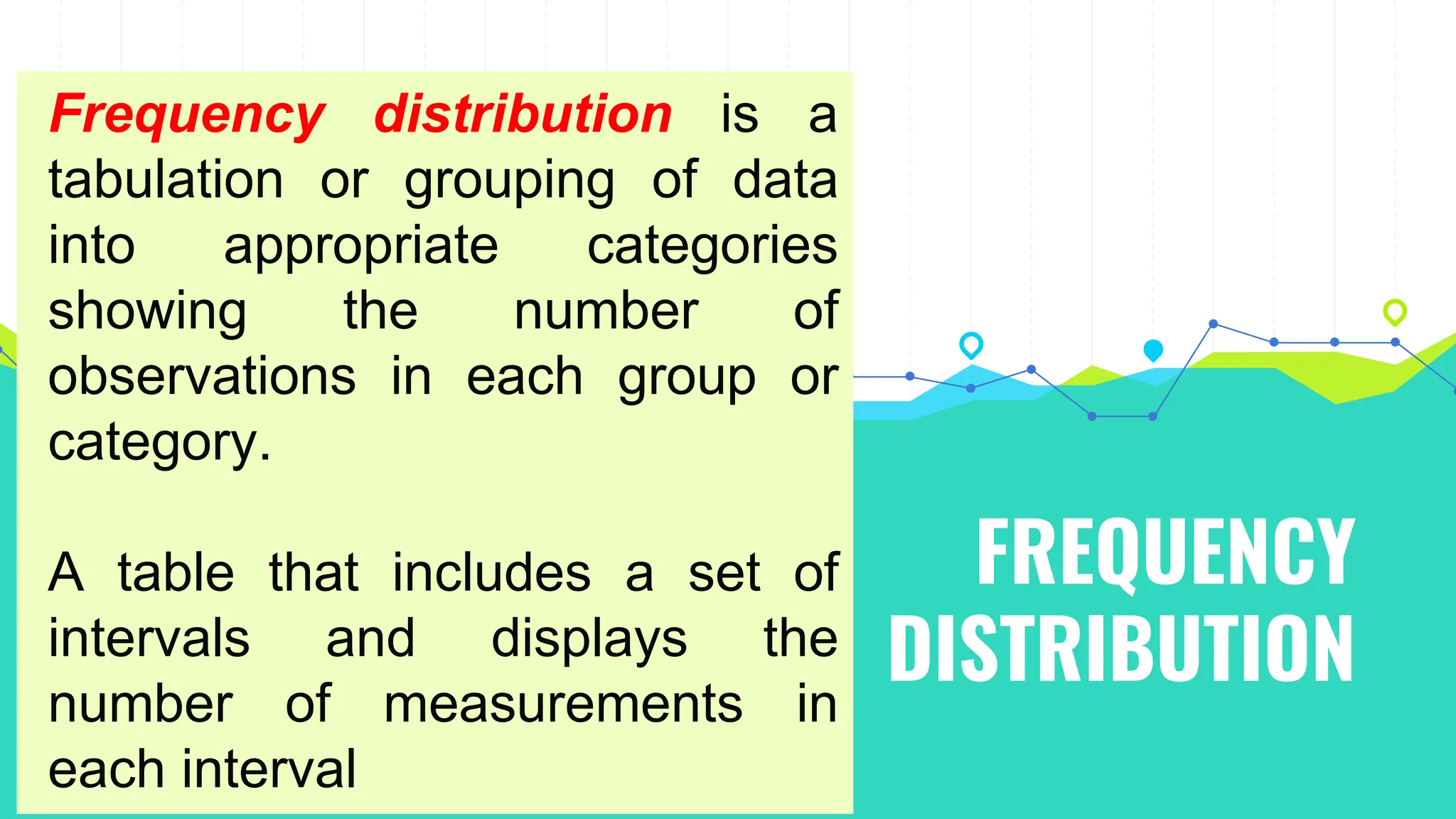
Frequency distribution is a
tabulation or grouping of data
into appropriate categories
showing the number of
observations in each group or
category.
A table that includes a set of
intervals and displays the
number of measurements in
each interval
Class Limits/
Class Intervals
Class
Boundaries
Frequency
Class
Mark
Cumulative
Frequency Percentage
<cf >cf
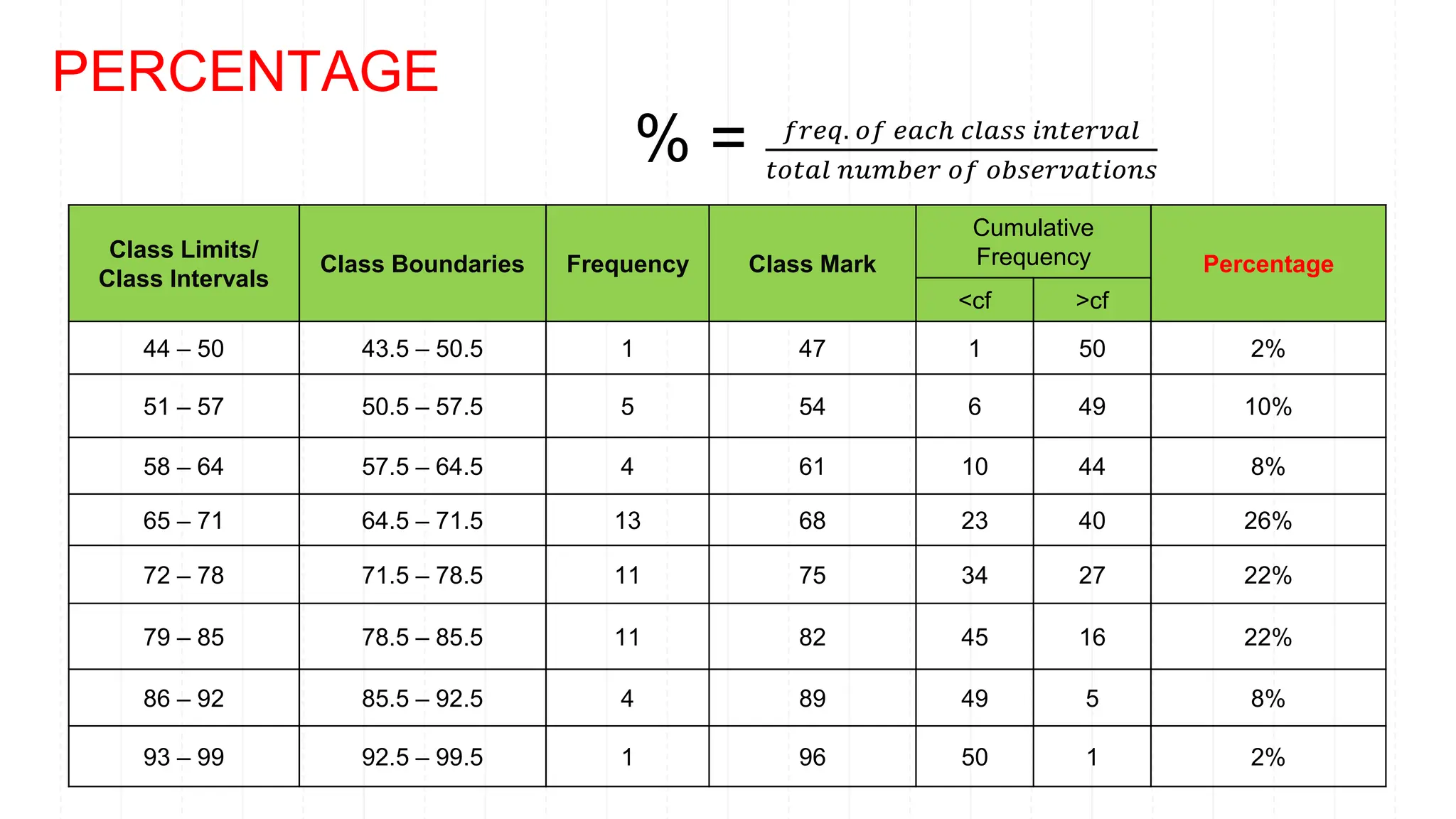
44 – 50 43.5 – 50.5 1 47 1 50 2%
51 – 57 50.5 – 57.5 5 54 6 49 10%
58 – 64 57.5 – 64.5 4 61 10 44 8%
65 – 71 64.5 – 71.5 13 68 23 40 26%
72 – 78 71.5 – 78.5 11 75 34 27 22%
79 – 85 78.5 – 85.5 11 82 45 16 22%
86 – 92 85.5 – 92.5 4 89 49 5 8%
93 – 99 92.5 – 99.5 1 96 50 1 2%
Frequency Table
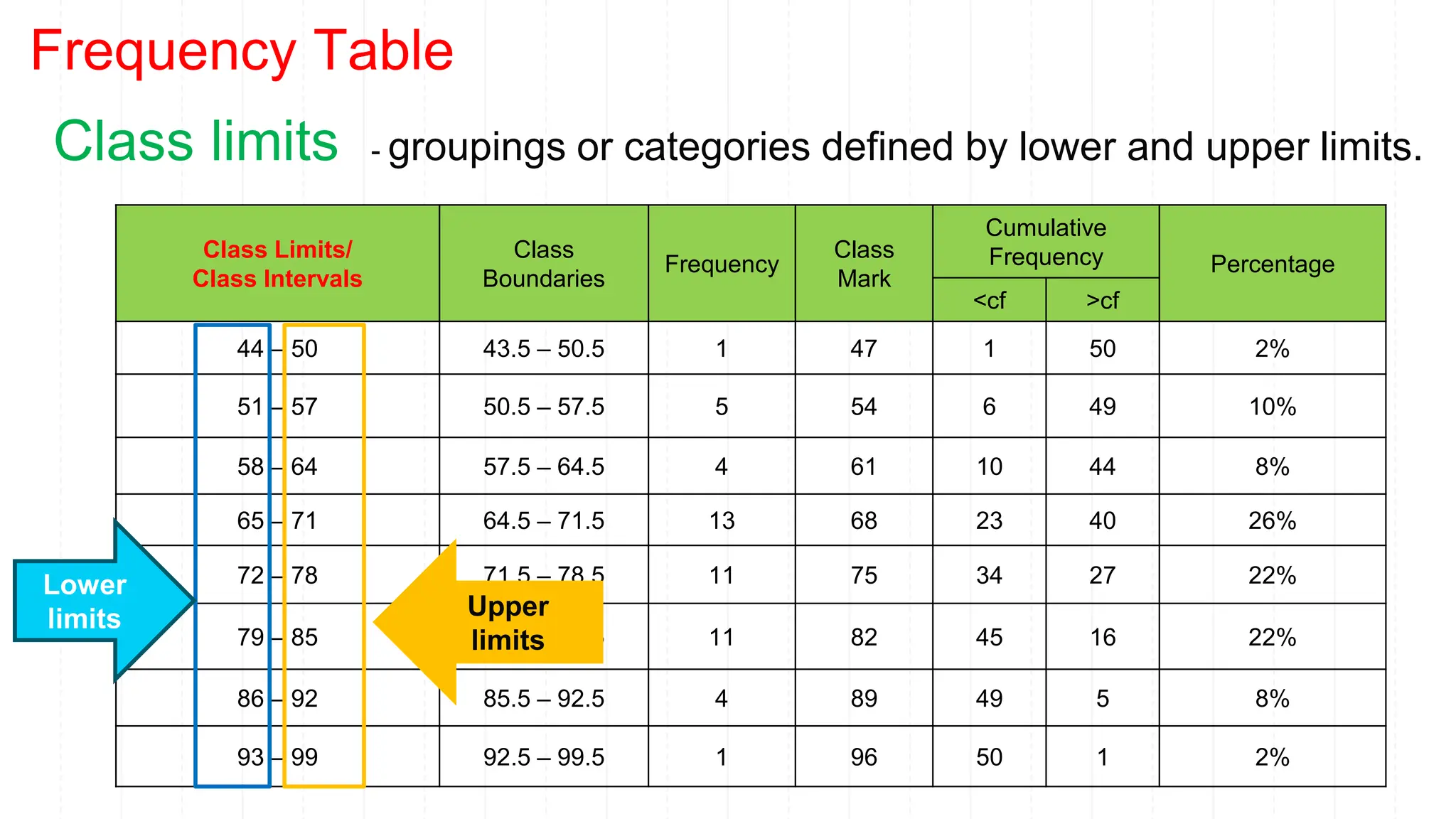
Class limits - groupings or categories defined by lower and upper limits.
Lower
limits Upper
limits
Class Limits/
Class Intervals
Class Boundaries Frequency
Class
Mark
Cumulative
Frequency Percentage
<cf >cf
44 – 50 43.5 – 50.5 1 47 1 50 2%
51 – 57 50.5 – 57.5 5 54 6 49 10%
58 – 64 57.5 – 64.5 4 61 10 44 8%
65 – 71 64.5 – 71.5 13 68 23 40 26%
72 – 78 71.5 – 78.5 11 75 34 27 22%
79 – 85 78.5 – 85.5 11 82 45 16 22%
86 – 92 85.5 – 92.5 4 89 49 5 8%
93 – 99 92.5 – 99.5 1 96 50 1 2%
Class boundaries
or true limits
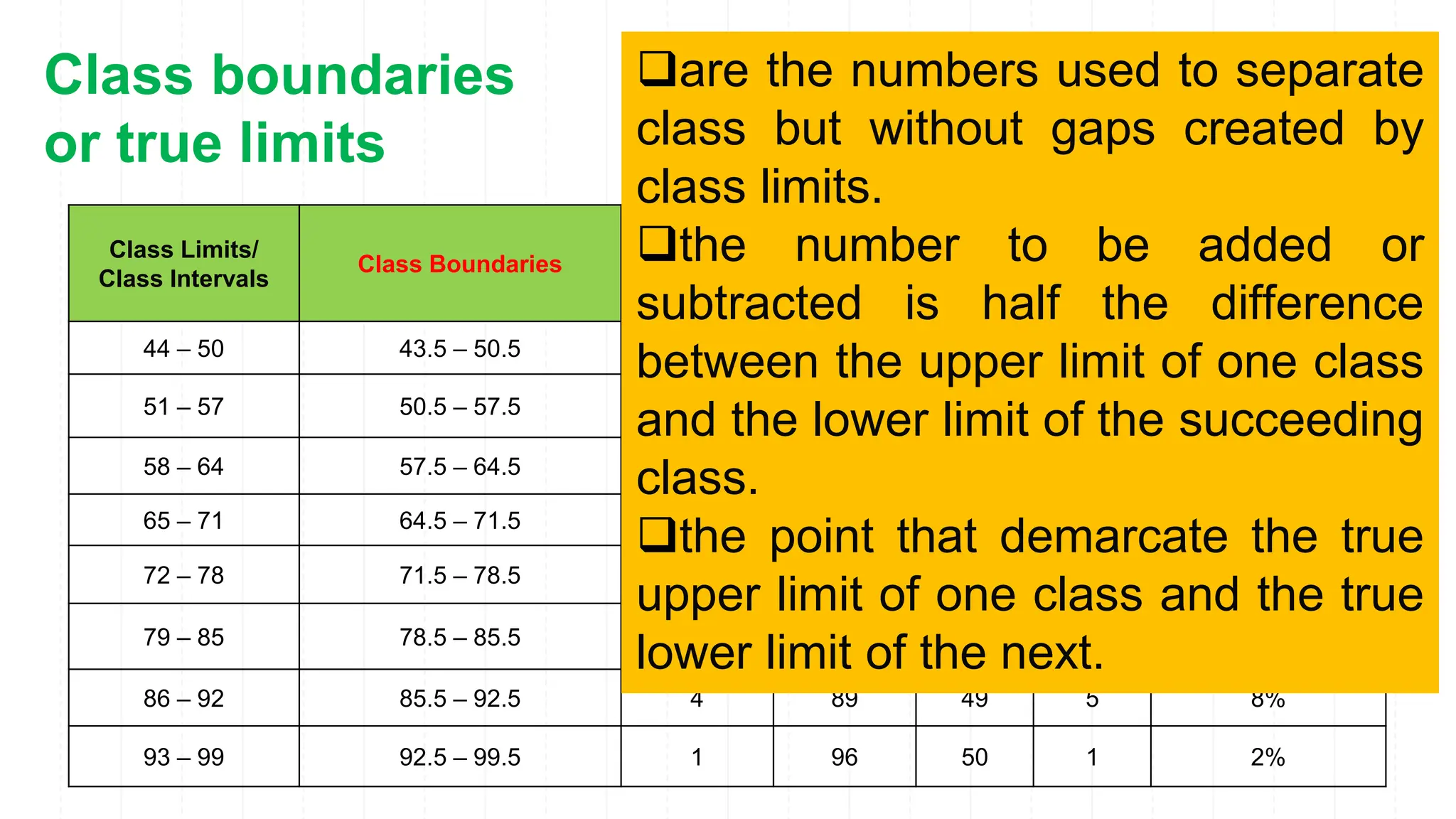
❑are the numbers used to separate
class but without gaps created by
class limits.
❑the number to be added or
subtracted is half the difference
between the upper limit of one class
and the lower limit of the succeeding
class.
❑the point that demarcate the true
upper limit of one class and the true
lower limit of the next.
Class Limits/
Class Intervals
Class Boundaries Frequency Class Mark
Cumulative
Frequency Percentage
<cf >cf
44 – 50 43.5 – 50.5 1 47 1 50 2%
51 – 57 50.5 – 57.5 5 54 6 49 10%
58 – 64 57.5 – 64.5 4 61 10 44 8%
65 – 71 64.5 – 71.5 13 68 23 40 26%
72 – 78 71.5 – 78.5 11 75 34 27 22%
79 – 85 78.5 – 85.5 11 82 45 16 22%
86 – 92 85.5 – 92.5 4 89 49 5 8%
93 – 99 92.5 – 99.5 1 96 50 1 2%
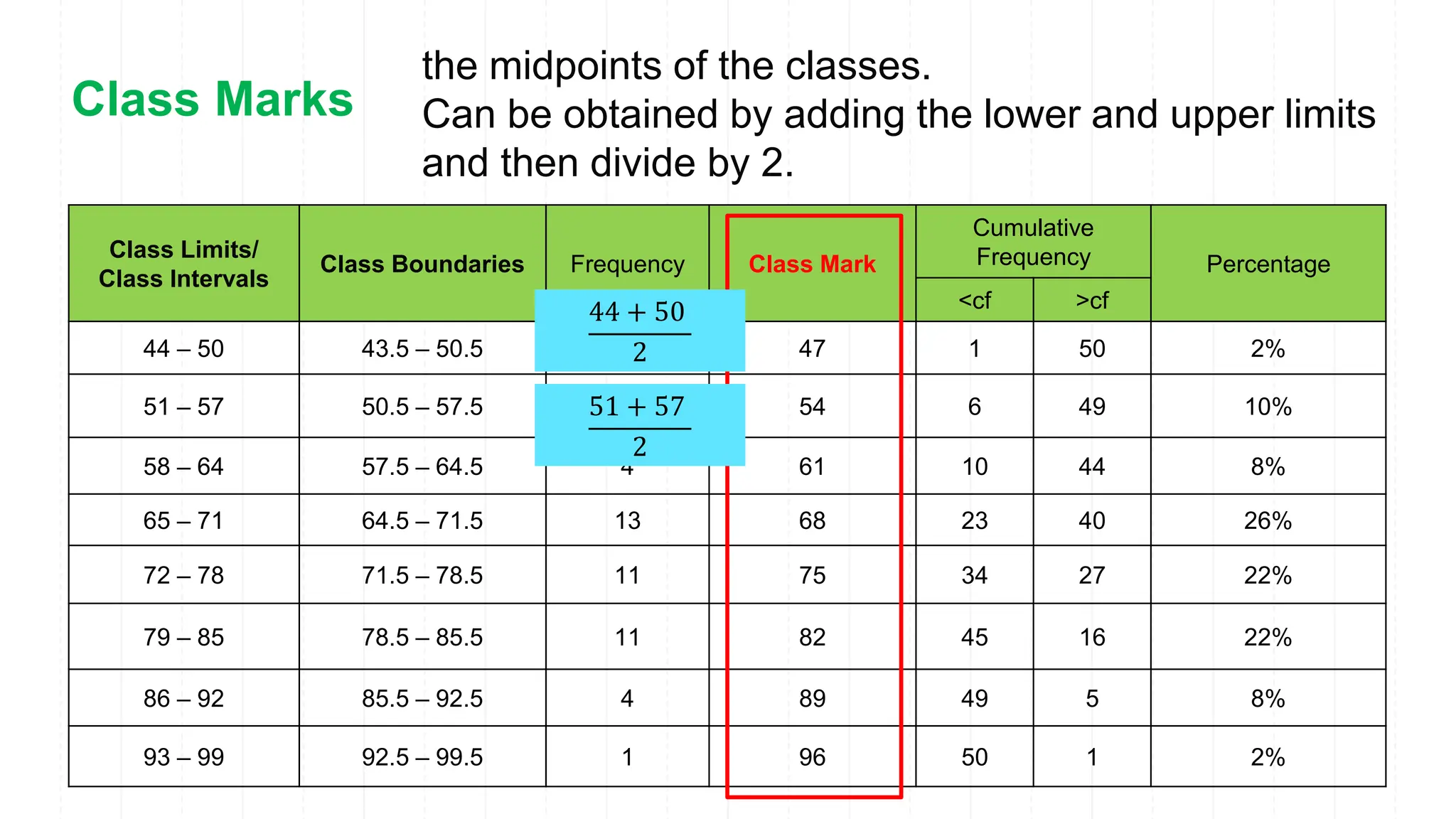
the midpoints of the classes.
Can be obtained by adding the lower and upper limits
and then divide by 2.
Class Marks
44 + 50
2
51 + 57
2
Class Limits/
Class Intervals
Class Boundaries Frequency Class Mark
Cumulative
Frequency Percentage
<cf >cf
44 – 50 43.5 – 50.5 1 47 1 50 2%
51 – 57 50.5 – 57.5 5 54 6 49 10%
58 – 64 57.5 – 64.5 4 61 10 44 8%
65 – 71 64.5 – 71.5 13 68 23 40 26%
72 – 78 71.5 – 78.5 11 75 34 27 22%
79 – 85 78.5 – 85.5 11 82 45 16 22%
86 – 92 85.5 – 92.5 4 89 49 5 8%
93 – 99 92.5 – 99.5 1 96 50 1 2%
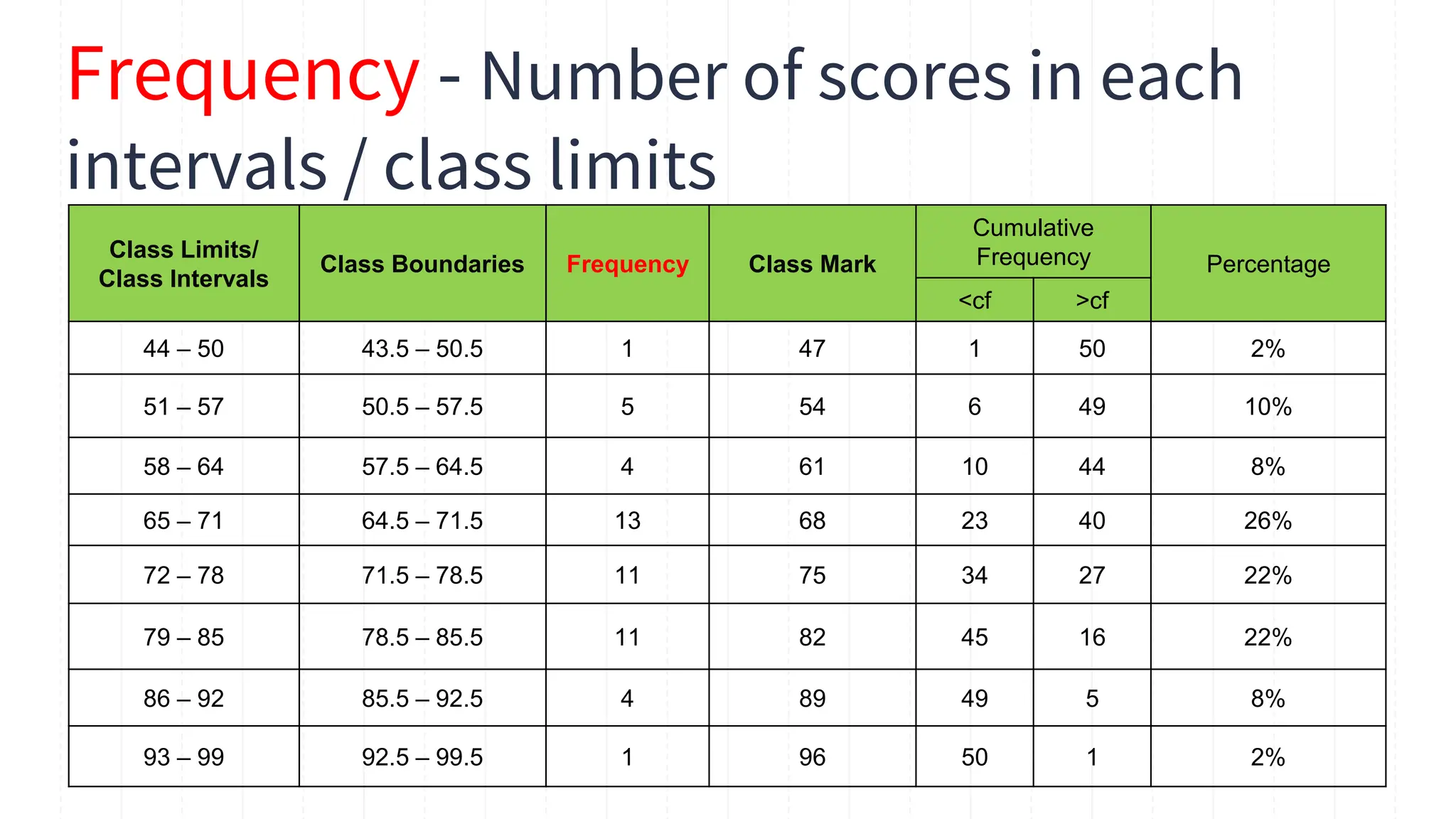
Frequency - Number of scores in each
intervals / class limits
Class Limits/
Class Intervals
Class Boundaries Frequency Class Mark
Cumulative
Frequency Percentage
<cf >cf
44 – 50 43.5 – 50.5 1 47 1 50 2%
51 – 57 50.5 – 57.5 5 54 6 49 10%
58 – 64 57.5 – 64.5 4 61 10 44 8%
65 – 71 64.5 – 71.5 13 68 23 40 26%
72 – 78 71.5 – 78.5 11 75 34 27 22%
79 – 85 78.5 – 85.5 11 82 45 16 22%
86 – 92 85.5 – 92.5 4 89 49 5 8%
93 – 99 92.5 – 99.5 1 96 50 1 2%
PERCENTAGE
% = 𝑓𝑟𝑒𝑞. 𝑜𝑓 𝑒𝑎𝑐ℎ 𝑐𝑙𝑎𝑠𝑠 𝑖𝑛𝑡𝑒𝑟𝑣𝑎𝑙
𝑡𝑜𝑡𝑎𝑙 𝑛𝑢𝑚𝑏𝑒𝑟 𝑜𝑓 𝑜𝑏𝑠𝑒𝑟𝑣𝑎𝑡𝑖𝑜𝑛𝑠
8
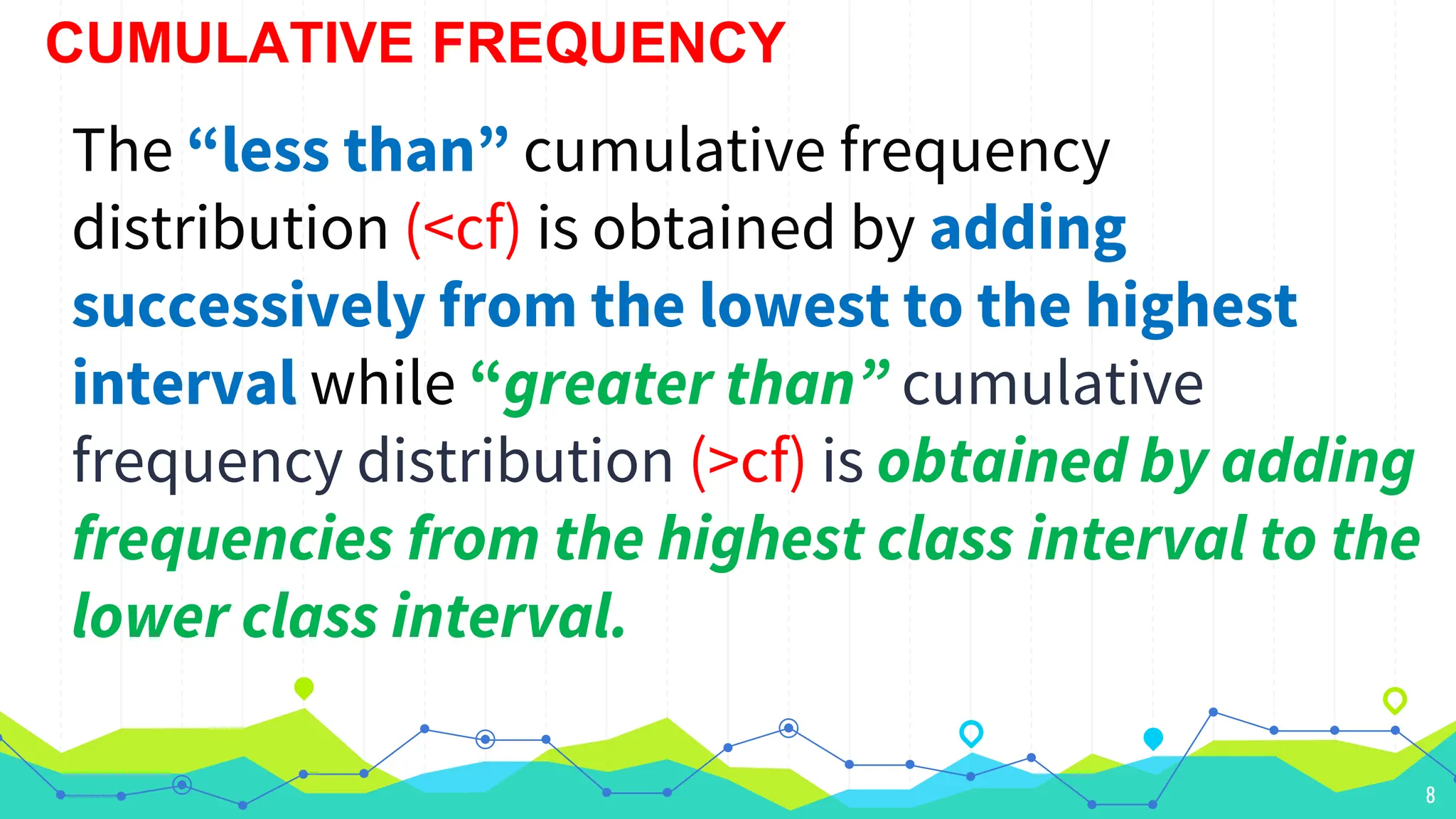
The “less than” cumulative frequency
distribution (<cf) is obtained by adding
successively from the lowest to the highest
interval while “greater than” cumulative
frequency distribution (>cf) is obtained by adding
frequencies from the highest class interval to the
lower class interval.
CUMULATIVE FREQUENCY
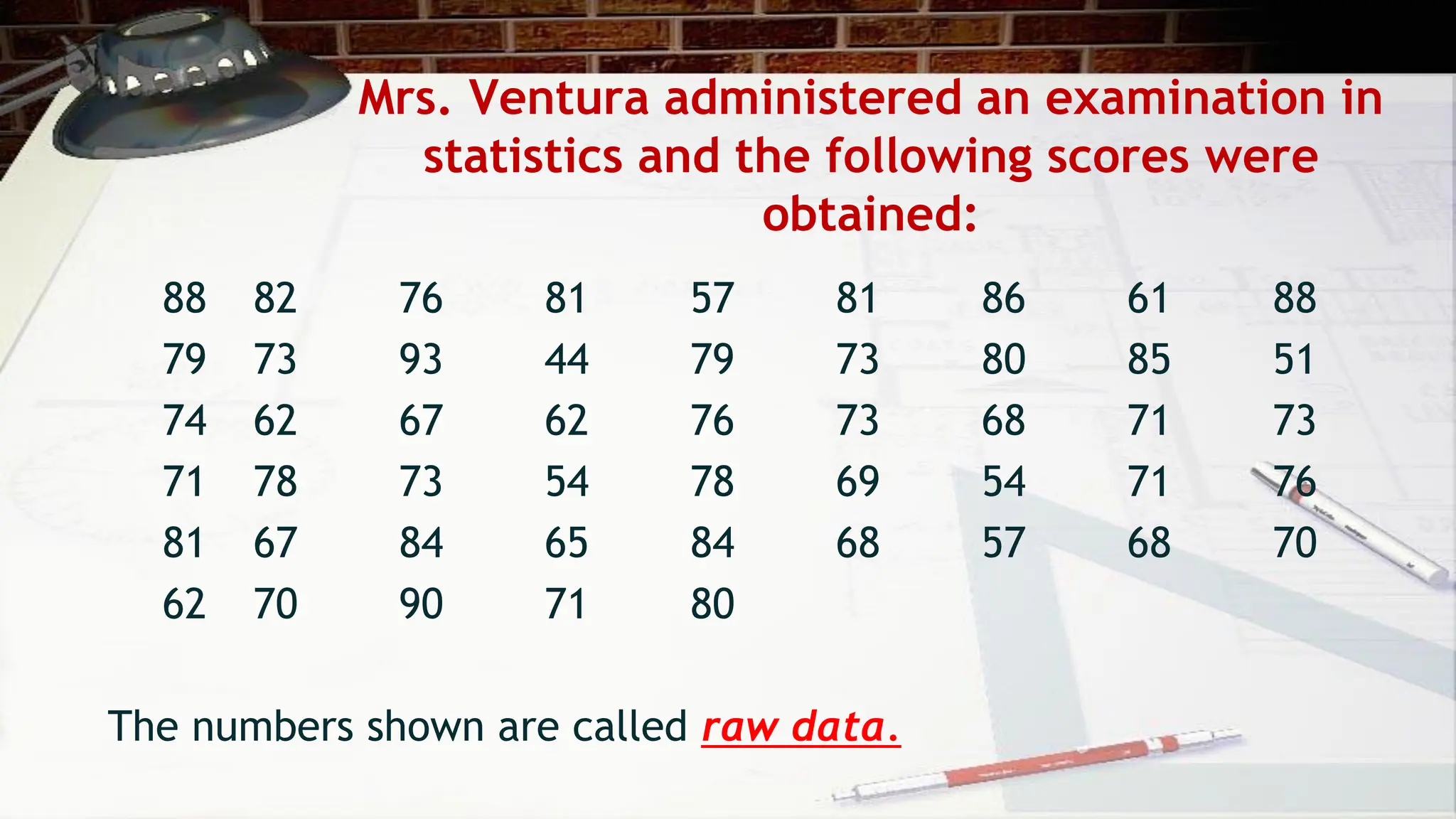
Mrs. Ventura administered an examination in
statistics and the following scores were
obtained:
88 82 76 81 57 81 86 61 88
79 73 93 44 79 73 80 85 51
74 62 67 62 76 73 68 71 73
71 78 73 54 78 69 54 71 76
81 67 84 65 84 68 57 68 70
62 70 90 71 80
The numbers shown are called raw data.
Steps in Constructing FDT
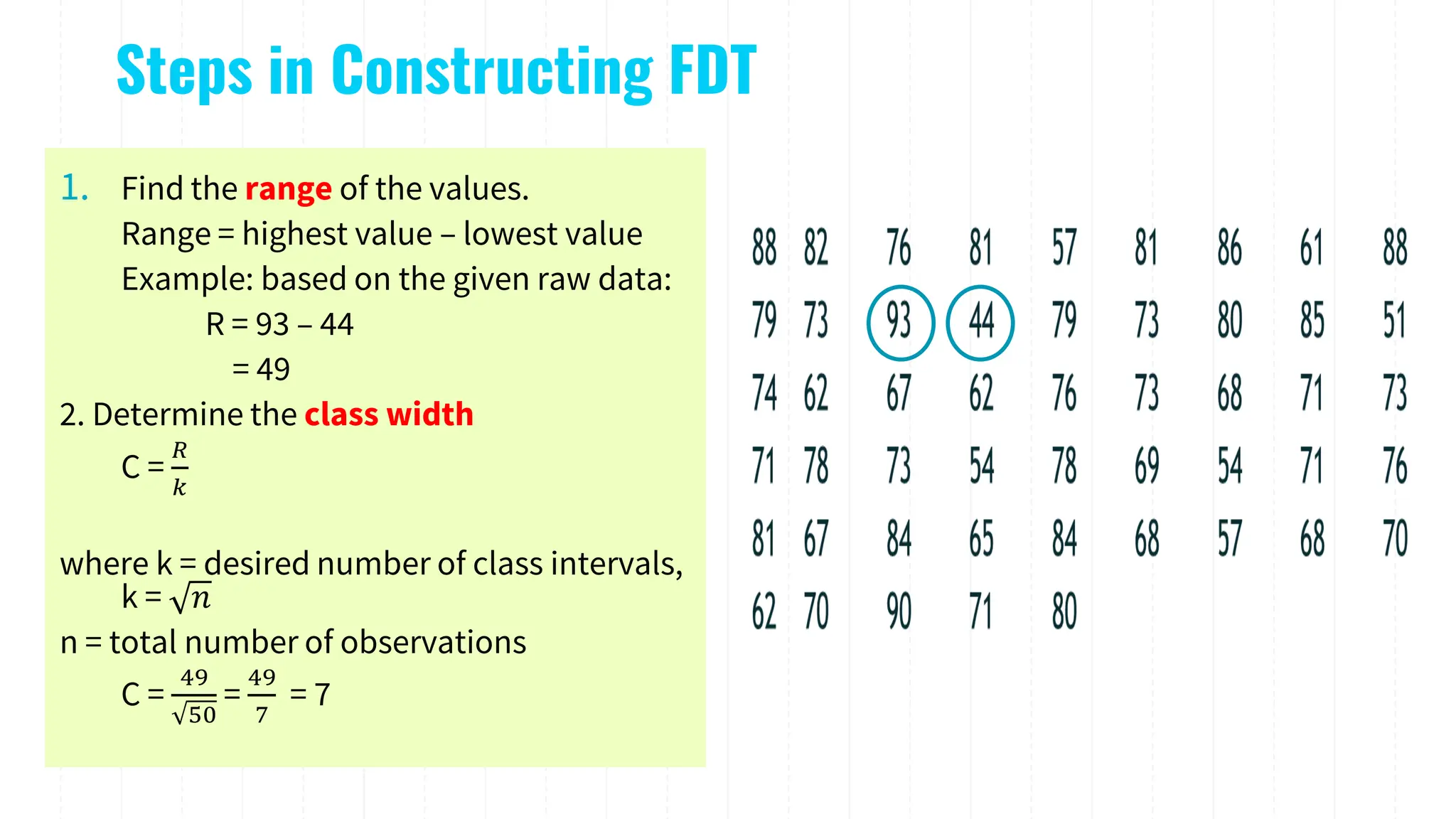
1. Find the range of the values.
Range = highest value – lowest value
Example: based on the given raw data:
R = 93 – 44
= 49
2. Determine the class width
C =
𝑅
𝑘
where k = desired number of class intervals,
k = 𝑛
n = total number of observations
C =
49
50
=
49
7
= 7
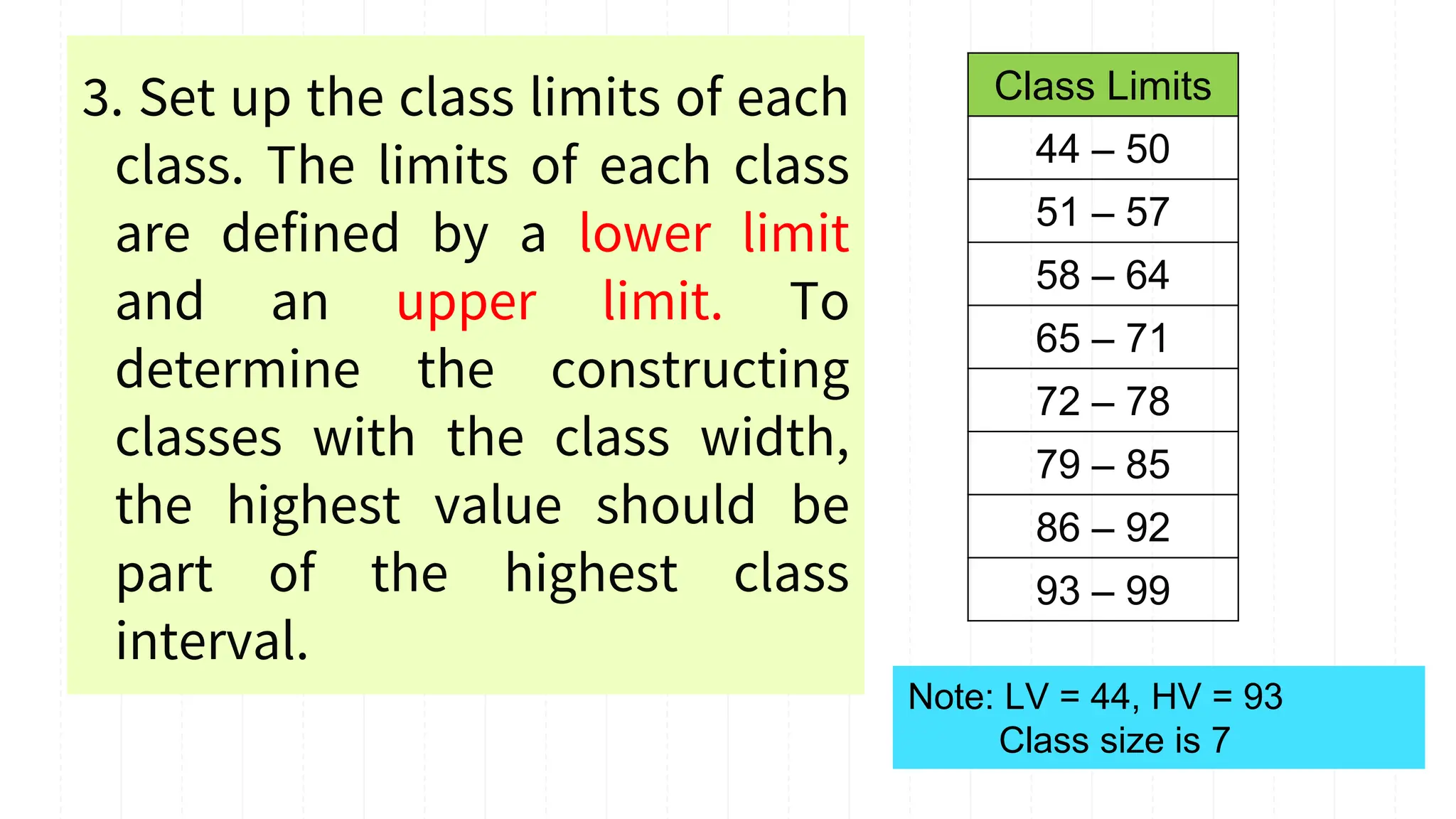
3. Set up the class limits of each
class. The limits of each class
are defined by a lower limit
and an upper limit. To
determine the constructing
classes with the class width,
the highest value should be
part of the highest class
interval.
Class Limits
44 – 50
51 – 57
58 – 64
65 – 71
72 – 78
79 – 85
86 – 92
93 – 99
Note: LV = 44, HV = 93
Class size is 7
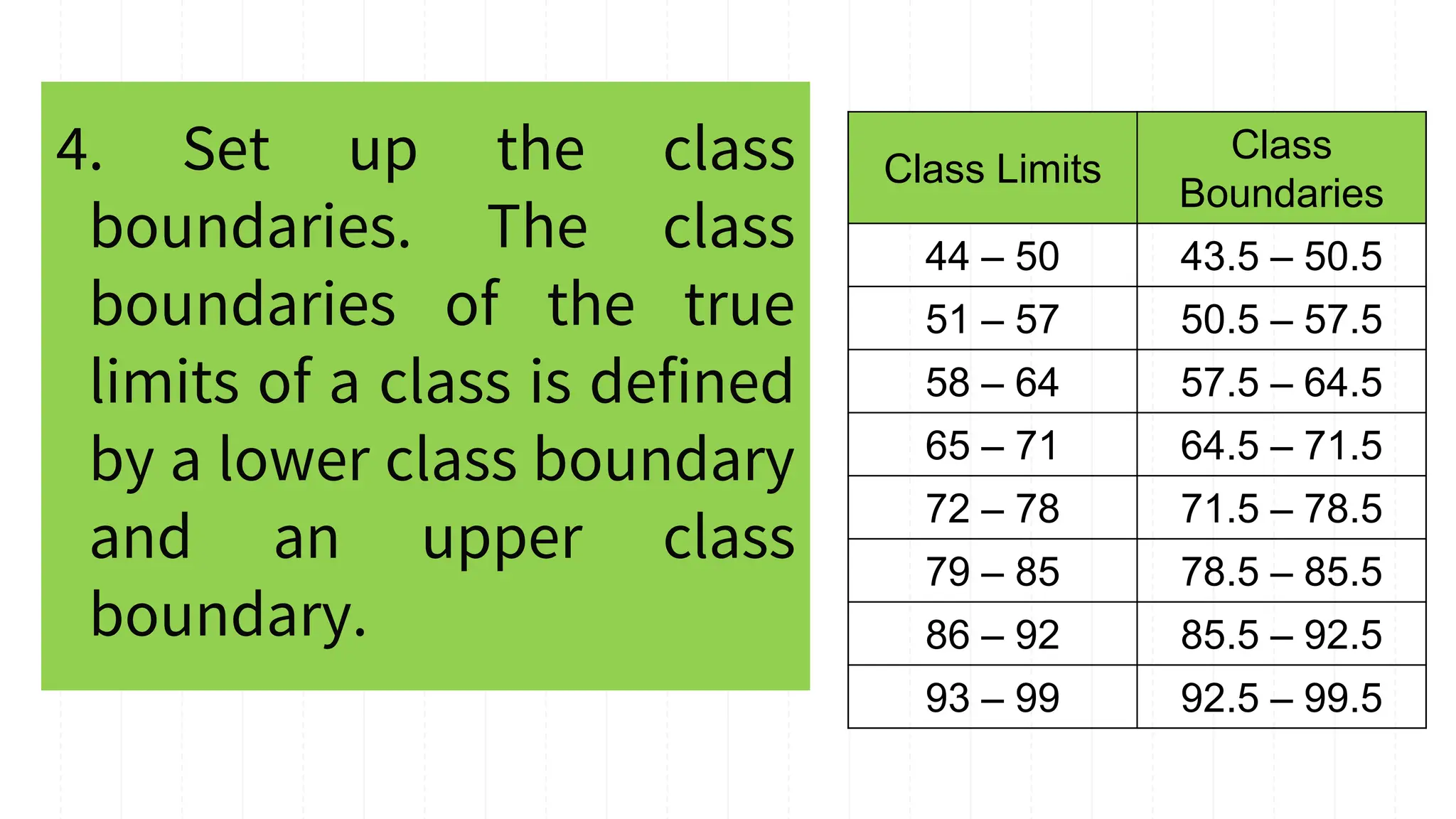
Class Limits
Class
Boundaries
44 – 50 43.5 – 50.5
51 – 57 50.5 – 57.5
58 – 64 57.5 – 64.5
65 – 71 64.5 – 71.5
72 – 78 71.5 – 78.5
79 – 85 78.5 – 85.5
86 – 92 85.5 – 92.5
93 – 99 92.5 – 99.5
4. Set up the class
boundaries. The class
boundaries of the true
limits of a class is defined
by a lower class boundary
and an upper class
boundary.
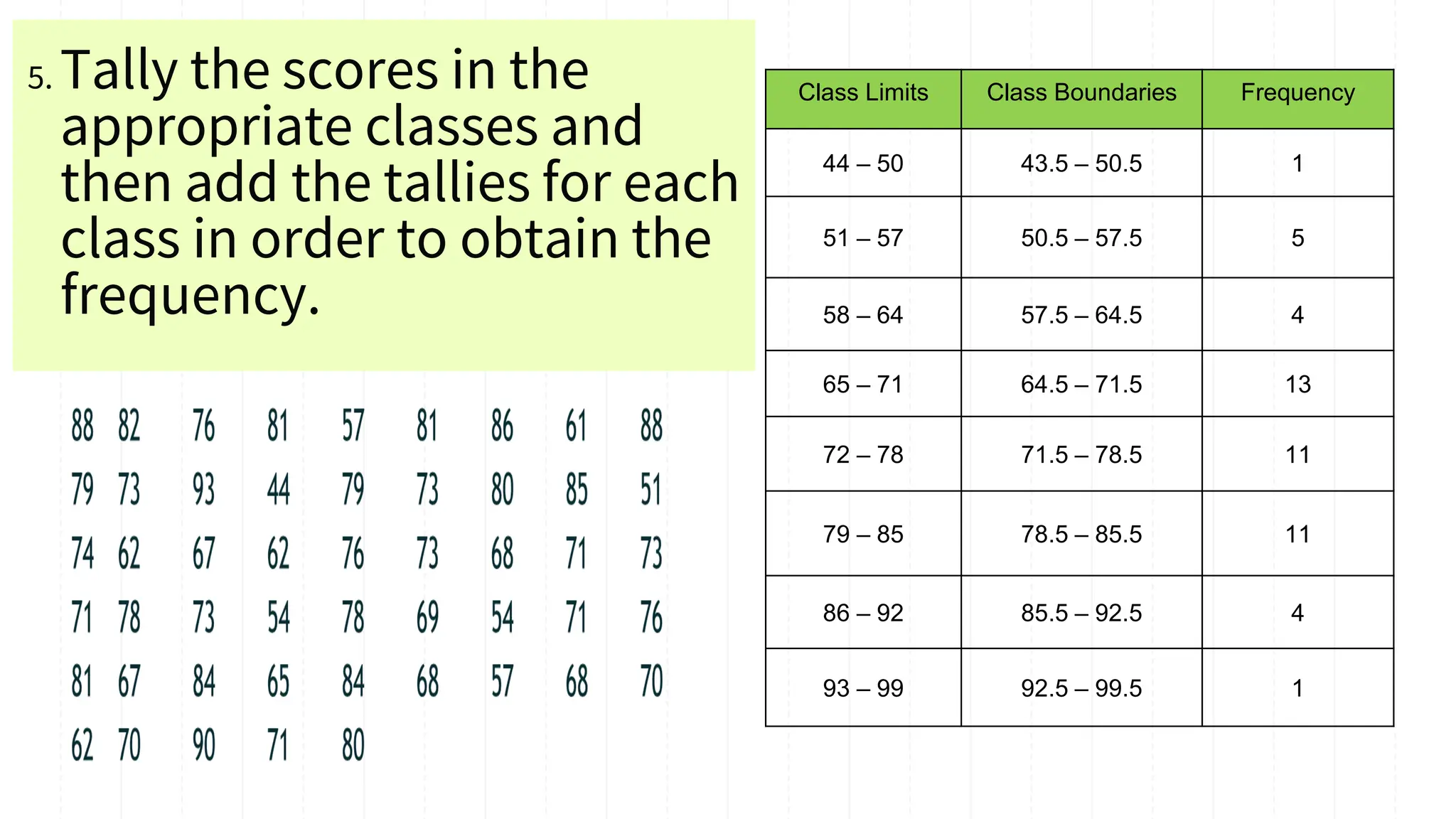
5. Tally the scores in the
appropriate classes and
then add the tallies for each
class in order to obtain the
frequency.
Class Limits Class Boundaries Frequency
44 – 50 43.5 – 50.5 1
51 – 57 50.5 – 57.5 5
58 – 64 57.5 – 64.5 4
65 – 71 64.5 – 71.5 13
72 – 78 71.5 – 78.5 11
79 – 85 78.5 – 85.5 11
86 – 92 85.5 – 92.5 4
93 – 99 92.5 – 99.5 1
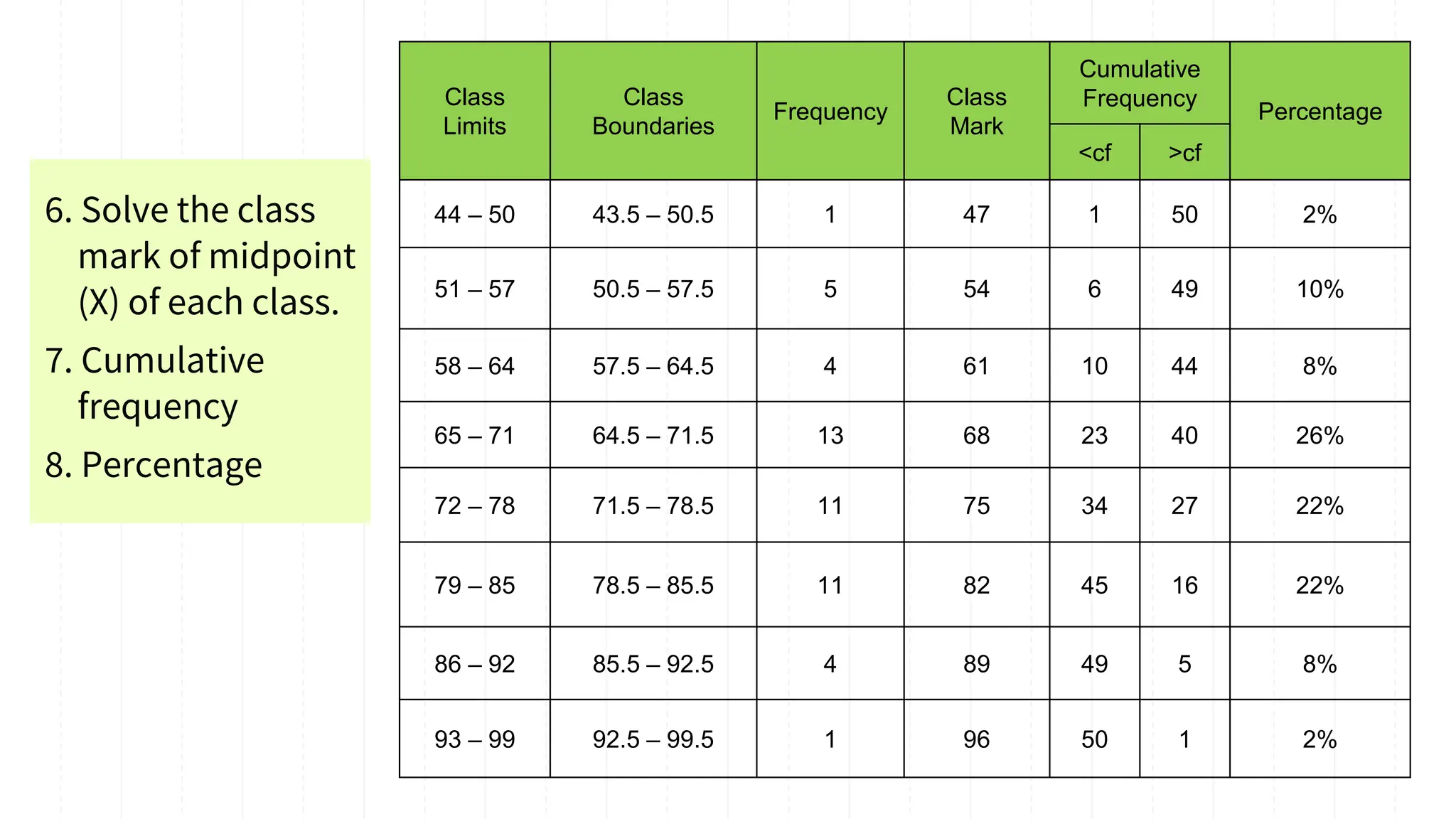
6. Solve the class
mark of midpoint
(X) of each class.
7. Cumulative
frequency
8. Percentage
Class
Limits
Class
Boundaries
Frequency
Class
Mark
Cumulative
Frequency
Percentage
<cf >cf
44 – 50 43.5 – 50.5 1 47 1 50 2%
51 – 57 50.5 – 57.5 5 54 6 49 10%
58 – 64 57.5 – 64.5 4 61 10 44 8%
65 – 71 64.5 – 71.5 13 68 23 40 26%
72 – 78 71.5 – 78.5 11 75 34 27 22%
79 – 85 78.5 – 85.5 11 82 45 16 22%
86 – 92 85.5 – 92.5 4 89 49 5 8%
93 – 99 92.5 – 99.5 1 96 50 1 2%
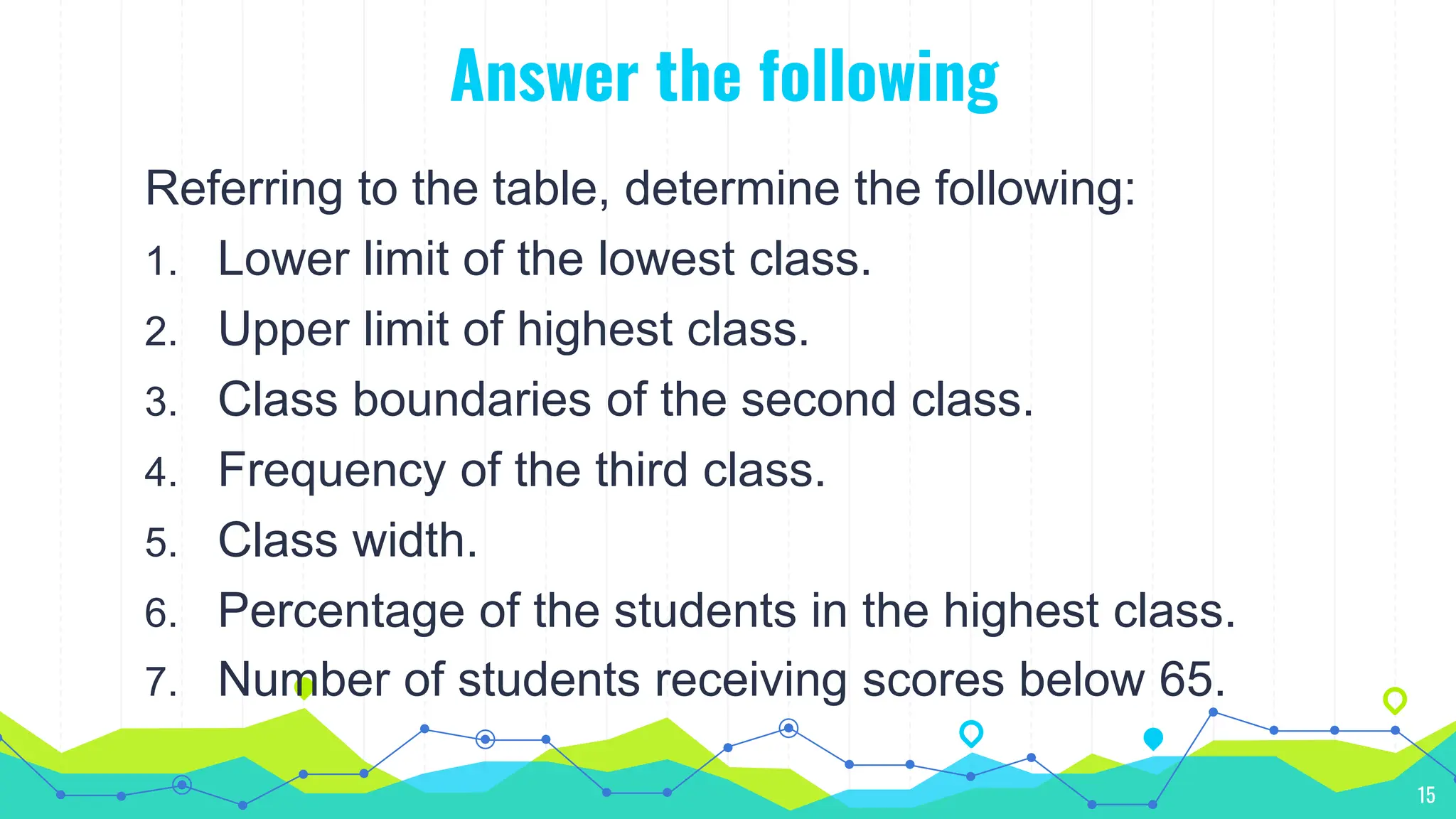
Answer the following
Referring to the table, determine the following:
1. Lower limit of the lowest class.
2. Upper limit of highest class.
3. Class boundaries of the second class.
4. Frequency of the third class.
5. Class width.
6. Percentage of the students in the highest class.
7. Number of students receiving scores below 65.
15
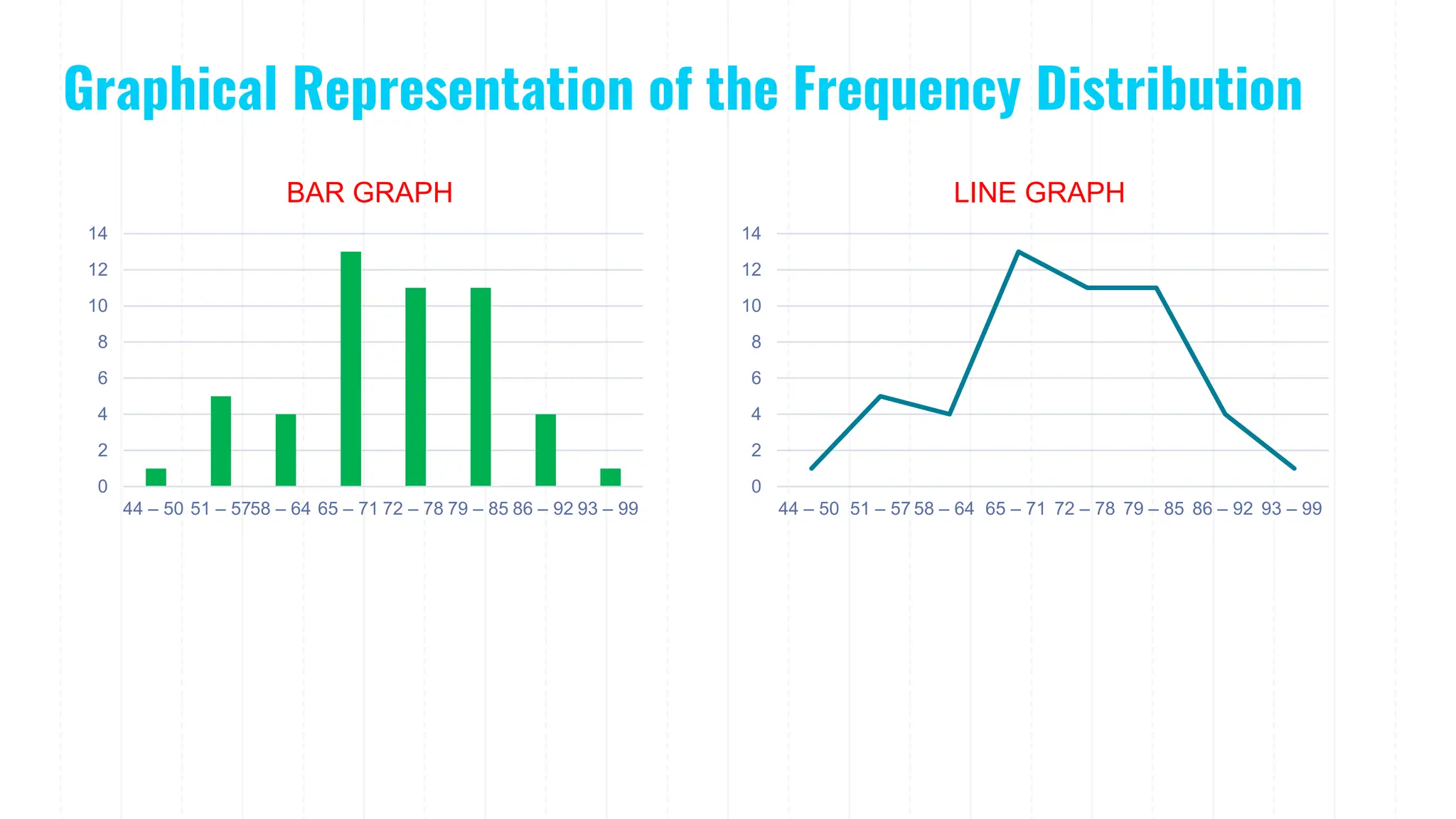
Graphical Representation of the Frequency Distribution
0
2
4
6
8
10
12
14
44 – 50 51 – 5758 – 64 65 – 71 72 – 78 79 – 85 86 – 92 93 – 99
BAR GRAPH
0
2
4
6
8
10
12
14
44 – 50 51 – 57 58 – 64 65 – 71 72 – 78 79 – 85 86 – 92 93 – 99
LINE GRAPH
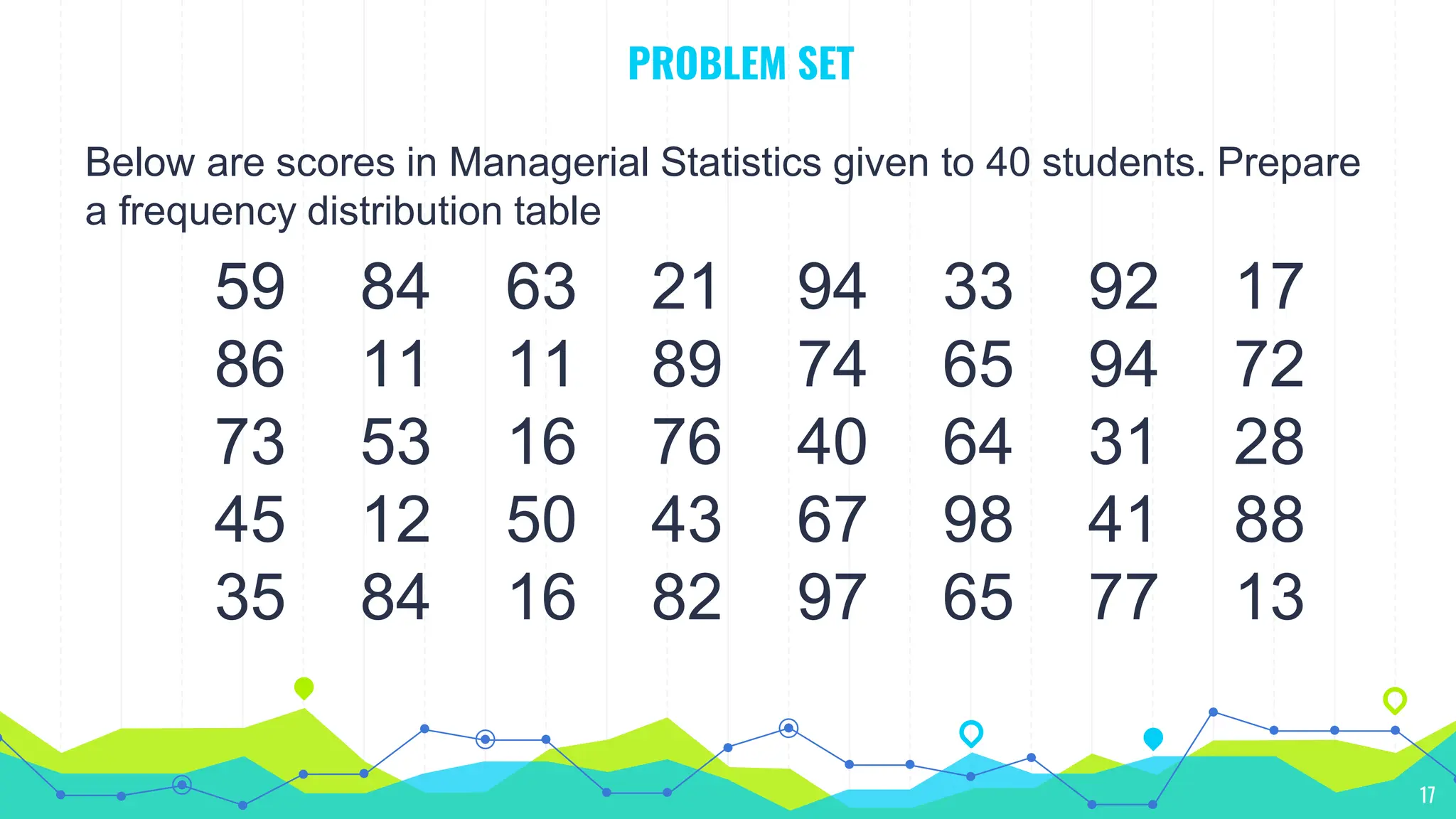
PROBLEM SET
Below are scores in Managerial Statistics given to 40 students. Prepare
a frequency distribution table
59 84 63 21 94 33 92 17
86 11 11 89 74 65 94 72
73 53 16 76 40 64 31 28
45 12 50 43 67 98 41 88
35 84 16 82 97 65 77 13
17
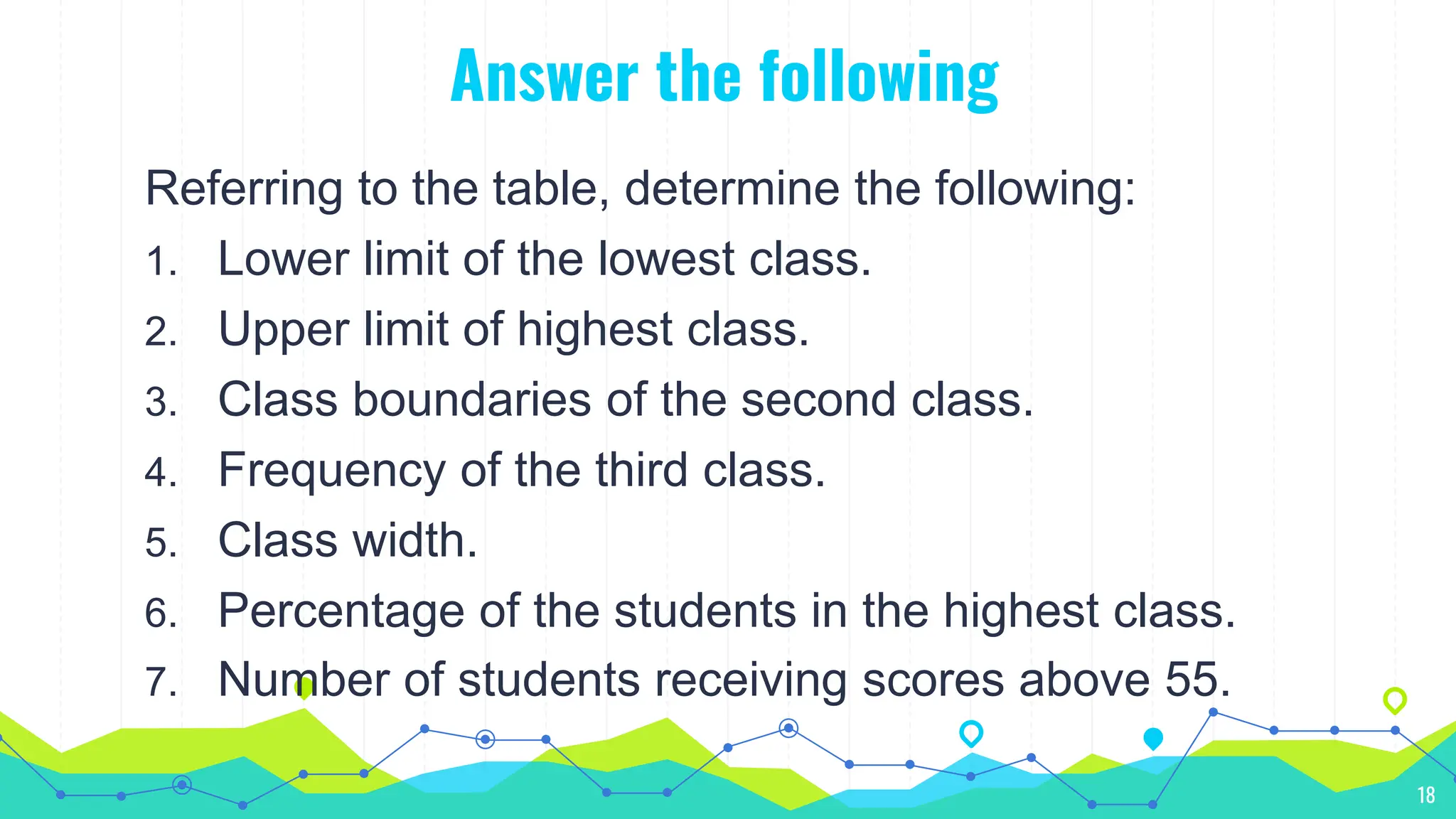
Answer the following
Referring to the table, determine the following:
1. Lower limit of the lowest class.
2. Upper limit of highest class.
3. Class boundaries of the second class.
4. Frequency of the third class.
5. Class width.
6. Percentage of the students in the highest class.
7. Number of students receiving scores above 55.
18
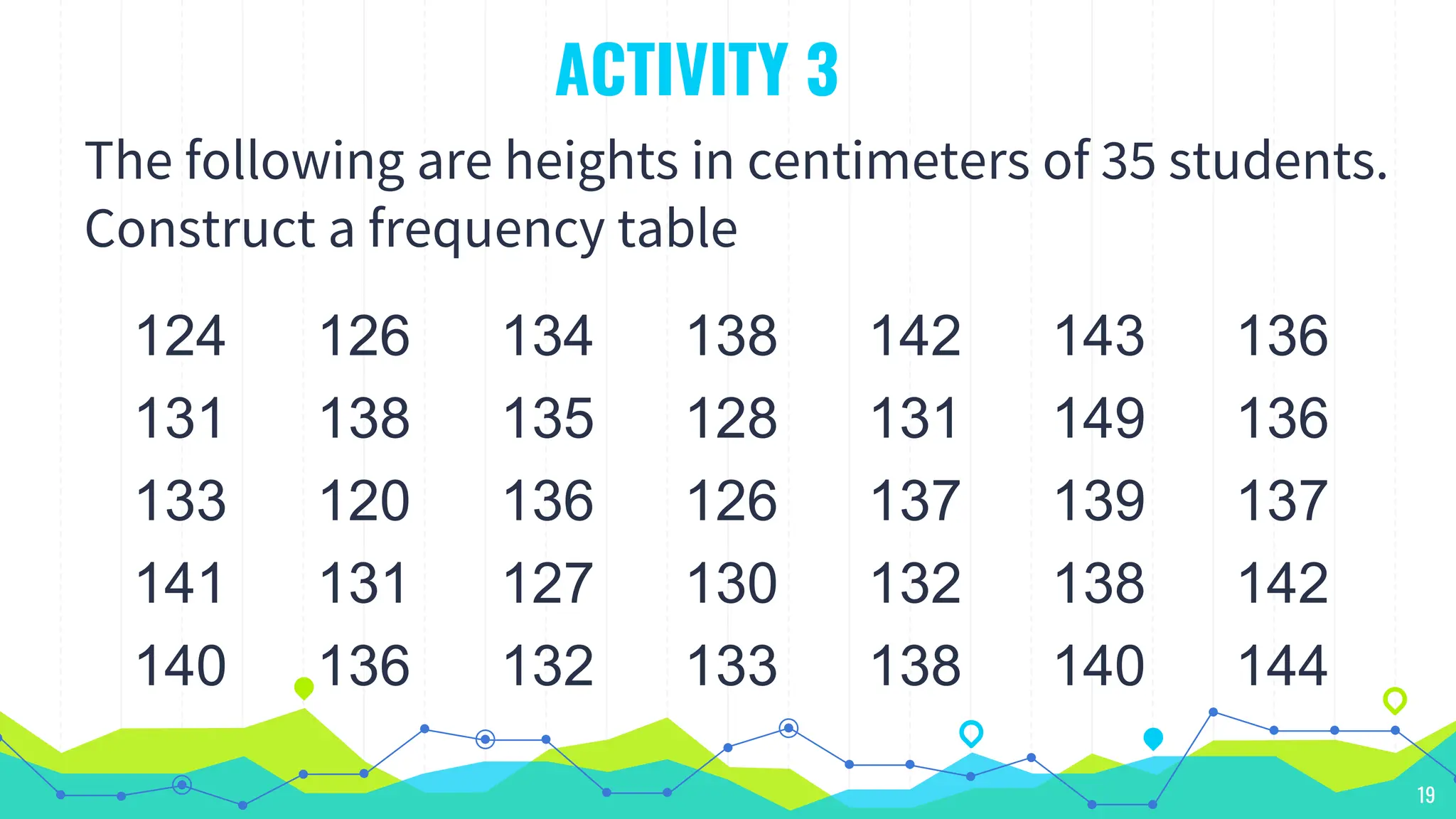
ACTIVITY 3
The following are heights in centimeters of 35 students.
Construct a frequency table
19
124 126 134 138 142 143 136
131 138 135 128 131 149 136
133 120 136 126 137 139 137
141 131 127 130 132 138 142
140 136 132 133 138 140 144
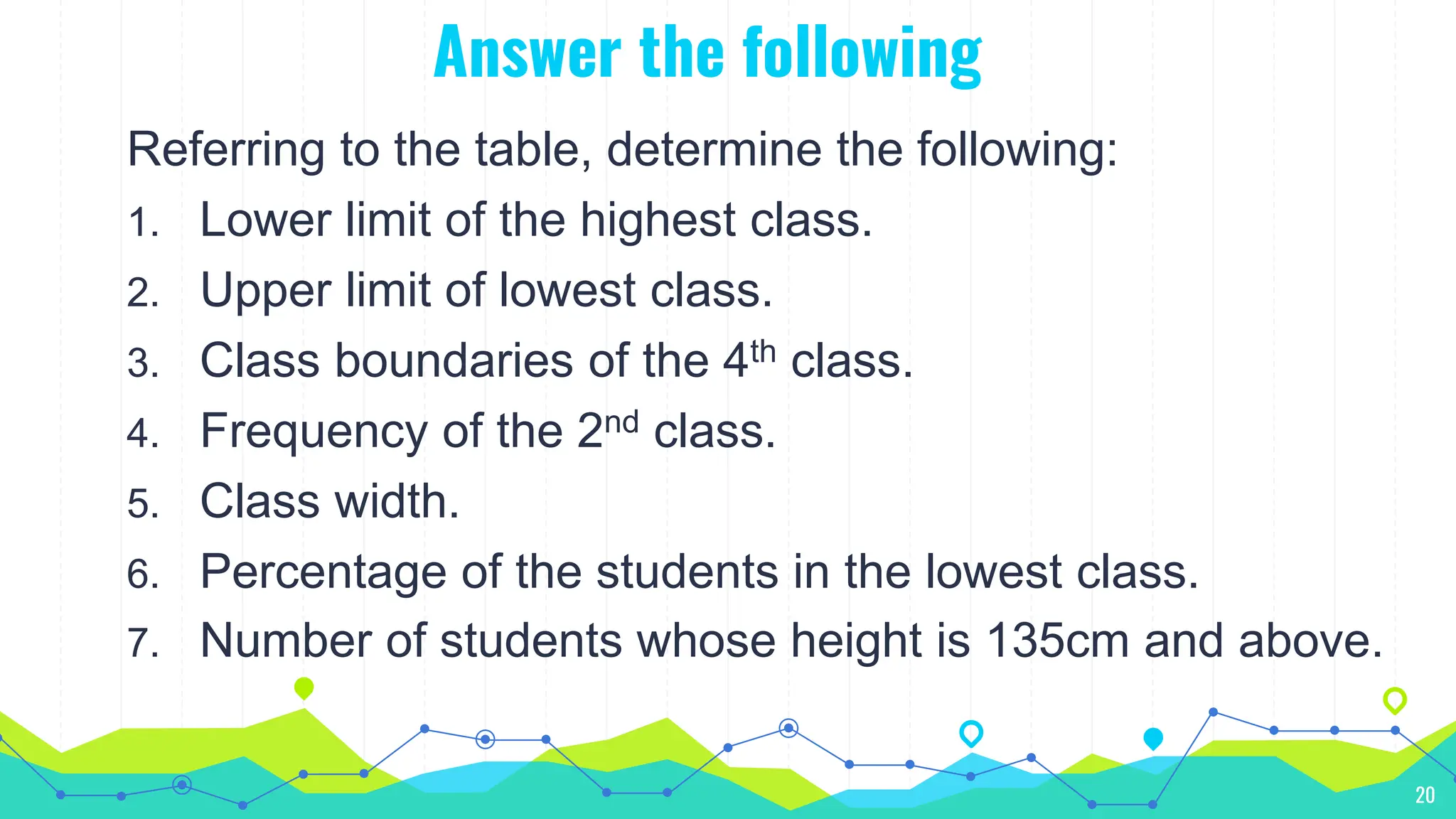
Answer the following
Referring to the table, determine the following:
1. Lower limit of the highest class.
2. Upper limit of lowest class.
3. Class boundaries of the 4th class.
4. Frequency of the 2nd class.
5. Class width.
6. Percentage of the students in the lowest class.
7. Number of students whose height is 135cm and above.
20
21
References
22
• Rivera, R. (2020). Principles of Managerial
Statistics and Data Science. John Wiley & Sons, Inc.
• Bhattacherjee, A. (2012). Social Science Research:
Principles, Methods and Practices
• Kothari, C. R. (2004). Research Methodology:
Methods and Techniques. New Age International

Learning the Frequency-Distributions.pdf

  • 1.
  • 2.
    FREQUENCY DISTRIBUTION Frequency distribution isa tabulation or grouping of data into appropriate categories showing the number of observations in each group or category. A table that includes a set of intervals and displays the number of measurements in each interval
  • 3.
    Class Limits/ Class Intervals Class Boundaries Frequency Class Mark Cumulative FrequencyPercentage <cf >cf 44 – 50 43.5 – 50.5 1 47 1 50 2% 51 – 57 50.5 – 57.5 5 54 6 49 10% 58 – 64 57.5 – 64.5 4 61 10 44 8% 65 – 71 64.5 – 71.5 13 68 23 40 26% 72 – 78 71.5 – 78.5 11 75 34 27 22% 79 – 85 78.5 – 85.5 11 82 45 16 22% 86 – 92 85.5 – 92.5 4 89 49 5 8% 93 – 99 92.5 – 99.5 1 96 50 1 2% Frequency Table Class limits - groupings or categories defined by lower and upper limits. Lower limits Upper limits
  • 4.
    Class Limits/ Class Intervals ClassBoundaries Frequency Class Mark Cumulative Frequency Percentage <cf >cf 44 – 50 43.5 – 50.5 1 47 1 50 2% 51 – 57 50.5 – 57.5 5 54 6 49 10% 58 – 64 57.5 – 64.5 4 61 10 44 8% 65 – 71 64.5 – 71.5 13 68 23 40 26% 72 – 78 71.5 – 78.5 11 75 34 27 22% 79 – 85 78.5 – 85.5 11 82 45 16 22% 86 – 92 85.5 – 92.5 4 89 49 5 8% 93 – 99 92.5 – 99.5 1 96 50 1 2% Class boundaries or true limits ❑are the numbers used to separate class but without gaps created by class limits. ❑the number to be added or subtracted is half the difference between the upper limit of one class and the lower limit of the succeeding class. ❑the point that demarcate the true upper limit of one class and the true lower limit of the next.
  • 5.
    Class Limits/ Class Intervals ClassBoundaries Frequency Class Mark Cumulative Frequency Percentage <cf >cf 44 – 50 43.5 – 50.5 1 47 1 50 2% 51 – 57 50.5 – 57.5 5 54 6 49 10% 58 – 64 57.5 – 64.5 4 61 10 44 8% 65 – 71 64.5 – 71.5 13 68 23 40 26% 72 – 78 71.5 – 78.5 11 75 34 27 22% 79 – 85 78.5 – 85.5 11 82 45 16 22% 86 – 92 85.5 – 92.5 4 89 49 5 8% 93 – 99 92.5 – 99.5 1 96 50 1 2% the midpoints of the classes. Can be obtained by adding the lower and upper limits and then divide by 2. Class Marks 44 + 50 2 51 + 57 2
  • 6.
    Class Limits/ Class Intervals ClassBoundaries Frequency Class Mark Cumulative Frequency Percentage <cf >cf 44 – 50 43.5 – 50.5 1 47 1 50 2% 51 – 57 50.5 – 57.5 5 54 6 49 10% 58 – 64 57.5 – 64.5 4 61 10 44 8% 65 – 71 64.5 – 71.5 13 68 23 40 26% 72 – 78 71.5 – 78.5 11 75 34 27 22% 79 – 85 78.5 – 85.5 11 82 45 16 22% 86 – 92 85.5 – 92.5 4 89 49 5 8% 93 – 99 92.5 – 99.5 1 96 50 1 2% Frequency - Number of scores in each intervals / class limits
  • 7.
    Class Limits/ Class Intervals ClassBoundaries Frequency Class Mark Cumulative Frequency Percentage <cf >cf 44 – 50 43.5 – 50.5 1 47 1 50 2% 51 – 57 50.5 – 57.5 5 54 6 49 10% 58 – 64 57.5 – 64.5 4 61 10 44 8% 65 – 71 64.5 – 71.5 13 68 23 40 26% 72 – 78 71.5 – 78.5 11 75 34 27 22% 79 – 85 78.5 – 85.5 11 82 45 16 22% 86 – 92 85.5 – 92.5 4 89 49 5 8% 93 – 99 92.5 – 99.5 1 96 50 1 2% PERCENTAGE % = 𝑓𝑟𝑒𝑞. 𝑜𝑓 𝑒𝑎𝑐ℎ 𝑐𝑙𝑎𝑠𝑠 𝑖𝑛𝑡𝑒𝑟𝑣𝑎𝑙 𝑡𝑜𝑡𝑎𝑙 𝑛𝑢𝑚𝑏𝑒𝑟 𝑜𝑓 𝑜𝑏𝑠𝑒𝑟𝑣𝑎𝑡𝑖𝑜𝑛𝑠
  • 8.
    8 The “less than”cumulative frequency distribution (<cf) is obtained by adding successively from the lowest to the highest interval while “greater than” cumulative frequency distribution (>cf) is obtained by adding frequencies from the highest class interval to the lower class interval. CUMULATIVE FREQUENCY
  • 9.
    Mrs. Ventura administeredan examination in statistics and the following scores were obtained: 88 82 76 81 57 81 86 61 88 79 73 93 44 79 73 80 85 51 74 62 67 62 76 73 68 71 73 71 78 73 54 78 69 54 71 76 81 67 84 65 84 68 57 68 70 62 70 90 71 80 The numbers shown are called raw data.
  • 10.
    Steps in ConstructingFDT 1. Find the range of the values. Range = highest value – lowest value Example: based on the given raw data: R = 93 – 44 = 49 2. Determine the class width C = 𝑅 𝑘 where k = desired number of class intervals, k = 𝑛 n = total number of observations C = 49 50 = 49 7 = 7
  • 11.
    3. Set upthe class limits of each class. The limits of each class are defined by a lower limit and an upper limit. To determine the constructing classes with the class width, the highest value should be part of the highest class interval. Class Limits 44 – 50 51 – 57 58 – 64 65 – 71 72 – 78 79 – 85 86 – 92 93 – 99 Note: LV = 44, HV = 93 Class size is 7
  • 12.
    Class Limits Class Boundaries 44 –50 43.5 – 50.5 51 – 57 50.5 – 57.5 58 – 64 57.5 – 64.5 65 – 71 64.5 – 71.5 72 – 78 71.5 – 78.5 79 – 85 78.5 – 85.5 86 – 92 85.5 – 92.5 93 – 99 92.5 – 99.5 4. Set up the class boundaries. The class boundaries of the true limits of a class is defined by a lower class boundary and an upper class boundary.
  • 13.
    5. Tally thescores in the appropriate classes and then add the tallies for each class in order to obtain the frequency. Class Limits Class Boundaries Frequency 44 – 50 43.5 – 50.5 1 51 – 57 50.5 – 57.5 5 58 – 64 57.5 – 64.5 4 65 – 71 64.5 – 71.5 13 72 – 78 71.5 – 78.5 11 79 – 85 78.5 – 85.5 11 86 – 92 85.5 – 92.5 4 93 – 99 92.5 – 99.5 1
  • 14.
    6. Solve theclass mark of midpoint (X) of each class. 7. Cumulative frequency 8. Percentage Class Limits Class Boundaries Frequency Class Mark Cumulative Frequency Percentage <cf >cf 44 – 50 43.5 – 50.5 1 47 1 50 2% 51 – 57 50.5 – 57.5 5 54 6 49 10% 58 – 64 57.5 – 64.5 4 61 10 44 8% 65 – 71 64.5 – 71.5 13 68 23 40 26% 72 – 78 71.5 – 78.5 11 75 34 27 22% 79 – 85 78.5 – 85.5 11 82 45 16 22% 86 – 92 85.5 – 92.5 4 89 49 5 8% 93 – 99 92.5 – 99.5 1 96 50 1 2%
  • 15.
    Answer the following Referringto the table, determine the following: 1. Lower limit of the lowest class. 2. Upper limit of highest class. 3. Class boundaries of the second class. 4. Frequency of the third class. 5. Class width. 6. Percentage of the students in the highest class. 7. Number of students receiving scores below 65. 15
  • 16.
    Graphical Representation ofthe Frequency Distribution 0 2 4 6 8 10 12 14 44 – 50 51 – 5758 – 64 65 – 71 72 – 78 79 – 85 86 – 92 93 – 99 BAR GRAPH 0 2 4 6 8 10 12 14 44 – 50 51 – 57 58 – 64 65 – 71 72 – 78 79 – 85 86 – 92 93 – 99 LINE GRAPH
  • 17.
    PROBLEM SET Below arescores in Managerial Statistics given to 40 students. Prepare a frequency distribution table 59 84 63 21 94 33 92 17 86 11 11 89 74 65 94 72 73 53 16 76 40 64 31 28 45 12 50 43 67 98 41 88 35 84 16 82 97 65 77 13 17
  • 18.
    Answer the following Referringto the table, determine the following: 1. Lower limit of the lowest class. 2. Upper limit of highest class. 3. Class boundaries of the second class. 4. Frequency of the third class. 5. Class width. 6. Percentage of the students in the highest class. 7. Number of students receiving scores above 55. 18
  • 19.
    ACTIVITY 3 The followingare heights in centimeters of 35 students. Construct a frequency table 19 124 126 134 138 142 143 136 131 138 135 128 131 149 136 133 120 136 126 137 139 137 141 131 127 130 132 138 142 140 136 132 133 138 140 144
  • 20.
    Answer the following Referringto the table, determine the following: 1. Lower limit of the highest class. 2. Upper limit of lowest class. 3. Class boundaries of the 4th class. 4. Frequency of the 2nd class. 5. Class width. 6. Percentage of the students in the lowest class. 7. Number of students whose height is 135cm and above. 20
  • 21.
  • 22.
    References 22 • Rivera, R.(2020). Principles of Managerial Statistics and Data Science. John Wiley & Sons, Inc. • Bhattacherjee, A. (2012). Social Science Research: Principles, Methods and Practices • Kothari, C. R. (2004). Research Methodology: Methods and Techniques. New Age International