Point
Measures
Prepared by:
Sweet Charey Lou T. Mapindan
Point Measures
Quartiles
Deciles
Deciles
Deciles are nine partitional values of the data or
the given set of observation into ten equal parts.
These 9 values are represented by D₁, D₂, D₃, D₄,
D₅, D₆, D₇, D₈ and D₉ .
They shows the 10%, 20%, 30%, 40%, 50%, 60%, 70%,
80% and 90%
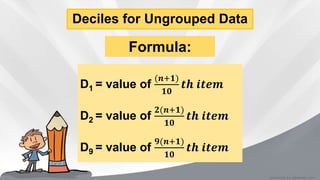
Deciles for Ungrouped Data
D1 = value of
(𝒏+𝟏)
𝟏𝟎
𝒕𝒉 𝒊𝒕𝒆𝒎
D2 = value of
𝟐(𝒏+𝟏)
𝟏𝟎
𝒕𝒉 𝒊𝒕𝒆𝒎
D9 = value of
𝟗(𝒏+𝟏)
𝟏𝟎
𝒕𝒉 𝒊𝒕𝒆𝒎
Formula:
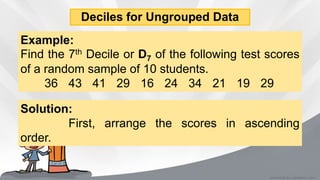
Deciles for Ungrouped Data
Solution:
First, arrange the scores in ascending
order.
Example:
Find the 7th Decile or D7 of the following test scores
of a random sample of 10 students.
36 43 41 29 16 24 34 21 19 29
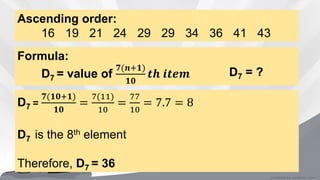
Ascending order:
16 19 21 24 29 29 34 36 41 43
Formula:
D7 = value of
𝟕(𝒏+𝟏)
𝟏𝟎
𝒕𝒉 𝒊𝒕𝒆𝒎 D7 = ?
D7 =
𝟕(𝟏𝟎+𝟏)
𝟏𝟎
=
7(11)
10
=
77
10
= 7.7 = 8
D7 is the 8th element
Therefore, D7 = 36
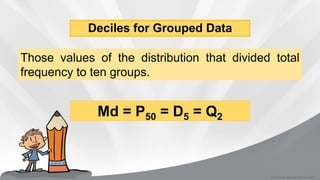
Deciles for Grouped Data
Those values of the distribution that divided total
frequency to ten groups.
Md = P50 = D5 = Q2
Md = P50 = D5 = Q2
Md = LL (
𝒏
𝟐
− 𝒇 𝒃
𝒇 𝒘
)𝒊
LL is the real lower limit of the median class,
𝒏 is the total number of cases in the distribution,
𝒇 𝒃 is the number of cases below the median class,
𝒇 𝒘 is the number of cases within the median class, and
𝒊 is the size of class interval (𝒊 = number of scores in a
class or group)
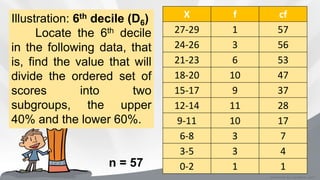
Illustration: 6th decile (D6)
Locate the 6th decile
in the following data, that
is, find the value that will
divide the ordered set of
scores into two
subgroups, the upper
40% and the lower 60%.
X f cf
27-29 1 57
24-26 3 56
21-23 6 53
18-20 10 47
15-17 9 37
12-14 11 28
9-11 10 17
6-8 3 7
3-5 3 4
0-2 1 1n = 57
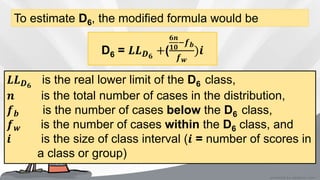
To estimate D6, the modified formula would be
D6 = 𝑳𝑳 𝑫 𝟔
+(
𝟔𝒏
𝟏𝟎
−𝒇 𝒃
𝒇 𝒘
)𝒊
𝑳𝑳 𝑫 𝟔
is the real lower limit of the D6 class,
𝒏 is the total number of cases in the distribution,
𝒇 𝒃 is the number of cases below the D6 class,
𝒇 𝒘 is the number of cases within the D6 class, and
𝒊 is the size of class interval (𝒊 = number of scores in
a class or group)
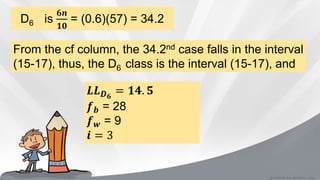
D6 is
𝟔𝒏
𝟏𝟎
= (0.6)(57) = 34.2
From the cf column, the 34.2nd case falls in the interval
(15-17), thus, the D6 class is the interval (15-17), and
𝑳𝑳 𝑫 𝟔
= 𝟏𝟒. 𝟓
𝒇 𝒃 = 28
𝒇 𝒘 = 9
𝒊 = 3
Using the modified formula:
D6 = 𝑳𝑳 𝑫 𝟔
+(
𝟔𝒏
𝟏𝟎
−𝒇 𝒃
𝒇 𝒘
)𝒊
𝐷6 = 14.5 +
34.2 − 28
9
3
𝐷6 = 14.5 +
6.2
9
3
= 14.5+2.06667
𝐷6= 16.57
This means that students
with scores greater than
16.57 belong to the upper
40% of the class and
students with scores less
than 16.57 belong to the
lower 60% of the class.
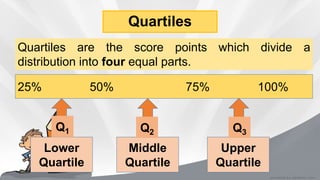
Quartiles
Quartiles are the score points which divide a
distribution into four equal parts.
25% 50% 75% 100%
Lower
Quartile
Middle
Quartile
Upper
Quartile
Q1 Q2 Q3
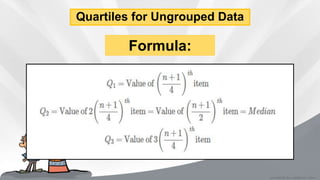
Quartiles for Ungrouped Data
Formula:
Example:
Following is the data of marks obtained by 20 students
in a test of statistics. Find Quartiles Q1 Q2 Q3 :
53 74 82 42 39 20 81 68 58 28
67 54 93 70 30 55 36 37 29 61
20 28 29 30 36 37 39 42 53 54
55 58 61 67 68 70 74 81 82 93
Ascending ordern = 20
Quartiles for Grouped Data
Illustration: 3rd quartile
(Q3)
Locate the 3rd quartile
(Q3) in the following data,
that is, find the value that
will divide the ordered set
of scores into two
subgroups, the upper 25%
and the lower 75%.
X f cf
27-29 1 57
24-26 3 56
21-23 6 53
18-20 10 47
15-17 9 37
12-14 11 28
9-11 10 17
6-8 3 7
3-5 3 4
0-2 1 1
n = 57
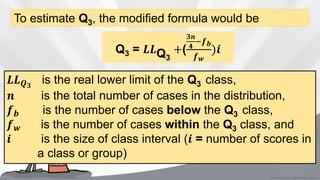
To estimate Q3, the modified formula would be
Q3 = 𝑳𝑳Q3
+(
𝟑𝒏
𝟒
−𝒇 𝒃
𝒇 𝒘
)𝒊
𝑳𝑳 𝑸 𝟑
is the real lower limit of the Q3 class,
𝒏 is the total number of cases in the distribution,
𝒇 𝒃 is the number of cases below the Q3 class,
𝒇 𝒘 is the number of cases within the Q3 class, and
𝒊 is the size of class interval (𝒊 = number of scores in
a class or group)
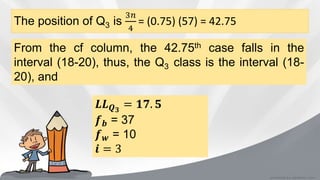
The position of Q3 is
3𝑛
4
= (0.75) (57) = 42.75
From the cf column, the 42.75th case falls in the
interval (18-20), thus, the Q3 class is the interval (18-
20), and
𝑳𝑳 𝑸 𝟑
= 𝟏𝟕. 𝟓
𝒇 𝒃 = 37
𝒇 𝒘 = 10
𝒊 = 3
𝑄3 = 17.5 +
42.75 − 37
10
3
𝑄3 = 14.5 +
5.75
10
3
= 17.5+1.725
𝑄3= 19.225
Using the modified formula:
Q3 = 𝑳𝑳Q3
+(
𝟑𝒏
𝟒
−𝒇 𝒃
𝒇 𝒘
)𝒊
This means that students
with scores greater than
19.225 belong to the
upper 25% of the class
and students with scores
less than 19.225 belong to
the lower 75% of the
class.
Exercises:
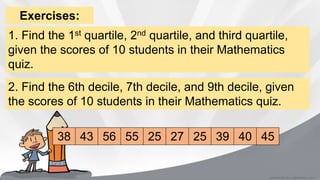
1. Find the 1st quartile, 2nd quartile, and third quartile,
given the scores of 10 students in their Mathematics
quiz.
38 43 56 55 25 27 25 39 40 45
2. Find the 6th decile, 7th decile, and 9th decile, given
the scores of 10 students in their Mathematics quiz.
Exercises:
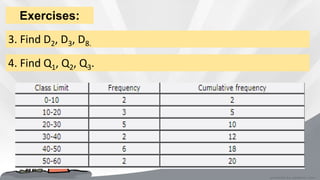
3. Find D2, D3, D8.
4. Find Q1, Q2, Q3.
Thank you for listening!
God bless. 

Deciles & Quartiles - Point Measures

  • 1.
  • 2.
  • 3.
    Deciles Deciles are ninepartitional values of the data or the given set of observation into ten equal parts. These 9 values are represented by D₁, D₂, D₃, D₄, D₅, D₆, D₇, D₈ and D₉ . They shows the 10%, 20%, 30%, 40%, 50%, 60%, 70%, 80% and 90%
  • 4.
    Deciles for UngroupedData D1 = value of (𝒏+𝟏) 𝟏𝟎 𝒕𝒉 𝒊𝒕𝒆𝒎 D2 = value of 𝟐(𝒏+𝟏) 𝟏𝟎 𝒕𝒉 𝒊𝒕𝒆𝒎 D9 = value of 𝟗(𝒏+𝟏) 𝟏𝟎 𝒕𝒉 𝒊𝒕𝒆𝒎 Formula:
  • 5.
    Deciles for UngroupedData Solution: First, arrange the scores in ascending order. Example: Find the 7th Decile or D7 of the following test scores of a random sample of 10 students. 36 43 41 29 16 24 34 21 19 29
  • 6.
    Ascending order: 16 1921 24 29 29 34 36 41 43 Formula: D7 = value of 𝟕(𝒏+𝟏) 𝟏𝟎 𝒕𝒉 𝒊𝒕𝒆𝒎 D7 = ? D7 = 𝟕(𝟏𝟎+𝟏) 𝟏𝟎 = 7(11) 10 = 77 10 = 7.7 = 8 D7 is the 8th element Therefore, D7 = 36
  • 7.
    Deciles for GroupedData Those values of the distribution that divided total frequency to ten groups. Md = P50 = D5 = Q2
  • 8.
    Md = P50= D5 = Q2 Md = LL ( 𝒏 𝟐 − 𝒇 𝒃 𝒇 𝒘 )𝒊 LL is the real lower limit of the median class, 𝒏 is the total number of cases in the distribution, 𝒇 𝒃 is the number of cases below the median class, 𝒇 𝒘 is the number of cases within the median class, and 𝒊 is the size of class interval (𝒊 = number of scores in a class or group)
  • 9.
    Illustration: 6th decile(D6) Locate the 6th decile in the following data, that is, find the value that will divide the ordered set of scores into two subgroups, the upper 40% and the lower 60%. X f cf 27-29 1 57 24-26 3 56 21-23 6 53 18-20 10 47 15-17 9 37 12-14 11 28 9-11 10 17 6-8 3 7 3-5 3 4 0-2 1 1n = 57
  • 10.
    To estimate D6,the modified formula would be D6 = 𝑳𝑳 𝑫 𝟔 +( 𝟔𝒏 𝟏𝟎 −𝒇 𝒃 𝒇 𝒘 )𝒊 𝑳𝑳 𝑫 𝟔 is the real lower limit of the D6 class, 𝒏 is the total number of cases in the distribution, 𝒇 𝒃 is the number of cases below the D6 class, 𝒇 𝒘 is the number of cases within the D6 class, and 𝒊 is the size of class interval (𝒊 = number of scores in a class or group)
  • 11.
    D6 is 𝟔𝒏 𝟏𝟎 = (0.6)(57)= 34.2 From the cf column, the 34.2nd case falls in the interval (15-17), thus, the D6 class is the interval (15-17), and 𝑳𝑳 𝑫 𝟔 = 𝟏𝟒. 𝟓 𝒇 𝒃 = 28 𝒇 𝒘 = 9 𝒊 = 3
  • 12.
    Using the modifiedformula: D6 = 𝑳𝑳 𝑫 𝟔 +( 𝟔𝒏 𝟏𝟎 −𝒇 𝒃 𝒇 𝒘 )𝒊 𝐷6 = 14.5 + 34.2 − 28 9 3 𝐷6 = 14.5 + 6.2 9 3 = 14.5+2.06667 𝐷6= 16.57 This means that students with scores greater than 16.57 belong to the upper 40% of the class and students with scores less than 16.57 belong to the lower 60% of the class.
  • 13.
    Quartiles Quartiles are thescore points which divide a distribution into four equal parts. 25% 50% 75% 100% Lower Quartile Middle Quartile Upper Quartile Q1 Q2 Q3
  • 14.
  • 15.
    Example: Following is thedata of marks obtained by 20 students in a test of statistics. Find Quartiles Q1 Q2 Q3 : 53 74 82 42 39 20 81 68 58 28 67 54 93 70 30 55 36 37 29 61 20 28 29 30 36 37 39 42 53 54 55 58 61 67 68 70 74 81 82 93 Ascending ordern = 20
  • 16.
    Quartiles for GroupedData Illustration: 3rd quartile (Q3) Locate the 3rd quartile (Q3) in the following data, that is, find the value that will divide the ordered set of scores into two subgroups, the upper 25% and the lower 75%. X f cf 27-29 1 57 24-26 3 56 21-23 6 53 18-20 10 47 15-17 9 37 12-14 11 28 9-11 10 17 6-8 3 7 3-5 3 4 0-2 1 1 n = 57
  • 17.
    To estimate Q3,the modified formula would be Q3 = 𝑳𝑳Q3 +( 𝟑𝒏 𝟒 −𝒇 𝒃 𝒇 𝒘 )𝒊 𝑳𝑳 𝑸 𝟑 is the real lower limit of the Q3 class, 𝒏 is the total number of cases in the distribution, 𝒇 𝒃 is the number of cases below the Q3 class, 𝒇 𝒘 is the number of cases within the Q3 class, and 𝒊 is the size of class interval (𝒊 = number of scores in a class or group)
  • 18.
    The position ofQ3 is 3𝑛 4 = (0.75) (57) = 42.75 From the cf column, the 42.75th case falls in the interval (18-20), thus, the Q3 class is the interval (18- 20), and 𝑳𝑳 𝑸 𝟑 = 𝟏𝟕. 𝟓 𝒇 𝒃 = 37 𝒇 𝒘 = 10 𝒊 = 3
  • 19.
    𝑄3 = 17.5+ 42.75 − 37 10 3 𝑄3 = 14.5 + 5.75 10 3 = 17.5+1.725 𝑄3= 19.225 Using the modified formula: Q3 = 𝑳𝑳Q3 +( 𝟑𝒏 𝟒 −𝒇 𝒃 𝒇 𝒘 )𝒊 This means that students with scores greater than 19.225 belong to the upper 25% of the class and students with scores less than 19.225 belong to the lower 75% of the class.
  • 20.
    Exercises: 1. Find the1st quartile, 2nd quartile, and third quartile, given the scores of 10 students in their Mathematics quiz. 38 43 56 55 25 27 25 39 40 45 2. Find the 6th decile, 7th decile, and 9th decile, given the scores of 10 students in their Mathematics quiz.
  • 21.
    Exercises: 3. Find D2,D3, D8. 4. Find Q1, Q2, Q3.
  • 22.
    Thank you forlistening! God bless. 

Editor's Notes

  • #4 A decile is a specific type of quantile that arranges data into 10 equal parts. In order to create deciles we must actually derive 9 specific numbers, or cut points, that define where these deciles begin and end.
  • #14 There are three quartiles called the first quartile, second quartile and third quartile. The quartiles divide the set of observations into four equal parts. The second quartile is equal to the median. The first quartile is also called the lower quartile and is denoted by Q1Q1. The third quartile is also called the upper quartile and is denoted by Q3Q3. The lower quartile Q1Q1 is a point which has 25% of the observations below it and 75% of the observations above it. The upper quartile Q3Q3 is a point with 75% of the observations below it and 25% of the observations above it. Read more: https://www.emathzone.com/tutorials/basic-statistics/quartiles.html#ixzz5lR0DddB2