1) Padhiar Rushabh D. 130010119061
2) Naik Harsh K. 130010119059
3) Maharshi Soni H. 130010119050
4) Mihir Dalwadi D. 130010119057
HEAT TRANSFER
PREPARED BY,
. TOPIC .
EFFECT OF FOULING ON
HEAT EXCHANGER
SUBMITTED TO :- PROF.ABHISHEK PANDEY
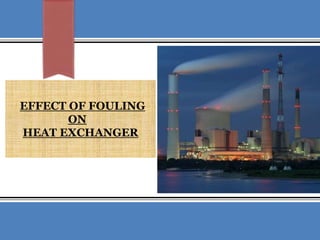
EFFECT OF FOULING
ON
HEAT EXCHANGER
 Heat Exchanger
 Fouling
a. Types and Effect
b. Facts and recent scenario
c. Design considerations
d. Economic importance of fouling
e. Fouling control
CONTENTS
HEAT EXCHANGER
 Heat exchangers are units designed to transfer
heat from a hot flowing stream to a cold flowing
stream.
 Use :-
Heat exchangers and heat recovery is
often used to improve process efficiency.
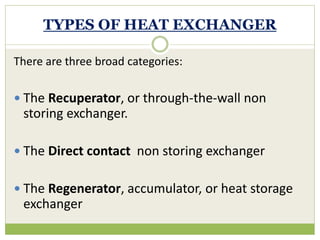
TYPES OF HEAT EXCHANGER
There are three broad categories:
 The Recuperator, or through-the-wall non
storing exchanger.
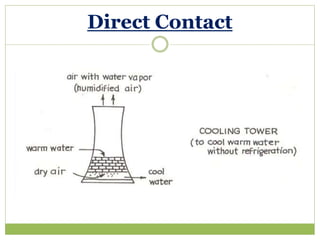
 The Direct contact non storing exchanger
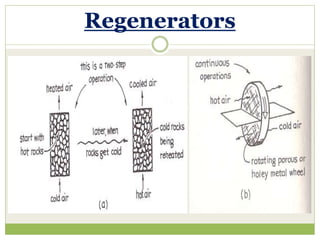
 The Regenerator, accumulator, or heat storage
exchanger
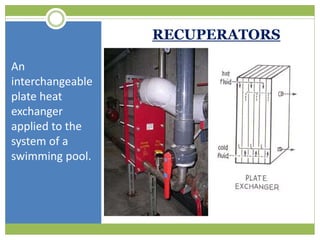
An
interchangeable
plate heat
exchanger
applied to the
system of a
swimming pool.
RECUPERATORS
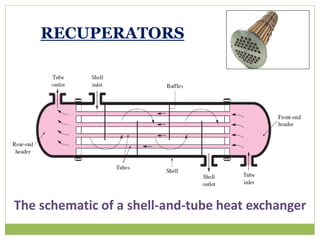
The schematic of a shell-and-tube heat exchanger
RECUPERATORS
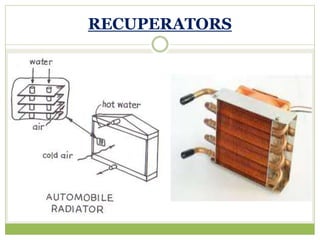
RECUPERATORS
Direct Contact
Regenerators
Applications of Heat Exchangers
Heat Exchangers
prevent car engine
overheating and
increase efficiency
Heat exchangers
are used in Industry
for heat transfer
Heat
exchangers are
used in AC and
furnaces
Fouling, in technical language, it is the
general term of unwanted material which is
accumulating on surfaces, such as inside
pipes, machines or heat exchangers.
FOULING
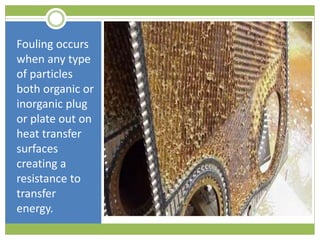
Fouling occurs
when any type
of particles
both organic or
inorganic plug
or plate out on
heat transfer
surfaces
creating a
resistance to
transfer
energy.
Examples of components that may be subject to
fouling and the corresponding effects of fouling
 Heat exchanger surfaces – reduces thermal efficiency,
increases temperature on the hot side, decreases
temperature on the cold side, corrosion, increases use of
cooling water;
 Piping, flow channels –reduces flow, increases pressure
drop, increases energy expenditure, may cause flow
oscillations, cavitation; may increase flow velocity
elsewhere, may induce vibrations;
 Ship hulls – increases fuel usage, reduces maximum
speed;
Examples of components that may be subject to
fouling and the corresponding effects of fouling
 Turbines – reduces efficiency, increases probability of
failure;
 Solar panels –decreases the electrical power generated;
 Electrical heating element – increases temperature of
the element, increases corrosion, reduces lifespan;
 Venturi tubes, orifice plates – inaccurate or incorrect
measurement of flow rate;
 Pitot tubes in airplanes – inaccurate or incorrect
indication of airplane speed
TYPES OF FOULING
 There are two broad categories :-
1. Macro fouling
2. Micro fouling
Macro Fouling
 Macro fouling is caused by coarse matter
of either biological or inorganic origin, for
example industrially produced refuse. Such
matter enters into the cooling water circuit
through the cooling water pumps from
sources like the open sea, rivers or lakes.
Micro Fouling
As to micro fouling, distinctions are made between:
 Scaling or precipitation fouling
 Chemical reaction fouling
 Bio-fouling
 Particulate fouling
 Corrosion fouling
 Solidification fouling
 Composite fouling
Scaling or precipitation fouling
 Scaling is the most common type of fouling and is
commonly associated with inverse solubility salts such as
calcium carbonate (CaCO3) found in water. Reverse
solubility salts become less solute as the temperature
increases and thus deposit on the heat exchanger
surface. Scale is difficult to remove mechanically and
chemical cleaning may be required.
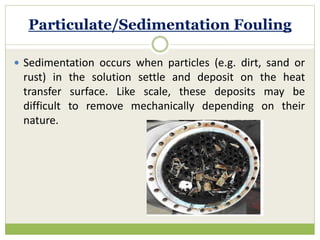
Particulate/Sedimentation Fouling
 Sedimentation occurs when particles (e.g. dirt, sand or
rust) in the solution settle and deposit on the heat
transfer surface. Like scale, these deposits may be
difficult to remove mechanically depending on their
nature.
Corrosion Fouling
 Results from a chemical reaction which involves the
heat exchanger surface material. Many metals such
as copper and aluminum form adherent oxide
coatings which serve to passivate the surface and
prevent further corrosion. Metal oxides which are
corrosion products exhibit quite a low thermal
conductivity and even relatively thin coatings of
oxides may significantly affect heat exchanger
performance.
Chemical Fouling
 Fouling from chemical reactions in the fluid stream
which result in the deposition of material on the
heat exchanger surface. This type of fouling is
common for chemically sensitive materials when
the fluid is heated to temperatures near its
decomposition (degradation) temperature. Coking
of hydrocarbon material on the heat transfer
surface is also a common chemical fouling
problem.
 Corrosion Fouling
 Chemical Fouling
Freezing Fouling
 Occurs when a portion of the hot stream is cooled to near
the freezing point of one of its components. An example
in refineries is when paraffin solidifies from a cooled
petroleum product. Another example is freezing of
polymer products on the heat exchanger surface.
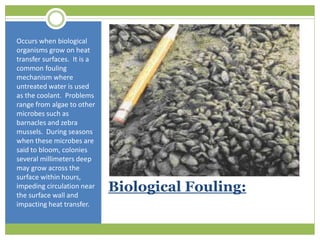
Biological Fouling:
Occurs when biological
organisms grow on heat
transfer surfaces. It is a
common fouling
mechanism where
untreated water is used
as the coolant. Problems
range from algae to other
microbes such as
barnacles and zebra
mussels. During seasons
when these microbes are
said to bloom, colonies
several millimeters deep
may grow across the
surface within hours,
impeding circulation near
the surface wall and
impacting heat transfer.
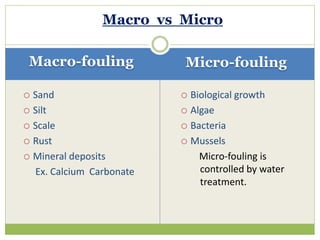
Macro-fouling Micro-fouling
 Sand
 Silt
 Scale
 Rust
 Mineral deposits
Ex. Calcium Carbonate
 Biological growth
 Algae
 Bacteria
 Mussels
Micro-fouling is
controlled by water
treatment.
Macro vs Micro
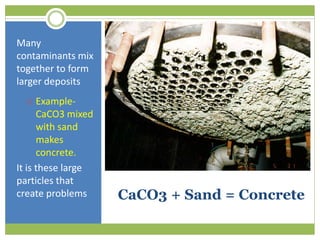
CaCO3 + Sand = Concrete
Many
contaminants mix
together to form
larger deposits
 Example-
CaCO3 mixed
with sand
makes
concrete.
It is these large
particles that
create problems
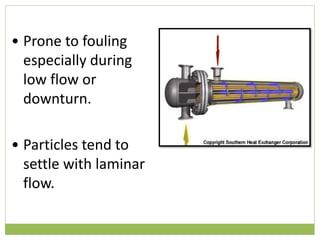
Shell and Tube Heat Exchanger
• Prone to fouling
especially during
low flow or
downturn.
• Particles tend to
settle with laminar
flow.
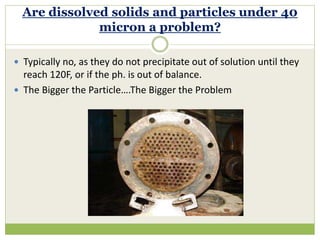
 Typically no, as they do not precipitate out of solution until they
reach 120F, or if the ph. is out of balance.
 The Bigger the Particle….The Bigger the Problem
Are dissolved solids and particles under 40
micron a problem?
FoulingParticle Size vs. Volume with 1 Trillion
Particles
Size of Particle Quantity of Particles Volume Volume % Volume
5um 212.5 Billion 14.58cm³ 14580mm³
3um 212.5 Billion 3.11cm³ 3110mm³
1um 212.5 Billion 0.11cm³ 110mm³
0.45um 212.5 Billion 0.0098cm³ 9.8mm³
Sub Total: 850 Billion 17.83cm³ 17809mm³ 1%
10um 37.5 Billion 21.30cm³ 21300mm³
25um 37.5 Billion 303.16cm³ 303160mm³
50um 37.5 Billion 2459.70cm³ 2459700mm³
75um 37.5 Billion 8260.72cm³ 8260720mm³
Sub Total: 150 Billion Particles 11044.88cm³ 11044880mm³ 99%
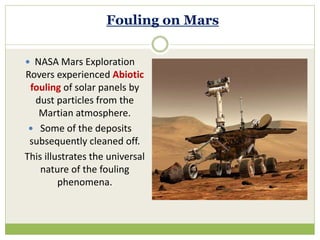
Fouling on Mars
 NASA Mars Exploration
Rovers experienced Abiotic
fouling of solar panels by
dust particles from the
Martian atmosphere.
 Some of the deposits
subsequently cleaned off.
This illustrates the universal
nature of the fouling
phenomena.
DESIGN CONSIDERATIONS
 It is important to consider fouling in the design of a heat
exchanger.
 There are different methods to provide the added heat transfer
area needed to account for the expected fouling and maximize
runtime between cleaning.
 For shell and tube heat exchanger, the common method is to
use fouling factors. For other types of heat exchangers, excess
heat transfer area is often used. However, fouling is a self-
fulfilling prophecy and the selection of fouling factors or excess
area must be done carefully.
Fouling Factor
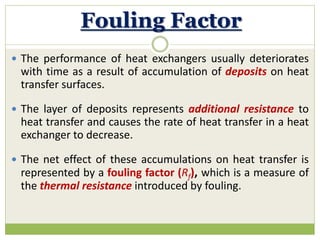
 The performance of heat exchangers usually deteriorates
with time as a result of accumulation of deposits on heat
transfer surfaces.
 The layer of deposits represents additional resistance to
heat transfer and causes the rate of heat transfer in a heat
exchanger to decrease.
 The net effect of these accumulations on heat transfer is
represented by a fouling factor (Rf), which is a measure of
the thermal resistance introduced by fouling.
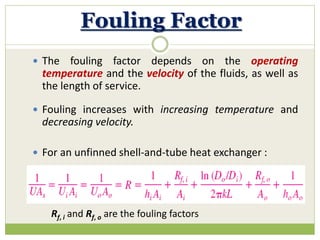
 The fouling factor depends on the operating
temperature and the velocity of the fluids, as well as
the length of service.
 Fouling increases with increasing temperature and
decreasing velocity.
 For an unfinned shell-and-tube heat exchanger :
Rf, i and Rf, o are the fouling factors
Fouling Factor
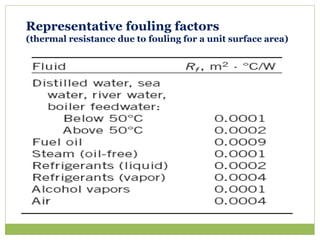
Representative fouling factors
(thermal resistance due to fouling for a unit surface area)
Economic and environmental importance
of fouling
 Fouling is ubiquitous and generates tremendous
operational losses, not unlike corrosion. For
example, one estimate puts the losses due to
fouling of heat exchangers in industrialized
nations to be about 0.25% of their GDP.
 Another analysis estimated the economical loss
due to boiler and turbine fouling in China
utilities at 4.68 billion dollars, which is about
0.169% the country GDP .
FOULING CONTROL
 Plate and frame heat exchangers can be disassembled and
cleaned periodically. Tubular heat exchangers can be cleaned
by such methods as acid cleaning, sandblasting, high-pressure
water jet, bullet cleaning, or drill rods.
 In large-scale cooling water systems for heat exchangers,
water treatment such as purification, addition of chemicals,
and testing, is used to minimize fouling of the heat exchange
equipment. Other water treatment is also used in steam
systems for power plants, etc. to minimize fouling and
corrosion of the heat exchange and other equipment.
 A variety of companies have started using water borne
oscillations technology to prevent biofouling. Without the use
of chemicals, this type of technology has helped in providing a
low-pressure drop in heat exchangers.
CONCLUSION
MAINTENANCE IS NOT
AN OPTION IT IS MUST!!!
REFERENCES
 https://www.google.co.in/url?sa=t&rct=j&q=&esrc=s&source=web&cd
=1&cad=rja&uact=8&ved=0CBwQFjAAahUKEwitl5HD7KjIAhXJBY4K
Hd-
KDmA&url=https%3A%2F%2Fen.wikipedia.org%2Fwiki%2FFouling&
usg=AFQjCNFOt2WzgJxRkxrld33MOYTZOIi7Vg
 Heat and Mass Transfer book by R.K.Rajput.
 Principles of Heat and Mass Transfer, 7th Edition
By Dewitt and Incropera.
THANK YOU…

Fouling effects on boiler

  • 1.
    1) Padhiar RushabhD. 130010119061 2) Naik Harsh K. 130010119059 3) Maharshi Soni H. 130010119050 4) Mihir Dalwadi D. 130010119057 HEAT TRANSFER PREPARED BY, . TOPIC . EFFECT OF FOULING ON HEAT EXCHANGER SUBMITTED TO :- PROF.ABHISHEK PANDEY
  • 2.
  • 3.
     Heat Exchanger Fouling a. Types and Effect b. Facts and recent scenario c. Design considerations d. Economic importance of fouling e. Fouling control CONTENTS
  • 4.
    HEAT EXCHANGER  Heatexchangers are units designed to transfer heat from a hot flowing stream to a cold flowing stream.  Use :- Heat exchangers and heat recovery is often used to improve process efficiency.
  • 5.
    TYPES OF HEATEXCHANGER There are three broad categories:  The Recuperator, or through-the-wall non storing exchanger.  The Direct contact non storing exchanger  The Regenerator, accumulator, or heat storage exchanger
  • 6.
    An interchangeable plate heat exchanger applied tothe system of a swimming pool. RECUPERATORS
  • 7.
    The schematic ofa shell-and-tube heat exchanger RECUPERATORS
  • 8.
  • 9.
  • 10.
  • 11.
    Applications of HeatExchangers Heat Exchangers prevent car engine overheating and increase efficiency Heat exchangers are used in Industry for heat transfer Heat exchangers are used in AC and furnaces
  • 12.
    Fouling, in technicallanguage, it is the general term of unwanted material which is accumulating on surfaces, such as inside pipes, machines or heat exchangers. FOULING
  • 13.
    Fouling occurs when anytype of particles both organic or inorganic plug or plate out on heat transfer surfaces creating a resistance to transfer energy.
  • 14.
    Examples of componentsthat may be subject to fouling and the corresponding effects of fouling  Heat exchanger surfaces – reduces thermal efficiency, increases temperature on the hot side, decreases temperature on the cold side, corrosion, increases use of cooling water;  Piping, flow channels –reduces flow, increases pressure drop, increases energy expenditure, may cause flow oscillations, cavitation; may increase flow velocity elsewhere, may induce vibrations;  Ship hulls – increases fuel usage, reduces maximum speed;
  • 15.
    Examples of componentsthat may be subject to fouling and the corresponding effects of fouling  Turbines – reduces efficiency, increases probability of failure;  Solar panels –decreases the electrical power generated;  Electrical heating element – increases temperature of the element, increases corrosion, reduces lifespan;  Venturi tubes, orifice plates – inaccurate or incorrect measurement of flow rate;  Pitot tubes in airplanes – inaccurate or incorrect indication of airplane speed
  • 16.
    TYPES OF FOULING There are two broad categories :- 1. Macro fouling 2. Micro fouling
  • 17.
    Macro Fouling  Macrofouling is caused by coarse matter of either biological or inorganic origin, for example industrially produced refuse. Such matter enters into the cooling water circuit through the cooling water pumps from sources like the open sea, rivers or lakes.
  • 18.
    Micro Fouling As tomicro fouling, distinctions are made between:  Scaling or precipitation fouling  Chemical reaction fouling  Bio-fouling  Particulate fouling  Corrosion fouling  Solidification fouling  Composite fouling
  • 19.
    Scaling or precipitationfouling  Scaling is the most common type of fouling and is commonly associated with inverse solubility salts such as calcium carbonate (CaCO3) found in water. Reverse solubility salts become less solute as the temperature increases and thus deposit on the heat exchanger surface. Scale is difficult to remove mechanically and chemical cleaning may be required.
  • 20.
    Particulate/Sedimentation Fouling  Sedimentationoccurs when particles (e.g. dirt, sand or rust) in the solution settle and deposit on the heat transfer surface. Like scale, these deposits may be difficult to remove mechanically depending on their nature.
  • 21.
    Corrosion Fouling  Resultsfrom a chemical reaction which involves the heat exchanger surface material. Many metals such as copper and aluminum form adherent oxide coatings which serve to passivate the surface and prevent further corrosion. Metal oxides which are corrosion products exhibit quite a low thermal conductivity and even relatively thin coatings of oxides may significantly affect heat exchanger performance.
  • 22.
    Chemical Fouling  Foulingfrom chemical reactions in the fluid stream which result in the deposition of material on the heat exchanger surface. This type of fouling is common for chemically sensitive materials when the fluid is heated to temperatures near its decomposition (degradation) temperature. Coking of hydrocarbon material on the heat transfer surface is also a common chemical fouling problem.
  • 23.
     Corrosion Fouling Chemical Fouling
  • 24.
    Freezing Fouling  Occurswhen a portion of the hot stream is cooled to near the freezing point of one of its components. An example in refineries is when paraffin solidifies from a cooled petroleum product. Another example is freezing of polymer products on the heat exchanger surface.
  • 25.
    Biological Fouling: Occurs whenbiological organisms grow on heat transfer surfaces. It is a common fouling mechanism where untreated water is used as the coolant. Problems range from algae to other microbes such as barnacles and zebra mussels. During seasons when these microbes are said to bloom, colonies several millimeters deep may grow across the surface within hours, impeding circulation near the surface wall and impacting heat transfer.
  • 26.
    Macro-fouling Micro-fouling  Sand Silt  Scale  Rust  Mineral deposits Ex. Calcium Carbonate  Biological growth  Algae  Bacteria  Mussels Micro-fouling is controlled by water treatment. Macro vs Micro
  • 27.
    CaCO3 + Sand= Concrete Many contaminants mix together to form larger deposits  Example- CaCO3 mixed with sand makes concrete. It is these large particles that create problems
  • 28.
    Shell and TubeHeat Exchanger • Prone to fouling especially during low flow or downturn. • Particles tend to settle with laminar flow.
  • 29.
     Typically no,as they do not precipitate out of solution until they reach 120F, or if the ph. is out of balance.  The Bigger the Particle….The Bigger the Problem Are dissolved solids and particles under 40 micron a problem?
  • 30.
    FoulingParticle Size vs.Volume with 1 Trillion Particles Size of Particle Quantity of Particles Volume Volume % Volume 5um 212.5 Billion 14.58cm³ 14580mm³ 3um 212.5 Billion 3.11cm³ 3110mm³ 1um 212.5 Billion 0.11cm³ 110mm³ 0.45um 212.5 Billion 0.0098cm³ 9.8mm³ Sub Total: 850 Billion 17.83cm³ 17809mm³ 1% 10um 37.5 Billion 21.30cm³ 21300mm³ 25um 37.5 Billion 303.16cm³ 303160mm³ 50um 37.5 Billion 2459.70cm³ 2459700mm³ 75um 37.5 Billion 8260.72cm³ 8260720mm³ Sub Total: 150 Billion Particles 11044.88cm³ 11044880mm³ 99%
  • 31.
    Fouling on Mars NASA Mars Exploration Rovers experienced Abiotic fouling of solar panels by dust particles from the Martian atmosphere.  Some of the deposits subsequently cleaned off. This illustrates the universal nature of the fouling phenomena.
  • 32.
    DESIGN CONSIDERATIONS  Itis important to consider fouling in the design of a heat exchanger.  There are different methods to provide the added heat transfer area needed to account for the expected fouling and maximize runtime between cleaning.  For shell and tube heat exchanger, the common method is to use fouling factors. For other types of heat exchangers, excess heat transfer area is often used. However, fouling is a self- fulfilling prophecy and the selection of fouling factors or excess area must be done carefully.
  • 33.
    Fouling Factor  Theperformance of heat exchangers usually deteriorates with time as a result of accumulation of deposits on heat transfer surfaces.  The layer of deposits represents additional resistance to heat transfer and causes the rate of heat transfer in a heat exchanger to decrease.  The net effect of these accumulations on heat transfer is represented by a fouling factor (Rf), which is a measure of the thermal resistance introduced by fouling.
  • 34.
     The foulingfactor depends on the operating temperature and the velocity of the fluids, as well as the length of service.  Fouling increases with increasing temperature and decreasing velocity.  For an unfinned shell-and-tube heat exchanger : Rf, i and Rf, o are the fouling factors Fouling Factor
  • 35.
    Representative fouling factors (thermalresistance due to fouling for a unit surface area)
  • 36.
    Economic and environmentalimportance of fouling  Fouling is ubiquitous and generates tremendous operational losses, not unlike corrosion. For example, one estimate puts the losses due to fouling of heat exchangers in industrialized nations to be about 0.25% of their GDP.  Another analysis estimated the economical loss due to boiler and turbine fouling in China utilities at 4.68 billion dollars, which is about 0.169% the country GDP .
  • 37.
    FOULING CONTROL  Plateand frame heat exchangers can be disassembled and cleaned periodically. Tubular heat exchangers can be cleaned by such methods as acid cleaning, sandblasting, high-pressure water jet, bullet cleaning, or drill rods.  In large-scale cooling water systems for heat exchangers, water treatment such as purification, addition of chemicals, and testing, is used to minimize fouling of the heat exchange equipment. Other water treatment is also used in steam systems for power plants, etc. to minimize fouling and corrosion of the heat exchange and other equipment.  A variety of companies have started using water borne oscillations technology to prevent biofouling. Without the use of chemicals, this type of technology has helped in providing a low-pressure drop in heat exchangers.
  • 38.
  • 39.
  • 40.