Process Training - Heat Exchanger
Heat Exchanger Calculations
By Sharon Wenger
February 26, 2015
1
Overview
Introduction
 Basic Heat Transfer
 Conduction
 Convection
 Radiation
 Types of Exchangers
 Shell & Tube
 Hairpin
 Plate & Frame
 Brazed Plate
 Welded Plate
 Finned Tube TEMA Heat Exchangers
 Heat Transfer Calculation Formulas
 General
 Sensible Heating or Cooling of Fluids
 Steam Condensing
 Heating of Cooling a Solid
 Terminology and Definitions
 Working Problems
 Work Example 1 - Shell and Tube Heat Exchanger Calculation
 Work Example 2 - Mozambique LNG PJ FEED - DeC2 OVHD Condenser (251-E-1006)
2
Basic Heat Transfer
There are three forms of heat transfer.
 Conduction
 Convection
 Radiation
Conduction
Heat flow through a solid medium due to the temperature
difference across the solid. The temperature difference is the
driving force for heat transfer.
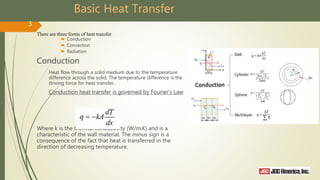
Conduction heat transfer is governed by Fourier's Law
Where k is the thermal conductivity (W/m.K) and is a
characteristic of the wall material. The minus sign is a
consequence of the fact that heat is transferred in the
direction of decreasing temperature.
3
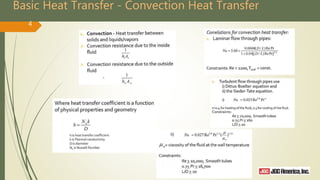
Basic Heat Transfer - Convection Heat Transfer
4
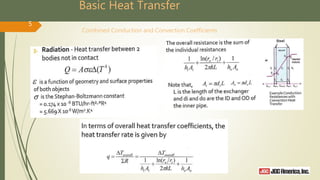
Basic Heat Transfer
5
Combined Conduction and Convection Coefficients
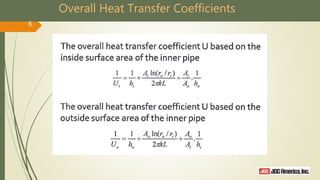
Overall Heat Transfer Coefficients
6
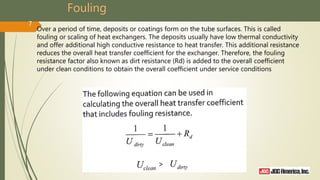
Fouling
Over a period of time, deposits or coatings form on the tube surfaces. This is called
fouling or scaling of heat exchangers. The deposits usually have low thermal conductivity
and offer additional high conductive resistance to heat transfer. This additional resistance
reduces the overall heat transfer coefficient for the exchanger. Therefore, the fouling
resistance factor also known as dirt resistance (Rd) is added to the overall coefficient
under clean conditions to obtain the overall coefficient under service conditions
7
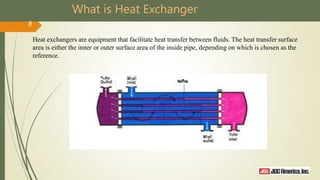
What is Heat Exchanger
Heat exchangers are equipment that facilitate heat transfer between fluids. The heat transfer surface
area is either the inner or outer surface area of the inside pipe, depending on which is chosen as the
reference.
8
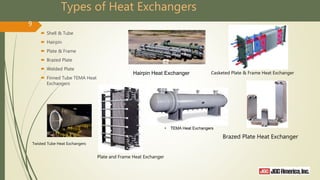
Types of Heat Exchangers
 Shell & Tube
 Hairpin
 Plate & Frame
 Brazed Plate
 Welded Plate
 Finned Tube TEMA Heat
Exchangers
9
Plate and Frame Heat Exchanger
Casketed Plate & Frame Heat Exchanger
Brazed Plate Heat Exchanger
Hairpin Heat Exchanger
Twisted Tube Heat Exchangers
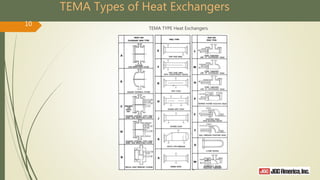
TEMA Types of Heat Exchangers
TEMA TYPE Heat Exchangers
10
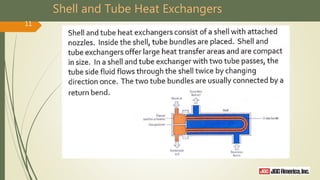
Shell and Tube Heat Exchangers
11
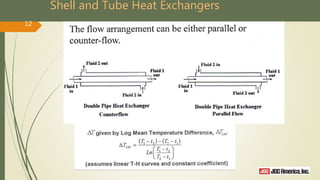
Shell and Tube Heat Exchangers
12
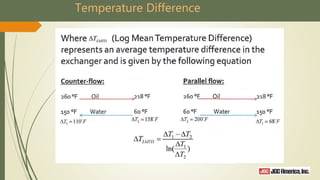
Temperature Difference
Shell and Tube Heat Exchangers
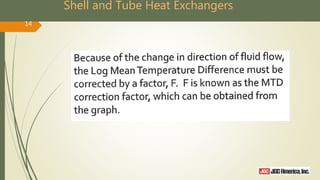
14
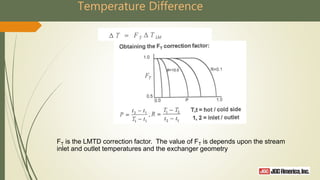
Temperature Difference
FT is the LMTD correction factor. The value of FT is depends upon the stream
inlet and outlet temperatures and the exchanger geometry
Approach of a Temperature Difference (ATD)
16
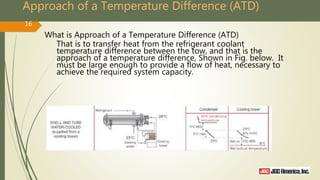
What is Approach of a Temperature Difference (ATD)
That is to transfer heat from the refrigerant coolant
temperature difference between the tow, and that is the
approach of a temperature difference, Shown in Fig. below. It
must be large enough to provide a flow of heat, necessary to
achieve the required system capacity.
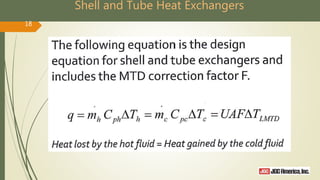
Main heat transfer equation
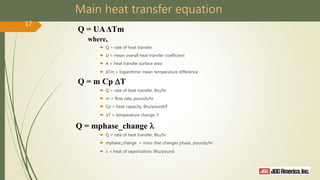
Q = UAΔTm
where,
 Q = rate of heat transfer
 U = mean overall heat transfer coefficient
 A = heat transfer surface area
 ΔTm = logarithmic mean temperature difference
Q = m Cp T
 Q = rate of heat transfer, Btu/hr
 m = flow rate, pounds/hr
 Cp = heat capacity, Btu/pound/F
 T = temperature change, F
Q = mphase_change 
 Q = rate of heat transfer, Btu/hr
 mphase_change = mass that changes phase, pounds/hr
  = heat of vaporization, Btu/pound
17
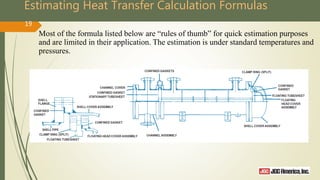
Shell and Tube Heat Exchangers
18
Estimating Heat Transfer Calculation Formulas
19
Most of the formula listed below are “rules of thumb” for quick estimation purposes
and are limited in their application. The estimation is under standard temperatures and
pressures.
“Quick” Heat Transfer Calculation Formulas – for Estimation
General
Liquid:
20
–
Btu
hr
= kW × 3412 = HP × 2544
–
Lbs
hr
= GPM x Density 8.022 = GPM × 501.375 × Specific Gravity
Specific Gravity = Density/62.4 Psia = Psig+14.7
–
Btu
hr
= Tons of Refrigeration × 12000
–
Btu
hr
= Evaporative Cooling Tower Tons x 15000
– SCFM of air = [ACFM x (psig + 14.7) x 528] / [(Temp + 460) x 14.7]
– SCFM of air = Lbs/ Hr of air / 4.5 (at atmospheric temperature and pressure)
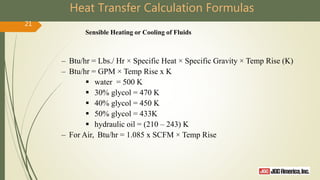
Heat Transfer Calculation Formulas
Sensible Heating or Cooling of Fluids
21
– Btu/hr = Lbs./ Hr × Specific Heat × Specific Gravity × Temp Rise (K)
– Btu/hr = GPM × Temp Rise x K
 water = 500 K
 30% glycol = 470 K
 40% glycol = 450 K
 50% glycol = 433K
 hydraulic oil = (210 – 243) K
– For Air, Btu/hr = 1.085 x SCFM × Temp Rise
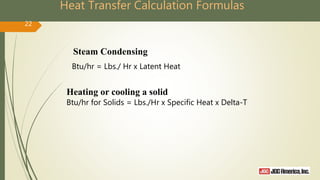
Heat Transfer Calculation Formulas
Steam Condensing
22
Btu/hr = Lbs./ Hr x Latent Heat
Heating or cooling a solid
Btu/hr for Solids = Lbs./Hr x Specific Heat x Delta-T
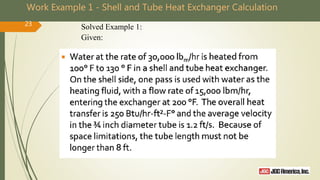
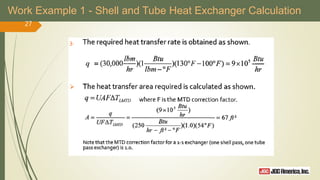
Work Example 1 - Shell and Tube Heat Exchanger Calculation
23
Solved Example 1:
Given:
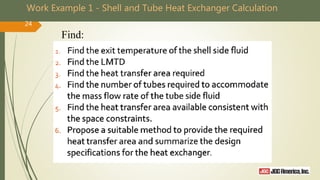
Work Example 1 - Shell and Tube Heat Exchanger Calculation
24
Find:
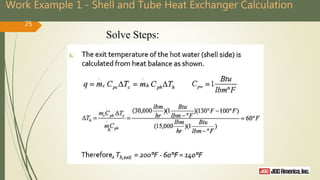
Work Example 1 - Shell and Tube Heat Exchanger Calculation
25
Solve Steps:
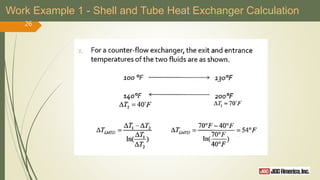
26
Work Example 1 - Shell and Tube Heat Exchanger Calculation
27
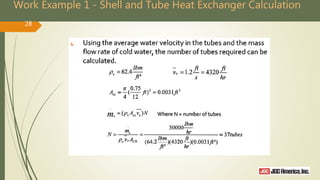
Work Example 1 - Shell and Tube Heat Exchanger Calculation
28
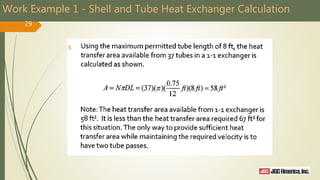
Work Example 1 - Shell and Tube Heat Exchanger Calculation
29
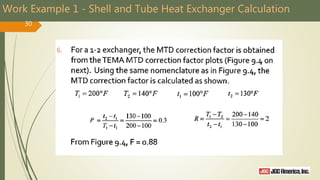
Work Example 1 - Shell and Tube Heat Exchanger Calculation
30
Work Example 1 - Shell and Tube Heat Exchanger Calculation
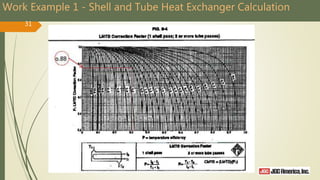
31
Work Example 1 - Shell and Tube Heat Exchanger Calculation
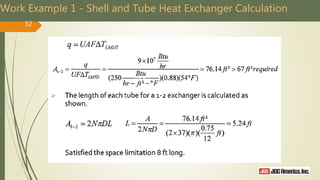
32
Work Example 1 - Shell and Tube Heat Exchanger Calculation
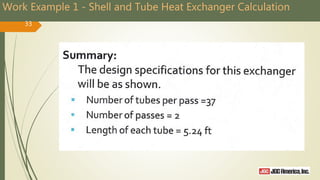
33
Working Problem 2 –
Mozambique LNGFEED - DeC2 OVHD Condenser (251-E-1006)
Do we have to have all the required information to design a heat
exchanger? Not necessary. That is where we use the quick calculation
formulas to design it
Example 2 - Working Problem from Mozambique LNG FEED - DeC2
OVHD Condenser (251-E-1006)
34
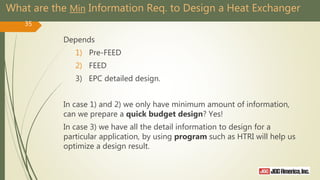
What are the Min Information Req. to Design a Heat Exchanger
Depends
1) Pre-FEED
2) FEED
3) EPC detailed design.
In case 1) and 2) we only have minimum amount of information,
can we prepare a quick budget design? Yes!
In case 3) we have all the detail information to design for a
particular application, by using program such as HTRI will help us
optimize a design result.
35
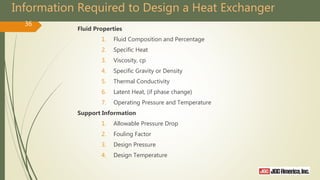
Information Required to Design a Heat Exchanger
Fluid Properties
1. Fluid Composition and Percentage
2. Specific Heat
3. Viscosity, cp
4. Specific Gravity or Density
5. Thermal Conductivity
6. Latent Heat, (if phase change)
7. Operating Pressure and Temperature
Support Information
1. Allowable Pressure Drop
2. Fouling Factor
3. Design Pressure
4. Design Temperature
36
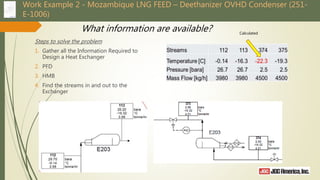
Work Example 2 - Mozambique LNG FEED – Deethanizer OVHD Condenser (251-
E-1006)
Steps to solve the problem
1. Gather all the Information Required to
Design a Heat Exchanger
2. PFD
3. HMB
4. Find the streams in and out to the
Exchanger
37
Calculated
What information are available?
Approach of a Temperature Difference (ATD)
Condensate Supply Temp. (°C) = achieve T (-16) – rise T (-3) – ATD (-3) = -22.3 (°C)
38
Streams
Hot Side Cold Side
112 113 374 375
Temperature [C] -0.14 -16.3 -22.3 -19.3
Pressure [bara] 26.7 26.7 2.5 2.5
Mass Flow [kg/h] 3980 3980 4500 4500
Calculate Heat Exchanger Duty Required
39
Streams 1 2 3 4
Temperature [C] tc1
tc2
Th1
Th2
-0.14 -16.3 -22.3 -19.3
Pressure [bara] 26.7 26.7 2.5 2.5
Mass Flow [kg/h] 3980 3980 4500 4500
ΔTLM
(°C) 11.35
UA (Kw/°C) 33 - 40 From Go-By
For UA = 33 Q (Kw) = 375
For UA = 40 Q (Kw) = 454
Result UniSim Results
Q = UA ΔTLM
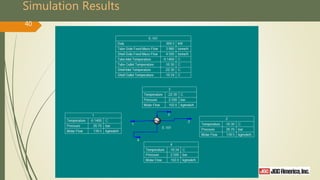
Simulation Results
40
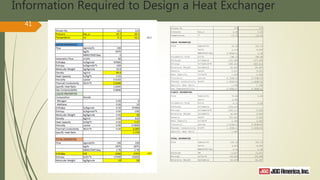
Information Required to Design a Heat Exchanger
 Streams
41 Stream No. 374 375
Pressure bar_a 2.50 2.50
Temperature
o
C -19.32 -19.32
VAPOR PROPERTIES
Flow kgmole/hr 25.30 102.16
kg/hr 1,116 4,505
MMSCF60F/day 5.080E-01 2.05
Volumetric Flow m3/hr 198.11 799.99
Enthalpy kJ/kgmole -107,494 -107,494
Entropy kJ/kgmole*K -289.614 -289.614
Molecular Weight kg/kgmole 44.097 44.097
Density kg/m3 5.631 5.631
Heat Capacity kJ/kg*K 1.604 1.604
Viscosity cpoise 6.744E-03 6.744E-03
Thermal Conductivity W/m*K 1.365E-02 1.365E-02
Specific Heat Ratio 1.198 1.198
Gas Compressibility 9.286E-01 9.286E-01
LIQUID PROPERTIES
Flow kgmole/hr 76.86 0.00
kg/hr 3,389
Volumetric Flow m3/hr 6.12 0.00
Enthalpy kJ/kgmole -125,135
Entropy kJ/kgmole*K -359.113 0.000
Molecular Weight kg/kgmole 44.097 0.000
Density kg/m3 553.422 0.000
Heat Capacity kJ/kg*K 2.364 0.000
Viscosity cpoise 1.512E-01 0.000E+00
Thermal Conductivity W/m*K 1.183E-01 0.000E+00
Specific Heat Ratio 1.567
TOTAL PROPERTIES
Flow kgmole/hr 102.16 102.16
kg/hr 4,505 4,505
MMSCF60F/day 2.05 2.05
Enthalpy kW -3,427 -3,051
Entropy kJ/hr*K -34,930 -29,588
Molecular Weight kg/kgmole 44.097 44.097
Thanks & Questions
42

Heat exchanger training 02. 25. 15

  • 1.
    Process Training -Heat Exchanger Heat Exchanger Calculations By Sharon Wenger February 26, 2015 1
  • 2.
    Overview Introduction  Basic HeatTransfer  Conduction  Convection  Radiation  Types of Exchangers  Shell & Tube  Hairpin  Plate & Frame  Brazed Plate  Welded Plate  Finned Tube TEMA Heat Exchangers  Heat Transfer Calculation Formulas  General  Sensible Heating or Cooling of Fluids  Steam Condensing  Heating of Cooling a Solid  Terminology and Definitions  Working Problems  Work Example 1 - Shell and Tube Heat Exchanger Calculation  Work Example 2 - Mozambique LNG PJ FEED - DeC2 OVHD Condenser (251-E-1006) 2
  • 3.
    Basic Heat Transfer Thereare three forms of heat transfer.  Conduction  Convection  Radiation Conduction Heat flow through a solid medium due to the temperature difference across the solid. The temperature difference is the driving force for heat transfer. Conduction heat transfer is governed by Fourier's Law Where k is the thermal conductivity (W/m.K) and is a characteristic of the wall material. The minus sign is a consequence of the fact that heat is transferred in the direction of decreasing temperature. 3
  • 4.
    Basic Heat Transfer- Convection Heat Transfer 4
  • 5.
    Basic Heat Transfer 5 CombinedConduction and Convection Coefficients
  • 6.
    Overall Heat TransferCoefficients 6
  • 7.
    Fouling Over a periodof time, deposits or coatings form on the tube surfaces. This is called fouling or scaling of heat exchangers. The deposits usually have low thermal conductivity and offer additional high conductive resistance to heat transfer. This additional resistance reduces the overall heat transfer coefficient for the exchanger. Therefore, the fouling resistance factor also known as dirt resistance (Rd) is added to the overall coefficient under clean conditions to obtain the overall coefficient under service conditions 7
  • 8.
    What is HeatExchanger Heat exchangers are equipment that facilitate heat transfer between fluids. The heat transfer surface area is either the inner or outer surface area of the inside pipe, depending on which is chosen as the reference. 8
  • 9.
    Types of HeatExchangers  Shell & Tube  Hairpin  Plate & Frame  Brazed Plate  Welded Plate  Finned Tube TEMA Heat Exchangers 9 Plate and Frame Heat Exchanger Casketed Plate & Frame Heat Exchanger Brazed Plate Heat Exchanger Hairpin Heat Exchanger Twisted Tube Heat Exchangers
  • 10.
    TEMA Types ofHeat Exchangers TEMA TYPE Heat Exchangers 10
  • 11.
    Shell and TubeHeat Exchangers 11
  • 12.
    Shell and TubeHeat Exchangers 12
  • 13.
  • 14.
    Shell and TubeHeat Exchangers 14
  • 15.
    Temperature Difference FT isthe LMTD correction factor. The value of FT is depends upon the stream inlet and outlet temperatures and the exchanger geometry
  • 16.
    Approach of aTemperature Difference (ATD) 16 What is Approach of a Temperature Difference (ATD) That is to transfer heat from the refrigerant coolant temperature difference between the tow, and that is the approach of a temperature difference, Shown in Fig. below. It must be large enough to provide a flow of heat, necessary to achieve the required system capacity.
  • 17.
    Main heat transferequation Q = UAΔTm where,  Q = rate of heat transfer  U = mean overall heat transfer coefficient  A = heat transfer surface area  ΔTm = logarithmic mean temperature difference Q = m Cp T  Q = rate of heat transfer, Btu/hr  m = flow rate, pounds/hr  Cp = heat capacity, Btu/pound/F  T = temperature change, F Q = mphase_change   Q = rate of heat transfer, Btu/hr  mphase_change = mass that changes phase, pounds/hr   = heat of vaporization, Btu/pound 17
  • 18.
    Shell and TubeHeat Exchangers 18
  • 19.
    Estimating Heat TransferCalculation Formulas 19 Most of the formula listed below are “rules of thumb” for quick estimation purposes and are limited in their application. The estimation is under standard temperatures and pressures.
  • 20.
    “Quick” Heat TransferCalculation Formulas – for Estimation General Liquid: 20 – Btu hr = kW × 3412 = HP × 2544 – Lbs hr = GPM x Density 8.022 = GPM × 501.375 × Specific Gravity Specific Gravity = Density/62.4 Psia = Psig+14.7 – Btu hr = Tons of Refrigeration × 12000 – Btu hr = Evaporative Cooling Tower Tons x 15000 – SCFM of air = [ACFM x (psig + 14.7) x 528] / [(Temp + 460) x 14.7] – SCFM of air = Lbs/ Hr of air / 4.5 (at atmospheric temperature and pressure)
  • 21.
    Heat Transfer CalculationFormulas Sensible Heating or Cooling of Fluids 21 – Btu/hr = Lbs./ Hr × Specific Heat × Specific Gravity × Temp Rise (K) – Btu/hr = GPM × Temp Rise x K  water = 500 K  30% glycol = 470 K  40% glycol = 450 K  50% glycol = 433K  hydraulic oil = (210 – 243) K – For Air, Btu/hr = 1.085 x SCFM × Temp Rise
  • 22.
    Heat Transfer CalculationFormulas Steam Condensing 22 Btu/hr = Lbs./ Hr x Latent Heat Heating or cooling a solid Btu/hr for Solids = Lbs./Hr x Specific Heat x Delta-T
  • 23.
    Work Example 1- Shell and Tube Heat Exchanger Calculation 23 Solved Example 1: Given:
  • 24.
    Work Example 1- Shell and Tube Heat Exchanger Calculation 24 Find:
  • 25.
    Work Example 1- Shell and Tube Heat Exchanger Calculation 25 Solve Steps:
  • 26.
    26 Work Example 1- Shell and Tube Heat Exchanger Calculation
  • 27.
    27 Work Example 1- Shell and Tube Heat Exchanger Calculation
  • 28.
    Work Example 1- Shell and Tube Heat Exchanger Calculation 28
  • 29.
    Work Example 1- Shell and Tube Heat Exchanger Calculation 29
  • 30.
    Work Example 1- Shell and Tube Heat Exchanger Calculation 30
  • 31.
    Work Example 1- Shell and Tube Heat Exchanger Calculation 31
  • 32.
    Work Example 1- Shell and Tube Heat Exchanger Calculation 32
  • 33.
    Work Example 1- Shell and Tube Heat Exchanger Calculation 33
  • 34.
    Working Problem 2– Mozambique LNGFEED - DeC2 OVHD Condenser (251-E-1006) Do we have to have all the required information to design a heat exchanger? Not necessary. That is where we use the quick calculation formulas to design it Example 2 - Working Problem from Mozambique LNG FEED - DeC2 OVHD Condenser (251-E-1006) 34
  • 35.
    What are theMin Information Req. to Design a Heat Exchanger Depends 1) Pre-FEED 2) FEED 3) EPC detailed design. In case 1) and 2) we only have minimum amount of information, can we prepare a quick budget design? Yes! In case 3) we have all the detail information to design for a particular application, by using program such as HTRI will help us optimize a design result. 35
  • 36.
    Information Required toDesign a Heat Exchanger Fluid Properties 1. Fluid Composition and Percentage 2. Specific Heat 3. Viscosity, cp 4. Specific Gravity or Density 5. Thermal Conductivity 6. Latent Heat, (if phase change) 7. Operating Pressure and Temperature Support Information 1. Allowable Pressure Drop 2. Fouling Factor 3. Design Pressure 4. Design Temperature 36
  • 37.
    Work Example 2- Mozambique LNG FEED – Deethanizer OVHD Condenser (251- E-1006) Steps to solve the problem 1. Gather all the Information Required to Design a Heat Exchanger 2. PFD 3. HMB 4. Find the streams in and out to the Exchanger 37 Calculated What information are available?
  • 38.
    Approach of aTemperature Difference (ATD) Condensate Supply Temp. (°C) = achieve T (-16) – rise T (-3) – ATD (-3) = -22.3 (°C) 38 Streams Hot Side Cold Side 112 113 374 375 Temperature [C] -0.14 -16.3 -22.3 -19.3 Pressure [bara] 26.7 26.7 2.5 2.5 Mass Flow [kg/h] 3980 3980 4500 4500
  • 39.
    Calculate Heat ExchangerDuty Required 39 Streams 1 2 3 4 Temperature [C] tc1 tc2 Th1 Th2 -0.14 -16.3 -22.3 -19.3 Pressure [bara] 26.7 26.7 2.5 2.5 Mass Flow [kg/h] 3980 3980 4500 4500 ΔTLM (°C) 11.35 UA (Kw/°C) 33 - 40 From Go-By For UA = 33 Q (Kw) = 375 For UA = 40 Q (Kw) = 454 Result UniSim Results Q = UA ΔTLM
  • 40.
  • 41.
    Information Required toDesign a Heat Exchanger  Streams 41 Stream No. 374 375 Pressure bar_a 2.50 2.50 Temperature o C -19.32 -19.32 VAPOR PROPERTIES Flow kgmole/hr 25.30 102.16 kg/hr 1,116 4,505 MMSCF60F/day 5.080E-01 2.05 Volumetric Flow m3/hr 198.11 799.99 Enthalpy kJ/kgmole -107,494 -107,494 Entropy kJ/kgmole*K -289.614 -289.614 Molecular Weight kg/kgmole 44.097 44.097 Density kg/m3 5.631 5.631 Heat Capacity kJ/kg*K 1.604 1.604 Viscosity cpoise 6.744E-03 6.744E-03 Thermal Conductivity W/m*K 1.365E-02 1.365E-02 Specific Heat Ratio 1.198 1.198 Gas Compressibility 9.286E-01 9.286E-01 LIQUID PROPERTIES Flow kgmole/hr 76.86 0.00 kg/hr 3,389 Volumetric Flow m3/hr 6.12 0.00 Enthalpy kJ/kgmole -125,135 Entropy kJ/kgmole*K -359.113 0.000 Molecular Weight kg/kgmole 44.097 0.000 Density kg/m3 553.422 0.000 Heat Capacity kJ/kg*K 2.364 0.000 Viscosity cpoise 1.512E-01 0.000E+00 Thermal Conductivity W/m*K 1.183E-01 0.000E+00 Specific Heat Ratio 1.567 TOTAL PROPERTIES Flow kgmole/hr 102.16 102.16 kg/hr 4,505 4,505 MMSCF60F/day 2.05 2.05 Enthalpy kW -3,427 -3,051 Entropy kJ/hr*K -34,930 -29,588 Molecular Weight kg/kgmole 44.097 44.097
  • 42.

Editor's Notes

  • #2 The Purpose of this course is to review the fundamental basic heat transfer forms and heat transfer equations. The goal is to achieve sizing heat exchangers with minimum available information by using the basic heat transfer equations. What are we going to cover today? We will cover next page
  • #3  Basic Heat Transfer Types of Exchangers Heat Transfer Calculation Formulas Working Problems Lets first review basic heat transfer – next page
  • #4 How many forms of heat transfer? As we learned in school-There are three forms of heat transfer There are Conduction Convection Radiation I am not going to read and explain all this three forms, you may read them late. The purpose I am showing here is to show you how the heat transfer equations are derived.
  • #6 These are the basic fundamental equations
  • #8 When we sized the heat exchanger we need to make sure to check that the U clean is greater than U dirty. Normally the ratio at least is 1.1
  • #9 Now we have refreshed heat transfer basics , here is the picture of shell and tube heat exchanger. It shows you how the heat transfer happens between Hot and cold sides
  • #10  In order to size heat exchanger correctly, we need to know what type of exchanger we are designing, Here are the basic Types of Heat Exchangers
  • #11 In the oil and gas industry we use TEMA Types as a standard design
  • #12 Remember there are many parts attached to heat exchanger. They are all need to take consideration. But not in this course.
  • #13 The basic flow Patten are 1) parallel flow or 2) counter –flow.
  • #14 Here schematic to show how to do log mean temperature difference calculation
  • #15 Obtaining the Ft correction factor can be found in GPSA Book. The graph can be found in GPSA Chapter 9 for shell and tube exchangers. Chapter 10 for Air Coolers,
  • #16 This slide shows you how to read the graph to find Ft correction factor.
  • #17 The other important factor we need to consider for sizing heat exchanger is Approach of a temperature difference. This number you can find in the basis of design document.
  • #18 Now we know all about heat transfers. The real work is to design a heat exchanger. By doing that we need to know which equation we need to use. There are the main heat transfer equations
  • #19 In process calculation we always have to check material balance and heat balance. The above equation is used to check heat balance. Then to find out either process missing variable or utility variable.
  • #20 The equations I am going to show you today are rules of thumb for quick estimation or check purposes.
  • #24 In order to size heat exchanger, what do we need to know? types of the fluids, heat transfer surface area and forms of heat transfer
  • #36 We are often asked what information we require to design a heat exchanger. It depends on the project phases Do we have to have all the required information to design a heat exchanger? Not necessary. That is where we use the quick calculation formulas to design it
  • #37 Information Required to Design a Heat Exchanger 1) Any program or excel spreadsheet requires all the above information
  • #38 In this case PFDs.
  • #39 First We need to know what is the Approach of a Temperature Difference (ATD). This information is from licensor. In the basis of design
  • #40 Check from HYSIS simulation results