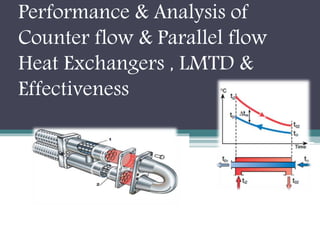
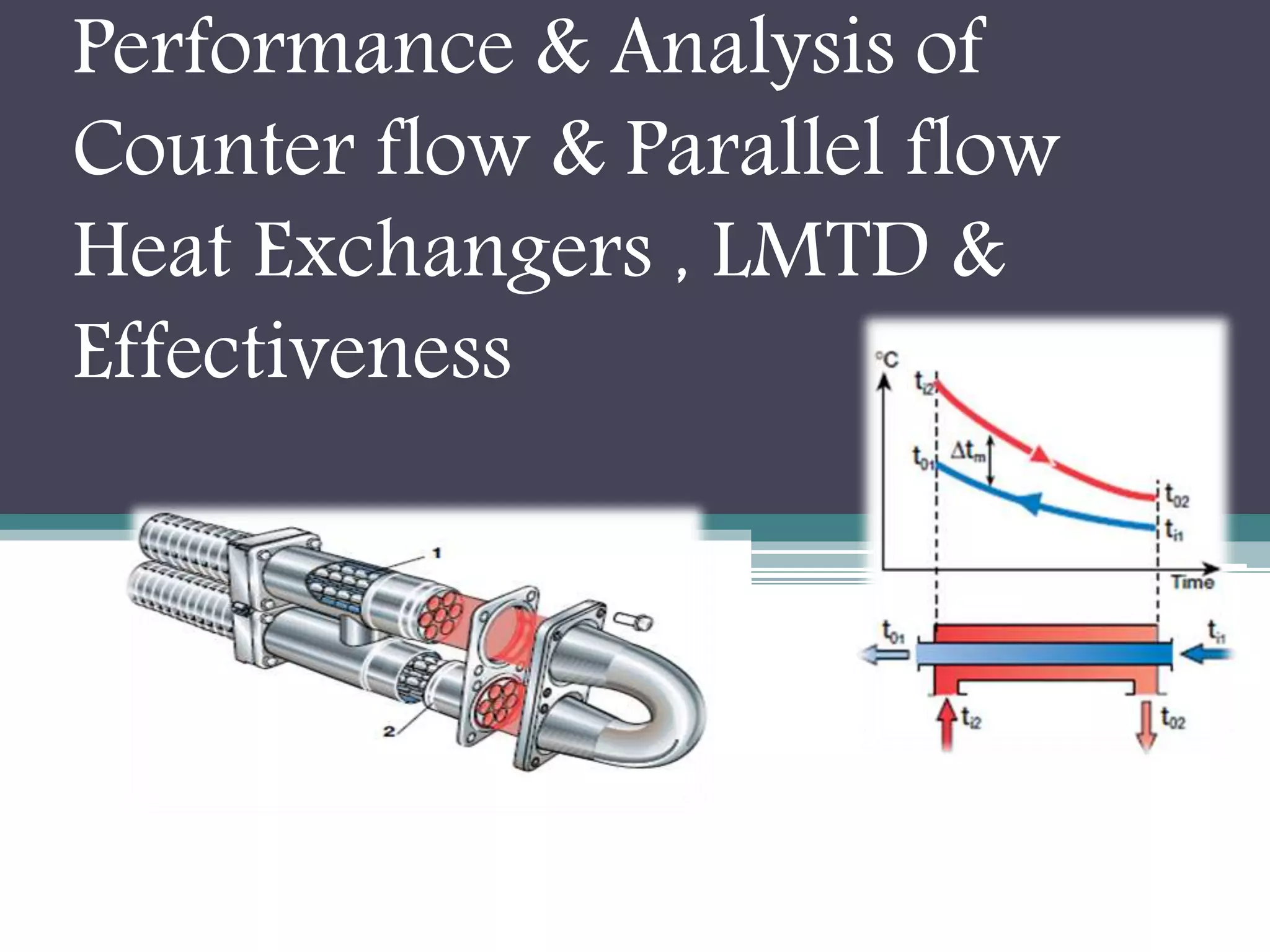
Performance & Analysis of
Counter flow & Parallel flow
Heat Exchangers , LMTD &
Effectiveness
Introduction
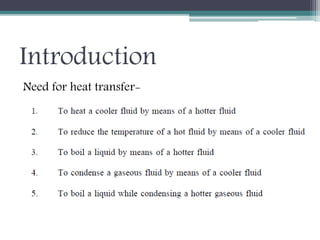
Need for heat transfer-
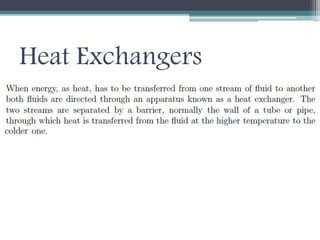
Heat Exchangers
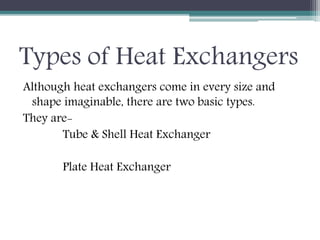
Types of Heat Exchangers
Although heat exchangers come in every size and
shape imaginable, there are two basic types.
They are-
Tube & Shell Heat Exchanger
Plate Heat Exchanger
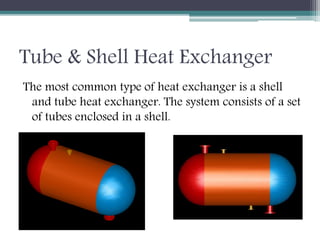
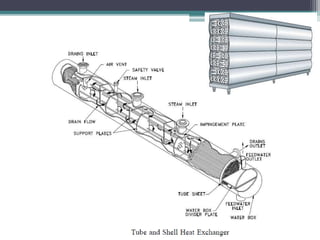
Tube & Shell Heat Exchanger
The most common type of heat exchanger is a shell
and tube heat exchanger. The system consists of a set
of tubes enclosed in a shell.
Cont..
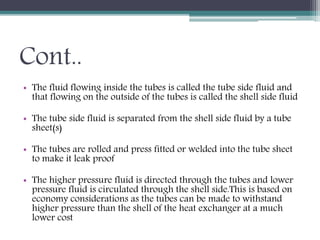
• The fluid flowing inside the tubes is called the tube side fluid and
that flowing on the outside of the tubes is called the shell side fluid
• The tube side fluid is separated from the shell side fluid by a tube
sheet(s)
• The tubes are rolled and press fitted or welded into the tube sheet
to make it leak proof
• The higher pressure fluid is directed through the tubes and lower
pressure fluid is circulated through the shell side.This is based on
economy considerations as the tubes can be made to withstand
higher pressure than the shell of the heat exchanger at a much
lower cost
Plate Heat Exchanger
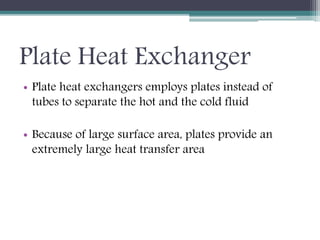
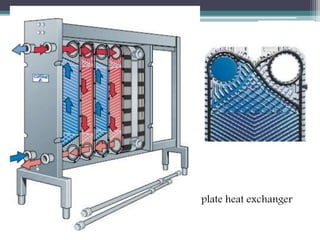
• Plate heat exchangers employs plates instead of
tubes to separate the hot and the cold fluid
• Because of large surface area, plates provide an
extremely large heat transfer area
Cont..
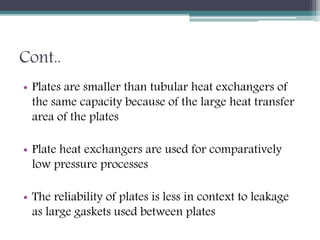
• Plates are smaller than tubular heat exchangers of
the same capacity because of the large heat transfer
area of the plates
• Plate heat exchangers are used for comparatively
low pressure processes
• The reliability of plates is less in context to leakage
as large gaskets used between plates
•
• fffffffffffffff plate heat exchanger
Classification of Heat Exchangers
The heat exchangers are categorized on the basis of-
1. Flow configuration
2. Regeneration
Flow Configurations
• Three basic flow arrangements are:-
1. Parallel Flow
2. Counter Flow
3. Cross Flow
Parallel Flow Heat Exchangers
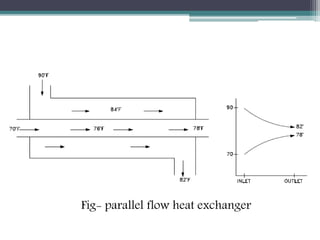
• In parallel flow heat exchangers both hot and cold streams enter
the heat exchanger at the same end and travel to the opposite end
in parallel streams
• Energy is transferred along the length from the hot to the cold fluid
so the outlet temperature asymptotically approach each other
• Parallel flow results in rapid initial rates of heat exchange near the
entrance, but the transfer rates rapidly decrease as the temperature
of two streams approach one another
• Hottest cold fluid temperature is less than the coldest hot fluid
temperature
Fig- parallel flow heat exchanger
Counter Flow Heat Exchangers
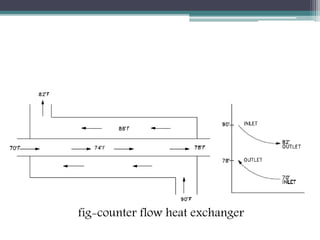
• In a counter flow heat exchanger, two streams enter at
opposite ends of a heat exchanger and flow in parallel
but opposite directions
• Temperatures within the two streams tend to approach
in a nearly linearly fashion, resulting in a much more
uniform heating pattern
• In contrast to the co-current flow, the counter flow heat
exchangers can have the hottest cold fluid temperature
greater than the coldest hot fluid temperature
fig-counter flow heat exchanger
Cross flow heat exchangers
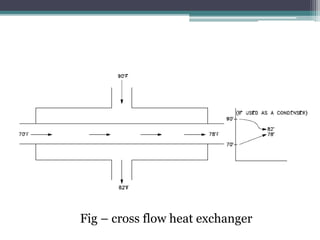
• Cross flow exists when one fluid flows
perpendicular to the second fluid
• In this arrangement one fluid flows through the
tubes and other fluid flows around the tube at 90
angle
• They find application when one of the fluid changes
state e.g. boilers, condensers
˚
Fig – cross flow heat exchanger
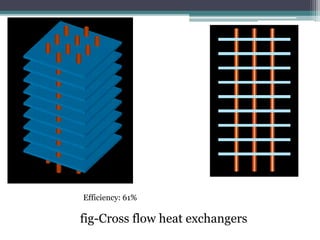
fig-Cross flow heat exchangers
Efficiency: 61%
Log Mean Temperature Difference
• Heat flows between the hot and the cold streams due
to temperature difference across the tube acting as a
driving force
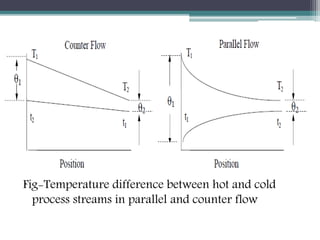
• The temperature difference will vary along the
length of the heat exchanger
• Fig:
Fig-Temperature difference between hot and cold
process streams in parallel and counter flow
Cont..
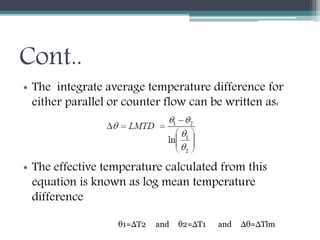
• The integrate average temperature difference for
either parallel or counter flow can be written as:
• The effective temperature calculated from this
equation is known as log mean temperature
difference
θ1=ΔT2 θ2=ΔT1and Δθ=ΔTlmand
Comparison
• Each of the three types of heat exchangers have their
advantages and disadvantages
• Of the three the counter flow heat exchanger is the
most efficient when comparing heat transfer rate
per unit area
• The LMTD Δθ=ΔTlm is greater, than a similar
parallel or cross flow heat exchanger
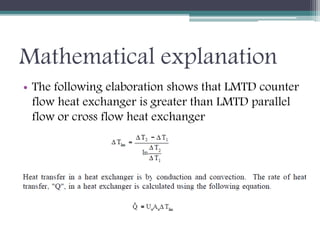
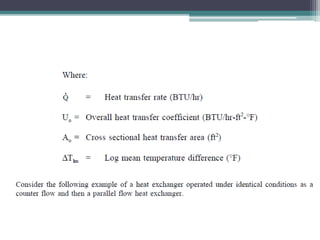
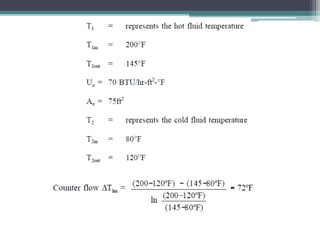
Mathematical explanation
• The following elaboration shows that LMTD counter
flow heat exchanger is greater than LMTD parallel
flow or cross flow heat exchanger
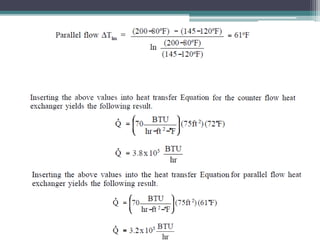
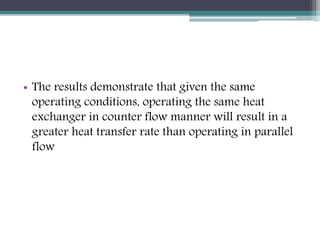
• The results demonstrate that given the same
operating conditions, operating the same heat
exchanger in counter flow manner will result in a
greater heat transfer rate than operating in parallel
flow
Actually what is done…
• Most large heat exchangers are not purely parallel or
counter or cross flow, rather a mixture of two or three
heat exchangers is used
• The reason for this mixture is to maximize the efficiency
of heat exchangers within the restrictions placed on
design such as size, cost, operating pressure, required
efficiency, type of fluid processed and temperature
• Two fluids are made to pass each other several times
within a single heat exchanger to increase the
performance
Cont…
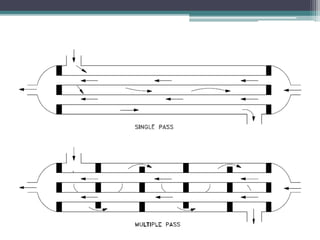
• When the fluids pass each other more than one time it is
called multi-pass heat exchanger
• If the fluids pass each other single time it is called
single-pass heat exchanger
• Commonly the multi pass heat exchangers reverses the
flow several times by the use of “U” tubes
• A second method to achieve multi passes is by the use of
baffles on the shell side of the heat exchangers
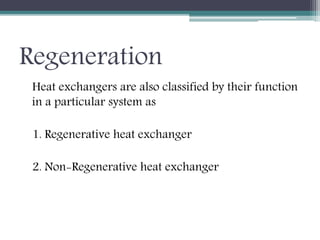
Regeneration
Heat exchangers are also classified by their function
in a particular system as
1. Regenerative heat exchanger
2. Non-Regenerative heat exchanger
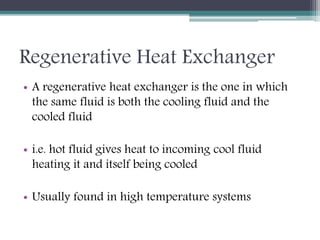
Regenerative Heat Exchanger
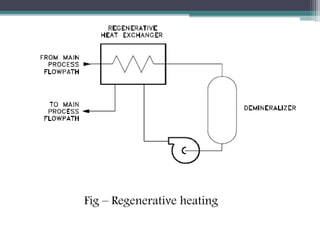
• A regenerative heat exchanger is the one in which
the same fluid is both the cooling fluid and the
cooled fluid
• i.e. hot fluid gives heat to incoming cool fluid
heating it and itself being cooled
• Usually found in high temperature systems
Fig – Regenerative heating
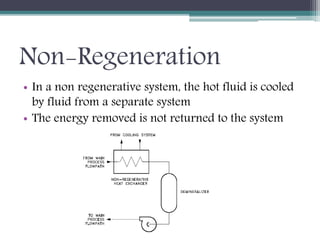
Non-Regeneration
• In a non regenerative system, the hot fluid is cooled
by fluid from a separate system
• The energy removed is not returned to the system
Effectiveness-NTU Method
• NTU or number of transfer units is used to calculate
the rate of heat transfer in heat exchangers
• NTU method used when there is insufficient
information to calculate the LMTD
• So when the inlet and outlet temperatures are not
specified properly, the NTU method is use
The Method
• To define the effectiveness of a heat exchanger, we need
to find the maximum possible heat transfer that can be
hypothetically achieved in a counter flow heat
exchanger of infinite length
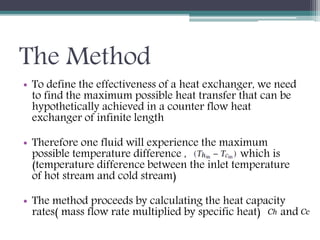
• Therefore one fluid will experience the maximum
possible temperature difference , which is
(temperature difference between the inlet temperature
of hot stream and cold stream)
• The method proceeds by calculating the heat capacity
rates( mass flow rate multiplied by specific heat) andСһ Сс
Cont..
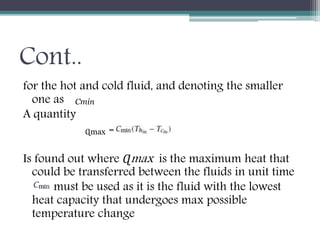
for the hot and cold fluid, and denoting the smaller
one as
A quantity
=
Is found out where Ɋmax is the maximum heat that
could be transferred between the fluids in unit time
must be used as it is the fluid with the lowest
heat capacity that undergoes max possible
temperature change
Сmin
Ɋmax
Cont…
• The other fluid changes temperature more slowly
along the heat exchanger length
• We are concerned only with the fluid undergoing
the maximum temperature change
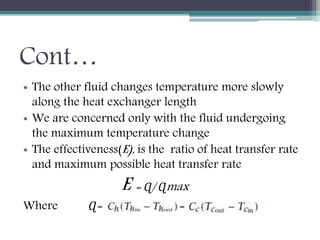
• The effectiveness(E), is the ratio of heat transfer rate
and maximum possible heat transfer rate
E = Ɋ/ Ɋmax
Where Ɋ= =
Cont…
• Effectiveness is a dimensionless quantity between 0
and 1
• If we know E for a particular heat exchanger and
we know the inlet conditions of the two flow
streams, we can calculate the amount of heat being
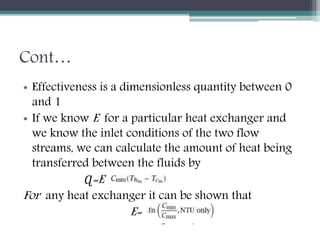
transferred between the fluids by
Ɋ=E
For any heat exchanger it can be shown that
E=
Cont…
• For a given geometry, E can be calculated using
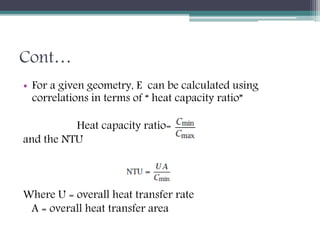
correlations in terms of “ heat capacity ratio”
Heat capacity ratio=
and the NTU
Where U = overall heat transfer rate
A = overall heat transfer area
Cont…
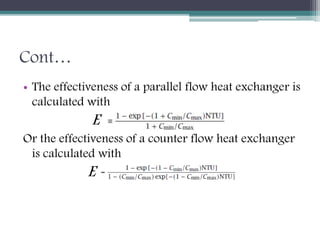
• The effectiveness of a parallel flow heat exchanger is
calculated with
E
Or the effectiveness of a counter flow heat exchanger
is calculated with
E
Cont…
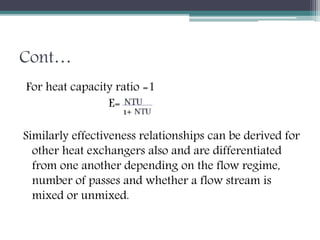
For heat capacity ratio =1
E=
Similarly effectiveness relationships can be derived for
other heat exchangers also and are differentiated
from one another depending on the flow regime,
number of passes and whether a flow stream is
mixed or unmixed.
1+
Cont…
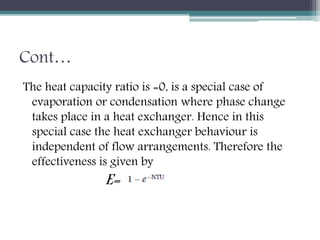
The heat capacity ratio is =0, is a special case of
evaporation or condensation where phase change
takes place in a heat exchanger. Hence in this
special case the heat exchanger behaviour is
independent of flow arrangements. Therefore the
effectiveness is given by
E=
Conclusion
• Heat exchangers serve as the backbone of the
industry in which it is used
• Their effectiveness directly relates to the economy of
the organization and the tasks performed with them
• So the arrangements of heat exchangers are very
important
• The proper functioning of the units are necessary as
they save energy, cost & product damage
Thank you

Log mean temperature difference

  • 1.
    Performance & Analysisof Counter flow & Parallel flow Heat Exchangers , LMTD & Effectiveness
  • 2.
  • 3.
  • 4.
    Types of HeatExchangers Although heat exchangers come in every size and shape imaginable, there are two basic types. They are- Tube & Shell Heat Exchanger Plate Heat Exchanger
  • 5.
    Tube & ShellHeat Exchanger The most common type of heat exchanger is a shell and tube heat exchanger. The system consists of a set of tubes enclosed in a shell.
  • 6.
    Cont.. • The fluidflowing inside the tubes is called the tube side fluid and that flowing on the outside of the tubes is called the shell side fluid • The tube side fluid is separated from the shell side fluid by a tube sheet(s) • The tubes are rolled and press fitted or welded into the tube sheet to make it leak proof • The higher pressure fluid is directed through the tubes and lower pressure fluid is circulated through the shell side.This is based on economy considerations as the tubes can be made to withstand higher pressure than the shell of the heat exchanger at a much lower cost
  • 8.
    Plate Heat Exchanger •Plate heat exchangers employs plates instead of tubes to separate the hot and the cold fluid • Because of large surface area, plates provide an extremely large heat transfer area
  • 9.
    Cont.. • Plates aresmaller than tubular heat exchangers of the same capacity because of the large heat transfer area of the plates • Plate heat exchangers are used for comparatively low pressure processes • The reliability of plates is less in context to leakage as large gaskets used between plates
  • 10.
  • 11.
    Classification of HeatExchangers The heat exchangers are categorized on the basis of- 1. Flow configuration 2. Regeneration
  • 12.
    Flow Configurations • Threebasic flow arrangements are:- 1. Parallel Flow 2. Counter Flow 3. Cross Flow
  • 13.
    Parallel Flow HeatExchangers • In parallel flow heat exchangers both hot and cold streams enter the heat exchanger at the same end and travel to the opposite end in parallel streams • Energy is transferred along the length from the hot to the cold fluid so the outlet temperature asymptotically approach each other • Parallel flow results in rapid initial rates of heat exchange near the entrance, but the transfer rates rapidly decrease as the temperature of two streams approach one another • Hottest cold fluid temperature is less than the coldest hot fluid temperature
  • 14.
    Fig- parallel flowheat exchanger
  • 15.
    Counter Flow HeatExchangers • In a counter flow heat exchanger, two streams enter at opposite ends of a heat exchanger and flow in parallel but opposite directions • Temperatures within the two streams tend to approach in a nearly linearly fashion, resulting in a much more uniform heating pattern • In contrast to the co-current flow, the counter flow heat exchangers can have the hottest cold fluid temperature greater than the coldest hot fluid temperature
  • 16.
  • 17.
    Cross flow heatexchangers • Cross flow exists when one fluid flows perpendicular to the second fluid • In this arrangement one fluid flows through the tubes and other fluid flows around the tube at 90 angle • They find application when one of the fluid changes state e.g. boilers, condensers ˚
  • 18.
    Fig – crossflow heat exchanger
  • 19.
    fig-Cross flow heatexchangers Efficiency: 61%
  • 20.
    Log Mean TemperatureDifference • Heat flows between the hot and the cold streams due to temperature difference across the tube acting as a driving force • The temperature difference will vary along the length of the heat exchanger
  • 21.
    • Fig: Fig-Temperature differencebetween hot and cold process streams in parallel and counter flow
  • 22.
    Cont.. • The integrateaverage temperature difference for either parallel or counter flow can be written as: • The effective temperature calculated from this equation is known as log mean temperature difference θ1=ΔT2 θ2=ΔT1and Δθ=ΔTlmand
  • 23.
    Comparison • Each ofthe three types of heat exchangers have their advantages and disadvantages • Of the three the counter flow heat exchanger is the most efficient when comparing heat transfer rate per unit area • The LMTD Δθ=ΔTlm is greater, than a similar parallel or cross flow heat exchanger
  • 24.
    Mathematical explanation • Thefollowing elaboration shows that LMTD counter flow heat exchanger is greater than LMTD parallel flow or cross flow heat exchanger
  • 28.
    • The resultsdemonstrate that given the same operating conditions, operating the same heat exchanger in counter flow manner will result in a greater heat transfer rate than operating in parallel flow
  • 29.
    Actually what isdone… • Most large heat exchangers are not purely parallel or counter or cross flow, rather a mixture of two or three heat exchangers is used • The reason for this mixture is to maximize the efficiency of heat exchangers within the restrictions placed on design such as size, cost, operating pressure, required efficiency, type of fluid processed and temperature • Two fluids are made to pass each other several times within a single heat exchanger to increase the performance
  • 30.
    Cont… • When thefluids pass each other more than one time it is called multi-pass heat exchanger • If the fluids pass each other single time it is called single-pass heat exchanger • Commonly the multi pass heat exchangers reverses the flow several times by the use of “U” tubes • A second method to achieve multi passes is by the use of baffles on the shell side of the heat exchangers
  • 32.
    Regeneration Heat exchangers arealso classified by their function in a particular system as 1. Regenerative heat exchanger 2. Non-Regenerative heat exchanger
  • 33.
    Regenerative Heat Exchanger •A regenerative heat exchanger is the one in which the same fluid is both the cooling fluid and the cooled fluid • i.e. hot fluid gives heat to incoming cool fluid heating it and itself being cooled • Usually found in high temperature systems
  • 34.
  • 35.
    Non-Regeneration • In anon regenerative system, the hot fluid is cooled by fluid from a separate system • The energy removed is not returned to the system
  • 36.
    Effectiveness-NTU Method • NTUor number of transfer units is used to calculate the rate of heat transfer in heat exchangers • NTU method used when there is insufficient information to calculate the LMTD • So when the inlet and outlet temperatures are not specified properly, the NTU method is use
  • 37.
    The Method • Todefine the effectiveness of a heat exchanger, we need to find the maximum possible heat transfer that can be hypothetically achieved in a counter flow heat exchanger of infinite length • Therefore one fluid will experience the maximum possible temperature difference , which is (temperature difference between the inlet temperature of hot stream and cold stream) • The method proceeds by calculating the heat capacity rates( mass flow rate multiplied by specific heat) andСһ Сс
  • 38.
    Cont.. for the hotand cold fluid, and denoting the smaller one as A quantity = Is found out where Ɋmax is the maximum heat that could be transferred between the fluids in unit time must be used as it is the fluid with the lowest heat capacity that undergoes max possible temperature change Сmin Ɋmax
  • 39.
    Cont… • The otherfluid changes temperature more slowly along the heat exchanger length • We are concerned only with the fluid undergoing the maximum temperature change • The effectiveness(E), is the ratio of heat transfer rate and maximum possible heat transfer rate E = Ɋ/ Ɋmax Where Ɋ= =
  • 40.
    Cont… • Effectiveness isa dimensionless quantity between 0 and 1 • If we know E for a particular heat exchanger and we know the inlet conditions of the two flow streams, we can calculate the amount of heat being transferred between the fluids by Ɋ=E For any heat exchanger it can be shown that E=
  • 41.
    Cont… • For agiven geometry, E can be calculated using correlations in terms of “ heat capacity ratio” Heat capacity ratio= and the NTU Where U = overall heat transfer rate A = overall heat transfer area
  • 42.
    Cont… • The effectivenessof a parallel flow heat exchanger is calculated with E Or the effectiveness of a counter flow heat exchanger is calculated with E
  • 43.
    Cont… For heat capacityratio =1 E= Similarly effectiveness relationships can be derived for other heat exchangers also and are differentiated from one another depending on the flow regime, number of passes and whether a flow stream is mixed or unmixed. 1+
  • 44.
    Cont… The heat capacityratio is =0, is a special case of evaporation or condensation where phase change takes place in a heat exchanger. Hence in this special case the heat exchanger behaviour is independent of flow arrangements. Therefore the effectiveness is given by E=
  • 45.
    Conclusion • Heat exchangersserve as the backbone of the industry in which it is used • Their effectiveness directly relates to the economy of the organization and the tasks performed with them • So the arrangements of heat exchangers are very important • The proper functioning of the units are necessary as they save energy, cost & product damage
  • 46.