Double pipe heat exchanger
• Two sets of concentric pipes, two connecting tees, and a
  return head and a return bend.
• A device whose purpose is the transfer of thermal
  energy between two fluids.

• Heat Exchanger-HX

• Common applications: Boilers, Coolers, Condensers,
  Evaporators.

• Common design consists of tow fluids separated by a
  conducting medium.
Classification
   Heat transfer mechanism
   Degree of surface compactness
   Heat transfer type
   Flow arrangement
   Number of passes
   Construction
Classification
 Direct contact type: Cooling towers, Spray towers
 Indirect contact type


        Cooling tower                 Spray tower
Classification
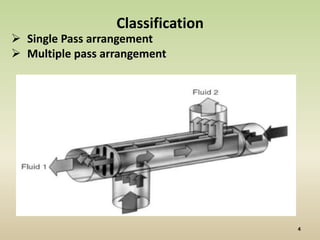
 Single Pass arrangement
 Multiple pass arrangement
Classification
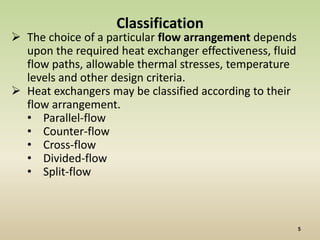
 The choice of a particular flow arrangement depends
  upon the required heat exchanger effectiveness, fluid
  flow paths, allowable thermal stresses, temperature
  levels and other design criteria.
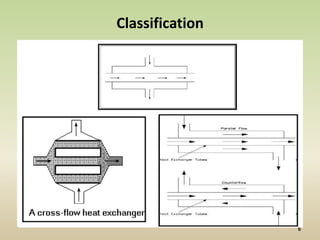
 Heat exchangers may be classified according to their
  flow arrangement.
  • Parallel-flow
  • Counter-flow
  • Cross-flow
  • Divided-flow
  • Split-flow
Classification
Classification
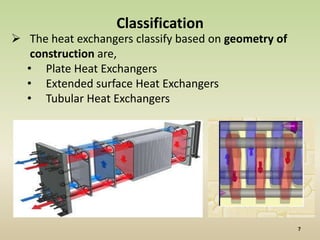
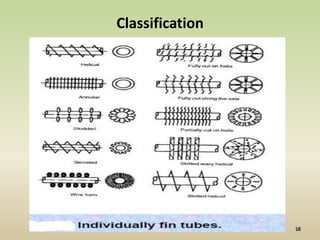
 The heat exchangers classify based on geometry of
   construction are,
  • Plate Heat Exchangers
  • Extended surface Heat Exchangers
  • Tubular Heat Exchangers
Classification
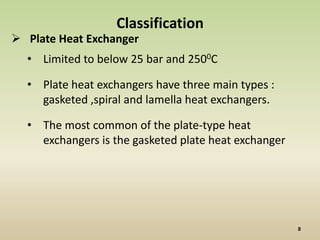
 Plate Heat Exchanger
  • Limited to below 25 bar and 2500C

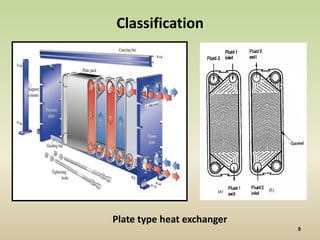
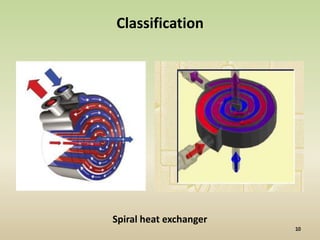
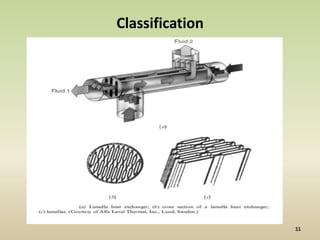
  • Plate heat exchangers have three main types :
    gasketed ,spiral and lamella heat exchangers.
  • The most common of the plate-type heat
    exchangers is the gasketed plate heat exchanger
Classification


Plate type heat exchanger
Classification


Spiral heat exchanger
Classification
Classification
 Plate Heat Exchanger
   Aadvantages

  • Plate heat exchangers yield heat transfer rates
    three to five times greater than other types of heat
    exchangers.

  • The design of the plate heat exchanger allows to
    add or remove plates to optimize performance, or
    to allow for cleaning, service, or maintenance.

  • Plate exchangers offer the highest efficiency
    mechanism for heat transfer available in industry.
Classification
 Plate Heat Exchanger
   Disadvantages

  • Plate exchangers are limited when high pressures,
    high temperatures, or aggressive fluids are present.

  • Because of this problem these type of heat
    exchangers have only been used in small, low
    pressure applications such as on oil coolers for
    engines.
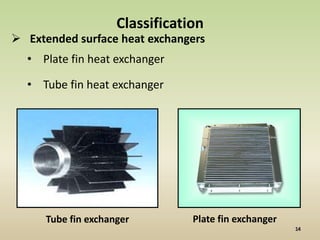
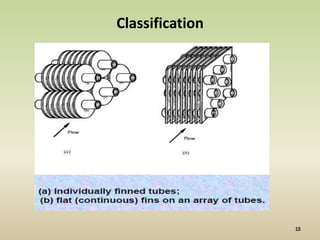
Classification
 Extended surface heat exchangers
  • Plate fin heat exchanger

  • Tube fin heat exchanger


      Tube fin exchanger         Plate fin exchanger
Classification
Classification
Classification
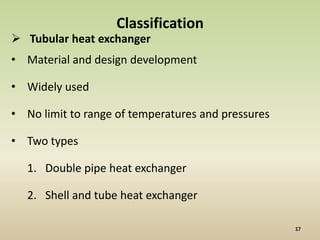
 Tubular heat exchanger
• Material and design development

• Widely used

• No limit to range of temperatures and pressures

• Two types

   1. Double pipe heat exchanger

   2. Shell and tube heat exchanger
Classification
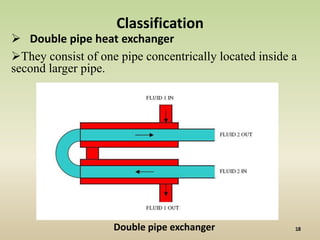
 Double pipe heat exchanger
They consist of one pipe concentrically located inside a
second larger pipe.


                    Double pipe exchanger
Classification
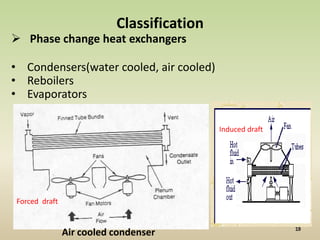
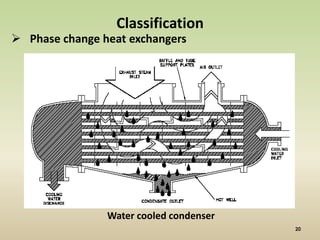
 Phase change heat exchangers

• Condensers(water cooled, air cooled)
• Reboilers
• Evaporators

                                           Induced draft


Forced draft


               Air cooled condenser
Classification
 Phase change heat exchangers


                Water cooled condenser
Classification
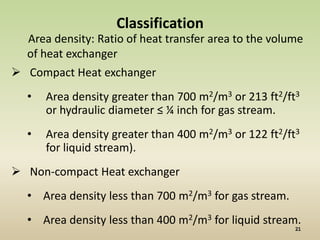
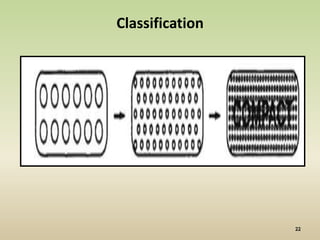
  Area density: Ratio of heat transfer area to the volume
  of heat exchanger
 Compact Heat exchanger
  •   Area density greater than 700 m2/m3 or 213 ft2/ft3
      or hydraulic diameter ≤ ¼ inch for gas stream.
  •   Area density greater than 400 m2/m3 or 122 ft2/ft3
      for liquid stream).
 Non-compact Heat exchanger
  • Area density less than 700 m2/m3 for gas stream.
  • Area density less than 400 m2/m3 for liquid stream.
Classification
Thank You
     for
Your Attention

Double pipe heat exchanger

  • 1.
    Double pipe heatexchanger • Two sets of concentric pipes, two connecting tees, and a return head and a return bend. • A device whose purpose is the transfer of thermal energy between two fluids. • Heat Exchanger-HX • Common applications: Boilers, Coolers, Condensers, Evaporators. • Common design consists of tow fluids separated by a conducting medium.
  • 2.
    Classification  Heat transfer mechanism  Degree of surface compactness  Heat transfer type  Flow arrangement  Number of passes  Construction
  • 3.
    Classification  Direct contacttype: Cooling towers, Spray towers  Indirect contact type Cooling tower Spray tower
  • 4.
    Classification  Single Passarrangement  Multiple pass arrangement
  • 5.
    Classification  The choiceof a particular flow arrangement depends upon the required heat exchanger effectiveness, fluid flow paths, allowable thermal stresses, temperature levels and other design criteria.  Heat exchangers may be classified according to their flow arrangement. • Parallel-flow • Counter-flow • Cross-flow • Divided-flow • Split-flow
  • 6.
  • 7.
    Classification  The heatexchangers classify based on geometry of construction are, • Plate Heat Exchangers • Extended surface Heat Exchangers • Tubular Heat Exchangers
  • 8.
    Classification  Plate HeatExchanger • Limited to below 25 bar and 2500C • Plate heat exchangers have three main types : gasketed ,spiral and lamella heat exchangers. • The most common of the plate-type heat exchangers is the gasketed plate heat exchanger
  • 9.
  • 10.
  • 11.
  • 12.
    Classification  Plate HeatExchanger  Aadvantages • Plate heat exchangers yield heat transfer rates three to five times greater than other types of heat exchangers. • The design of the plate heat exchanger allows to add or remove plates to optimize performance, or to allow for cleaning, service, or maintenance. • Plate exchangers offer the highest efficiency mechanism for heat transfer available in industry.
  • 13.
    Classification  Plate HeatExchanger  Disadvantages • Plate exchangers are limited when high pressures, high temperatures, or aggressive fluids are present. • Because of this problem these type of heat exchangers have only been used in small, low pressure applications such as on oil coolers for engines.
  • 14.
    Classification  Extended surfaceheat exchangers • Plate fin heat exchanger • Tube fin heat exchanger Tube fin exchanger Plate fin exchanger
  • 15.
  • 16.
  • 17.
    Classification  Tubular heatexchanger • Material and design development • Widely used • No limit to range of temperatures and pressures • Two types 1. Double pipe heat exchanger 2. Shell and tube heat exchanger
  • 18.
    Classification  Double pipeheat exchanger They consist of one pipe concentrically located inside a second larger pipe. Double pipe exchanger
  • 19.
    Classification  Phase changeheat exchangers • Condensers(water cooled, air cooled) • Reboilers • Evaporators Induced draft Forced draft Air cooled condenser
  • 20.
    Classification  Phase changeheat exchangers Water cooled condenser
  • 21.
    Classification Areadensity: Ratio of heat transfer area to the volume of heat exchanger  Compact Heat exchanger • Area density greater than 700 m2/m3 or 213 ft2/ft3 or hydraulic diameter ≤ ¼ inch for gas stream. • Area density greater than 400 m2/m3 or 122 ft2/ft3 for liquid stream).  Non-compact Heat exchanger • Area density less than 700 m2/m3 for gas stream. • Area density less than 400 m2/m3 for liquid stream.
  • 22.
  • 23.
    Thank You for Your Attention