Downloaded 331 times

![1. Introduction:
In many parts of the world, there is a growing awareness that
some alternative energy sources could have an important role
to play in the production of electricity.
However,only the solar energy represents totally nonpolluting
inexhaustible energy resource that can be utilized economically
to supply Man’s energy needs for all time.
There are lots of methods
of using the solar energy ,
and the Solar Chimney is
one of them, which can
be seen below, in figure
1.
Fig. 1 The Prototype Manzanares
Solar Chimney [2].](https://image.slidesharecdn.com/seminarmtwch-150819110121-lva1-app6892/85/Seminar-0n-solar-Chimney-3-320.jpg)
![2.a. Parts of the Solar Chimney
2.a.i. The Collector
Collector is the part,which is
used to produce hot air by
green-house effect. It is usually
5-6 meters high and covers a
very large area about thousands
of m² as seen in fıgure 2.
Since glazing increases the
mass of the roof, glazed
collectors should have stronger
rods and should be attached as
in figure 3.
Fig. 2 The Collector [2].
Collector](https://image.slidesharecdn.com/seminarmtwch-150819110121-lva1-app6892/85/Seminar-0n-solar-Chimney-4-320.jpg)
![Turbines, seen in figure 4, are used to convert air
current to the mechanical energy. Turbines are
placed horizontally in chimney, vertically in the
collector.In order to obtain maximum energy
from the warmed air,turbines blades should
cover all the cross-sectional area of the chimney.
To do this,one big turbine or a few small
turbines should be used in chimney, as can be
seen from the figure 5. and figure 6.
Fig. 4 Turbine for Solar
Chimney Power Station [2].
2.a.ii. Turbines
Fig. 5 Turbine with large diameter [5].Fig. 6 Small turbines [5].](https://image.slidesharecdn.com/seminarmtwch-150819110121-lva1-app6892/85/Seminar-0n-solar-Chimney-5-320.jpg)
![The most important part of the
plant is the chimney,seen in
fıgure 7. It acts as a thermal
engine. Since the friction loss
is minimum in the chimney it
likes a pressure tube.
Longer the chimneys height, the
more the energy produced from the
chimney.
The efficiency of the chimney is not
depend on the amount of the
temperature rising, but depends on
the outside temperature.
Thus, efficiency directly
proportional to the ratio between the
height of the chimney and the outside
temperature. [5]
Chimney
Fig. 7 The chimney [2].
2.a.iii. The chimney](https://image.slidesharecdn.com/seminarmtwch-150819110121-lva1-app6892/85/Seminar-0n-solar-Chimney-6-320.jpg)
![2.b. Working principles of
Solar Chimney
Transparent roof, which is seen in fıgure
10, admits the short wave solar radiation
component and retains long-wave radiation
from the heated ground. Thus, when solar
radiation pass through the transparent roof
it is absorbed by the ground elements and it
converts into heat energy.
Since air is heated, it starts to rise up and
move towards to chimney,seen in fıgure 11.
Also, it gains velocity.Heated air enters the
chimney placed at the center of the roof and
creates an up draught there.
•Inside the chimney, turbines with electric
generator,produce electricity [6].
Fig. 10 Transparent
roof [4].
Fig. 11 Schematic seen of
the solar chimney [6]](https://image.slidesharecdn.com/seminarmtwch-150819110121-lva1-app6892/85/Seminar-0n-solar-Chimney-7-320.jpg)
![2.c. Technology
•Solar chimneys are large-scale power plants with an
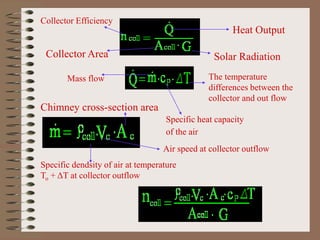
output of 5 to 200 MW each [4].
•A 100 MW plant will produce about 750 GWh/year at
2.300 kWh/m² global horizontal radiation [4].
•For that the glass roof has to be several kilometers in
diameter and the tube has to be as high as possible to
achieve a large annual output [4].
•The turbines are basically more closely related to the
pressure-staged hydroelectric turbines than to the speed-
stepped wind turbines. Therefore they have been
developed and designed in collaboration with
hydroelectric power plant manufacturers [4].
• The turbine’s life span is based on its resistance to
rapid pressure and speed changes of the air [5].](https://image.slidesharecdn.com/seminarmtwch-150819110121-lva1-app6892/85/Seminar-0n-solar-Chimney-9-320.jpg)
![4.Cost
“With the support of construction companies, the glass industry and
turbine manufacturers a rather exact cost estimate for a 200 MW solar
chimney could be compiled. We asked the utility "Energie Baden
Württemberg" to determine the energy production costs compared to coal-
and combined cycle power plants based on equal and common methods”
[8]. (Table. 1).
Fig. 13 Energy production costs from solar chimneys, coal and combined cycle
power plants depending on the interest rate [8].](https://image.slidesharecdn.com/seminarmtwch-150819110121-lva1-app6892/85/Seminar-0n-solar-Chimney-10-320.jpg)
![7.Disadvantages
Some estimates say that the cost of
generating electricity from a solar chimney is
5x more than from a gas turbine. Although
fuel is not required, solar chimneys have a
very high capital cost [2].
The structure itself is massive and requires
a lot of engineering expertise and materials to
construct [2].](https://image.slidesharecdn.com/seminarmtwch-150819110121-lva1-app6892/85/Seminar-0n-solar-Chimney-12-320.jpg)
![8.Conclusion
Solar chimney power stations could make
important contributions to the energy
supplies in Africa, Asia and Australia,
because there is plenty of space and
sunlight available there [2].
It is very important for the future, because
our resources are limited, except our sun.](https://image.slidesharecdn.com/seminarmtwch-150819110121-lva1-app6892/85/Seminar-0n-solar-Chimney-13-320.jpg)

This seminar discusses the solar chimney, which uses solar energy to generate electricity. It is comprised of three main parts: the collector, turbines, and chimney. The collector heats air using the greenhouse effect. The heated air rises through the tall chimney, powering turbines that generate electricity. While large upfront costs are required to build it, the solar chimney is a non-polluting source of baseload electricity well-suited for sunny desert regions with low population densities.


