HOW SHOULD WE
INTERPRET THE
FOSSIL RECORD?
DOCUMENTARY DRAMA
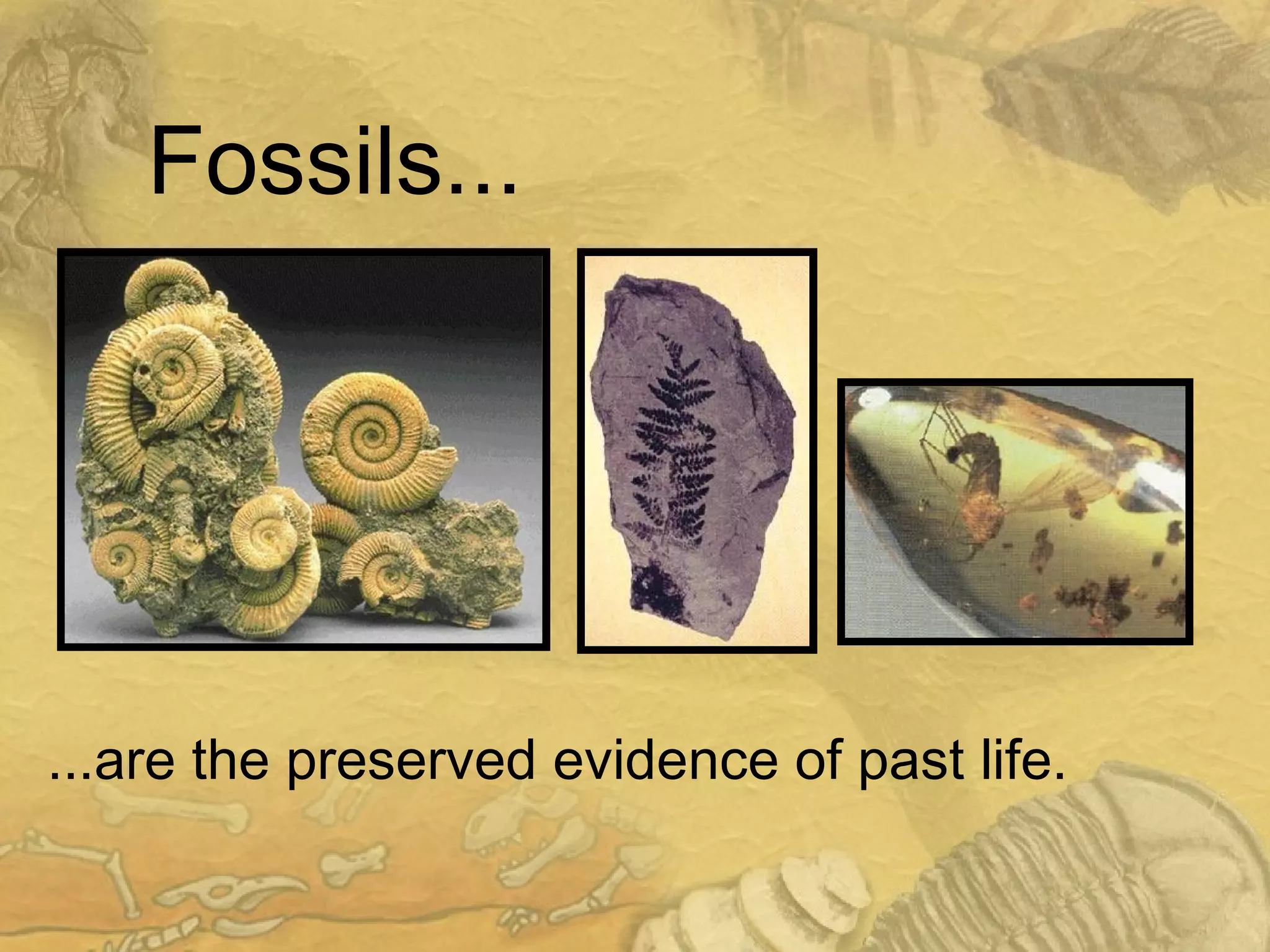
Fossils...
...are the preserved evidence of past life.
Controversial Evidence
• Distinct fossil organisms are found in
different rock layers, many of which are
now extinct.
• Darwin assumed that the rocks would
eventually reveal many fossil
intermediates (so-called transitional fossils).
• Even in the Twenty-First Century, this
assumption has still not been confirmed.
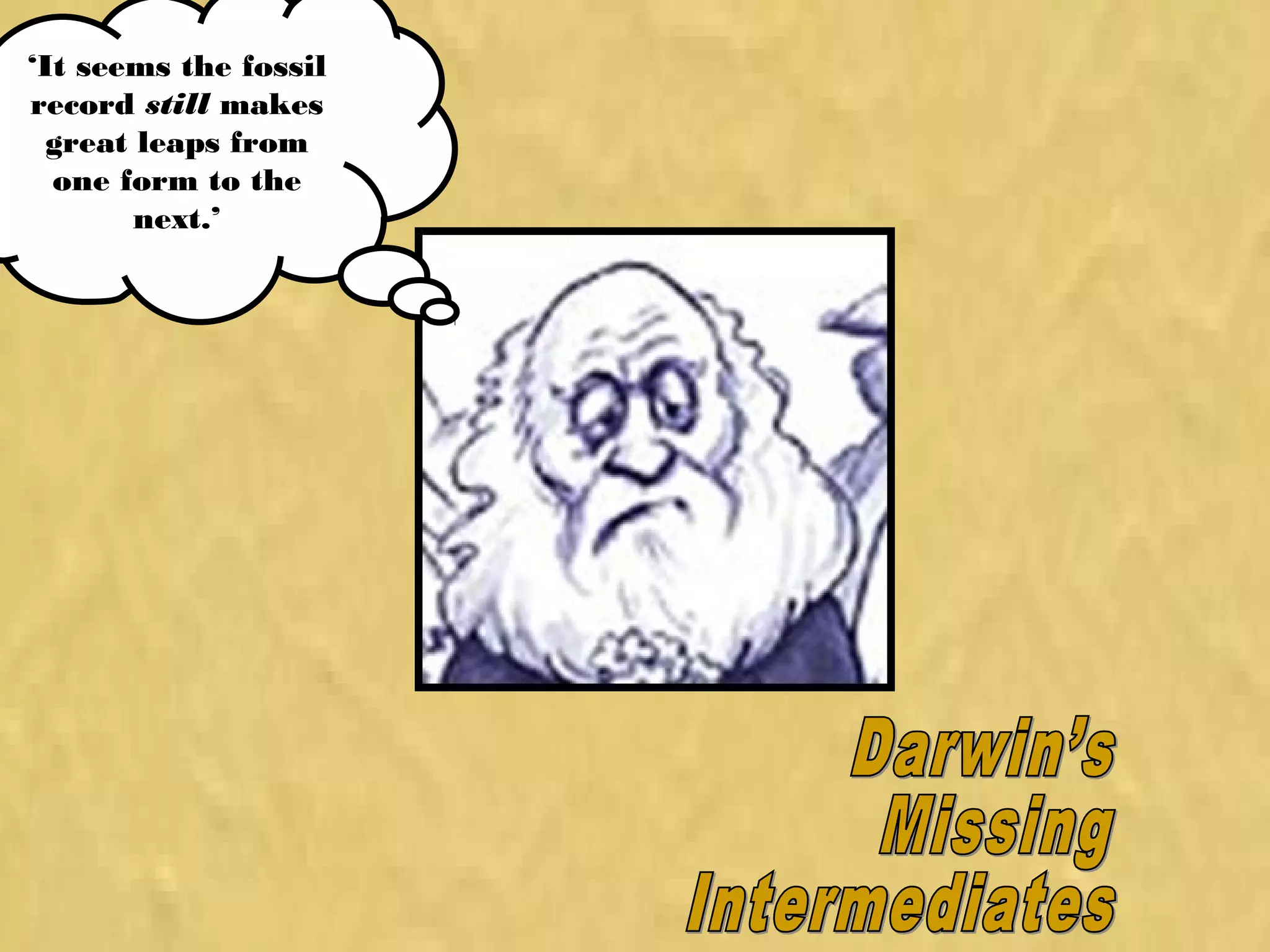
‘It seems the fossil
record still makes
great leaps from
one form to the
next.’
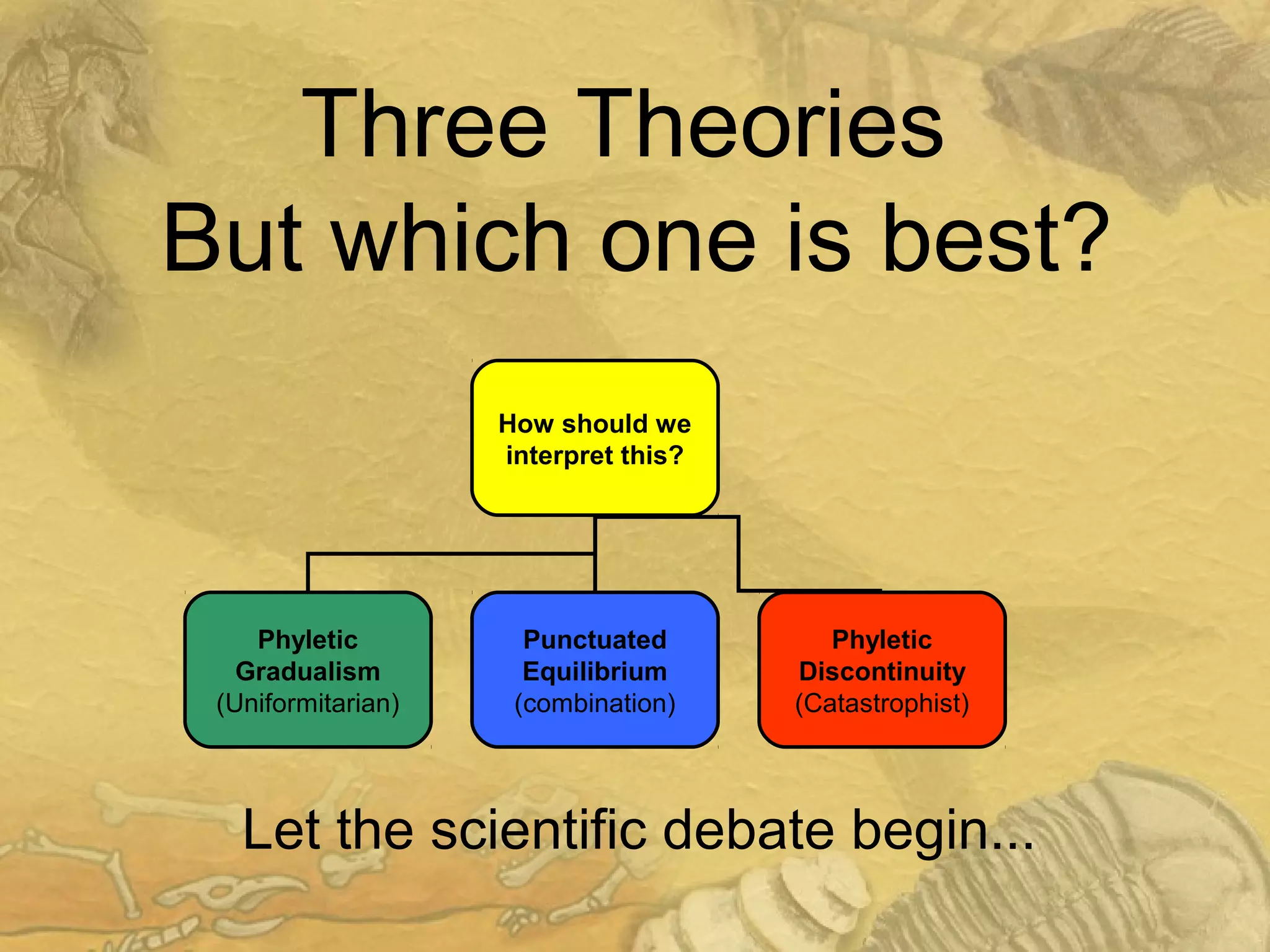
Three Theories
But which one is best?
How should we
interpret this?
Phyletic
Gradualism
(Uniformitarian)
Punctuated
Equilibrium
(combination)
Phyletic
Discontinuity
(Catastrophist)
Let the scientific debate begin...
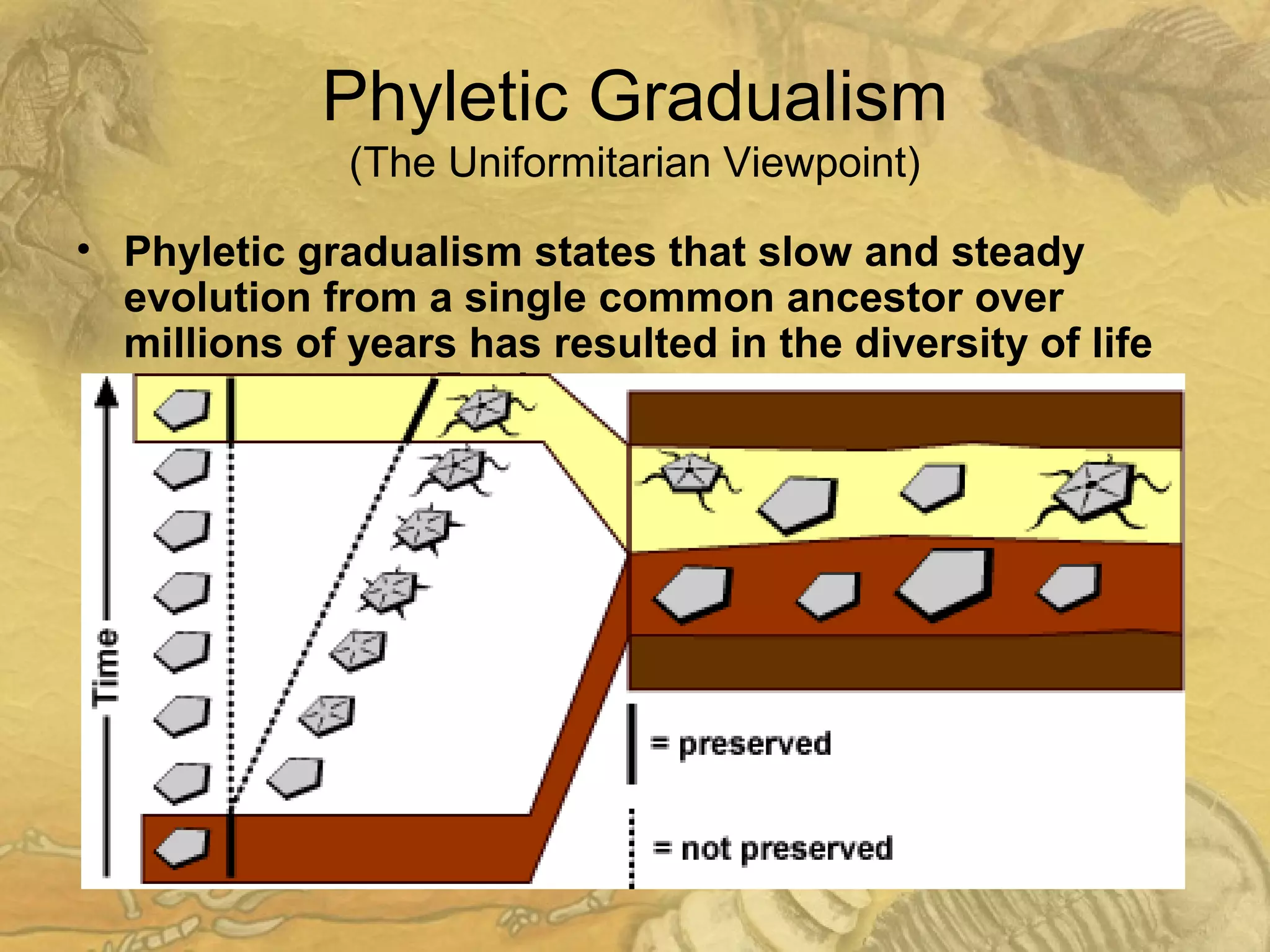
Phyletic Gradualism
(The Uniformitarian Viewpoint)
• Phyletic gradualism states that slow and steady
evolution from a single common ancestor over
millions of years has resulted in the diversity of life
we now see on Earth.
– Most rock layers on Earth have been laid down by the
same slow, steady sedimentation rates we see today.
– The “burst” of evolution seen in the fossil record
("Cambrian Explosion") is simply a geological illusion.
• It only looks like a burst because a lot of time (i.e. 5 million
years) passed between the times when the two rock layers
were laid down.
• In this period of time, a new species gradually diverged from
its ancestor through a series of transitional forms, but these
transitional forms were not preserved (escaped fossilization).
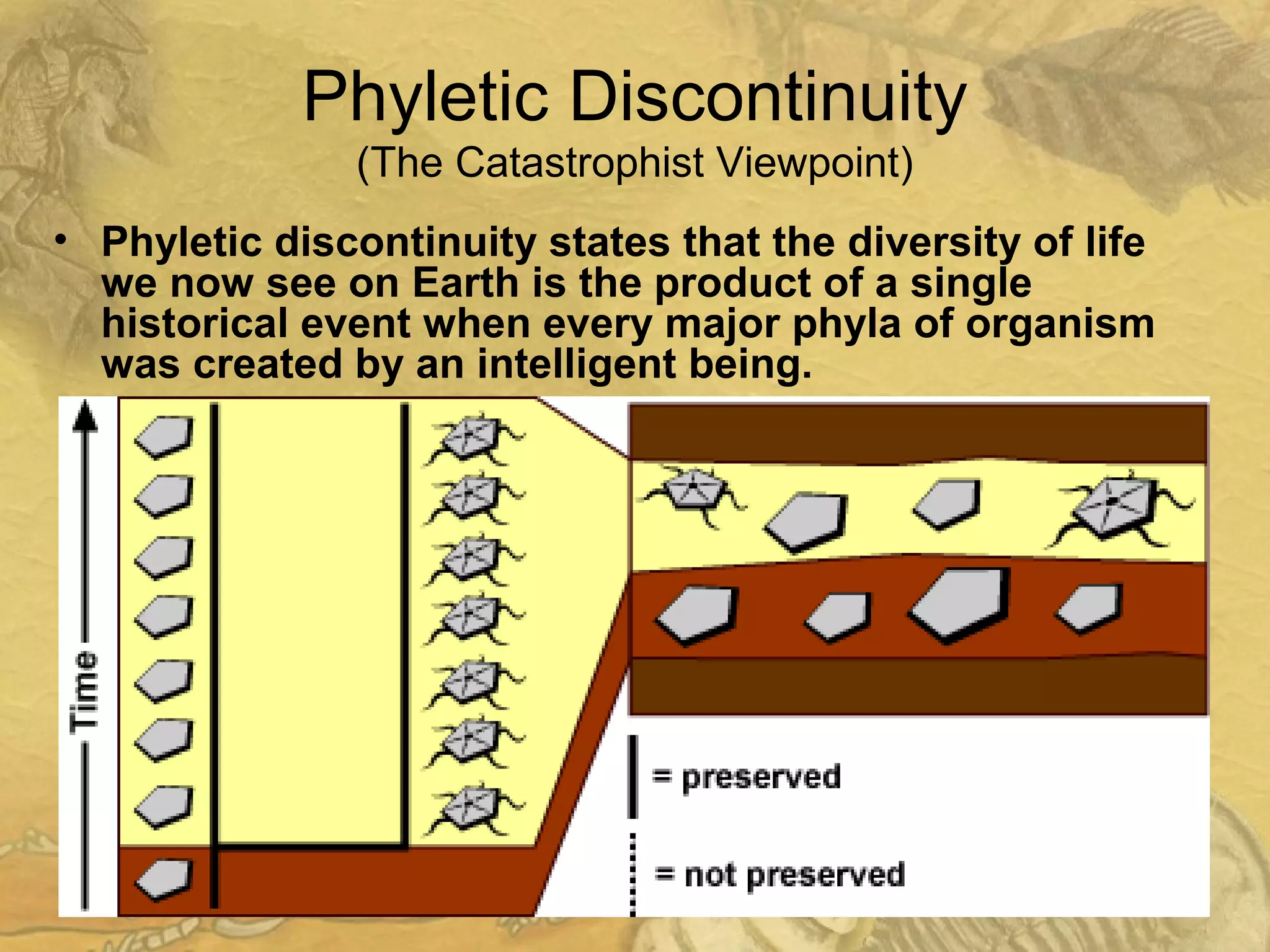
Phyletic Discontinuity
(The Catastrophist Viewpoint)
• Phyletic discontinuity states that the diversity of life
we now see on Earth is the product of a single
historical event when every major phyla of organism
was created by an intelligent being.
– Most rock layers on Earth have been laid down quickly
by catastrophic events (both local and global).
– The sudden appearance of every major body plan as
seen in the fossil record ("Cambrian Explosion") is
evidence that each biological form had an independent
origin.
• Darwin's "missing" transitional fossils never existed; they were
only fabricated by evolutionists to make their theory plausible.
• The fossil record, as it stands, supports the sudden appearance
of a variety of different organisms, not the gradual evolution of
distinct body plans.
• The mass extinctions recorded in the fossil record are further
evidence for worldwide cataclysmic events.
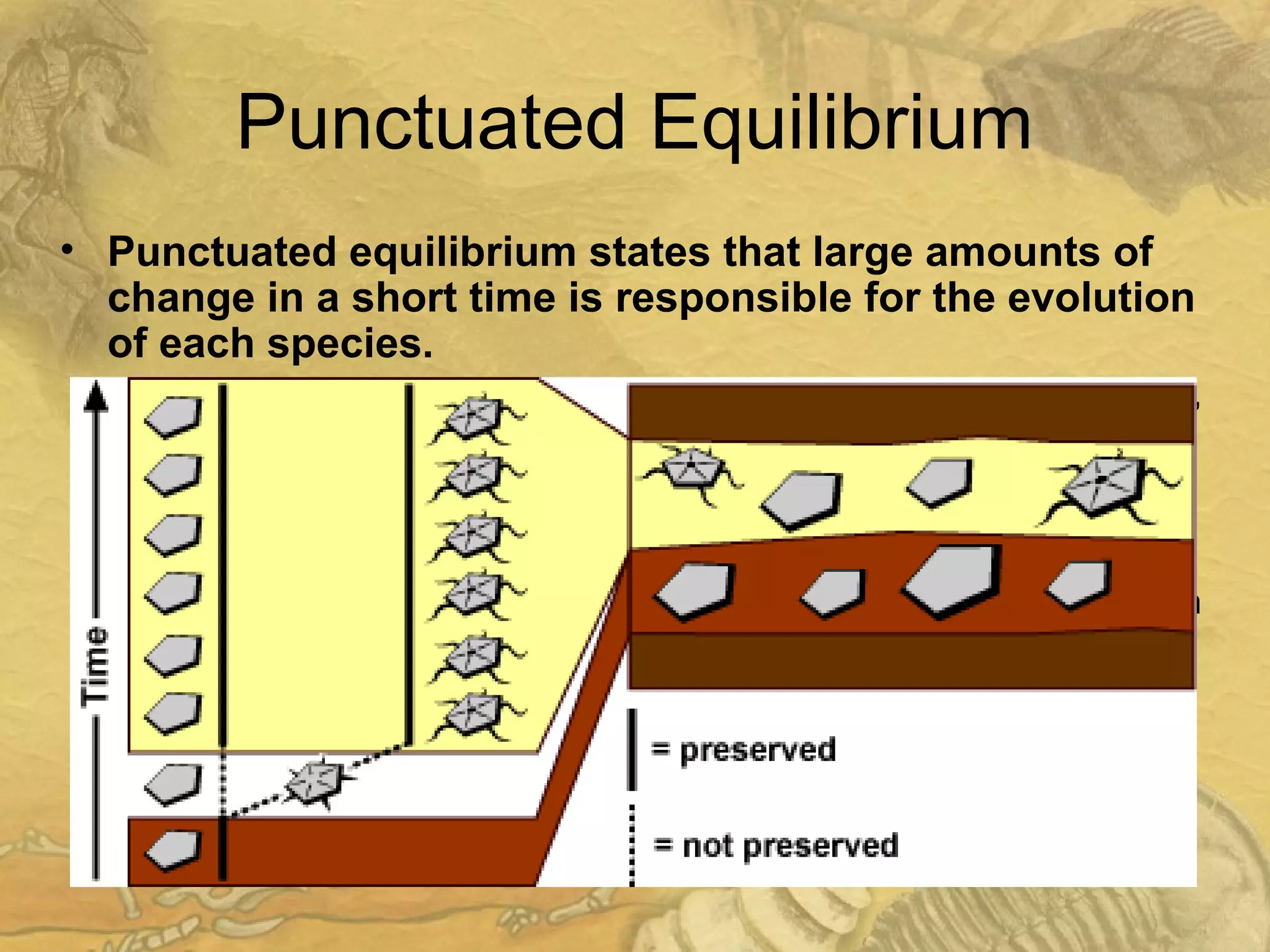
Punctuated Equilibrium
• Punctuated equilibrium states that large amounts of
change in a short time is responsible for the evolution
of each species.
– New species are only ~100,000 years younger than their ancestor,
and all the evolutionary change connecting them took place in this
short time.
– The “burst” of evolution is really a burst.
– Transitional forms between ancestor and new species did exist,
but for such a short amount of time that they were not preserved in
the fossil record.
CAST YOUR VOTES NOW!
• Phyletic Gradualism
• Punctuated Equilibrium
• Phyletic Discontinuity
WHICH THEORY WILL
YOU CHOOSE?



Fossil Record Debate

Fossil Record Debate

  • 1.
    HOW SHOULD WE INTERPRETTHE FOSSIL RECORD? DOCUMENTARY DRAMA
  • 2.
    Fossils... ...are the preservedevidence of past life.
  • 3.
    Controversial Evidence • Distinctfossil organisms are found in different rock layers, many of which are now extinct. • Darwin assumed that the rocks would eventually reveal many fossil intermediates (so-called transitional fossils). • Even in the Twenty-First Century, this assumption has still not been confirmed.
  • 4.
    ‘It seems thefossil record still makes great leaps from one form to the next.’
  • 5.
    Three Theories But whichone is best? How should we interpret this? Phyletic Gradualism (Uniformitarian) Punctuated Equilibrium (combination) Phyletic Discontinuity (Catastrophist) Let the scientific debate begin...
  • 6.
    Phyletic Gradualism (The UniformitarianViewpoint) • Phyletic gradualism states that slow and steady evolution from a single common ancestor over millions of years has resulted in the diversity of life we now see on Earth. – Most rock layers on Earth have been laid down by the same slow, steady sedimentation rates we see today. – The “burst” of evolution seen in the fossil record ("Cambrian Explosion") is simply a geological illusion. • It only looks like a burst because a lot of time (i.e. 5 million years) passed between the times when the two rock layers were laid down. • In this period of time, a new species gradually diverged from its ancestor through a series of transitional forms, but these transitional forms were not preserved (escaped fossilization).
  • 7.
    Phyletic Discontinuity (The CatastrophistViewpoint) • Phyletic discontinuity states that the diversity of life we now see on Earth is the product of a single historical event when every major phyla of organism was created by an intelligent being. – Most rock layers on Earth have been laid down quickly by catastrophic events (both local and global). – The sudden appearance of every major body plan as seen in the fossil record ("Cambrian Explosion") is evidence that each biological form had an independent origin. • Darwin's "missing" transitional fossils never existed; they were only fabricated by evolutionists to make their theory plausible. • The fossil record, as it stands, supports the sudden appearance of a variety of different organisms, not the gradual evolution of distinct body plans. • The mass extinctions recorded in the fossil record are further evidence for worldwide cataclysmic events.
  • 8.
    Punctuated Equilibrium • Punctuatedequilibrium states that large amounts of change in a short time is responsible for the evolution of each species. – New species are only ~100,000 years younger than their ancestor, and all the evolutionary change connecting them took place in this short time. – The “burst” of evolution is really a burst. – Transitional forms between ancestor and new species did exist, but for such a short amount of time that they were not preserved in the fossil record.
  • 9.
    CAST YOUR VOTESNOW! • Phyletic Gradualism • Punctuated Equilibrium • Phyletic Discontinuity WHICH THEORY WILL YOU CHOOSE?   

Editor's Notes

  • #6 Another theory: Macromutation—a big mutation produces sudden evolutionary change skipping over transitional forms: The “burst” of evolution is really a burst—there was a lot of evolutionary change in a very short amount of time. Species 3 was produced by a mutation that radically changed the offspring of ancestor 1 in many ways. Such extreme mutants are sometimes called “hopeful monsters.” This hypothesis is consistent with the fossils; however, based on other observations, we do not have clear evidence that such extreme yet adaptive mutations generally occur. Nevertheless, it is possible that mutations affecting development have far-reaching phenotypic effects and have played an important role in the evolution of life.
  • #8 Another theory: Macromutation—a big mutation produces sudden evolutionary change skipping over transitional forms: The “burst” of evolution is really a burst—there was a lot of evolutionary change in a very short amount of time. Species 3 was produced by a mutation that radically changed the offspring of ancestor 1 in many ways. Such extreme mutants are sometimes called “hopeful monsters.” This hypothesis is consistent with the fossils; however, based on other observations, we do not have clear evidence that such extreme yet adaptive mutations generally occur. Nevertheless, it is possible that mutations affecting development have far-reaching phenotypic effects and have played an important role in the evolution of life.