II. What are Fossils?
 Fossils are the remains or traces of
prehistoric life. They are important
components of sediment and
sedimentary rocks.
 The type of fossil that is formed is
determined by the conditions
under which an organism died and
how it was buried.
II. Altered vs. Unaltered
Remains
A. Unaltered Remains
Some remains of organisms—
such as teeth, bones, and
shells—may not have been
altered, or may have changed
hardly at all over time.
B. Altered Remains
• The remains of an organism are likely to be
changed over time.
• Fossils often become petrified or turned to
stone.
• Molds and casts are another common type
of fossil.
• Carbonization is particularly effective in
preserving leaves and delicate animals. It
occurs when an organism is buried under
fine sediment.
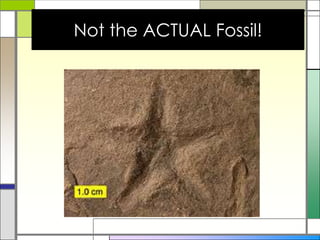
a. Trace fossils are indirect
evidence of prehistoric
life.
 Can tell us about the activity,
habitat, diet, etc. of an animal
 Examples: Tracks, shelters, and
poop
III. Indirect evidence
Not the ACTUAL Fossil!
IV. Preserved Fossil Types
 Conditions Favoring Preservation
Most organisms do not
become fossils…
• Two conditions are important for
preservation: rapid burial and the possession
of hard parts.
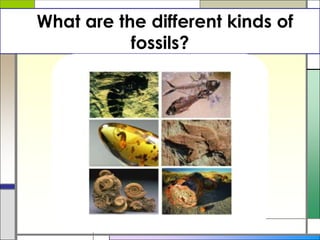
What are the different kinds of
fossils?
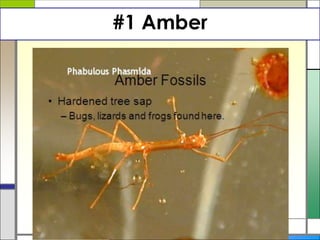
Amber
#1 Amber
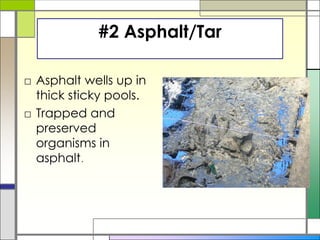
#2 Asphalt/Tar
□ Asphalt wells up in
thick sticky pools.
□ Trapped and
preserved
organisms in
asphalt.
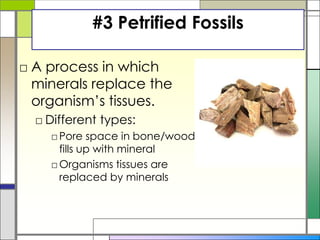
#3 Petrified Fossils
□ A process in which
minerals replace the
organism’s tissues.
□ Different types:
□Pore space in bone/wood
fills up with mineral
□Organisms tissues are
replaced by minerals
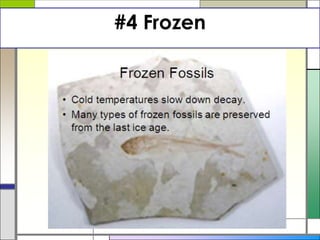
#4 Frozen
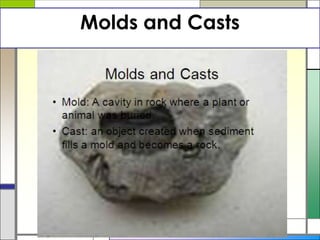
Molds and Casts
VI. Environments
a. Interpreting Environments
• Fossils can also be used to interpret and
describe ancient environments and
changes that occurred (polar areas once
being tropical)
• They can identify extinct species and
effects of catastrophism (floods, volcanic
eruptions, earthquakes).
• They can describe geologic changes
(mountains once under water, Pangaea)
Shark tooth in Georgia?!?!
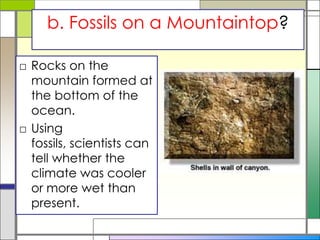
b. Fossils on a Mountaintop?
□ Rocks on the
mountain formed at
the bottom of the
ocean.
□ Using
fossils, scientists can
tell whether the
climate was cooler
or more wet than
present.

Fossils

  • 1.
    II. What areFossils?  Fossils are the remains or traces of prehistoric life. They are important components of sediment and sedimentary rocks.  The type of fossil that is formed is determined by the conditions under which an organism died and how it was buried.
  • 2.
    II. Altered vs.Unaltered Remains
  • 3.
    A. Unaltered Remains Someremains of organisms— such as teeth, bones, and shells—may not have been altered, or may have changed hardly at all over time.
  • 4.
    B. Altered Remains •The remains of an organism are likely to be changed over time. • Fossils often become petrified or turned to stone. • Molds and casts are another common type of fossil. • Carbonization is particularly effective in preserving leaves and delicate animals. It occurs when an organism is buried under fine sediment.
  • 5.
    a. Trace fossilsare indirect evidence of prehistoric life.  Can tell us about the activity, habitat, diet, etc. of an animal  Examples: Tracks, shelters, and poop III. Indirect evidence
  • 6.
  • 7.
    IV. Preserved FossilTypes  Conditions Favoring Preservation Most organisms do not become fossils… • Two conditions are important for preservation: rapid burial and the possession of hard parts.
  • 8.
    What are thedifferent kinds of fossils?
  • 9.
  • 10.
  • 12.
    #2 Asphalt/Tar □ Asphaltwells up in thick sticky pools. □ Trapped and preserved organisms in asphalt.
  • 14.
    #3 Petrified Fossils □A process in which minerals replace the organism’s tissues. □ Different types: □Pore space in bone/wood fills up with mineral □Organisms tissues are replaced by minerals
  • 16.
  • 18.
  • 19.
    VI. Environments a. InterpretingEnvironments • Fossils can also be used to interpret and describe ancient environments and changes that occurred (polar areas once being tropical) • They can identify extinct species and effects of catastrophism (floods, volcanic eruptions, earthquakes). • They can describe geologic changes (mountains once under water, Pangaea) Shark tooth in Georgia?!?!
  • 20.
    b. Fossils ona Mountaintop? □ Rocks on the mountain formed at the bottom of the ocean. □ Using fossils, scientists can tell whether the climate was cooler or more wet than present.