What is a fossil?
•

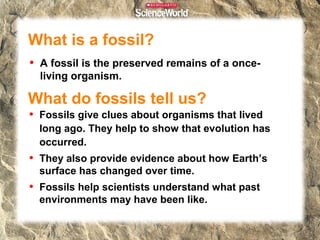
A fossil is the preserved remains of a onceliving organism.

What do fossils tell us?

• Fossils give clues about organisms that lived
long ago. They help to show that evolution has
occurred.

• They also provide evidence about how Earth’s
surface has changed over time.

• Fossils help scientists understand what past
environments may have been like.
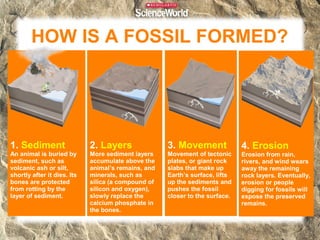
HOW IS A FOSSIL FORMED?

1. Sediment

2. Layers

3. Movement

An animal is buried by
sediment, such as
volcanic ash or silt,
shortly after it dies. Its
bones are protected
from rotting by the
layer of sediment.

More sediment layers
accumulate above the
animal’s remains, and
minerals, such as
silica (a compound of
silicon and oxygen),
slowly replace the
calcium phosphate in
the bones.

Movement of tectonic
plates, or giant rock
slabs that make up
Earth’s surface, lifts
up the sediments and
pushes the fossil
closer to the surface.

4. Erosion
Erosion from rain,
rivers, and wind wears
away the remaining
rock layers. Eventually,
erosion or people
digging for fossils will
expose the preserved
remains.
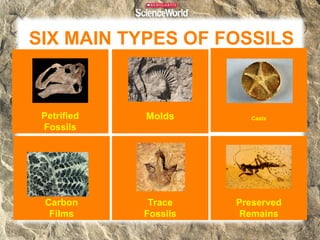
SIX MAIN TYPES OF FOSSILS

Petrified
Fossils

Molds

Casts

Carbon
Films

Trace
Fossils

Preserved
Remains
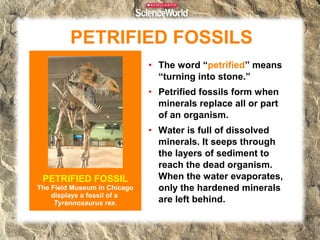
PETRIFIED FOSSILS
• The word “petrified” means
“turning into stone.”
• Petrified fossils form when
minerals replace all or part
of an organism.

PETRIFIED FOSSIL
The Field Museum in Chicago
displays a fossil of a
Tyrannosaurus rex.

• Water is full of dissolved
minerals. It seeps through
the layers of sediment to
reach the dead organism.
When the water evaporates,
only the hardened minerals
are left behind.
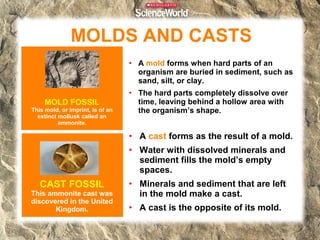
MOLDS AND CASTS
• A mold forms when hard parts of an
organism are buried in sediment, such as
sand, silt, or clay.

MOLD FOSSIL
This mold, or imprint, is of an
extinct mollusk called an
ammonite.

• The hard parts completely dissolve over
time, leaving behind a hollow area with
the organism’s shape.

• A cast forms as the result of a mold.
• Water with dissolved minerals and
sediment fills the mold’s empty
spaces.

CAST FOSSIL

This ammonite cast was
discovered in the United
Kingdom.

• Minerals and sediment that are left
in the mold make a cast.
• A cast is the opposite of its mold.
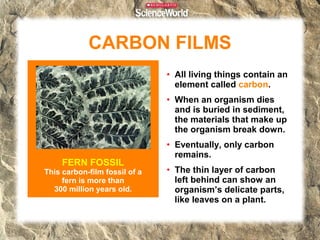
CARBON FILMS
• All living things contain an
element called carbon.
• When an organism dies
and is buried in sediment,
the materials that make up
the organism break down.

FERN FOSSIL

This carbon-film fossil of a
fern is more than
300 million years old.

• Eventually, only carbon
remains.
• The thin layer of carbon
left behind can show an
organism’s delicate parts,
like leaves on a plant.
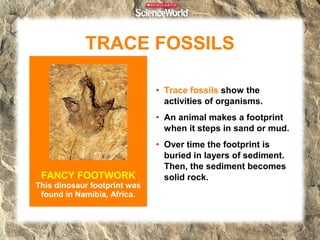
TRACE FOSSILS
• Trace fossils show the
activities of organisms.
• An animal makes a footprint
when it steps in sand or mud.

FANCY FOOTWORK
This dinosaur footprint was
found in Namibia, Africa.

• Over time the footprint is
buried in layers of sediment.
Then, the sediment becomes
solid rock.
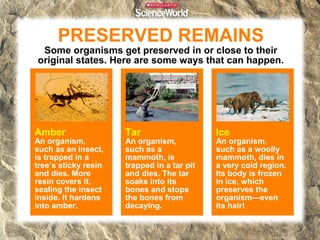
PRESERVED REMAINS

Some organisms get preserved in or close to their
original states. Here are some ways that can happen.

Amber

An organism,
such as an insect,
is trapped in a
tree’s sticky resin
and dies. More
resin covers it,
sealing the insect
inside. It hardens
into amber.

Tar

An organism,
such as a
mammoth, is
trapped in a tar pit
and dies. The tar
soaks into its
bones and stops
the bones from
decaying.

Ice

An organism,
such as a woolly
mammoth, dies in
a very cold region.
Its body is frozen
in ice, which
preserves the
organism—even
its hair!
For more on fossils visit:
Video: Becoming a Fossil
http://www.pbs.org/wgbh/evolution/library/04/3/l_043_01.html

PBS

Article: Major Fossil Find
http://www2.scholastic.com/browse/article.jsp?id=3751945

Scholastic News Online

Online Exhibit: Fossil Halls
http://www.amnh.org/exhibitions/permanent/fossilhalls

American Museum of Natural History

Interactive Game: Fossil Hunt
http://channel.nationalgeographic.com/episode/dino-death-trap-2998#tab-fossil-hunt

National Geographic
Scholastic Classroom Magazines. www.scholastic.com Photo Credits:

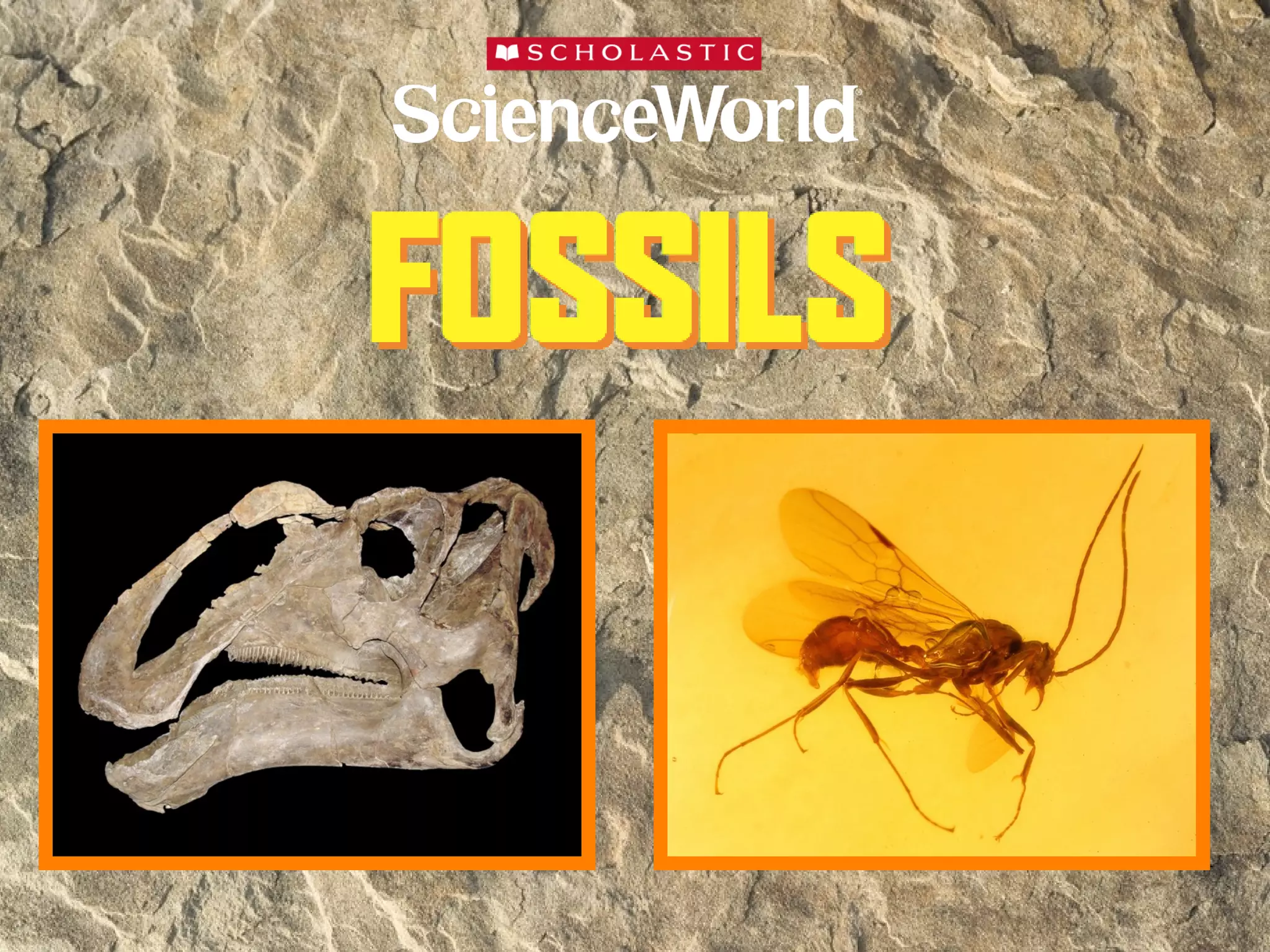
PAGE 1: UTAH MUSEUM OF NATURAL HISTORY (DINOSAUR); PHOTOTAKE INC./ALAMY (ANT). PAGE
3: 5W INFORGRAPHIC (GRAPHIC). PAGE 4: Jason Lindsey/Alamy (DINOSAUR); Peter Bowater/Alamy (MOLD); David Lyons/Alamy (FERN); Hoberman Collection UK/Alamy (FOOTPRINT); John
Cancalosi/Alamy (MANTIS). PAGE 5: Gary Crabbe/Alamy (DINOSAUR). PAGE 6: Peter Bowater/Alamy (MOLD); Detail Heritage/Alamy (CAST). PAGE 7: David Lyons/Alamy (FERN). PAGE 8: Hoberman
Collection UK/Alamy (FOOTPRINT). PAGE 9: John Cancalosi/Alamy (MANTIS); R1/Alamy (TAR PITS); Gianni Dagli Orti/Corbis (MAMMOTH).

Fossils

  • 2.
    What is afossil? • A fossil is the preserved remains of a onceliving organism. What do fossils tell us? • Fossils give clues about organisms that lived long ago. They help to show that evolution has occurred. • They also provide evidence about how Earth’s surface has changed over time. • Fossils help scientists understand what past environments may have been like.
  • 3.
    HOW IS AFOSSIL FORMED? 1. Sediment 2. Layers 3. Movement An animal is buried by sediment, such as volcanic ash or silt, shortly after it dies. Its bones are protected from rotting by the layer of sediment. More sediment layers accumulate above the animal’s remains, and minerals, such as silica (a compound of silicon and oxygen), slowly replace the calcium phosphate in the bones. Movement of tectonic plates, or giant rock slabs that make up Earth’s surface, lifts up the sediments and pushes the fossil closer to the surface. 4. Erosion Erosion from rain, rivers, and wind wears away the remaining rock layers. Eventually, erosion or people digging for fossils will expose the preserved remains.
  • 4.
    SIX MAIN TYPESOF FOSSILS Petrified Fossils Molds Casts Carbon Films Trace Fossils Preserved Remains
  • 5.
    PETRIFIED FOSSILS • Theword “petrified” means “turning into stone.” • Petrified fossils form when minerals replace all or part of an organism. PETRIFIED FOSSIL The Field Museum in Chicago displays a fossil of a Tyrannosaurus rex. • Water is full of dissolved minerals. It seeps through the layers of sediment to reach the dead organism. When the water evaporates, only the hardened minerals are left behind.
  • 6.
    MOLDS AND CASTS •A mold forms when hard parts of an organism are buried in sediment, such as sand, silt, or clay. MOLD FOSSIL This mold, or imprint, is of an extinct mollusk called an ammonite. • The hard parts completely dissolve over time, leaving behind a hollow area with the organism’s shape. • A cast forms as the result of a mold. • Water with dissolved minerals and sediment fills the mold’s empty spaces. CAST FOSSIL This ammonite cast was discovered in the United Kingdom. • Minerals and sediment that are left in the mold make a cast. • A cast is the opposite of its mold.
  • 7.
    CARBON FILMS • Allliving things contain an element called carbon. • When an organism dies and is buried in sediment, the materials that make up the organism break down. FERN FOSSIL This carbon-film fossil of a fern is more than 300 million years old. • Eventually, only carbon remains. • The thin layer of carbon left behind can show an organism’s delicate parts, like leaves on a plant.
  • 8.
    TRACE FOSSILS • Tracefossils show the activities of organisms. • An animal makes a footprint when it steps in sand or mud. FANCY FOOTWORK This dinosaur footprint was found in Namibia, Africa. • Over time the footprint is buried in layers of sediment. Then, the sediment becomes solid rock.
  • 9.
    PRESERVED REMAINS Some organismsget preserved in or close to their original states. Here are some ways that can happen. Amber An organism, such as an insect, is trapped in a tree’s sticky resin and dies. More resin covers it, sealing the insect inside. It hardens into amber. Tar An organism, such as a mammoth, is trapped in a tar pit and dies. The tar soaks into its bones and stops the bones from decaying. Ice An organism, such as a woolly mammoth, dies in a very cold region. Its body is frozen in ice, which preserves the organism—even its hair!
  • 10.
    For more onfossils visit: Video: Becoming a Fossil http://www.pbs.org/wgbh/evolution/library/04/3/l_043_01.html PBS Article: Major Fossil Find http://www2.scholastic.com/browse/article.jsp?id=3751945 Scholastic News Online Online Exhibit: Fossil Halls http://www.amnh.org/exhibitions/permanent/fossilhalls American Museum of Natural History Interactive Game: Fossil Hunt http://channel.nationalgeographic.com/episode/dino-death-trap-2998#tab-fossil-hunt National Geographic Scholastic Classroom Magazines. www.scholastic.com Photo Credits: PAGE 1: UTAH MUSEUM OF NATURAL HISTORY (DINOSAUR); PHOTOTAKE INC./ALAMY (ANT). PAGE 3: 5W INFORGRAPHIC (GRAPHIC). PAGE 4: Jason Lindsey/Alamy (DINOSAUR); Peter Bowater/Alamy (MOLD); David Lyons/Alamy (FERN); Hoberman Collection UK/Alamy (FOOTPRINT); John Cancalosi/Alamy (MANTIS). PAGE 5: Gary Crabbe/Alamy (DINOSAUR). PAGE 6: Peter Bowater/Alamy (MOLD); Detail Heritage/Alamy (CAST). PAGE 7: David Lyons/Alamy (FERN). PAGE 8: Hoberman Collection UK/Alamy (FOOTPRINT). PAGE 9: John Cancalosi/Alamy (MANTIS); R1/Alamy (TAR PITS); Gianni Dagli Orti/Corbis (MAMMOTH).