Discovering Earth’s History     Rocks record geological events and changing life forms of the past.    We have learned that Earth is much older than anyone had previously imagined and that its surface and interior have been changed by the same geological processes that continue today. Rocks Record Earth History
Discovering Earth’s History     Uniformitarianism  means that the forces and processes that we observe today have been at work for a very long time. A Brief History of Geology
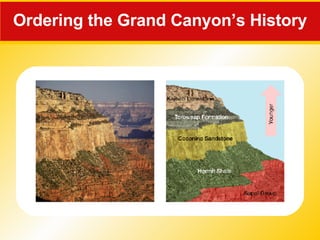
Discovering Earth’s History     Relative dating  tells us the sequence in which events occurred, not how long ago they occurred.    Law of Superposition •  The  law of superposition  states that in an undeformed sequence of sedimentary rocks, each bed is older than the one above it and younger than the one below it. Relative Dating—Key Principles
Ordering the Grand Canyon’s History
Discovering Earth’s History     Principle of Original Horizontality •  The  principle of original horizontality  means that layers of sediment are generally deposited in a horizontal position. Relative Dating—Key Principles
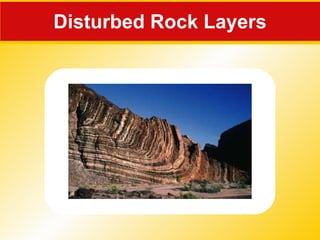
Disturbed Rock Layers
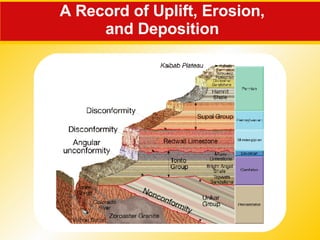
Discovering Earth’s History     Unconformities •  An  unconformity  represents a long period during which deposition stopped, erosion removed previously formed rocks, and then deposition resumed. •  An angular unconformity indicates that during the pause in deposition, a period of deformation (folding or tilting) and erosion occurred. Relative Dating—Key Principles
Discovering Earth’s History     Unconformities •  A nonconformity is when the erosional surface separates older metamorphic or intrusive igneous rocks from younger sedimentary rocks. •  A disconformity is when two sedimentary rock layers are separated by an erosional surface. Relative Dating—Key Principles
A Record of Uplift, Erosion,  and Deposition
Fossils: Evidence of Past Life     Fossils  are the remains or traces of prehistoric life. They are important components of sediment and sedimentary rocks.   •  Some remains of organisms—such as teeth, bones, and shells—may not have been altered, or may have changed hardly at all over time.    The type of fossil that is formed is determined by the conditions under which an organism died and how it was buried.    Unaltered Remains Fossil Formation
Fossils: Evidence of Past Life    Altered Remains •  The remains of an organism are likely to be changed over time. •  Fossils often become petrified or turned to stone. •  Molds and casts are another common type of fossil. •  Carbonization is particularly effective in preserving leaves and delicate animals. It occurs when an organism is buried under fine sediment.  Fossil Formation
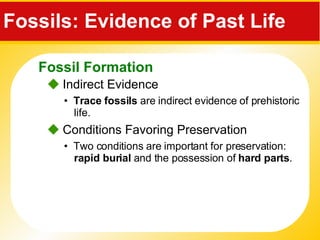
Fossils: Evidence of Past Life     Indirect Evidence •  Trace fossils  are indirect evidence of prehistoric life.    Conditions Favoring Preservation •  Two conditions are important for preservation:  rapid burial  and the possession of  hard parts . Fossil Formation
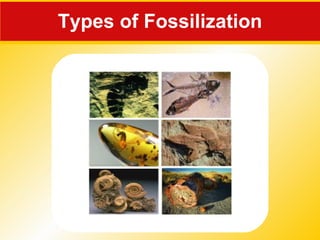
Types of Fossilization
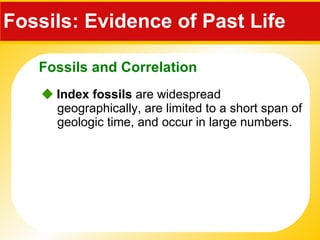
Fossils: Evidence of Past Life     Index fossils  are widespread geographically, are limited to a short span of geologic time, and occur in large numbers. Fossils and Correlation
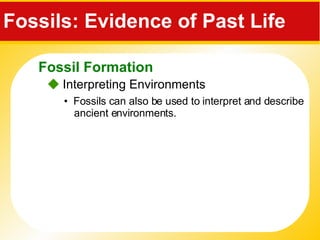
Fossils: Evidence of Past Life     Interpreting Environments •  Fossils can also be used to interpret and describe ancient environments. Fossil Formation
Dating with Radioactivity     Radioactivity  is the spontaneous decay of certain unstable atomic nuclei. Radioactivity
Dating with Radioactivity     A  half-life  is the amount of time necessary for one-half of the nuclei in a sample to decay to a stable isotope. Half-Life
Dating with Radioactivity     Radiocarbon dating  is the method for determining age by comparing the amount of carbon-14 to the amount of carbon-12 in a sample.    When an organism dies, the amount of carbon-14 it contains gradually decreases as it decays. By comparing the ratio of carbon-14 to carbon-12 in a sample, radiocarbon dates can be determined. Dating with Carbon-14
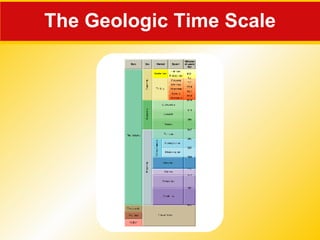
The Geologic Time Scale     Based on their interpretations of the rock record, geologists have divided Earth’s 4.56-billion-year history into units that represent specific amounts of time. Taken together, these time spans make up the  geologic time scale . Structure of the Time Scale
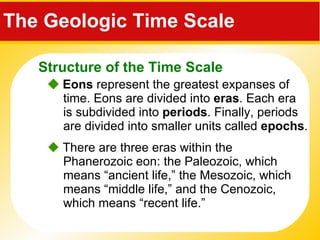
The Geologic Time Scale     Eons  represent the greatest expanses of time. Eons are divided into  eras . Each era is subdivided into  periods . Finally, periods are divided into smaller units called  epochs .    There are three eras within the Phanerozoic eon: the Paleozoic, which means “ancient life,” the Mesozoic, which means “middle life,” and the Cenozoic, which means “recent life.” Structure of the Time Scale
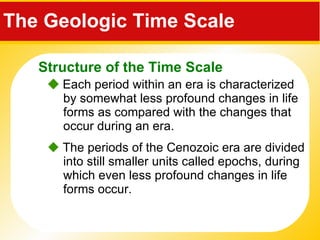
The Geologic Time Scale     Each period within an era is characterized by somewhat less profound changes in life forms as compared with the changes that occur during an era.    The periods of the Cenozoic era are divided into still smaller units called epochs, during which even less profound changes in life forms occur. Structure of the Time Scale
The Geologic Time Scale     During Precambrian time, there were fewer life forms. These life forms are more difficult to identify and the rocks have been disturbed often. Precambrian Time
The Geologic Time Scale
The Geologic Time Scale     A sedimentary rock may contain particles that contain radioactive isotopes, but these particles are not the same age as the rock in which they occur.    The age of a particular mineral in a metamorphic rock does not necessarily represent the time when the rock was first formed. Instead, the date may indicate when the rock was metamorphosed. Difficulties With the Geologic Time Scale

Geologic Time

  • 1.
    Discovering Earth’s History  Rocks record geological events and changing life forms of the past.  We have learned that Earth is much older than anyone had previously imagined and that its surface and interior have been changed by the same geological processes that continue today. Rocks Record Earth History
  • 2.
    Discovering Earth’s History  Uniformitarianism means that the forces and processes that we observe today have been at work for a very long time. A Brief History of Geology
  • 3.
    Discovering Earth’s History  Relative dating tells us the sequence in which events occurred, not how long ago they occurred.  Law of Superposition • The law of superposition states that in an undeformed sequence of sedimentary rocks, each bed is older than the one above it and younger than the one below it. Relative Dating—Key Principles
  • 4.
    Ordering the GrandCanyon’s History
  • 5.
    Discovering Earth’s History  Principle of Original Horizontality • The principle of original horizontality means that layers of sediment are generally deposited in a horizontal position. Relative Dating—Key Principles
  • 6.
  • 7.
    Discovering Earth’s History  Unconformities • An unconformity represents a long period during which deposition stopped, erosion removed previously formed rocks, and then deposition resumed. • An angular unconformity indicates that during the pause in deposition, a period of deformation (folding or tilting) and erosion occurred. Relative Dating—Key Principles
  • 8.
    Discovering Earth’s History  Unconformities • A nonconformity is when the erosional surface separates older metamorphic or intrusive igneous rocks from younger sedimentary rocks. • A disconformity is when two sedimentary rock layers are separated by an erosional surface. Relative Dating—Key Principles
  • 9.
    A Record ofUplift, Erosion, and Deposition
  • 10.
    Fossils: Evidence ofPast Life  Fossils are the remains or traces of prehistoric life. They are important components of sediment and sedimentary rocks. • Some remains of organisms—such as teeth, bones, and shells—may not have been altered, or may have changed hardly at all over time.  The type of fossil that is formed is determined by the conditions under which an organism died and how it was buried.  Unaltered Remains Fossil Formation
  • 11.
    Fossils: Evidence ofPast Life  Altered Remains • The remains of an organism are likely to be changed over time. • Fossils often become petrified or turned to stone. • Molds and casts are another common type of fossil. • Carbonization is particularly effective in preserving leaves and delicate animals. It occurs when an organism is buried under fine sediment. Fossil Formation
  • 12.
    Fossils: Evidence ofPast Life  Indirect Evidence • Trace fossils are indirect evidence of prehistoric life.  Conditions Favoring Preservation • Two conditions are important for preservation: rapid burial and the possession of hard parts . Fossil Formation
  • 13.
  • 14.
    Fossils: Evidence ofPast Life  Index fossils are widespread geographically, are limited to a short span of geologic time, and occur in large numbers. Fossils and Correlation
  • 15.
    Fossils: Evidence ofPast Life  Interpreting Environments • Fossils can also be used to interpret and describe ancient environments. Fossil Formation
  • 16.
    Dating with Radioactivity  Radioactivity is the spontaneous decay of certain unstable atomic nuclei. Radioactivity
  • 17.
    Dating with Radioactivity  A half-life is the amount of time necessary for one-half of the nuclei in a sample to decay to a stable isotope. Half-Life
  • 18.
    Dating with Radioactivity  Radiocarbon dating is the method for determining age by comparing the amount of carbon-14 to the amount of carbon-12 in a sample.  When an organism dies, the amount of carbon-14 it contains gradually decreases as it decays. By comparing the ratio of carbon-14 to carbon-12 in a sample, radiocarbon dates can be determined. Dating with Carbon-14
  • 19.
    The Geologic TimeScale  Based on their interpretations of the rock record, geologists have divided Earth’s 4.56-billion-year history into units that represent specific amounts of time. Taken together, these time spans make up the geologic time scale . Structure of the Time Scale
  • 20.
    The Geologic TimeScale  Eons represent the greatest expanses of time. Eons are divided into eras . Each era is subdivided into periods . Finally, periods are divided into smaller units called epochs .  There are three eras within the Phanerozoic eon: the Paleozoic, which means “ancient life,” the Mesozoic, which means “middle life,” and the Cenozoic, which means “recent life.” Structure of the Time Scale
  • 21.
    The Geologic TimeScale  Each period within an era is characterized by somewhat less profound changes in life forms as compared with the changes that occur during an era.  The periods of the Cenozoic era are divided into still smaller units called epochs, during which even less profound changes in life forms occur. Structure of the Time Scale
  • 22.
    The Geologic TimeScale  During Precambrian time, there were fewer life forms. These life forms are more difficult to identify and the rocks have been disturbed often. Precambrian Time
  • 23.
  • 24.
    The Geologic TimeScale  A sedimentary rock may contain particles that contain radioactive isotopes, but these particles are not the same age as the rock in which they occur.  The age of a particular mineral in a metamorphic rock does not necessarily represent the time when the rock was first formed. Instead, the date may indicate when the rock was metamorphosed. Difficulties With the Geologic Time Scale