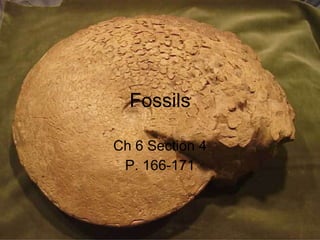
Fossils Ch 6 Section 4 P. 166-171
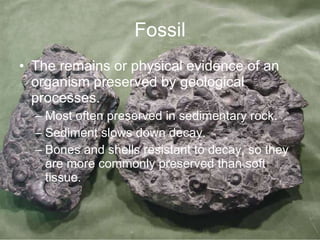
Fossil The remains or physical evidence of an organism preserved by geological processes. Most often preserved in sedimentary rock. Sediment slows down decay. Bones and shells resistant to decay, so they are more commonly preserved than soft tissue.
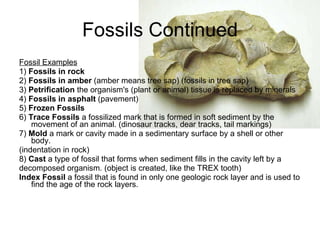
Fossils Continued Fossil Examples 1)  Fossils in rock 2)  Fossils in amber  (amber means tree sap) (fossils in tree sap) 3)  Petrification  the organism's (plant or animal) tissue is replaced by minerals 4)  Fossils in asphalt  (pavement) 5)  Frozen Fossils 6)  Trace Fossils  a fossilized mark that is formed in soft sediment by the movement of an animal. (dinosaur tracks, dear tracks, tail markings) 7)  Mold  a mark or cavity made in a sedimentary surface by a shell or other body. (indentation in rock) 8)  Cast  a type of fossil that forms when sediment fills in the cavity left by a decomposed organism. (object is created, like the TREX tooth) Index Fossil  a fossil that is found in only one geologic rock layer and is used to find the age of the rock layers.
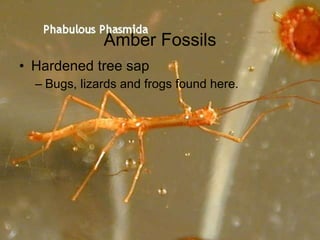
Amber Fossils Hardened tree sap Bugs, lizards and frogs found here.
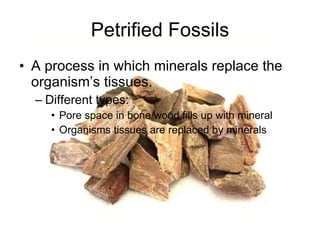
Petrified Fossils A process in which minerals replace the organism’s tissues. Different types: Pore space in bone/wood fills up with mineral Organisms tissues are replaced by minerals
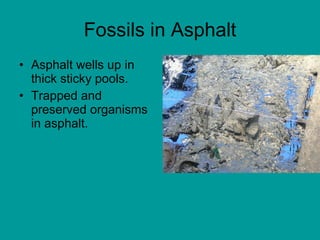
Fossils in Asphalt Asphalt wells up in thick sticky pools. Trapped and preserved organisms in asphalt.
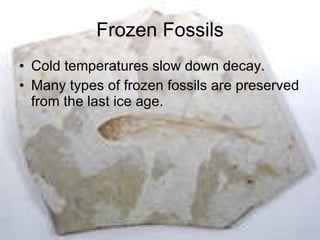
Frozen Fossils Cold temperatures slow down decay. Many types of frozen fossils are preserved from the last ice age.
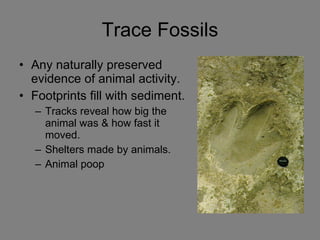
Trace Fossils Any naturally preserved evidence of animal activity. Footprints fill with sediment. Tracks reveal how big the animal was & how fast it moved. Shelters made by animals. Animal poop
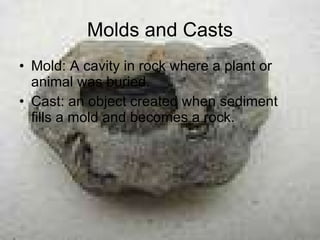
Molds and Casts Mold: A cavity in rock where a plant or animal was buried. Cast: an object created when sediment fills a mold and becomes a rock.
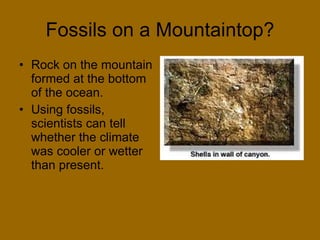
Fossils on a Mountaintop? Rock on the mountain formed at the bottom of the ocean. Using fossils, scientists can tell whether the climate was cooler or wetter than present.
Fossils Help Date Rocks Index Fossils: fossils of organisms that lived during a relatively short, well-defined geologic time span.

Fossils

  • 1.
    Fossils Ch 6Section 4 P. 166-171
  • 2.
    Fossil The remainsor physical evidence of an organism preserved by geological processes. Most often preserved in sedimentary rock. Sediment slows down decay. Bones and shells resistant to decay, so they are more commonly preserved than soft tissue.
  • 3.
    Fossils Continued FossilExamples 1) Fossils in rock 2) Fossils in amber (amber means tree sap) (fossils in tree sap) 3) Petrification the organism's (plant or animal) tissue is replaced by minerals 4) Fossils in asphalt (pavement) 5) Frozen Fossils 6) Trace Fossils a fossilized mark that is formed in soft sediment by the movement of an animal. (dinosaur tracks, dear tracks, tail markings) 7) Mold a mark or cavity made in a sedimentary surface by a shell or other body. (indentation in rock) 8) Cast a type of fossil that forms when sediment fills in the cavity left by a decomposed organism. (object is created, like the TREX tooth) Index Fossil a fossil that is found in only one geologic rock layer and is used to find the age of the rock layers.
  • 4.
    Amber Fossils Hardenedtree sap Bugs, lizards and frogs found here.
  • 5.
    Petrified Fossils Aprocess in which minerals replace the organism’s tissues. Different types: Pore space in bone/wood fills up with mineral Organisms tissues are replaced by minerals
  • 6.
    Fossils in AsphaltAsphalt wells up in thick sticky pools. Trapped and preserved organisms in asphalt.
  • 7.
    Frozen Fossils Coldtemperatures slow down decay. Many types of frozen fossils are preserved from the last ice age.
  • 8.
    Trace Fossils Anynaturally preserved evidence of animal activity. Footprints fill with sediment. Tracks reveal how big the animal was & how fast it moved. Shelters made by animals. Animal poop
  • 9.
    Molds and CastsMold: A cavity in rock where a plant or animal was buried. Cast: an object created when sediment fills a mold and becomes a rock.
  • 10.
    Fossils on aMountaintop? Rock on the mountain formed at the bottom of the ocean. Using fossils, scientists can tell whether the climate was cooler or wetter than present.
  • 11.
    Fossils Help DateRocks Index Fossils: fossils of organisms that lived during a relatively short, well-defined geologic time span.