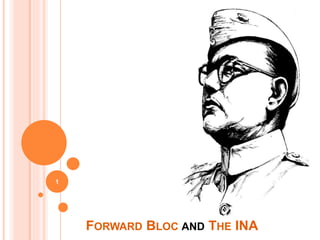

FORWARD BLOC AND THE INA
1
BOSE & THE CONGRESS
 Bose criticized Gandhi for withdrawing Non
Cooperation Movement in 1922.
 Bose participated in Civil Disobedience Movement
and was elected as President of the Congress at
Haripura (Gujarat) session.
 All India National Planning Committee was
formally inaugurated by Bose at Mumbai in
December 1938.
2
DRIFT BETWEEN GANDHI AND BOSE
 Bose favored LARGE SCALE industries. Gandhi
favored SMALL SCALE industries.
 Bose favored TACT while dealing with opponents &
Gandhi favored OPENNESS.
 Congress party had two wings- Right Wing and Left
Wing. Bose led Left Wing which demanded that
Congress should help people of Princely States in their
struggle for freedom. Gandhi opposed it.
 Britain was facing challenges in Europe because of
German threat, Gandhiji wanted to compromise and
didn’t want to start any National struggle during War.
On the other hand Bose wanted to take advantage of
this situation and difficulties faced by British.
3
RIFT IN THE CONGRESS
 At Tripuri (Madhya Pradesh) session Gandhi tried to
discourage Bose from standing for re-election as
President of Congress for a second term.
 Bose still decided to stand for elections.
 Gandhiji nominated his candidate Pattabhi
Sitaramayya for the Presidential candidate and used
his all powers for his candidate.
 Bose still won by majority.
 Gandhiji resigned and 13 members of Congress
Working Committee resigned.
 Working committee requestedPresident to work as per
wishes of Gandhiji. Majority supported Gandhi. There
was a deadlock between Gandhi and Bose. Gandhi
wing made impossible for Bose to function.
 Bose finally resigned from presidentialship of the
Congress on April 29,1939.
4
FORMATION OF FORWARD BLOC
 Bose left he should form a LEFT WING in the Congress.
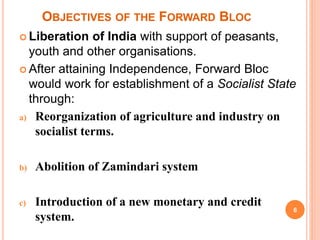
 After resigning, he formed a new party within Congress
to bring entire wing under one banner. This party was
known as Forward Bloc, was formed on May 3, 1939.
5
OBJECTIVES OF THE FORWARD BLOC
 Liberation of India with support of peasants,
youth and other organisations.
 After attaining Independence, Forward Bloc
would work for establishment of a Socialist State
through:
a) Reorganization of agriculture and industry on
socialist terms.
b) Abolition of Zamindari system
c) Introduction of a new monetary and credit
system.
6
INDIAN NATIONAL ARMY (INA)
 In MALAYA, Mohan Singh who was Indian Officer in
British Indian Army conceived(got) an idea of the Indian
National Army.
 He went to Japanese for help.
 Japanese had always encouraged Indians to join Anti-
British organisations but had no such idea of forming a
military wing consisting of Indians.
 Indian Prisoners of War (POWs) were handed by
Japanese to Mohan Singh who inducted them to INA.
 Singapore was defeated which brought 45,000 Indian
POWs to Mohan Singh’s INA.
 By end of 1942, 40,000 people expressed their wish to
join INA.
 It was clear that INA would go to India only on invitation
of INC and people of India. 7
OBJECTIVES OF THE INA
1. To organize an armed revolution and to fight the
British army with modern arms.
2. As it wasn’t possible for Indians staying in homeland to
organize an armed revolution, this task was passed to
Indians living abroad, particularly in East Asia.
3. To organize a Provisional government of FREE
INDIA in order to assemble all forces effectively
4. Total mobilization of Indian man-power and money
for a total war.
5. The motto of the INA was ‘UNITY, FATH and
SACRIFICE.’
8
ACHIEVEMENTS OF INA
 INA with Japanese army won many territories in
South East Asia.
 In May 1944 INA captured Mowdok, an outpost situated
in SE of Chittagong.
 In 1944 they reached frontier of India.
 They captured strong military post of Klang Klang.
 Gave tough fight to British forces in Assam hills and
successfully captured Ukhral and Kohima.
 The raised and hoisted Tricolor Flag for the first time on
the liberated Indian soil on March 19,1944.
9
10

Forward Bloc and The INA

  • 1.
  • 2.
    BOSE & THECONGRESS  Bose criticized Gandhi for withdrawing Non Cooperation Movement in 1922.  Bose participated in Civil Disobedience Movement and was elected as President of the Congress at Haripura (Gujarat) session.  All India National Planning Committee was formally inaugurated by Bose at Mumbai in December 1938. 2
  • 3.
    DRIFT BETWEEN GANDHIAND BOSE  Bose favored LARGE SCALE industries. Gandhi favored SMALL SCALE industries.  Bose favored TACT while dealing with opponents & Gandhi favored OPENNESS.  Congress party had two wings- Right Wing and Left Wing. Bose led Left Wing which demanded that Congress should help people of Princely States in their struggle for freedom. Gandhi opposed it.  Britain was facing challenges in Europe because of German threat, Gandhiji wanted to compromise and didn’t want to start any National struggle during War. On the other hand Bose wanted to take advantage of this situation and difficulties faced by British. 3
  • 4.
    RIFT IN THECONGRESS  At Tripuri (Madhya Pradesh) session Gandhi tried to discourage Bose from standing for re-election as President of Congress for a second term.  Bose still decided to stand for elections.  Gandhiji nominated his candidate Pattabhi Sitaramayya for the Presidential candidate and used his all powers for his candidate.  Bose still won by majority.  Gandhiji resigned and 13 members of Congress Working Committee resigned.  Working committee requestedPresident to work as per wishes of Gandhiji. Majority supported Gandhi. There was a deadlock between Gandhi and Bose. Gandhi wing made impossible for Bose to function.  Bose finally resigned from presidentialship of the Congress on April 29,1939. 4
  • 5.
    FORMATION OF FORWARDBLOC  Bose left he should form a LEFT WING in the Congress.  After resigning, he formed a new party within Congress to bring entire wing under one banner. This party was known as Forward Bloc, was formed on May 3, 1939. 5
  • 6.
    OBJECTIVES OF THEFORWARD BLOC  Liberation of India with support of peasants, youth and other organisations.  After attaining Independence, Forward Bloc would work for establishment of a Socialist State through: a) Reorganization of agriculture and industry on socialist terms. b) Abolition of Zamindari system c) Introduction of a new monetary and credit system. 6
  • 7.
    INDIAN NATIONAL ARMY(INA)  In MALAYA, Mohan Singh who was Indian Officer in British Indian Army conceived(got) an idea of the Indian National Army.  He went to Japanese for help.  Japanese had always encouraged Indians to join Anti- British organisations but had no such idea of forming a military wing consisting of Indians.  Indian Prisoners of War (POWs) were handed by Japanese to Mohan Singh who inducted them to INA.  Singapore was defeated which brought 45,000 Indian POWs to Mohan Singh’s INA.  By end of 1942, 40,000 people expressed their wish to join INA.  It was clear that INA would go to India only on invitation of INC and people of India. 7
  • 8.
    OBJECTIVES OF THEINA 1. To organize an armed revolution and to fight the British army with modern arms. 2. As it wasn’t possible for Indians staying in homeland to organize an armed revolution, this task was passed to Indians living abroad, particularly in East Asia. 3. To organize a Provisional government of FREE INDIA in order to assemble all forces effectively 4. Total mobilization of Indian man-power and money for a total war. 5. The motto of the INA was ‘UNITY, FATH and SACRIFICE.’ 8
  • 9.
    ACHIEVEMENTS OF INA INA with Japanese army won many territories in South East Asia.  In May 1944 INA captured Mowdok, an outpost situated in SE of Chittagong.  In 1944 they reached frontier of India.  They captured strong military post of Klang Klang.  Gave tough fight to British forces in Assam hills and successfully captured Ukhral and Kohima.  The raised and hoisted Tricolor Flag for the first time on the liberated Indian soil on March 19,1944. 9
  • 10.