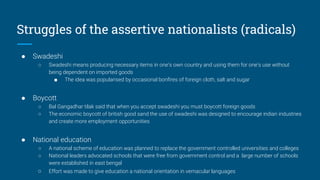
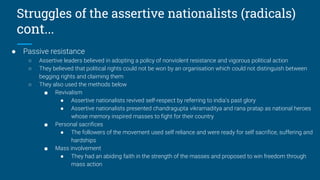
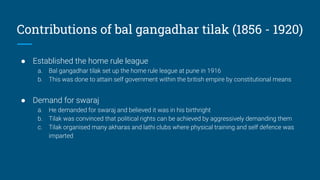
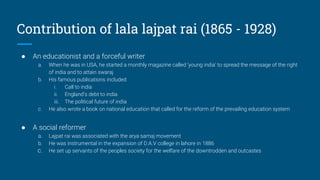
The second phase of the Indian national movement from 1907-1916 was led by assertive nationalists who aimed for complete independence rather than just self-governance. They drew support from the masses and sought to achieve swaraj immediately. Key events included the partition of Bengal in 1905, which nationalists opposed as it divided Bengalis along religious lines. Assertive nationalists used strategies like swadeshi, boycott of British goods, national education, and passive resistance to achieve their goals. Bal Gangadhar Tilak, Bipin Chandra Pal, and Lala Lajpat Rai were influential leaders who contributed to the movement through organizations, writings, and social reforms.








![HISTORYProjectOutline class 10 of icse board education]](https://cdn.slidesharecdn.com/ss_thumbnails/historyprojectoutline10-240727055256-780bf30f-thumbnail.jpg?width=640&height=640&fit=bounds)


