
Local Self Government- Urban
1
Urban Self
Governing
Bodies
Municipal
Corporation
Municipal
Committees
Cantonment
Board
Port Trust Improvement
Board
2
Urban Self Governing Bodies
Municipal
Corporation
Municipal
Council
Nagar Panchayat
Three Tier Local Bodies for Urban Areas
3
4
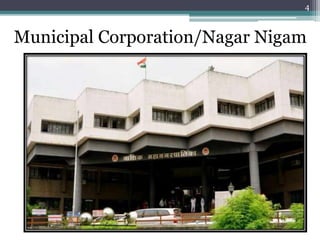
Municipal Corporation/Nagar Nigam
A) Municipal Corporation- Meaning
• An elected body that is responsible for running the
civic affairs of a large city and looking after various
needs of the people who live there is called as
Municipal Corporation/Nagar Nigam.
• The Constitution lists 18 subjects in the 12th
Schedule which states the duties that the
Municipal bodies need to complete.
• These include town planning, roads, water supply,
public health etc.
• It is seen in cities with more than 10 lakhs
population.
5
Municipal
Corporation
General
Council
The Mayor
The Standing
Committee
A Municipal
Commissioner
A) Municipal Corporation
a) Composition:
6
Municipal Corporation: Composition
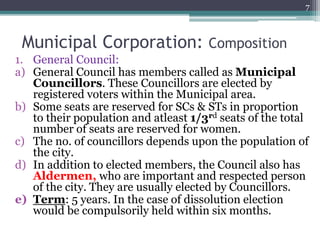
1. General Council:
a) General Council has members called as Municipal
Councillors. These Councillors are elected by
registered voters within the Municipal area.
b) Some seats are reserved for SCs & STs in proportion
to their population and atleast 1/3rd seats of the total
number of seats are reserved for women.
c) The no. of councillors depends upon the population of
the city.
d) In addition to elected members, the Council also has
Aldermen, who are important and respected person
of the city. They are usually elected by Councillors.
e) Term: 5 years. In the case of dissolution election
would be compulsorily held within six months.
7
2. Mayor:
• Municipal Councillors elects Mayor and Deputy
Mayor from among themselves.
• Mayor is generally elected annually. In some
States the Mayor is elected by general voters and
in that case he would have a five-year term.
Functions:
• He is the First Citizen of the City.
• Decides agendas for the meetings.
• Presides all the meetings of the Corporation
• Coordinates all the departments.
• Acts as a link between Corporation and State
Government.
8
Municipal Corporation: Composition
3. The Standing Committee:
Standing Committee handle the different
departments like:
• Health
• Finance
• Taxation etc.
9
Municipal Corporation: Composition
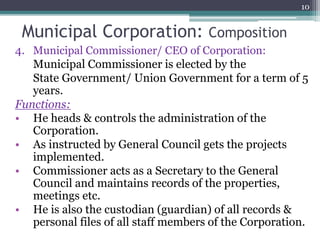
4. Municipal Commissioner/ CEO of Corporation:
Municipal Commissioner is elected by the
State Government/ Union Government for a term of 5
years.
Functions:
• He heads & controls the administration of the
Corporation.
• As instructed by General Council gets the projects
implemented.
• Commissioner acts as a Secretary to the General
Council and maintains records of the properties,
meetings etc.
• He is also the custodian (guardian) of all records &
personal files of all staff members of the Corporation.
10
Municipal Corporation: Composition
Functions of
Municipal
Corporation
Obligatory
(compulsory)
Discretionary
(Optional)
11
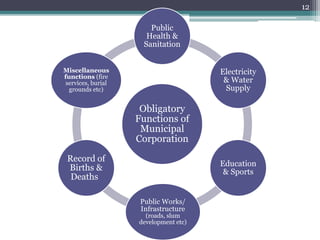
Obligatory
Functions of
Municipal
Corporation
Public
Health &
Sanitation
Electricity
& Water
Supply
Education
& Sports
Public Works/
Infrastructure
(roads, slum
development etc)
Record of
Births &
Deaths
Miscellaneous
functions (fire
services, burial
grounds etc)
12
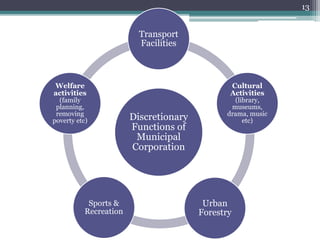
Discretionary
Functions of
Municipal
Corporation
Transport
Facilities
Cultural
Activities
(library,
museums,
drama, music
etc)
Urban
Forestry
Sports &
Recreation
Welfare
activities
(family
planning,
removing
poverty etc)
13
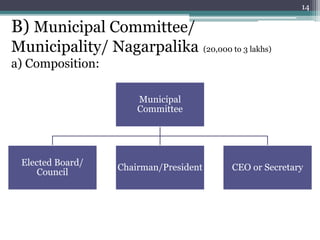
Municipal
Committee
Elected Board/
Council
Chairman/President CEO or Secretary
B) Municipal Committee/
Municipality/ Nagarpalika (20,000 to 3 lakhs)
a) Composition:
14
Municipal Committee Composition:
1. Elected Board/ Council:
a) It has members called as Councillors. These
Councillors are elected by registered voters within
the Municipal area.
b) Some seats are reserved for SCs & STs in
proportion to their population and atleast 23%
seats of the total number of seats are reserved for
women. Some states have raised it to 50% for
women.
c) The no. of councillors depends upon the
population of the city.
d) Term: 5 years. In the case of dissolution election
would be compulsorily held within six months.
15
2. Chairman/Municipal President:
• Councillors elect Chairman and Vice-Chairman
from among themselves. In some State general
voters elect the President/Chairperson.
Functions of Chairman/President of Municipal
Committee: (His functions are similar to the functions of a
Mayor in Municipal Corporation.)
• Decides agendas for the meetings.
• Presides all the meetings of the Municipal
Committee.
• Coordinates all the departments.
• Acts as a link between Municipal Committee and
State Government.
16
Municipal Committee Composition:
3. Chief Executive Officer (CEO) or The Secretary:
• CEO controls the administration of the Municipal
Committee.
• He is either taken from State cadre of Municipal
officers or from State Civil Service.
Functions:
• He heads & controls the administration of
the Municipal Committee.
• He distributes the work among other officers.
• He prepares Budget every year.
• Executive Officer acts as a Secretary to the
Council and maintains records of the properties,
meetings etc.
• He also grants licences and contracts for
various jobs.
17
Municipal Committee Composition:
Functions of
Municipal
Committee
Obligatory
(compulsory)
Discretionary
(Optional)
18
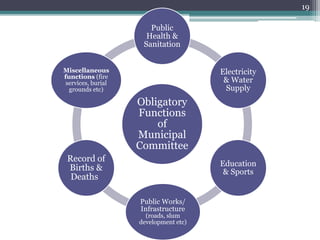
Obligatory
Functions
of
Municipal
Committee
Public
Health &
Sanitation
Electricity
& Water
Supply
Education
& Sports
Public Works/
Infrastructure
(roads, slum
development etc)
Record of
Births &
Deaths
Miscellaneous
functions (fire
services, burial
grounds etc)
19
Discretionary
Functions of
Municipal
Committee
Transport
Facilities
Cultural
Activities
(library,
museums,
drama, music
etc)
Urban
Forestry
Sports &
Recreation
Welfare
activities
(family
planning,
removing
poverty etc)
20
Difference Between:
Municipal Corporations
1. These are meant for big
cities.
2. Its head is called as
Mayor.
3. It has more powers and
sources of revenue.
4. It deals with State
Government directly.
Municipal Committees
1. These are meant for
smaller cities.
2. It head is called as
Chairman/President.
3. It has less powers and
sources of revenue.
4. It deals with State
Government indirectly
through District
Administration.
21