Growth of Nationalism
1
Nationalism: Meaning
 Nationalism is a feeling of
oneness and common
consciousness that is seen in the
people who live in a common
area/territory and share common
language, history, culture and values
and consider themselves as one
nation.
2
Factors
 Economic Exploitation (Peasants, Artisans &
Craftsmen, Working Class & Educated Indians)
 Repressive Colonial Policies (Vernacular Press
Act, Indian Arms Act, ICS Exam Eligibility age 21 -
> 19, Grand Delhi Darbar)
 Socio- Religious Reform Movements (Raja
Ram Mohan Roy, Jyotiba Phule)
 Role of Press ({TOI, Hindu, Bengali etc,}, ideas
of democracy, exposed true nature of British,
international events)
3
Factors promoting growth of Nationalism
1. Economic Exploitation:
 Indians realized that British are more interested in their
own interests instead of welfare of Indians.
 Unhappiness was seen in different sections of society
like:
1. Peasants: a big share was taken from their
produce in the form of Land revenue and
taxes.
2. Artisans and Craftsmen : British were against
Indian trade and industry. Indian handicrafts
industry was destroyed by British. Raw
material was taken from India and finished4
Economic Exploitation
5
3. Working Class: Due to Industry a new
class- working class was seen in the
society. Factory owners exploited this
class.
4. Educated Indians: For educated Indians
jobs were only available at Government
Service where competition was high and
had no chances of promotion. British
policies kept Indians economically
backward.
2.Repressive Colonial Policies
 British policies became major barrier to India’s
economic, social, cultural, intellectual and political
development.
 Policies introduced by Lord Lytton-Viceroy of India
(1876-80) acted as catalyst for growth of Nationalism.
1. Lakhs of rupees were spent At ‘Grand Delhi
Darbar’ in 1877 to declare Queen Victoria as
Empress of India. While Indians were facing a
famine on the other hand.
2. Vernacular Press Act (1878): Vernacular papers
weren't allowed to publish anything against
British government. It wasn’t applicable to
English newspapers.
3. Indian Arms Act (1878): Indians can’t carry
6
2.Repressive Colonial Policies
7
4. Eligibility to appear for Indian Civil Service
(ICS)Examination was reduced to 19 (from 21 yrs)
making Indians less competent.
5. Import duties on British textiles were removed. It
affected Indian industry.
6. Ilbert Bill (1883): Bill was introduced to abolish judicial
disqualification on the basis of racial discrimination.
British were against it. So introduced Defense
Association. Educated Indians protested. Bill was
withdrawn and more moderate measures were taken.
Bill made it clear that Indians shouldn’t expect justice
against Europeans.
3.Socio Religious Reform
Movements
 Indians realized that they need to reform their religion
and society. They accepted the best of East and West
which resulted in birth of socio-religious reform
movements.
 Examples: Abolition of Caste system, Child
Marriage, Dowry System, Purdah system, Sati,
Infanticide, Social and legal inequalities Along with
fighting religious superstitions, attacked idolatry,
hereditary priesthood etc.
 Some prominent reforms were:
1. Brahmo Samaj (Raja Rammohan Roy)
2. Arya Samaj (Swami Dayanand Saraswati)
3. Ramakrishna Mission (Swami Vivekanand)8
9
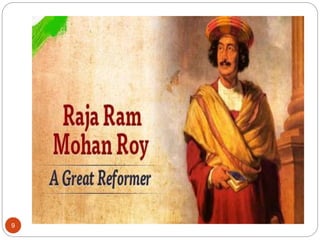
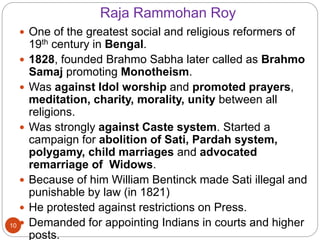
Raja Rammohan Roy
 One of the greatest social and religious reformers of
19th century in Bengal.
 1828, founded Brahmo Sabha later called as Brahmo
Samaj promoting Monotheism.
 Was against Idol worship and promoted prayers,
meditation, charity, morality, unity between all
religions.
 Was strongly against Caste system. Started a
campaign for abolition of Sati, Pardah system,
polygamy, child marriages and advocated
remarriage of Widows.
 Because of him William Bentinck made Sati illegal and
punishable by law (in 1821)
 He protested against restrictions on Press.
 Demanded for appointing Indians in courts and higher
posts.
10
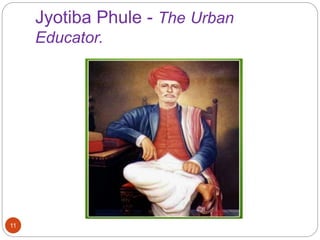
Jyotiba Phule - The Urban
Educator.
11
Jyotiba Phule
 Was an urban educator from low caste.
 Was critical about Hindu religion.
 1854, started a school for untouchables
and started a private orphanage for the
widows.
 Made people of deprived classes aware
about their rights and liberated them.
 1873, Satya Shodhak Samaj was founded
to give social justice for the weaker
sections of society.
 Worked for widow remarriage and12
Socio Religious Reform Movements
 These movements contributed to
nationalism in following ways:
1. Proved Indian culture and civilisation is
superior.
2. Fought against Untouchability and Caste
system.
3. Importance of women increased
4. Protested against British rule in India.
5. Equality for all was promoted.
13
4. Role of Press
 Large number of newspapers were started
like The Times of India, The Hindu, The
Bengali etc.
 Through the press message of nationalism
and ideas like democracy, liberty, freedom,
equality etc were spread across the nation.
 Press exposed the true nature British rule in
India and criticized repressive colonial
policies.
 Press made Indians aware of what is
happening around the world.14
Growth of Political Associations
 LANDHOLDER’s SOCIETY- First political
association was started in Kolkata (1838).
 Other associations included:
1. British India Association
2. East India Association (@London in 1866)
3. Indian Association (@Bengal in 1876)
4. London Indian Society
5. Bengal British India Society.
6. Indian National Conference (@ Kolkata in
1883)
These associations served as a basis for the
formation of
Congress- an all India political organization.
15
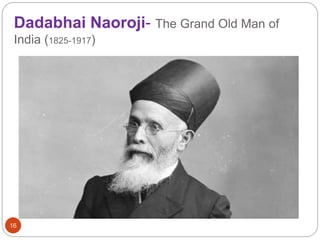
Dadabhai Naoroji- The Grand Old Man of
India (1825-1917)
16
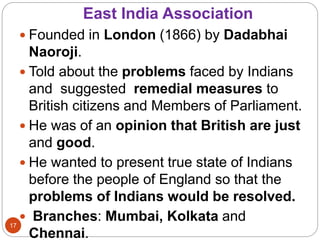
East India Association
 Founded in London (1866) by Dadabhai
Naoroji.
 Told about the problems faced by Indians
and suggested remedial measures to
British citizens and Members of Parliament.
 He was of an opinion that British are just
and good.
 He wanted to present true state of Indians
before the people of England so that the
problems of Indians would be resolved.
 Branches: Mumbai, Kolkata and
Chennai.
17
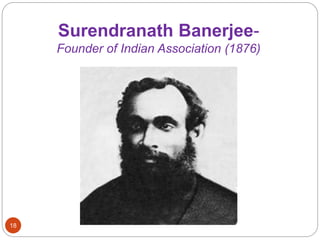
Surendranath Banerjee-
Founder of Indian Association (1876)
18
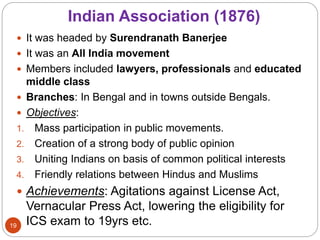
Indian Association (1876)
 It was headed by Surendranath Banerjee
 It was an All India movement
 Members included lawyers, professionals and educated
middle class
 Branches: In Bengal and in towns outside Bengals.
 Objectives:
1. Mass participation in public movements.
2. Creation of a strong body of public opinion
3. Uniting Indians on basis of common political interests
4. Friendly relations between Hindus and Muslims
 Achievements: Agitations against License Act,
Vernacular Press Act, lowering the eligibility for
ICS exam to 19yrs etc.19
Indian National Conference (1883)
 Surendranath Banerjee arranged the All India
National Conference in Kolkata.
 It was a provincial organisation
 It offered a model to Indian National Congress
(INC) which was formed after 2 years.
 Second Session of Indian National Conference
was held in 1885 at Kolkata at the same time INC
held its session in Mumbai
 Both had same purpose: Welfare of Indians
 Finally National Conference merged in the Indian
National Congress in December 1886.
20
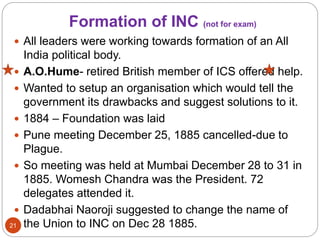
Formation of INC (not for exam)
 All leaders were working towards formation of an All
India political body.
 A.O.Hume- retired British member of ICS offered help.
 Wanted to setup an organisation which would tell the
government its drawbacks and suggest solutions to it.
 1884 – Foundation was laid
 Pune meeting December 25, 1885 cancelled-due to
Plague.
 So meeting was held at Mumbai December 28 to 31 in
1885. Womesh Chandra was the President. 72
delegates attended it.
 Dadabhai Naoroji suggested to change the name of
the Union to INC on Dec 28 1885.21
Aims of INC
 Promote friendly relations between all
leaders from different parts of the country.
 Develop feeling of National Unity
irrespective of caste or religion.
 To put together popular demands and
present them before the government
 To train and organize public opinion in
the country.
22
Sessions of the INC
 First Session:
Year: 1885
Place: Mumbai
President: Womesh Chandra
Banerjee
 Second Session
Year: 1886
Place: Kolkata
President: Dadabhai Naoroji23