 Introduction
 Sources
 Origin and Extent
 Urban Planning: Harappan Cities, Town
Planning & Houses
 Trade
 Arts and Crafts
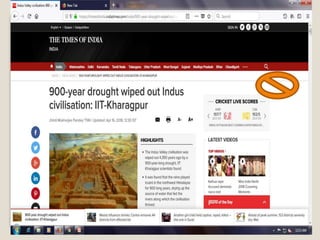
 Decline
Introduction
 An advanced stage of human cultural
development is called as Civilisation.
 Traits (character/qualities) of civilisation are:
a) Evolution of cities
b) Surplus (extra/excess) Food
c) Division of labour
d) System of writing
e) Monumental (massive/huge)Public buildings
f) Development of technology
Introduction
 Man settled on the banks of the rivers.
 River valleys offered fertile land to
produce surplus food for the
population.
 Surplus food helped people to move to
other fields and become specialists in
wood, metals, construction, writing etc.
 This finally helped the civilisation to
develop.
Chalcolithic Period
 Metals replaced stone. Metal was more
durable.
 Copper was the first metal that was
discovered.
 The period when man used both- STONE
and COPPER is called as CHALCOLITHIC
Period.
Bronze Age Civilisation
 Later, Copper was mixed with Tin or Zinc
to form an alloy called BRONZE.
 Bronze is more hard and ductile than
copper. Hence was used to manufacture
tools, utensils and weapons.
 Bronze became important and hence this
period was called as Bronze Period.
 And the first civilisations that used Bronze
were called as Bronze Age Civilisations.
It played an important role in its growth.
Four Bronze Age Civilisations
 Four Bronze Age Civilisations seen were:
1) Harappan Civilisation in Northern and
Western parts of India and Pakistan on
the banks of the river indus.
2) Mesopotamian Civilisation in Iraq on
the banks of the rivers: Euphrates and
Tigris.
3) Chinese Civilisation in the valleys of
the rivers: Hwany Yo and Yangtze.
4) Egyptian Civilisation in Egypt on the
banks of the river Nile.
Indus valley/Harappan Civilisation
 Indus valley civilisation was discovered in
20th century.
 Indus valley civilisation is known for its
Harappan culture.
 It is also called as Harappan Civilisation
after the name of the first site: Harappan
site, that was found in the Indus region in
1921.
 In 1922, second site: Mohenjo-Daro was
found.
Discovery of Harappa
 In 1901 – Sir John Marshal revealed the
Harappan civilisation.
 In 1921- Dayaram Sahni (officer in
ASI- Archaeological Survey of India)
Discovery of Mohenjo-Daro
 In 1922- R.D.Banerjee was led to the
site by a Buddhist monk. Monk expected
the site to be a Buddhist Stupa. But this
was the city of Mohenjo-Daro.
 Mohenjo-Daro – means mound
(mountain/heap) of the dead.
Sources of Harappa
 No adequate written records are available
to get the knowledge of Harappan
civilisation.
 So, the knowledge that we have about it
is entirely based on the archaeological
remains such as buildings, pottery,
sculpture, seals ,cemeteries etc.
 The major sources of our information are:
1) The Great Bath, 2) The Citadel,
3) Seals, 4) Bearded Man,
5) Dancing Girl, 6)Dockyard, 7)
Script,
Sources of Harappa: Great Bath
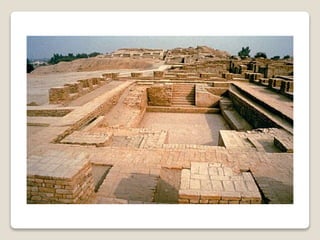
 Great Bath: The great bath at Mohenjo-Daro is
a huge structure.
 It denotes that the art of building had reached a
high degree of perfection.
 It denotes the existence of ruling class which
built such huge structures for the public.
 Burnt bricks were used to build it. It had flight
of steps on North and South leading to the
tank.
 The walls of the pool were made watertight,
specially-made bricks and gypsum mortar.
 It might have been used for religious purposes.
 It shows advanced planning with features like
water supply and drainage.
Sources of Harappa: The Citadel
 The raised area of each city was called as
the Citadel.
 The area was raised with the help of mud
brick platforms.
 Ruling class had their houses in this area
along with other important buildings like
the Great Bath, Granary, Assembly Hall
and the Workshops.
 It denotes advanced planning. We can call
it an urban civilisation.
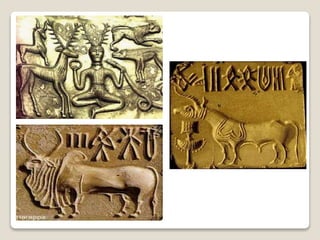
Sources of Harappa: Seals
 Seals: The seals used by harappans show
their artistic skills.
 2000 seals have been discovered.
 It comprises of seals with one horned bull,
buffalo, tiger, goat, elephant and rhinoceros.
 Seals were Rectangular, Square or Circular.
 Pashupati Seal shows that they believed
Shiva.
 Unicorn Seal shows their mythical beliefs.
 Seals were used by traders to stamp their
goods. Seals were pressed on the layer of
wet clay after tying the knot to the bag of
goods.
 Seals were found in different areas.
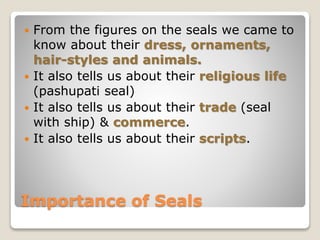
Importance of Seals
 From the figures on the seals we came to
know about their dress, ornaments,
hair-styles and animals.
 It also tells us about their religious life
(pashupati seal)
 It also tells us about their trade (seal
with ship) & commerce.
 It also tells us about their scripts.
Sources of Harappa:
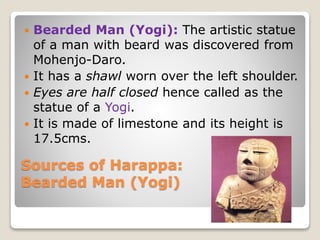
Bearded Man (Yogi)
 Bearded Man (Yogi): The artistic statue
of a man with beard was discovered from
Mohenjo-Daro.
 It has a shawl worn over the left shoulder.
 Eyes are half closed hence called as the
statue of a Yogi.
 It is made of limestone and its height is
17.5cms.
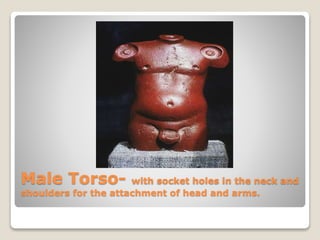
Male Torso- with socket holes in the neck and
shoulders for the attachment of head and arms.
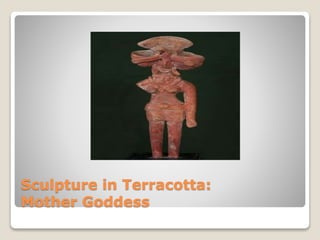
Sculpture in Terracotta:
Mother Goddess
Sources of Harappa:
Dancing Girl
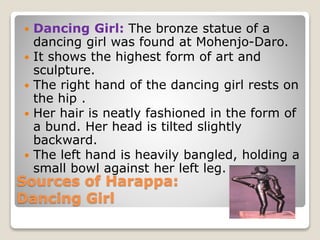
 Dancing Girl: The bronze statue of a
dancing girl was found at Mohenjo-Daro.
 It shows the highest form of art and
sculpture.
 The right hand of the dancing girl rests on
the hip .
 Her hair is neatly fashioned in the form of
a bund. Her head is tilted slightly
backward.
 The left hand is heavily bangled, holding a
small bowl against her left leg.
Sources of Harappa: Dockyard
 Dockyard (sea port/dock): A rectangular
dock was discovered at Lothal in Gujarat.
 It was surrounded by a huge brick wall to
protect it from floods.
 It was made of baked bricks.
 It was an important sea port of Indus
Valley Civilisation used for carrying out
overseas trade.
Sources of Harappa: Scripts
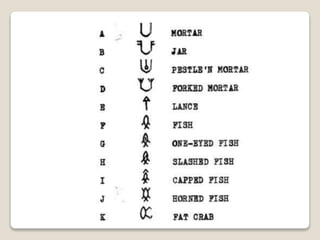
 Script: Harappans used a pictographic
script with signs representing birds, fish
and humans.
 375 to 400 number of Harappan scripts
were found.
 Scripts were inscribed (to write with pressure) on
seals, copper tools, rims of jars, copper
and terracotta tablets, jewellery and
ancient signboard.
 In some cases it is written from right to
left and in some it is from left to right.
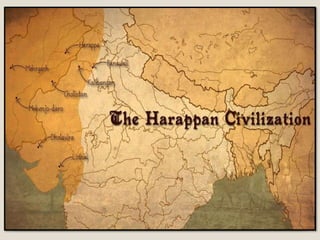
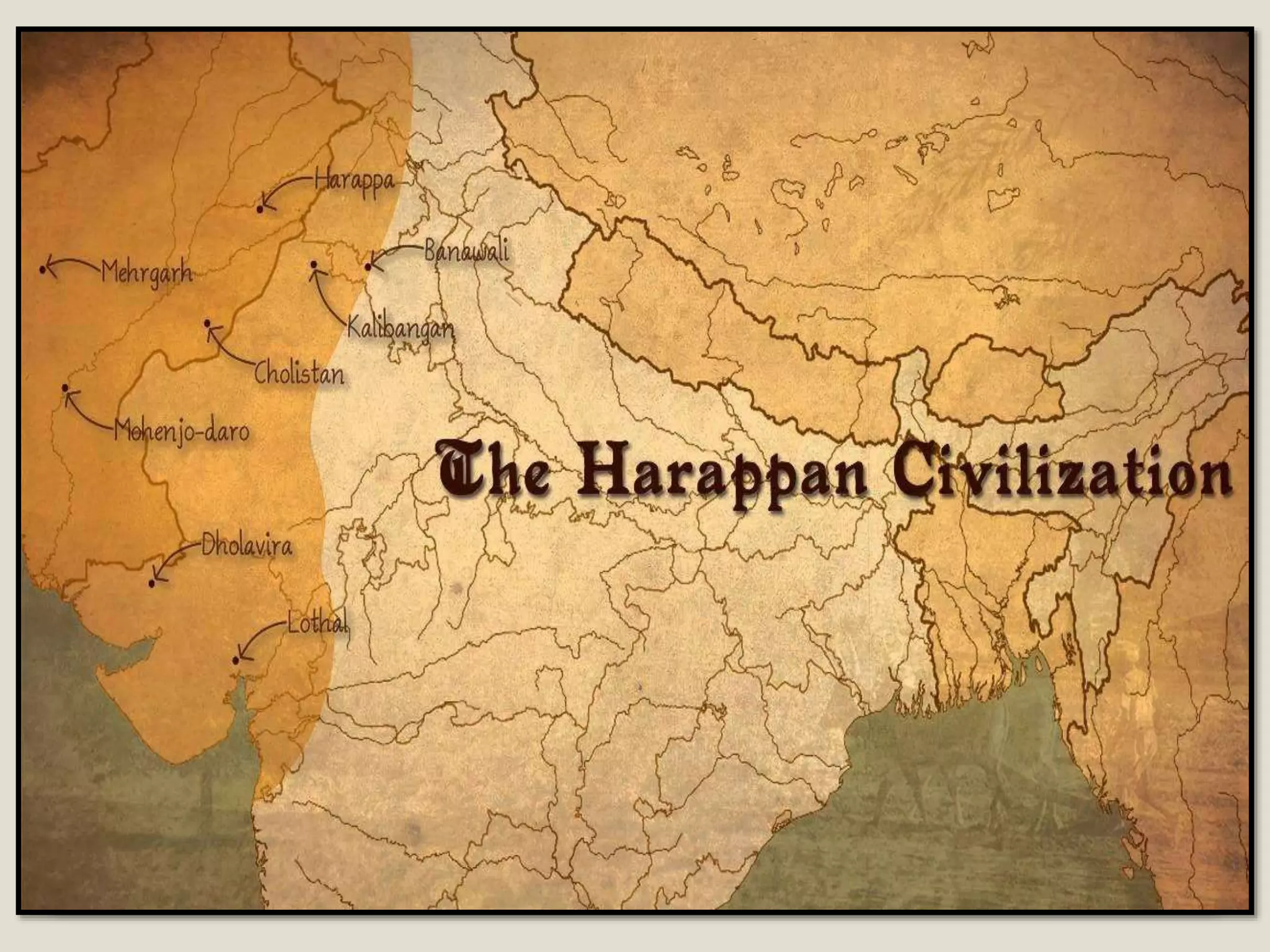
Origin and Extent of Harappan
Civilisation
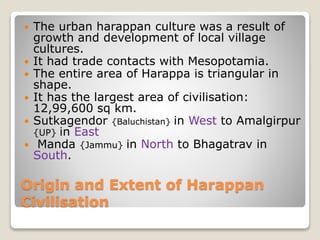
 The urban harappan culture was a result of
growth and development of local village
cultures.
 It had trade contacts with Mesopotamia.
 The entire area of Harappa is triangular in
shape.
 It has the largest area of civilisation:
12,99,600 sq km.
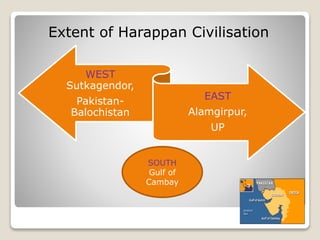
 Sutkagendor {Baluchistan} in West to Amalgirpur
{UP} in East
 Manda {Jammu} in North to Bhagatrav in
South.
WEST
Sutkagendor,
Pakistan-
Balochistan
EAST
Alamgirpur,
UP
SOUTH
Gulf of
Cambay
Extent of Harappan Civilisation
Urban Planning
 Six Harappan Cities included:
1. Harappa- Montgomery district in
Punjab.
2. Mohenjo-Daro in Larkana district in
Sindh (now in Pakistan).
 Both the cities are linked by river Indus
hence called as Indus valley civilisation.
3. Chanhudaro {near Mohenjo-Daro- South}
4. Lothal in Gujarat
5. Kalibangan {Rajasthan}
6. Banawali {Hissar, Haryana}
 The Indus cities followed Grid Pattern.
 Each city was divided into two parts: Citadel
and the Lower town.
 Streets also followed a grid pattern.
 Houses at street corners were rounded to
allow carts to pass easily.
 House drains emptied all waste water into the
street drains.
 Houses were not allowed to encroach upon
the streets.
 House drains were connected to main drain.
At regular intervals it had manholes for
inspection and cleaning. Provision of drainage
clearly indicates their concern about
sanitation and health.
Urban Planning
Houses
 Residential buildings were built on high
mound to protect from floods.
 Houses were spacious with rooms and
bathrooms.
 Each house had covered drains connected
with street drains.
 Houses were single/double storeyed.
 Houses had courtyard and kitchen.
 Houses were made of wood and brick.
 Each house had doors and windows.
Doors and windows opened on side of the
street and not on the main roads.
Trade
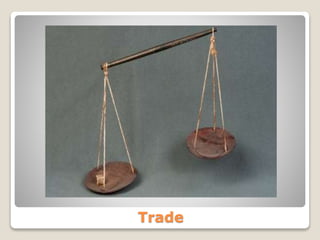
 Granaries, seals, script, regulated weight
and measures in a wide area indicate the
existence of a highly developed system of
trade.
 Harappans not only traded with others part of
India but also with other countries in Asia.
 Barter system was used by them. They
traded stone, metal, shell etc.
 Mohenjo-Daro, Harappa and Lothal were
important centres for metallurgy. Tools,
kitchenware and other objects were produced
here.
Trade
Trade
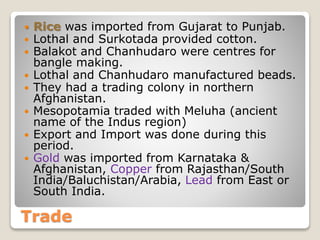
 Rice was imported from Gujarat to Punjab.
 Lothal and Surkotada provided cotton.
 Balakot and Chanhudaro were centres for
bangle making.
 Lothal and Chanhudaro manufactured beads.
 They had a trading colony in northern
Afghanistan.
 Mesopotamia traded with Meluha (ancient
name of the Indus region)
 Export and Import was done during this
period.
 Gold was imported from Karnataka &
Afghanistan, Copper from Rajasthan/South
India/Baluchistan/Arabia, Lead from East or
South India.
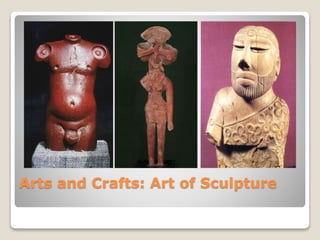
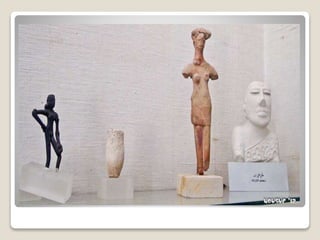
Arts and Crafts: Art of Sculpture
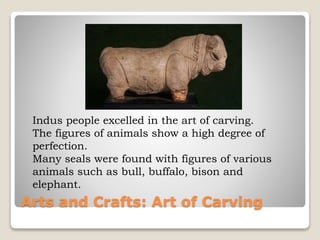
Arts and Crafts: Art of Carving
Indus people excelled in the art of carving.
The figures of animals show a high degree of
perfection.
Many seals were found with figures of various
animals such as bull, buffalo, bison and
elephant.
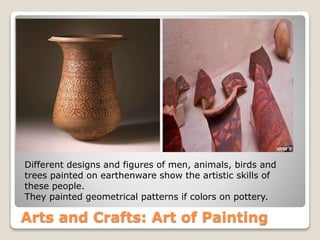
Arts and Crafts: Art of Painting
Different designs and figures of men, animals, birds and
trees painted on earthenware show the artistic skills of
these people.
They painted geometrical patterns if colors on pottery.
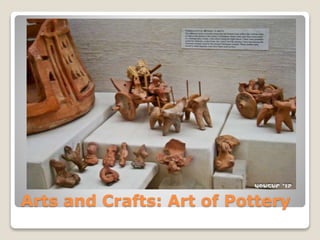
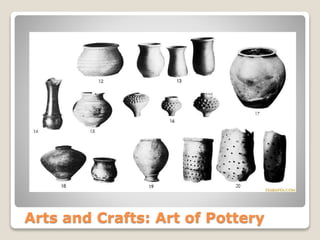
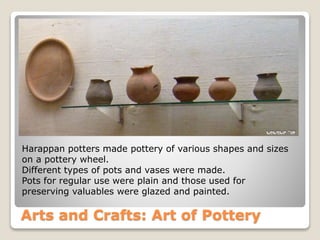
Arts and Crafts: Art of Pottery
Harappan potters made pottery of various shapes and sizes
on a pottery wheel.
Different types of pots and vases were made.
Pots for regular use were plain and those used for
preserving valuables were glazed and painted.
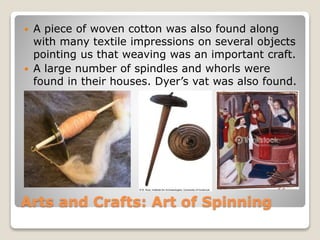
Arts and Crafts: Art of Spinning
 A piece of woven cotton was also found along
with many textile impressions on several objects
pointing us that weaving was an important craft.
 A large number of spindles and whorls were
found in their houses. Dyer’s vat was also found.
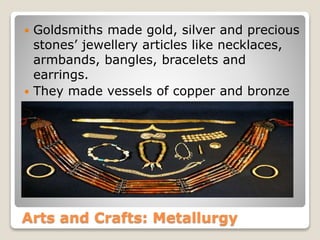
 Goldsmiths made gold, silver and precious
stones’ jewellery articles like necklaces,
armbands, bangles, bracelets and
earrings.
 They made vessels of copper and bronze
Arts and Crafts: Metallurgy
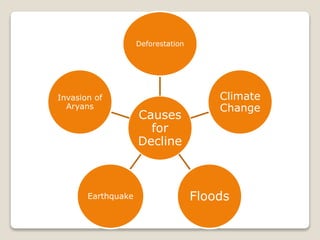
Decline of the Civilisation 1800 BC
 Floods and Climate Change: Heavy rainfall
affected agriculture and stock breeding.
Decrease in fertile land because of the
expansion of the near by desert. Sudden
floods can be a few reasons for the decline.
 Deforestation: Indus valley was Bronze Age
civilisation so enormous quantities of wood
was needed to produce bronze. Wood was
also needed to produce jewellery, pottery,
bake bricks, boats, furniture etc thus leading
to deforestation causing the climatic change.
 Attack: Aryans might have invaded the city.
 Earthquake
Causes
for
Decline
Deforestation
Climate
Change
FloodsEarthquake
Invasion of
Aryans
Harappan Civilisation

Harappan Civilisation

  • 2.
     Introduction  Sources Origin and Extent  Urban Planning: Harappan Cities, Town Planning & Houses  Trade  Arts and Crafts  Decline
  • 3.
    Introduction  An advancedstage of human cultural development is called as Civilisation.  Traits (character/qualities) of civilisation are: a) Evolution of cities b) Surplus (extra/excess) Food c) Division of labour d) System of writing e) Monumental (massive/huge)Public buildings f) Development of technology
  • 4.
    Introduction  Man settledon the banks of the rivers.  River valleys offered fertile land to produce surplus food for the population.  Surplus food helped people to move to other fields and become specialists in wood, metals, construction, writing etc.  This finally helped the civilisation to develop.
  • 5.
    Chalcolithic Period  Metalsreplaced stone. Metal was more durable.  Copper was the first metal that was discovered.  The period when man used both- STONE and COPPER is called as CHALCOLITHIC Period.
  • 6.
    Bronze Age Civilisation Later, Copper was mixed with Tin or Zinc to form an alloy called BRONZE.  Bronze is more hard and ductile than copper. Hence was used to manufacture tools, utensils and weapons.  Bronze became important and hence this period was called as Bronze Period.  And the first civilisations that used Bronze were called as Bronze Age Civilisations. It played an important role in its growth.
  • 7.
    Four Bronze AgeCivilisations  Four Bronze Age Civilisations seen were: 1) Harappan Civilisation in Northern and Western parts of India and Pakistan on the banks of the river indus. 2) Mesopotamian Civilisation in Iraq on the banks of the rivers: Euphrates and Tigris. 3) Chinese Civilisation in the valleys of the rivers: Hwany Yo and Yangtze. 4) Egyptian Civilisation in Egypt on the banks of the river Nile.
  • 8.
    Indus valley/Harappan Civilisation Indus valley civilisation was discovered in 20th century.  Indus valley civilisation is known for its Harappan culture.  It is also called as Harappan Civilisation after the name of the first site: Harappan site, that was found in the Indus region in 1921.  In 1922, second site: Mohenjo-Daro was found.
  • 9.
    Discovery of Harappa In 1901 – Sir John Marshal revealed the Harappan civilisation.  In 1921- Dayaram Sahni (officer in ASI- Archaeological Survey of India)
  • 10.
    Discovery of Mohenjo-Daro In 1922- R.D.Banerjee was led to the site by a Buddhist monk. Monk expected the site to be a Buddhist Stupa. But this was the city of Mohenjo-Daro.  Mohenjo-Daro – means mound (mountain/heap) of the dead.
  • 11.
    Sources of Harappa No adequate written records are available to get the knowledge of Harappan civilisation.  So, the knowledge that we have about it is entirely based on the archaeological remains such as buildings, pottery, sculpture, seals ,cemeteries etc.  The major sources of our information are: 1) The Great Bath, 2) The Citadel, 3) Seals, 4) Bearded Man, 5) Dancing Girl, 6)Dockyard, 7) Script,
  • 12.
    Sources of Harappa:Great Bath  Great Bath: The great bath at Mohenjo-Daro is a huge structure.  It denotes that the art of building had reached a high degree of perfection.  It denotes the existence of ruling class which built such huge structures for the public.  Burnt bricks were used to build it. It had flight of steps on North and South leading to the tank.  The walls of the pool were made watertight, specially-made bricks and gypsum mortar.  It might have been used for religious purposes.  It shows advanced planning with features like water supply and drainage.
  • 14.
    Sources of Harappa:The Citadel  The raised area of each city was called as the Citadel.  The area was raised with the help of mud brick platforms.  Ruling class had their houses in this area along with other important buildings like the Great Bath, Granary, Assembly Hall and the Workshops.  It denotes advanced planning. We can call it an urban civilisation.
  • 15.
    Sources of Harappa:Seals  Seals: The seals used by harappans show their artistic skills.  2000 seals have been discovered.  It comprises of seals with one horned bull, buffalo, tiger, goat, elephant and rhinoceros.  Seals were Rectangular, Square or Circular.  Pashupati Seal shows that they believed Shiva.  Unicorn Seal shows their mythical beliefs.  Seals were used by traders to stamp their goods. Seals were pressed on the layer of wet clay after tying the knot to the bag of goods.  Seals were found in different areas.
  • 16.
    Importance of Seals From the figures on the seals we came to know about their dress, ornaments, hair-styles and animals.  It also tells us about their religious life (pashupati seal)  It also tells us about their trade (seal with ship) & commerce.  It also tells us about their scripts.
  • 18.
    Sources of Harappa: BeardedMan (Yogi)  Bearded Man (Yogi): The artistic statue of a man with beard was discovered from Mohenjo-Daro.  It has a shawl worn over the left shoulder.  Eyes are half closed hence called as the statue of a Yogi.  It is made of limestone and its height is 17.5cms.
  • 19.
    Male Torso- withsocket holes in the neck and shoulders for the attachment of head and arms.
  • 20.
  • 21.
    Sources of Harappa: DancingGirl  Dancing Girl: The bronze statue of a dancing girl was found at Mohenjo-Daro.  It shows the highest form of art and sculpture.  The right hand of the dancing girl rests on the hip .  Her hair is neatly fashioned in the form of a bund. Her head is tilted slightly backward.  The left hand is heavily bangled, holding a small bowl against her left leg.
  • 22.
    Sources of Harappa:Dockyard  Dockyard (sea port/dock): A rectangular dock was discovered at Lothal in Gujarat.  It was surrounded by a huge brick wall to protect it from floods.  It was made of baked bricks.  It was an important sea port of Indus Valley Civilisation used for carrying out overseas trade.
  • 23.
    Sources of Harappa:Scripts  Script: Harappans used a pictographic script with signs representing birds, fish and humans.  375 to 400 number of Harappan scripts were found.  Scripts were inscribed (to write with pressure) on seals, copper tools, rims of jars, copper and terracotta tablets, jewellery and ancient signboard.  In some cases it is written from right to left and in some it is from left to right.
  • 25.
    Origin and Extentof Harappan Civilisation  The urban harappan culture was a result of growth and development of local village cultures.  It had trade contacts with Mesopotamia.  The entire area of Harappa is triangular in shape.  It has the largest area of civilisation: 12,99,600 sq km.  Sutkagendor {Baluchistan} in West to Amalgirpur {UP} in East  Manda {Jammu} in North to Bhagatrav in South.
  • 26.
  • 27.
    Urban Planning  SixHarappan Cities included: 1. Harappa- Montgomery district in Punjab. 2. Mohenjo-Daro in Larkana district in Sindh (now in Pakistan).  Both the cities are linked by river Indus hence called as Indus valley civilisation. 3. Chanhudaro {near Mohenjo-Daro- South} 4. Lothal in Gujarat 5. Kalibangan {Rajasthan} 6. Banawali {Hissar, Haryana}
  • 28.
     The Induscities followed Grid Pattern.  Each city was divided into two parts: Citadel and the Lower town.  Streets also followed a grid pattern.  Houses at street corners were rounded to allow carts to pass easily.  House drains emptied all waste water into the street drains.  Houses were not allowed to encroach upon the streets.  House drains were connected to main drain. At regular intervals it had manholes for inspection and cleaning. Provision of drainage clearly indicates their concern about sanitation and health. Urban Planning
  • 29.
    Houses  Residential buildingswere built on high mound to protect from floods.  Houses were spacious with rooms and bathrooms.  Each house had covered drains connected with street drains.  Houses were single/double storeyed.  Houses had courtyard and kitchen.  Houses were made of wood and brick.  Each house had doors and windows. Doors and windows opened on side of the street and not on the main roads.
  • 30.
    Trade  Granaries, seals,script, regulated weight and measures in a wide area indicate the existence of a highly developed system of trade.  Harappans not only traded with others part of India but also with other countries in Asia.  Barter system was used by them. They traded stone, metal, shell etc.  Mohenjo-Daro, Harappa and Lothal were important centres for metallurgy. Tools, kitchenware and other objects were produced here.
  • 31.
  • 32.
    Trade  Rice wasimported from Gujarat to Punjab.  Lothal and Surkotada provided cotton.  Balakot and Chanhudaro were centres for bangle making.  Lothal and Chanhudaro manufactured beads.  They had a trading colony in northern Afghanistan.  Mesopotamia traded with Meluha (ancient name of the Indus region)  Export and Import was done during this period.  Gold was imported from Karnataka & Afghanistan, Copper from Rajasthan/South India/Baluchistan/Arabia, Lead from East or South India.
  • 33.
    Arts and Crafts:Art of Sculpture
  • 35.
    Arts and Crafts:Art of Carving Indus people excelled in the art of carving. The figures of animals show a high degree of perfection. Many seals were found with figures of various animals such as bull, buffalo, bison and elephant.
  • 36.
    Arts and Crafts:Art of Painting Different designs and figures of men, animals, birds and trees painted on earthenware show the artistic skills of these people. They painted geometrical patterns if colors on pottery.
  • 37.
    Arts and Crafts:Art of Pottery
  • 38.
    Arts and Crafts:Art of Pottery
  • 39.
    Arts and Crafts:Art of Pottery Harappan potters made pottery of various shapes and sizes on a pottery wheel. Different types of pots and vases were made. Pots for regular use were plain and those used for preserving valuables were glazed and painted.
  • 40.
    Arts and Crafts:Art of Spinning  A piece of woven cotton was also found along with many textile impressions on several objects pointing us that weaving was an important craft.  A large number of spindles and whorls were found in their houses. Dyer’s vat was also found.
  • 41.
     Goldsmiths madegold, silver and precious stones’ jewellery articles like necklaces, armbands, bangles, bracelets and earrings.  They made vessels of copper and bronze Arts and Crafts: Metallurgy
  • 42.
    Decline of theCivilisation 1800 BC  Floods and Climate Change: Heavy rainfall affected agriculture and stock breeding. Decrease in fertile land because of the expansion of the near by desert. Sudden floods can be a few reasons for the decline.  Deforestation: Indus valley was Bronze Age civilisation so enormous quantities of wood was needed to produce bronze. Wood was also needed to produce jewellery, pottery, bake bricks, boats, furniture etc thus leading to deforestation causing the climatic change.  Attack: Aryans might have invaded the city.  Earthquake
  • 43.