National Movement 1939-47
• Second World War and Nationalist Response
– Gandhi – Unconditional Support to the Allied Powers
– Subhash Bose – Launch CDM to take advantage of the War
– Nehru – Neutral to the War
• Pakistan Resolution (March 1940)
• August Offer (August 1940)
– Dominion Status
– Expansion of Viceroy’s Executive Council
– Setting up of Constitutional Assembly after the war where mainly Indians would
decide the Constitution
– No Future Constitution to be adopted without the Consent of the Minorities
Continued…
• Individual Satyagrahas (1941)
– Aims
• Express People’s Opinion that they were not interested in War
• Another Opportunity to the Government to accept INC Demands
– Strategy
• Freedom of Speech against the war through Anti war Declaration
• Delhi Chalo Movement
– Vinobha Bhave was the First Satyagrahi and Nehru, the Second
• Cripps Mission (March 1942)
– Dominion Status to India
– Free to Decide its relation with Commonwealth and Freedom to participate in
UN
– Constituent Assembly- Partly Elected by Provincial Assemblies and Partly
Nominated by Princes
– British to accept the Constitution under 2 Conditions
• Any province not willing to Join Indian Union could have a separate
Constitution and Form Separate Union
• Safeguard the religious rights of the Minorities
Quit India Movement
• AICC Meeting – Gowalia Tank, Bombay ( August 8, 1942)
– Government Servants : Don’t Resign, but declare allegiance to Congress
– Soldiers : Don’t resign, but don’t fire on Indians
– Students : If Confident, leave Studies
– Peasants : Do not pay rent if Zamindar is Pro- Government
– Princes : Support the Masses
– People of Princely States : Support the prince only if he is anti-government
– Do or Die
• Arrest of all Congress Leaders in early hours of August 9
• Public on Rampage
• Underground Activity
– Ram Manohar Lohia, Jayaprakash Narayan, Aruna Asaf Ali, Achyut Patwardhan,
Sucheta Kriplani
– Usha Sharma Started Underground radio in Bombay
Continued…
• Parallel Governments
– Ballia under Chittu Pandey
– Tamluk ( Midnapore) – “Jatiya Sarkar”, Bidyut Bahinis
organised to undertake Cyclone relief works, Education,
Healthcare etc
– Satara – “Prati Sarkar” under Y B Chavan and Nana Patil
• Gandhi undertook 21 days fast on Feb 10, 1943 against Violence
of the State
• Rajagopalachari Formula
– Muslim league to Endorse Congress Demand for Independence
– The entire population in the Muslim Majority Provinces to decide
whether to Join India or Form separate Entity
– In case of partition, a joint agreement between the countries to
safeguard Defence, Communication etc
Continued…
 Desai- Liaqat Plan ( Draft proposal for Formation of Interim Government)
 Equal number of Seats to be nominated by INC and Muslim league in
the Central Legislature
 20% to be reserved for the Minorities
 Wavell Plan (1945) – ( Reconstitute the Governor General’s Executive
Council)
 Except the Governor General and Commander in Chief, all other
members of Executive Council were to be Indians
 Equal representation of Hindus and Muslims
 Political Parties to submit the Joint list for the Members in the
Executive Council through Consensus
 If Consensus is not possible, separate lists to be presented by the
Political Parties
Indian National Army
• Formed by Mohan Singh in Malaysia
• Main Points:
– Subhash Bose was assisted by Rash Behari Bose
– Set up Provisional Government in Rangoon and Singapore
– Women’s Regiment was Called as “ Rani Jhansi Regiment”
– INA battalion commanded by Shah Nawaz allowed to accompany
Japanese Troops to Indo-Burma border and participate in Imphal
Campaign
– Failure of Imphal Campaign and surrender of INA
• Post war nationalist Upsurges
– INA trials
• Prem Kumar Sehgal, Shah Nawaz Khan and Gurbhaksh Singh
Dhillon tried at Red Fort
• Defence of INA prisoners was organised by Bhulabhai Desai, Tej
Bahadur Sapru, Kailash Nath Katju
• INA Agitation : Nov 12, 1945 ( INA Day), Nov 5-11,1945 ( INA
Week)
• Wide Publicity of the Trials, Participation of Diverse Groups
Continued…
• RIN Mutiny ( Feb 18,1946)
– Phase 1 : Naval ratings of HMIS Talwar staged Mutiny against
• Racial Discrimination
• Unhygienic Food
• Abuse by Superior Officers
• Arrest of B.C Dutt, a rating for writing “Quit India” on HMIS
Talwar
– Phase 2 : People in Bombay joined the Ratings. Hartals by
Shopkeepers, Workers, Students
– Phase 3 : Strikes on HMIS Hindustan and in other millitary
Establishments
Cabinet Mission
• 3 members : Pethick Lawrence ( Secretary of State) , Cripps and A.V.
Alexander
• Main Points
– Rejected the Demand for Separate Pakistan
– Grouping of existing provincial assemblies into 3 sections
• Section A : Madras, Bombay, Central Provinces, United Provinces,
Bihar and Orissa(HinduMajority Provinces)
• Section B : Punjab, NWFP, Sindh (Muslim Majority Provinces)
• Section C : Bengal and Assam (Muslim Majority Provinces)
– Constituent Assembly partly elected by Provincial Assemblies and
partly nominated by Princely States
– Members from Group A, B and C to frame constitution for the
Provinces seperately
– All the members of the group to frame constitution for the Union
– A common centre to control Defence, Communication and External
Affairs
• Different Interpretations on Grouping Clause – Compulsory or Optional
• Rejection of Cabinet Mission Plan by the Muslim League
Continued…
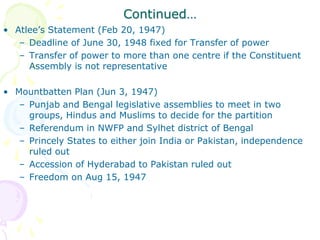
• Atlee’s Statement (Feb 20, 1947)
– Deadline of June 30, 1948 fixed for Transfer of power
– Transfer of power to more than one centre if the Constituent
Assembly is not representative
• Mountbatten Plan (Jun 3, 1947)
– Punjab and Bengal legislative assemblies to meet in two
groups, Hindus and Muslims to decide for the partition
– Referendum in NWFP and Sylhet district of Bengal
– Princely States to either join India or Pakistan, independence
ruled out
– Accession of Hyderabad to Pakistan ruled out
– Freedom on Aug 15, 1947

National movement 1939 1947

  • 1.
    National Movement 1939-47 •Second World War and Nationalist Response – Gandhi – Unconditional Support to the Allied Powers – Subhash Bose – Launch CDM to take advantage of the War – Nehru – Neutral to the War • Pakistan Resolution (March 1940) • August Offer (August 1940) – Dominion Status – Expansion of Viceroy’s Executive Council – Setting up of Constitutional Assembly after the war where mainly Indians would decide the Constitution – No Future Constitution to be adopted without the Consent of the Minorities
  • 2.
    Continued… • Individual Satyagrahas(1941) – Aims • Express People’s Opinion that they were not interested in War • Another Opportunity to the Government to accept INC Demands – Strategy • Freedom of Speech against the war through Anti war Declaration • Delhi Chalo Movement – Vinobha Bhave was the First Satyagrahi and Nehru, the Second • Cripps Mission (March 1942) – Dominion Status to India – Free to Decide its relation with Commonwealth and Freedom to participate in UN – Constituent Assembly- Partly Elected by Provincial Assemblies and Partly Nominated by Princes – British to accept the Constitution under 2 Conditions • Any province not willing to Join Indian Union could have a separate Constitution and Form Separate Union • Safeguard the religious rights of the Minorities
  • 3.
    Quit India Movement •AICC Meeting – Gowalia Tank, Bombay ( August 8, 1942) – Government Servants : Don’t Resign, but declare allegiance to Congress – Soldiers : Don’t resign, but don’t fire on Indians – Students : If Confident, leave Studies – Peasants : Do not pay rent if Zamindar is Pro- Government – Princes : Support the Masses – People of Princely States : Support the prince only if he is anti-government – Do or Die • Arrest of all Congress Leaders in early hours of August 9 • Public on Rampage • Underground Activity – Ram Manohar Lohia, Jayaprakash Narayan, Aruna Asaf Ali, Achyut Patwardhan, Sucheta Kriplani – Usha Sharma Started Underground radio in Bombay
  • 4.
    Continued… • Parallel Governments –Ballia under Chittu Pandey – Tamluk ( Midnapore) – “Jatiya Sarkar”, Bidyut Bahinis organised to undertake Cyclone relief works, Education, Healthcare etc – Satara – “Prati Sarkar” under Y B Chavan and Nana Patil • Gandhi undertook 21 days fast on Feb 10, 1943 against Violence of the State • Rajagopalachari Formula – Muslim league to Endorse Congress Demand for Independence – The entire population in the Muslim Majority Provinces to decide whether to Join India or Form separate Entity – In case of partition, a joint agreement between the countries to safeguard Defence, Communication etc
  • 5.
    Continued…  Desai- LiaqatPlan ( Draft proposal for Formation of Interim Government)  Equal number of Seats to be nominated by INC and Muslim league in the Central Legislature  20% to be reserved for the Minorities  Wavell Plan (1945) – ( Reconstitute the Governor General’s Executive Council)  Except the Governor General and Commander in Chief, all other members of Executive Council were to be Indians  Equal representation of Hindus and Muslims  Political Parties to submit the Joint list for the Members in the Executive Council through Consensus  If Consensus is not possible, separate lists to be presented by the Political Parties
  • 6.
    Indian National Army •Formed by Mohan Singh in Malaysia • Main Points: – Subhash Bose was assisted by Rash Behari Bose – Set up Provisional Government in Rangoon and Singapore – Women’s Regiment was Called as “ Rani Jhansi Regiment” – INA battalion commanded by Shah Nawaz allowed to accompany Japanese Troops to Indo-Burma border and participate in Imphal Campaign – Failure of Imphal Campaign and surrender of INA • Post war nationalist Upsurges – INA trials • Prem Kumar Sehgal, Shah Nawaz Khan and Gurbhaksh Singh Dhillon tried at Red Fort • Defence of INA prisoners was organised by Bhulabhai Desai, Tej Bahadur Sapru, Kailash Nath Katju • INA Agitation : Nov 12, 1945 ( INA Day), Nov 5-11,1945 ( INA Week) • Wide Publicity of the Trials, Participation of Diverse Groups
  • 7.
    Continued… • RIN Mutiny( Feb 18,1946) – Phase 1 : Naval ratings of HMIS Talwar staged Mutiny against • Racial Discrimination • Unhygienic Food • Abuse by Superior Officers • Arrest of B.C Dutt, a rating for writing “Quit India” on HMIS Talwar – Phase 2 : People in Bombay joined the Ratings. Hartals by Shopkeepers, Workers, Students – Phase 3 : Strikes on HMIS Hindustan and in other millitary Establishments
  • 8.
    Cabinet Mission • 3members : Pethick Lawrence ( Secretary of State) , Cripps and A.V. Alexander • Main Points – Rejected the Demand for Separate Pakistan – Grouping of existing provincial assemblies into 3 sections • Section A : Madras, Bombay, Central Provinces, United Provinces, Bihar and Orissa(HinduMajority Provinces) • Section B : Punjab, NWFP, Sindh (Muslim Majority Provinces) • Section C : Bengal and Assam (Muslim Majority Provinces) – Constituent Assembly partly elected by Provincial Assemblies and partly nominated by Princely States – Members from Group A, B and C to frame constitution for the Provinces seperately – All the members of the group to frame constitution for the Union – A common centre to control Defence, Communication and External Affairs • Different Interpretations on Grouping Clause – Compulsory or Optional • Rejection of Cabinet Mission Plan by the Muslim League
  • 9.
    Continued… • Atlee’s Statement(Feb 20, 1947) – Deadline of June 30, 1948 fixed for Transfer of power – Transfer of power to more than one centre if the Constituent Assembly is not representative • Mountbatten Plan (Jun 3, 1947) – Punjab and Bengal legislative assemblies to meet in two groups, Hindus and Muslims to decide for the partition – Referendum in NWFP and Sylhet district of Bengal – Princely States to either join India or Pakistan, independence ruled out – Accession of Hyderabad to Pakistan ruled out – Freedom on Aug 15, 1947