THE MUSLIM LEAGUE
LESSON -6
We will learn….
Factors leading to the formation of
Muslim League.
Objectives of the
Muslim League .
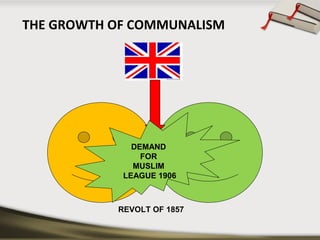
THE GROWTH OF COMMUNALISM
REVOLT OF 1857
DEMAND
FOR
MUSLIM
LEAGUE 1906
FACTORS- FORMATION OF MUSLIM LEAGUE
• LOSS OF SOVEREIGNTY OF THE MUGHAL
EMPIRE
• PARTICIPATION IN REVOLT 1857
• BRITISH DISCRIMINATION TOWARDS
MUSLIMS
• AFTER 1870 APPEASEMENT OF MUSLIMS
THE BRITISH POLICY OF DIVIDE AND RULE
• Unity of the Muslims and Hindus was a threat.
• Encouraged communal and separatist politics.
• Under Lord Mayo’s rule, Urdu was made the
medium of instruction and huge grants were given to
schools run by Muslims.
• To Hindus- they portrayed Muslims as foreigners
who plundered Indian wealth and the rule of the
Rajputana Dynasty.
• Justified the partition of Bengal to create Muslim
majority and Muslim state, as Hindus would not
work for the welfare of Muslim population
• Use the caste system- Brahmins and lower
castes.
• Treated Hindus , Muslims and Sikhs as
different communities and recognized their
respective leaders as authentic.
• Spread communal hatred- through posters,
literature and public platform.
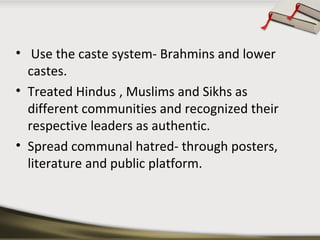
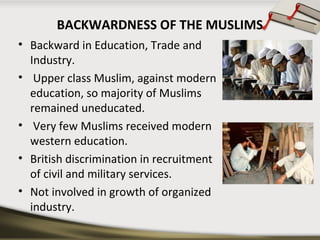
BACKWARDNESS OF THE MUSLIMS
• Backward in Education, Trade and
Industry.
• Upper class Muslim, against modern
education, so majority of Muslims
remained uneducated.
• Very few Muslims received modern
western education.
• British discrimination in recruitment
of civil and military services.
• Not involved in growth of organized
industry.
BACKWARDNESS OF THE MUSLIMS
• Muslims were too proud of their literature , did not
accept western education.
• Western education necessary for the government
jobs.
• Muslims continued to remain backward whereas
Hindus accepted the western education and
developed.
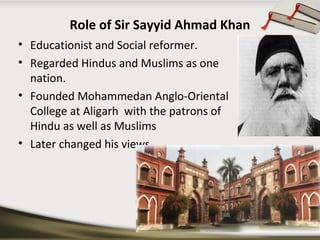
Role of Sir Sayyid Ahmad Khan
• Educationist and Social reformer.
• Regarded Hindus and Muslims as one
nation.
• Founded Mohammedan Anglo-Oriental
College at Aligarh with the patrons of
Hindu as well as Muslims
• Later changed his views…….
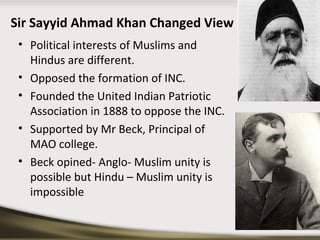
Sir Sayyid Ahmad Khan Changed View
• Political interests of Muslims and
Hindus are different.
• Opposed the formation of INC.
• Founded the United Indian Patriotic
Association in 1888 to oppose the INC.
• Supported by Mr Beck, Principal of
MAO college.
• Beck opined- Anglo- Muslim unity is
possible but Hindu – Muslim unity is
impossible
Sir Sayyid Ahmad Khan Changed View
• Hindu population is in majority , they would dominate
after the Britishers have left.
• The British Rule is advantageous for the growth and
welfare of the Muslim Community.
• Educated Muslims should support the British so that
they are rewarded with government jobs and special
favours.
Mis-interpretation of History
• Divided Indian history into two phases-
– Hindu History : Hindu rule- Rana Pratap, Shivaji
– Muslim History- Turks, Akbar, Aurangzeb.
• Failed to interpret to Composite culture.
• Hindu culture was not developed in the Muslim
period, but Muslim literature and culture was
developed.
• Communalism propagated through poetry,
drama, novels and newspapers.
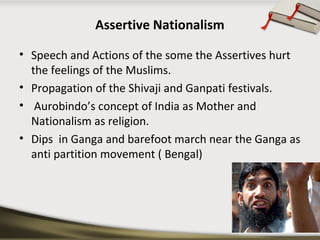
Assertive Nationalism
• Speech and Actions of the some the Assertives hurt
the feelings of the Muslims.
• Propagation of the Shivaji and Ganpati festivals.
• Aurobindo’s concept of India as Mother and
Nationalism as religion.
• Dips in Ganga and barefoot march near the Ganga as
anti partition movement ( Bengal)
THE FORMATION OF
MUSLIM LEAGUE
• Hindi Vs Urdu: Court language in Muslim dominated
areas was Urdu, many hindu sections unhappy about
this, so govt made the also included hindi as court
language. This hurt the sentiments of Muslims.
• Congress became more popular than the MAO.
• President of MAO Nawab Mohsin- ul- Mulk (after
the death of Sir Sayyed) raised the agitation for hindi
– urdu controversy.
• Lt Governor of UP, Macdonnel very angry, asked
Nawab to resign.
• Muslim decided to form political party.
• Muslims in East Bengal happy to have independent
state and supported the Partition of Bengal.
• Lord Minto announced more representation to
Indians in the Legislative council.
• Muslims decided to address the Viceroy. Content of
their address was decided by Mr Archibald new
principal of MAO.
– Begin the address with pledging loyalty to British rule.
– request for representation on basis of religion.
The Demands..
• 35 influential Muslims presented the address to
Viceroy in Shimla on 1 Oct 1906.
• Representation to Muslim as per political importance
and not numerical strength.
• Separate Electoral Constituencies.
• Preference should be given to Muslims while filing
the nominations.
• Reservation of seats for Muslims in State services.
• State aid for Muslim universities.
• December 1906, all the emminent muslims met at
Dacca and proposed to form a centrally orgainsed
political party named – All India Muslim League.
– President : Nawab Salimullah
– Permanent President : Agha Khan.
– Head Quarters : Aligarh
– Central Office : Lucknow
– Formed a party constitution in Karachi on December 1907
– Held the first session in Amritsar on Decemeber 1908
– Session Chairman : Syed Ali Imam
AIMS AND OBJECTIVES
• Support British government and earn a good rapport
with them.
• protect and advance the political rights of the
Muslims.
• Maintain peace between Muslims and other
communities.
THE IMPACT….
• More importance to political representation than
welfare of the muslim masses.
• Morley – Minto reforms formed the separate
electorate for the muslims.
• Turko- Italian and Balkan War ( where British
Massacred many muslims) hurt the feelings of the
Indian Muslims and they criticized the British for
such policies and launched the Khilfat Movement
• Annulment of the Partition of Bengal- detrimental for
the Muslim
• Young member of the League disliked the loyalty to
the British.
The rapprochment
• The Lucknow Pact- 1916
– Congress and Muslim League came to an agreement
– Congress accepted communal electorate.
– in 1930 the League made a demand for a separate nation
PAKISTAN.
Muslim league

Muslim league

  • 1.
  • 2.
    We will learn…. Factorsleading to the formation of Muslim League. Objectives of the Muslim League .
  • 3.
    THE GROWTH OFCOMMUNALISM REVOLT OF 1857 DEMAND FOR MUSLIM LEAGUE 1906
  • 4.
    FACTORS- FORMATION OFMUSLIM LEAGUE • LOSS OF SOVEREIGNTY OF THE MUGHAL EMPIRE • PARTICIPATION IN REVOLT 1857 • BRITISH DISCRIMINATION TOWARDS MUSLIMS • AFTER 1870 APPEASEMENT OF MUSLIMS
  • 5.
    THE BRITISH POLICYOF DIVIDE AND RULE
  • 6.
    • Unity ofthe Muslims and Hindus was a threat. • Encouraged communal and separatist politics. • Under Lord Mayo’s rule, Urdu was made the medium of instruction and huge grants were given to schools run by Muslims. • To Hindus- they portrayed Muslims as foreigners who plundered Indian wealth and the rule of the Rajputana Dynasty. • Justified the partition of Bengal to create Muslim majority and Muslim state, as Hindus would not work for the welfare of Muslim population
  • 7.
    • Use thecaste system- Brahmins and lower castes. • Treated Hindus , Muslims and Sikhs as different communities and recognized their respective leaders as authentic. • Spread communal hatred- through posters, literature and public platform.
  • 8.
    BACKWARDNESS OF THEMUSLIMS • Backward in Education, Trade and Industry. • Upper class Muslim, against modern education, so majority of Muslims remained uneducated. • Very few Muslims received modern western education. • British discrimination in recruitment of civil and military services. • Not involved in growth of organized industry.
  • 9.
    BACKWARDNESS OF THEMUSLIMS • Muslims were too proud of their literature , did not accept western education. • Western education necessary for the government jobs. • Muslims continued to remain backward whereas Hindus accepted the western education and developed.
  • 10.
    Role of SirSayyid Ahmad Khan • Educationist and Social reformer. • Regarded Hindus and Muslims as one nation. • Founded Mohammedan Anglo-Oriental College at Aligarh with the patrons of Hindu as well as Muslims • Later changed his views…….
  • 11.
    Sir Sayyid AhmadKhan Changed View • Political interests of Muslims and Hindus are different. • Opposed the formation of INC. • Founded the United Indian Patriotic Association in 1888 to oppose the INC. • Supported by Mr Beck, Principal of MAO college. • Beck opined- Anglo- Muslim unity is possible but Hindu – Muslim unity is impossible
  • 12.
    Sir Sayyid AhmadKhan Changed View • Hindu population is in majority , they would dominate after the Britishers have left. • The British Rule is advantageous for the growth and welfare of the Muslim Community. • Educated Muslims should support the British so that they are rewarded with government jobs and special favours.
  • 13.
    Mis-interpretation of History •Divided Indian history into two phases- – Hindu History : Hindu rule- Rana Pratap, Shivaji – Muslim History- Turks, Akbar, Aurangzeb. • Failed to interpret to Composite culture. • Hindu culture was not developed in the Muslim period, but Muslim literature and culture was developed. • Communalism propagated through poetry, drama, novels and newspapers.
  • 14.
    Assertive Nationalism • Speechand Actions of the some the Assertives hurt the feelings of the Muslims. • Propagation of the Shivaji and Ganpati festivals. • Aurobindo’s concept of India as Mother and Nationalism as religion. • Dips in Ganga and barefoot march near the Ganga as anti partition movement ( Bengal)
  • 15.
  • 16.
    • Hindi VsUrdu: Court language in Muslim dominated areas was Urdu, many hindu sections unhappy about this, so govt made the also included hindi as court language. This hurt the sentiments of Muslims. • Congress became more popular than the MAO. • President of MAO Nawab Mohsin- ul- Mulk (after the death of Sir Sayyed) raised the agitation for hindi – urdu controversy. • Lt Governor of UP, Macdonnel very angry, asked Nawab to resign. • Muslim decided to form political party.
  • 17.
    • Muslims inEast Bengal happy to have independent state and supported the Partition of Bengal. • Lord Minto announced more representation to Indians in the Legislative council. • Muslims decided to address the Viceroy. Content of their address was decided by Mr Archibald new principal of MAO. – Begin the address with pledging loyalty to British rule. – request for representation on basis of religion.
  • 18.
    The Demands.. • 35influential Muslims presented the address to Viceroy in Shimla on 1 Oct 1906. • Representation to Muslim as per political importance and not numerical strength. • Separate Electoral Constituencies. • Preference should be given to Muslims while filing the nominations. • Reservation of seats for Muslims in State services. • State aid for Muslim universities.
  • 19.
    • December 1906,all the emminent muslims met at Dacca and proposed to form a centrally orgainsed political party named – All India Muslim League. – President : Nawab Salimullah – Permanent President : Agha Khan. – Head Quarters : Aligarh – Central Office : Lucknow – Formed a party constitution in Karachi on December 1907 – Held the first session in Amritsar on Decemeber 1908 – Session Chairman : Syed Ali Imam
  • 20.
  • 21.
    • Support Britishgovernment and earn a good rapport with them. • protect and advance the political rights of the Muslims. • Maintain peace between Muslims and other communities.
  • 22.
  • 23.
    • More importanceto political representation than welfare of the muslim masses. • Morley – Minto reforms formed the separate electorate for the muslims. • Turko- Italian and Balkan War ( where British Massacred many muslims) hurt the feelings of the Indian Muslims and they criticized the British for such policies and launched the Khilfat Movement • Annulment of the Partition of Bengal- detrimental for the Muslim • Young member of the League disliked the loyalty to the British.
  • 24.
    The rapprochment • TheLucknow Pact- 1916 – Congress and Muslim League came to an agreement – Congress accepted communal electorate. – in 1930 the League made a demand for a separate nation PAKISTAN.