Presentation on :
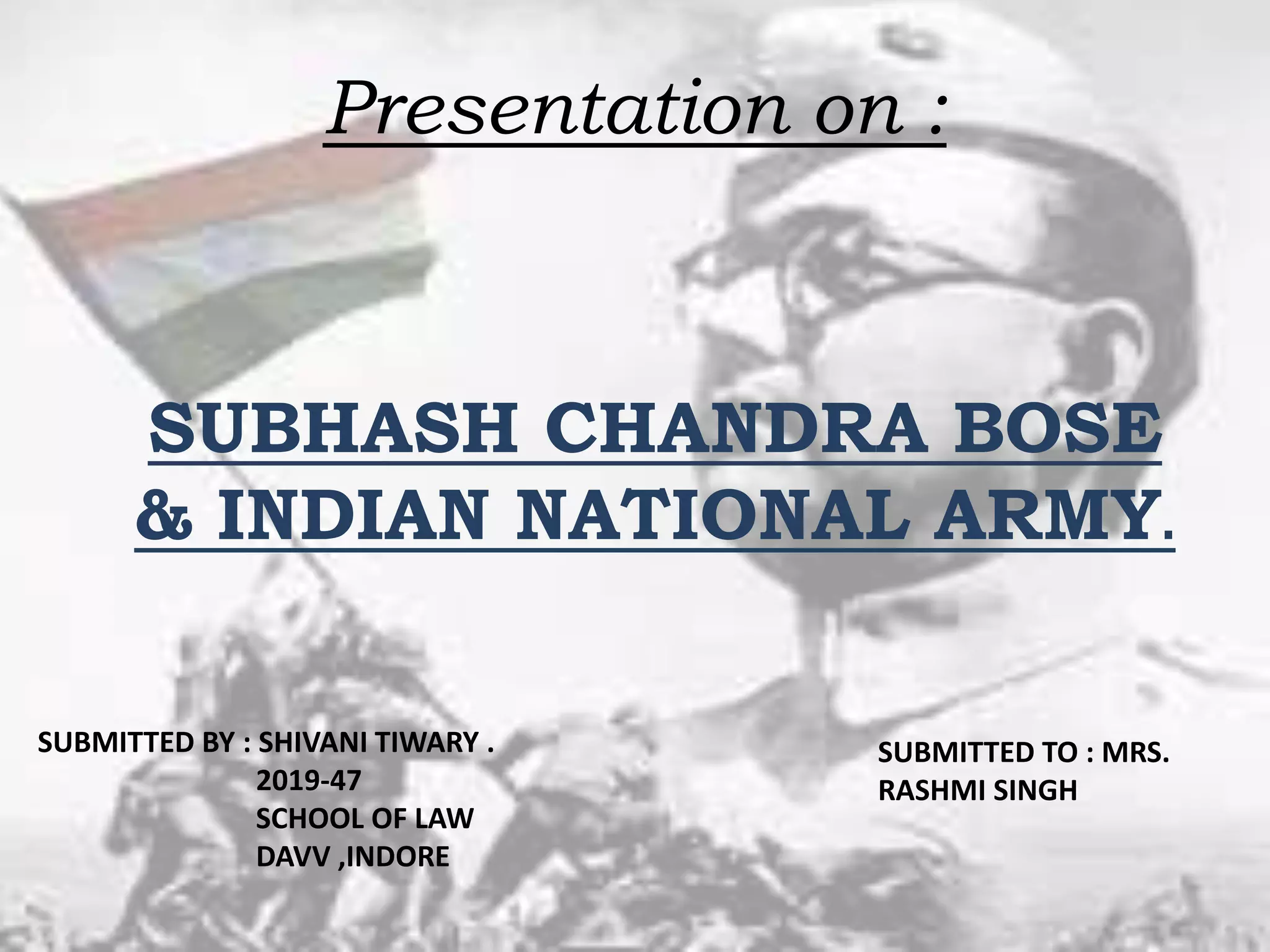
SUBHASH CHANDRA BOSE
& INDIAN NATIONAL ARMY.
SUBMITTED BY : SHIVANI TIWARY .
2019-47
SCHOOL OF LAW
DAVV ,INDORE
SUBMITTED TO : MRS.
RASHMI SINGH
CONTENTS
SERAIL
NO.
TITLE
1. INTRODUCTION .
2. EARLY LIFE & POLITICAL ACTIVITY OF BOSE .
3. BOSE & INDIAN NATIONAL CONGRESS .
4. FALLING OUT WITH GANDHI .
5. FORWARD BLOC & INDIAN NATIONAL ARMY .
6. CONCLUSION .
7. BIBLIOGRAPHY .
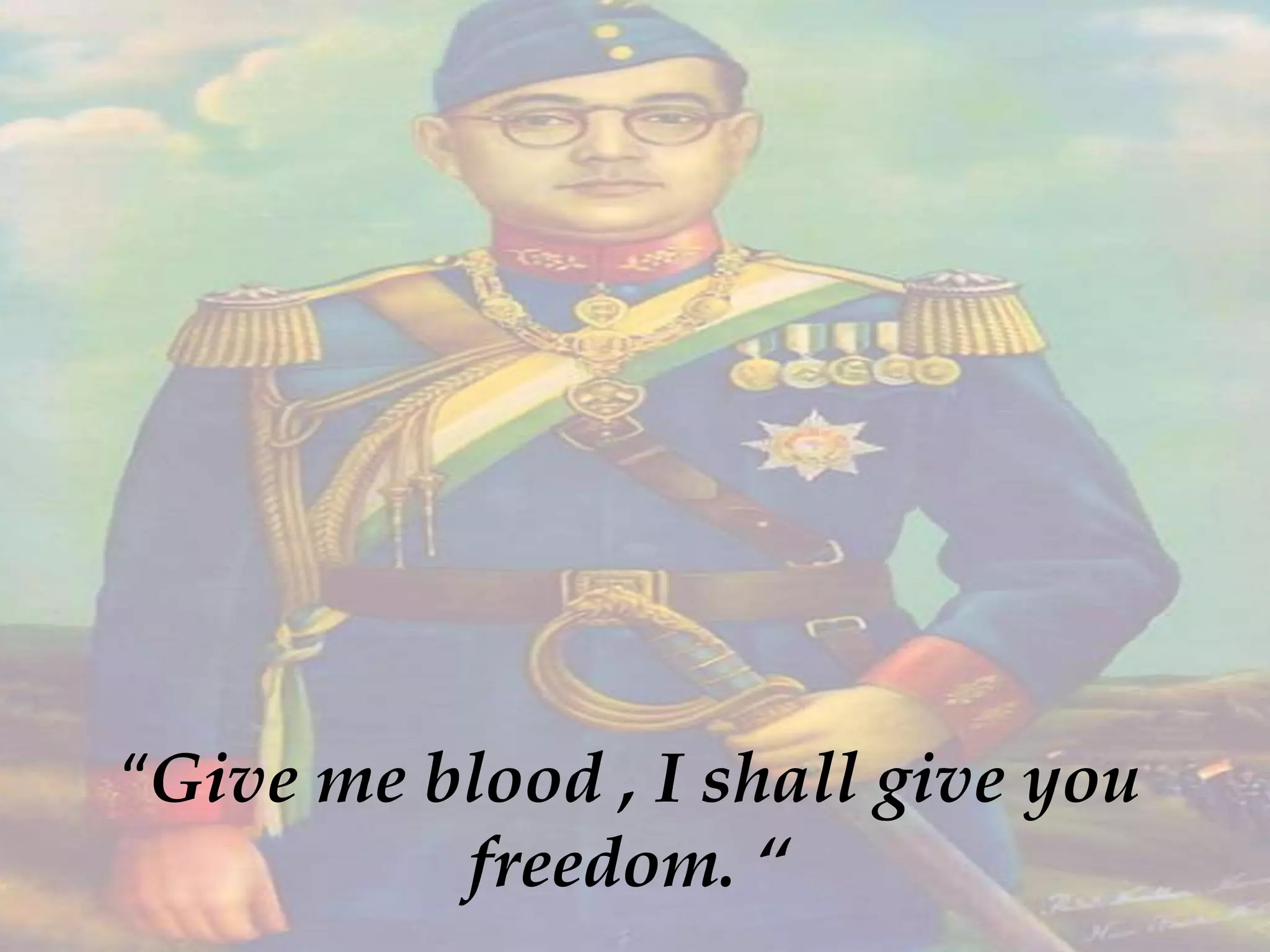
“Give me blood , I shall give you
freedom. “
INTRODUCTION
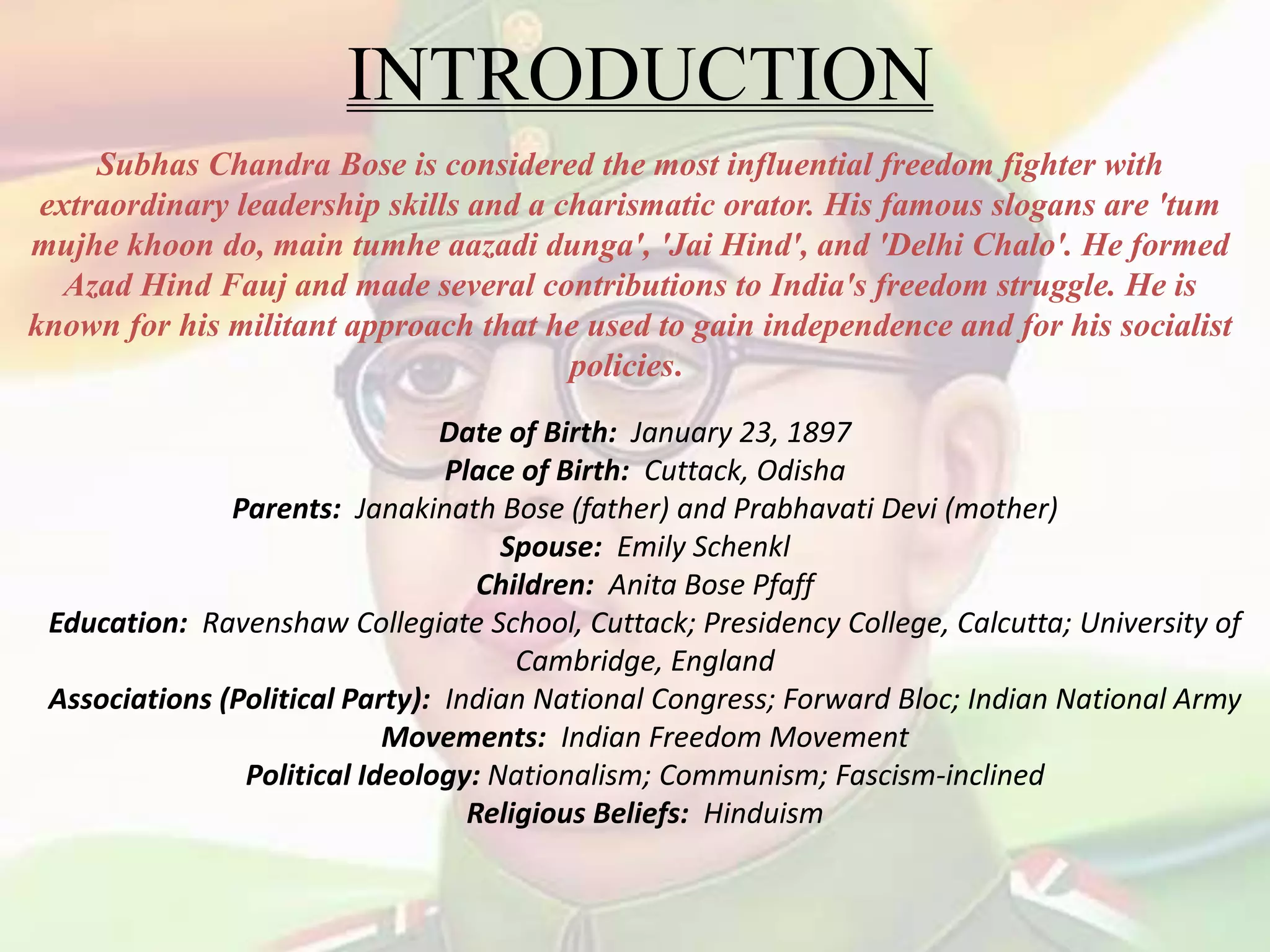
Subhas Chandra Bose is considered the most influential freedom fighter with
extraordinary leadership skills and a charismatic orator. His famous slogans are 'tum
mujhe khoon do, main tumhe aazadi dunga', 'Jai Hind', and 'Delhi Chalo'. He formed
Azad Hind Fauj and made several contributions to India's freedom struggle. He is
known for his militant approach that he used to gain independence and for his socialist
policies.
Date of Birth: January 23, 1897
Place of Birth: Cuttack, Odisha
Parents: Janakinath Bose (father) and Prabhavati Devi (mother)
Spouse: Emily Schenkl
Children: Anita Bose Pfaff
Education: Ravenshaw Collegiate School, Cuttack; Presidency College, Calcutta; University of
Cambridge, England
Associations (Political Party): Indian National Congress; Forward Bloc; Indian National Army
Movements: Indian Freedom Movement
Political Ideology: Nationalism; Communism; Fascism-inclined
Religious Beliefs: Hinduism
EARLY LIFE & POLITICAL
CAREER.
• Subhas Chandra Bose was born on 23 January 1897 (at 12.10 pm)
in Cuttack, Orissa Division, Bengal Province, to Prabhavati Dutt
Bose and Janakinath Bose, an advocate belonging to a Kayastha family. He was the
ninth in a family of 14 children. His family was well to do.
• He was admitted to the Protestant European School (presently Stewart High
School) in Cuttack, in January 1902. He continued his studies at this school which
was run by the Baptist Mission up to 1909 and then shifted to the Ravenshaw
Collegiate School. After securing the second position in the matriculation
examination in 1913, he was admitted to the Presidency College where he studied
briefly .
• He was influenced by the teachings of Swami Vivekananda and Ramakrishna after
reading their works at the age of 16. He felt that his religion was more important
than his studies.
• In those days, the British in Calcutta often made offensive remarks to the Indians
in public places and insulted them openly. This behavior of the British as well as
the outbreak of World War I began to influence his thinking.
• His nationalistic temperament came to light when he was expelled for assaulting
Professor Oaten (who had manhandled some Indian students ). He was expelled
although he appealed that he only witnessed the assault and did not actually
participate in it .He later joined the Scottish Church College at the University of
Calcutta and passed his B.A. in 1918 in philosophy.
• Bose left India for Europe on 15 September 1919, arriving in London on 20
October. He had made a promise to his father to prepare and appear for
the Indian Civil Services (ICS) examination, for which his father has made
available Rs 10,000. In London, Bose readied his application for the ICS,
staying in Belsize Park with his brother Satish, who was preparing for the bar
exam .
• Bose was eager to gain admission to a college at the University of
Cambridge. However, it was already past the deadline for admission. With the
help of some Indian students there and Mr. Reddaway, the Censor of Fitzwilliam
Hall, a body run by the Non-Collegiate Students Board of the university, for
making available the university's education at an economical cost without formal
admission to a college, Bose entered the register of the university on 19
November 1919.
INDIAN NATIONAL CONGRESS
• He started the newspaper Swaraj and took charge of publicity for the Bengal
Provincial Congress Committee. His mentor was Chittaranjan Das who was a
spokesman for aggressive nationalism in Bengal. In the year 1923, Bose was elected
the President of All India Youth Congress and also the Secretary of Bengal State
Congress.
• He was also the editor of the newspaper "Forward", founded by Chittaranjan
Das.Bose worked as the CEO of the Calcutta Municipal Corporation for Das when
the latter was elected mayor of Calcutta in 1924.] In a roundup of nationalists in
1925, Bose was arrested and sent to prison in Mandalay, where he
contracted tuberculosis.
• In 1927, after being released from prison, Bose became general secretary of the
Congress party and worked with Jawaharlal Nehru for independence. In late
December 1928, Bose organised the Annual Meeting of the Indian National
Congress in Calcutta.His most memorable role was as General Officer Commanding
(GOC) Congress Volunteer Corps.
• Mahatma Gandhi is a sincere pacifist vowed to non-violence, did not like the
strutting, clicking of boots, and saluting, and he afterward described the Calcutta
session of the Congress as a Bertram Mills circus, which caused a great deal of
indignation among the Bengalis. A little later, Bose was again arrested and jailed
for civil disobedience; this time he emerged to become Mayor of Calcutta in 1930.
Falling out with Gandhi
 Vocal support for Gandhi increased within the Indian National Congress,
meanwhile, and, in light of this, Gandhi resumed a more commanding
role in the party.
 When the civil disobedience movement was started in 1930, Bose was
already in detention for his associations with an underground
revolutionary group, the Bengal Volunteers. Nevertheless, he was
elected mayor of Calcutta while in prison.
 Released and then rearrested several times for his suspected role in
violent acts, Bose was finally allowed to proceed to Europe after he
contracted tuberculosis and was released for ill health.
 In enforced exile and still ill, he wrote The Indian Struggle, 1920–
1934 and pleaded India’s cause with European leaders. He returned
from Europe in 1936, was again taken into custody, and was released
after a year.
• Meanwhile, Bose became increasingly critical of Gandhi’s
more conservative economics as well as his less confrontational approach
toward independence.
• In 1938 he was elected president of the Indian National Congress and formed
a national planning committee, which formulated a policy of broad
industrialization. However, this did not harmonize with Gandhian economic
thought, which clung to the notion of cottage industries and benefiting from
the use of the country’s own resources.
• Bose’s vindication came in 1939, when he defeated a Gandhian rival for
reelection. Nonetheless, the “rebel president” felt bound to resign because of
the lack of Gandhi’s support.
• He founded the Forward Bloc, hoping to rally radical elements, but was again
incarcerated in July 1940. His refusal to remain in prison at this critical period
of India’s history was expressed in a determination to fast to death, which
frightened the British government into releasing him.
• On January 26, 1941, though closely watched, he escaped from his Calcutta
residence in disguise and, traveling via Kabul and Moscow, eventually
reached Germany in April.
• Subhas Chandra Bose and the
formation of Forward Bloc :
All India Forward Bloc was a left
wing nationalist political party in
India which emerged as a faction
within the India Congress in 1939,
led by Subhas Chandra Bose. He
was well known for his leftist views
in the Congress. The prime objective
of the Froward Bloc was to bring all
radical elements of the Congress
party. So that he could spread the
meaning of complete independence
of India with adherence of the
application of principles of equality
and social justice.
Subhas Chandra Bose and Indian
National Army (INA) or Azad Hind
Fauz
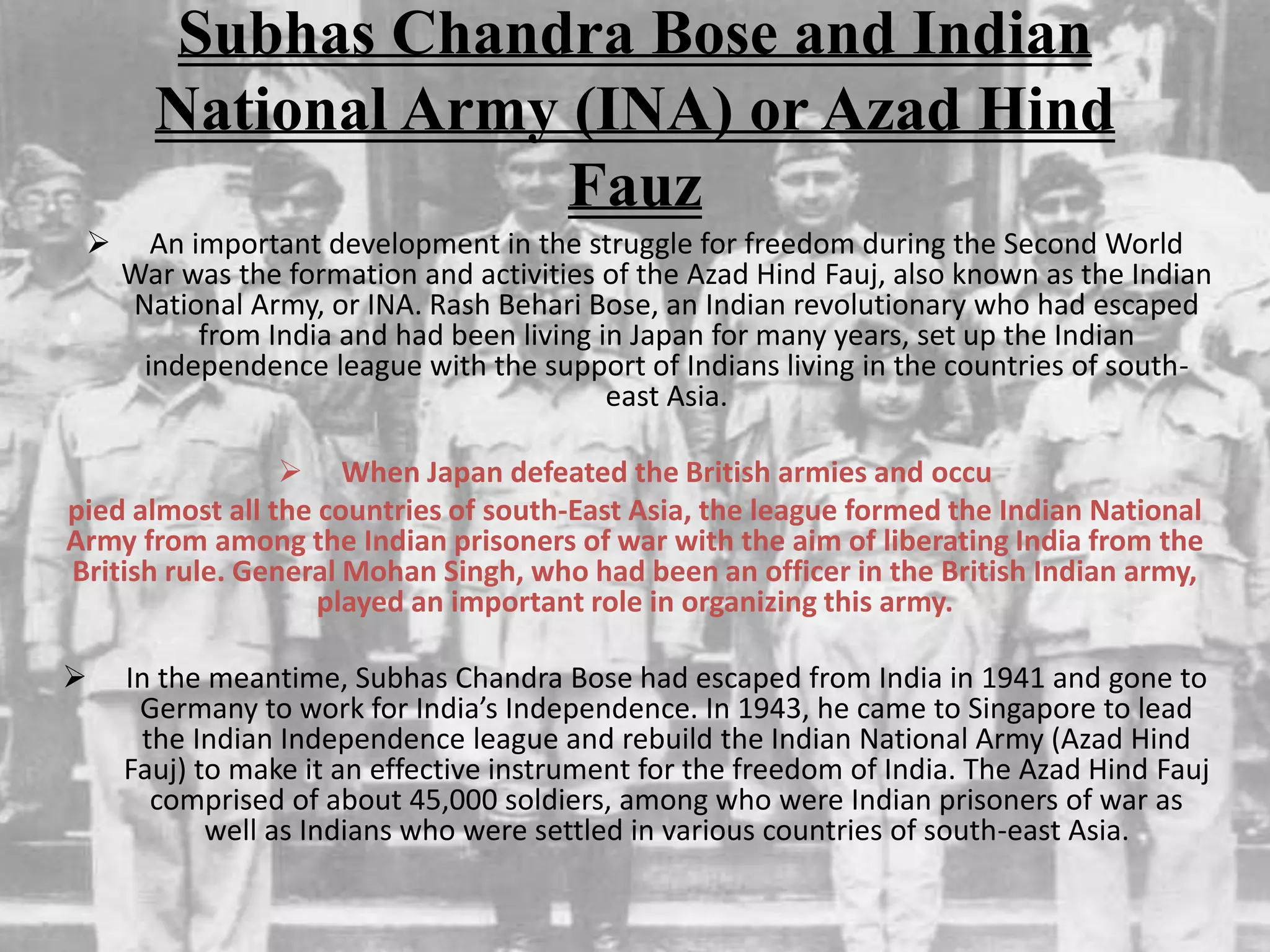
 An important development in the struggle for freedom during the Second World
War was the formation and activities of the Azad Hind Fauj, also known as the Indian
National Army, or INA. Rash Behari Bose, an Indian revolutionary who had escaped
from India and had been living in Japan for many years, set up the Indian
independence league with the support of Indians living in the countries of south-
east Asia.
 When Japan defeated the British armies and occu
pied almost all the countries of south-East Asia, the league formed the Indian National
Army from among the Indian prisoners of war with the aim of liberating India from the
British rule. General Mohan Singh, who had been an officer in the British Indian army,
played an important role in organizing this army.
 In the meantime, Subhas Chandra Bose had escaped from India in 1941 and gone to
Germany to work for India’s Independence. In 1943, he came to Singapore to lead
the Indian Independence league and rebuild the Indian National Army (Azad Hind
Fauj) to make it an effective instrument for the freedom of India. The Azad Hind Fauj
comprised of about 45,000 soldiers, among who were Indian prisoners of war as
well as Indians who were settled in various countries of south-east Asia.
• On 21 October 1943, Netaji, proclaimed the formation of the provisional
government of independent India (Azad Hind) in Singapore. Netaji went to the
Andaman which had been occupied by the Japanese and hoisted there the flag of
India.
• In early 1944, three units of the INA took part in the attack on the north-eastern
parts of India to oust the British from India. However, the attempt to liberate
India by the Azad Hind Fauj failed.
• The Indian nationalist movement did not view the Japanese government as a
friend of India. Its sympathies were with the people of those countries which had
fallen victims to Japan’s aggression. Netaji, however, believed that with the help
of the Azad Hind Fauj, supported by Japan, and a revolt inside India, the British
rule over India could be ended.
• The Azad Hind Fauj, with the slogan of ‘Delhi Chalo’ and
• the salutation Jai Hind was a source of inspiration to Indians, inside and outside
the country. Netaji rallied together the Indians of all religions and regions, living in
south-east Asia, for the cause of India’s freedom..
• Indian women also played an important role in the activities for the
freedom of India.
• A women’s regiment of Azad Hind Fauj was formed, which was
under the command of Captain Lakshmi Swaminathan. It was called
the Rani Jhansi regiment
• . The Azad Hind Fauj became the symbol of unity and heroism to the
people of India.
• Netaji, who had been one of the greatest leaders of India’s struggle
for freedom, was reported killed in an air crash a few days after
Japan had surrendered.
CONCLUSION
Netaji without a shadow of a doubt, remains one of the most
key figures in the history of India’s independence. He played a
crucial role in freeing the country from the clutches of 200 years
of British rule in his own inimitable way, much like the other
leading lights of the day such as Mahatma Gandhi and
Jawaharlal Nehru. Till the last day of his life as an active
freedom fighter, he kept the spirit of fighting the British – even at
the time of his death he was planning to migrate to Russia and
find a new way to combat the British – and it is this persistence
and patriotic fervour that needs to be respected more than
anything else.
 WIKIPEDIA
 WEBSITES :
www.historydiscussion.net
www.jagranjosh.com
www.Britannica.com
Shodhganga.inflibnet.ac.in
www.mapsofIndia.com
 BIPIN CHANDRA : HISTORY OF MODERN
INDIA .

Subhash Chandra Bose &Indian National Army.

  • 1.
    Presentation on : SUBHASHCHANDRA BOSE & INDIAN NATIONAL ARMY. SUBMITTED BY : SHIVANI TIWARY . 2019-47 SCHOOL OF LAW DAVV ,INDORE SUBMITTED TO : MRS. RASHMI SINGH
  • 2.
    CONTENTS SERAIL NO. TITLE 1. INTRODUCTION . 2.EARLY LIFE & POLITICAL ACTIVITY OF BOSE . 3. BOSE & INDIAN NATIONAL CONGRESS . 4. FALLING OUT WITH GANDHI . 5. FORWARD BLOC & INDIAN NATIONAL ARMY . 6. CONCLUSION . 7. BIBLIOGRAPHY .
  • 3.
    “Give me blood, I shall give you freedom. “
  • 4.
    INTRODUCTION Subhas Chandra Boseis considered the most influential freedom fighter with extraordinary leadership skills and a charismatic orator. His famous slogans are 'tum mujhe khoon do, main tumhe aazadi dunga', 'Jai Hind', and 'Delhi Chalo'. He formed Azad Hind Fauj and made several contributions to India's freedom struggle. He is known for his militant approach that he used to gain independence and for his socialist policies. Date of Birth: January 23, 1897 Place of Birth: Cuttack, Odisha Parents: Janakinath Bose (father) and Prabhavati Devi (mother) Spouse: Emily Schenkl Children: Anita Bose Pfaff Education: Ravenshaw Collegiate School, Cuttack; Presidency College, Calcutta; University of Cambridge, England Associations (Political Party): Indian National Congress; Forward Bloc; Indian National Army Movements: Indian Freedom Movement Political Ideology: Nationalism; Communism; Fascism-inclined Religious Beliefs: Hinduism
  • 5.
    EARLY LIFE &POLITICAL CAREER. • Subhas Chandra Bose was born on 23 January 1897 (at 12.10 pm) in Cuttack, Orissa Division, Bengal Province, to Prabhavati Dutt Bose and Janakinath Bose, an advocate belonging to a Kayastha family. He was the ninth in a family of 14 children. His family was well to do. • He was admitted to the Protestant European School (presently Stewart High School) in Cuttack, in January 1902. He continued his studies at this school which was run by the Baptist Mission up to 1909 and then shifted to the Ravenshaw Collegiate School. After securing the second position in the matriculation examination in 1913, he was admitted to the Presidency College where he studied briefly . • He was influenced by the teachings of Swami Vivekananda and Ramakrishna after reading their works at the age of 16. He felt that his religion was more important than his studies. • In those days, the British in Calcutta often made offensive remarks to the Indians in public places and insulted them openly. This behavior of the British as well as the outbreak of World War I began to influence his thinking.
  • 6.
    • His nationalistictemperament came to light when he was expelled for assaulting Professor Oaten (who had manhandled some Indian students ). He was expelled although he appealed that he only witnessed the assault and did not actually participate in it .He later joined the Scottish Church College at the University of Calcutta and passed his B.A. in 1918 in philosophy. • Bose left India for Europe on 15 September 1919, arriving in London on 20 October. He had made a promise to his father to prepare and appear for the Indian Civil Services (ICS) examination, for which his father has made available Rs 10,000. In London, Bose readied his application for the ICS, staying in Belsize Park with his brother Satish, who was preparing for the bar exam . • Bose was eager to gain admission to a college at the University of Cambridge. However, it was already past the deadline for admission. With the help of some Indian students there and Mr. Reddaway, the Censor of Fitzwilliam Hall, a body run by the Non-Collegiate Students Board of the university, for making available the university's education at an economical cost without formal admission to a college, Bose entered the register of the university on 19 November 1919.
  • 7.
    INDIAN NATIONAL CONGRESS •He started the newspaper Swaraj and took charge of publicity for the Bengal Provincial Congress Committee. His mentor was Chittaranjan Das who was a spokesman for aggressive nationalism in Bengal. In the year 1923, Bose was elected the President of All India Youth Congress and also the Secretary of Bengal State Congress. • He was also the editor of the newspaper "Forward", founded by Chittaranjan Das.Bose worked as the CEO of the Calcutta Municipal Corporation for Das when the latter was elected mayor of Calcutta in 1924.] In a roundup of nationalists in 1925, Bose was arrested and sent to prison in Mandalay, where he contracted tuberculosis. • In 1927, after being released from prison, Bose became general secretary of the Congress party and worked with Jawaharlal Nehru for independence. In late December 1928, Bose organised the Annual Meeting of the Indian National Congress in Calcutta.His most memorable role was as General Officer Commanding (GOC) Congress Volunteer Corps. • Mahatma Gandhi is a sincere pacifist vowed to non-violence, did not like the strutting, clicking of boots, and saluting, and he afterward described the Calcutta session of the Congress as a Bertram Mills circus, which caused a great deal of indignation among the Bengalis. A little later, Bose was again arrested and jailed for civil disobedience; this time he emerged to become Mayor of Calcutta in 1930.
  • 8.
    Falling out withGandhi  Vocal support for Gandhi increased within the Indian National Congress, meanwhile, and, in light of this, Gandhi resumed a more commanding role in the party.  When the civil disobedience movement was started in 1930, Bose was already in detention for his associations with an underground revolutionary group, the Bengal Volunteers. Nevertheless, he was elected mayor of Calcutta while in prison.  Released and then rearrested several times for his suspected role in violent acts, Bose was finally allowed to proceed to Europe after he contracted tuberculosis and was released for ill health.  In enforced exile and still ill, he wrote The Indian Struggle, 1920– 1934 and pleaded India’s cause with European leaders. He returned from Europe in 1936, was again taken into custody, and was released after a year.
  • 9.
    • Meanwhile, Bosebecame increasingly critical of Gandhi’s more conservative economics as well as his less confrontational approach toward independence. • In 1938 he was elected president of the Indian National Congress and formed a national planning committee, which formulated a policy of broad industrialization. However, this did not harmonize with Gandhian economic thought, which clung to the notion of cottage industries and benefiting from the use of the country’s own resources. • Bose’s vindication came in 1939, when he defeated a Gandhian rival for reelection. Nonetheless, the “rebel president” felt bound to resign because of the lack of Gandhi’s support. • He founded the Forward Bloc, hoping to rally radical elements, but was again incarcerated in July 1940. His refusal to remain in prison at this critical period of India’s history was expressed in a determination to fast to death, which frightened the British government into releasing him. • On January 26, 1941, though closely watched, he escaped from his Calcutta residence in disguise and, traveling via Kabul and Moscow, eventually reached Germany in April.
  • 10.
    • Subhas ChandraBose and the formation of Forward Bloc : All India Forward Bloc was a left wing nationalist political party in India which emerged as a faction within the India Congress in 1939, led by Subhas Chandra Bose. He was well known for his leftist views in the Congress. The prime objective of the Froward Bloc was to bring all radical elements of the Congress party. So that he could spread the meaning of complete independence of India with adherence of the application of principles of equality and social justice.
  • 11.
    Subhas Chandra Boseand Indian National Army (INA) or Azad Hind Fauz  An important development in the struggle for freedom during the Second World War was the formation and activities of the Azad Hind Fauj, also known as the Indian National Army, or INA. Rash Behari Bose, an Indian revolutionary who had escaped from India and had been living in Japan for many years, set up the Indian independence league with the support of Indians living in the countries of south- east Asia.  When Japan defeated the British armies and occu pied almost all the countries of south-East Asia, the league formed the Indian National Army from among the Indian prisoners of war with the aim of liberating India from the British rule. General Mohan Singh, who had been an officer in the British Indian army, played an important role in organizing this army.  In the meantime, Subhas Chandra Bose had escaped from India in 1941 and gone to Germany to work for India’s Independence. In 1943, he came to Singapore to lead the Indian Independence league and rebuild the Indian National Army (Azad Hind Fauj) to make it an effective instrument for the freedom of India. The Azad Hind Fauj comprised of about 45,000 soldiers, among who were Indian prisoners of war as well as Indians who were settled in various countries of south-east Asia.
  • 12.
    • On 21October 1943, Netaji, proclaimed the formation of the provisional government of independent India (Azad Hind) in Singapore. Netaji went to the Andaman which had been occupied by the Japanese and hoisted there the flag of India. • In early 1944, three units of the INA took part in the attack on the north-eastern parts of India to oust the British from India. However, the attempt to liberate India by the Azad Hind Fauj failed. • The Indian nationalist movement did not view the Japanese government as a friend of India. Its sympathies were with the people of those countries which had fallen victims to Japan’s aggression. Netaji, however, believed that with the help of the Azad Hind Fauj, supported by Japan, and a revolt inside India, the British rule over India could be ended. • The Azad Hind Fauj, with the slogan of ‘Delhi Chalo’ and • the salutation Jai Hind was a source of inspiration to Indians, inside and outside the country. Netaji rallied together the Indians of all religions and regions, living in south-east Asia, for the cause of India’s freedom..
  • 13.
    • Indian womenalso played an important role in the activities for the freedom of India. • A women’s regiment of Azad Hind Fauj was formed, which was under the command of Captain Lakshmi Swaminathan. It was called the Rani Jhansi regiment • . The Azad Hind Fauj became the symbol of unity and heroism to the people of India. • Netaji, who had been one of the greatest leaders of India’s struggle for freedom, was reported killed in an air crash a few days after Japan had surrendered.
  • 14.
    CONCLUSION Netaji without ashadow of a doubt, remains one of the most key figures in the history of India’s independence. He played a crucial role in freeing the country from the clutches of 200 years of British rule in his own inimitable way, much like the other leading lights of the day such as Mahatma Gandhi and Jawaharlal Nehru. Till the last day of his life as an active freedom fighter, he kept the spirit of fighting the British – even at the time of his death he was planning to migrate to Russia and find a new way to combat the British – and it is this persistence and patriotic fervour that needs to be respected more than anything else.
  • 15.
     WIKIPEDIA  WEBSITES: www.historydiscussion.net www.jagranjosh.com www.Britannica.com Shodhganga.inflibnet.ac.in www.mapsofIndia.com  BIPIN CHANDRA : HISTORY OF MODERN INDIA .