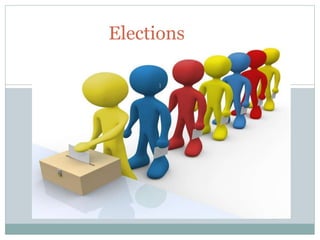
Elections
1
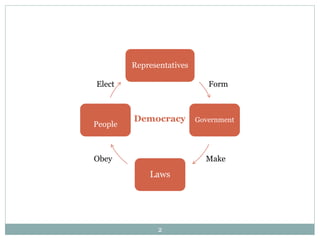
Representatives
Government
Laws
People
Elect Form
MakeObey
Democracy
2
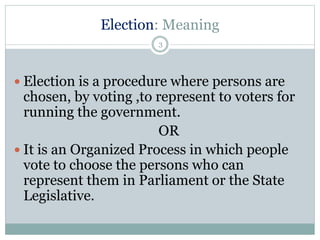
Election: Meaning
 Election is a procedure where persons are
chosen, by voting ,to represent to voters for
running the government.
OR
 It is an Organized Process in which people
vote to choose the persons who can
represent them in Parliament or the State
Legislative.
3
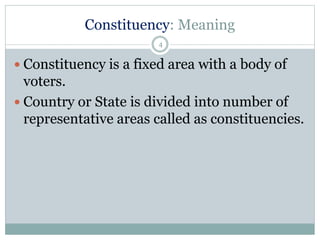
Constituency: Meaning
 Constituency is a fixed area with a body of
voters.
 Country or State is divided into number of
representative areas called as constituencies.
4
Need & Importance of Elections
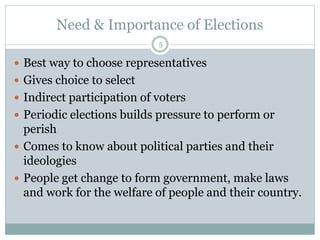
 Best way to choose representatives
 Gives choice to select
 Indirect participation of voters
 Periodic elections builds pressure to perform or
perish
 Comes to know about political parties and their
ideologies
 People get change to form government, make laws
and work for the welfare of people and their country.
5
Types of Elections
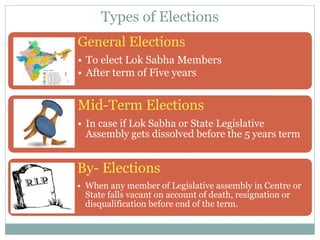
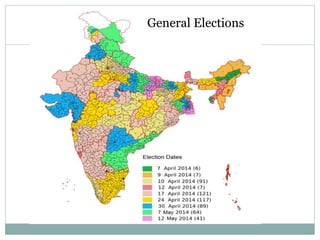
General Elections
• To elect Lok Sabha Members
• After term of Five years
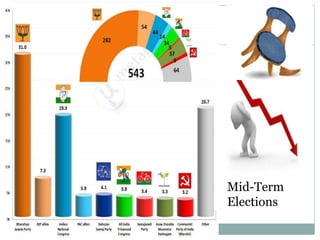
Mid-Term Elections
• In case if Lok Sabha or State Legislative
Assembly gets dissolved before the 5 years term
By- Elections
• When any member of Legislative assembly in Centre or
State falls vacant on account of death, resignation or
disqualification before end of the term.
6
7
General Elections
8
Mid-Term
Elections
By Elections
9
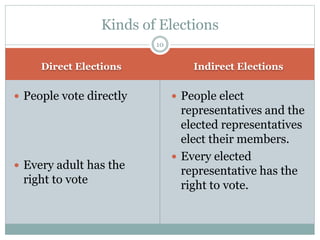
Direct Elections Indirect Elections
 People vote directly
 Every adult has the
right to vote
 People elect
representatives and the
elected representatives
elect their members.
 Every elected
representative has the
right to vote.
Kinds of Elections
10
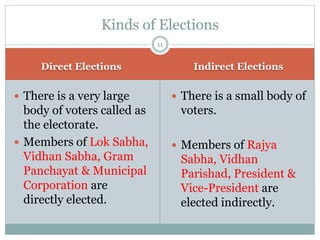
Direct Elections Indirect Elections
 There is a very large
body of voters called as
the electorate.
 Members of Lok Sabha,
Vidhan Sabha, Gram
Panchayat & Municipal
Corporation are
directly elected.
 There is a small body of
voters.
 Members of Rajya
Sabha, Vidhan
Parishad, President &
Vice-President are
elected indirectly.
Kinds of Elections
11
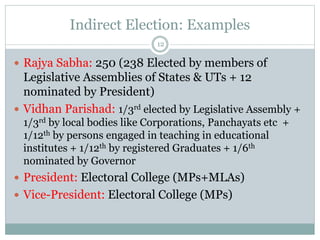
Indirect Election: Examples
12
 Rajya Sabha: 250 (238 Elected by members of
Legislative Assemblies of States & UTs + 12
nominated by President)
 Vidhan Parishad: 1/3rd elected by Legislative Assembly +
1/3rd by local bodies like Corporations, Panchayats etc +
1/12th by persons engaged in teaching in educational
institutes + 1/12th by registered Graduates + 1/6th
nominated by Governor
 President: Electoral College (MPs+MLAs)
 Vice-President: Electoral College (MPs)
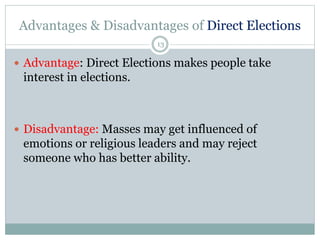
Advantages & Disadvantages of Direct Elections
13
 Advantage: Direct Elections makes people take
interest in elections.
 Disadvantage: Masses may get influenced of
emotions or religious leaders and may reject
someone who has better ability.
Advantages & Disadvantages of Indirect Elections
14
 Advantages:
a) It is perfect for large constituencies with millions of
people. It can save money and energy.
b) Reduces the heat of the election campaign.
 Disadvantage: It may lead to evil practices such as
bribery as electors are very few in number.
15
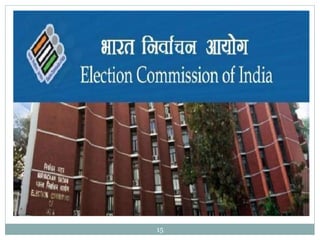
Election Commission of India
16
Composition:
 It headed by Chief Election Commissioner (CEC)
assisted by other Election Commissioners.
 CEC acts as a Chairman of the Election Commission.
 At present it is a THREE MEMBERED body.
Election Commission of India
17
Appointment:
 The Chief Election Commissioner (CEC) & other
Election Commissioners are appointed by the
President.
 President may also appoint Regional Commissioners
to assist the Election Commission.
Election Commission of India
18
Term (Tenure) of Office & Conditions of
Service:
 The Chief Election Commissioner (CEC) & other
Election Commissioners hold the office for the term of 6
years.
 However, they need to vacate the office if they attain the
age of 65 years.
 Their salary is equal to the salary of Supreme Court. After
retirement they get pension.
 All the decisions will be taken according to the opinion of
MAJORITY in case there is difference in opinion among
CEC and other ECs.
Election Commission of India
19
Independence of ECI:
 Removal: CEC and Other ECs can be removed in
the manner as a Judge of Supreme Court.
Other ECs can be removed only on the
recommendation of CEC.
 No one can change the conditions of service
of CEC.
 ECI has complete control over its staff on
election duty.
Powers & Functions of Election Commission
20
1. Preparation of Election Rolls and Photo Identity
Cards
2. Recognition to Political Parties
3. Allotment of Symbols to Parties and Independent
Candidates
4. Conduct of Elections
5. Ensuring Free & Fair Election
6. Disqualification on grounds such as being of
unsound mind, holding office of profit etc.
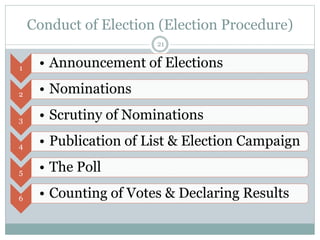
Conduct of Election (Election Procedure)
21
1 • Announcement of Elections
2 • Nominations
3 • Scrutiny of Nominations
4 • Publication of List & Election Campaign
5 • The Poll
6 • Counting of Votes & Declaring Results
Allotment of Symbols to Parties and Independent Candidates
22
 National and State Parties can have same registered
symbols for all their candidates.
 Independent Candidates can choose any symbols out
of the list of Free Symbols.
 Illiterate masses can’t read the names however they
can easily identify the symbols.
 Reserved Symbols sometimes become so well-known
that the party doesn’t have to do much to showcase
their candidates.

Elections & Election Commission

  • 1.
  • 2.
  • 3.
    Election: Meaning  Electionis a procedure where persons are chosen, by voting ,to represent to voters for running the government. OR  It is an Organized Process in which people vote to choose the persons who can represent them in Parliament or the State Legislative. 3
  • 4.
    Constituency: Meaning  Constituencyis a fixed area with a body of voters.  Country or State is divided into number of representative areas called as constituencies. 4
  • 5.
    Need & Importanceof Elections  Best way to choose representatives  Gives choice to select  Indirect participation of voters  Periodic elections builds pressure to perform or perish  Comes to know about political parties and their ideologies  People get change to form government, make laws and work for the welfare of people and their country. 5
  • 6.
    Types of Elections GeneralElections • To elect Lok Sabha Members • After term of Five years Mid-Term Elections • In case if Lok Sabha or State Legislative Assembly gets dissolved before the 5 years term By- Elections • When any member of Legislative assembly in Centre or State falls vacant on account of death, resignation or disqualification before end of the term. 6
  • 7.
  • 8.
  • 9.
  • 10.
    Direct Elections IndirectElections  People vote directly  Every adult has the right to vote  People elect representatives and the elected representatives elect their members.  Every elected representative has the right to vote. Kinds of Elections 10
  • 11.
    Direct Elections IndirectElections  There is a very large body of voters called as the electorate.  Members of Lok Sabha, Vidhan Sabha, Gram Panchayat & Municipal Corporation are directly elected.  There is a small body of voters.  Members of Rajya Sabha, Vidhan Parishad, President & Vice-President are elected indirectly. Kinds of Elections 11
  • 12.
    Indirect Election: Examples 12 Rajya Sabha: 250 (238 Elected by members of Legislative Assemblies of States & UTs + 12 nominated by President)  Vidhan Parishad: 1/3rd elected by Legislative Assembly + 1/3rd by local bodies like Corporations, Panchayats etc + 1/12th by persons engaged in teaching in educational institutes + 1/12th by registered Graduates + 1/6th nominated by Governor  President: Electoral College (MPs+MLAs)  Vice-President: Electoral College (MPs)
  • 13.
    Advantages & Disadvantagesof Direct Elections 13  Advantage: Direct Elections makes people take interest in elections.  Disadvantage: Masses may get influenced of emotions or religious leaders and may reject someone who has better ability.
  • 14.
    Advantages & Disadvantagesof Indirect Elections 14  Advantages: a) It is perfect for large constituencies with millions of people. It can save money and energy. b) Reduces the heat of the election campaign.  Disadvantage: It may lead to evil practices such as bribery as electors are very few in number.
  • 15.
  • 16.
    Election Commission ofIndia 16 Composition:  It headed by Chief Election Commissioner (CEC) assisted by other Election Commissioners.  CEC acts as a Chairman of the Election Commission.  At present it is a THREE MEMBERED body.
  • 17.
    Election Commission ofIndia 17 Appointment:  The Chief Election Commissioner (CEC) & other Election Commissioners are appointed by the President.  President may also appoint Regional Commissioners to assist the Election Commission.
  • 18.
    Election Commission ofIndia 18 Term (Tenure) of Office & Conditions of Service:  The Chief Election Commissioner (CEC) & other Election Commissioners hold the office for the term of 6 years.  However, they need to vacate the office if they attain the age of 65 years.  Their salary is equal to the salary of Supreme Court. After retirement they get pension.  All the decisions will be taken according to the opinion of MAJORITY in case there is difference in opinion among CEC and other ECs.
  • 19.
    Election Commission ofIndia 19 Independence of ECI:  Removal: CEC and Other ECs can be removed in the manner as a Judge of Supreme Court. Other ECs can be removed only on the recommendation of CEC.  No one can change the conditions of service of CEC.  ECI has complete control over its staff on election duty.
  • 20.
    Powers & Functionsof Election Commission 20 1. Preparation of Election Rolls and Photo Identity Cards 2. Recognition to Political Parties 3. Allotment of Symbols to Parties and Independent Candidates 4. Conduct of Elections 5. Ensuring Free & Fair Election 6. Disqualification on grounds such as being of unsound mind, holding office of profit etc.
  • 21.
    Conduct of Election(Election Procedure) 21 1 • Announcement of Elections 2 • Nominations 3 • Scrutiny of Nominations 4 • Publication of List & Election Campaign 5 • The Poll 6 • Counting of Votes & Declaring Results
  • 22.
    Allotment of Symbolsto Parties and Independent Candidates 22  National and State Parties can have same registered symbols for all their candidates.  Independent Candidates can choose any symbols out of the list of Free Symbols.  Illiterate masses can’t read the names however they can easily identify the symbols.  Reserved Symbols sometimes become so well-known that the party doesn’t have to do much to showcase their candidates.