THE MEDIEVAL INDIA- DELHI
SULTANATE
The Delhi Sultanate
1
Introduction
 Due to lack of political unity in India during 10th
and 11th century, India was unable to stop attack
from the invaders.
 Turks attacked Indian from all sides and were
getting quick victories.
 They established their empire in 13th century.
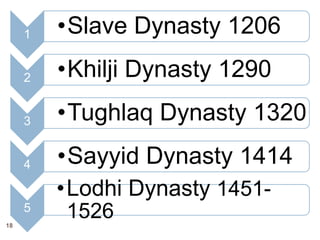
 The period between 1206 to 1526 when five
dynasties (Slave 1206, Khilji 1290, Tughlaq 1320,
Sayyid 1414 & Lodhi 1451 to 1526) successively
ruled from Delhi is known as the period of Delhi
Sultanate. The rulers who ruled from Delhi were
called as Sultans.
2
Archaeological
Sources
Inscriptions Monuments
3
Inscriptions
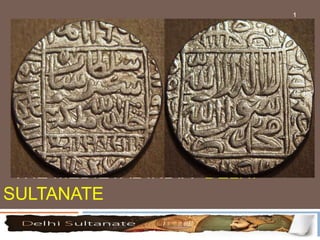
 Many inscriptions were found on coins,
monuments (mosques, temples, places etc)
milestones and tombstones.
 Most of the inscriptions are in Sanskrit,
Persian, Arabic, Hindi and other languages.
Some inscriptions have both Arabic &
Sanskrit languages used.
 These inscriptions gave a lot of information
about the political, society, culture, religion,
& administration seen during this period.
 Some inscriptions describes the gifts given
to religious and charitable institutions.
4
Inscriptions continued…
5
 Pehowa Inscription suggests that Delhi was
founded in 736 AD by Tomaras (Rajputs) and
they had ruled over Haryana region with
Dhillika (Delhi) as their capital.
 Sarban Inscription (in South Delhi) gives
information about Delhi during the rule of
Muhammad Tughlaq.
Monuments
 The rulers of Delhi Sultanate built many
monuments in India.
 It gives us a lot of information about them.
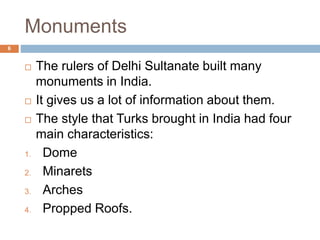
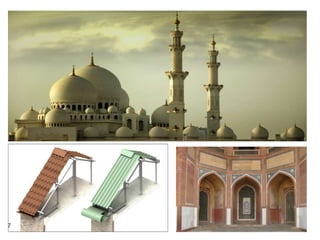
 The style that Turks brought in India had four
main characteristics:
1. Dome
2. Minarets
3. Arches
4. Propped Roofs.
6
7
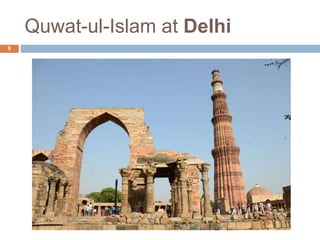
Quwat-ul-Islam at Delhi
8
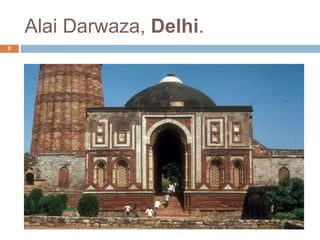
Alai Darwaza, Delhi.
9
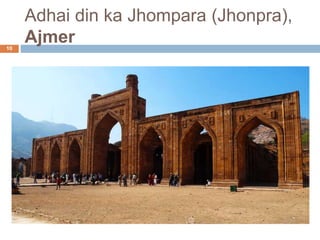
Adhai din ka Jhompara (Jhonpra),
Ajmer10
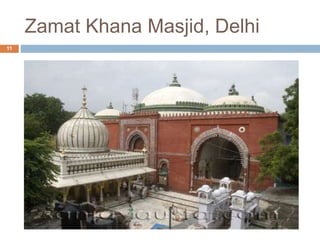
Zamat Khana Masjid, Delhi
11
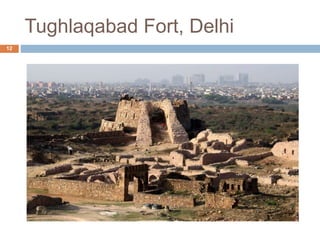
Tughlaqabad Fort, Delhi
12
13
14
15
16
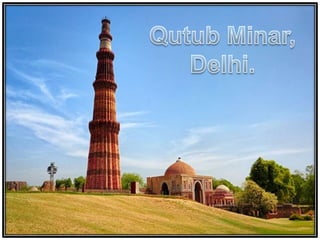
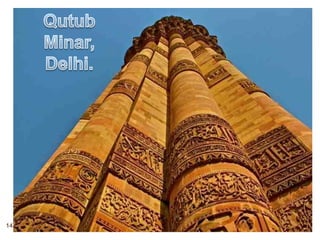
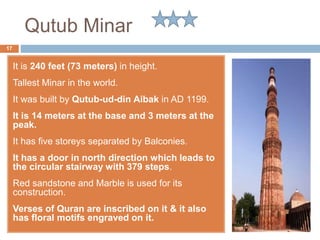
Qutub Minar
It is 240 feet (73 meters) in height.
Tallest Minar in the world.
It was built by Qutub-ud-din Aibak in AD 1199.
It is 14 meters at the base and 3 meters at the
peak.
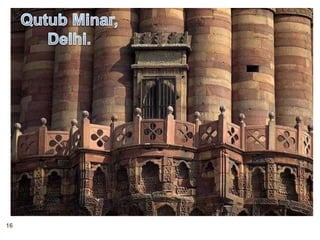
It has five storeys separated by Balconies.
It has a door in north direction which leads to
the circular stairway with 379 steps.
Red sandstone and Marble is used for its
construction.
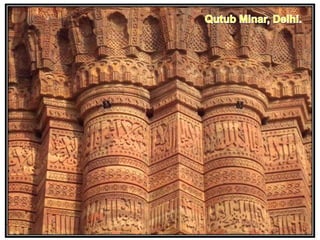
Verses of Quran are inscribed on it & it also
has floral motifs engraved on it.
17
1 •Slave Dynasty 1206
2 •Khilji Dynasty 1290
3 •Tughlaq Dynasty 1320
4 •Sayyid Dynasty 1414
5
•Lodhi Dynasty 1451-
152618
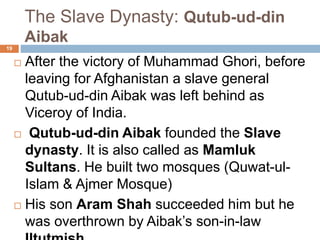
The Slave Dynasty: Qutub-ud-din
Aibak
 After the victory of Muhammad Ghori,
before leaving for Afghanistan a slave
general Qutub-ud-din Aibak was left
behind as Viceroy of India.
 Qutub-ud-din Aibak founded the Slave
dynasty. It is also called as Mamluk
Sultans. He built two mosques (Quwat-ul-
Islam & Ajmer Mosque)
 His son Aram Shah succeeded him but
he was overthrown by Aibak’s son-in-law
19
The Slave Dynasty: Qutub-ud-din
Aibak
 Chenghez Khan had driven out his enemy
Jalaluddin. Iltutmish decided not to give
refuge to Jalaluddin as he didn’t want
Chenghez Khan (Mongol) to invade India.
 He formed Turkan-i-Chalisa ( a group of
forty nobles) who ruled during the period.
 Silver and Copper coins were introduced by
him.
 Iltutmish didn’t consider his sons to be
capable so he nominated his daughter Razia
Sultan as his successor. She had to face
many challenges. But she proved to be an
20
Khilji/Khalji Dynasty
 After murdering the last slave King Kaikubad
Balban, Jalaluddin Khilji founded the Khilji
Dynasty in 1290.
 After six years i.e. in 1296 Jalaluddin was killed
by his nephew & son-in-law Alauddin Khilji who
proclaimed himself as Sultan.
 Alauddin had to face rebellion of Mongols, but he
killed most of them near Delhi.
 He captured Malwa, Gujarat, Ranthambhor &
Chittor.
 Alauddin’s military commander- Malik Kafur
captured many territories & collected immense
21
Reforms Introduced by Alauddin
Khilji22
 After controlling the most of northern India he
brought many changes like Market Regulations
(fixed prices of commodities like food grains,
clothes, sugar, cooking oil etc helped soldiers &
common men, built markets) Deccan Expedition
(he conquered Yadavas, Kakatiyas, Hoysalas &
Pandyas but did not annex them), Measures
against nobles (spy system, restriction) Military
reforms (imported horses, branding of horses and
giving I-cards to every soldier) Revenue reforms
(he cancelled all land-grants given to Muslim
landlords, handled Hindu landlord harshly, two
officers (diwan-i-riyasat & shahana-i-
mandi)controlled this process and they punished
those who violated these regulations)
Tughlaq Dynasty
 In 1320, Ghazi Malik ended the Khilji Dynasty
and established Tughlaq Dynasty.
 His son Jauna Khan succeeded him. He got the
title Muhammad bin Tughlaq.
 Innovative ideas of Muhammad Tughlaq led him
to ruin. These ideas included:
1. Transfer of Capital: He transferred his capital to
Daulatabad (near Aurangabad, 1500kms away
from Delhi) to have a better control and then
due to some reason transferred the capital back
to Delhi. This made people suffer a lot and
caused loss of lives and resources.
23
Tughlaq Dynasty
 2. Token Currency: He tried to introduce Bronze coins
due to shortage of silver but due to the severe problem
of fake coins he withdrew the bronze coins as people
started manufacturing coins at their homes. This
severely affected the Trade & Business.
 3. Taxation in Doab: He asked people of Doab
(between rivers Ganga & Yamuna) to pay heavy taxes
in order to raise a bigger army. But unfortunately at the
same time a severe famine occurred in this region so
the cultivators were not in a position to pay taxes.
However, Sultan’s officers still insisted them to pay
taxes. So, Sultan decided to give them loans, seeds &
dig wells . People used the loans to meet their needs.
As a result the whole scheme failed resulting in heavy
losses for the Sultan.
24
Later Tughlaqs
25
 Jauna had no male successor, so he was
succeeded by his cousin Firoz Shah Tughlaq.
 He started Karkhanas, constructed roads and
irrigation canals. He gave a lot of help to the
poor.
 After his death Sultanate grew weak.
 Timur Lang a Mongol Ruler invaded India and
ended Tughlaq Dynasty.
Sultanate Administration
 Delhi Sultanate was a Muslim State which followed
Theocracy system in which the Sultan ruled in the
name of God and Islam was the religion of the
country.
 Sultan was the supreme executive, legislative, judicial
and military authority.
 He was assisted by a number of ministers. His
chief/prime minister i.e. Wazir supervised all the other
ministers.
 Minister in charge of Army was called as ‘ariz-i-
mumalik.’
26
Sultanate Administration
continued…
27
 Provincial Administration: Sultanate was divided into
provinces (Malwa, Khandesh, Deccan, Gujarat,
Jaunpur & Bengal) called as iqtas. These were
headed by Governors who maintained huge armies so
that they can provide help to Sultan whenever
needed.
 Provinces (Iqtas) were further divided into Shiqs
(headed by Shiqdars) and Shiqs were further divided
into Parganas. Each village had a revenue officer
called as Patwari.
 Sources of Revenue included: land tax 1/10th of total
produce (major source), booty captured, grazing tax,
import tax, house tax, religious tax called as zakat for
Muslims & poll tax called as Jiziya was collected from

Delhi Sultanate (Medieval India)

  • 1.
    THE MEDIEVAL INDIA-DELHI SULTANATE The Delhi Sultanate 1
  • 2.
    Introduction  Due tolack of political unity in India during 10th and 11th century, India was unable to stop attack from the invaders.  Turks attacked Indian from all sides and were getting quick victories.  They established their empire in 13th century.  The period between 1206 to 1526 when five dynasties (Slave 1206, Khilji 1290, Tughlaq 1320, Sayyid 1414 & Lodhi 1451 to 1526) successively ruled from Delhi is known as the period of Delhi Sultanate. The rulers who ruled from Delhi were called as Sultans. 2
  • 3.
  • 4.
    Inscriptions  Many inscriptionswere found on coins, monuments (mosques, temples, places etc) milestones and tombstones.  Most of the inscriptions are in Sanskrit, Persian, Arabic, Hindi and other languages. Some inscriptions have both Arabic & Sanskrit languages used.  These inscriptions gave a lot of information about the political, society, culture, religion, & administration seen during this period.  Some inscriptions describes the gifts given to religious and charitable institutions. 4
  • 5.
    Inscriptions continued… 5  PehowaInscription suggests that Delhi was founded in 736 AD by Tomaras (Rajputs) and they had ruled over Haryana region with Dhillika (Delhi) as their capital.  Sarban Inscription (in South Delhi) gives information about Delhi during the rule of Muhammad Tughlaq.
  • 6.
    Monuments  The rulersof Delhi Sultanate built many monuments in India.  It gives us a lot of information about them.  The style that Turks brought in India had four main characteristics: 1. Dome 2. Minarets 3. Arches 4. Propped Roofs. 6
  • 7.
  • 8.
  • 9.
  • 10.
    Adhai din kaJhompara (Jhonpra), Ajmer10
  • 11.
  • 12.
  • 13.
  • 14.
  • 15.
  • 16.
  • 17.
    Qutub Minar It is240 feet (73 meters) in height. Tallest Minar in the world. It was built by Qutub-ud-din Aibak in AD 1199. It is 14 meters at the base and 3 meters at the peak. It has five storeys separated by Balconies. It has a door in north direction which leads to the circular stairway with 379 steps. Red sandstone and Marble is used for its construction. Verses of Quran are inscribed on it & it also has floral motifs engraved on it. 17
  • 18.
    1 •Slave Dynasty1206 2 •Khilji Dynasty 1290 3 •Tughlaq Dynasty 1320 4 •Sayyid Dynasty 1414 5 •Lodhi Dynasty 1451- 152618
  • 19.
    The Slave Dynasty:Qutub-ud-din Aibak  After the victory of Muhammad Ghori, before leaving for Afghanistan a slave general Qutub-ud-din Aibak was left behind as Viceroy of India.  Qutub-ud-din Aibak founded the Slave dynasty. It is also called as Mamluk Sultans. He built two mosques (Quwat-ul- Islam & Ajmer Mosque)  His son Aram Shah succeeded him but he was overthrown by Aibak’s son-in-law 19
  • 20.
    The Slave Dynasty:Qutub-ud-din Aibak  Chenghez Khan had driven out his enemy Jalaluddin. Iltutmish decided not to give refuge to Jalaluddin as he didn’t want Chenghez Khan (Mongol) to invade India.  He formed Turkan-i-Chalisa ( a group of forty nobles) who ruled during the period.  Silver and Copper coins were introduced by him.  Iltutmish didn’t consider his sons to be capable so he nominated his daughter Razia Sultan as his successor. She had to face many challenges. But she proved to be an 20
  • 21.
    Khilji/Khalji Dynasty  Aftermurdering the last slave King Kaikubad Balban, Jalaluddin Khilji founded the Khilji Dynasty in 1290.  After six years i.e. in 1296 Jalaluddin was killed by his nephew & son-in-law Alauddin Khilji who proclaimed himself as Sultan.  Alauddin had to face rebellion of Mongols, but he killed most of them near Delhi.  He captured Malwa, Gujarat, Ranthambhor & Chittor.  Alauddin’s military commander- Malik Kafur captured many territories & collected immense 21
  • 22.
    Reforms Introduced byAlauddin Khilji22  After controlling the most of northern India he brought many changes like Market Regulations (fixed prices of commodities like food grains, clothes, sugar, cooking oil etc helped soldiers & common men, built markets) Deccan Expedition (he conquered Yadavas, Kakatiyas, Hoysalas & Pandyas but did not annex them), Measures against nobles (spy system, restriction) Military reforms (imported horses, branding of horses and giving I-cards to every soldier) Revenue reforms (he cancelled all land-grants given to Muslim landlords, handled Hindu landlord harshly, two officers (diwan-i-riyasat & shahana-i- mandi)controlled this process and they punished those who violated these regulations)
  • 23.
    Tughlaq Dynasty  In1320, Ghazi Malik ended the Khilji Dynasty and established Tughlaq Dynasty.  His son Jauna Khan succeeded him. He got the title Muhammad bin Tughlaq.  Innovative ideas of Muhammad Tughlaq led him to ruin. These ideas included: 1. Transfer of Capital: He transferred his capital to Daulatabad (near Aurangabad, 1500kms away from Delhi) to have a better control and then due to some reason transferred the capital back to Delhi. This made people suffer a lot and caused loss of lives and resources. 23
  • 24.
    Tughlaq Dynasty  2.Token Currency: He tried to introduce Bronze coins due to shortage of silver but due to the severe problem of fake coins he withdrew the bronze coins as people started manufacturing coins at their homes. This severely affected the Trade & Business.  3. Taxation in Doab: He asked people of Doab (between rivers Ganga & Yamuna) to pay heavy taxes in order to raise a bigger army. But unfortunately at the same time a severe famine occurred in this region so the cultivators were not in a position to pay taxes. However, Sultan’s officers still insisted them to pay taxes. So, Sultan decided to give them loans, seeds & dig wells . People used the loans to meet their needs. As a result the whole scheme failed resulting in heavy losses for the Sultan. 24
  • 25.
    Later Tughlaqs 25  Jaunahad no male successor, so he was succeeded by his cousin Firoz Shah Tughlaq.  He started Karkhanas, constructed roads and irrigation canals. He gave a lot of help to the poor.  After his death Sultanate grew weak.  Timur Lang a Mongol Ruler invaded India and ended Tughlaq Dynasty.
  • 26.
    Sultanate Administration  DelhiSultanate was a Muslim State which followed Theocracy system in which the Sultan ruled in the name of God and Islam was the religion of the country.  Sultan was the supreme executive, legislative, judicial and military authority.  He was assisted by a number of ministers. His chief/prime minister i.e. Wazir supervised all the other ministers.  Minister in charge of Army was called as ‘ariz-i- mumalik.’ 26
  • 27.
    Sultanate Administration continued… 27  ProvincialAdministration: Sultanate was divided into provinces (Malwa, Khandesh, Deccan, Gujarat, Jaunpur & Bengal) called as iqtas. These were headed by Governors who maintained huge armies so that they can provide help to Sultan whenever needed.  Provinces (Iqtas) were further divided into Shiqs (headed by Shiqdars) and Shiqs were further divided into Parganas. Each village had a revenue officer called as Patwari.  Sources of Revenue included: land tax 1/10th of total produce (major source), booty captured, grazing tax, import tax, house tax, religious tax called as zakat for Muslims & poll tax called as Jiziya was collected from