Poorly Soluble Drugs
Trials and Tribulations of the Modern Formulator


              Bruce Rehlaender, Ph.D.
        Principal, Formulation Development
               PharmaDirections, Inc.


                                                   1
The Problem of Insolubility

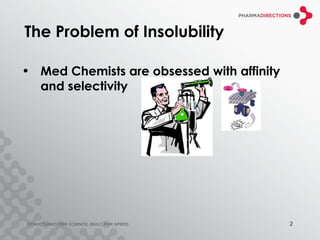
• Med Chemists are obsessed with affinity
  and selectivity


                                            2
The Problem of Insolubility

• Med Chemists are obsessed with affinity
  and selectivity
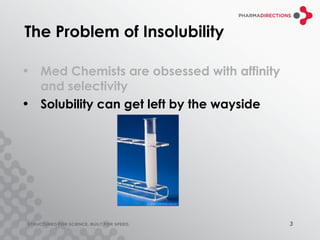
• Solubility can get left by the wayside


                                            3
The Problem of Insolubility

• Med Chemists are obsessed with affinity
  and selectivity
• Solubility can get left by the wayside
• General tendency is that new drugs are
  becoming more insoluble


                                            4
The Problem of Insolubility

• Med Chemists are obsessed with affinity
  and selectivity
• Solubility can get left by the wayside
• General tendency is that new drugs are
  becoming more insoluble
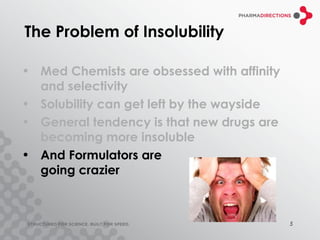
• And Formulators are
  going crazier


                                            5
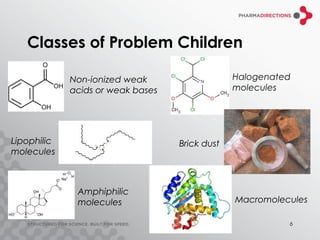
Classes of Problem Children

             Non-ionized weak                   Halogenated
             acids or weak bases                molecules


Lipophilic                         Brick dust
molecules


              Amphiphilic
              molecules                         Macromolecules

                                                          6
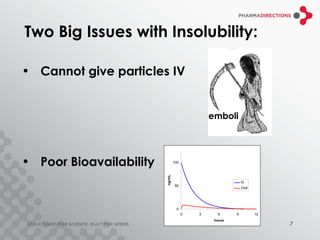
Two Big Issues with Insolubility:

• Cannot give particles IV


                                               emboli


• Poor Bioavailability   ng/mL
                                 100


                                                            IV
                                 50
                                                            Oral


                                  0
                                       0   3     6      9          12
                                                hours
                                                                        7
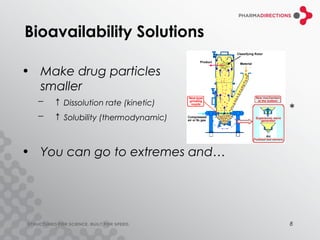
Bioavailability Solutions

• Make drug particles
  smaller
  – ↑ Dissolution rate (kinetic)
                                   *
  – ↑ Solubility (thermodynamic)


• You can go to extremes and…


                                   8
Bioavailability Solutions

• Nanosize It


*Formerly known as colloid sciences

                                      9
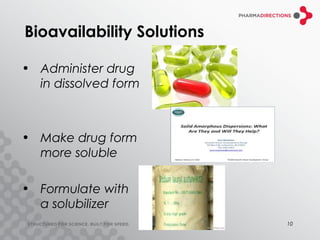
Bioavailability Solutions

• Administer drug
  in dissolved form


• Make drug form
  more soluble

• Formulate with
  a solubilizer
                            10
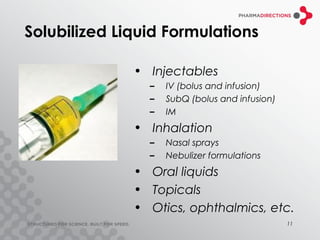
Solubilized Liquid Formulations

              • Injectables
                –   IV (bolus and infusion)
                –   SubQ (bolus and infusion)
                –   IM
              • Inhalation
                –   Nasal sprays
                –   Nebulizer formulations
              • Oral liquids
              • Topicals
              • Otics, ophthalmics, etc.
                                                11
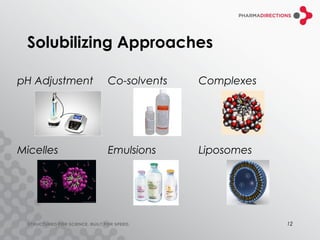
Solubilizing Approaches

pH Adjustment   Co-solvents   Complexes


Micelles        Emulsions     Liposomes


                                          12
pH Adjustment

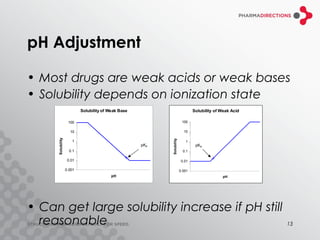
• Most drugs are weak acids or weak bases
• Solubility depends on ionization state
                          Solubility of Weak Base                              Solubility of Weak Acid

                   100                                                  100

                    10                                                   10
     Solubility


                                                          Solubility
                     1                                                    1
                                                    pKa                         pKa
                    0.1                                                  0.1

                   0.01                                                 0.01

                  0.001                                                0.001
                                         pH                                                  pH


• Can get large solubility increase if pH still
  reasonable                                                                                             13
pH Adjustment
What pH is acceptable for injection?
• It depends…..
  – Route of administration (central vein IV,
    peripheral vein IV, SubQ, IM)
  – Rate and duration of administration
  – Buffer capacity of the formulation (D5W is in
    spec at pH 2.5 due to lack of buffering)
  – Indication (routine vs. critical, acute vs.
    chronic)
• Problem is that you need buffer to assure
  solubility, but buffering decreases range
                                                    14
Pop Quiz

Which of these excipients are allowed for use
 in injectable products?
   –   Polyethylene glycol?
   –   Ethanol?
   –   Bile salts?
   –   N-methyl-pyrrolidone (NMP)?
   –   Dimethyl-acetamide (DMA)?
   –   Polysorbates (Tweens)?


• All of the above are used in approved injectable
  products
                                                 15
Co-Solvent Formulations
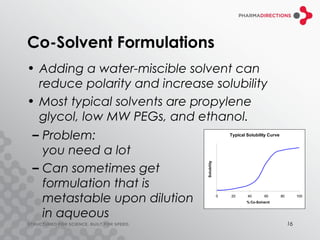
• Adding a water-miscible solvent can
  reduce polarity and increase solubility
• Most typical solvents are propylene
  glycol, low MW PEGs, and ethanol.
 – Problem:                                    Typical Solubility Curve


   you need a lot
 – Can sometimes get


                              Solubility
   formulation that is
   metastable upon dilution                0   20      40       60
                                                       % Co-Solvent
                                                                          80        100


   in aqueous
                                                                               16
Co-Solvent Formulations
How much solvent is allowed?
• It depends…..
  – Route of administration (central vein IV,
    peripheral vein IV, SubQ, IM)
  – Rate and duration of administration
  – Indication (routine vs. critical, acute vs.
    chronic)
• These formulations are very hypertonic, so
  best for IV or dilute-for-use
• Example: several formulations with 40%
  PG and 10% ethanol for IV and IM
                                                  17
Complexes (Cyclodextrins)
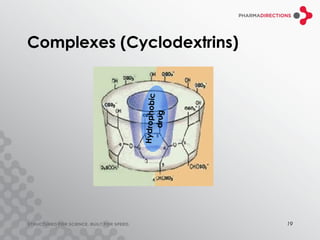
• Cyclodextrins are “basket-like” molecules
  with a hydrophobic pocket and hydrophilic
  exterior
• Hydroxypropyl-β-CD and sulfobutyl ether- β-
  CD used for injectables
• Need high concentration (>10%) since level
  needs to be stoichiometric with drug
• Quite safe. Only significant issue is some
  nephrotoxicity
• Licensing was a big issue in past
                                             18
Complexes (Cyclodextrins)


             Hydrophobic
                drug


                            19
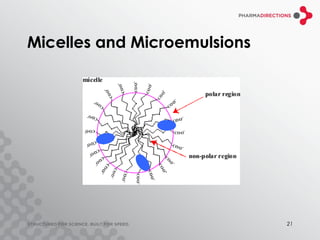
Micelles and Microemulsions

• Micelles are aggregates of surfactant
  molecules that can solubilize drugs.
• Typically used surfactants are:
  –   Polysorbates (PEGylated sorbitan fatty acid esters)
  –   Cremophor (PEGylated castor oil)
  –   Pluronic F68 (PEG/PPG block copolymer)
  –   Solutol (PEGylated hydroxystearate)

• All can cause anaphylactic reactions
• Example: Taxol formulated in pure surfactant.
  Diluted to metastable dispersion prior to infusing
                                                            20
Micelles and Microemulsions


                              21
Emulsions
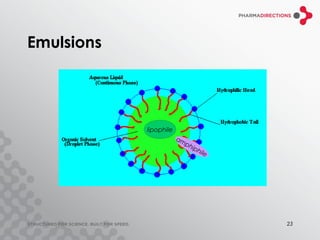
• In contrast to micelles/microemulsions,
  emulsions are thermodynamically unstable
• Prepared with high pressure homogenizer
• Oil droplet size typically >0.2 µm, so must be
  heat (or radiation) sterilized
• Oil droplets similar to chylomicrons, so are
  very safe
• Phospholipids used as emulsifier. Non-ionics
  (Tweens, etc.) can be used for non-sterile
  products but cannot take heat

                                             22
Emulsions


            lipophile
                        am
                          ph
                               i ph
                                   i le


                                          23
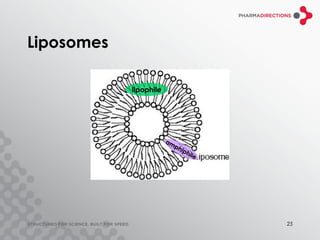
Liposomes
• Liposomes are small vesicles composed of
  phospholipid bilayers
• Liposomes are also unstable and are
  typically quite fussy and expensive
• Like emulsions, liposomes are very non-
  toxic
• Unlike emulsions, liposomes can be sterile
  filtered and lyophilized
• Special process equipment is required
                                           24
Liposomes

            lipophile


                        am
                           ph
                             iph
                                ile


                                      25
Summary

Approach                    +                        -
                                        Tight range for comfort
Adjust pH     Simple, few excipients
                                        and stability
                                        Toxicity, osmolarity,
Co-solvent Simple process
                                        precipitation on dilution

Complexes Low toxicity, dilutable, High cost, process can
              lyophilizable             be moderately complex
                                        Anaphylaxis and other
Micelles      Simple process, dilutable
                                        toxicity issues
              Non-toxic, isotonic,      Complex process,
Emulsion      generally dilutable       no filter sterilization
              Non-toxic, isotonic,      Cost, complex process,
Liposomes filterable, lyophilizable poor physical stability
                                                                26
Choosing a Formulation
 Formulating poorly soluble drugs is like
   voting….


There are seldom good options, just
  least objectionable ones
                                            27
Choosing a Formulation
What system is right for you?
• It depends…..
  –   What solubilizes your drug (first and foremost)
  –   Stability considerations
  –   Route, rate, and duration of administration
  –   Factors specific to disease state
  –   IP considerations and, of course, marketing
• Step 1: Cast a broad net to identify your
  options
• Step 2: Choose your poison
                                                        28
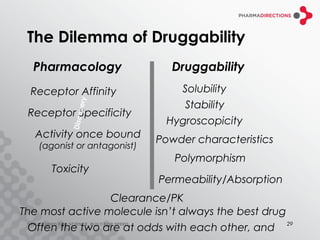
The Dilemma of Druggability
  Pharmacology                 Druggability
  Receptor Affinity             Solubility
               very


                                 Stability
 Receptor Specificity
          Disco


                              Hygroscopicity
   Activity once bound       Powder characteristics
   (agonist or antagonist)
                                Polymorphism
      Toxicity
                             Permeability/Absorption
                 Clearance/PK
The most active molecule isn’t always the best drug
                                                    29
  Often the two are at odds with each other, and
PharmaDirections, Inc.
Pharmaceutical Consulting and Project Management
       Preclinical, CMC, Regulatory Affairs


           www.PharmaDirections.com


                                                   30

Formulation Development of Poorly Soluble Drugs

  • 1.
    Poorly Soluble Drugs Trialsand Tribulations of the Modern Formulator Bruce Rehlaender, Ph.D. Principal, Formulation Development PharmaDirections, Inc. 1
  • 2.
    The Problem ofInsolubility • Med Chemists are obsessed with affinity and selectivity 2
  • 3.
    The Problem ofInsolubility • Med Chemists are obsessed with affinity and selectivity • Solubility can get left by the wayside 3
  • 4.
    The Problem ofInsolubility • Med Chemists are obsessed with affinity and selectivity • Solubility can get left by the wayside • General tendency is that new drugs are becoming more insoluble 4
  • 5.
    The Problem ofInsolubility • Med Chemists are obsessed with affinity and selectivity • Solubility can get left by the wayside • General tendency is that new drugs are becoming more insoluble • And Formulators are going crazier 5
  • 6.
    Classes of ProblemChildren Non-ionized weak Halogenated acids or weak bases molecules Lipophilic Brick dust molecules Amphiphilic molecules Macromolecules 6
  • 7.
    Two Big Issueswith Insolubility: • Cannot give particles IV emboli • Poor Bioavailability ng/mL 100 IV 50 Oral 0 0 3 6 9 12 hours 7
  • 8.
    Bioavailability Solutions • Makedrug particles smaller – ↑ Dissolution rate (kinetic) * – ↑ Solubility (thermodynamic) • You can go to extremes and… 8
  • 9.
    Bioavailability Solutions • NanosizeIt *Formerly known as colloid sciences 9
  • 10.
    Bioavailability Solutions • Administerdrug in dissolved form • Make drug form more soluble • Formulate with a solubilizer 10
  • 11.
    Solubilized Liquid Formulations • Injectables – IV (bolus and infusion) – SubQ (bolus and infusion) – IM • Inhalation – Nasal sprays – Nebulizer formulations • Oral liquids • Topicals • Otics, ophthalmics, etc. 11
  • 12.
    Solubilizing Approaches pH Adjustment Co-solvents Complexes Micelles Emulsions Liposomes 12
  • 13.
    pH Adjustment • Mostdrugs are weak acids or weak bases • Solubility depends on ionization state Solubility of Weak Base Solubility of Weak Acid 100 100 10 10 Solubility Solubility 1 1 pKa pKa 0.1 0.1 0.01 0.01 0.001 0.001 pH pH • Can get large solubility increase if pH still reasonable 13
  • 14.
    pH Adjustment What pHis acceptable for injection? • It depends….. – Route of administration (central vein IV, peripheral vein IV, SubQ, IM) – Rate and duration of administration – Buffer capacity of the formulation (D5W is in spec at pH 2.5 due to lack of buffering) – Indication (routine vs. critical, acute vs. chronic) • Problem is that you need buffer to assure solubility, but buffering decreases range 14
  • 15.
    Pop Quiz Which ofthese excipients are allowed for use in injectable products? – Polyethylene glycol? – Ethanol? – Bile salts? – N-methyl-pyrrolidone (NMP)? – Dimethyl-acetamide (DMA)? – Polysorbates (Tweens)? • All of the above are used in approved injectable products 15
  • 16.
    Co-Solvent Formulations • Addinga water-miscible solvent can reduce polarity and increase solubility • Most typical solvents are propylene glycol, low MW PEGs, and ethanol. – Problem: Typical Solubility Curve you need a lot – Can sometimes get Solubility formulation that is metastable upon dilution 0 20 40 60 % Co-Solvent 80 100 in aqueous 16
  • 17.
    Co-Solvent Formulations How muchsolvent is allowed? • It depends….. – Route of administration (central vein IV, peripheral vein IV, SubQ, IM) – Rate and duration of administration – Indication (routine vs. critical, acute vs. chronic) • These formulations are very hypertonic, so best for IV or dilute-for-use • Example: several formulations with 40% PG and 10% ethanol for IV and IM 17
  • 18.
    Complexes (Cyclodextrins) • Cyclodextrinsare “basket-like” molecules with a hydrophobic pocket and hydrophilic exterior • Hydroxypropyl-β-CD and sulfobutyl ether- β- CD used for injectables • Need high concentration (>10%) since level needs to be stoichiometric with drug • Quite safe. Only significant issue is some nephrotoxicity • Licensing was a big issue in past 18
  • 19.
    Complexes (Cyclodextrins) Hydrophobic drug 19
  • 20.
    Micelles and Microemulsions •Micelles are aggregates of surfactant molecules that can solubilize drugs. • Typically used surfactants are: – Polysorbates (PEGylated sorbitan fatty acid esters) – Cremophor (PEGylated castor oil) – Pluronic F68 (PEG/PPG block copolymer) – Solutol (PEGylated hydroxystearate) • All can cause anaphylactic reactions • Example: Taxol formulated in pure surfactant. Diluted to metastable dispersion prior to infusing 20
  • 21.
  • 22.
    Emulsions • In contrastto micelles/microemulsions, emulsions are thermodynamically unstable • Prepared with high pressure homogenizer • Oil droplet size typically >0.2 µm, so must be heat (or radiation) sterilized • Oil droplets similar to chylomicrons, so are very safe • Phospholipids used as emulsifier. Non-ionics (Tweens, etc.) can be used for non-sterile products but cannot take heat 22
  • 23.
    Emulsions lipophile am ph i ph i le 23
  • 24.
    Liposomes • Liposomes aresmall vesicles composed of phospholipid bilayers • Liposomes are also unstable and are typically quite fussy and expensive • Like emulsions, liposomes are very non- toxic • Unlike emulsions, liposomes can be sterile filtered and lyophilized • Special process equipment is required 24
  • 25.
    Liposomes lipophile am ph iph ile 25
  • 26.
    Summary Approach + - Tight range for comfort Adjust pH Simple, few excipients and stability Toxicity, osmolarity, Co-solvent Simple process precipitation on dilution Complexes Low toxicity, dilutable, High cost, process can lyophilizable be moderately complex Anaphylaxis and other Micelles Simple process, dilutable toxicity issues Non-toxic, isotonic, Complex process, Emulsion generally dilutable no filter sterilization Non-toxic, isotonic, Cost, complex process, Liposomes filterable, lyophilizable poor physical stability 26
  • 27.
    Choosing a Formulation Formulating poorly soluble drugs is like voting…. There are seldom good options, just least objectionable ones 27
  • 28.
    Choosing a Formulation Whatsystem is right for you? • It depends….. – What solubilizes your drug (first and foremost) – Stability considerations – Route, rate, and duration of administration – Factors specific to disease state – IP considerations and, of course, marketing • Step 1: Cast a broad net to identify your options • Step 2: Choose your poison 28
  • 29.
    The Dilemma ofDruggability Pharmacology Druggability Receptor Affinity Solubility very Stability Receptor Specificity Disco Hygroscopicity Activity once bound Powder characteristics (agonist or antagonist) Polymorphism Toxicity Permeability/Absorption Clearance/PK The most active molecule isn’t always the best drug 29 Often the two are at odds with each other, and
  • 30.
    PharmaDirections, Inc. Pharmaceutical Consultingand Project Management Preclinical, CMC, Regulatory Affairs www.PharmaDirections.com 30