MICROMERITICSMICROMERITICS
&&
PRECIPITATIONPRECIPITATION
Dr. Asra HameedDr. Asra Hameed
Pharm.D (JUW)Pharm.D (JUW)
asra_hameed1@hotmail.comasra_hameed1@hotmail.com
CONTENTS:
MICROMERITICS:
Definition & Origin of the term
“MICROMERITICS”
Applications
Factors affecting the flow
properties of powders
Particle size analysis
Particle size reduction
Bulk density
True density
Porosity
Importance of particle size
MICROMERITICS:
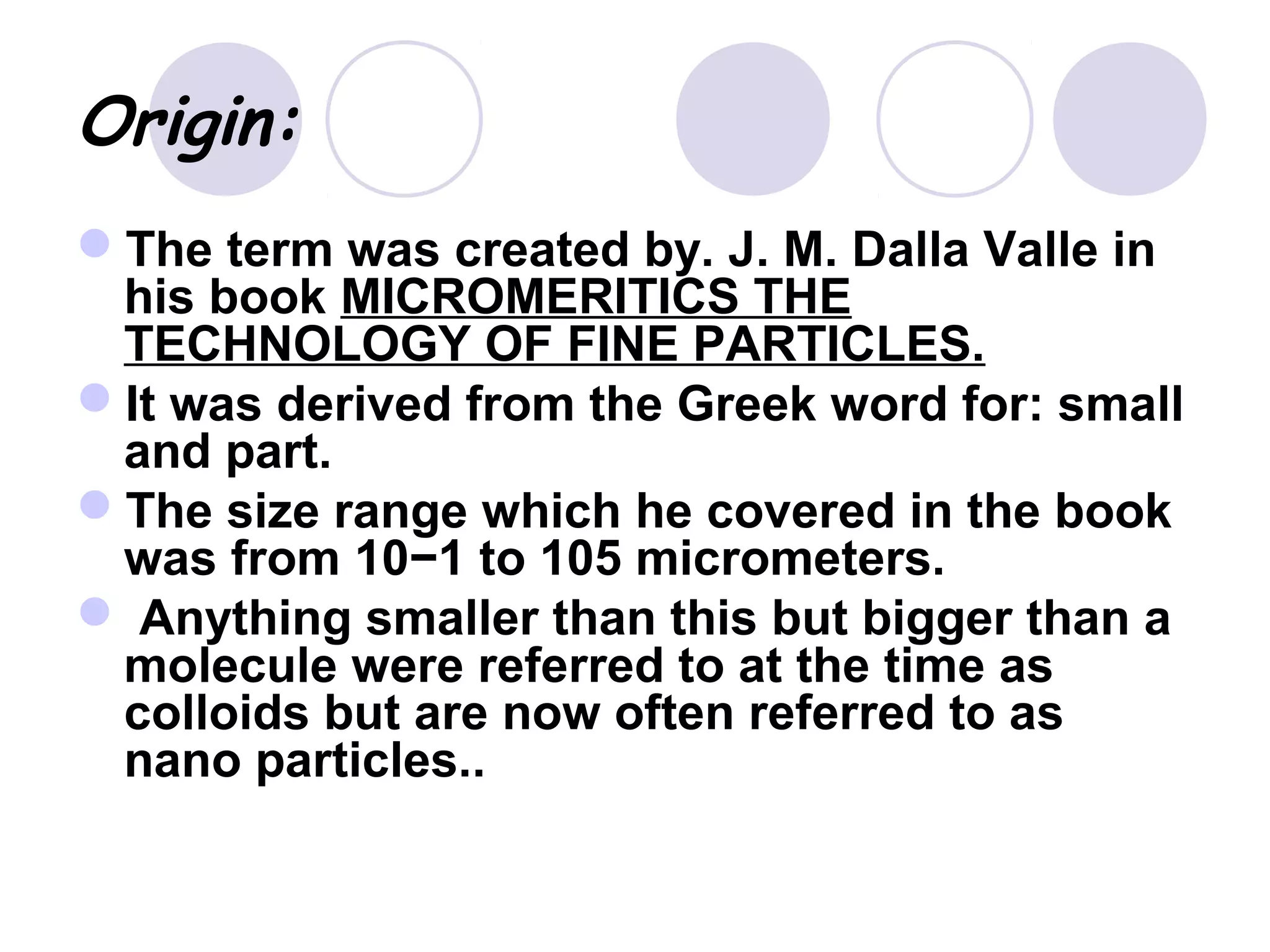
 Micromeritics is the science and technology
of small particles.
 The knowledge and control of the size of
particles is of importance in pharmacy.
 The size, and hence the surface area of a
particle, can be related to the physical,
chemical & pharmacologic properties of
drugs.
 Clinically, the particle size of a drug can
affect its release from dosage forms that
are administered orally, parenterally,
rectally & topically.
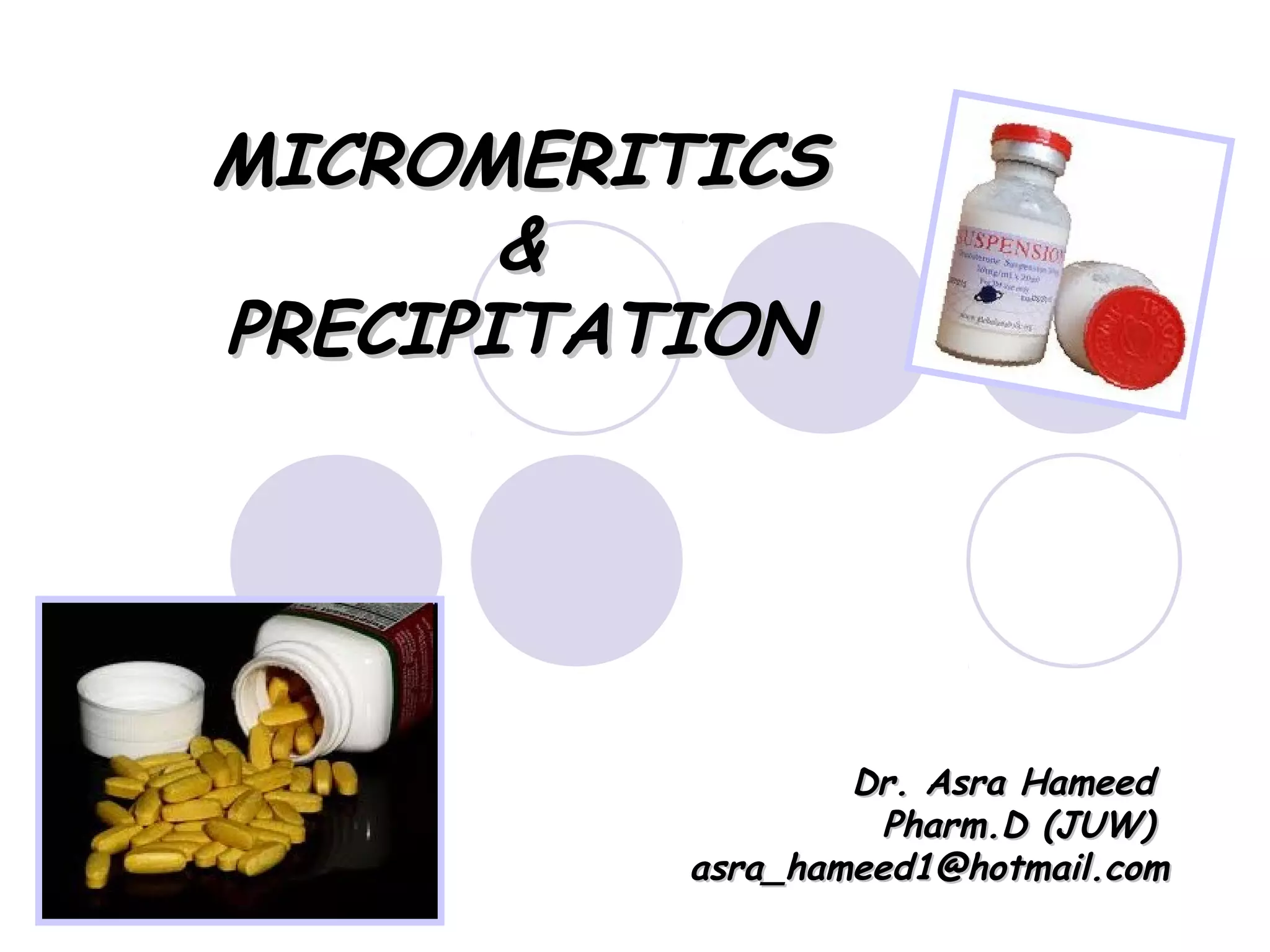
 The successful formulation of suspensions,
emulsions & tablets; both physical stability
& pharmacologic response also depends
on the particle size achieved in the product.
Origin:
The term was created by. J. M. Dalla Valle in
his book MICROMERITICS THE
TECHNOLOGY OF FINE PARTICLES.
It was derived from the Greek word for: small
and part.
The size range which he covered in the book
was from 10−1 to 105 micrometers.
 Anything smaller than this but bigger than a
molecule were referred to at the time as
colloids but are now often referred to as
nano particles..
Applications:
Release & dissolution
Particle size & surface area influence the release
of a drug from a dosage form that is
administered orally, rectally parenterally &
topically. Higher surface area brings about
intimate contact of the drug with the
dissolution fluids in vivo & increases the drug
solubility & dissolution.
Absorption & drug action
Particle size & surface area influence the drug
absorption & subsequently the therapeutic
action. Higher the dissolution, faster the
absorption & hence quicker & greater the drug
action.
Applications:
Physical stability
Micromeritic properties of a particle i.e the
particle size in a formulation influences the
physical stability of the suspensions &
emulsions. Smaller the size of the particle,
better the physical stability of the dosage
form owing to the brownian movement of the
particles in the dispersion.
Dose uniformity
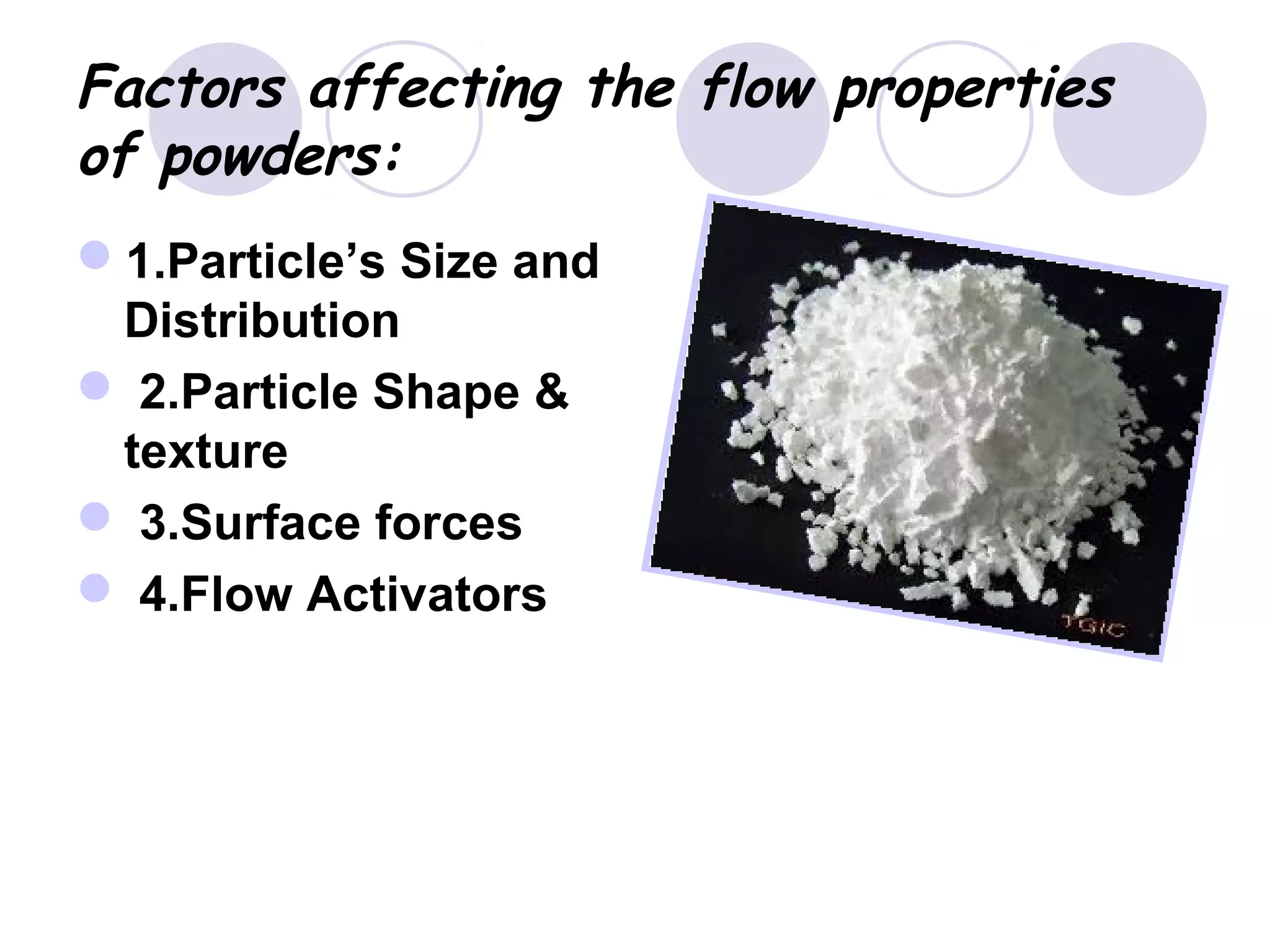
Good flow properties of granules & powders are
important in the manufacturing of tablets &
capsules. The distribution of particles should
be uniform in terms of number & weight.
Factors affecting the flow properties
of powders:
1.Particle’s Size and
Distribution
 2.Particle Shape &
texture
 3.Surface forces
 4.Flow Activators
Particle’s size & Distribution:
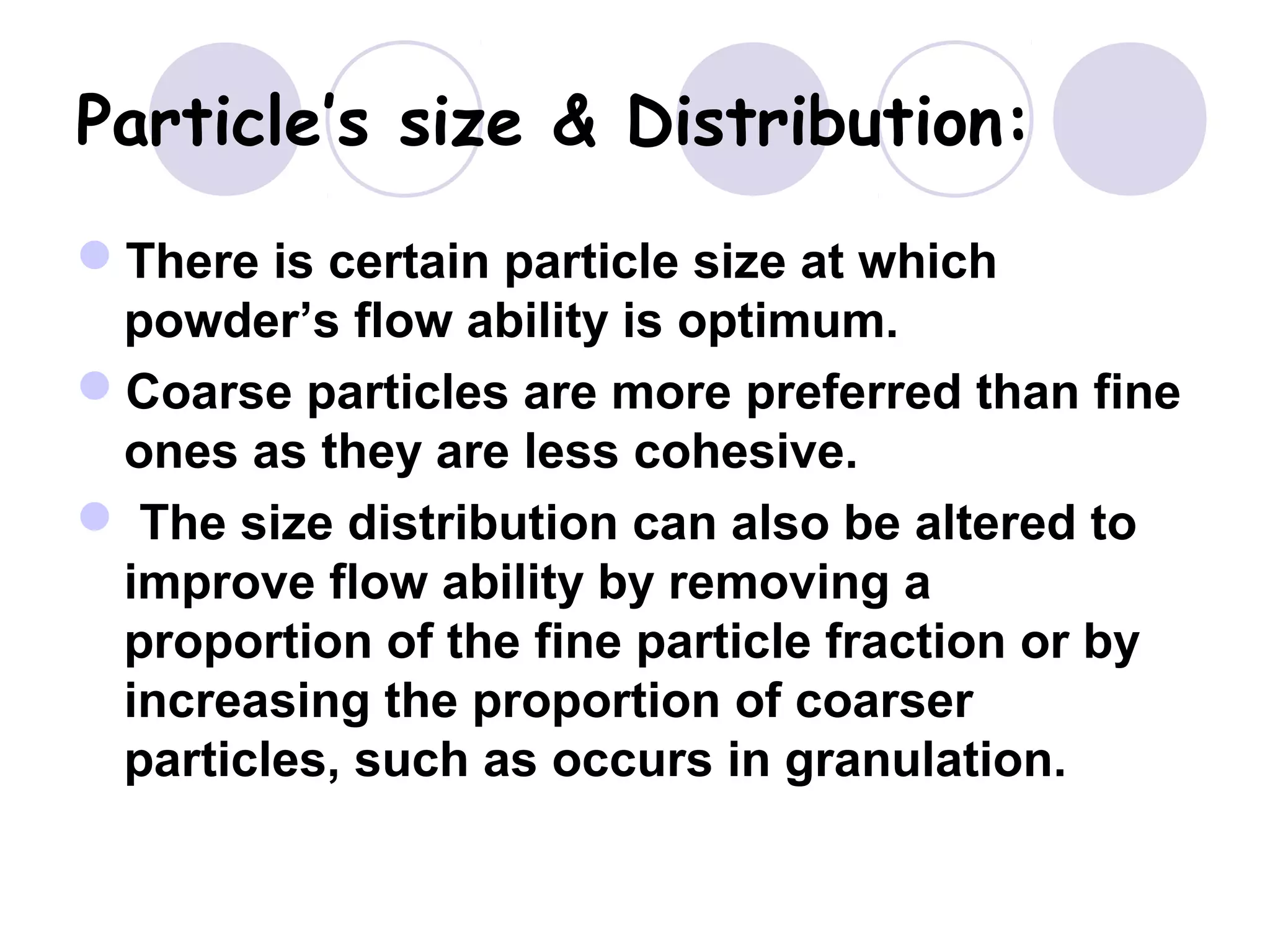
There is certain particle size at which
powder’s flow ability is optimum.
Coarse particles are more preferred than fine
ones as they are less cohesive.
 The size distribution can also be altered to
improve flow ability by removing a
proportion of the fine particle fraction or by
increasing the proportion of coarser
particles, such as occurs in granulation.
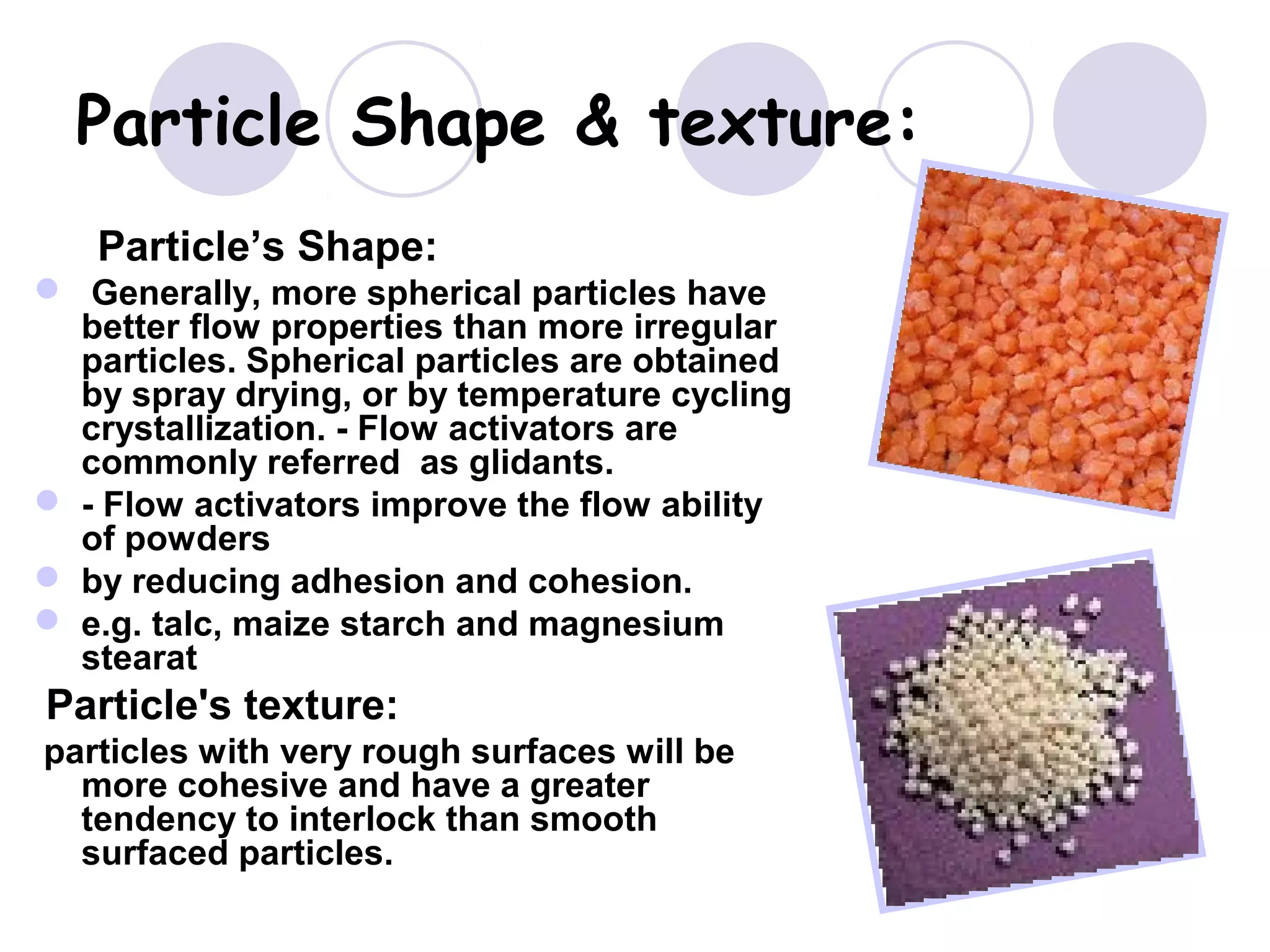
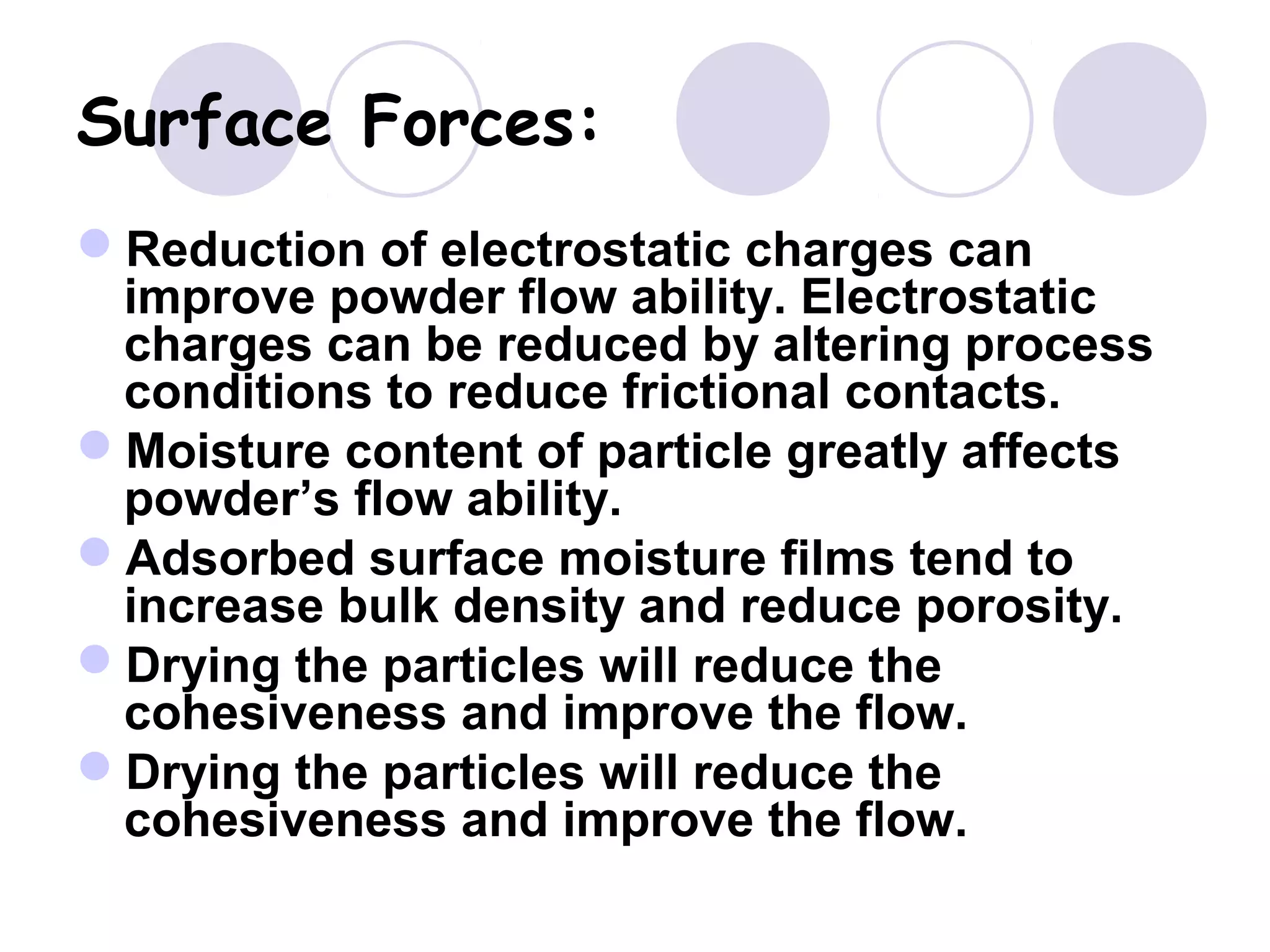
Particle Shape & texture:
Particle’s Shape:
 Generally, more spherical particles have
better flow properties than more irregular
particles. Spherical particles are obtained
by spray drying, or by temperature cycling
crystallization. - Flow activators are
commonly referred as glidants.
 - Flow activators improve the flow ability
of powders
 by reducing adhesion and cohesion.
 e.g. talc, maize starch and magnesium
stearat
Particle's texture:
particles with very rough surfaces will be
more cohesive and have a greater
tendency to interlock than smooth
surfaced particles.
Surface Forces:
Reduction of electrostatic charges can
improve powder flow ability. Electrostatic
charges can be reduced by altering process
conditions to reduce frictional contacts.
Moisture content of particle greatly affects
powder’s flow ability.
Adsorbed surface moisture films tend to
increase bulk density and reduce porosity.
Drying the particles will reduce the
cohesiveness and improve the flow.
Drying the particles will reduce the
cohesiveness and improve the flow.
Flow activators:
Flow activators are commonly referred
as glidants.
Flow activators improve the flow ability
of powders by reducing adhesion and
cohesion.
e.g. talc, maize starch and magnesium
stearat
Methods for determining particle size:
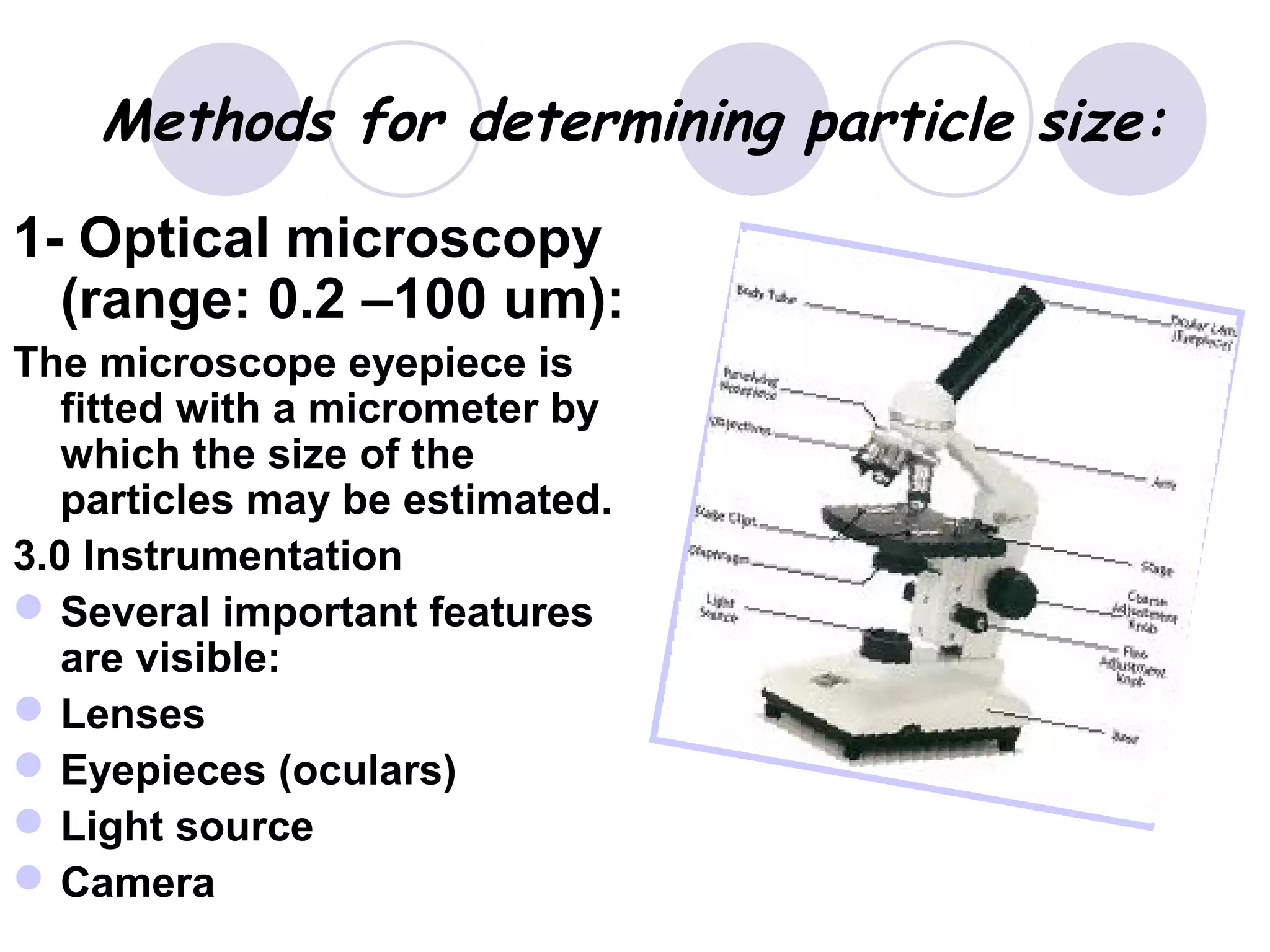
1- Optical microscopy
(range: 0.2 –100 um):
The microscope eyepiece is
fitted with a micrometer by
which the size of the
particles may be estimated.
3.0 Instrumentation
Several important features
are visible:
Lenses
Eyepieces (oculars)
Light source
Camera
Methods for determining particle size:
2- Sieving (range: 40-
9500μm):
 Standard sized sieves are available to cover a
wide range of sizes. These sieves are designed
to sit in a stack so that material falls through
smaller and smaller meshes until it reaches a
mesh which is too fine for it to pass through.
 The stack of sieves is mechanically shaken to
promote the passage of the solids.
 The fraction of the material between pairs of
sieve sizes is determined by weighing the
residue on each sieve.
 The result achieved will depend on the
duration of the agitation and the manner of the
agitation.
Methods for determining particle size:
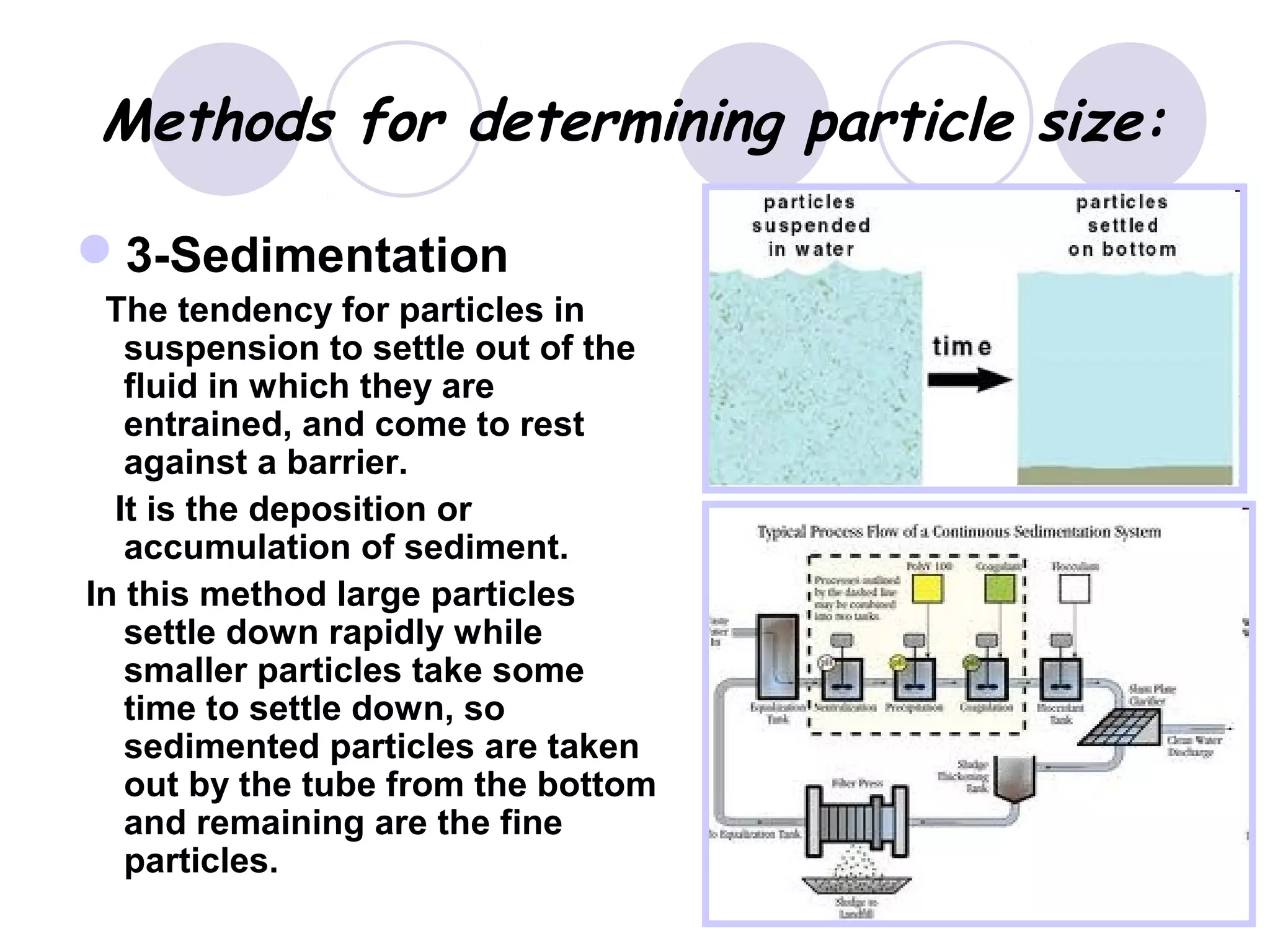
3-Sedimentation
The tendency for particles in
suspension to settle out of the
fluid in which they are
entrained, and come to rest
against a barrier.
It is the deposition or
accumulation of sediment.
In this method large particles
settle down rapidly while
smaller particles take some
time to settle down, so
sedimented particles are taken
out by the tube from the bottom
and remaining are the fine
particles.
Methods for determining particle size:
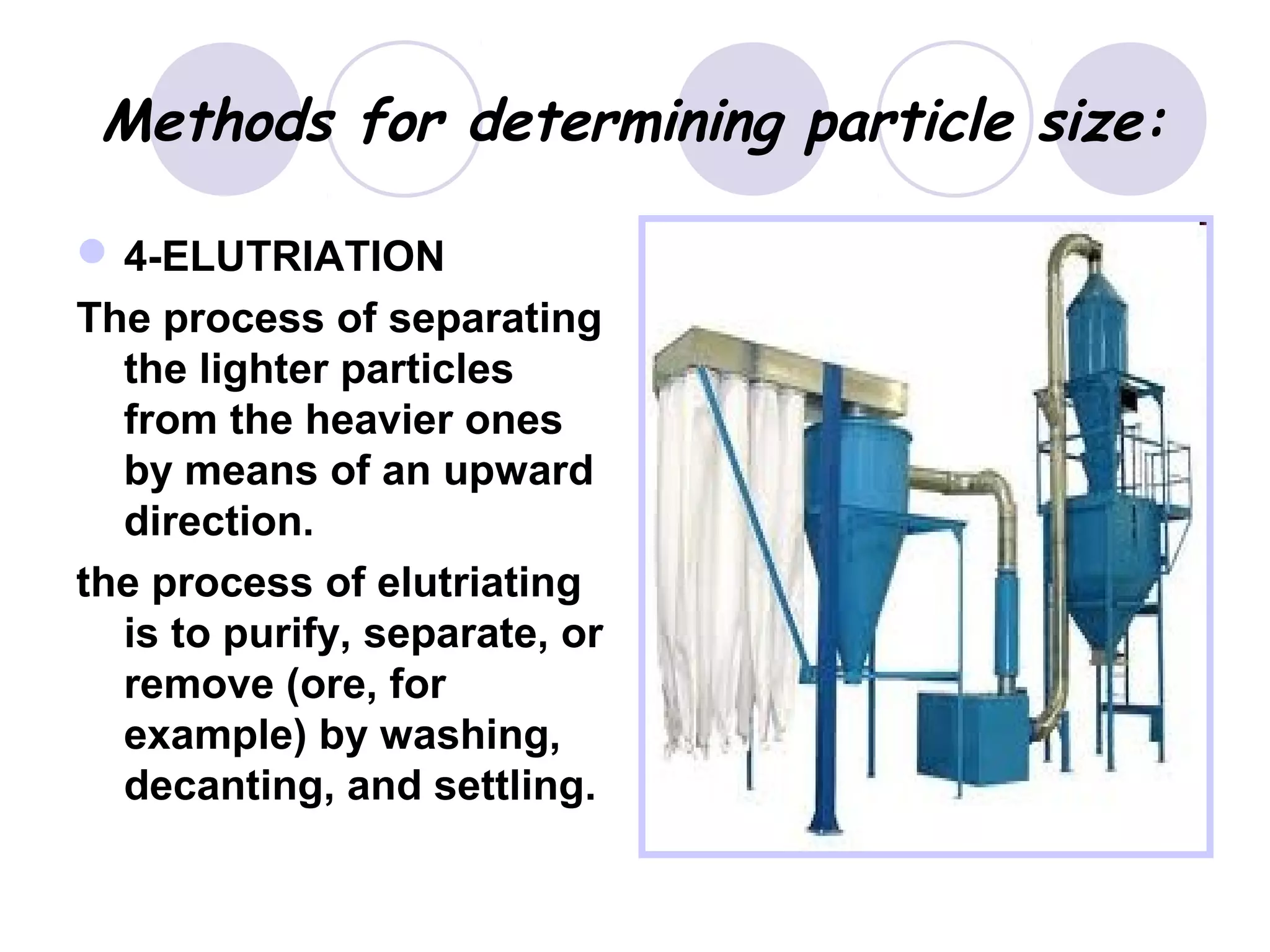
4-ELUTRIATION
The process of separating
the lighter particles
from the heavier ones
by means of an upward
direction.
the process of elutriating
is to purify, separate, or
remove (ore, for
example) by washing,
decanting, and settling.
Size Reduction
Four commonly used methods
for size reduction:
Compression
Impact
Attrition
Cutting
Size reduction equipment
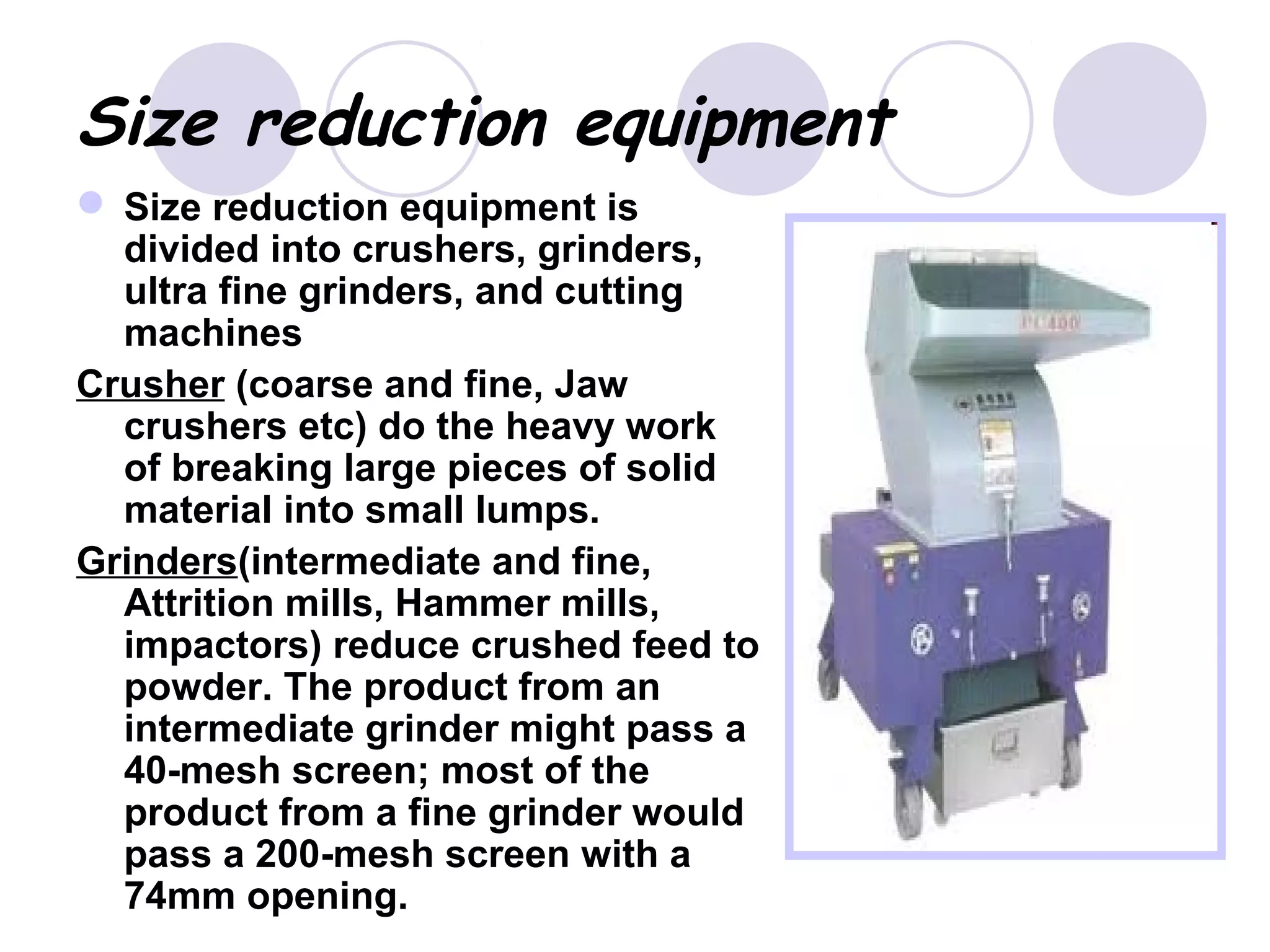
 Size reduction equipment is
divided into crushers, grinders,
ultra fine grinders, and cutting
machines
Crusher (coarse and fine, Jaw
crushers etc) do the heavy work
of breaking large pieces of solid
material into small lumps.
Grinders(intermediate and fine,
Attrition mills, Hammer mills,
impactors) reduce crushed feed to
powder. The product from an
intermediate grinder might pass a
40-mesh screen; most of the
product from a fine grinder would
pass a 200-mesh screen with a
74mm opening.
Size reduction equipment
 An ultra fine grinder
(Fluid-energy mills,
Hammer mills with
internal classification etc)
accepts feed particles no
larger than 6mm and the
product size is typically 1
to 5m m.
 Cutters(Knife, cutters ,
dicers, slitters)give
particles of definite size
and shape, 2 to 10mm in
length.
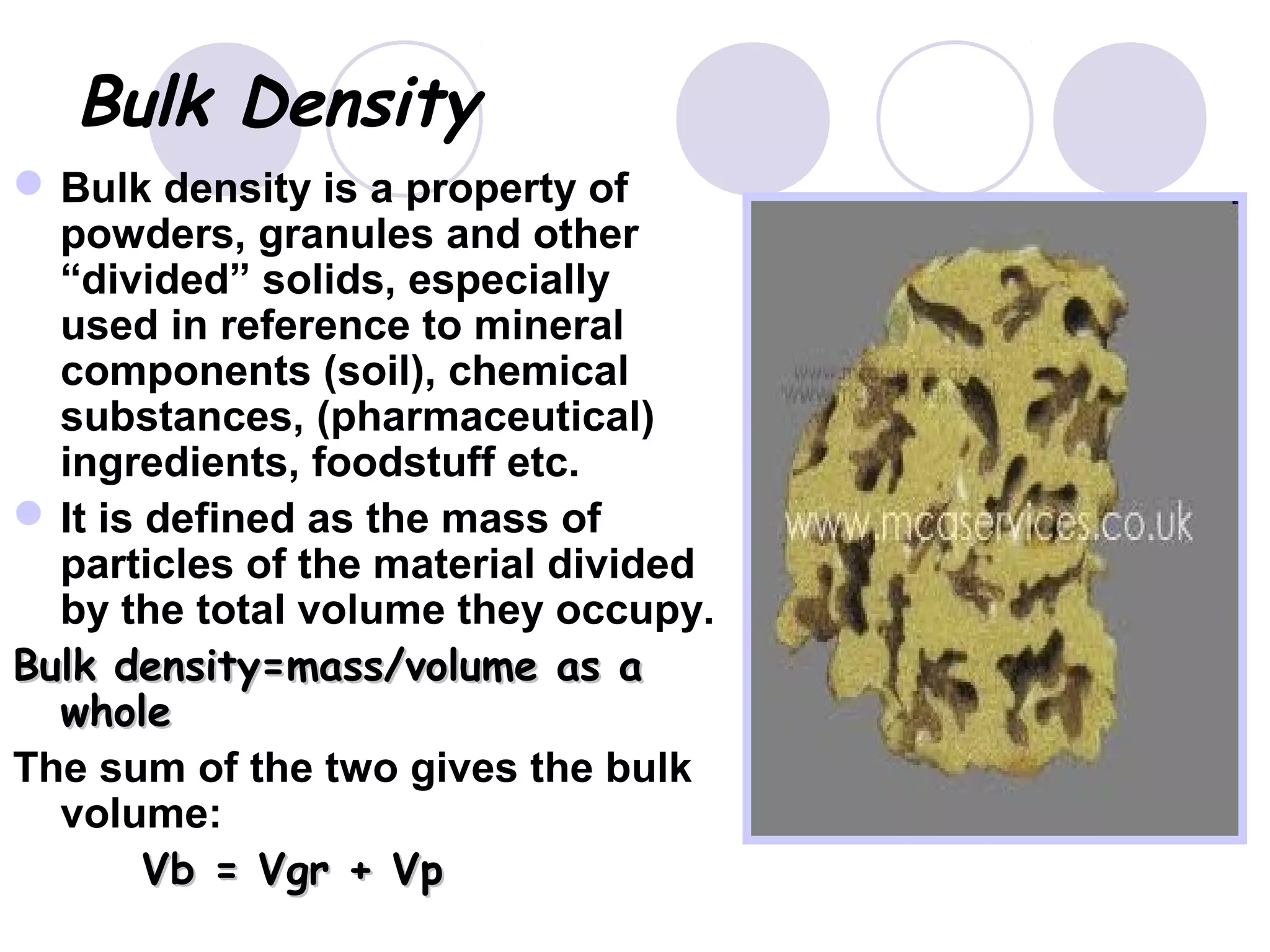
Bulk Density
Bulk density is a property of
powders, granules and other
“divided” solids, especially
used in reference to mineral
components (soil), chemical
substances, (pharmaceutical)
ingredients, foodstuff etc.
It is defined as the mass of
particles of the material divided
by the total volume they occupy.
Bulk density=mass/volume as aBulk density=mass/volume as a
wholewhole
The sum of the two gives the bulk
volume:
Vb = Vgr + VpVb = Vgr + Vp
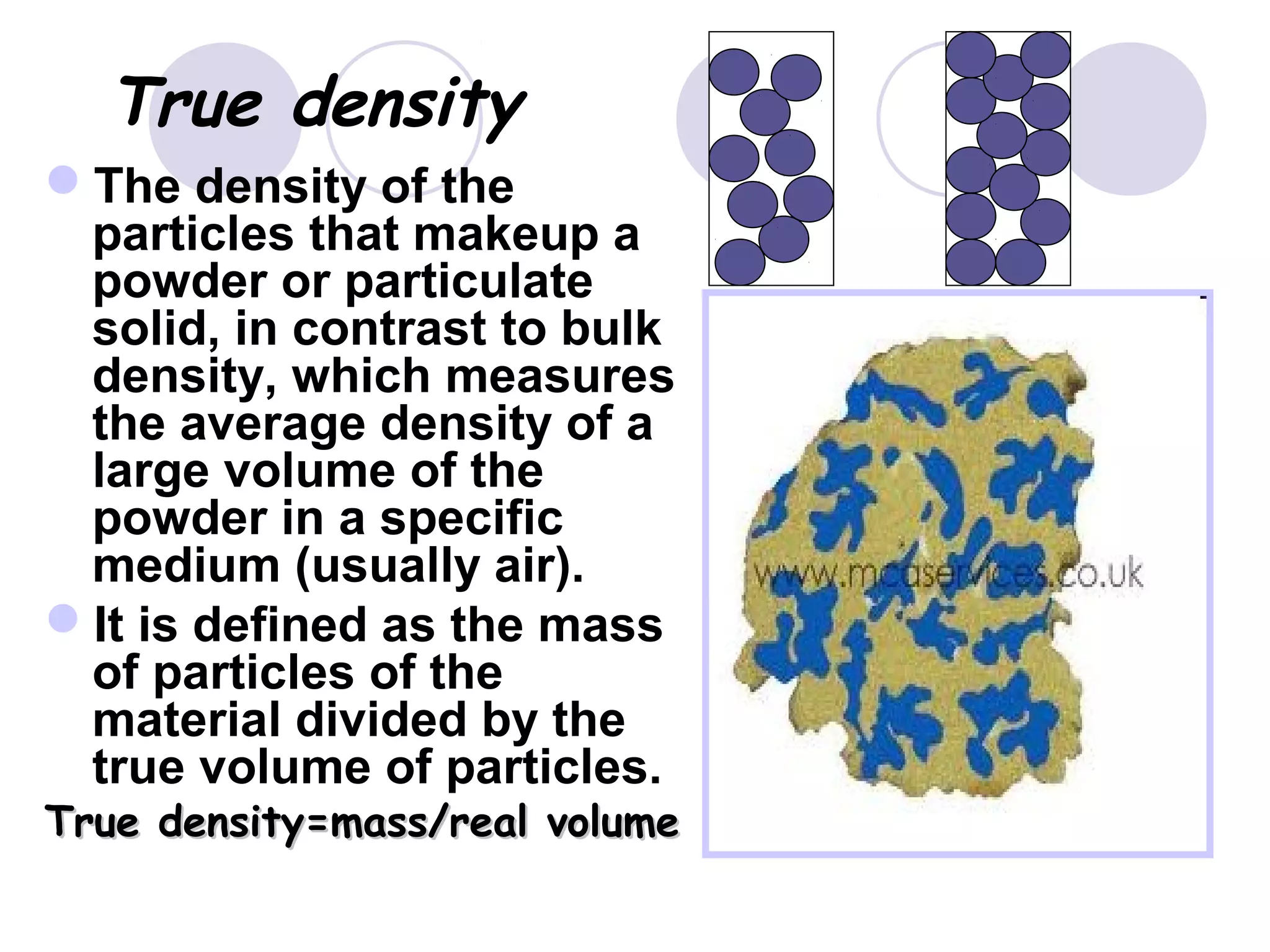
 True density
The density of the
particles that makeup a
powder or particulate
solid, in contrast to bulk
density, which measures
the average density of a
large volume of the
powder in a specific
medium (usually air).
It is defined as the mass
of particles of the
material divided by the
true volume of particles.
True density=mass/real volumeTrue density=mass/real volume
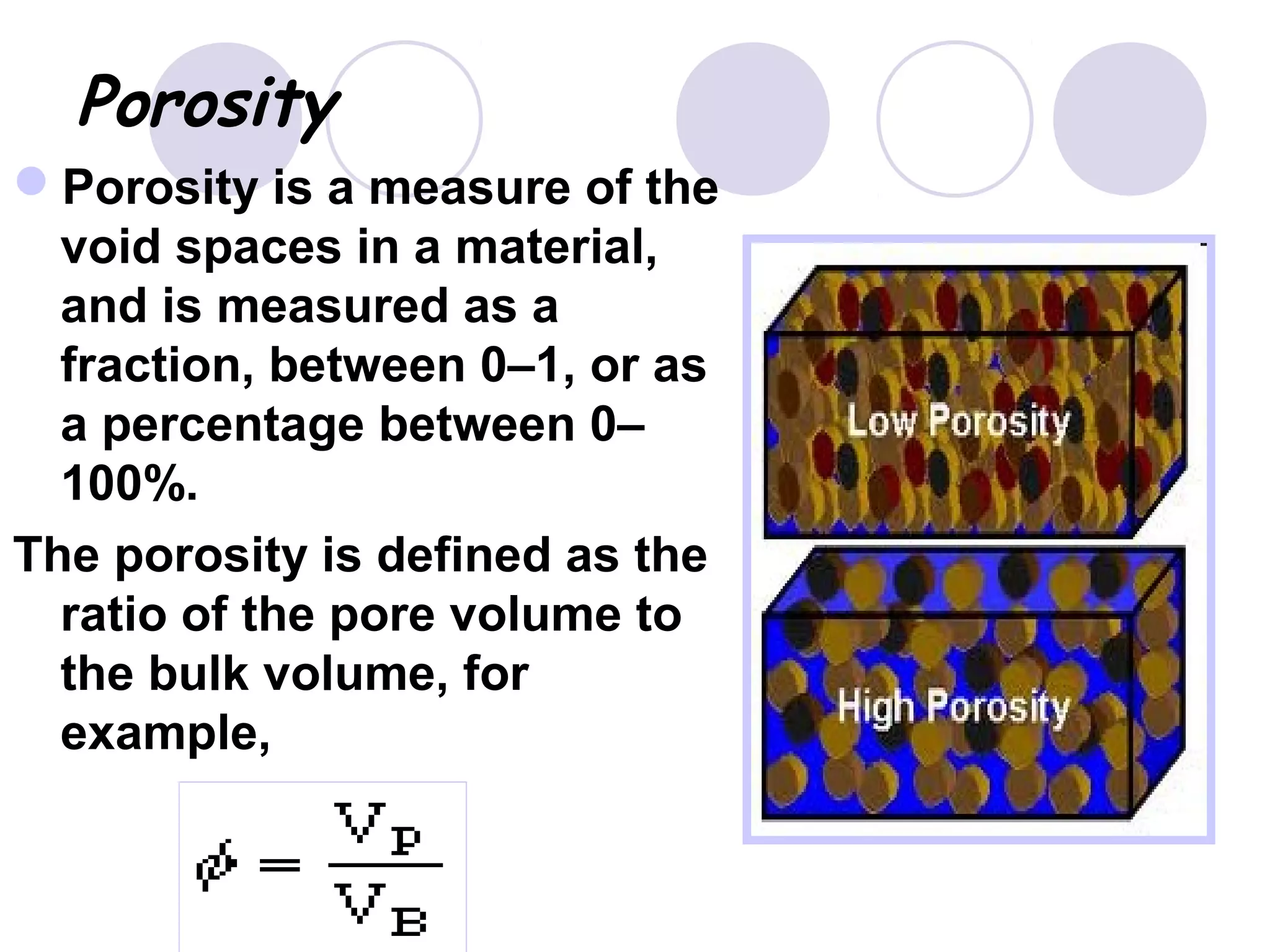
Porosity
Porosity is a measure of the
void spaces in a material,
and is measured as a
fraction, between 0–1, or as
a percentage between 0–
100%.
The porosity is defined as the
ratio of the pore volume to
the bulk volume, for
example,
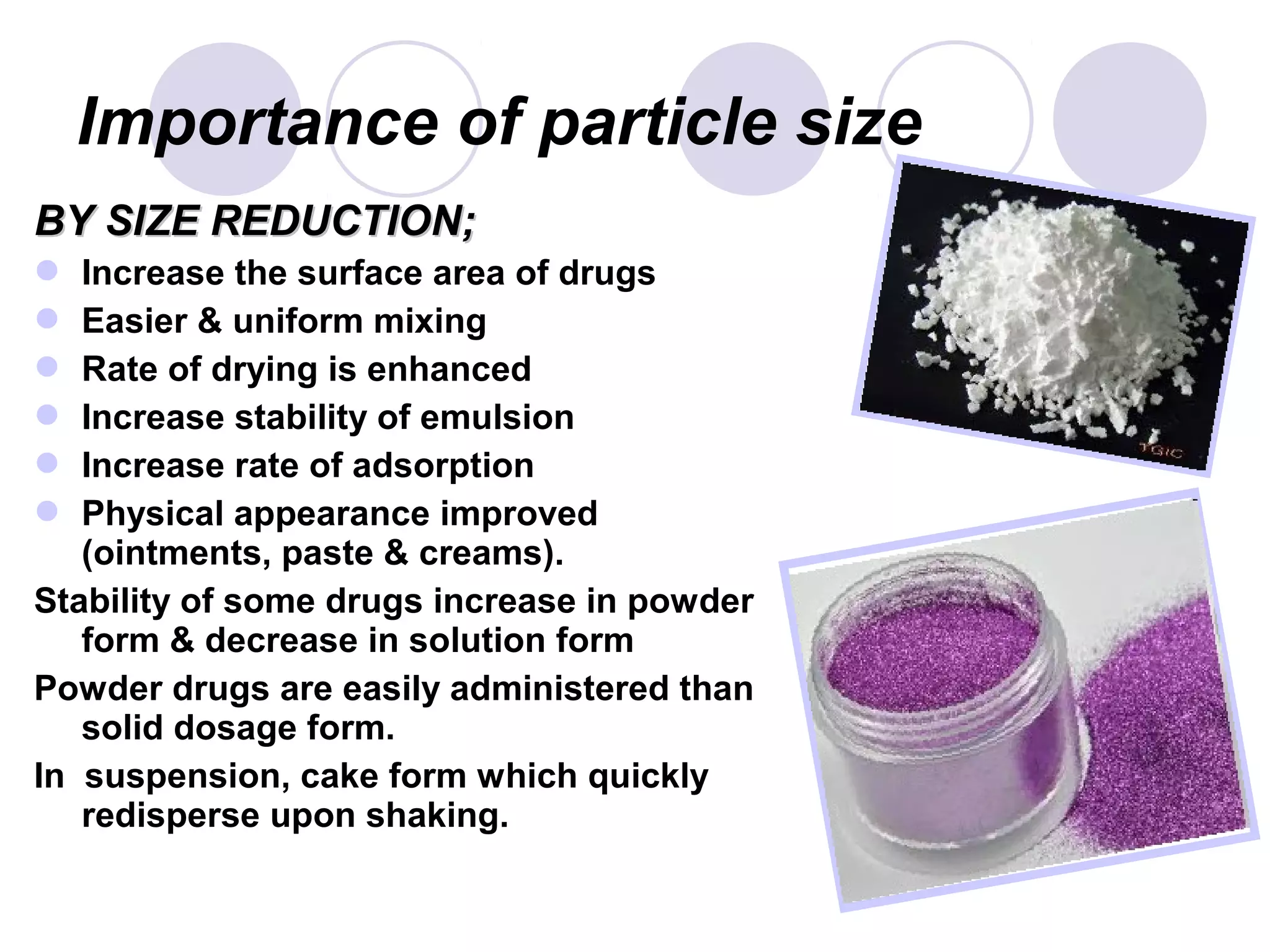
Importance of particle size
BY SIZE REDUCTION;BY SIZE REDUCTION;
 Increase the surface area of drugs
 Easier & uniform mixing
 Rate of drying is enhanced
 Increase stability of emulsion
 Increase rate of adsorption
 Physical appearance improved
(ointments, paste & creams).
Stability of some drugs increase in powder
form & decrease in solution form
Powder drugs are easily administered than
solid dosage form.
In suspension, cake form which quickly
redisperse upon shaking.
Contents
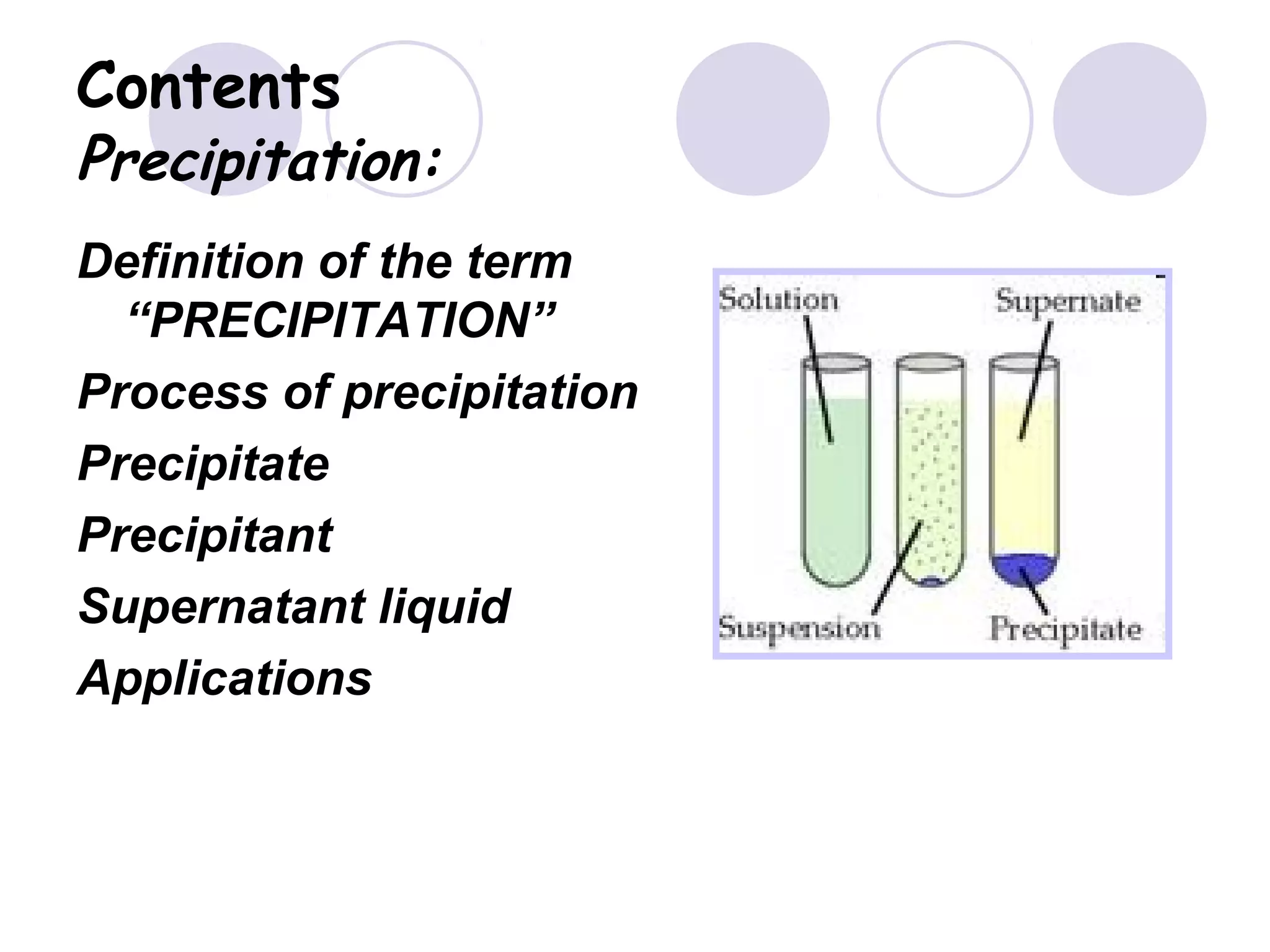
Precipitation:
Definition of the term
“PRECIPITATION”
Process of precipitation
Precipitate
Precipitant
Supernatant liquid
Applications
PRECIPITATION
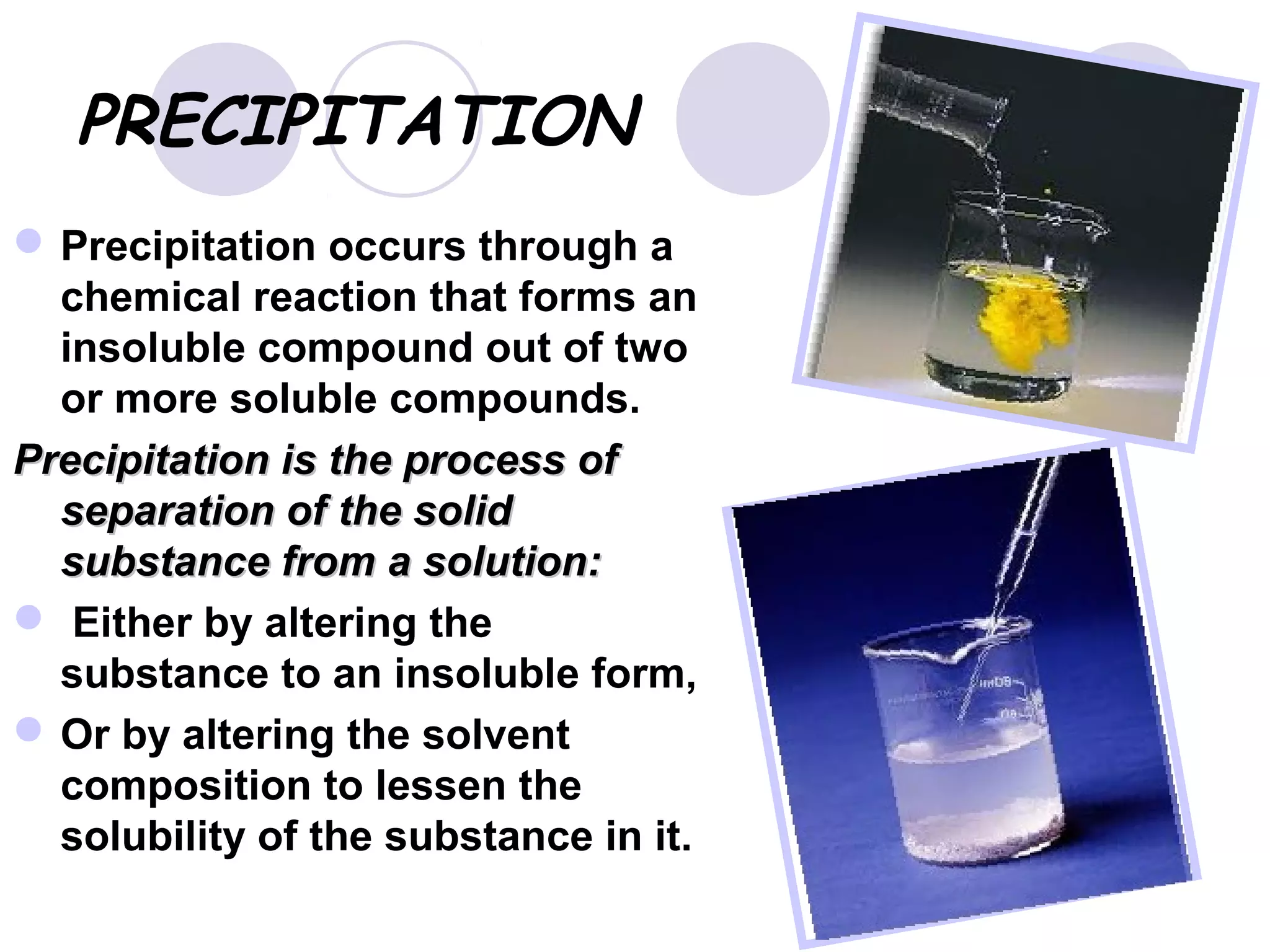
Precipitation occurs through a
chemical reaction that forms an
insoluble compound out of two
or more soluble compounds.
Precipitation is the process ofPrecipitation is the process of
separation of the solidseparation of the solid
substance from a solution:substance from a solution:
 Either by altering the
substance to an insoluble form,
Or by altering the solvent
composition to lessen the
solubility of the substance in it.
Process Of Precipitation
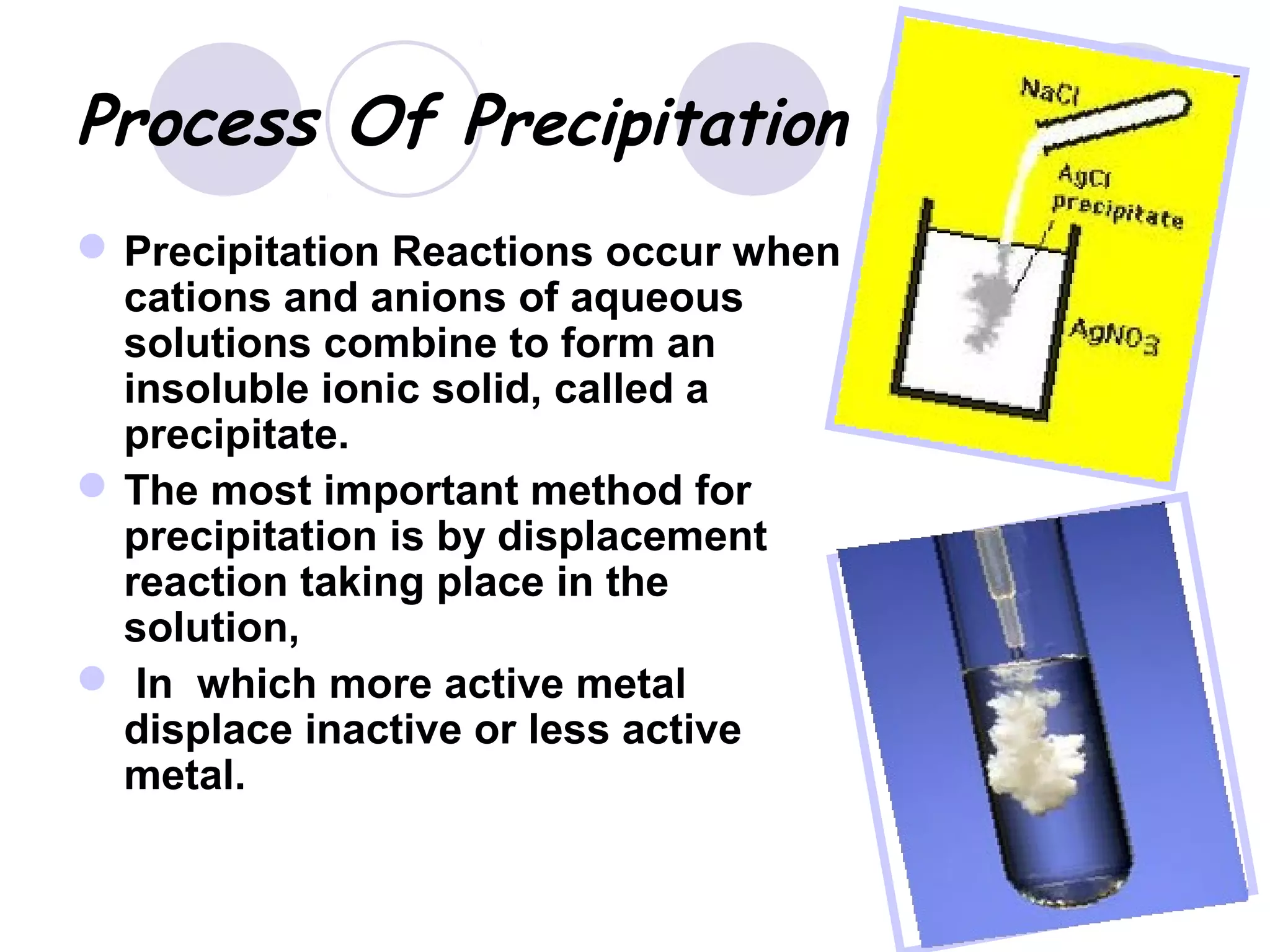
Precipitation Reactions occur when
cations and anions of aqueous
solutions combine to form an
insoluble ionic solid, called a
precipitate.
The most important method for
precipitation is by displacement
reaction taking place in the
solution,
 In which more active metal
displace inactive or less active
metal.
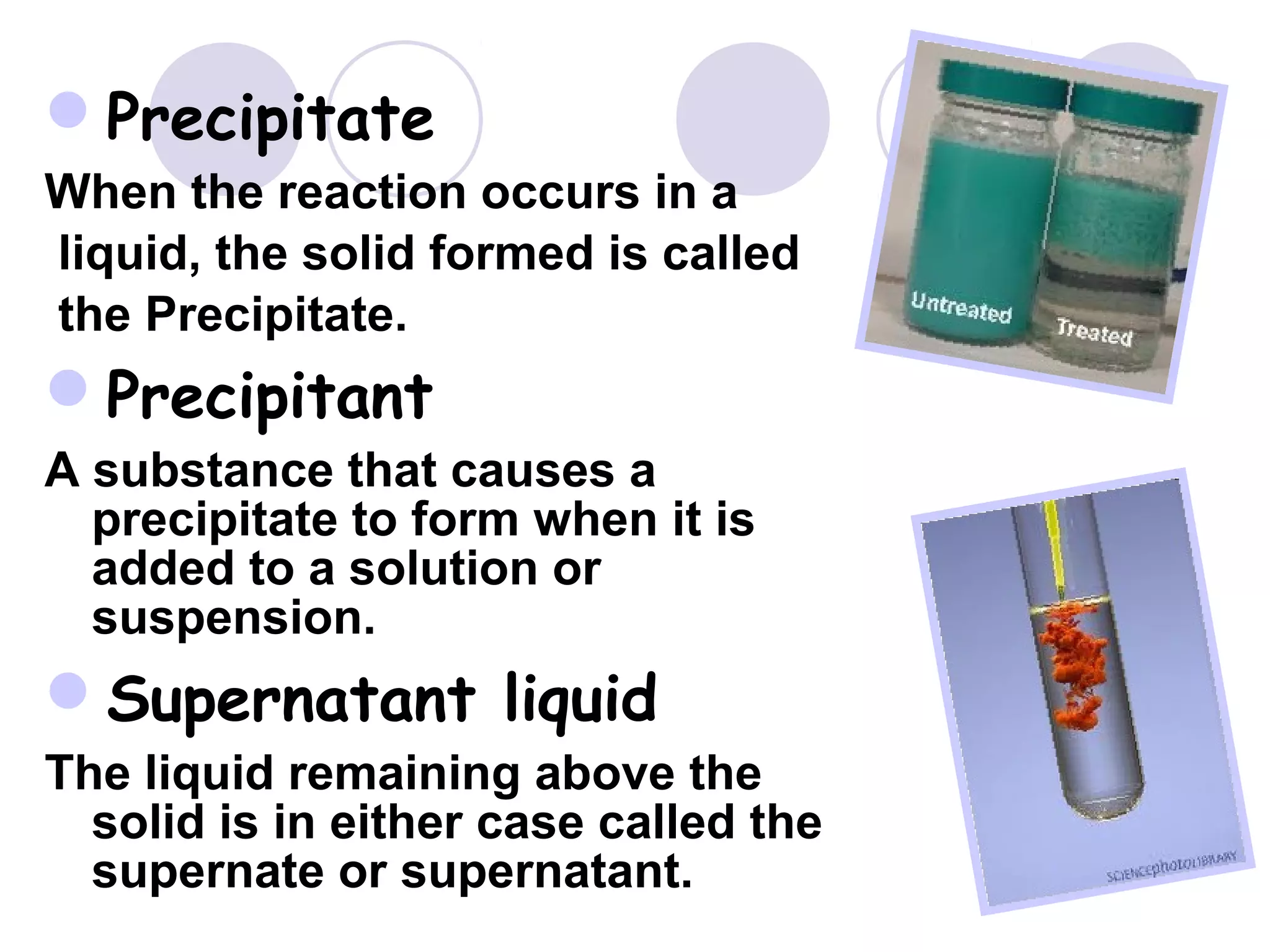
Precipitate
When the reaction occurs in a
liquid, the solid formed is called
the Precipitate.
Precipitant
A substance that causes a
precipitate to form when it is
added to a solution or
suspension.
Supernatant liquid
The liquid remaining above the
solid is in either case called the
supernate or supernatant.
Applications
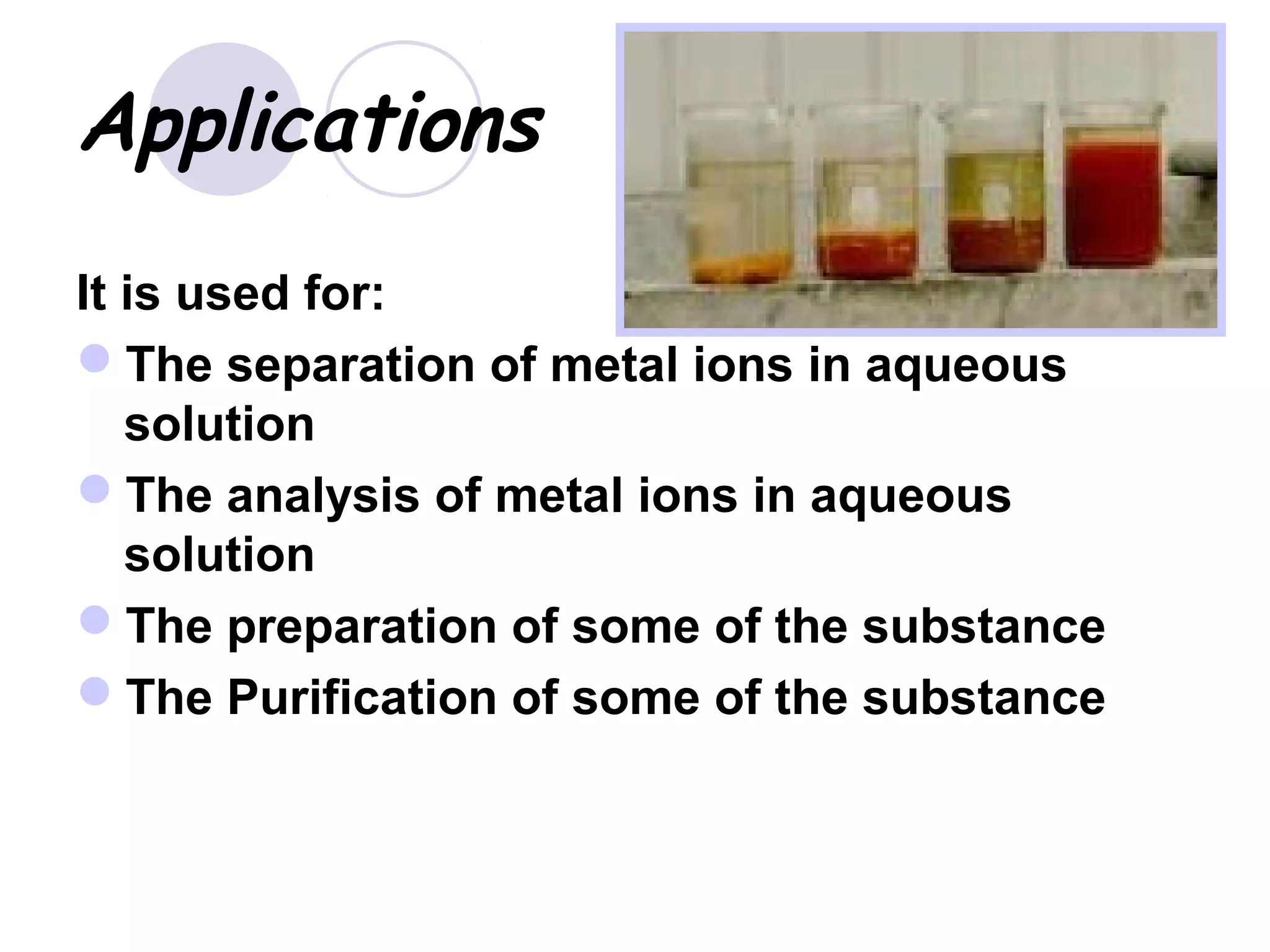
It is used for:
The separation of metal ions in aqueous
solution
The analysis of metal ions in aqueous
solution
The preparation of some of the substance
The Purification of some of the substance
Applications
Separation
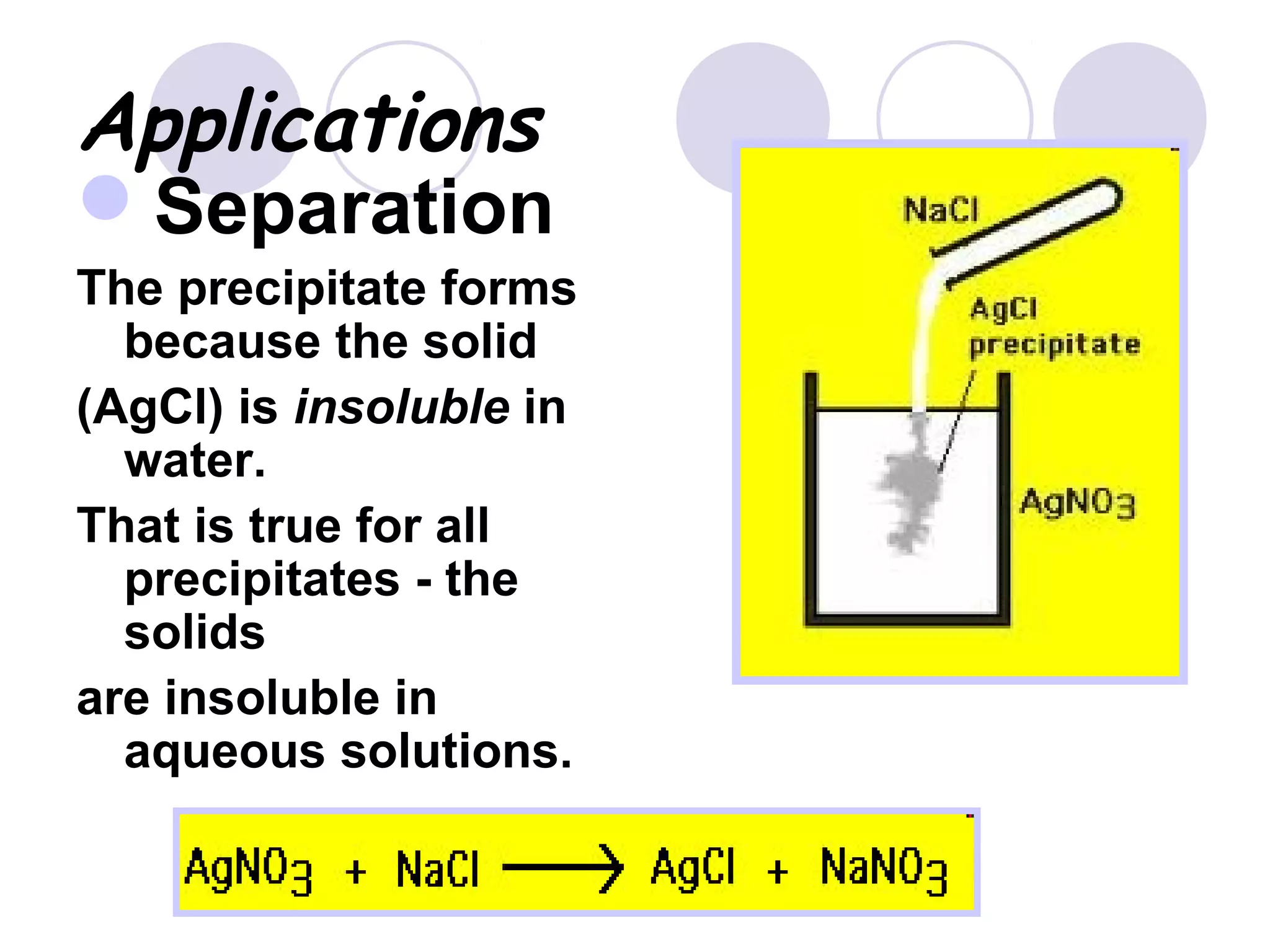
The precipitate forms
because the solid
(AgCl) is insoluble in
water.
That is true for all
precipitates - the
solids
are insoluble in
aqueous solutions.
Applications
Preparation
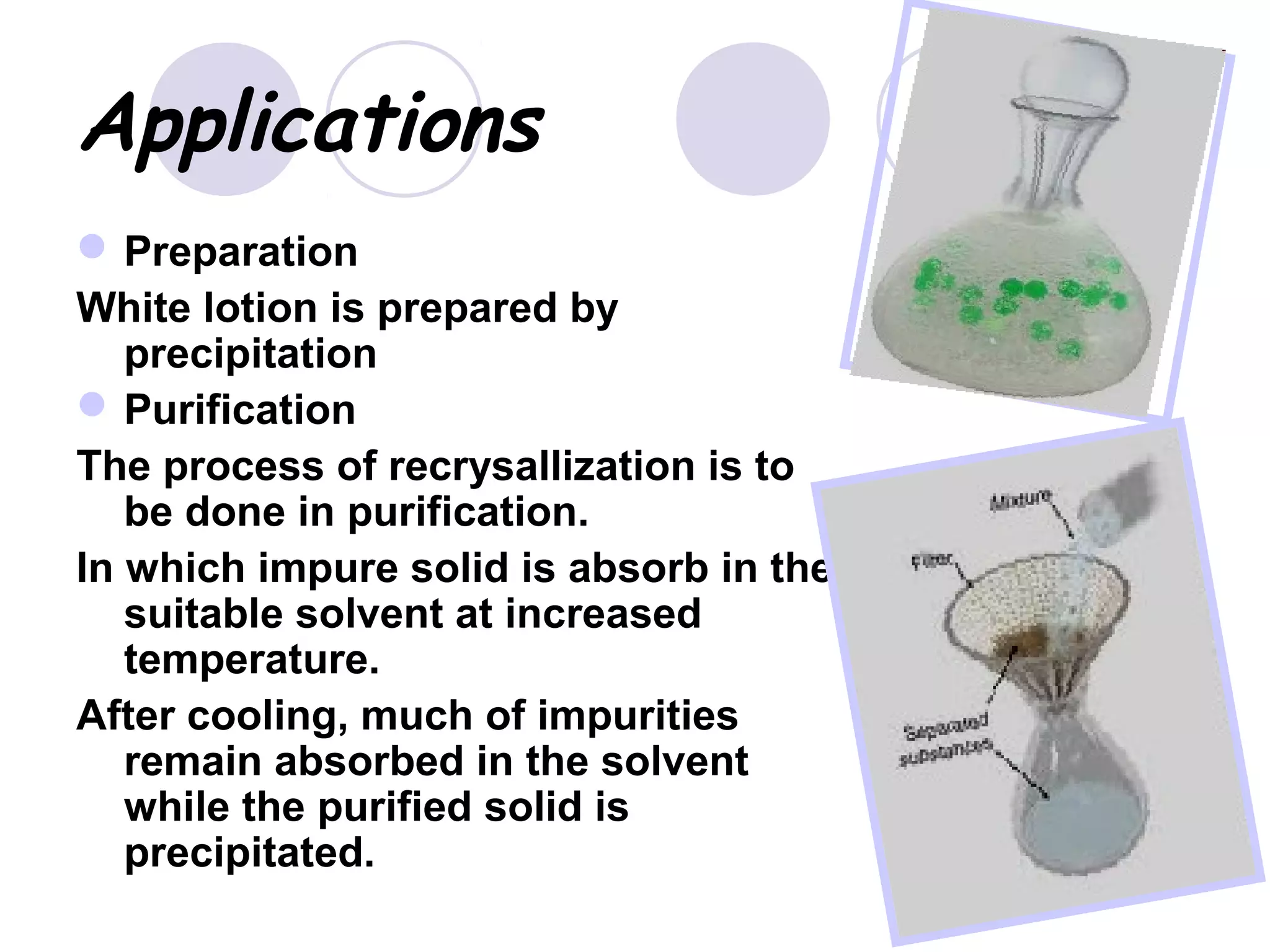
White lotion is prepared by
precipitation
Purification
The process of recrysallization is to
be done in purification.
In which impure solid is absorb in the
suitable solvent at increased
temperature.
After cooling, much of impurities
remain absorbed in the solvent
while the purified solid is
precipitated.
MICROMERITICS & PRECIPITATION

MICROMERITICS & PRECIPITATION

  • 1.
    MICROMERITICSMICROMERITICS && PRECIPITATIONPRECIPITATION Dr. Asra HameedDr.Asra Hameed Pharm.D (JUW)Pharm.D (JUW) asra_hameed1@hotmail.comasra_hameed1@hotmail.com
  • 2.
    CONTENTS: MICROMERITICS: Definition & Originof the term “MICROMERITICS” Applications Factors affecting the flow properties of powders Particle size analysis Particle size reduction Bulk density True density Porosity Importance of particle size
  • 3.
    MICROMERITICS:  Micromeritics isthe science and technology of small particles.  The knowledge and control of the size of particles is of importance in pharmacy.  The size, and hence the surface area of a particle, can be related to the physical, chemical & pharmacologic properties of drugs.  Clinically, the particle size of a drug can affect its release from dosage forms that are administered orally, parenterally, rectally & topically.  The successful formulation of suspensions, emulsions & tablets; both physical stability & pharmacologic response also depends on the particle size achieved in the product.
  • 4.
    Origin: The term wascreated by. J. M. Dalla Valle in his book MICROMERITICS THE TECHNOLOGY OF FINE PARTICLES. It was derived from the Greek word for: small and part. The size range which he covered in the book was from 10−1 to 105 micrometers.  Anything smaller than this but bigger than a molecule were referred to at the time as colloids but are now often referred to as nano particles..
  • 5.
    Applications: Release & dissolution Particlesize & surface area influence the release of a drug from a dosage form that is administered orally, rectally parenterally & topically. Higher surface area brings about intimate contact of the drug with the dissolution fluids in vivo & increases the drug solubility & dissolution. Absorption & drug action Particle size & surface area influence the drug absorption & subsequently the therapeutic action. Higher the dissolution, faster the absorption & hence quicker & greater the drug action.
  • 6.
    Applications: Physical stability Micromeritic propertiesof a particle i.e the particle size in a formulation influences the physical stability of the suspensions & emulsions. Smaller the size of the particle, better the physical stability of the dosage form owing to the brownian movement of the particles in the dispersion. Dose uniformity Good flow properties of granules & powders are important in the manufacturing of tablets & capsules. The distribution of particles should be uniform in terms of number & weight.
  • 7.
    Factors affecting theflow properties of powders: 1.Particle’s Size and Distribution  2.Particle Shape & texture  3.Surface forces  4.Flow Activators
  • 8.
    Particle’s size &Distribution: There is certain particle size at which powder’s flow ability is optimum. Coarse particles are more preferred than fine ones as they are less cohesive.  The size distribution can also be altered to improve flow ability by removing a proportion of the fine particle fraction or by increasing the proportion of coarser particles, such as occurs in granulation.
  • 9.
    Particle Shape &texture: Particle’s Shape:  Generally, more spherical particles have better flow properties than more irregular particles. Spherical particles are obtained by spray drying, or by temperature cycling crystallization. - Flow activators are commonly referred as glidants.  - Flow activators improve the flow ability of powders  by reducing adhesion and cohesion.  e.g. talc, maize starch and magnesium stearat Particle's texture: particles with very rough surfaces will be more cohesive and have a greater tendency to interlock than smooth surfaced particles.
  • 10.
    Surface Forces: Reduction ofelectrostatic charges can improve powder flow ability. Electrostatic charges can be reduced by altering process conditions to reduce frictional contacts. Moisture content of particle greatly affects powder’s flow ability. Adsorbed surface moisture films tend to increase bulk density and reduce porosity. Drying the particles will reduce the cohesiveness and improve the flow. Drying the particles will reduce the cohesiveness and improve the flow.
  • 11.
    Flow activators: Flow activatorsare commonly referred as glidants. Flow activators improve the flow ability of powders by reducing adhesion and cohesion. e.g. talc, maize starch and magnesium stearat
  • 12.
    Methods for determiningparticle size: 1- Optical microscopy (range: 0.2 –100 um): The microscope eyepiece is fitted with a micrometer by which the size of the particles may be estimated. 3.0 Instrumentation Several important features are visible: Lenses Eyepieces (oculars) Light source Camera
  • 13.
    Methods for determiningparticle size: 2- Sieving (range: 40- 9500μm):  Standard sized sieves are available to cover a wide range of sizes. These sieves are designed to sit in a stack so that material falls through smaller and smaller meshes until it reaches a mesh which is too fine for it to pass through.  The stack of sieves is mechanically shaken to promote the passage of the solids.  The fraction of the material between pairs of sieve sizes is determined by weighing the residue on each sieve.  The result achieved will depend on the duration of the agitation and the manner of the agitation.
  • 14.
    Methods for determiningparticle size: 3-Sedimentation The tendency for particles in suspension to settle out of the fluid in which they are entrained, and come to rest against a barrier. It is the deposition or accumulation of sediment. In this method large particles settle down rapidly while smaller particles take some time to settle down, so sedimented particles are taken out by the tube from the bottom and remaining are the fine particles.
  • 15.
    Methods for determiningparticle size: 4-ELUTRIATION The process of separating the lighter particles from the heavier ones by means of an upward direction. the process of elutriating is to purify, separate, or remove (ore, for example) by washing, decanting, and settling.
  • 16.
    Size Reduction Four commonlyused methods for size reduction: Compression Impact Attrition Cutting
  • 17.
    Size reduction equipment Size reduction equipment is divided into crushers, grinders, ultra fine grinders, and cutting machines Crusher (coarse and fine, Jaw crushers etc) do the heavy work of breaking large pieces of solid material into small lumps. Grinders(intermediate and fine, Attrition mills, Hammer mills, impactors) reduce crushed feed to powder. The product from an intermediate grinder might pass a 40-mesh screen; most of the product from a fine grinder would pass a 200-mesh screen with a 74mm opening.
  • 18.
    Size reduction equipment An ultra fine grinder (Fluid-energy mills, Hammer mills with internal classification etc) accepts feed particles no larger than 6mm and the product size is typically 1 to 5m m.  Cutters(Knife, cutters , dicers, slitters)give particles of definite size and shape, 2 to 10mm in length.
  • 19.
    Bulk Density Bulk densityis a property of powders, granules and other “divided” solids, especially used in reference to mineral components (soil), chemical substances, (pharmaceutical) ingredients, foodstuff etc. It is defined as the mass of particles of the material divided by the total volume they occupy. Bulk density=mass/volume as aBulk density=mass/volume as a wholewhole The sum of the two gives the bulk volume: Vb = Vgr + VpVb = Vgr + Vp
  • 20.
     True density The densityof the particles that makeup a powder or particulate solid, in contrast to bulk density, which measures the average density of a large volume of the powder in a specific medium (usually air). It is defined as the mass of particles of the material divided by the true volume of particles. True density=mass/real volumeTrue density=mass/real volume
  • 21.
    Porosity Porosity is ameasure of the void spaces in a material, and is measured as a fraction, between 0–1, or as a percentage between 0– 100%. The porosity is defined as the ratio of the pore volume to the bulk volume, for example,
  • 22.
    Importance of particlesize BY SIZE REDUCTION;BY SIZE REDUCTION;  Increase the surface area of drugs  Easier & uniform mixing  Rate of drying is enhanced  Increase stability of emulsion  Increase rate of adsorption  Physical appearance improved (ointments, paste & creams). Stability of some drugs increase in powder form & decrease in solution form Powder drugs are easily administered than solid dosage form. In suspension, cake form which quickly redisperse upon shaking.
  • 24.
    Contents Precipitation: Definition of theterm “PRECIPITATION” Process of precipitation Precipitate Precipitant Supernatant liquid Applications
  • 25.
    PRECIPITATION Precipitation occurs througha chemical reaction that forms an insoluble compound out of two or more soluble compounds. Precipitation is the process ofPrecipitation is the process of separation of the solidseparation of the solid substance from a solution:substance from a solution:  Either by altering the substance to an insoluble form, Or by altering the solvent composition to lessen the solubility of the substance in it.
  • 26.
    Process Of Precipitation PrecipitationReactions occur when cations and anions of aqueous solutions combine to form an insoluble ionic solid, called a precipitate. The most important method for precipitation is by displacement reaction taking place in the solution,  In which more active metal displace inactive or less active metal.
  • 27.
    Precipitate When the reactionoccurs in a liquid, the solid formed is called the Precipitate. Precipitant A substance that causes a precipitate to form when it is added to a solution or suspension. Supernatant liquid The liquid remaining above the solid is in either case called the supernate or supernatant.
  • 28.
    Applications It is usedfor: The separation of metal ions in aqueous solution The analysis of metal ions in aqueous solution The preparation of some of the substance The Purification of some of the substance
  • 29.
    Applications Separation The precipitate forms becausethe solid (AgCl) is insoluble in water. That is true for all precipitates - the solids are insoluble in aqueous solutions.
  • 30.
    Applications Preparation White lotion isprepared by precipitation Purification The process of recrysallization is to be done in purification. In which impure solid is absorb in the suitable solvent at increased temperature. After cooling, much of impurities remain absorbed in the solvent while the purified solid is precipitated.