POLYMERS
by
s. kavya
m.pharmacy (pharmaceutics) i-year
srmc & ri
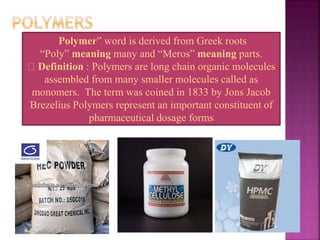
Polymer” word is derived from Greek roots
“Poly” meaning many and “Meros” meaning parts.
Definition : Polymers are long chain organic molecules
assembled from many smaller molecules called as
monomers. The term was coined in 1833 by Jons Jacob
Brezelius Polymers represent an important constituent of
pharmaceutical dosage forms
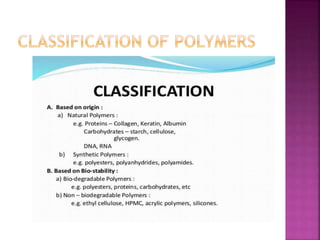
 Types of polymer
 Since the structural and physicochemical characteristics of the polymer are decisive in
the drug release mechanism, some will be more suitable than others, depending on
the aim pursued and the drug desired .
 Hydrophilic polymers
 a) Cellulosic
 · Methylcellulose
 · Hydroxypropylmethylcellulose
 (Hypromellose, HPMC)
 b)Non-cellulosic
 · Sodium alginate
 · Xanthan gum
 · Carrageenan
 Hydrophobic polymers
 · Ethylcellulose
 · Hypromellose acetate succinate
 · Cellulose acetate
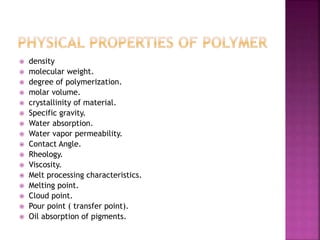
 density
 molecular weight.
 degree of polymerization.
 molar volume.
 crystallinity of material.
 Specific gravity.
 Water absorption.
 Water vapor permeability.
 Contact Angle.
 Rheology.
 Viscosity.
 Melt processing characteristics.
 Melting point.
 Cloud point.
 Pour point ( transfer point).
 Oil absorption of pigments.
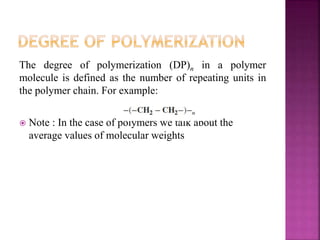
The degree of polymerization (DP)n in a polymer
molecule is defined as the number of repeating units in
the polymer chain. For example:
 Note : In the case of polymers we talk about the
average values of molecular weights
 Flowchart:
Physical
properties
Transition
Temperature
Viscosity
Mechanical
Properties
Strength
stiffness
toughness
These
Properties
depends on
Molecular
Weight.
M.W∞physical
and
mechanical
properties.
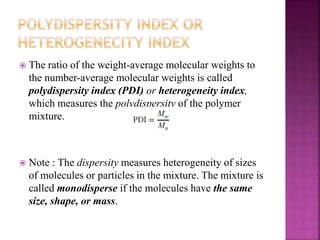
 The ratio of the weight-average molecular weights to
the number-average molecular weights is called
polydispersity index (PDI) or heterogeneity index,
which measures the polydispersity of the polymer
mixture.
 Note : The dispersity measures heterogeneity of sizes
of molecules or particles in the mixture. The mixture is
called monodisperse if the molecules have the same
size, shape, or mass.
polymer characteristics uses
Methylcellulose (MC) Water soluble, Viscosity range
10-15,000 MPa for 2%
aqueous solution
Tablet coating and granulation
Ethylcellulose (EC) Insoluble in water Soluble in
chloroform, THF
Microencapsulation Sustained
release tablet coating
Hydroxypropylcellulose
(HPC)
Soluble in cold water and polar
organic solvents, insoluble in
hot water and hydrocarbons
Controlled release matrix
Hydroxyethylcellulose (HEC) Soluble in hot or cold water
Insoluble in organic solvents
Ophthalmic formulations
Topical formulations
Thickener
Hydroxypropylmethylcellulose Hygroscopic Soluble in cold
water, mixture of water and
alcohol, insoluble in ethanol,
ether
Viscosity increasing agent
Stabilising agent
Hydroxyethylmethyl cellulose Viscosity = 100-70,000 MPa
for 2% aqueous solution
Suspending and a thickening
agent
Polymer Characteristics Uses
Poly (butyl methacrylate,
(2-dimethyl aminoethyl)
methylacrylate)
Cationic polymer.
Soluble in gastric juices and
weakly acidic buffer
solutions pH~5.
Film coatings.
Poly(methacrylic acid,
methacrylate)
Anionic copolymers. Soluble
in neutral to weakly alkaline
solutions (pH~6-7) and form
salts with alkali. Soluble in
intestinal pH.
Enteric coatings; resistant to
gastric juices.
Poly(ethyl acrylate,
methylmethacrylate,
trimethylaminoethyl
methacrylate chloride)
Water insoluble
copolymer.
Water insoluble, used as
film coats for sustained
release
Polymer Properties
Poly(D-Lactide) (D-PLA) Semi-crystalline
Poly(L-Lactide) (L-PLA) Semi-crystalline ;
Soluble in MeCl2, CHCl3
Poly(DL-Lactide)
(DL-PLA)
Amorphous ; Soluble in
MeCl2, THF, EtOAc,
CHCl3
Poly(ε-caprolactone)
(PCL)
Semi-crystalline; Soluble
in MeCl2, C3H6O, CHCl3
Polyglycolide (PGA) Semi-crystalline ;
Soluble in hexafluoro-
isopropanol
Chemical Properties Uses
Cationic polyamine Drug delivery (cationic nature
allows the formation of
complexes with the
drug/excipient molecules)
Reactive hydroxyl and amino
group
Adsorption enhancer for
hydrophilic drugs
High charge density at pH<6.5 Controlled drug release (gel
forming ability in low pH
media, has a high charge density
at pH<6.5)

Polymers and its applications

  • 1.
  • 2.
    Polymer” word isderived from Greek roots “Poly” meaning many and “Meros” meaning parts. Definition : Polymers are long chain organic molecules assembled from many smaller molecules called as monomers. The term was coined in 1833 by Jons Jacob Brezelius Polymers represent an important constituent of pharmaceutical dosage forms
  • 8.
     Types ofpolymer  Since the structural and physicochemical characteristics of the polymer are decisive in the drug release mechanism, some will be more suitable than others, depending on the aim pursued and the drug desired .  Hydrophilic polymers  a) Cellulosic  · Methylcellulose  · Hydroxypropylmethylcellulose  (Hypromellose, HPMC)  b)Non-cellulosic  · Sodium alginate  · Xanthan gum  · Carrageenan  Hydrophobic polymers  · Ethylcellulose  · Hypromellose acetate succinate  · Cellulose acetate
  • 9.
     density  molecularweight.  degree of polymerization.  molar volume.  crystallinity of material.  Specific gravity.  Water absorption.  Water vapor permeability.  Contact Angle.  Rheology.  Viscosity.  Melt processing characteristics.  Melting point.  Cloud point.  Pour point ( transfer point).  Oil absorption of pigments.
  • 10.
    The degree ofpolymerization (DP)n in a polymer molecule is defined as the number of repeating units in the polymer chain. For example:  Note : In the case of polymers we talk about the average values of molecular weights
  • 11.
  • 12.
     The ratioof the weight-average molecular weights to the number-average molecular weights is called polydispersity index (PDI) or heterogeneity index, which measures the polydispersity of the polymer mixture.  Note : The dispersity measures heterogeneity of sizes of molecules or particles in the mixture. The mixture is called monodisperse if the molecules have the same size, shape, or mass.
  • 13.
    polymer characteristics uses Methylcellulose(MC) Water soluble, Viscosity range 10-15,000 MPa for 2% aqueous solution Tablet coating and granulation Ethylcellulose (EC) Insoluble in water Soluble in chloroform, THF Microencapsulation Sustained release tablet coating Hydroxypropylcellulose (HPC) Soluble in cold water and polar organic solvents, insoluble in hot water and hydrocarbons Controlled release matrix Hydroxyethylcellulose (HEC) Soluble in hot or cold water Insoluble in organic solvents Ophthalmic formulations Topical formulations Thickener Hydroxypropylmethylcellulose Hygroscopic Soluble in cold water, mixture of water and alcohol, insoluble in ethanol, ether Viscosity increasing agent Stabilising agent Hydroxyethylmethyl cellulose Viscosity = 100-70,000 MPa for 2% aqueous solution Suspending and a thickening agent
  • 14.
    Polymer Characteristics Uses Poly(butyl methacrylate, (2-dimethyl aminoethyl) methylacrylate) Cationic polymer. Soluble in gastric juices and weakly acidic buffer solutions pH~5. Film coatings. Poly(methacrylic acid, methacrylate) Anionic copolymers. Soluble in neutral to weakly alkaline solutions (pH~6-7) and form salts with alkali. Soluble in intestinal pH. Enteric coatings; resistant to gastric juices. Poly(ethyl acrylate, methylmethacrylate, trimethylaminoethyl methacrylate chloride) Water insoluble copolymer. Water insoluble, used as film coats for sustained release
  • 15.
    Polymer Properties Poly(D-Lactide) (D-PLA)Semi-crystalline Poly(L-Lactide) (L-PLA) Semi-crystalline ; Soluble in MeCl2, CHCl3 Poly(DL-Lactide) (DL-PLA) Amorphous ; Soluble in MeCl2, THF, EtOAc, CHCl3 Poly(ε-caprolactone) (PCL) Semi-crystalline; Soluble in MeCl2, C3H6O, CHCl3 Polyglycolide (PGA) Semi-crystalline ; Soluble in hexafluoro- isopropanol
  • 16.
    Chemical Properties Uses Cationicpolyamine Drug delivery (cationic nature allows the formation of complexes with the drug/excipient molecules) Reactive hydroxyl and amino group Adsorption enhancer for hydrophilic drugs High charge density at pH<6.5 Controlled drug release (gel forming ability in low pH media, has a high charge density at pH<6.5)