Presented by-
Miss Shraddha M.
Kumbhar
M. Pharm (Pharmaceutics)
Satara college of
Under the guidance of -
Dr. Ajit S. Kulkarni
Vice-Principal
Satara college of Pharmacy,
Satara
A
Colloquium
on
1
Introduction
•Parenteral route: most effective
•To achieve constant drug level in the systemic
circulation, two strategies can be employed:
1)To control the rate of absorption of a drug.
2)To control the rate of excretion i. e. by modifying
physiology of body.
Depot: Long acting parenteral drug formulation is
designed, ideally to provide slow, constant,
sustained, prolonged action.
The release can either be continuous or pulsatile
depending on the structure of the device and the
polymer characteristics.
2
Parenteral depot system:
Properties:
• Safe from accidental release
• Simple to administer and remove
• Inert and Biocompatible
• Comfortable for the patient
• Capable of achieving high drug loading
• Easy to fabricate and sterilize
• Free of leachable impurities
3
Approaches used…
• Use of viscous, water miscible vehicles – aq.
Solution of gelatin
• Use of water immiscible vehicles – vegetable oils +
aluminium monosterate
• Formation of thixotropic suspension
• Preparation of water insoluble drug derivatives –
salts, complexes and esters
•Dispersion in polymeric microspheres and
microcapsules like- lactide-glycolide
homopolymers/ co-polymers.
• Co-administration of vasoconstrictors
4
Polymers used……
Generally, Biodegradable polymers are used as it
get degraded in the body.
•Natural- albumin, starch, dextran, gelatin,
fibrinogen, hemoglobin.
•Synthetic- poly ethyl-polyalkyl cynoacrylates, poly
amides, poly acryl amides, poly amino acid, poly
urethane.
5
Desirable characteristics of an ideal
Parenteral drug carrier
• Versatile
• High capacity to carry a sufficient quantity of
drug
• Uniform distribution
• Restricting drug activity at the target site over a
prolonged period.
• Protecting drug from inactivation by plasma
enzymes.
• Biocompatible and minimally antigenic.
• Undergoing biologic degradation with minimal 6
TYPES OF DEPOT
FORMULATION
1. Dissolution controlled depot formulation
2. Adsorption type depot formulation
3. Encapsulation type depot formulation
4. Esterification type depot formulation
7
Dissolution controlled depots
RDS of drug absorption is dissolution of drug.
• Approaches :
 Formation of salt or complexes with low aqueous
solubility.
Example:
penicillin G procaine (Cs = 4 mg/ml) and
penicillin G benzathine (Cs = 0.2 mg/ml).
 Suspension of Macrocrystals:
to control the rate of drug dissolution.
Example: aqueous suspension of testosterone
isobutyrate for intramuscular administration. 8
Adsorption type depots
This depot preparation is formed by the binding of
drug molecules to adsorbents.
Example: vaccine preparations in which the
antigens are bound to highly dispersed aluminum
hydroxide gel to sustain their release and hence
prolong the duration of stimulation of antibody
formation.
9
Encapsulation-type depots
prepared by encapsulating drug solids .
-The release is controlled by the rate of
permeation across the permeation barrier and the
rate of biodegradation.
Biodegradable or bio absorbable macromolecules
are used, e. g. gelatin, dextran, poly lactic acid,
lactide-glycolide copolymers, phospholipids, and
long-chain fatty acids and glycerides.
Example:
naltrexone pamoate –
releasing biodegradable microcapsule, 10
Esterification-type depots
produced by esterifying a drug to form a
bioconvertible prodrug-type ester.
The rate of drug absorption is controlled by
the interfacial partitioning of drug esters from
the reservoir to the tissue fluid and the rate of
bioconversion.
Example: fluphenazine enanthate,
nandrolone decanoate in oleaginous solution.
11
Parenteral Controlled Drug
Delivery System
A. Inject able drug delivery
B. Implantable drug delivery
system
C. Infusion devices
D. Recent advances
12
Injectable Drug Delivery
1. Thermoplastic pastes
2. In situ cross linked systems
3. In situ polymer precipitation
4. Thermally induced gelling
system
5. In situ solidifying organogels.
13
Thermoplastic pastes
•In this semisolid polymers are injected as a melt
and form a depot upon cooling to body temperature.
•having a low melting point (25-65˚C) intrinsic
viscosity (0.05-0.8 dl/g).
•Drugs are incorporated into the molten polymer by
mixing without the application of solvents.
•Polymers: D, L-lactide, glycolide, E-caprolactone,
dioxanone orthoesters etc.
•polycaprolactone (PCL) requires injection
temperature at least 60˚C i.e. painful injections and
necrosis at the injection site,POE have good
biocompatibility, relatively low softening14
In situ polymer precipitation
water-insoluble,
biodegradable polymer
+ biocompatible organic
solvent + drug
solution
or
suspensio
n after
mixing.
When this
formulation is
injected into
the body, the
water miscible
organic solvent
dissipates and
water
penetrates into
the organic
phase.
This leads to
phase
separation
and
precipitation
of the
polymer
forming the
depot at the
site of
injection
15
Thermally induced gelling system
•Environmental temperature causes change in
solubility of thermo sensitive polymers.
•Example:
Poly (NIPAAM) exhibit sharp lower critical solution
temperature, LCST at about 32˚C, poly NIPAAM
based gels with salt and surfactant shows release
over 10-20d.
16
Injectables
• Solid Lipid Nanoparticle (SLN)
• Nanodispersions
• Suspensions
• Niosomes
• Liposomes
• Microspheres
• Emulsomes
• Resealed Erythrocytes
• Cyclodextrins
• Aquasomes
• Dendrimers
17
SLN
•SLN are submicron colloidal particles composed of
a biocompatible/biodegradable lipid matrix that is
solid at body temperature.
•size range : 100-400 nm.
•Generally physiological lipid dispersed in water or in
aqueous surfactant solution. SLNs combine
advantages of polymeric nanoparticles, fat
emulsions and liposomes.
Advantages:
•Particulate nature
•encapsulate hydrophilic and hydrophobic drugs
•Ability to sustain the release, to prevent chemical,
photochemical, or oxidative degradation of drug 18
Nanodispersions
Nanoemulsions / miniemulsions / submicron emulsions:
These are transparent or translucent oil-in-water (o/w) or
water-in-oil droplets with a mean droplet diameter in the
range between 100 and 500 nm. great stability due to their
small droplet size.
Nanosuspensions:
Nanosuspensions of drugs are submicron colloidal dispersions
of drug particles which are stabilized by
surfactants. Nanocrystals are crystals of poorly water soluble
drug in nanosize.
Advantages: Used to formulate drugs that are insoluble in both
water and oil, have higher loading (upto 90% of crystalline
particle is drug).
Used when drug have high melting point.
19
Suspensions
•Drug release dependent upon both the intrinsic
aqueous solubility of the drug and the dissolution
of the drug particles.
•Example: Abbott laboratories developed aqueous
thixotropic suspension of penicillin procaine (40-
70%w/w), such as Duracillin (Lilly), Crystacillin
(Squibb) which on intramuscular injection
produces therapeutic blood level of penicillin in
both animal and human for 162hr
20
Niosomes
These are nonionic surfactant vesicles obtained on
hydration, with or without incorporation of cholesterol
or other lipids.
•These are bilayered structure which can entrap both
hydrophilic and lipophilic drugs.
•Drug is incorporated into by….
Ether injection-Doxorubicin,
Hand shaking- Methotrexate,
Sonication- Vasopressin
21
Liposomes
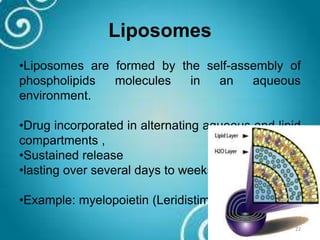
•Liposomes are formed by the self-assembly of
phospholipids molecules in an aqueous
environment.
•Drug incorporated in alternating aqueous and lipid
compartments ,
•Sustained release
•lasting over several days to weeks.
•Example: myelopoietin (Leridistim)
22
Microspheres
•Contains dispersed molecules either in solution or in
crystalline form, biodegradable polymers are used.
Magnetic microspheres increases target site
specificity & non-toxic and non-reactive with blood
components.
Examples:
Minocycline Arestin® Orapharma,
Bromocriptine Parlodel LAR ™ Novartis
23
EMULSOMES
•Emulosomes are lipid based drug delivery
systems, which are poorly water soluble.
• Emulosome particles are basically consisting of
microscopic lipid assembly with a polar core.
•Prepared by- melt expression/ emulsion solvent
diffusive extraction.
•Used as adjuvants for vaccines, as carrier
container for targeted drug delivery to liver, brain
and RES rich organs
24
Resealed Erythrocytes
•Here erythrocytes lose their haemoglobin content
when they are processed by various methods i.e.
osmolysis, electrical breakdown/electro-encapsulation,
endocytosis etc.
•Hb loss provides intracellular space for drug
incorporation. Erythrocytes membrane can be
resealed by restoring tonicity of the media and
incubating them at 37°C.
•t1/2= 60-120 days.
•biodegradable, biocompatible, and non-immunogenic.
25
Cyclodextrins
• Cyclodextrins are water soluble cyclic
carbohydrate compounds with
hydrophobic cavity.
• forms inclusion complexes with
hydrophobic molecules
• Example:
• Sulphobutyl β- cyclodextrin
Nimodipine aq. suspension –the
relative solubility of the drug is
increased with no change in drug
AUC.
26
AQUASOMES
• Aquasomes are 3-layered self assembling
composition.
• solid or glassy particles dispersed in an aq.
Environment & MOA is controlled by their
surface chemistry.
• For gene therapy, a 5- layered composition of
Aquasome comprised of the ceramic mono
crystalline core, the polyhydroxyl oligomeric film
coating, the noncovalently bound layer of
therapeutic gene segment, an additional
conserve viral membrane proteins have been
proposed for gene therapy
27
Dendrimers
• Dendrimers are highly branched 3-D-
macromolecules with highly controlled structures
with all bounds emanating from a central core.
• Methods-
Divergent method-
one branching unit after another is successfully
attached to the core molecule.
Convergent method-
where the skeleton in built stepwise starting from
the end group towards the inside and finally
treated with a core molecule to produce the
Dendrimer. 28
Implantable drug delivery system
• Implant systems are indicated in case of chronic
therapy, such as hormone replacement therapy.
Parenteral implants can be highly viscous liquids
or semisolid formulations.
• Polymers used – polysaccharides, polylactic
acid coglycolic acid (no need for surgical
removal of the implant after treatment) and non
degradable methacrylates.
• Types:
1. Solid implants
2. In situ forming implants 29
Infusion devices
• Osmotic pumps(alzet):
After implantation, water from the surrounding tissue
fluids is imbibed through the semi permeable
membrane.
Drug release osmotic pressure difference.
Ionized drugs macromolecules, steroids, and
peptides (insulin) can be delivered by such a device.30
• Vapour pressure powered pumps
(Infusaid):
After implantation, the volatile liquid vaporizes at the
body temperature and creates a vapor pressure.
Example:
Insulin for diabetics and morphine for terminally ill
cancer.
shows back flow of infusate.
• Battery powered pumps:
Types:
1. Peristaltic pump
2. Reciprocating pump,
both with electronic controls.
Do not show back flow of the infusate. 31
Evaluation of depots
Viscosity
Drug Content
In vitro release study
Sterility testing
32
Development of depots:
• Long acting antibiotic preparations:
aqueous solubility of penicillin is reduced by
converting to penicillin G procaine (aq. Solubility
4mg/ml) e.g. Duracillin (Lilly)
• Long acting insulin preparations:
Plasma t1/2 of insulin = 40 min
insulin-protamine complex has isoelectric point at
pH 7.3 and therefore it is insoluble in body fluid
which shows sustained release upto 24 hrs,
stability issues arises but solved by adding zinc
chloride.
33
Development of depots:
• Long acting vit.B12 preparations:
Vit.B12–zinc-tannate complex is suspended in
sesame oil gelled with aluminium-monostearate
having significant prolonged effect.
• Long acting adrenocorticotropic hormone
preparations:
when given parenterally ACTH gets disappeared
cause of plasma t1/2 15 min. addition of partially
hydrolyzed gelatin solution into injectable ACTH
solution shows prolonged release. Gelatin inhibits
protein binding of ACTH and enhances response. 34
Development of depots:
• Antipsychotic depots:
Example:
Piportil-Pipothiazinepalmitate up to 200 milligrams 1
injection every 4 weeks
• Long acting anti-narcotic preparations:
Gelled oleaginous suspension of narcotic antagonist
–salt complex shows sustained release for 72 hrs
• Long acting contraceptive preparations:
Norethindrone in a biodegradable polymer beads.
Norgestrel 17β-fatty acid esters in oleaginous
solution.
35
Conclusion
Parenteral controlled drug delivery system is
designed to achieve a desired
pharmacological response in a sustained
manner at a selected site without
undesirable interactions at the other sites.
Extended release parenteral products are
complex dosage forms, requiring careful
development of test methods and
acceptance criteria for the specifications
36
References
• Bari H.(July-Aug2010)A Prolonged Release Parenteral
Drug Delivery System- An Overview, ISSN(vol 3,p.1-11)
• Chien Y. W., Novel Drug Delivery Systems; Drugs and
Pharmaceutical Sciences(2nded, vol-50) Parenteral Drug
Delivery (pp-381-528),New York: Marcel Dekker.
• David A. S. & Adams C.(2001) Depot antipsychotic
medication in treatment of patients with schizophrenia,
Health Technology Assessment (vol 5, 34), Basingstoke:
Queen’s printer and controller of HMSO
• Gothoskar A. V. (March 2004),Resealed erythrocytes: A
review, Pharmaceutical technology (pp.140-158)
• Kempe S. & Mader K.(July 2012),In-situ forming
implants-an attractive formulation principle for parenteral
depot formulation, Journal of Controlled Release
(pp.668-679)
37
References
• Lachman L. & Libberman H. & Kanig J.(2007) Sterile
products(pp.653-654),Bombay: Varghese Publishing
House.
• M. Kalyani & P.Surendra & V. Sirisha(2013).Parenteral
Controlled Drug Delivery System, International Journal
Of Research In Pharmaceutics & Nanosciences (pp.572-
580)
• Malik K. & Sigh I. & Nagpal M. & Arrora S.(2010),
Atrigel: A potential Parenteral control Drug delivery
system, pelagia research lab der pharmacia sinica
(pp.74-81)
• Mischel N. & Cox L.(2012),Allergen Immunotherapy
Extract Preparation Manual, AAAAI Practice
Management Resource Guide(pp.1-39) 38
References
• Vyas S. P. & Khar R. K.(2006), Targeted and
Controlled Drug Delivery Novel Carrier Systems(pp.3-
38;173-279; 387-457) New Delhi: CBS Publishers and
Distributors.
• Wheeler A. M. & Newland B. Advantages of L-tyrosine
as a depot adjuvant for formulation of therapeutic
allergy vaccines; Allergy therapeutics: transforming
allergy treatment
• www.pharmatutor.org/articles/aquasomes-potential-
approach-novel -drug-delivery
• www.pharmatutor.org/articles/information-and-article-
on-erythrocytes-as-a-drug carrier.
• www.pharmatutor.org/articles/review-parenteral-
controlled-drug -delivery-system
39
40

Depot preparations

  • 1.
    Presented by- Miss ShraddhaM. Kumbhar M. Pharm (Pharmaceutics) Satara college of Under the guidance of - Dr. Ajit S. Kulkarni Vice-Principal Satara college of Pharmacy, Satara A Colloquium on 1
  • 2.
    Introduction •Parenteral route: mosteffective •To achieve constant drug level in the systemic circulation, two strategies can be employed: 1)To control the rate of absorption of a drug. 2)To control the rate of excretion i. e. by modifying physiology of body. Depot: Long acting parenteral drug formulation is designed, ideally to provide slow, constant, sustained, prolonged action. The release can either be continuous or pulsatile depending on the structure of the device and the polymer characteristics. 2
  • 3.
    Parenteral depot system: Properties: •Safe from accidental release • Simple to administer and remove • Inert and Biocompatible • Comfortable for the patient • Capable of achieving high drug loading • Easy to fabricate and sterilize • Free of leachable impurities 3
  • 4.
    Approaches used… • Useof viscous, water miscible vehicles – aq. Solution of gelatin • Use of water immiscible vehicles – vegetable oils + aluminium monosterate • Formation of thixotropic suspension • Preparation of water insoluble drug derivatives – salts, complexes and esters •Dispersion in polymeric microspheres and microcapsules like- lactide-glycolide homopolymers/ co-polymers. • Co-administration of vasoconstrictors 4
  • 5.
    Polymers used…… Generally, Biodegradablepolymers are used as it get degraded in the body. •Natural- albumin, starch, dextran, gelatin, fibrinogen, hemoglobin. •Synthetic- poly ethyl-polyalkyl cynoacrylates, poly amides, poly acryl amides, poly amino acid, poly urethane. 5
  • 6.
    Desirable characteristics ofan ideal Parenteral drug carrier • Versatile • High capacity to carry a sufficient quantity of drug • Uniform distribution • Restricting drug activity at the target site over a prolonged period. • Protecting drug from inactivation by plasma enzymes. • Biocompatible and minimally antigenic. • Undergoing biologic degradation with minimal 6
  • 7.
    TYPES OF DEPOT FORMULATION 1.Dissolution controlled depot formulation 2. Adsorption type depot formulation 3. Encapsulation type depot formulation 4. Esterification type depot formulation 7
  • 8.
    Dissolution controlled depots RDSof drug absorption is dissolution of drug. • Approaches :  Formation of salt or complexes with low aqueous solubility. Example: penicillin G procaine (Cs = 4 mg/ml) and penicillin G benzathine (Cs = 0.2 mg/ml).  Suspension of Macrocrystals: to control the rate of drug dissolution. Example: aqueous suspension of testosterone isobutyrate for intramuscular administration. 8
  • 9.
    Adsorption type depots Thisdepot preparation is formed by the binding of drug molecules to adsorbents. Example: vaccine preparations in which the antigens are bound to highly dispersed aluminum hydroxide gel to sustain their release and hence prolong the duration of stimulation of antibody formation. 9
  • 10.
    Encapsulation-type depots prepared byencapsulating drug solids . -The release is controlled by the rate of permeation across the permeation barrier and the rate of biodegradation. Biodegradable or bio absorbable macromolecules are used, e. g. gelatin, dextran, poly lactic acid, lactide-glycolide copolymers, phospholipids, and long-chain fatty acids and glycerides. Example: naltrexone pamoate – releasing biodegradable microcapsule, 10
  • 11.
    Esterification-type depots produced byesterifying a drug to form a bioconvertible prodrug-type ester. The rate of drug absorption is controlled by the interfacial partitioning of drug esters from the reservoir to the tissue fluid and the rate of bioconversion. Example: fluphenazine enanthate, nandrolone decanoate in oleaginous solution. 11
  • 12.
    Parenteral Controlled Drug DeliverySystem A. Inject able drug delivery B. Implantable drug delivery system C. Infusion devices D. Recent advances 12
  • 13.
    Injectable Drug Delivery 1.Thermoplastic pastes 2. In situ cross linked systems 3. In situ polymer precipitation 4. Thermally induced gelling system 5. In situ solidifying organogels. 13
  • 14.
    Thermoplastic pastes •In thissemisolid polymers are injected as a melt and form a depot upon cooling to body temperature. •having a low melting point (25-65˚C) intrinsic viscosity (0.05-0.8 dl/g). •Drugs are incorporated into the molten polymer by mixing without the application of solvents. •Polymers: D, L-lactide, glycolide, E-caprolactone, dioxanone orthoesters etc. •polycaprolactone (PCL) requires injection temperature at least 60˚C i.e. painful injections and necrosis at the injection site,POE have good biocompatibility, relatively low softening14
  • 15.
    In situ polymerprecipitation water-insoluble, biodegradable polymer + biocompatible organic solvent + drug solution or suspensio n after mixing. When this formulation is injected into the body, the water miscible organic solvent dissipates and water penetrates into the organic phase. This leads to phase separation and precipitation of the polymer forming the depot at the site of injection 15
  • 16.
    Thermally induced gellingsystem •Environmental temperature causes change in solubility of thermo sensitive polymers. •Example: Poly (NIPAAM) exhibit sharp lower critical solution temperature, LCST at about 32˚C, poly NIPAAM based gels with salt and surfactant shows release over 10-20d. 16
  • 17.
    Injectables • Solid LipidNanoparticle (SLN) • Nanodispersions • Suspensions • Niosomes • Liposomes • Microspheres • Emulsomes • Resealed Erythrocytes • Cyclodextrins • Aquasomes • Dendrimers 17
  • 18.
    SLN •SLN are submicroncolloidal particles composed of a biocompatible/biodegradable lipid matrix that is solid at body temperature. •size range : 100-400 nm. •Generally physiological lipid dispersed in water or in aqueous surfactant solution. SLNs combine advantages of polymeric nanoparticles, fat emulsions and liposomes. Advantages: •Particulate nature •encapsulate hydrophilic and hydrophobic drugs •Ability to sustain the release, to prevent chemical, photochemical, or oxidative degradation of drug 18
  • 19.
    Nanodispersions Nanoemulsions / miniemulsions/ submicron emulsions: These are transparent or translucent oil-in-water (o/w) or water-in-oil droplets with a mean droplet diameter in the range between 100 and 500 nm. great stability due to their small droplet size. Nanosuspensions: Nanosuspensions of drugs are submicron colloidal dispersions of drug particles which are stabilized by surfactants. Nanocrystals are crystals of poorly water soluble drug in nanosize. Advantages: Used to formulate drugs that are insoluble in both water and oil, have higher loading (upto 90% of crystalline particle is drug). Used when drug have high melting point. 19
  • 20.
    Suspensions •Drug release dependentupon both the intrinsic aqueous solubility of the drug and the dissolution of the drug particles. •Example: Abbott laboratories developed aqueous thixotropic suspension of penicillin procaine (40- 70%w/w), such as Duracillin (Lilly), Crystacillin (Squibb) which on intramuscular injection produces therapeutic blood level of penicillin in both animal and human for 162hr 20
  • 21.
    Niosomes These are nonionicsurfactant vesicles obtained on hydration, with or without incorporation of cholesterol or other lipids. •These are bilayered structure which can entrap both hydrophilic and lipophilic drugs. •Drug is incorporated into by…. Ether injection-Doxorubicin, Hand shaking- Methotrexate, Sonication- Vasopressin 21
  • 22.
    Liposomes •Liposomes are formedby the self-assembly of phospholipids molecules in an aqueous environment. •Drug incorporated in alternating aqueous and lipid compartments , •Sustained release •lasting over several days to weeks. •Example: myelopoietin (Leridistim) 22
  • 23.
    Microspheres •Contains dispersed moleculeseither in solution or in crystalline form, biodegradable polymers are used. Magnetic microspheres increases target site specificity & non-toxic and non-reactive with blood components. Examples: Minocycline Arestin® Orapharma, Bromocriptine Parlodel LAR ™ Novartis 23
  • 24.
    EMULSOMES •Emulosomes are lipidbased drug delivery systems, which are poorly water soluble. • Emulosome particles are basically consisting of microscopic lipid assembly with a polar core. •Prepared by- melt expression/ emulsion solvent diffusive extraction. •Used as adjuvants for vaccines, as carrier container for targeted drug delivery to liver, brain and RES rich organs 24
  • 25.
    Resealed Erythrocytes •Here erythrocyteslose their haemoglobin content when they are processed by various methods i.e. osmolysis, electrical breakdown/electro-encapsulation, endocytosis etc. •Hb loss provides intracellular space for drug incorporation. Erythrocytes membrane can be resealed by restoring tonicity of the media and incubating them at 37°C. •t1/2= 60-120 days. •biodegradable, biocompatible, and non-immunogenic. 25
  • 26.
    Cyclodextrins • Cyclodextrins arewater soluble cyclic carbohydrate compounds with hydrophobic cavity. • forms inclusion complexes with hydrophobic molecules • Example: • Sulphobutyl β- cyclodextrin Nimodipine aq. suspension –the relative solubility of the drug is increased with no change in drug AUC. 26
  • 27.
    AQUASOMES • Aquasomes are3-layered self assembling composition. • solid or glassy particles dispersed in an aq. Environment & MOA is controlled by their surface chemistry. • For gene therapy, a 5- layered composition of Aquasome comprised of the ceramic mono crystalline core, the polyhydroxyl oligomeric film coating, the noncovalently bound layer of therapeutic gene segment, an additional conserve viral membrane proteins have been proposed for gene therapy 27
  • 28.
    Dendrimers • Dendrimers arehighly branched 3-D- macromolecules with highly controlled structures with all bounds emanating from a central core. • Methods- Divergent method- one branching unit after another is successfully attached to the core molecule. Convergent method- where the skeleton in built stepwise starting from the end group towards the inside and finally treated with a core molecule to produce the Dendrimer. 28
  • 29.
    Implantable drug deliverysystem • Implant systems are indicated in case of chronic therapy, such as hormone replacement therapy. Parenteral implants can be highly viscous liquids or semisolid formulations. • Polymers used – polysaccharides, polylactic acid coglycolic acid (no need for surgical removal of the implant after treatment) and non degradable methacrylates. • Types: 1. Solid implants 2. In situ forming implants 29
  • 30.
    Infusion devices • Osmoticpumps(alzet): After implantation, water from the surrounding tissue fluids is imbibed through the semi permeable membrane. Drug release osmotic pressure difference. Ionized drugs macromolecules, steroids, and peptides (insulin) can be delivered by such a device.30
  • 31.
    • Vapour pressurepowered pumps (Infusaid): After implantation, the volatile liquid vaporizes at the body temperature and creates a vapor pressure. Example: Insulin for diabetics and morphine for terminally ill cancer. shows back flow of infusate. • Battery powered pumps: Types: 1. Peristaltic pump 2. Reciprocating pump, both with electronic controls. Do not show back flow of the infusate. 31
  • 32.
    Evaluation of depots Viscosity DrugContent In vitro release study Sterility testing 32
  • 33.
    Development of depots: •Long acting antibiotic preparations: aqueous solubility of penicillin is reduced by converting to penicillin G procaine (aq. Solubility 4mg/ml) e.g. Duracillin (Lilly) • Long acting insulin preparations: Plasma t1/2 of insulin = 40 min insulin-protamine complex has isoelectric point at pH 7.3 and therefore it is insoluble in body fluid which shows sustained release upto 24 hrs, stability issues arises but solved by adding zinc chloride. 33
  • 34.
    Development of depots: •Long acting vit.B12 preparations: Vit.B12–zinc-tannate complex is suspended in sesame oil gelled with aluminium-monostearate having significant prolonged effect. • Long acting adrenocorticotropic hormone preparations: when given parenterally ACTH gets disappeared cause of plasma t1/2 15 min. addition of partially hydrolyzed gelatin solution into injectable ACTH solution shows prolonged release. Gelatin inhibits protein binding of ACTH and enhances response. 34
  • 35.
    Development of depots: •Antipsychotic depots: Example: Piportil-Pipothiazinepalmitate up to 200 milligrams 1 injection every 4 weeks • Long acting anti-narcotic preparations: Gelled oleaginous suspension of narcotic antagonist –salt complex shows sustained release for 72 hrs • Long acting contraceptive preparations: Norethindrone in a biodegradable polymer beads. Norgestrel 17β-fatty acid esters in oleaginous solution. 35
  • 36.
    Conclusion Parenteral controlled drugdelivery system is designed to achieve a desired pharmacological response in a sustained manner at a selected site without undesirable interactions at the other sites. Extended release parenteral products are complex dosage forms, requiring careful development of test methods and acceptance criteria for the specifications 36
  • 37.
    References • Bari H.(July-Aug2010)AProlonged Release Parenteral Drug Delivery System- An Overview, ISSN(vol 3,p.1-11) • Chien Y. W., Novel Drug Delivery Systems; Drugs and Pharmaceutical Sciences(2nded, vol-50) Parenteral Drug Delivery (pp-381-528),New York: Marcel Dekker. • David A. S. & Adams C.(2001) Depot antipsychotic medication in treatment of patients with schizophrenia, Health Technology Assessment (vol 5, 34), Basingstoke: Queen’s printer and controller of HMSO • Gothoskar A. V. (March 2004),Resealed erythrocytes: A review, Pharmaceutical technology (pp.140-158) • Kempe S. & Mader K.(July 2012),In-situ forming implants-an attractive formulation principle for parenteral depot formulation, Journal of Controlled Release (pp.668-679) 37
  • 38.
    References • Lachman L.& Libberman H. & Kanig J.(2007) Sterile products(pp.653-654),Bombay: Varghese Publishing House. • M. Kalyani & P.Surendra & V. Sirisha(2013).Parenteral Controlled Drug Delivery System, International Journal Of Research In Pharmaceutics & Nanosciences (pp.572- 580) • Malik K. & Sigh I. & Nagpal M. & Arrora S.(2010), Atrigel: A potential Parenteral control Drug delivery system, pelagia research lab der pharmacia sinica (pp.74-81) • Mischel N. & Cox L.(2012),Allergen Immunotherapy Extract Preparation Manual, AAAAI Practice Management Resource Guide(pp.1-39) 38
  • 39.
    References • Vyas S.P. & Khar R. K.(2006), Targeted and Controlled Drug Delivery Novel Carrier Systems(pp.3- 38;173-279; 387-457) New Delhi: CBS Publishers and Distributors. • Wheeler A. M. & Newland B. Advantages of L-tyrosine as a depot adjuvant for formulation of therapeutic allergy vaccines; Allergy therapeutics: transforming allergy treatment • www.pharmatutor.org/articles/aquasomes-potential- approach-novel -drug-delivery • www.pharmatutor.org/articles/information-and-article- on-erythrocytes-as-a-drug carrier. • www.pharmatutor.org/articles/review-parenteral- controlled-drug -delivery-system 39
  • 40.