
InstantGMP Compliance Series
for cGMP Dietary Supplements
 Improving Quality through In-Process
              Control
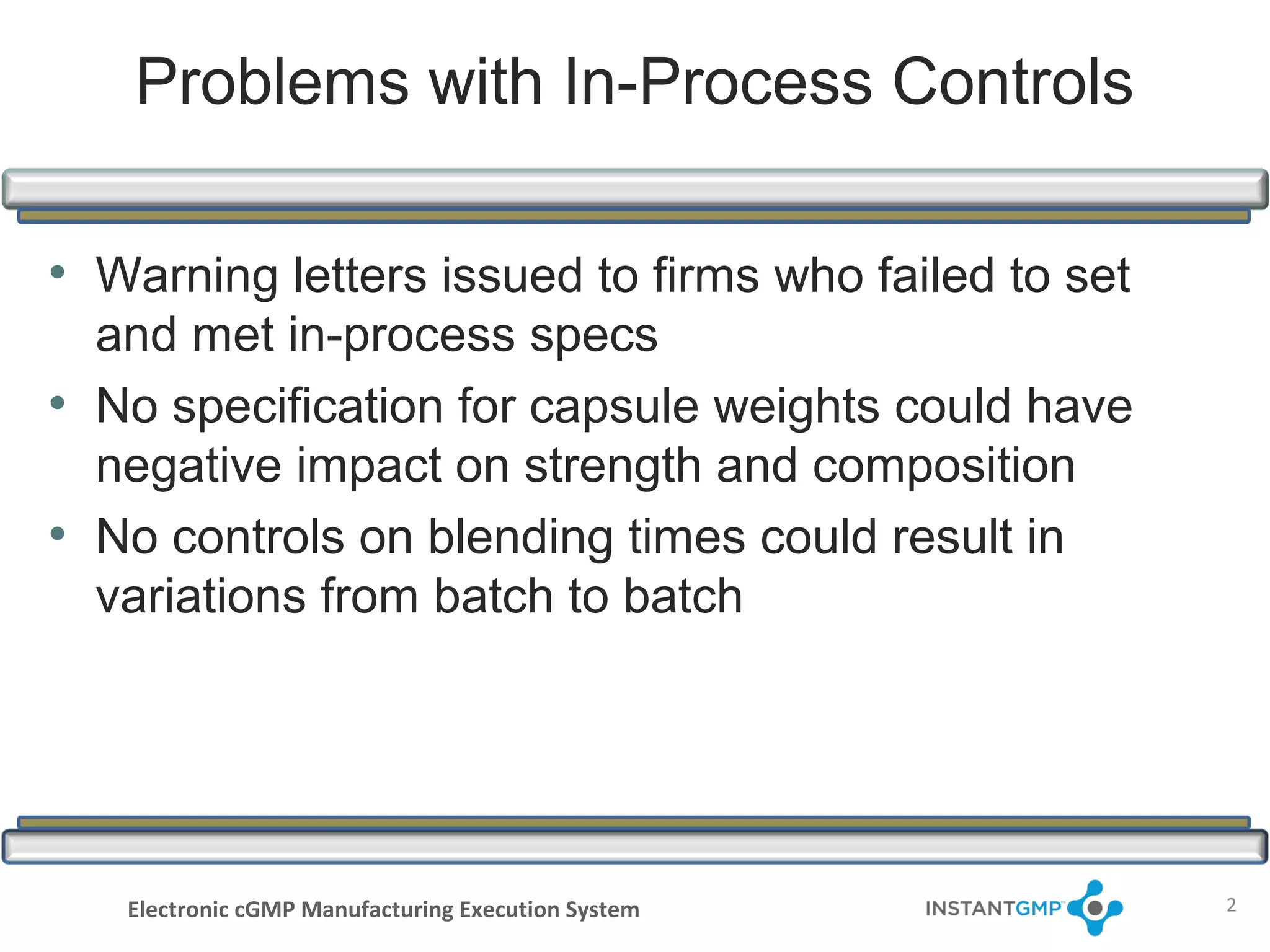
Problems with In-Process Controls

• Warning letters issued to firms who failed to set
  and met in-process specs
• No specification for capsule weights could have
  negative impact on strength and composition
• No controls on blending times could result in
  variations from batch to batch


   Electronic cGMP Manufacturing Execution System     2
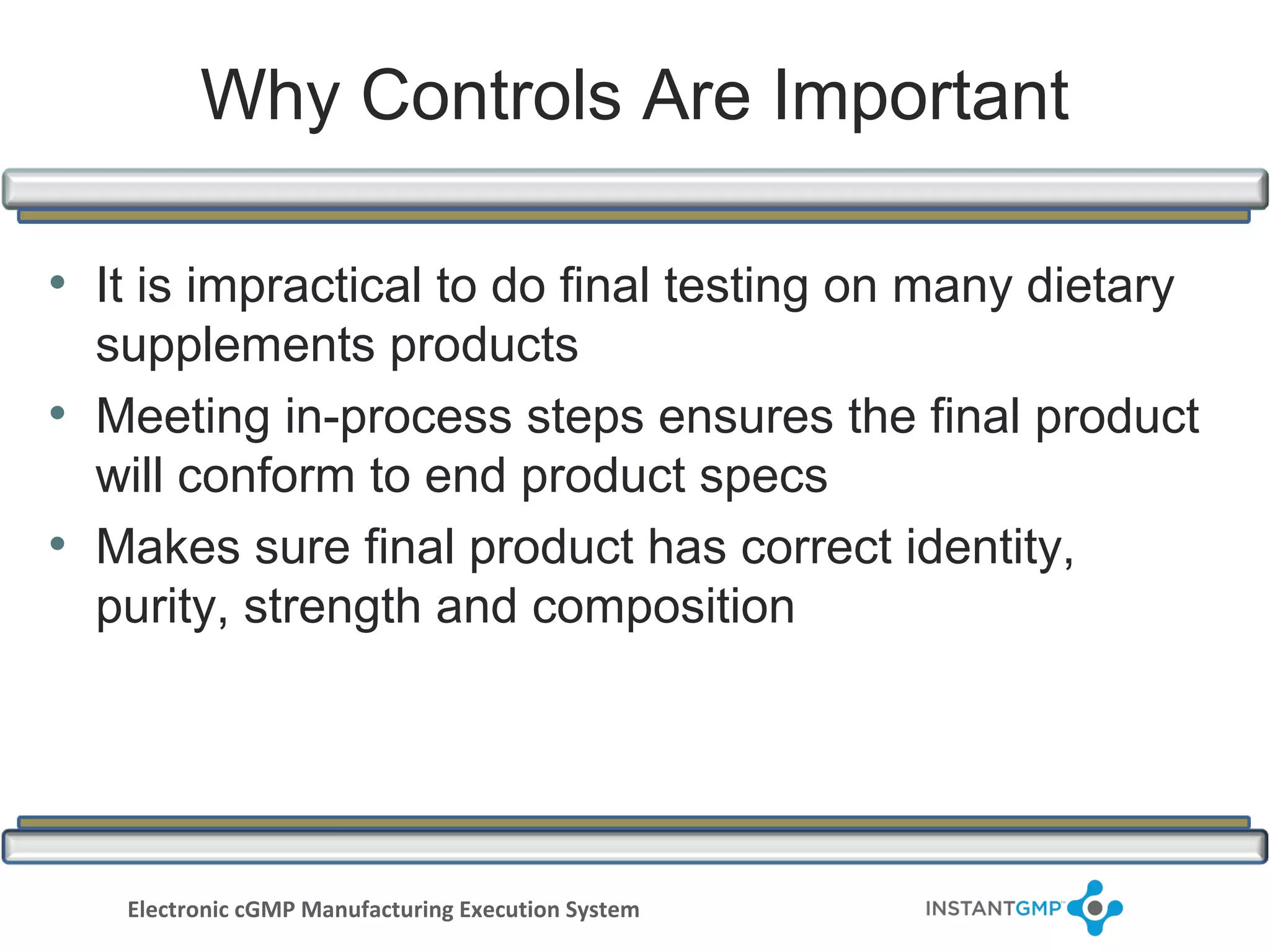
Why Controls Are Important

• It is impractical to do final testing on many dietary
  supplements products
• Meeting in-process steps ensures the final product
  will conform to end product specs
• Makes sure final product has correct identity,
  purity, strength and composition


   Electronic cGMP Manufacturing Execution System
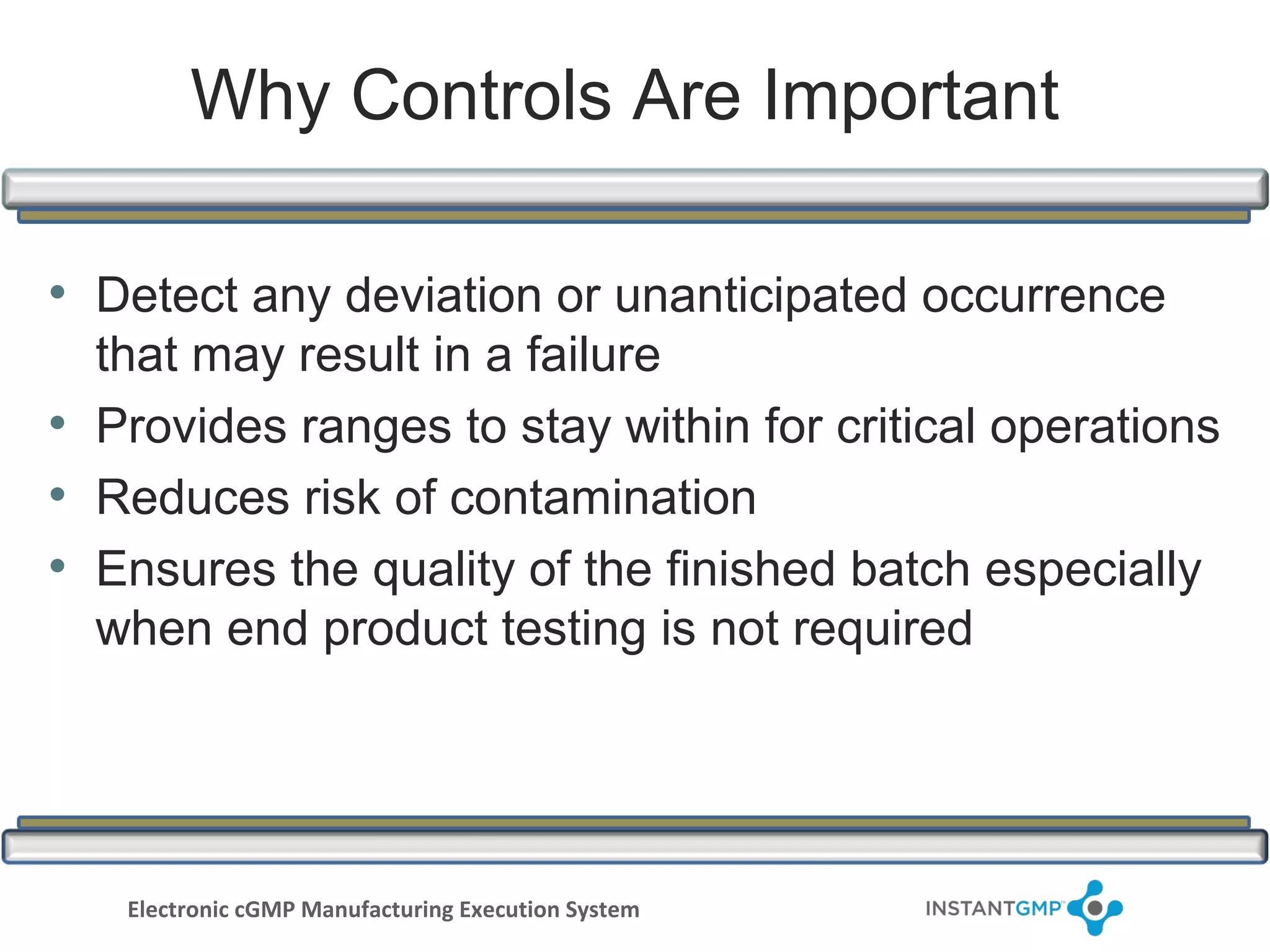
Why Controls Are Important

• Detect any deviation or unanticipated occurrence
  that may result in a failure
• Provides ranges to stay within for critical operations
• Reduces risk of contamination
• Ensures the quality of the finished batch especially
  when end product testing is not required


   Electronic cGMP Manufacturing Execution System
Production Controls Include:

• COA from qualified suppler (except for dietary
  ingredient identity)
• Components that meet specifications
• Confirmation of component identity prior to use
• Confirmation of other specifications using either
  COA or by testing


   Electronic cGMP Manufacturing Execution System
Process Control System

• Covers all stages of manufacturing, packaging,
  labeling, and holding
• Makes sure product is packaged and labeled as
  specified in the master manufacturing record
• First step is to use high quality components with
  well-defined specifications
• Avoids risk of making adulterated product


   Electronic cGMP Manufacturing Execution System
In-Process Specifications

• Required for each process step where control is
    needed to assure quality
•   Heating or cooling steps
•   Specific sanitation requirements
•   Product formulation steps
•   Points where cross-contamination may occur
•   Where hygiene is necessary to control quality


     Electronic cGMP Manufacturing Execution System
Tablet and Capsule Control

• Special controls when manufacturing tablets or
  capsules
• Prevent inclusion of foreign material using filters,
  traps, magnets, metal detectors
• Periodic checks on weights, tablet hardness, etc.
  throughout manufacturing


   Electronic cGMP Manufacturing Execution System
Deviations

• Triggered by any unanticipated occurrence could
    result in adulteration
•   Must be noted in batch record
•   Quality must conduct a material review
•   Then make a disposition decision
•   May not reprocess a batch that deviates unless
    approved by Quality


     Electronic cGMP Manufacturing Execution System
InstantGMP™ - Our goal is to make
       GMP compliance easy

• Electronic cGMP Manufacturing Execution System
• Web-based application makes all data visible to
  everyone at all times
• Uses built-in quality procedures to make GMP
  compliance easy
• Provides opportunities for more flexibility, visibility
  and productivity


   Electronic cGMP Manufacturing Execution System
Benefits of Electronic Manufacturing

• More efficient than manual systems
• Eliminate redundant processes and forms
• Trim time and overhead costs
• Reduce errors, omissions and deviations
• Provide opportunities to reorganize and update
  processes
• Increases throughput, quality and margins


     Electronic cGMP Manufacturing Execution System
InstantGMP™

        Thank you for visiting!
 Find more presentations and videos on
GMP Manufacturing in the Resource Center
                   at
         www.InstantGMP.com

InstantGMP Compliance Series - Improving Quality through In-Process Control

  • 1.
    InstantGMP Compliance Series forcGMP Dietary Supplements Improving Quality through In-Process Control
  • 2.
    Problems with In-ProcessControls • Warning letters issued to firms who failed to set and met in-process specs • No specification for capsule weights could have negative impact on strength and composition • No controls on blending times could result in variations from batch to batch Electronic cGMP Manufacturing Execution System 2
  • 3.
    Why Controls AreImportant • It is impractical to do final testing on many dietary supplements products • Meeting in-process steps ensures the final product will conform to end product specs • Makes sure final product has correct identity, purity, strength and composition Electronic cGMP Manufacturing Execution System
  • 4.
    Why Controls AreImportant • Detect any deviation or unanticipated occurrence that may result in a failure • Provides ranges to stay within for critical operations • Reduces risk of contamination • Ensures the quality of the finished batch especially when end product testing is not required Electronic cGMP Manufacturing Execution System
  • 5.
    Production Controls Include: •COA from qualified suppler (except for dietary ingredient identity) • Components that meet specifications • Confirmation of component identity prior to use • Confirmation of other specifications using either COA or by testing Electronic cGMP Manufacturing Execution System
  • 6.
    Process Control System •Covers all stages of manufacturing, packaging, labeling, and holding • Makes sure product is packaged and labeled as specified in the master manufacturing record • First step is to use high quality components with well-defined specifications • Avoids risk of making adulterated product Electronic cGMP Manufacturing Execution System
  • 7.
    In-Process Specifications • Requiredfor each process step where control is needed to assure quality • Heating or cooling steps • Specific sanitation requirements • Product formulation steps • Points where cross-contamination may occur • Where hygiene is necessary to control quality Electronic cGMP Manufacturing Execution System
  • 8.
    Tablet and CapsuleControl • Special controls when manufacturing tablets or capsules • Prevent inclusion of foreign material using filters, traps, magnets, metal detectors • Periodic checks on weights, tablet hardness, etc. throughout manufacturing Electronic cGMP Manufacturing Execution System
  • 9.
    Deviations • Triggered byany unanticipated occurrence could result in adulteration • Must be noted in batch record • Quality must conduct a material review • Then make a disposition decision • May not reprocess a batch that deviates unless approved by Quality Electronic cGMP Manufacturing Execution System
  • 10.
    InstantGMP™ - Ourgoal is to make GMP compliance easy • Electronic cGMP Manufacturing Execution System • Web-based application makes all data visible to everyone at all times • Uses built-in quality procedures to make GMP compliance easy • Provides opportunities for more flexibility, visibility and productivity Electronic cGMP Manufacturing Execution System
  • 11.
    Benefits of ElectronicManufacturing • More efficient than manual systems • Eliminate redundant processes and forms • Trim time and overhead costs • Reduce errors, omissions and deviations • Provide opportunities to reorganize and update processes • Increases throughput, quality and margins Electronic cGMP Manufacturing Execution System
  • 12.
    InstantGMP™ Thank you for visiting! Find more presentations and videos on GMP Manufacturing in the Resource Center at www.InstantGMP.com

Editor's Notes

  • #2 The staff at InstantGMP prepared this Compliance Series for GMPs in Dietary Supplements to focus on good manufacturing practices and GMP compliance. These are brought to you by our quality and manufacturing experts in the hope that it will help you avoid any GMP compliance issues in your shop. This presentation will address improving quality through In-Process Controls.
  • #3 In-Process controls must be set in order to produce a compliant product. One dietary supplement manufacturer received a warning letter in part because they did not have in-process specifications for the weight of capsules that were checked throughout manufacturing. Capsule weights can affect both the strength and composition of the finished product and this was not being properly controlled.  Another firm received a warning letter that contained a similar observation. Raw materials were blended for a certain time, but there was no specification set for the threshold of mixing time needed to homogenize all mixtures. Thus, they did not know what impact varying blending times from batch to batch would have on their final product.
  • #4 It is impractical to do final testing on many dietary supplements products. Meeting the in-process specifications, in combination with meeting component specifications, will help ensure that the final product specifications are met and that the product produced has the correct identity, purity, strength, and composition.
  • #5 In-Process controls serve many purposes. They can detect deviation or unanticipated occurrence that may result in a failure of the final product. They can provide ranges to stay within for critical operations such as mixing blends or compressing tablets. They can help reduce the risk of microbial contamination or other factors that might lead to an adulterated product. Most of all, they help ensure the quality of the finished batch especially when end product testing is not required or performed.
  • #6 Production Controls are controls on in-coming components and dietary ingredients. This could include the use of a certificate of analysis from a qualified supplier for specifications other than the identity of a dietary ingredient. The identity of each component must be confirmed prior to use. Other required specifications for components must be checked either by relying upon a certificate of analysis or by testing or examining the component.
  • #7 In-Process controls serve many purposes. They can detect deviation or unanticipated occurrence that may result in a failure of the final product. They can provide ranges to stay within for critical operations such as mixing blends or compressing tablets. They can help reduce the risk of microbial contamination or other factors that might lead to an adulterated product. Most of all, they help ensure the quality of the finished batch especially when end product testing is not required or performed.
  • #8 In-process specifications have to be set for any step or place in the manufacturing process where in-process control is needed. These might include heating, cooling or blending steps or product formulation steps. They might also include points where a specific sanitation procedure is needed, where cross-contamination may occur, or where employee and environmental controls and aseptic techniques are necessary to ensure quality.
  • #9 Manufacturing processes for tablets and capsules should include the use of filters, strainers, traps, magnets, electronic metal detectors, or any other comparable means of preventing the inclusion of foreign materials from equipment or the environment in the product. Periodic weight checks of capsules and tablets should be performed, as well as checks for hardness and height for tablets throughout the manufacturing process.
  • #10 GMP regulations require results of any crucial deviation or unanticipated occurrence be reviewed. The deviation should be noted in the batch production record along with documentation that describes the investigation into the cause of the deviation or the unanticipated occurrence. The Quality Control Unit must conduct a material review and make a disposition decision if there is such an unanticipated occurrence during manufacturing. Quality must review and give approval in order to reprocess a batch with an asssociated deviation.
  • #11 InstantGMP™ is an Electronic cGMP Manufacturing Execution System that was designed to make GMP compliance easy. It is a web-based application that makes all data visible to everyone at all times. It uses built-in quality procedures to make GMP compliance easy and it provides opportunities for more flexibility, visibility and productivity.
  • #12 There are many reasons that companies will want to adopt an electronic manufacturing system. They are more efficient than manual systems. For example, they can shrink or eliminate the redundant process and forms that occur in manual systems. They can trim time and costs compared to manually compiling and reviewing documentation. They can reduce errors, omissions and deviations.   Probably the most important advantage is that a transition to an electronic system can provide opportunities to reorganize and to update processes to make the whole plant function better. All of these benefits taken together will result in increased throughput, quality and margins.
  • #13 Thank you for visiting. This presentation is just one of many articles and videos available on GMP compliance for Dietary Supplements. You can access them at the Resource Center at InstantGMP.com.