Taking advantage of the amorphous form–  the preparation and characterisation of solid dispersions  Rakesh Dontireddy, UCC, Cork
Outline Brief introduction to amorphous solids Solid dispersions  Selected model drug and carrier Influence of drug:carrier ratio  Influence of solvent composition Influence of processing parameters
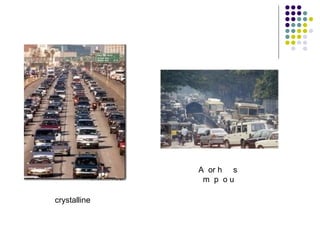
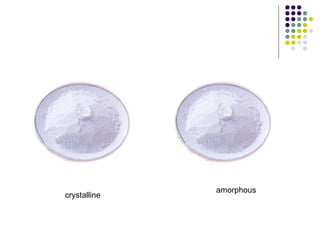
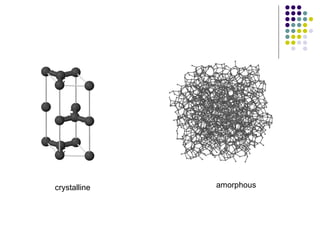
crystalline A  or h  s m  p  o u
crystalline amorphous
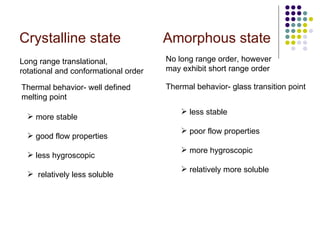
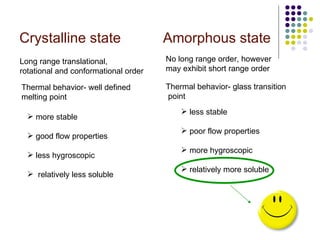
Crystalline state Amorphous state more stable good flow properties less hygroscopic relatively less soluble less stable poor flow properties more hygroscopic relatively more soluble Long range translational, rotational and conformational order No long range order, however may exhibit short range order Thermal behavior- well defined  melting point Thermal behavior- glass transition point
Crystalline state Amorphous state more stable good flow properties less hygroscopic relatively less soluble less stable poor flow properties more hygroscopic relatively more soluble Long range translational, rotational and conformational order No long range order, however may exhibit short range order Thermal behavior- well defined  melting point Thermal behavior- glass transition  point
Outline Brief introduction to amorphous solids Solid dispersions  Selected model drug and carrier Influence of drug:carrier ratio  Influence of solvent composition Influence of processing parameters
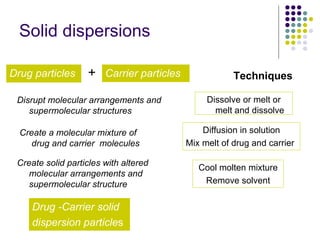
Solid dispersions + Drug particles Carrier particles Disrupt molecular arrangements and supermolecular structures  Create solid particles with altered  molecular arrangements and supermolecular structure  Create a molecular mixture of drug and carrier  molecules Drug -Carrier solid dispersion particle s Diffusion in solution Mix melt of drug and carrier Cool molten mixture Remove solvent Dissolve or melt or melt and dissolve Techniques
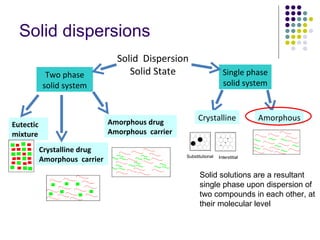
Solid dispersions Solid solutions are a resultant single phase upon dispersion of two compounds in each other, at their molecular level  Eutectic mixture  Crystalline drug  Amorphous  carrier Amorphous drug  Amorphous  carrier Solid  Dispersion Solid State Two phase solid system Single phase solid system Crystalline Amorphous Substitutional Interstitial
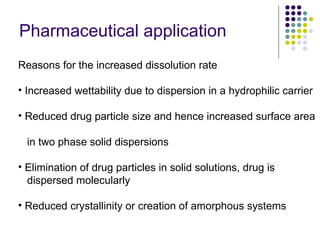
Pharmaceutical application Reasons for the increased dissolution rate Increased wettability due to dispersion in a hydrophilic carrier Reduced drug particle size and hence increased surface area    in two phase solid dispersions Elimination of drug particles in solid solutions, drug is    dispersed molecularly Reduced crystallinity or creation of amorphous systems
Outline Brief introduction to amorphous solids Solid dispersions  Selected model drug and carrier Influence of drug:carrier ratio  Influence of solvent composition Influence of processing parameters
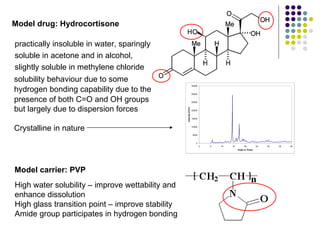
Model drug: Hydrocortisone practically insoluble in water, sparingly  soluble in acetone and in alcohol,  slightly soluble in methylene chloride solubility behaviour due to some  hydrogen bonding capability due to the presence of both C=O and OH groups but largely due to dispersion forces Crystalline in nature Model carrier: PVP High water solubility – improve wettability and  enhance dissolution High glass transition point – improve stability Amide group participates in hydrogen bonding
Outline Brief introduction to amorphous solids Solid dispersions  Selected model drug and carrier Influence of drug:carrier ratio  Influence of solvent composition Influence of processing parameters
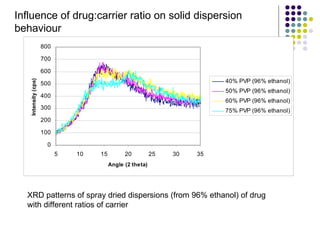
Influence of drug:carrier ratio on solid dispersion behaviour XRD patterns of spray dried dispersions (from 96% ethanol) of drug  with different ratios of carrier
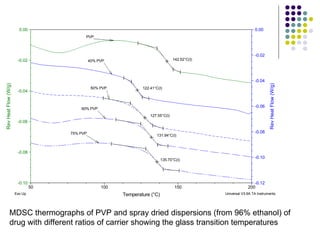
MDSC thermographs of PVP and spray dried dispersions (from 96% ethanol) of  drug with different ratios of carrier showing the glass transition temperatures
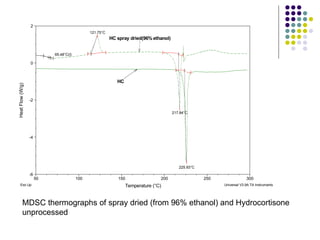
MDSC thermographs of spray dried (from 96% ethanol) and Hydrocortisone unprocessed
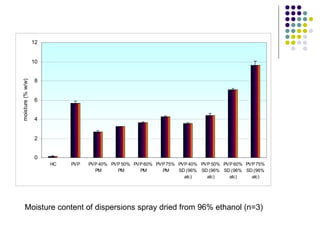
Moisture content of dispersions spray dried from 96% ethanol (n=3)
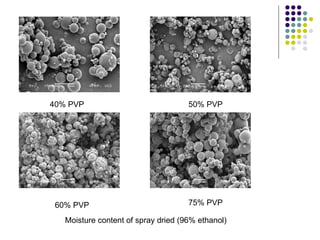
40% PVP 50% PVP 60% PVP 75% PVP Moisture content of spray dried (96% ethanol)
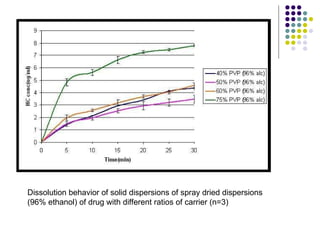
Dissolution behavior of solid dispersions of spray dried dispersions  (96% ethanol) of drug with different ratios of carrier (n=3)
Outline Brief introduction to amorphous solids Solid dispersions  Selected model drug and carrier Influence of drug:carrier ratio  Influence of solvent composition Influence of processing parameters
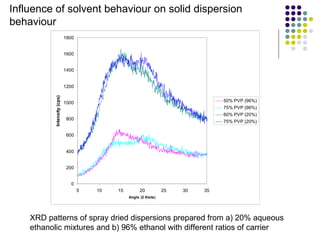
Influence of solvent composition XRD patterns of spray dried dispersions prepared from a) 20% aqueous  ethanolic mixtures and b) 96% ethanol with different ratios of carrier Influence of solvent behaviour on solid dispersion behaviour
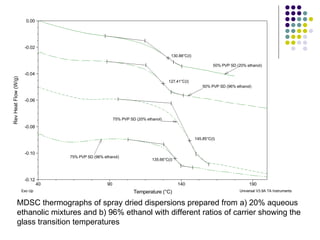
MDSC thermographs of spray dried dispersions prepared from a) 20% aqueous  ethanolic mixtures and b) 96% ethanol with different ratios of carrier showing the glass transition temperatures
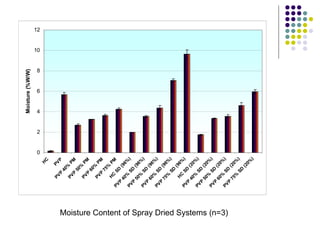
Moisture Content of Spray Dried Systems (n=3)
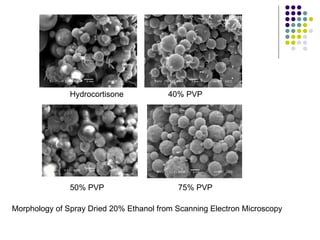
Morphology of Spray Dried 20% Ethanol from Scanning Electron Microscopy Hydrocortisone 40% PVP 50% PVP 75% PVP
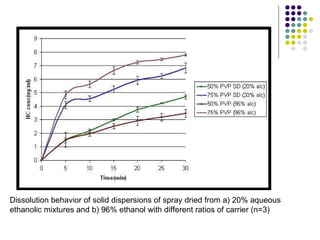
Dissolution behavior of solid dispersions of spray dried from a) 20% aqueous  ethanolic mixtures and b) 96% ethanol with different ratios of carrier (n=3)
Outline Brief introduction to amorphous solids Solid dispersions  Selected model drug and carrier Influence of drug:carrier ratio  Influence of solvent composition Influence of processing parameters
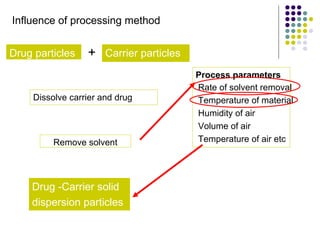
Influence of processing method + Drug particles Carrier particles Drug -Carrier solid dispersion particles Remove solvent Dissolve carrier and drug Process parameters Rate of solvent removal Temperature of material Humidity of air Volume of air Temperature of air etc
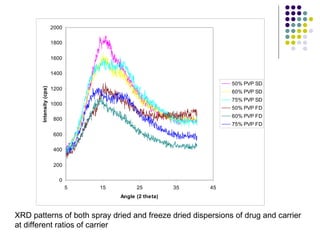
XRD patterns of both spray dried and freeze dried dispersions of drug and carrier at different ratios of carrier
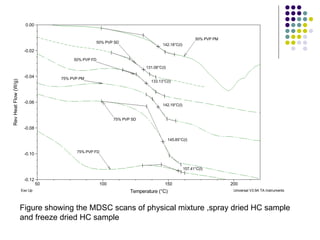
Figure showing the MDSC scans of physical mixture ,spray dried HC sample  and freeze dried HC sample
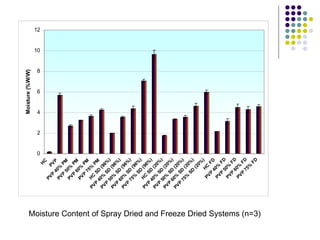
Moisture Content of Spray Dried and Freeze Dried Systems (n=3)
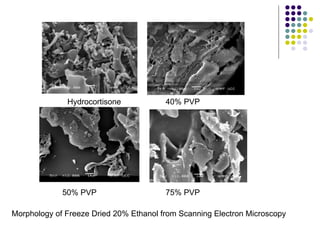
Hydrocortisone 40% PVP 50% PVP 75% PVP Morphology of Freeze Dried 20% Ethanol from Scanning Electron Microscopy
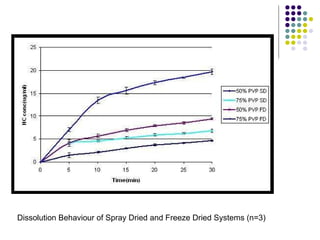
Dissolution Behaviour of Spray Dried and Freeze Dried Systems (n=3)
Conclusions:   Drug:carrier ratio had a profound influence on the amorphosity Spray dried dispersions from both 20% ethanol and 96% ethanol solutions produced amorphous solids Spray dried dispersions from 20% ethanol solutions have higher Tg    (greater stability???) Moisture content was higher for dispersions sprayed from 96% ethanol solutions Freeze dried dispersions showed a greater enhancement in dissolution rate  compared to spray dried dispersions 75% w/w PVP freeze dried dispersions had the fastest dissolution rate of all    dispersions prepared and also posses the highest glass transition temperature Freeze dried systems have higher Tg than both spray dried systems (Stability???)
Future work: Study the effects of storage conditions (temperature/humidity) on the stability of the amorphous dispersions Investigate further the impact of freeze drying conditions on performance    of dispersions Further characterisation of dispersions by various techniques  including DVS (Dynamic Vapour Sorption), IGC (Inverse  Gas Chromatography), Surface area analysis Investigate further the relationship between moisture content of the    dispersions and its effect on their glass transition temperature  To measure the glass transition temperatures of samples using  hermetically sealed crucibles Acknowledgements: Dr. Abina Crean, my supervisor, UCC, Cork Dr. Ann Marie Healy, TCD, Dublin

poorly soluble drugs and solid dispersions

  • 1.
    Taking advantage ofthe amorphous form– the preparation and characterisation of solid dispersions Rakesh Dontireddy, UCC, Cork
  • 2.
    Outline Brief introductionto amorphous solids Solid dispersions Selected model drug and carrier Influence of drug:carrier ratio Influence of solvent composition Influence of processing parameters
  • 3.
    crystalline A or h s m p o u
  • 4.
  • 5.
  • 6.
    Crystalline state Amorphousstate more stable good flow properties less hygroscopic relatively less soluble less stable poor flow properties more hygroscopic relatively more soluble Long range translational, rotational and conformational order No long range order, however may exhibit short range order Thermal behavior- well defined melting point Thermal behavior- glass transition point
  • 7.
    Crystalline state Amorphousstate more stable good flow properties less hygroscopic relatively less soluble less stable poor flow properties more hygroscopic relatively more soluble Long range translational, rotational and conformational order No long range order, however may exhibit short range order Thermal behavior- well defined melting point Thermal behavior- glass transition point
  • 8.
    Crystalline state Amorphousstate more stable good flow properties less hygroscopic relatively less soluble less stable poor flow properties more hygroscopic relatively more soluble Long range translational, rotational and conformational order No long range order, however may exhibit short range order Thermal behavior- well defined melting point Thermal behavior- glass transition point
  • 9.
    Outline Brief introductionto amorphous solids Solid dispersions Selected model drug and carrier Influence of drug:carrier ratio Influence of solvent composition Influence of processing parameters
  • 10.
    Solid dispersions +Drug particles Carrier particles Disrupt molecular arrangements and supermolecular structures Create solid particles with altered molecular arrangements and supermolecular structure Create a molecular mixture of drug and carrier molecules Drug -Carrier solid dispersion particle s Diffusion in solution Mix melt of drug and carrier Cool molten mixture Remove solvent Dissolve or melt or melt and dissolve Techniques
  • 11.
    Solid dispersions Solidsolutions are a resultant single phase upon dispersion of two compounds in each other, at their molecular level Eutectic mixture Crystalline drug Amorphous carrier Amorphous drug Amorphous carrier Solid Dispersion Solid State Two phase solid system Single phase solid system Crystalline Amorphous Substitutional Interstitial
  • 12.
    Pharmaceutical application Reasonsfor the increased dissolution rate Increased wettability due to dispersion in a hydrophilic carrier Reduced drug particle size and hence increased surface area in two phase solid dispersions Elimination of drug particles in solid solutions, drug is dispersed molecularly Reduced crystallinity or creation of amorphous systems
  • 13.
    Outline Brief introductionto amorphous solids Solid dispersions Selected model drug and carrier Influence of drug:carrier ratio Influence of solvent composition Influence of processing parameters
  • 14.
    Model drug: Hydrocortisonepractically insoluble in water, sparingly soluble in acetone and in alcohol, slightly soluble in methylene chloride solubility behaviour due to some hydrogen bonding capability due to the presence of both C=O and OH groups but largely due to dispersion forces Crystalline in nature Model carrier: PVP High water solubility – improve wettability and enhance dissolution High glass transition point – improve stability Amide group participates in hydrogen bonding
  • 15.
    Outline Brief introductionto amorphous solids Solid dispersions Selected model drug and carrier Influence of drug:carrier ratio Influence of solvent composition Influence of processing parameters
  • 16.
    Influence of drug:carrierratio on solid dispersion behaviour XRD patterns of spray dried dispersions (from 96% ethanol) of drug with different ratios of carrier
  • 17.
    MDSC thermographs ofPVP and spray dried dispersions (from 96% ethanol) of drug with different ratios of carrier showing the glass transition temperatures
  • 18.
    MDSC thermographs ofspray dried (from 96% ethanol) and Hydrocortisone unprocessed
  • 19.
    Moisture content ofdispersions spray dried from 96% ethanol (n=3)
  • 20.
    40% PVP 50%PVP 60% PVP 75% PVP Moisture content of spray dried (96% ethanol)
  • 21.
    Dissolution behavior ofsolid dispersions of spray dried dispersions (96% ethanol) of drug with different ratios of carrier (n=3)
  • 22.
    Outline Brief introductionto amorphous solids Solid dispersions Selected model drug and carrier Influence of drug:carrier ratio Influence of solvent composition Influence of processing parameters
  • 23.
    Influence of solventcomposition XRD patterns of spray dried dispersions prepared from a) 20% aqueous ethanolic mixtures and b) 96% ethanol with different ratios of carrier Influence of solvent behaviour on solid dispersion behaviour
  • 24.
    MDSC thermographs ofspray dried dispersions prepared from a) 20% aqueous ethanolic mixtures and b) 96% ethanol with different ratios of carrier showing the glass transition temperatures
  • 25.
    Moisture Content ofSpray Dried Systems (n=3)
  • 26.
    Morphology of SprayDried 20% Ethanol from Scanning Electron Microscopy Hydrocortisone 40% PVP 50% PVP 75% PVP
  • 27.
    Dissolution behavior ofsolid dispersions of spray dried from a) 20% aqueous ethanolic mixtures and b) 96% ethanol with different ratios of carrier (n=3)
  • 28.
    Outline Brief introductionto amorphous solids Solid dispersions Selected model drug and carrier Influence of drug:carrier ratio Influence of solvent composition Influence of processing parameters
  • 29.
    Influence of processingmethod + Drug particles Carrier particles Drug -Carrier solid dispersion particles Remove solvent Dissolve carrier and drug Process parameters Rate of solvent removal Temperature of material Humidity of air Volume of air Temperature of air etc
  • 30.
    XRD patterns ofboth spray dried and freeze dried dispersions of drug and carrier at different ratios of carrier
  • 31.
    Figure showing theMDSC scans of physical mixture ,spray dried HC sample and freeze dried HC sample
  • 32.
    Moisture Content ofSpray Dried and Freeze Dried Systems (n=3)
  • 33.
    Hydrocortisone 40% PVP50% PVP 75% PVP Morphology of Freeze Dried 20% Ethanol from Scanning Electron Microscopy
  • 34.
    Dissolution Behaviour ofSpray Dried and Freeze Dried Systems (n=3)
  • 35.
    Conclusions: Drug:carrier ratio had a profound influence on the amorphosity Spray dried dispersions from both 20% ethanol and 96% ethanol solutions produced amorphous solids Spray dried dispersions from 20% ethanol solutions have higher Tg (greater stability???) Moisture content was higher for dispersions sprayed from 96% ethanol solutions Freeze dried dispersions showed a greater enhancement in dissolution rate compared to spray dried dispersions 75% w/w PVP freeze dried dispersions had the fastest dissolution rate of all dispersions prepared and also posses the highest glass transition temperature Freeze dried systems have higher Tg than both spray dried systems (Stability???)
  • 36.
    Future work: Studythe effects of storage conditions (temperature/humidity) on the stability of the amorphous dispersions Investigate further the impact of freeze drying conditions on performance of dispersions Further characterisation of dispersions by various techniques including DVS (Dynamic Vapour Sorption), IGC (Inverse Gas Chromatography), Surface area analysis Investigate further the relationship between moisture content of the dispersions and its effect on their glass transition temperature To measure the glass transition temperatures of samples using hermetically sealed crucibles Acknowledgements: Dr. Abina Crean, my supervisor, UCC, Cork Dr. Ann Marie Healy, TCD, Dublin