Microencapsulation
Presented By:
Poonam Y. Purkar M.Pharm
E.mail : pypurkar@gmail.com
Sir. Dr. M.S.Gosavi College of
Pharmaceutical Education & Research.
Nasik.
Content:
 Introduction
 Concept of Microencapsulation
 Merits of Microencapsulation
 Demerits of encapsulation
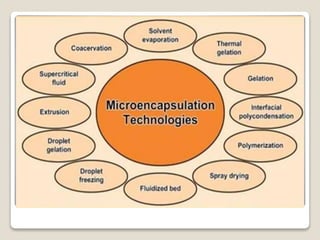
 Methods of preparation
 Chemical encapsulation process
 Mechanical encapsulation process
 Evaluation of Microcapsules
 Applications of Microcapsules
Introductions:
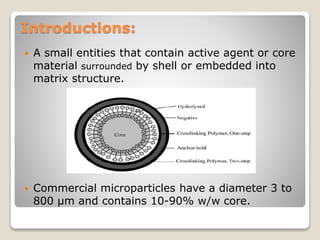
 A small entities that contain active agent or core
material surrounded by shell or embedded into
matrix structure.
 Commercial microparticles have a diameter 3 to
800 µm and contains 10-90% w/w core.
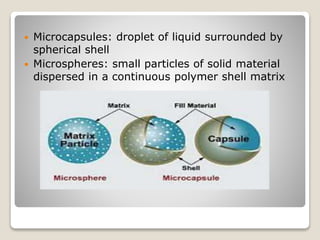
 Microcapsules: droplet of liquid surrounded by
spherical shell
 Microspheres: small particles of solid material
dispersed in a continuous polymer shell matrix
Concept of Microencapsulation:
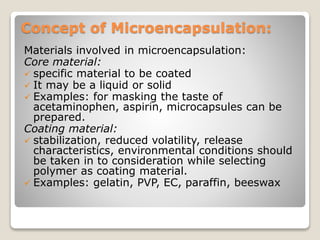
Materials involved in microencapsulation:
Core material:
 specific material to be coated
 It may be a liquid or solid
 Examples: for masking the taste of
acetaminophen, aspirin, microcapsules can be
prepared.
Coating material:
 stabilization, reduced volatility, release
characteristics, environmental conditions should
be taken in to consideration while selecting
polymer as coating material.
 Examples: gelatin, PVP, EC, paraffin, beeswax
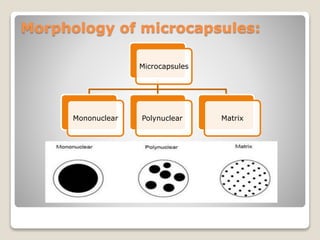
Morphology of microcapsules:
Microcapsules
Mononuclear MatrixPolynuclear
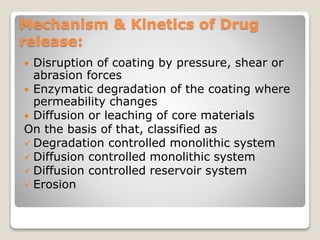
Mechanism & Kinetics of Drug
release:
 Disruption of coating by pressure, shear or
abrasion forces
 Enzymatic degradation of the coating where
permeability changes
 Diffusion or leaching of core materials
On the basis of that, classified as
 Degradation controlled monolithic system
 Diffusion controlled monolithic system
 Diffusion controlled reservoir system
 Erosion
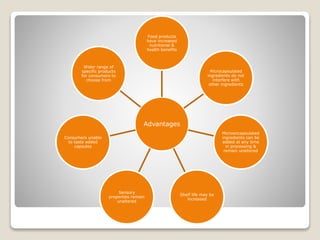
Advantages
Food products
have increased
nutritional &
health benefits
Microcapsulated
ingredients do not
interfere with
other ingredients
Microencapsulated
ingredients can be
added at any time
in processing &
remain unaltered
Shelf life may be
increased
Sensory
properties remain
unaltered
Consumers unable
to taste added
capsules
Wider range of
specific products
for consumers to
choose from
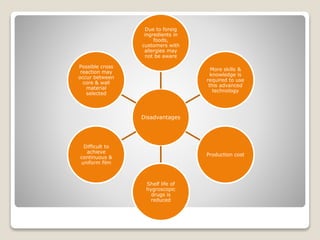
Disadvantages
Due to foreig
ingredients in
foods,
customers with
allergies may
not be aware
More skills &
knowledge is
required to use
this advanced
technology
Production cost
Shelf life of
hygroscopic
drugs is
reduced
Difficult to
achieve
continuous &
uniform film
Possible cross
reaction may
occur between
core & wall
material
selected
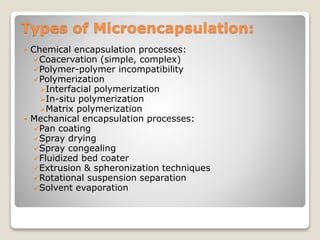
Types of Microencapsulation:
 Chemical encapsulation processes:
Coacervation (simple, complex)
Polymer-polymer incompatibility
Polymerization
Interfacial polymerization
In-situ polymerization
Matrix polymerization
 Mechanical encapsulation processes:
Pan coating
Spray drying
Spray congealing
Fluidized bed coater
Extrusion & spheronization techniques
Rotational suspension separation
Solvent evaporation
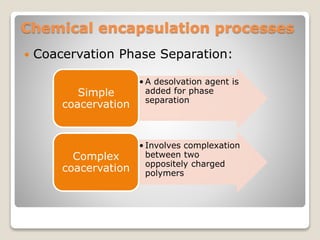
Chemical encapsulation processes
 Coacervation Phase Separation:
• A desolvation agent is
added for phase
separation
Simple
coacervation
• Involves complexation
between two
oppositely charged
polymers
Complex
coacervation
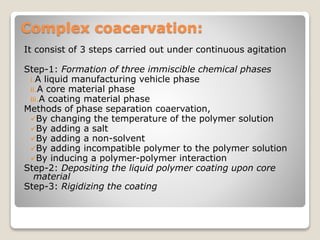
Simple coacervation:
 It can be effected by either by mixing two
colloidal dispersions, one having a high affinity
for water or it can be induced by adding strongly
hydrophilic substances such as alcohol or sodium
sulphate.
 The water soluble polymer is concentrated in
water by the action of water miscible, non-
solvent for emerging polymer phase.
 Phase separation can be effected by addition of
an electrolyte such as an inorganic salt to an
aqueous phase solution of polymer.
Complex coacervation:
It consist of 3 steps carried out under continuous agitation
Step-1: Formation of three immiscible chemical phases
i.A liquid manufacturing vehicle phase
ii.A core material phase
iii.A coating material phase
Methods of phase separation coaervation,
By changing the temperature of the polymer solution
By adding a salt
By adding a non-solvent
By adding incompatible polymer to the polymer solution
By inducing a polymer-polymer interaction
Step-2: Depositing the liquid polymer coating upon core
material
Step-3: Rigidizing the coating
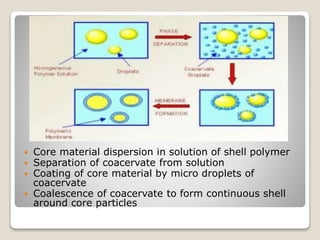
 Core material dispersion in solution of shell polymer
 Separation of coacervate from solution
 Coating of core material by micro droplets of
coacervate
 Coalescence of coacervate to form continuous shell
around core particles
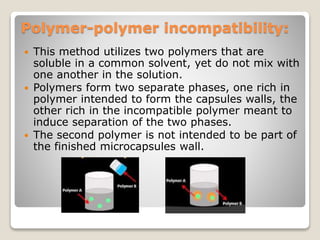
Polymer-polymer incompatibility:
 This method utilizes two polymers that are
soluble in a common solvent, yet do not mix with
one another in the solution.
 Polymers form two separate phases, one rich in
polymer intended to form the capsules walls, the
other rich in the incompatible polymer meant to
induce separation of the two phases.
 The second polymer is not intended to be part of
the finished microcapsules wall.
Polymerization:
 The methods involve the reaction of
monomeric units located at the interface
existing between core material substance
and a continuous phase in which the core
material is dispersed.
 Interfacial polymerization
 In-situ polymerization
 Matrix polymerization
Mechanical encapsulation processes
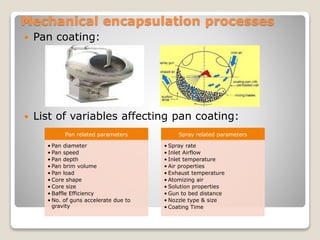
 Pan coating:
 List of variables affecting pan coating:
Pan related parameters
• Pan diameter
• Pan speed
• Pan depth
• Pan brim volume
• Pan load
• Core shape
• Core size
• Baffle Efficiency
• No. of guns accelerate due to
gravity
Spray related parameters
• Spray rate
• Inlet Airflow
• Inlet temperature
• Air properties
• Exhaust temperature
• Atomizing air
• Solution properties
• Gun to bed distance
• Nozzle type & size
• Coating Time
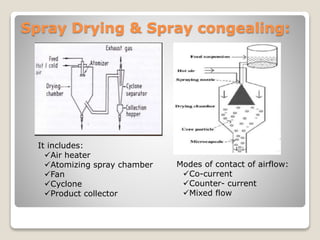
Spray Drying & Spray congealing:
It includes:
Air heater
Atomizing spray chamber
Fan
Cyclone
Product collector
Modes of contact of airflow:
Co-current
Counter- current
Mixed flow
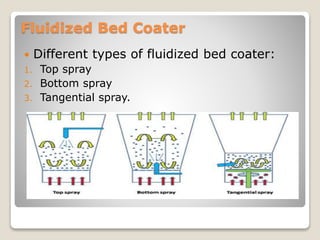
Fluidized Bed Coater
 Different types of fluidized bed coater:
1. Top spray
2. Bottom spray
3. Tangential spray.
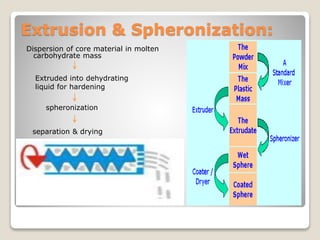
Extrusion & Spheronization:
Dispersion of core material in molten
carbohydrate mass
Extruded into dehydrating
liquid for hardening
spheronization
separation & drying
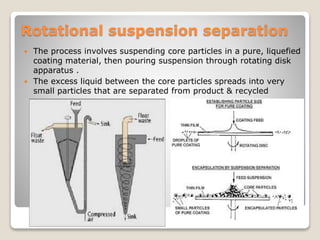
Rotational suspension separation
 The process involves suspending core particles in a pure, liquefied
coating material, then pouring suspension through rotating disk
apparatus .
 The excess liquid between the core particles spreads into very
small particles that are separated from product & recycled
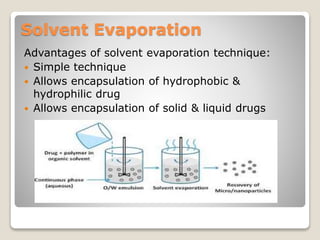
Solvent Evaporation
Advantages of solvent evaporation technique:
 Simple technique
 Allows encapsulation of hydrophobic &
hydrophilic drug
 Allows encapsulation of solid & liquid drugs
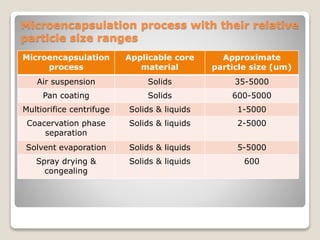
Microencapsulation process with their relative
particle size ranges
Microencapsulation
process
Applicable core
material
Approximate
particle size (um)
Air suspension Solids 35-5000
Pan coating Solids 600-5000
Multiorifice centrifuge Solids & liquids 1-5000
Coacervation phase
separation
Solids & liquids 2-5000
Solvent evaporation Solids & liquids 5-5000
Spray drying &
congealing
Solids & liquids 600
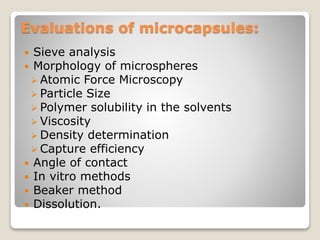
Evaluations of microcapsules:
 Sieve analysis
 Morphology of microspheres
 Atomic Force Microscopy
 Particle Size
 Polymer solubility in the solvents
 Viscosity
 Density determination
 Capture efficiency
 Angle of contact
 In vitro methods
 Beaker method
 Dissolution.
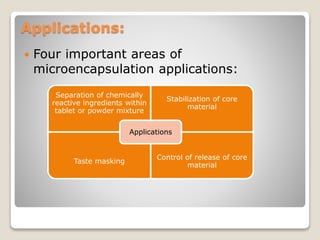
Applications:
 Four important areas of
microencapsulation applications:
Separation of chemically
reactive ingredients within
tablet or powder mixture
Stabilization of core
material
Taste masking
Control of release of core
material
Applications
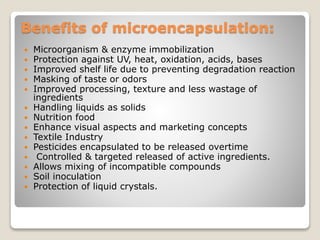
Benefits of microencapsulation:
 Microorganism & enzyme immobilization
 Protection against UV, heat, oxidation, acids, bases
 Improved shelf life due to preventing degradation reaction
 Masking of taste or odors
 Improved processing, texture and less wastage of
ingredients
 Handling liquids as solids
 Nutrition food
 Enhance visual aspects and marketing concepts
 Textile Industry
 Pesticides encapsulated to be released overtime
 Controlled & targeted released of active ingredients.
 Allows mixing of incompatible compounds
 Soil inoculation
 Protection of liquid crystals.
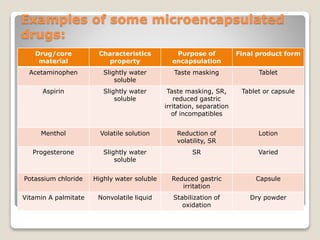
Examples of some microencapsulated
drugs:
Drug/core
material
Characteristics
property
Purpose of
encapsulation
Final product form
Acetaminophen Slightly water
soluble
Taste masking Tablet
Aspirin Slightly water
soluble
Taste masking, SR,
reduced gastric
irritation, separation
of incompatibles
Tablet or capsule
Menthol Volatile solution Reduction of
volatility, SR
Lotion
Progesterone Slightly water
soluble
SR Varied
Potassium chloride Highly water soluble Reduced gastric
irritation
Capsule
Vitamin A palmitate Nonvolatile liquid Stabilization of
oxidation
Dry powder
Microencapsulation