a school of literary criticism and literary theory
emerged in the early twentieth century as a reaction
against Marxist literary theory which believes in the
roles of society in the text and the text in society
1- Formalists criticism works on the practical dimension of art, they focus
on form “how things are done” more than “what it is about “, since form is
what tells stories or make meanings. i.e. the moves of dances form the
story of ballet.
2- They have to do with the structural purposes of a particular text; the
study of a text without taking into account any outside influence.
Formalism rejects notions of culture or societal influence, authorship, and
content, and instead focuses on modes, genres, discourse, and forms.
3- Classifying works into genres according to their formal attributes.
.
4- Advocating methodical and systematic reading of texts ;
making literary criticism a science.
5- Literature is autonomous from external conditions in the
sense that literary language is distinct from ordinary uses of
language
6- Since literature is made of language, linguistics will be a
foundational element of the science of literature.
In film studies , formalist analyses filmmaking,
language of film, such as editing, composition,
camera movement, the effects of different position
of camera, etc.
So they focus on the graphical qualities of the
image.
Two schools of formalist literary criticism developed,
Russian formalism, and soon after Anglo-American
New Criticism. Both schools developed in different
times and places, however shared certain literary
assumptions.
Originated in Russia around 1915, it is well-known for its emphasis
on the functional role of literary devices that distinguish literary
language from ordinary language, or “art from non-art”. It asserts
that :
1- The language of literature should be studied in and of itself,
without reference to meaning , by analysing the literary techniques
that distinguish literary forms and classify it into genres. (focus on
form)
2- invented a scientific method for studying poetic language
excluding the traditional psychological and cultural-historical
approaches (shift from moral approach "Marxism” to scientific
approach)
3- literary texts make use of language in such a way that it becomes
strange and unfamiliar in a given context. (defamiliarization)
* defamiliarization: the most important concept of the school that :
instead of seeing literature as a 'reflection' of the world, they saw it as
'making strange'. A formalist approach of a text enables the reader to
undertake an attentive close reading by which the reader become
“expert” into interpretive theory.
American school of literary criticism , flourished in USA by the
late 1930s argued that :
1- Literary study should focus on the text and the reader
should “enter” the text in order to get the meaning regardless
the external factors like history, psychology, or
sociology.(Intrinsic Approach)
2- The goal was to describe the unity of the work ; literary texts
were seen as works unified by their devices, motifs, themes,
and patterns. (organic unity ”form+ content”)
3- Meaning in the text not in the reader’s emotional reaction
(affective fallacy)
4- The text can be appreciated without turning to the author’s
intention (intentional fallacy)
5- Give liberty to literature; “Art for art’s sake” not as a political,
cultural or social tool. (liberalism)
(These principles lead to objective and “close reading”)
Form/Content
Form: how a work of art is done or made, the techniques and
procedures that an artist uses to construct a story or convey an idea.
content: what a work of art is about.
Technique
Devices and procedures: the way of doing something such as
constructing a character
Perspective /Point of view: the position from which a narration
operates, i.e. the view from which people are portrayed.
Narration /Story
narration or fabula: the series of events that are represented in a novel
or a film, it comes in non-chronological order. The events can be
artistically arranged by devices such as repetition and parallelism.
story, diegesis: chronological sequence of events represented in much
longer time.
Motif : a recurring element of a narration such as a particular event or
symbol used repeatedly.
Function : shared pattern among narratives. For example, all folk-tales
have the common function "the hero leaves home
Genre : a group of artistic works that shared certain features, rules or
conventions.
Discourse : a coherent body of statements about something such as an
event or an issue. They follow rules to produce unity and consistency
across different statements. For example, the discourse on race.
Hypotaxis and Parataxis: terms that describe the ways in which
relationship between successive ideas are expressed. In parataxis, the
ideas are expressed in simple phrases linked by conjunction and or but,
whereas in hypotaxis the ideas are expressed in subordinate clauses
joined by relational links such as after and when.
Poetic Meter: metric poetry uses different rhythms (stressed and
unstressed syllables) and different numbers of feet's (i.e. trimester or
hexameter).
Russian Formalism: focus on the practical dimension of the
work by studying the literary devices employed in the text so
the form is more important than content.
New Criticism: focus on the internal unity of the work, form and
content are inseparable since form is embodiment of content
or theme
The formal study of a poem begins with simple description of
the work like describing theme, setting, narrator, rhyme
scheme, repetition, metaphors and symbols.
In addition, it analyses the rhetorical form of the work such as
paradox and irony
Character : creation and representation of fictional persons and entities, like
antagonist, protagonist
Figures of speech: various expressive devices used in writing, like analogy, irony
Imagery: specific details used to describe characters, situations, things, ideas, or
events, like hearing, seeing
Plot: a series of events or happenings that organize a text, like climax, conflict
Point of view: perspective of the controlling narrative voice, like subjective, reliable
Setting: atmosphere, historical period, physical setting, or mood of text, like place,
time
Theme: a major idea or message in the text, like controlling idea
Formalists are criticized for narrow-mindedness which restricts to the
form and the language of the text.
However,
Formalism terminology forms the basis for most literary education and
critical approaches to reading and analysing literature.
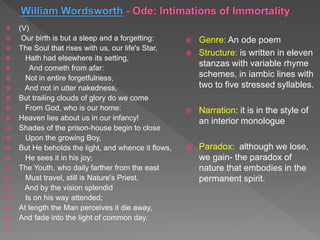
 (V)
 Our birth is but a sleep and a forgetting:
 The Soul that rises with us, our life's Star,
 Hath had elsewhere its setting,
 And cometh from afar:
 Not in entire forgetfulness,
 And not in utter nakedness,
 But trailing clouds of glory do we come
 From God, who is our home:
 Heaven lies about us in our infancy!
 Shades of the prison-house begin to close
 Upon the growing Boy,
 But He beholds the light, and whence it flows,
 He sees it in his joy;
 The Youth, who daily farther from the east
 Must travel, still is Nature's Priest,
 And by the vision splendid
 Is on his way attended;
 At length the Man perceives it die away,
 And fade into the light of common day.

 Genre: An ode poem
 Structure: is written in eleven
stanzas with variable rhyme
schemes, in iambic lines with
two to five stressed syllables.
 Narration: it is in the style of
an interior monologue
 Paradox: although we lose,
we gain- the paradox of
nature that embodies in the
permanent spirit.
 (V)
 Our birth is but a sleep and a forgetting:
 The Soul that rises with us, our life's Star,
 Hath had elsewhere its setting,
 And cometh from afar:
 Not in entire forgetfulness,
 And not in utter nakedness,
 But trailing clouds of glory do we come
 From God, who is our home:
 Heaven lies about us in our infancy!
 Shades of the prison-house begin to close
 Upon the growing Boy,
 But He beholds the light, and whence it flows,
 He sees it in his joy;
 The Youth, who daily farther from the east
 Must travel, still is Nature's Priest,
 And by the vision splendid
 Is on his way attended;
 At length the Man perceives it die away,
 And fade into the light of common day.

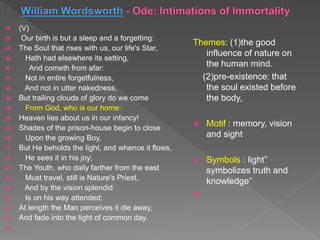
Themes: (1)the good
influence of nature on
the human mind.
(2)pre-existence: that
the soul existed before
the body,
 Motif : memory, vision
and sight
 Symbols : light”
symbolizes truth and
knowledge”


formalism.pptx for educational purposes use

  • 2.
    a school ofliterary criticism and literary theory emerged in the early twentieth century as a reaction against Marxist literary theory which believes in the roles of society in the text and the text in society
  • 3.
    1- Formalists criticismworks on the practical dimension of art, they focus on form “how things are done” more than “what it is about “, since form is what tells stories or make meanings. i.e. the moves of dances form the story of ballet. 2- They have to do with the structural purposes of a particular text; the study of a text without taking into account any outside influence. Formalism rejects notions of culture or societal influence, authorship, and content, and instead focuses on modes, genres, discourse, and forms. 3- Classifying works into genres according to their formal attributes. .
  • 4.
    4- Advocating methodicaland systematic reading of texts ; making literary criticism a science. 5- Literature is autonomous from external conditions in the sense that literary language is distinct from ordinary uses of language 6- Since literature is made of language, linguistics will be a foundational element of the science of literature.
  • 5.
    In film studies, formalist analyses filmmaking, language of film, such as editing, composition, camera movement, the effects of different position of camera, etc. So they focus on the graphical qualities of the image.
  • 6.
    Two schools offormalist literary criticism developed, Russian formalism, and soon after Anglo-American New Criticism. Both schools developed in different times and places, however shared certain literary assumptions.
  • 7.
    Originated in Russiaaround 1915, it is well-known for its emphasis on the functional role of literary devices that distinguish literary language from ordinary language, or “art from non-art”. It asserts that : 1- The language of literature should be studied in and of itself, without reference to meaning , by analysing the literary techniques that distinguish literary forms and classify it into genres. (focus on form) 2- invented a scientific method for studying poetic language excluding the traditional psychological and cultural-historical approaches (shift from moral approach "Marxism” to scientific approach)
  • 8.
    3- literary textsmake use of language in such a way that it becomes strange and unfamiliar in a given context. (defamiliarization) * defamiliarization: the most important concept of the school that : instead of seeing literature as a 'reflection' of the world, they saw it as 'making strange'. A formalist approach of a text enables the reader to undertake an attentive close reading by which the reader become “expert” into interpretive theory.
  • 9.
    American school ofliterary criticism , flourished in USA by the late 1930s argued that : 1- Literary study should focus on the text and the reader should “enter” the text in order to get the meaning regardless the external factors like history, psychology, or sociology.(Intrinsic Approach) 2- The goal was to describe the unity of the work ; literary texts were seen as works unified by their devices, motifs, themes, and patterns. (organic unity ”form+ content”)
  • 10.
    3- Meaning inthe text not in the reader’s emotional reaction (affective fallacy) 4- The text can be appreciated without turning to the author’s intention (intentional fallacy) 5- Give liberty to literature; “Art for art’s sake” not as a political, cultural or social tool. (liberalism) (These principles lead to objective and “close reading”)
  • 11.
    Form/Content Form: how awork of art is done or made, the techniques and procedures that an artist uses to construct a story or convey an idea. content: what a work of art is about. Technique Devices and procedures: the way of doing something such as constructing a character Perspective /Point of view: the position from which a narration operates, i.e. the view from which people are portrayed.
  • 12.
    Narration /Story narration orfabula: the series of events that are represented in a novel or a film, it comes in non-chronological order. The events can be artistically arranged by devices such as repetition and parallelism. story, diegesis: chronological sequence of events represented in much longer time. Motif : a recurring element of a narration such as a particular event or symbol used repeatedly. Function : shared pattern among narratives. For example, all folk-tales have the common function "the hero leaves home Genre : a group of artistic works that shared certain features, rules or conventions.
  • 13.
    Discourse : acoherent body of statements about something such as an event or an issue. They follow rules to produce unity and consistency across different statements. For example, the discourse on race. Hypotaxis and Parataxis: terms that describe the ways in which relationship between successive ideas are expressed. In parataxis, the ideas are expressed in simple phrases linked by conjunction and or but, whereas in hypotaxis the ideas are expressed in subordinate clauses joined by relational links such as after and when. Poetic Meter: metric poetry uses different rhythms (stressed and unstressed syllables) and different numbers of feet's (i.e. trimester or hexameter).
  • 14.
    Russian Formalism: focuson the practical dimension of the work by studying the literary devices employed in the text so the form is more important than content. New Criticism: focus on the internal unity of the work, form and content are inseparable since form is embodiment of content or theme
  • 15.
    The formal studyof a poem begins with simple description of the work like describing theme, setting, narrator, rhyme scheme, repetition, metaphors and symbols. In addition, it analyses the rhetorical form of the work such as paradox and irony
  • 16.
    Character : creationand representation of fictional persons and entities, like antagonist, protagonist Figures of speech: various expressive devices used in writing, like analogy, irony Imagery: specific details used to describe characters, situations, things, ideas, or events, like hearing, seeing Plot: a series of events or happenings that organize a text, like climax, conflict Point of view: perspective of the controlling narrative voice, like subjective, reliable Setting: atmosphere, historical period, physical setting, or mood of text, like place, time Theme: a major idea or message in the text, like controlling idea
  • 17.
    Formalists are criticizedfor narrow-mindedness which restricts to the form and the language of the text. However, Formalism terminology forms the basis for most literary education and critical approaches to reading and analysing literature.
  • 18.
     (V)  Ourbirth is but a sleep and a forgetting:  The Soul that rises with us, our life's Star,  Hath had elsewhere its setting,  And cometh from afar:  Not in entire forgetfulness,  And not in utter nakedness,  But trailing clouds of glory do we come  From God, who is our home:  Heaven lies about us in our infancy!  Shades of the prison-house begin to close  Upon the growing Boy,  But He beholds the light, and whence it flows,  He sees it in his joy;  The Youth, who daily farther from the east  Must travel, still is Nature's Priest,  And by the vision splendid  Is on his way attended;  At length the Man perceives it die away,  And fade into the light of common day.   Genre: An ode poem  Structure: is written in eleven stanzas with variable rhyme schemes, in iambic lines with two to five stressed syllables.  Narration: it is in the style of an interior monologue  Paradox: although we lose, we gain- the paradox of nature that embodies in the permanent spirit.
  • 19.
     (V)  Ourbirth is but a sleep and a forgetting:  The Soul that rises with us, our life's Star,  Hath had elsewhere its setting,  And cometh from afar:  Not in entire forgetfulness,  And not in utter nakedness,  But trailing clouds of glory do we come  From God, who is our home:  Heaven lies about us in our infancy!  Shades of the prison-house begin to close  Upon the growing Boy,  But He beholds the light, and whence it flows,  He sees it in his joy;  The Youth, who daily farther from the east  Must travel, still is Nature's Priest,  And by the vision splendid  Is on his way attended;  At length the Man perceives it die away,  And fade into the light of common day.  Themes: (1)the good influence of nature on the human mind. (2)pre-existence: that the soul existed before the body,  Motif : memory, vision and sight  Symbols : light” symbolizes truth and knowledge” 